
I started wargaming in 1979 with Panzer by Jim Day from Yaquinto Publishing. In the next few years my core group of friends (we were all in junior high school) got into wargaming and roleplaying games. Tactical wargames like Panzer or Wooden Ships & Iron Men (Avalon Hill, 1974) or Air Force (Battleline, 1976) were played. We also got into Star Fleet Battles (Task Force Games, 1979) in a serious way, just like we got into Traveller (GDW, 1977) for our roleplaying adventures. When it came to strategic-level wargames, however, we actually played very few. The one I do remember is John Prados’ Third Reich, in part because we played an epic campaign of it on my birthday in what had to be 1981.
I was in Colorado Springs on business last February and stopped in at Petrie’s Family Games, my favorite gaming store when I lived there. All consignment games were on a 30% off sale and on the shelves I found a used, obvious player’s copy, of Third Reich. I picked it up not so much to play it but to look back on it from the viewpoint of a grognard forty years after first playing.
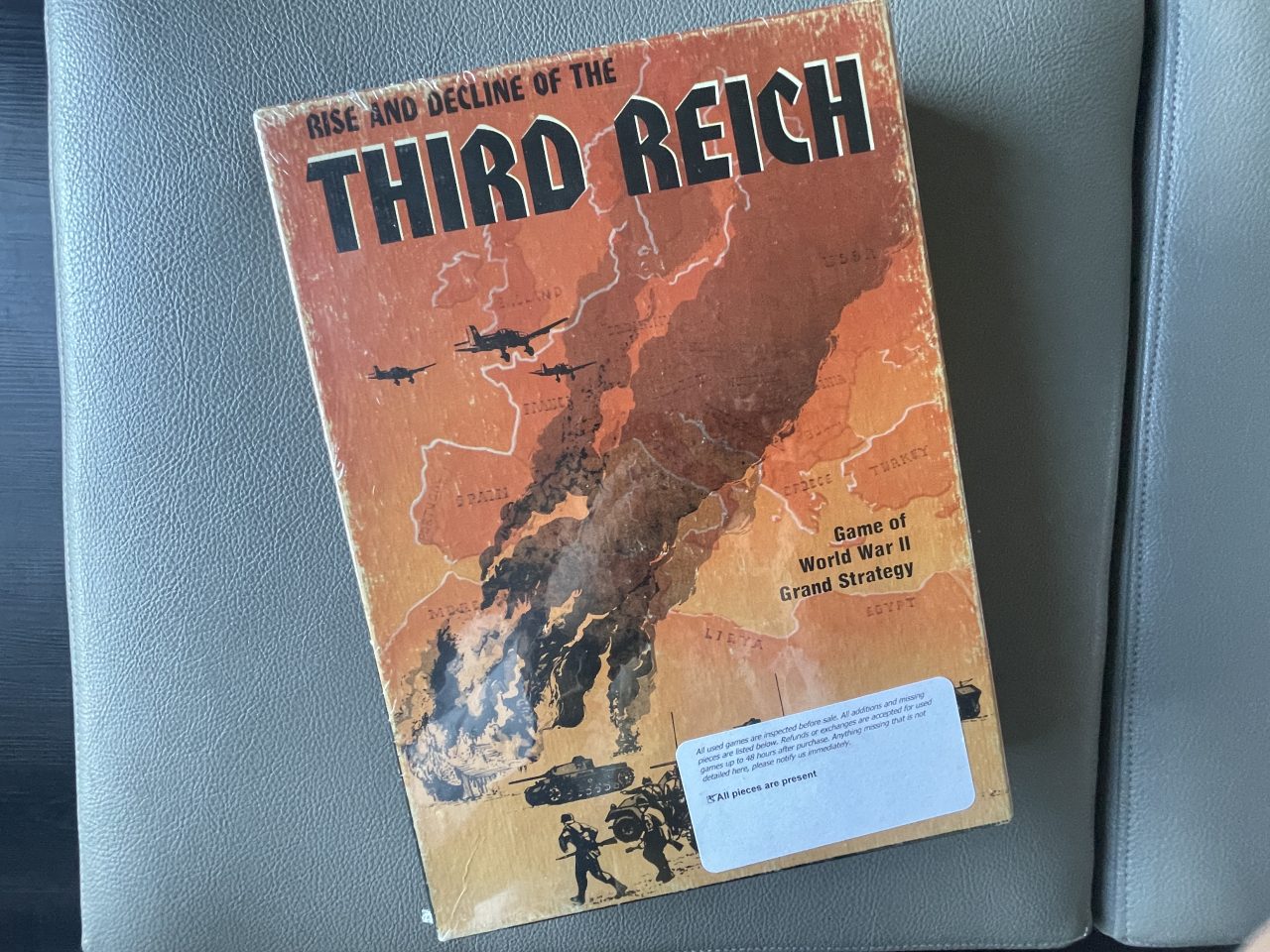
Player’s copy
When I say my new (old) copy of Third Reich is a player’s copy, I mean to say the game shows that it was played extensively. Oh boy, is this copy of Third Reich well-used!
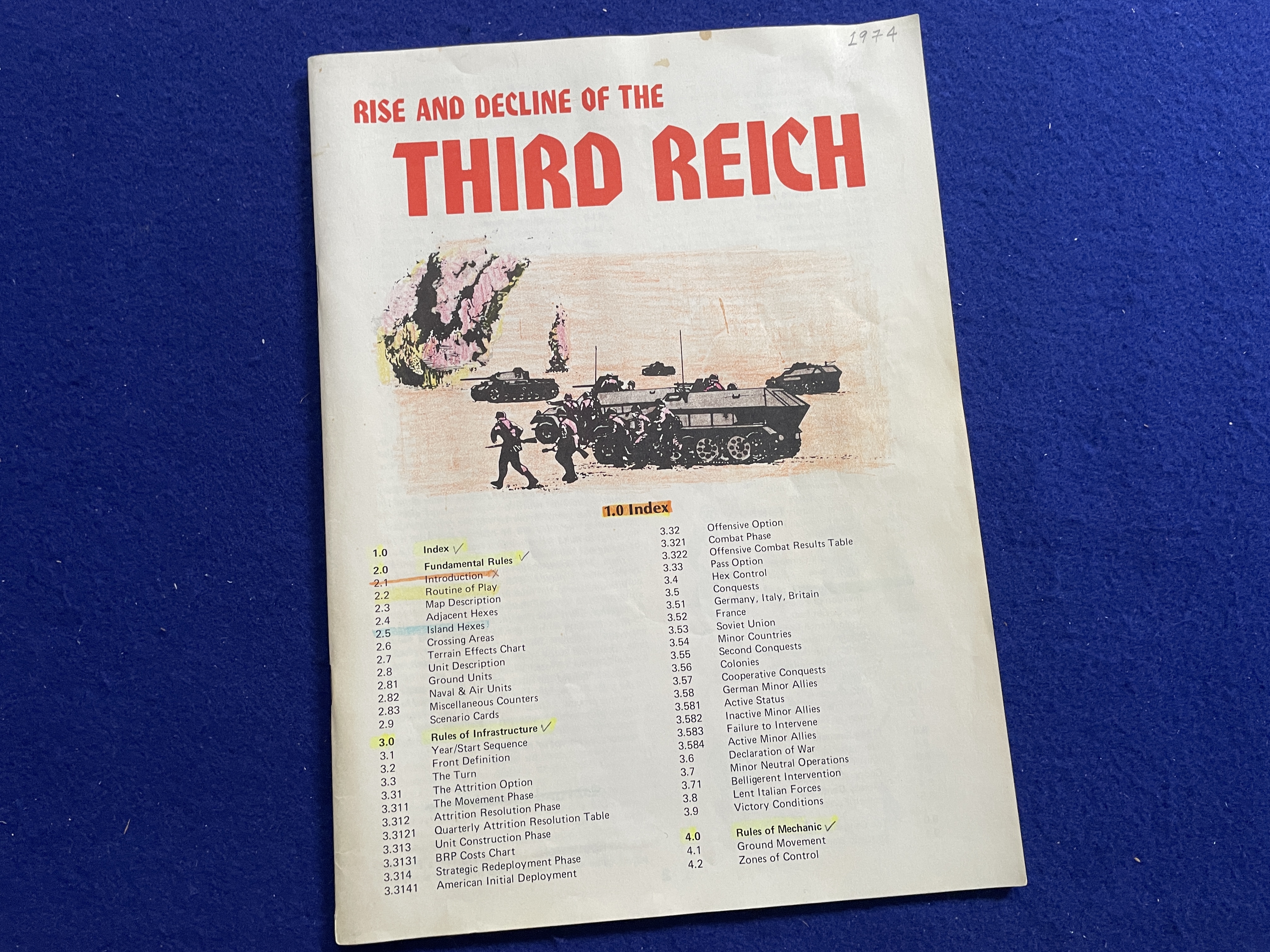
Based on a date at the top of the rulebook this appears to be a 1974 first edition of Third Reich. Officially, the components are:
- “A mammoth 32″ x 22″ four section, full color mapboard… .” All four mapboards are present, though the Central Europe board is damaged along the fold. It also appears that a previous owner colored in more than a few hexes and the various tables or boxes. Nicely done, if I must say…
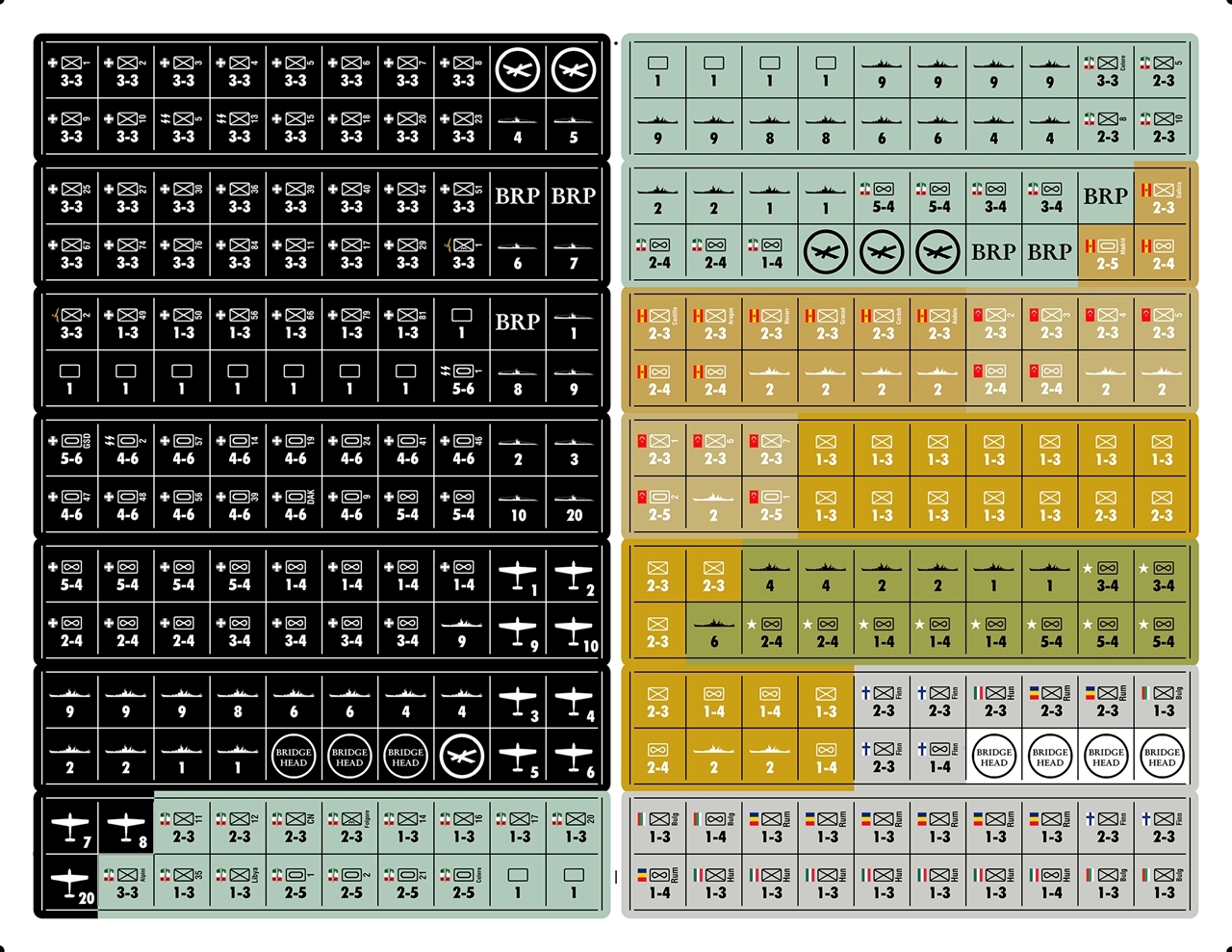
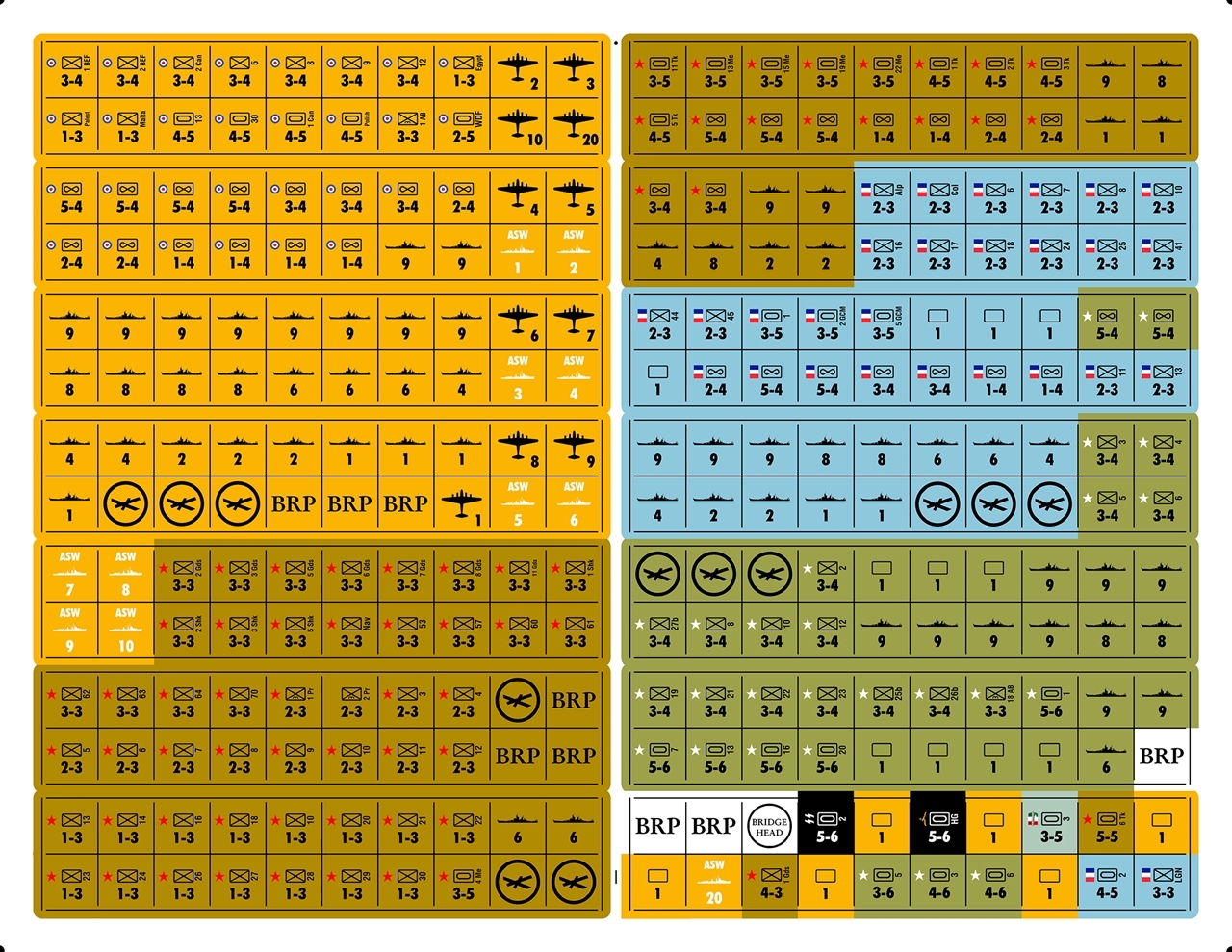
- “Two sets of die-cut troop counters representing over 550 units…” A major disappointment as NONE of the German counters are included. So much for the sales note that stated, “All pieces are present.”
- “1 die.” This copy comes with five none of which, I am willing to bet, are original.
- “Set of five ‘Force Pool’ Scenario Cards.” Check!
- “A 32 page Rules and Designer Notes manual…” Player highlighted.
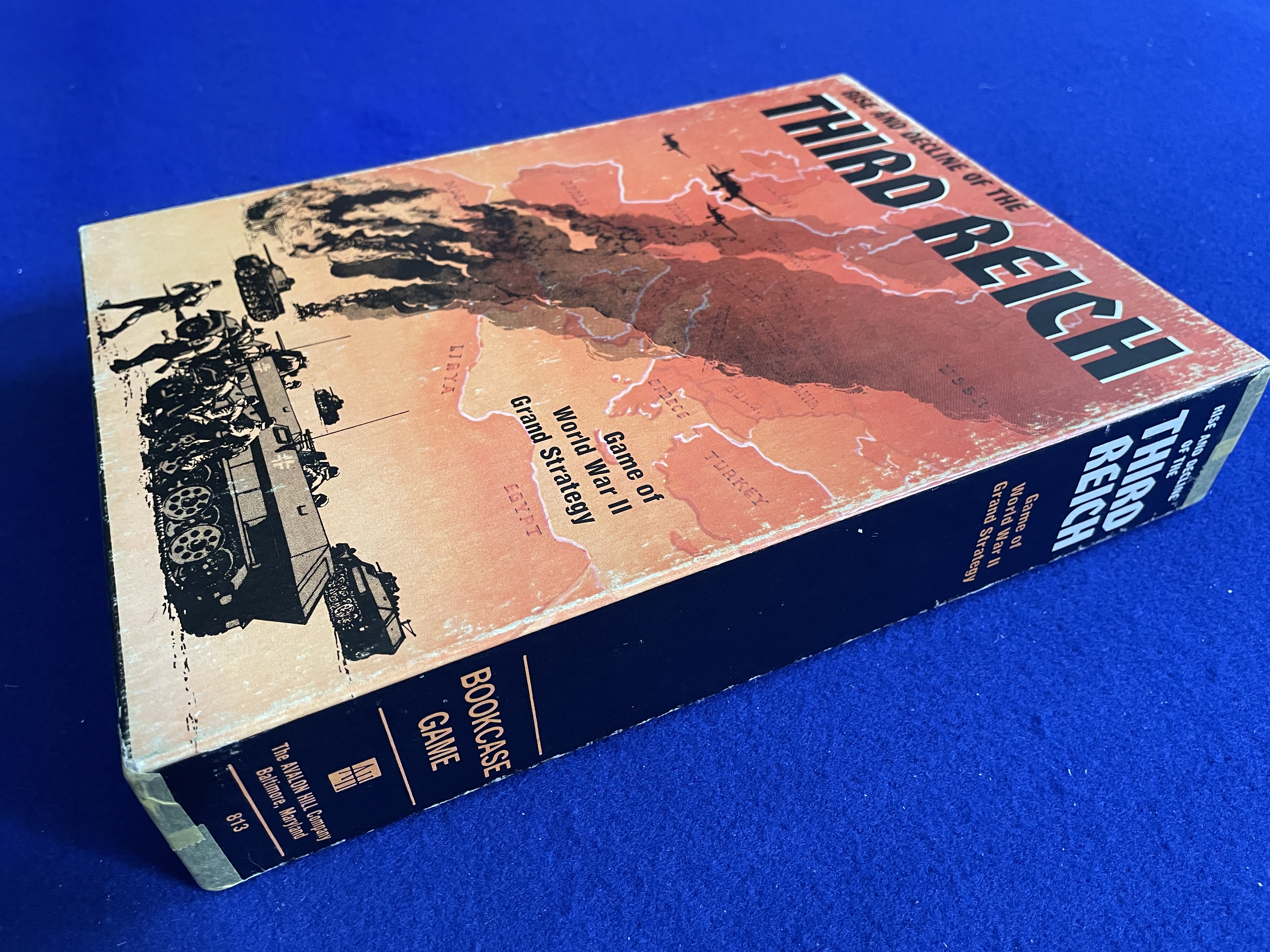
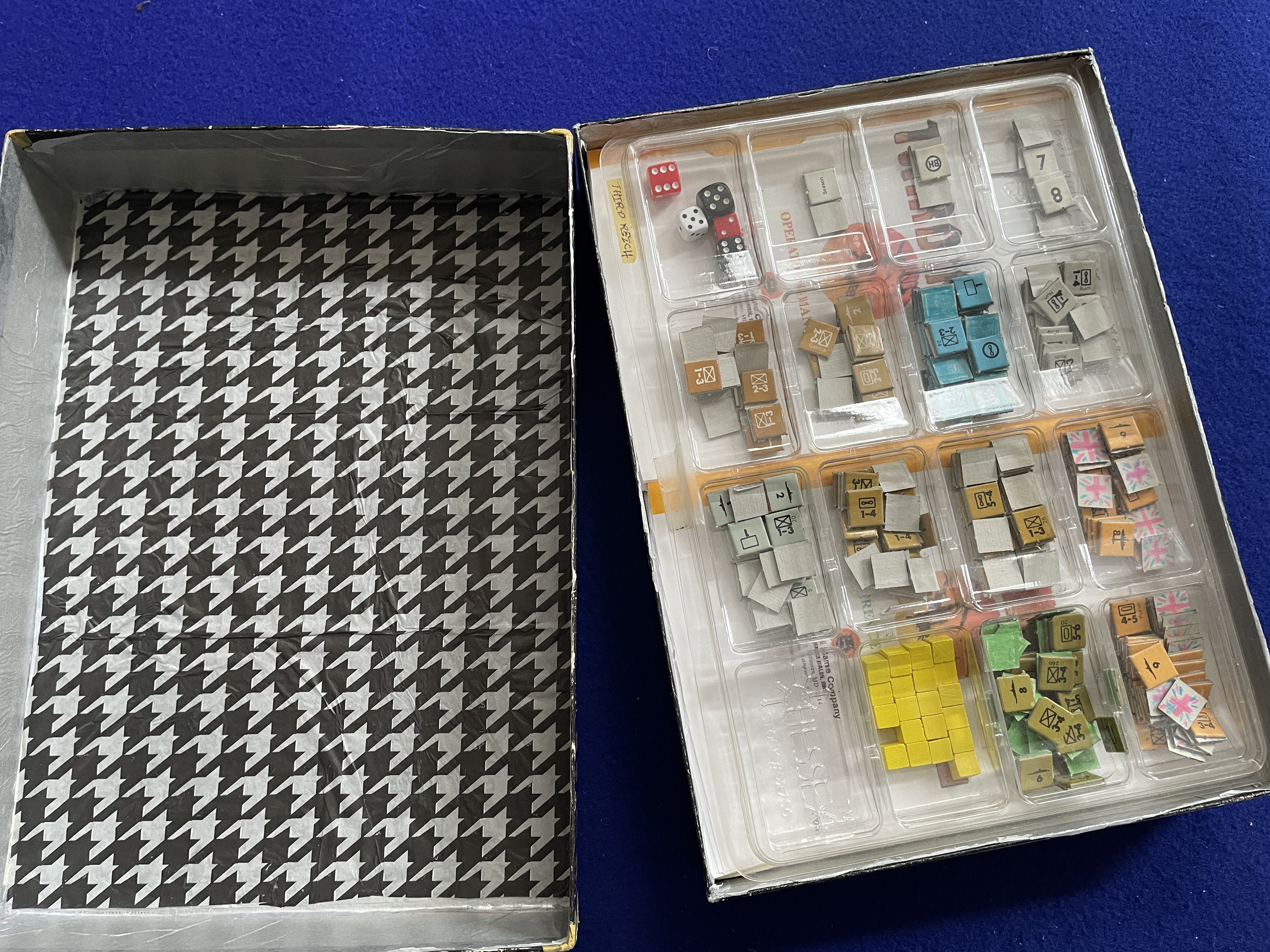
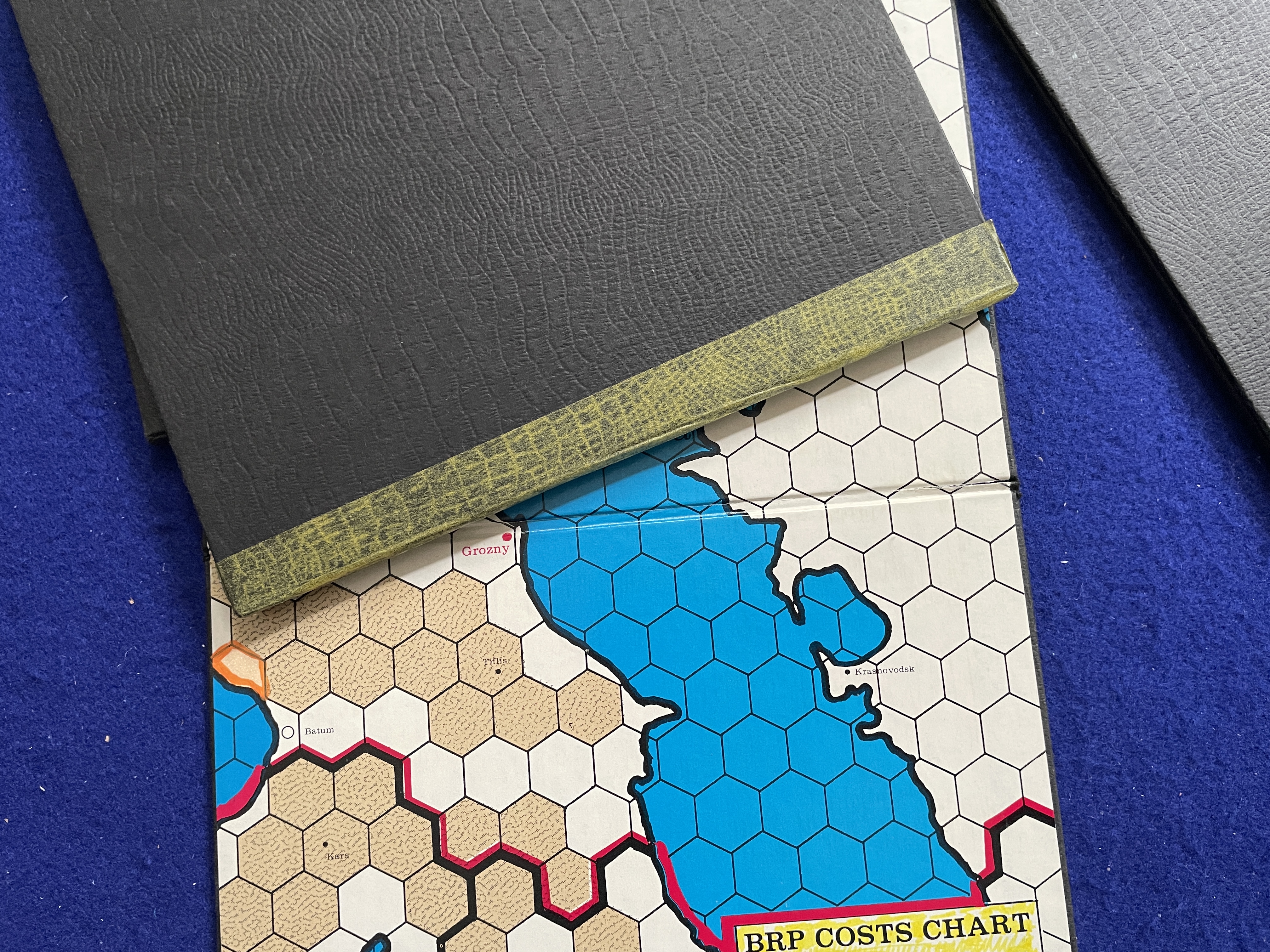
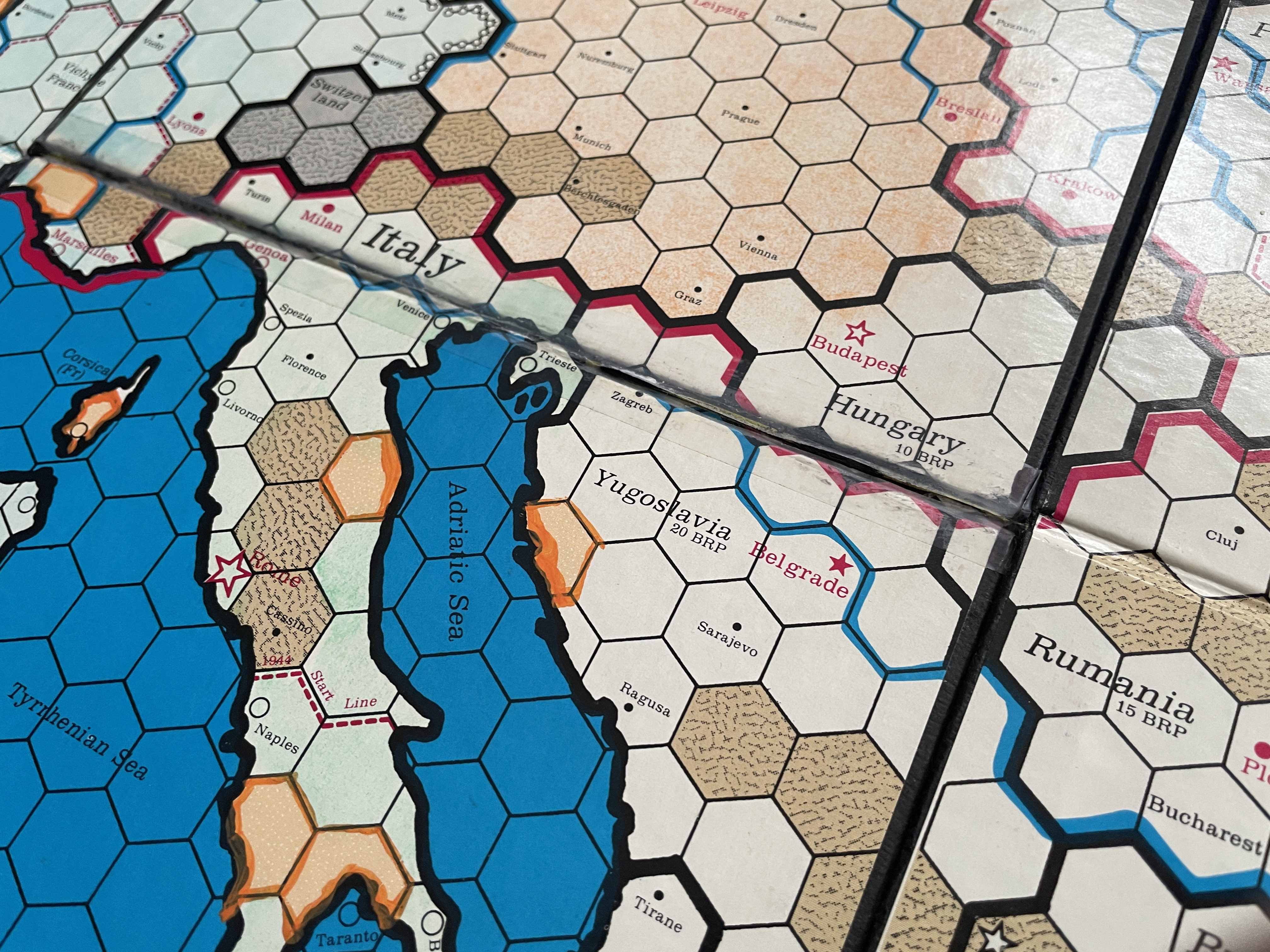
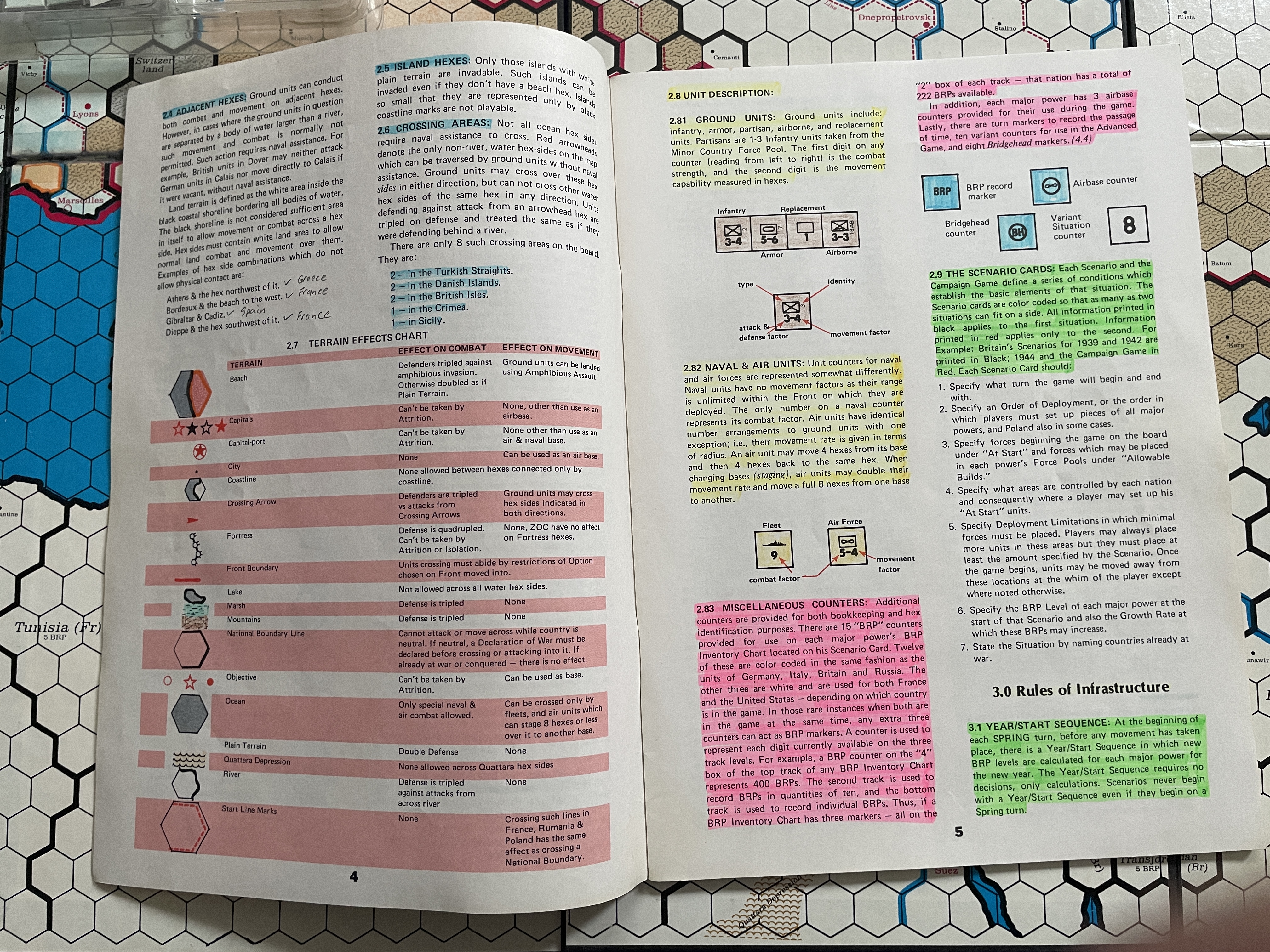
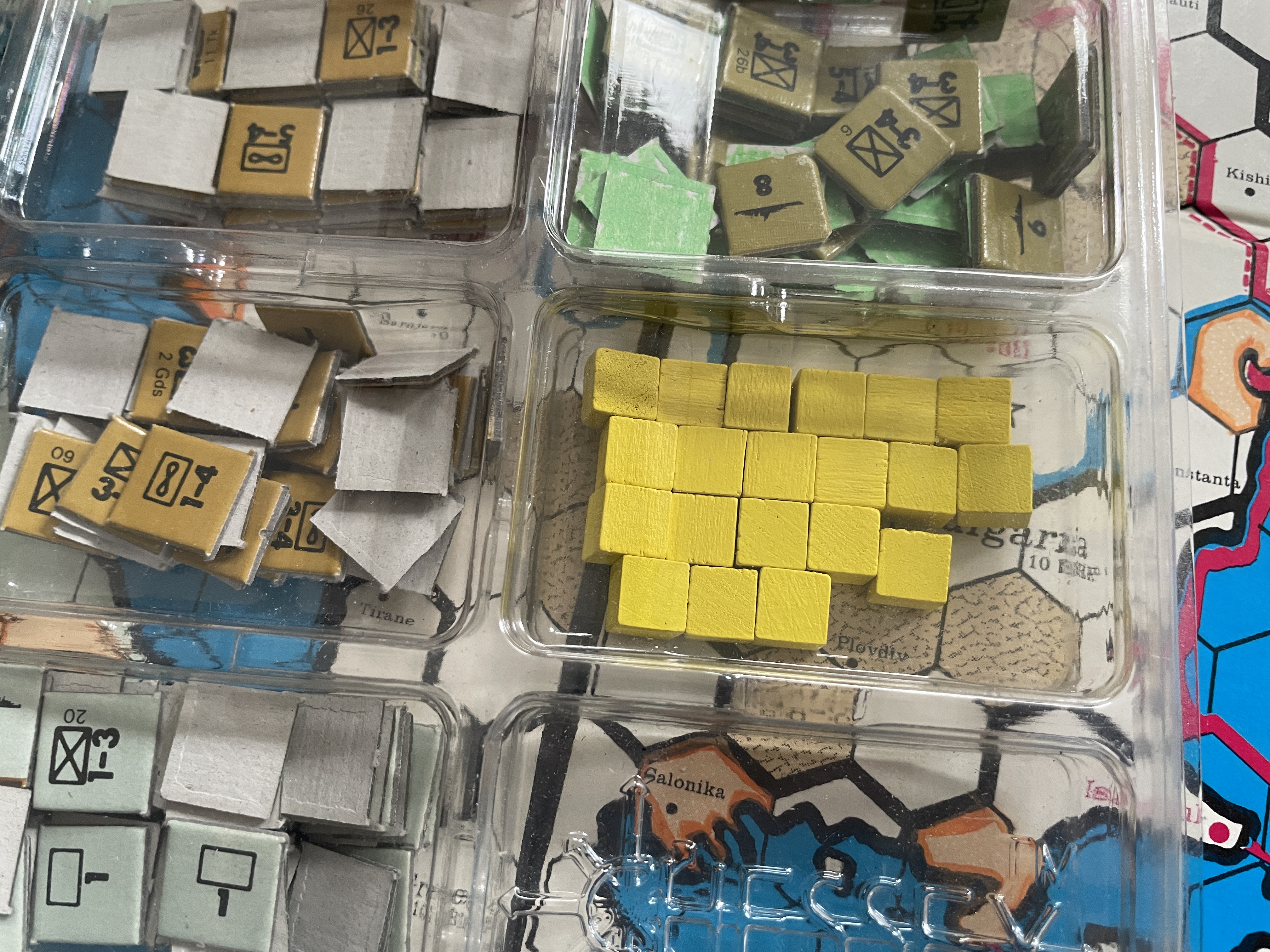
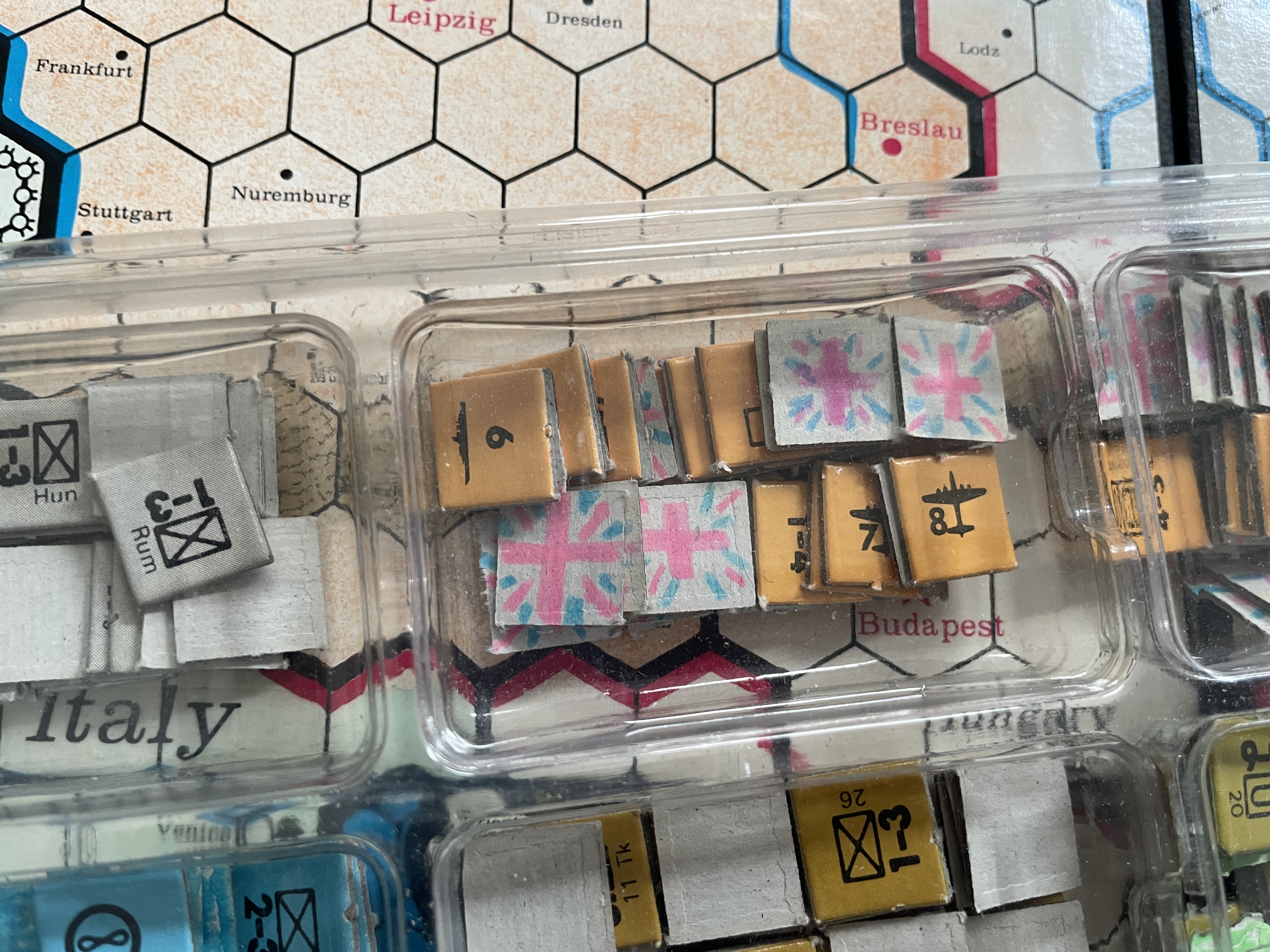
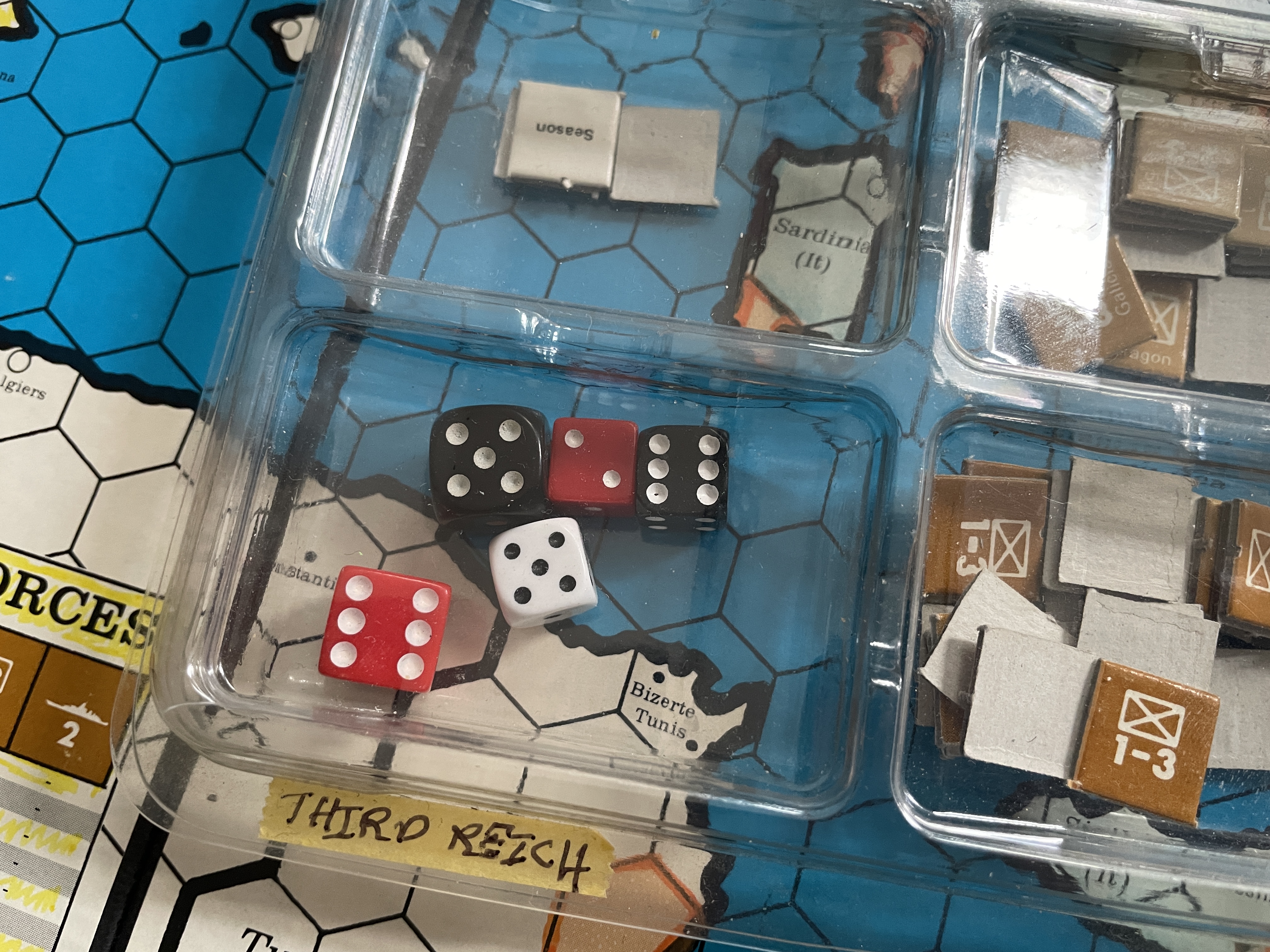
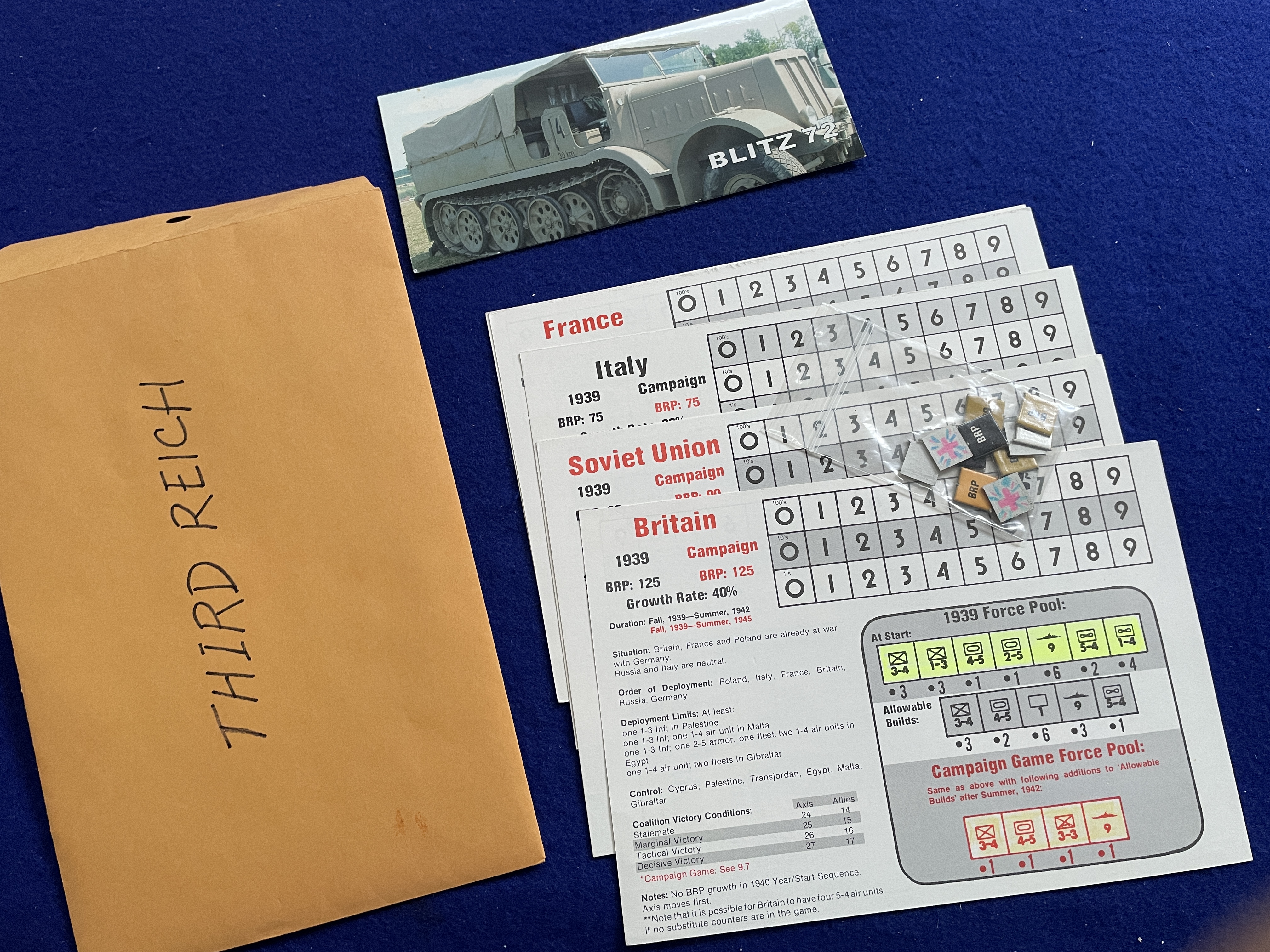
[There are sets of replacement counters available for Third Reich but at a cost of more than double what I paid for my copy. Looks like a bit of some counter-piracy is in my future…]
My copy also included about 20 small yellow wooden cubes. Definitely not an original component but useful for marking locations on the map, perhaps?
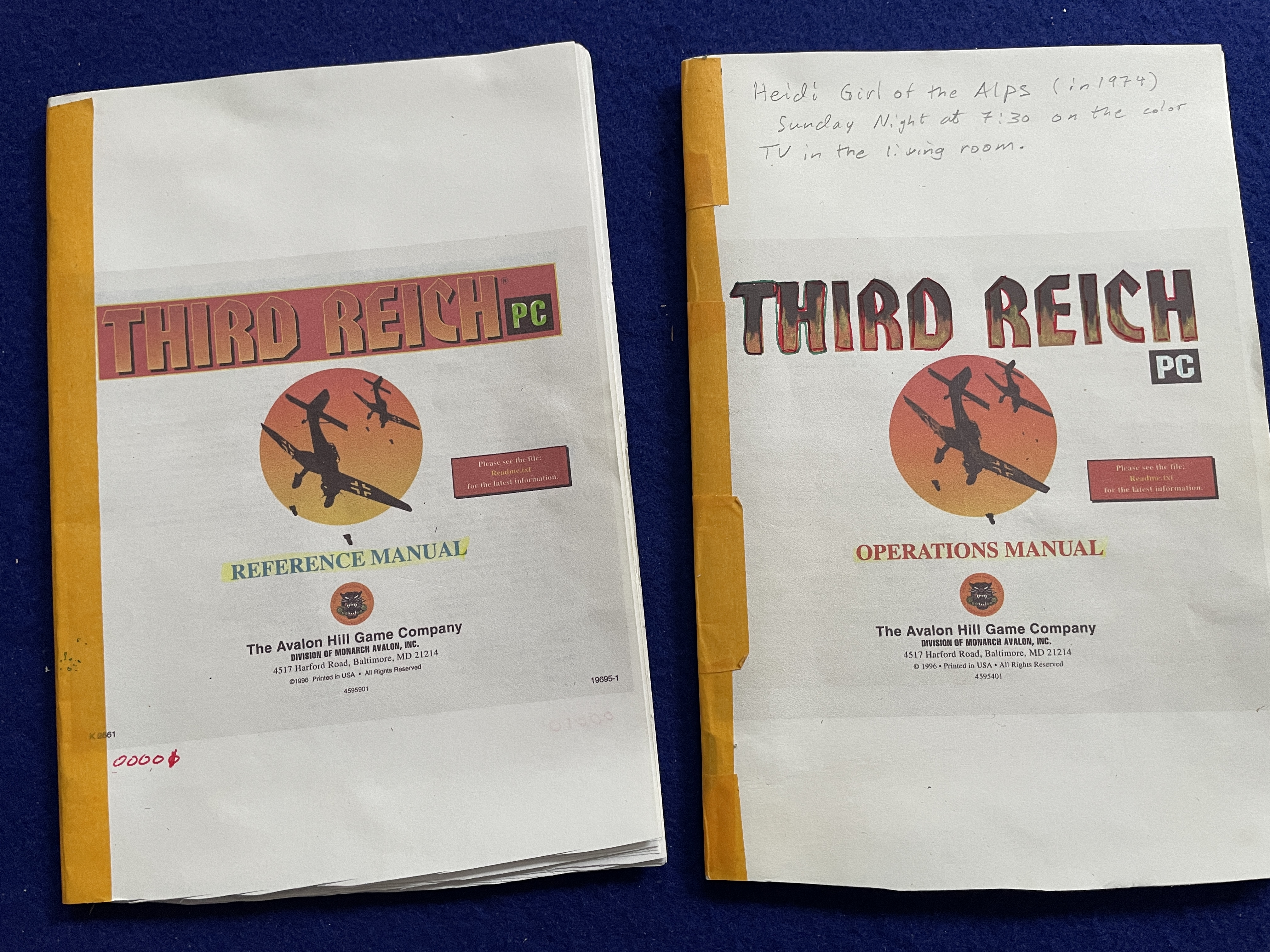
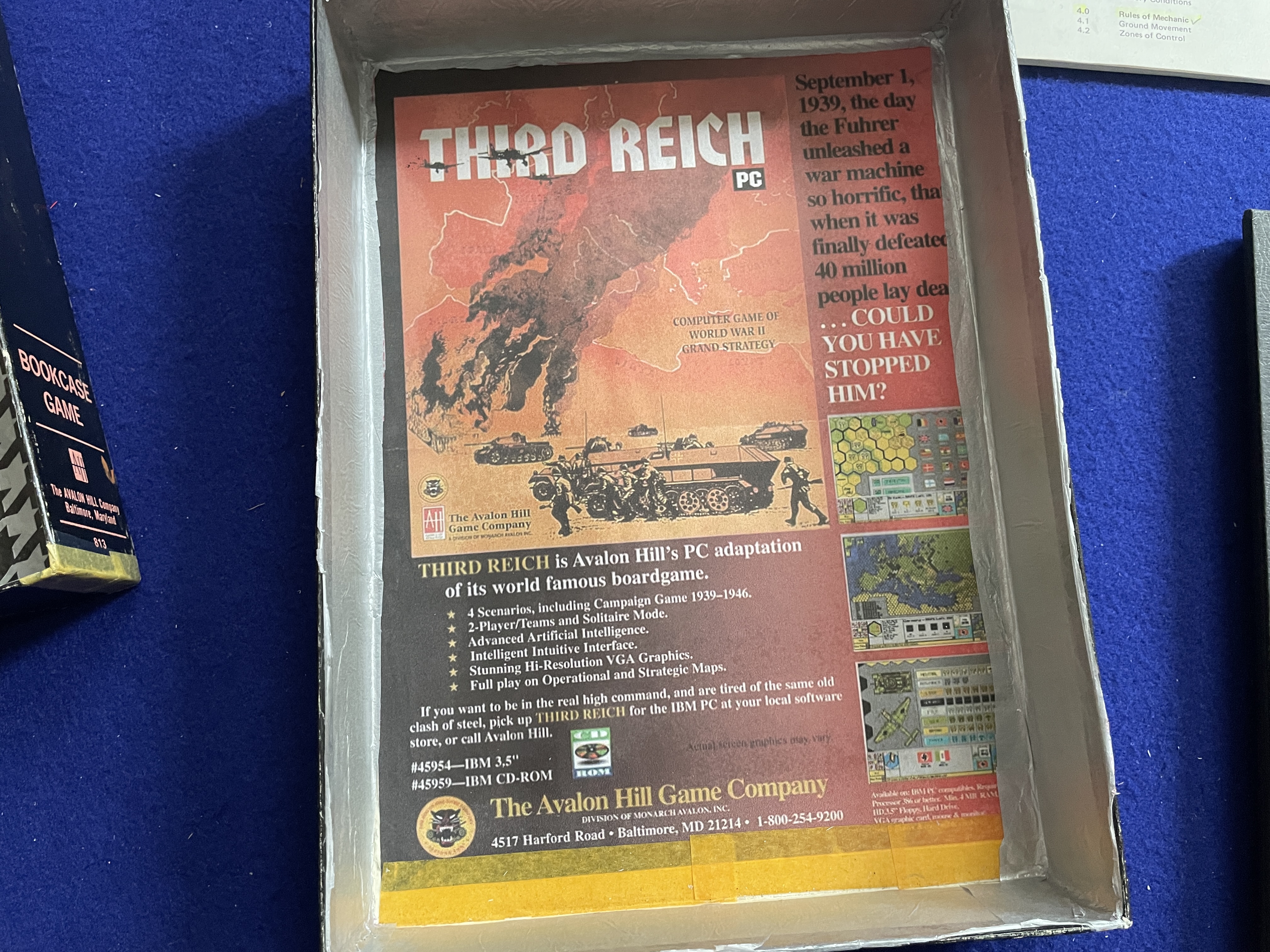
It appears that a previous owner of this copy of Third Reich also played the computer version, though the software for the game is not included.
Ruling Third Reich
What I (vaguely) remember from playing Third Reich back in the early 1980s is that it was a complicated game. I think that in those days, as much as my friends and I embraced playing detailed tactical wargames, the abstraction of strategic wargames was a bit baffling. Looking at the 32-page rulebook today, however, I see a basic—as in not very complex—set of wargame rules covered in the first 22 pages. Three scenarios are provided (1939, 1942, and 1944) as well as a Campaign Game; I cannot recall ever playing something other than the multi-player campaign game.
In the 1974 edition of Third Reich it appears Avalon Hill was yet to fully embrace the “SPI Case System” for numbering rules. This means some rules are multi-paragraph which likely made it hard for me to easily understand the rules at that time (and, admittedly, even today). This is how you get a long, multi-paragraph rule for the Year/Start Sequence (see 3.1 YEAR/START SEQUENCE) where players figure their Basic Resource Points (BRP) growth rate and base BRP for the following year. Not only does this procedure require off-board map (scrap paper is recommended) but there are also penalties and exceptions found within the four long paragraphs and three example paragraphs.
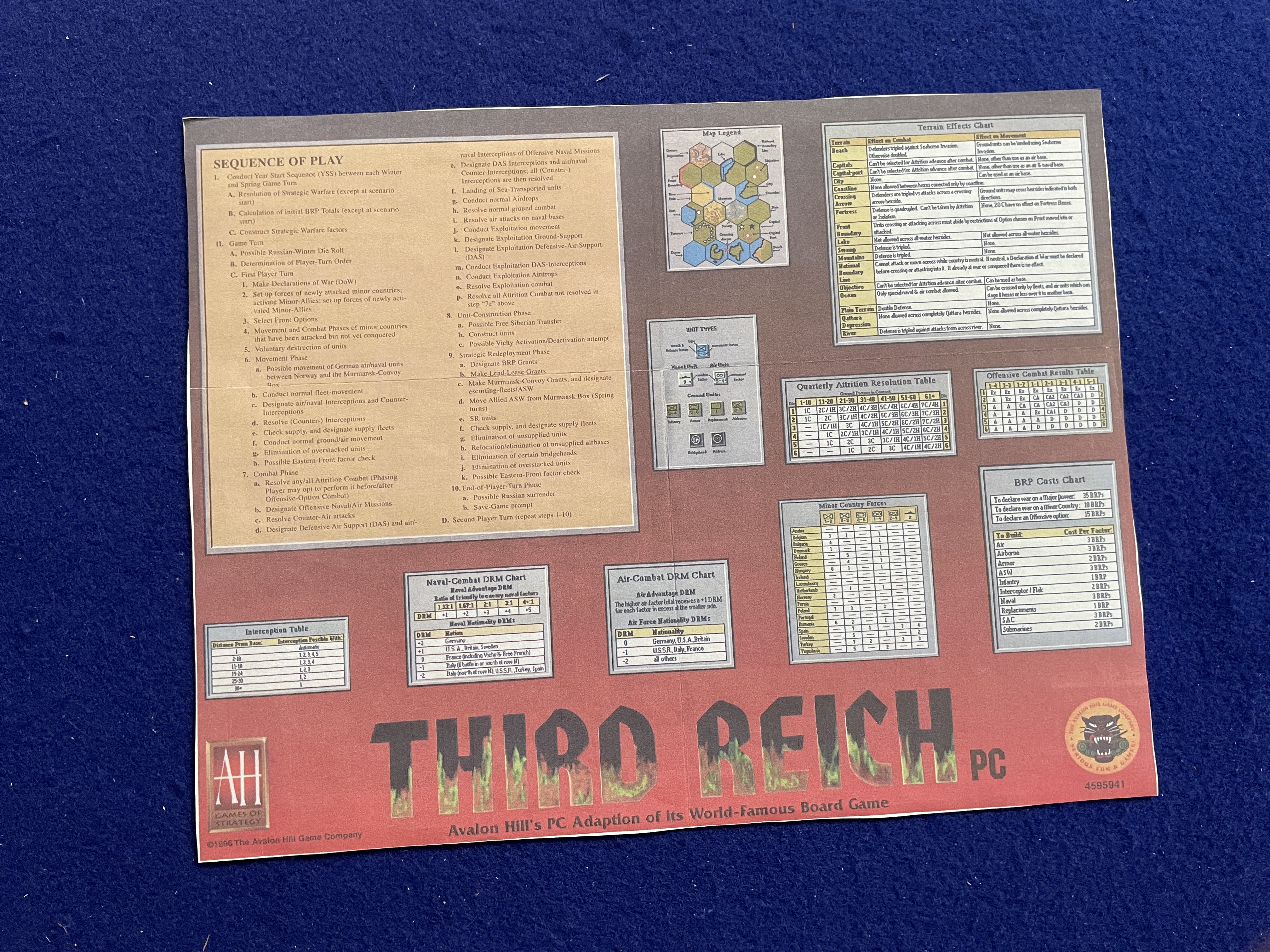
One of the extra artifacts found in my copy is a page from the PC version of Third Reich. I was wondering why the previous owner included it but it makes sense if they were looking for a detailed Sequence of Play. There is a Sequence of Play in the rulebook, but it is not annotated in steps but rather communicated narratively in rule 3.3 THE TURN. Reading the rules today, I was confused at first with the labeling of many rules as “Option” which my grognard brain read as “optional rule” given 47-years of wargaming experience. After a careful rereading of the Third Reich rulebook, I discovered that in 1974 Prados used Option in the sense of strategy:
Each game turn is made up of two (three in the case of a neutral Russian player in the multi-player version) player turns in which the Axis and Allied player each decide on a turn strategy, expressed in Options on each Front, move units, conduct any combat desired, expend BRPs to construct or replace forces, or to lend allies, and make desired Strategic Redeployments (3.314).
…
A player starts his turn by announcing what Option he has selected for each Front (3.2). He must select one Option, and only one, for each Front. … There are three types of Option: the Pass, the Attrition, and the Offensive.
3.3 THE TURN, pp. 6-7
To help me better understand Options in a player turn of Third Reich I constructed the table below. A helpful player aid for myself…
| ATTRITION Option (3.31) | OFFENSIVE Option (3.32) | PASS Option (3.33) |
| Cost = 0 BRP | Cost = 15 BRP/Front | Cost = 0 BRP |
| Movement Phase (3.311) | Movement Phase (3.311) | Movement Phase (3.311) |
| Attrition Resolution Phase (3.312) | Combat Phase (3.321) (includes Naval and Air Missions) | |
| Unit Construction Phase (3.313) | Unit Construction Phase (3.313) | Unit Construction Phase (3.313) |
| Strategic Redeployment Phase (3.314) | Strategic Redeployment Phase (3.314) | Strategic Redeployment Phase (3.314) |
For the life of me I cannot remember if we played Third Reich in the early 1980s with an understanding of the Option rules. I strongly suspect we did not; in those days we depended on one of us (usually the owner of the box) to learn the rules and then to teach them to all of us. Third Reich was not my game and I am not sure my buddy fully grasped the rules. Indeed, to fully grasp the rules today I had to read them carefully; a learned trait a middle school student almost certainly is not very skilled at.
Baltic Amphibious Assault
In my relearning (heck, call it what it is after 40+ years) learning of the rules for Third Reich I focused in on the rules for Amphibious Assault (4.9173). As I recall, in my epic birthday wargame I was playing Germany and at one point my forces were spread too far from the homeland. My British opponent conducted an Amphibious Assault along the Baltic Coast and sprinted into Berlin for an automatic victory. I wanted to see if we played the game right all those years ago. [Spoiler Alert – Nope!]
First off, taking the capital of a country is NOT an automatic victory. Although in my mind I remember the victory condition as such major powers are conquered using rule 3.5 CONQUESTS. Specifically, rule 3.51 designates that for Germany to be conquered, “The attacker must hold the capital against counterattacks for one opposition turn.” As I mull this one over I think we actually got this rule right—but other rules wrong.
As I recall, the British player sailed from England into the Baltic for an Amphibious Assault on the northern German coastline. Reviewing the rules, I believe we made several bad rulings to include:
- Option selection – To conduct an Amphibious Assault requires selection of the OFFENSIVE Option (see 4.91 NAVAL CAPABILITIES which specifies that Amphibious Assault is a Naval Mission executed during the Combat Phase of an OFFENSIVE Option). Further, a fleet sailing from Britain to the Baltic crosses a Front Boundary meaning this should cost the British 30 BRP for an OFFENSIVE on two fronts (15 BRP per Front). We almost certainly got this one wrong as I cannot recall my opponent paying 30 BRP; if anything was paid it very likely was only 15 BRP because—if one ignores the Front boundary along the Baltic coastline—it looks like an OFFENSIVE from England into Germany is in the same Front.
- Changing Front – If we got the rules right in 1981 the Amphibious Assault would never have happened. Rule 4.913 NAVAL RANGE specifically states, “A fleet may never carry out a mission on a Front other than that in which it starts its turn.” The rule for Fleets changing Front is found at 4.914 CHANGING FRONT that specifically states, “Fleets may change Front only by moving to a controlled naval base in an adjacent Front during the Strategic Redeployment Phase.” [EPIC rules failure.]
- Holding Berlin – As already mentioned, we got the conquest rule correct on holding Berlin for an opposition turn. What we got wrong, in retrospect, was the German attempted counterattack. As I recall, I had one or two infantry units on the Eastern (Russian) Front that could just barely reach the hex adjacent Berlin. When I went to move them, my opponent insisted they needed to stop at the Front boundary. I disagreed and likely read rule 4.1 GROUND MOVEMENT and the specification that, “Units may freely cross Front boundaries in movement… .” The rule almost certainly missed back then is the further stipulation in rule 4.1 that states, “Units changing Fronts must abide by the combat limitations of the turn Option being employed in the Front they are moving into.” This means I needed to pay 15 BRP for an OFFENSIVE Option in the Western Front where Berlin is located. As I am not sure we were playing the Option rules correctly I cannot recall if I paid the 15 BRP for the Western Front or 15 BRP for the Eastern Front where the units started from. What I do recall is that—by whatever twisted logic path we took—my two units faced off against a single British infantry in Berlin…and failed to retake the city. Following the conquest of Germany we ended that game of Third Reich right there with a bit of a bitter taste and moved onto a Traveller RPG adventure.
History lesson
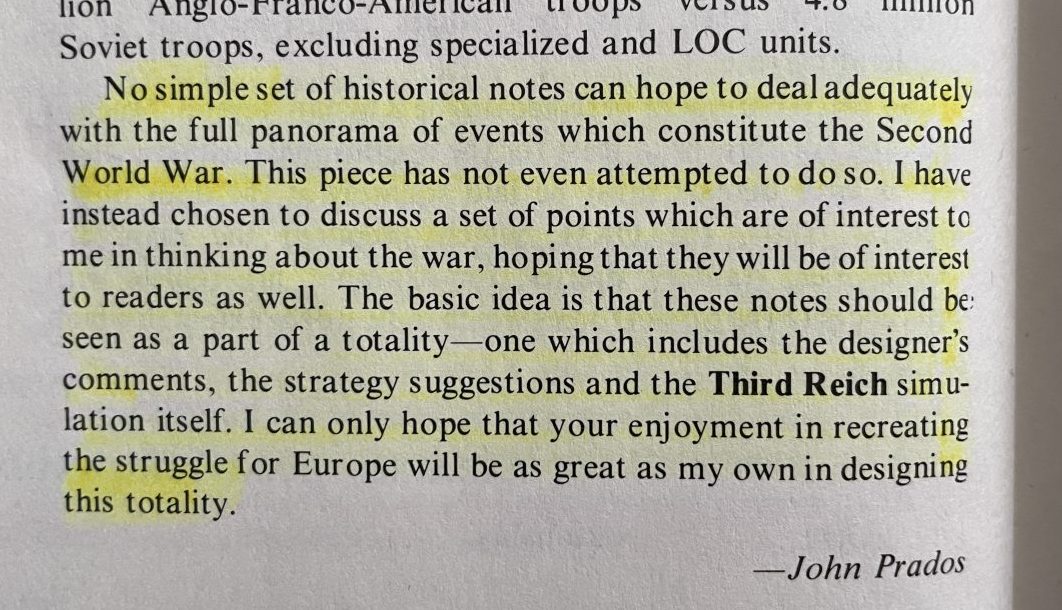
I am certain that I read the Historical Notes (12.0) for Third Reich back in the day. What I did not recognize back then is the name John Prados. Admittedly, in 1979 Prados was still making a name for himself but, with hindsight in 2026, one easily can see the analytic rigor he brought not only to his historical analysis but also game design. Sadly, I am sure I missed this concluding gem of a statement:
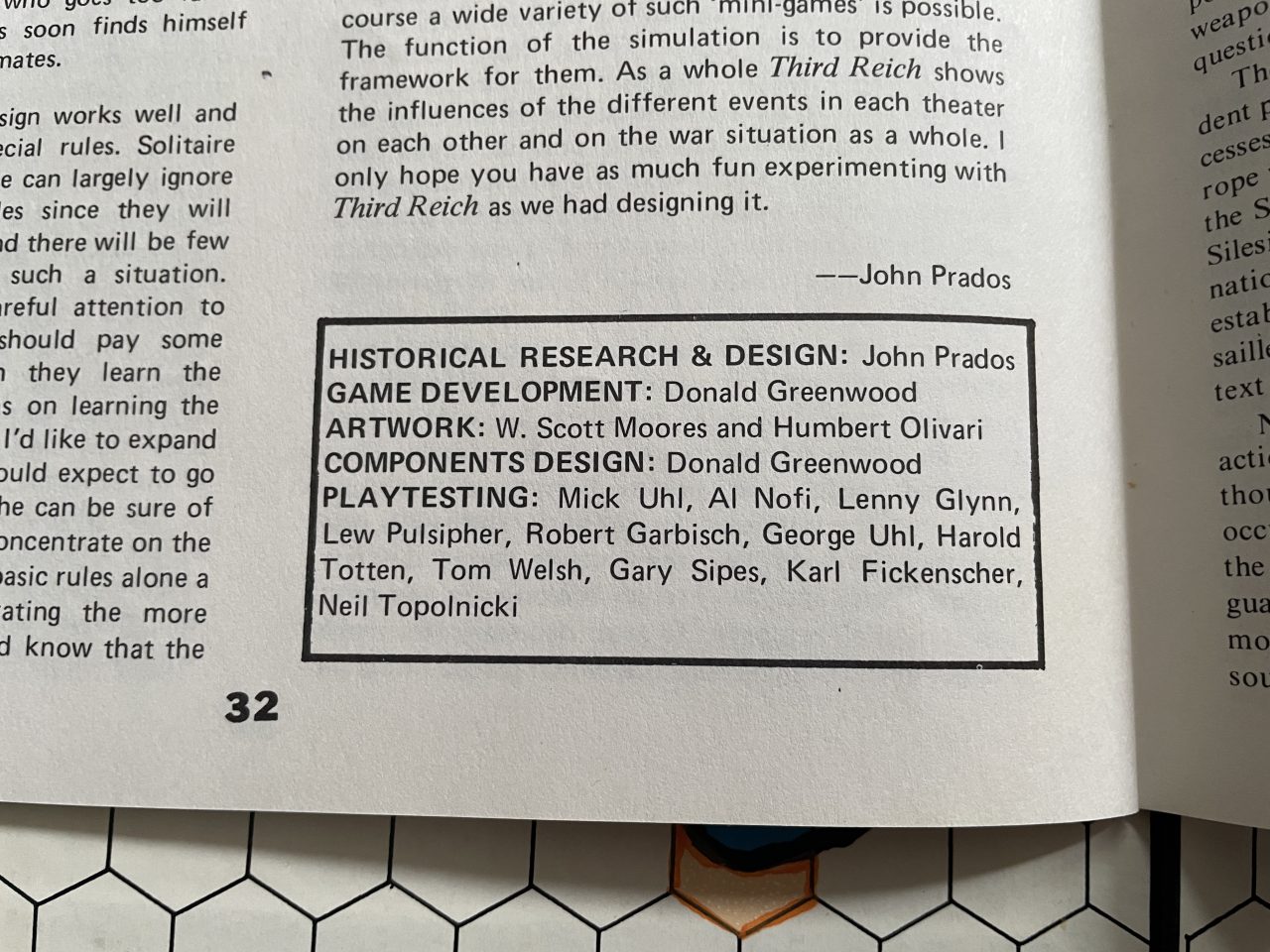
I am less sure I read 11.0 Designer’s Notes as, 1) the copy of Third Reich we played back in those days was owned by a friend and, 2) I rarely read Designer’s Notes in those early years. That is too bad as there is lots of good points for both players and wargame designers to learn from. I will say, again with the benefit of 40+ years hindsight, that the team that brought Third Reich to publication was a real powerhouse of the industry.
Decline and rise of Third Reich
After the epic birthday play of Third Reich in 1981 the game rarely reached our group gaming table again. Our declining interest almost certainly was because we failed to grasp the rules. If the game was mine I feel that I likely would have dived into reading the rules carefully and maybe, just maybe, the game might have gotten a second life. If I owned the game I might of read the Designer’s Notes and likely would come to better understand the wargame Prados presented to us. As I learn the game fresh in 2026, not only do I better understand the rules but I also better understand Prados’ intention for the game. My interest has risen enough that I am going to (someday) make a set of homemade German counters and give the various scenarios a try.
Feature image courtesy RMN
The opinions and views expressed in this blog are those of the author alone and are presented in a personal capacity. They do not necessarily represent the views of U.S. Navy or any other U.S. government Department, Service, Agency, Office, or employer.
RockyMountainNavy.com © 2007-2026 by Ian B is licensed under CC BY-SA 4.0


I played this game way back in the day too! I don’t remember too much about it, but I remember the economic unit was “BRPs”.
And of course my brother was much better at it than I was
Fascinating. I used to stare longingly at those AH games on the store shelves back in the 70s, and this was one of the most interesting-looking. Within the past year I was considering picking up one of them. I traced the path that (I think it was) this game had travelled to the present day. I was overwhelmed with options, but ultimately retreated and bought a copy of the Axis & Allies anniversary edition instead. Thinking it would be simpler and I’d be more likely to get a friend to play. Bottom line, it’s sitting here unopened and thus unplayed, so I guess it didn’t matter which edition or version I bought after all. Which I suppose I anticipated.