
I love discovering new games that challenge my assumptions. I have long been a fan of what I call Adventure Wargames like Twilight: 2000 4th Edition (Free League Publishing, 2019) or Five Parsecs From Home: Solo Adventure Wargaming (Mödiphiüs, 2021). To me, “Adventure Wargames” are games with elements of wargame and roleplaying games (RPGs) mixed together. With my recent acquisition of Dropship by Todd Ritzema and Nathan Lindy from Blackwall Games I now must refine my ontology of games. That is because Dropship is a new (to me) category of RPG I am going to call, “Combat RPGs.”
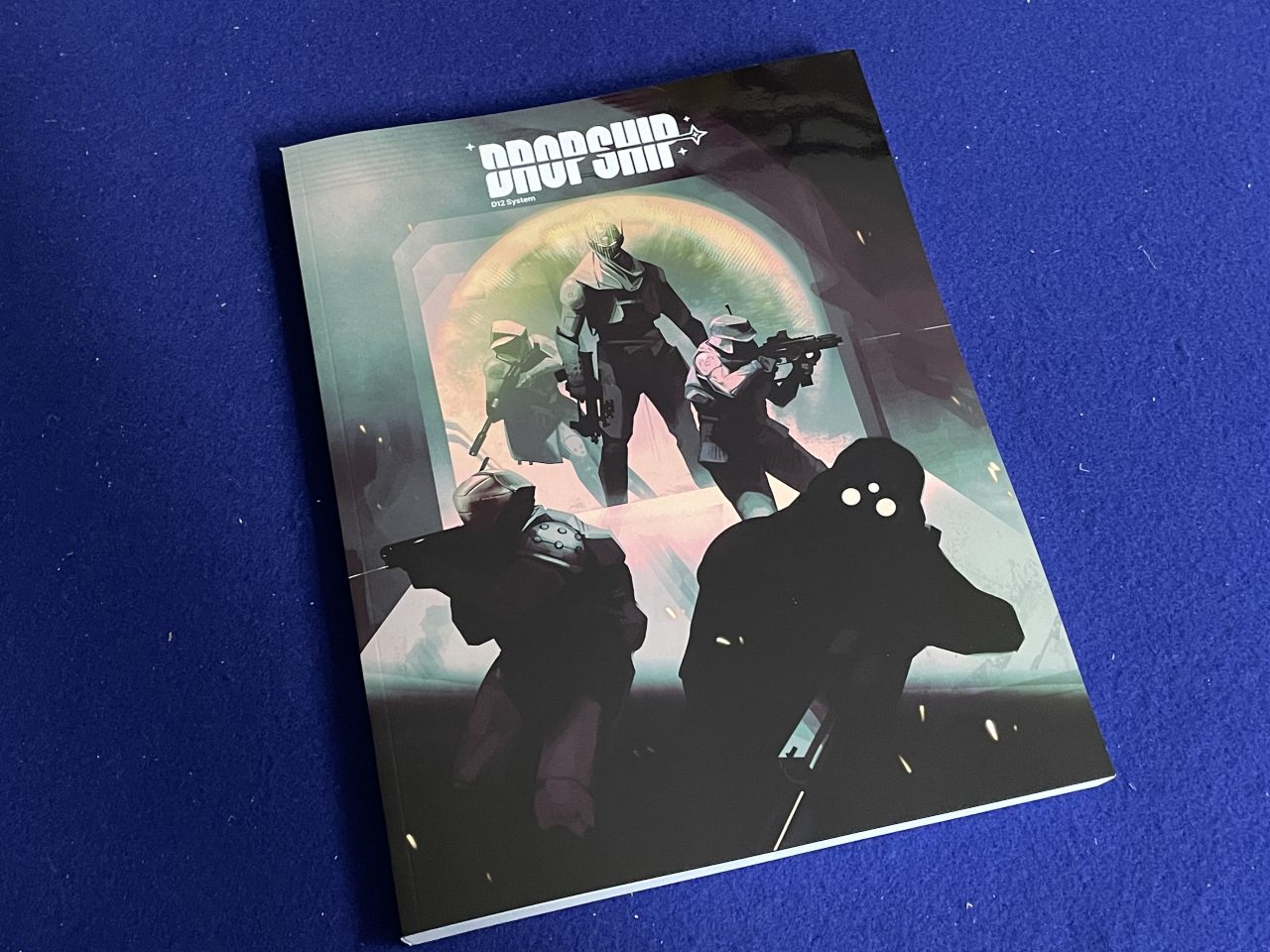
To be clear, Dropship is an RPG, but with a near-exclusive focus on combat. Although one can do most of the usual RPG-like adventuring using the rules, the game mechanisms and setting are clearly focused on combat as, “The Players take on the role of human soldiers battling aliens across known space” (p.1).
Reclaim the lost colonies and defeat the alien menace or die trying!
“Preorder Update,” Blackwall Games blog, 27 May 2026
A combat RPG
Dropship is in many ways a set of skirmish-scale wargaming rules but with characters created using an RPG. The game system used in Dropship is called the D12 System. The core game mechanism is incredibly simple: roll 1d12 adding the relevant Attribute or Skill or any Bonuses (modifiers). The die roll is compared to the Difficulty Category (DC) and if the roll equals or exceed the DC it is a success. Interestingly, a natural roll of 12 is automatic success; there is no automatic failure roll.
Normal play of Dropship proceeds in seating order around the table with each player getting a chance to act in their Turn. A complete circuit of the table is called a Round and represents from a few minutes to a few hours of time. The core game action, however, is at Character Scale (p.7). At Character Scale, each Combat Turn is five seconds and each Combat Space is 2 yards or 2 meters.
Character Creation in Dropship is a nine-step process:
- Pick your Species (there five types of Human to choose from)
- Calculate Hit Points
- Choose two Careers (there are 24 different Careers)
- Choose your Skills (there are 22 Skills)
- Choose Language and Fighting Styles (when using your chosen Fighting Style the character can make two attacks in an Action instead of the default single action)
- Choose your Starting Equipment
- Calculate your Carrying Capacity
- Pick a Feature (usually tied to Skills and usually award a special Skill Check condition; categories of Features are General, Combat, Power, or Starship)
- Calculate your Rank (p. 16)
Although there are aliens in Dropship the default character creation method allows one to make Human characters only. The five different variants, however, give players interesting choices. Do you want to be a standard Human or a Belter (low-gravity world) or Heayworlder (heavy-gravity world, obviously). Void Dwellers spent their entire life aboard starships. Wastelanders are survivors of planets hit by a nuclear or other holocaust. Regardless of the Human type selected, each character has four Attributes: Fitness, Reflexes, Senses, and Willpower.
The 24 careers in Dropship are a combination of expected—and unexpected—careers. Here I must give kudos to the writers of Dropship for showing how fantasy tropes and sci-fi can mix.
| Ace – Skilled combat pilot | Grenadier – Explosives and entrenchment expert | Psychic – Clairvoyance and mental prowness |
| Agent – Secret emissary | Heavy – Firearms enthusiast and automatic weapons expert | Ranger – Survival expert |
| Breacher – Force doors and clear rooms | Infiltrator – Incursion behind enemy lines | Smuggler – Purveyor of illegal goods |
| Bridge Officer – Expert in space warfare | Mechanic – Expert at destroying or repairing Starships | Sniper – Sharpshooter |
| Chaplain – Religious leader and theologian | Medic – Treat the wounded | Spacer – Expert in Zero-G and controlling Starships |
| Corsair – Space pirate | Military Police – Crowd control and criminal investigation | Tech Knight – Melee with futuristic tech |
| Diplomat – Corporate or government emissary | Paladin – Power Armor Expert | Technician – Expert at detecting enemy Starships |
| Field Officer – Expert in ground warfare | Psion – Telekinetic powers | Vanguard – Power armor expert |
The Skill list in Dropship is perhaps the least-combat focused part of character creation as many Skills are useful outside of combat.
| Athletics | Faith | Starships |
| Combat | Intuition | Stealth |
| Commerce | Investigate | Survival |
| Computers | Language | Underworld |
| Culture | Legal | Vehicles |
| Cybernetics | Medicine | |
| Deception | Powers | |
| Engineer | Science |
As mentioned above, Features in Dropship are special abilities based on Skills. For example, the General Feature “Icarus [Drone] Operator” requires the Computer Skill and gives the character an Icarus Drone to use. Incidentally, the Icarus Drone is defined in Dropship as a type of Monster.
Characters in Dropship advance in Level by earning Experience Points. Advanced levels award the character additional Hit Points (HP), a Perk (ranging from a new Ability Focus to Skills to Hit Points to an additional Fighting Style), or a new Feature or Capstone (a Feature related to species).
While most of the Equipment available for purchase in Dropship is combat related, I am happy to see that a character can buy a Board Game for a mere 2 credits. A true reminder that Dropship is, after all, a fantasy-adjacent sci-fi setting.
Vehicles and Starships in Dropship are created like Creatures though they cannot act on their own; the player-characters or Non-Player Characters (NPCs) control them. This means vehicles/Starships are described using terms such as Protection or Immunity or Perception and have Skills. Like Creatures, weapons for vehicles or Starships are defined as Actions used in Combat.
Creating Stars and Worlds in Dropship is simple; the governing philosophy appears to be, “roll only what is needed.” Although the Traveller roleplaying game was an inspiration for the designers it is clear that they streamlined the system focusing on essentials for play not technical detail.
While Starships are defined like Creatures in Dropship, Starship Combat is conducted at Starship Scale (p. 122). While the time duration of a Starship Scale round is not stated, a Combat Space at Starship Scale is ~2,000 miles or, “1.5 million Combat Spaces at the Character Scale” (p. 122).
A little under 15% of the core rulebook (42 pages) of Dropship is devoted to Beasts and Monsters. Humans (NPCs) and Aliens are covered in another 41 pages. Stat blocks for Starships (Human and Alien) take up another 39 pages. The quite literally means ~42% of the core rulebook for Dropship is stat blocks. The core rulebook of Dropship has no rules for creating your own Creature or Vehicle or Starship; perhaps those will be found in a later supplement.
For an RPG so focused on combat the opening line of the Setting chapter surprised me: “Dropship has an implied setting, a broader galaxy that is meant to be explored” (p. 268). In the Dropship galaxy there are Aliens and they definitely are not nice.
Nine years ago, first contact occurred. It went poorly. Several colonies fell. Attempts were made at brokering a truce, but every attempt failed or resulted in Human diplomats inexplicably conceding more and more territory to the Aliens. It became clear that the Balmori Imperium, Enlari Collective, Hierarchy, Nix Raiders, Phraelar Star Empire, and Vaskaran Protectorate had agreed to divide Human territory among themselves,
Most of the colonies have fallen. A couple dozen remain in the Sol Sector. All contact with the colonies in other Sectors has been lost. Rumors persist that a handful of colonies are holding out behind enemy lines.
“Setting,” p. 268
RPG campaign or skirmish builder?
All of which brings me back to Dropship as a Combat RPG. In the “Game Master” chapter, the designers write of different campaign types for the game:
You can use Dropship to play several types of campaigns, including a Marine Campaign, a Navy Campaign, or a Specialist Campaign. A Marine Campaign is focused on Character Scale engagements, while a Navy Campaign focuses on Starship Scale battles. A Specialist Campaign is focused on a mixture of both. Collision Course! in Chapter 16 is an introduction to a Specialist Campaign.
“Game Master – Campaign Types,” p. 97
Later in the Game Master chapter of Dropship are Missions, or episodic adventures that can link into a campaign (p. 99). Interestingly, here there are but two Mission types: Marine Missions and Navy Missions—there are no Specialist Missions given. The next section after Missions is “Exploration & Survival” which has rules for traveling across strange planets. The final Mission setting is “Planetary Invasion” which links Navy and Marine Missions (making that a Specialist Campaign?).
While called out as a sample Specialist Mission for Dropship, the Starting Adventure, “Collision Course!” is still heavily combat focused. The player-characters are a special military unit reporting for duty when a crisis occurs. Within 15 minutes of game time they must move to a ship on a collision course and prevent it from colliding with a space station. I do not think it is a spoiler if I tell you the players need to be ready for plenty of combat; controlling the ship to avoid a collision is very much an afterthought in this adventure. In more than a few ways the Campaigns and Missions in Dropship come across more like skirmish or battle generators than an “adventure.”
The drop—and dropped—on Dropship
The obvious focus on Marine or Navy Missions and a combat-heavy sample Specialist Mission reinforces my perception that Dropship is a Combat RPG. The closest Adventure Wargame is perhaps Five Parsecs From Home where each campaign consists of a series of battles. A Marine Campaign in Dropship is also much like a combat-focused Colonial Marines adventure or campaign found in ALIEN: The Roleplaying Game.
Given the tone of writing and implied setting details, Dropship likely will appeal to fantasy RPG gamers who are looking for an alternative RPG. If they are looking for an RPG which handles adventuring outside of combat, however, they likely will be disappointed. For myself, Dropship is an RPG that I can use for a combat-centric campaign. I just need to work on developing my own Specialist Missions and Campaigns to take advantage of the RPG elements of the design. On the positive side, the “rules-lite” D12 System in Dropship allows one to focus on combat with just a bit of other “adventuring” mixed in. Building out a campaign is a bit more challenging as rules for custom-designed beasts/equipment or Starships is not provided; then again, there are many stat blocks to call on.
If there is one area that Dropship needs to immediately improve it is the Character Sheet. Simply put, it is not aligned with the Character Creation chapter. Characters are defined by Attributes (Fitness, Reflexes, Senses, Willpower), Skills, Features, Capstones, and Actions. The character sheet includes area labeled “Passive Abilities” or “Maneuvers” or “Actions.” I am not sure what goes where nor how it all realtes together; frankly, it looks like the character sheet was for an earlier iteration of the rules and has not been updated. Don’t you dare tell me that if I understand certain other RPGs I should be able to understand what goes where—Dropship should be self-contained and not dependent on a priori knowledge. It is also note clear how bonuses stack. If I gain a skill, is that at Level 0 which grants me a +2 Bonus (for a total bonus of +2) or at Level 1 which, added to the +2 Bonus, is a total bonus of +3? I went to the Blackwall website and downloaded the free Dropship Sample Characters which is a great help…but at least one of these filled-in sheets should be in the core rulebook.
“So Rocky,” you ask, “do you like Dropship or not?” Yes, I like this Combat RPG, with the caveat that it needs more intuitive character sheet. I am going to call it a Combat RPG because when I want an RPG that is all-in on creating mayhem this will be high on the list of candidates to pull off the shelf.
The drop on a new gaming ontology
As far as my ontology of gaming goes, perhaps I need to delineate between “Adventure Wargames” which are “wargames which include rules for creating characters” and “Combat RPGs” which are “roleplaying games with a heavy focus on combat adventuring and campaigning.”
| Adventure Wargames | Combat RPGs |
| Commando (SPI, 1979) | Behind Enemy Lines (FASA, 1982) |
| Hammer’s Slammers: The Crucible (Pireme Publishing, 2010) | Colonial Marines Campaign in ALIEN: The Roleplaying Game (Free League Publishing, 2019) |
| Five Parsecs From Home (Mödiphiüs, 2021) | Lancer (Massif Press, 2019) |
| Twilight: 2000 4th Edition (Free League Publishing, 2021 | |
| Dropship (Blackwall Games, 2026) |
It is still an early thought experiment but here is how my Ontology of Gaming is starting to look like:
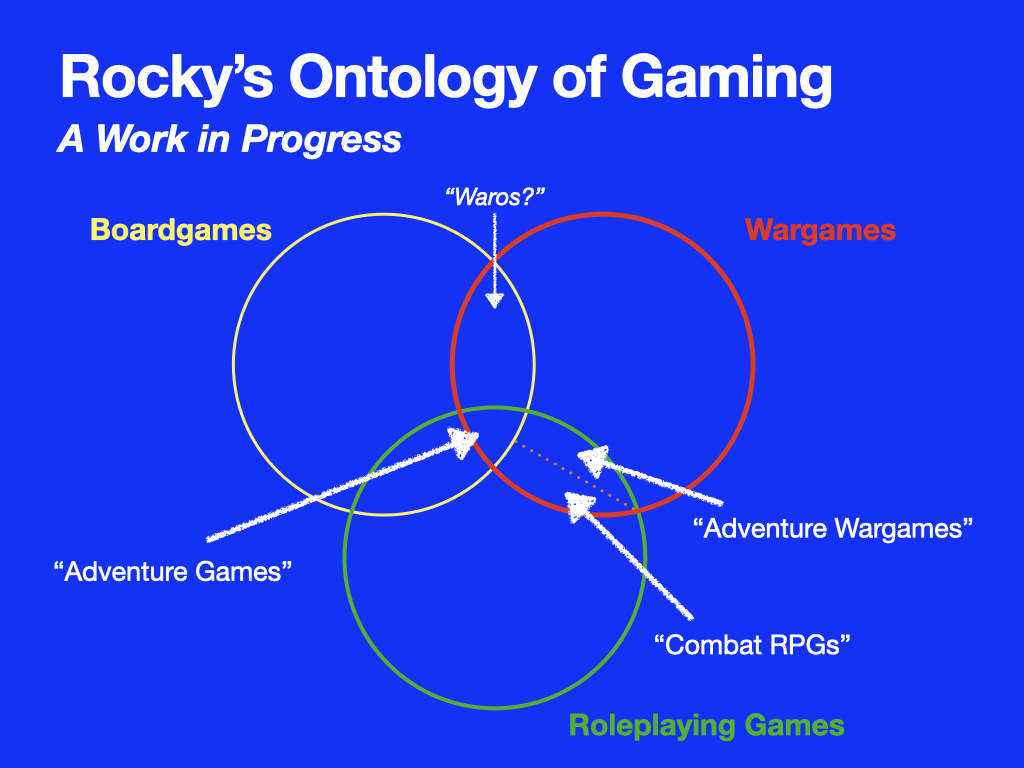
At the intersection of Boardgaming, Wargaming, and Roleplaying Games lies what I will call, “Adventure Games.” As much as some people hate the term, I see a slice for “Waros” standing out where Boardgames and Wargames overlap. The overlap of Wargames and RPGs is subdivided into “Adventure Wargames” which favor wargaming and “Combat RPGs” that favor roleplaying.
The area of overlap I am at a loss to name is the intersection of Boardgaming and Roleplaying Games. I actually am struggling to place a boardgame from my collection into that category. One possible example that comes to mind is Lord of the Rings: Fate of the Fellowship (Z-Man Games, 2025) that certainly is a boardgame and RPG-like if you are willing to stretch that definition as players take on the roles of various characters. It kind of describes that type of gaming….
Feature image courtesy RMN
The opinions and views expressed in this blog are those of the author alone and are presented in a personal capacity. They do not necessarily represent the views of U.S. Navy or any other U.S. government Department, Service, Agency, Office, or employer.
RockyMountainNavy.com © 2007-2026 by Ian B is licensed under CC BY-SA 4.0


I think Gloomhaven and its derivatives & imitators would be a good example of boardgame/rpg intersection.
Wait.
I can play an MP/Vanguard?
THAT would have made closing the EM Club WAY easier at the end of night back in the day.
That’s an AWESOME idea! 💡
I was not familiar with Blackwall Games before reading this post. The concept of a combat RPG centered on a dropship feels fresh, especially with the Adventure Wargame category you’ve defined. Your breakdown of the mechanics would be helpful to see in a future follow-up.