
The topic was Game Theory, the third of four scheduled classes in my graduate certificate of wargaming program. To be honest, I ended those 12 class hours more educated on Game Theory but still a bit confused. While I certainly gained a better understanding of Game Theory what I still lacked was a clear understanding of its application as a wargame practitioner.
In the course of one of those nights (third class?), somebody mentioned a new book from West Point Press. I quickly clicked over to the website (the class is virtual so multi-tasking on line is possible) and located the book. Here is the publishers blurb for Game Theory and the Art of War by Dean Dudley & Tony Martin (West Point Press, 2026):
In the complex world of military strategy, success often hinges not on isolated decisions but on the interaction of competing choices. Game Theory and the Art of War explores the powerful analytical framework of game theory as a practical tool for military decision makers operating in environments where outcomes depend on the choices of multiple actors. Drawing on real-world scenarios across military, political, and economic arenas, this volume presents a rigorous yet accessible examination of strategic choice. It avoids dense mathematics in favor of narrative clarity, intuitive explanation, and historical case studies that illuminate key concepts. From battlefield tactics to planning sessions, unlock the secrets of game theory and discover how to model conflicts, anticipate your opponents’ moves, devise optimal strategies to achieve your objectives, and win.
Publisher’s blurb
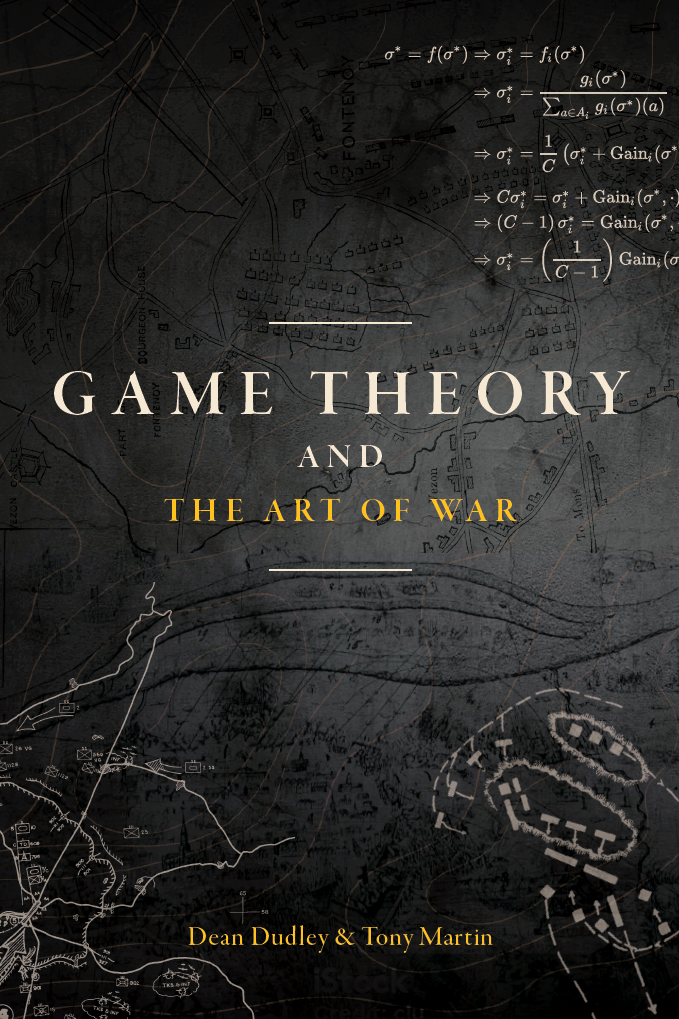
West Point Press offers a free electronic download (pdf format) and an option to request a physical copy with this note: “As part of our open access publishing model, West Point Press provides physical books at no cost to recipients (while supplies last), and all shipping costs are covered by the Press.” So I both downloaded and ordered a copy.
That was a Monday night. The book arrived in the Thursday mail drop. I am so glad I ordered it because the book is exactly what the wargame practitioner in me was searching for.
As somebody who is not heavily steeped in the mathematics of Game Theory—but seeks to become a wargame practitioner focusing on analytic wargaming—Dudley & Martin’s intent for Game Theory and the Art of War strongly resonates with me:
The central purpose of this book is to reposition game theory not as an abstract mathematical enterprise but as a practical discipline of strategic reasoning. Game theory is the thought arena in which competitors’ choices are analyzed as they interact and unfold into outcomes. By stripping away unnecessary formalism while preserving analytical rigor, we demonstrate how game theory can be used to clarify strategic-choice environments, identify credible courses of action, and explain why reasonable leaders sometimes arrive at profoundly different decisions. In doing so, we seek to make game theory accessible to practitioners without diminishing its explanatory power.
Across the chapters, the game-theoretic thought process develops cumulatively. We begin by defining what it means to “make the game”: to choose an appropriate level of abstraction, identify relevant players (including nonstrategic actors, such as Nature), specify feasible courses of action, and assign meaningful valuations to outcomes. This foundational work is not ancillary to strategy; it is strategy. As the parables of maps and models illustrate, the utility of any analytical framework depends on its appropriateness to the decision problem at hand. Too much detail obscures what matters; too little distorts reality.
From this foundation, we move to “playing the game”—that is, to understanding how rational, empathetic actors behave once the structure of the game is specified. We introduce concepts such as rational choice, dominant strategies, Nash equilibrium, and sub-game perfect equilibrium not as ends in themselves but as tools for anticipating behavior and evaluating choices. Through examples ranging from siege warfare to amphibious invasion, we show how backward induction and expected-value reasoning allow leaders to reason forward through uncertainty and then back toward sound decisions.
Dudley & Martin, pp. 275-276
Using Game Theory as an analytical framework is what the Game Theory classes were teaching, but Game Theory and the Art of War delivers the concept in terms that are more understandable to me. As Dudley & Martin assert:
This insight points to one of the book’s most important contributions: the treatment of beliefs and scenarios as central objects of strategic analysis. Strategic disagreement is often mischaracterized as incompetence, irrationality, or bad faith. Game theory offers a more charitable—and more useful—interpretation. When leaders disagree, they may be playing different games, informed by different experiences, assumptions, and probability assessments. By making those assumptions explicit, game theory transforms disagreement from a clash of personalities into a contest of models that can be examined, debated, and refined.
When leaders disagree about the probability distribution that their competitors will apply to strategy mixes in a game with uncertainty, the leaders can assess whether their beliefs are rational. For beliefs to be rational, they must be consistent and logical about the opponents’ rational actions given the game’s structure. Mixed strategy equilibrium is a powerful tool to eliminate irrational beliefs and scenarios, allowing leaders to assess and prune away irrelevant game formulations.
In this sense, game theory serves not only as an evaluative tool but also as a communicative one. It provides a common language for articulating why a course of action appears attractive, what assumptions sustain that judgment, and where points of genuine uncertainty lie. For military organizations—where persuasion, coordination, and shared understanding are as vital as command authority—this function is indispensable.
Dudley & Martin, pp. 276-277
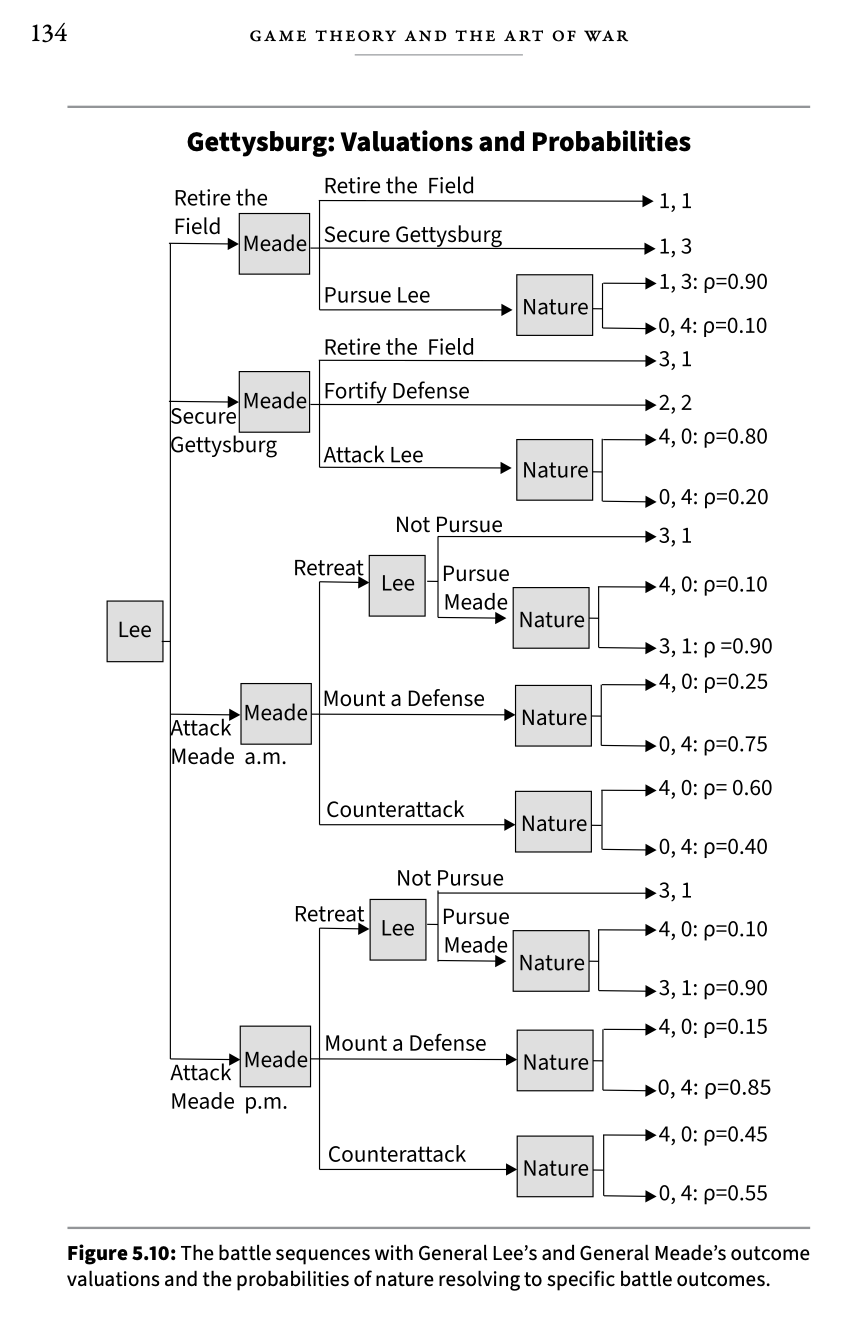
In the course of the classes on Game Theory I struggled to fully grasp many of the seemingly abstract concepts. This is where the case studies in Game Theory and the Art of War helped build my understanding. For example, here is The Battle of Gettysburg—always a popular battle for wargames to play or study—shown using the framework in Game Theory and the Art of War:
A second, more comprehensive, example is Operation Overlord:
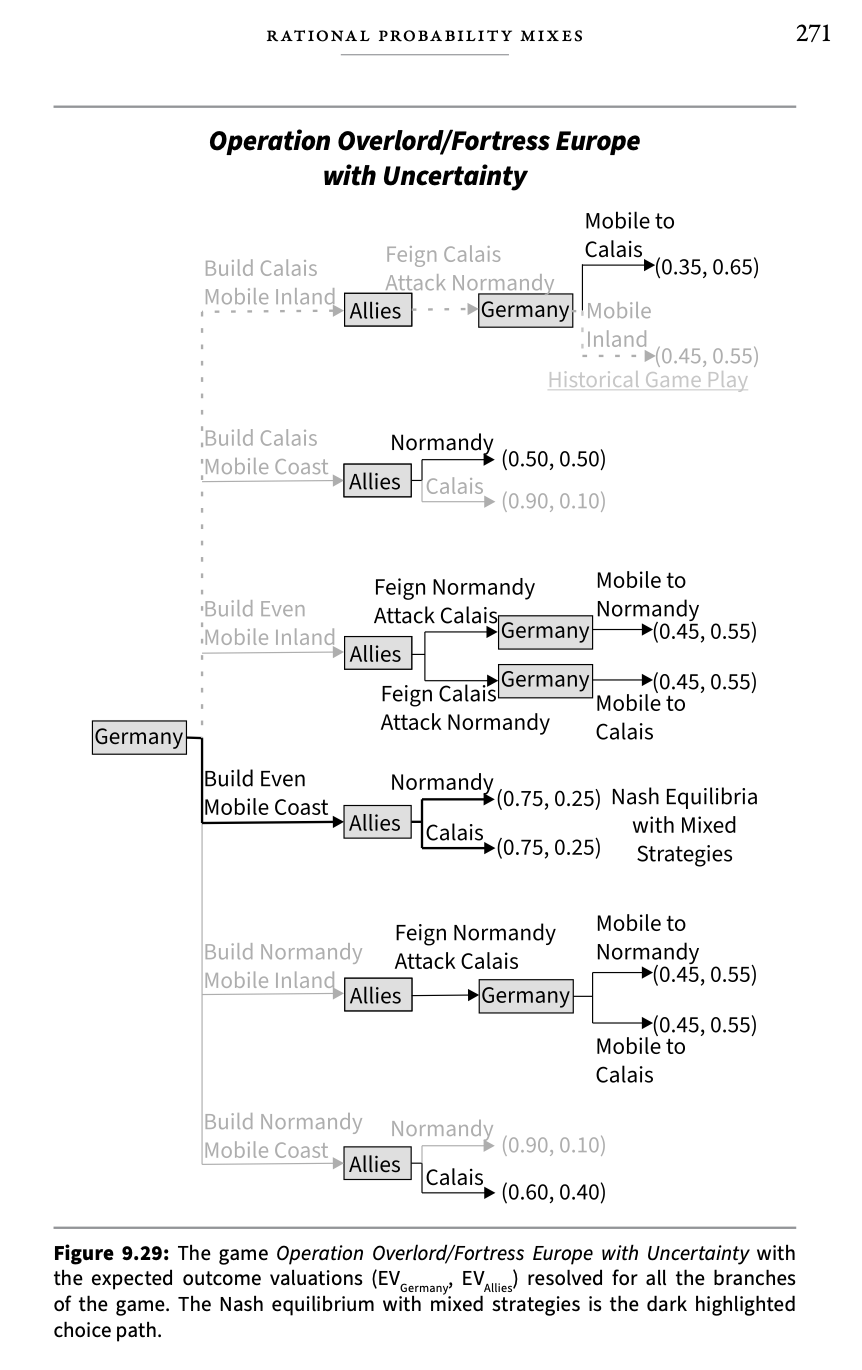
I do not expect the average reader to understand the above figures but by reading Game Theory and the Art of War you will be able to understand what is shown…and apply those concepts to your own wargame designs.
I also appreciate—and take heed of—the authors warning in Game Theory and the Art of War about the limits of Game Theory and wargame models:
At the same time, we have been careful to acknowledge what game theory cannot do. Models are abstractions, not mirrors of reality. They simplify, omit, and stylize. They depend on assumptions that may be wrong or incomplete. No equilibrium concept can capture the full richness of human motivation, organizational dysfunction, or chance. Recognizing these limitations is not a weakness of the approach but a condition of its responsible use. Game theory disciplines thinking; it does not absolve decision-makers of responsibility for judgment.
Several implications follow from this recognition. First, the value of game theory lies less in the precision of its predictions than in the clarity of its reasoning. A well-constructed model can be useful even if its quantitative estimates are imprecise, so long as it illuminates strategic structure and highlights critical dependencies. Second, disagreement among models should be expected and welcomed. Competing games reflect and provide form to competing understandings of reality, and progress often comes from examining why those understandings diverge.
Dudley & Martin, p. 278
As a wargame practitioner, I also welcome the challenge that Dudley & Martin lay out in Game Theory and the Art of War:
Finally, this approach invites further work. Future research might integrate richer behavioral assumptions, explore learning and adaptation over repeated interactions, or combine game-theoretic reasoning with empirical simulation and historical data. For practitioners, the next step is not more mathematics but more practice: applying these tools to new cases, refining assumptions, and cultivating the habit of explicit strategic reasoning [my emphasis].
Dudley & Martin, p. 278
Game Theory and the Art of War is not a read-once-and-file-away book. For a wargame practitioner, especially one who wants to answer Dudley & Martin’s challenge, this book almost certainly will become a key text in your library and game design toolkit.
Feature image courtesy RMN
The opinions and views expressed in this blog are those of the author alone and are presented in a personal capacity. They do not necessarily represent the views of U.S. Navy or any other U.S. government Department, Service, Agency, Office, or employer.
RockyMountainNavy.com © 2007-2026 by Ian B is licensed under CC BY-SA 4.0

