
Unlike so many trigger warnings in products from Wizard$ of the Coa$t, the production note for 4th Reich: “The Iron Dream” and the Great Return by Dana Lombardy and republished in Japanese by Bonsai Games in 2026 confronts the past without kowtowing to the snowflake masses:
Production Note: This is the Japanese edition of 4th Reich, originally published by Task Force Games in 1985. The game is set in the world—‘nightmare’—of Norman Spinrad’s 1972 science-fiction novel The Iron Dream, a metafiction presented as the second edition of of a fictional novel by Adolf Hitler. The game was designed as a satire of the Nazi imagery being consumed as pop culture, including in early wargaming. Some terminology and imagery do not meet current standards of compliance; this edition follows the original as closely as possible in respect to designer Dana Lombardy’s intent.
1.0 Introduction, 4th Reich (Bonsai Edition, 2026); translation using GPT-5.6 Luna
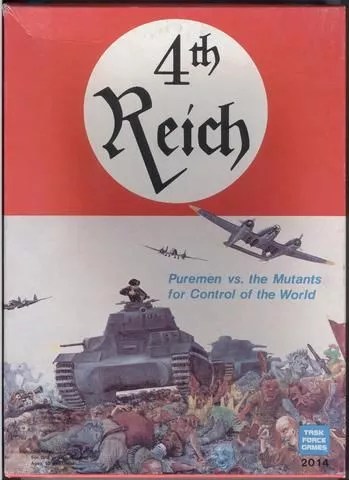

The BoardGameGeek listing for the original edition of 4th Reich describes the game this way (and kudos to the author for not just repeating the publisher’s blurb!):
“4th Reich: Puremen vs. the Mutants for Control of the World” is a somewhat obscure wargame by Task Force Games based on (albeit without attribution) the SF-novel “The Iron Dream” by the Jewish author Norman Spinrad. This very controversial novel describes a parallel world in which Hitler wasn’t successful with his “Kampf” in Germany and became a successful SF-pulp-novelist in the US. The main part of the book is the actual text of Hitler’s “Iron Dream”, a pulp-tale about “Ubermenschen” conquering a future world filled with mutant “scum.” The idea of Spinrad’s novel was to expose fascist tendencies in 50’s American literature. The TFG designers transported this “theme” into a board game which plays like a wargame: future Nazis against future mutants. The names of all protagonists have been changed in an apparent attempt to avoid infringement, but the game clearly takes its slightly tongue-in-cheek approach directly from the book.
[Interlude – Wargame Fascinations]
4th Reich is published in a special Showa edition of Banzai Magazine featuring wargames published in 1985. The magazine also addresses the issue of fascism in wargame culture—at least in America—by including an Analog Game Studies article from 2019 titled, “PLAYING THE NAZIS: POLITICAL IMPLICATIONS IN ANALOG WARGAMES” which discusses early wagaming’s fascination with fascism (albeit, sadly, with no mention of 4th Reich):
Some members of the wargame community were not simply “proud American patriots”, or non-political military history buffs. Some wargame clubs and fanzines went so far as to show signs of pro-Nazi sympathies…The question was openly discussed inside the community. In 1972, Stephen Patrick wrote an article in Moves, a “real” magazine, not a fanzine. It was titled “The Rommel Syndrome, or Wargames as a Snare and Delusion.” The author lamented the lack of respectability of wargame as a hobby, because it was “frequented by odd people who like to wear steel helmets around the house.” It was not just some crazy fringe of the wargame world. Donald Greenwood was so successful with Panzerfaust, that in 1972 he was hired by Avalon Hill, the major company in the business, to run its house press organ, The General. The titles and box covers of some games openly titillated the “worst instincts” of their audience. On the box cover of John Hill’s Squad Leader (1977), a tactical game set in World War Two, and one of the most successful wargames ever released, there is a Waffen-SS soldier, with Totenkopf insignia clearly visible on his collar… .
…
Should we assume that there was a morbid fascination with Nazism among wargamers? I would say “yes”, at least in part. One of the most important sections of the aforementioned magazine The General was the “Opponents Wanted” page. In the pre-Internet era, finding somebody living in your area who shared your very peculiar hobby was not an easy task. Wargamers used ads to find playing mates. Several of these ads clearly state a preference for playing the Germans –or even the Japanese– in games on World War Two. Some ads go even further, like one from a 1971 issue, which reads: “The Fuehrer desires a good Joe to crush in Stalingrad.” Actually, some of the interest in playing the Nazis has strictly technical reasons. Besides games specifically devoted to the last phase of the conflict, in World War Two games the German player is usually the one on the offensive, at least in the first part of the game, and one could argue that wargamers normally prefer to attack. In some ads, authors say that they prefer playing the Germans in games where the Axis has the initiative, but want to play the Allies in Anzio (1969), a game about the Italian campaign, where the Germans are on the defensive from the very beginning. Moreover, one of the main pleasures in playing a wargame is achieving a result that is different from the historical outcome. You thus might want to win World War Two with the Axis, as you might want to win the battle of Waterloo with the French. It would then mean that you would have been “smarter” than Napoleon. Nonetheless, dismissing this whole phenomenon with simply technical reasons would be naïve and misleading. There was a fascination with Nazism. After all, in the 1970s, Nazi paraphernalia were widespread in American and European popular culture. Susan Sontag’s well-known 1975 essay Fascinating Fascism elaborates on this point in detail. Wargames were following the current.
1/4 Reich?
BoardGameGeek describes the original 4th Reich as a, “Simple, off-the-wall sci-fi wargame… .” If the 2026 Japanese edition truly is a faithful reproduction then “simple” is an understatement—especially as it pertains to components.
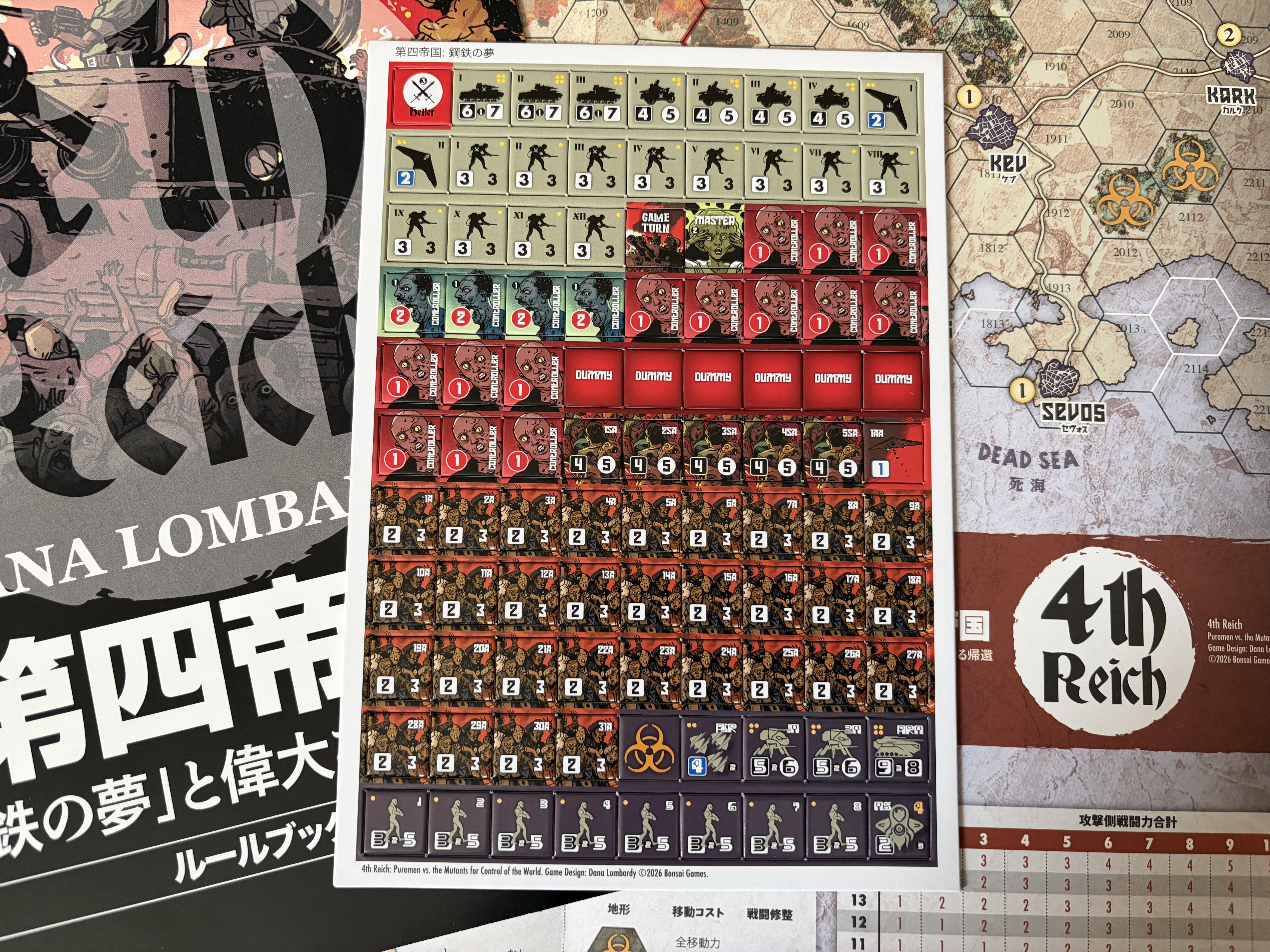
4th Reich ships with a small 12-page rulebook that covers not only the core game rules but also Solitaire Rules (12.0) and a special three-player variant (“The Great Return”, 13.0). The map is ~16.5” x ~23.5” and laid out in portrait orientation. The game map includes player tracks and tables (such as Terrain Effects Chart and Combat Results Table) arranged so that each player can see their charts as they sit across from each other over at the short edges of the map.1 The small half (?) counter sheet of 9/16” counters number but 99.
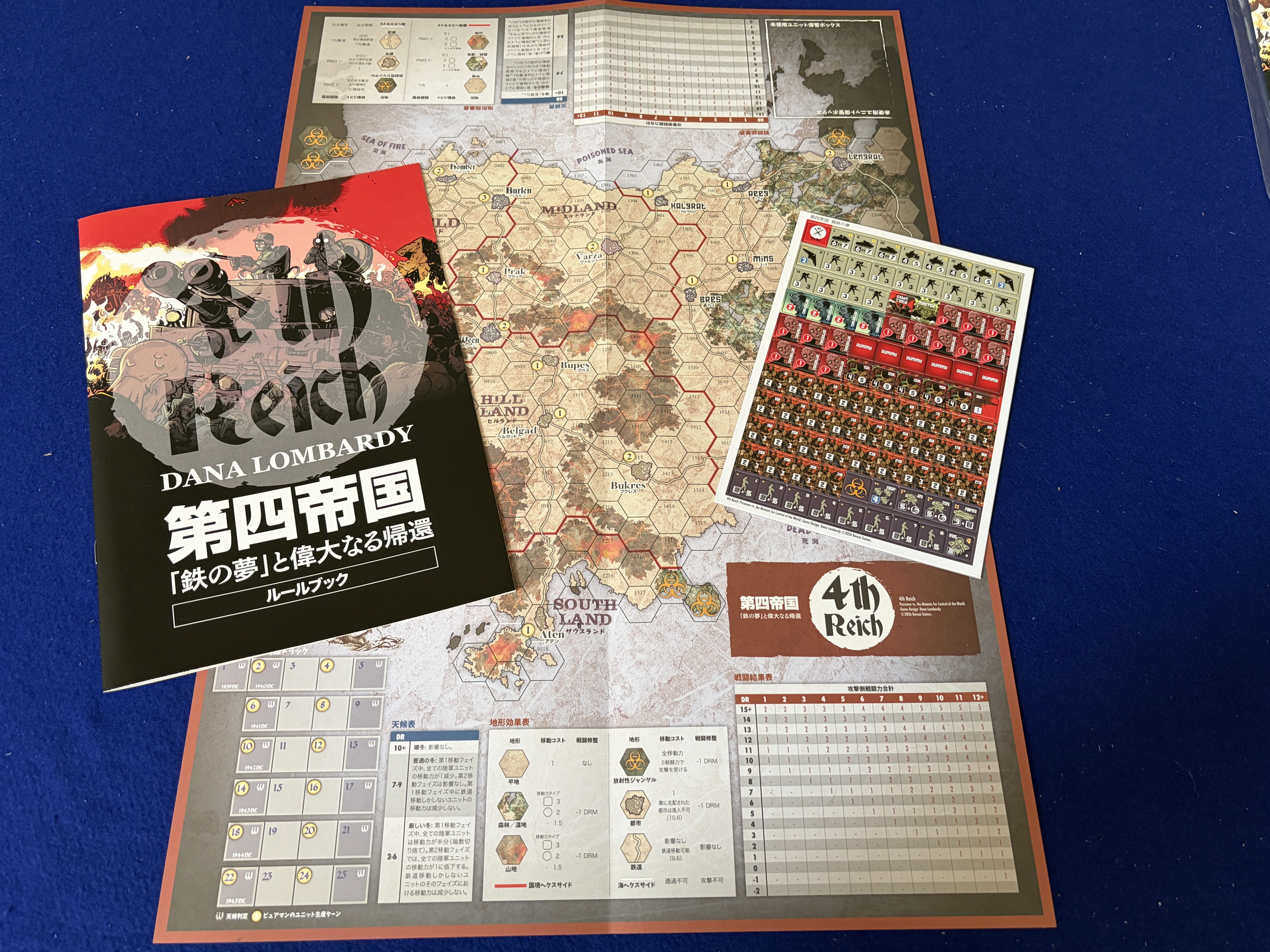
The map shows part of Earth 2,000 years after the nuclear war. Radioactive regions still exist. Continents are separated by radioactive jungles and wastelands created by the Great Flame. Melting polar ice, rising seas, volcanic activity, and earthquakes have further reshaped the planet. Seven countries appear on the map: Gerd, the Pureman homeland; Eastland, the mutant motherland; and five smaller countries largely under mutant control.
2.1 Map, 4th Reich (Bonsai Edition, 2026); translation using GPT-5.6 Luna
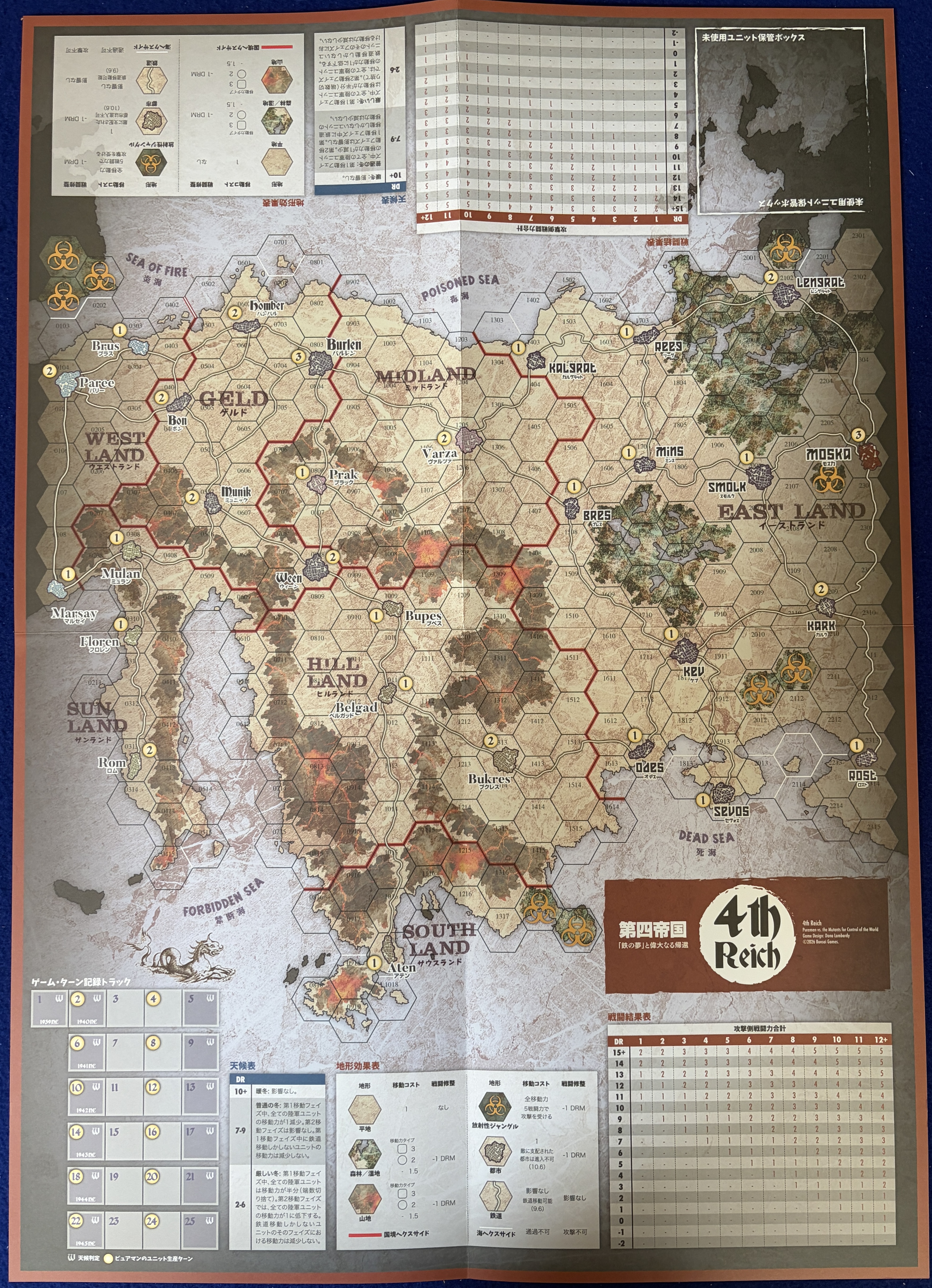
Unit counters in 4th Reich are very simple with Leaders and combat units. Most show only movement allowance and combat strength. The most important counters are not the combat units but those Leaders—supreme leaders for each side and mutant controllers—that are used in combat (see 10.2 Leaders in Combat) and for Production and Mobilization (11.0).
DIB wargaming2
Somewhat counterintuitively for what looks like a “classic” wargame, rule 11.0 Production and Mobilization in 4th Reich is perhaps the most important rule in the game. For the Pureman player, production depends on cities and the number of production points the cities produce directly relates to the total production point value of available units. Many cities give the Pureman player many units; too few cities and the number of units available for fielding is limited. For the Mutant player, Controllers in cities provide mobilization points for units. The Mutant supreme leader (“Master”) is the only Controller that can mobilize Special and Air units or resurrect dead Controllers.
Where the game design of 4th Reich shows some age is the Victory Conditions; as originally designed the game may run longer than many players today might tolerate for such a “simple” game design. The Pureman player wins if they control all 29 cities and remove every mutant Controller and mutant army from the map (4.1). The Mutant player wins if they control all five Gerd cities and remove all Pureman units from the map (4.2). If neither player wins by the end of Turn 25 (!) the game is a Draw.
Then again, playing 4th Reich likely will be relatively quick playing thanks to a “simple” Sequence of Play. Every game turn has six steps:
- Weather Determination
- Production/Mobilization (Pureman/Mutant)
- Pureman player turn – First Movement, First Attack, Second Movement, Second Attack
- Mutant player turn – First Move, First Attack, Second Move, Second Attack
- Turn End phase (5.0 Sequence of Play)
4th Reich, like so many wargames of its time, uses familiar game mechanisms like Zone of Control (7.0), movement by movement points (9.0), and an odds-based Combat Results Table (CRT). In the Solitaire Rules (12.0) the player is the Puremen.
While the game rules in 4th Reich are “simple,” that is not to say the game mechanisms used are staid and boring. Some of the “interesting” implementations are:
- Pureman Turn: Second Movement up to 1/2 movement allowance; Second Attack by Hetler and Tank/Mechanized Corps (5.2)
- Mutant Turn: First Movement only by Controllers that did not mobilize; First Attack must be stacked with a Controller; Second Attack only by Master, Controllers, and Special armies (5.3)
- Mutant ZoC crosses borders; Pureman ZoC does not cross border until invaded (7.0)
- Alternative orders of battle at start using alternate listings or based on combat strength limit (promotes replayabilty) (14.6).
The three-player variant of 4th Reich—called “The Great Return” is a scenario drawn straight from science-fiction:
After the nuclear war, two huge starships left Earth—one from North America and one from Siberia—About 2,000 years later, one returned. Unable to use its intended landing site, it headed for Europe. The Returners possess overwhelming technology and enter the war between the Puremen and the mutants.
13.0 Three-Player Variant: “The Great Return”; translation using GPT-5.6 Luna
2,000-year Reich
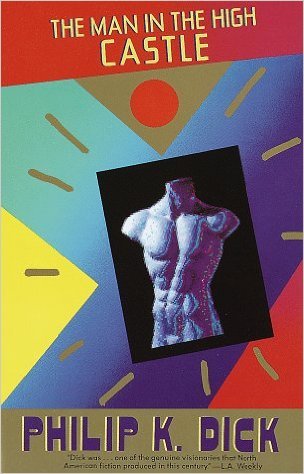
At the risk of people misunderstanding what I am about to say, the 2026 Banzai-edition of 4th Reich is a good game. Yes, the game uses a sensitive theme but—look at that magazine and rules cover—it confronts the topic with tongue firmly planted in cheek. This is clearly a satirical alternate-future setting, in some ways not so different from a book like The Man in the High Castle.
Stripping out the “Hetler” references, 4th Reich is a science-fiction wargame set in a far future, post-apocalypse Europe pitting a smaller mechanized army against a larger infantry-based army. If you are still not convinced, look at “The Great Return” variant which easily could skew towards awful themes but—with tongue again firmly planted in cheek—instead goes the bizarre UFO route. In fact, though the Returners are originally from North America (United States?) and Siberia (Soviet Union?) in this game they are just purple units when they land with no identification beyond “Returner.”
Given the state of the American boardgame industry—and especially those loud political voices in the hobby boardgame clique that pose themselves as the soul of the hobby—a game like 4th Reich almost certainly will never be published in the United States. Perhaps the game could be reskinned to remove the “offensive” elements. Realistically speaking, the most offensive parts in 4th Reich are the name of the game, the “pureman” term, and the not-so-veiled reference using “Hetler” as the name for a leader. Note that, even in the original version, there are no swastikas or other idolatry such as SS runes or the like used.
More sanguinely, I sense the absence of games like 4th Reich in the U.S. is proof that few hobby gamers—and particularly loud influencer-posers—understand satire. Better to just ignore the issues and wish them away…
- Bonsai Games—more so than any other wargame publisher I can think of—usually considers the player experience at the map and often arranges tables and charts so that each player can easily see them. THANK YOU, YASUSHI! ↩︎
- DIB = Defense Industrial Base. ↩︎
Feature image courtesy RMN
The opinions and views expressed in this blog are those of the author alone and are presented in a personal capacity. They do not necessarily represent the views of U.S. Navy or any other U.S. government Department, Service, Agency, Office, or employer.
RockyMountainNavy.com © 2007-2026 by Ian B is licensed under CC BY-SA 4.0


Interesting, Not a novel on my radar previously, oddly enough. Great write-up.
I’ve read the novel (which didn’t hook me), but the game concept sounds like fun. Unfortunately I must have at least fifty war games (BGG says exactly fifty, whaddya know?) and never have the opportunity to play any of them, so I won’t be picking this one up. As to the other issue mentioned, there have always been people fascinated by wars and history and various factions and cultures. And without holding any of the same beliefs or posthumously “taking a side.” Sometimes I like to play the Klingons. They have the coolest ships. Doesn’t make me a bad person.