
Magazine wargames are often limited in some form or manner. Many times the limitation derives from the small form factor inherent in a magazine wargame; smaller map, fewer counters, less (or no) play aids, and a shorter rulebook. All too often the publishing schedule for a magazine also necessitates releasing less developed wargames or fall back on a “proven” game design with just another thematic “skin” pasted on. The magazine wargame in the Spring 2026 edition of Banzai Magazine #29—Battle for Kirovograd: Setting the Trap, Russia, January 1944 by designer Jim Zoldak published by Bonsai Games, fortunately for us grognards, avoids the worst magazine publishing pitfalls. Battle for Kirovograd is small in form factor but big in delivering a historical conflict simulation with the use of an innovative game mechanism allowing players to refight what was a highly fluid battle.
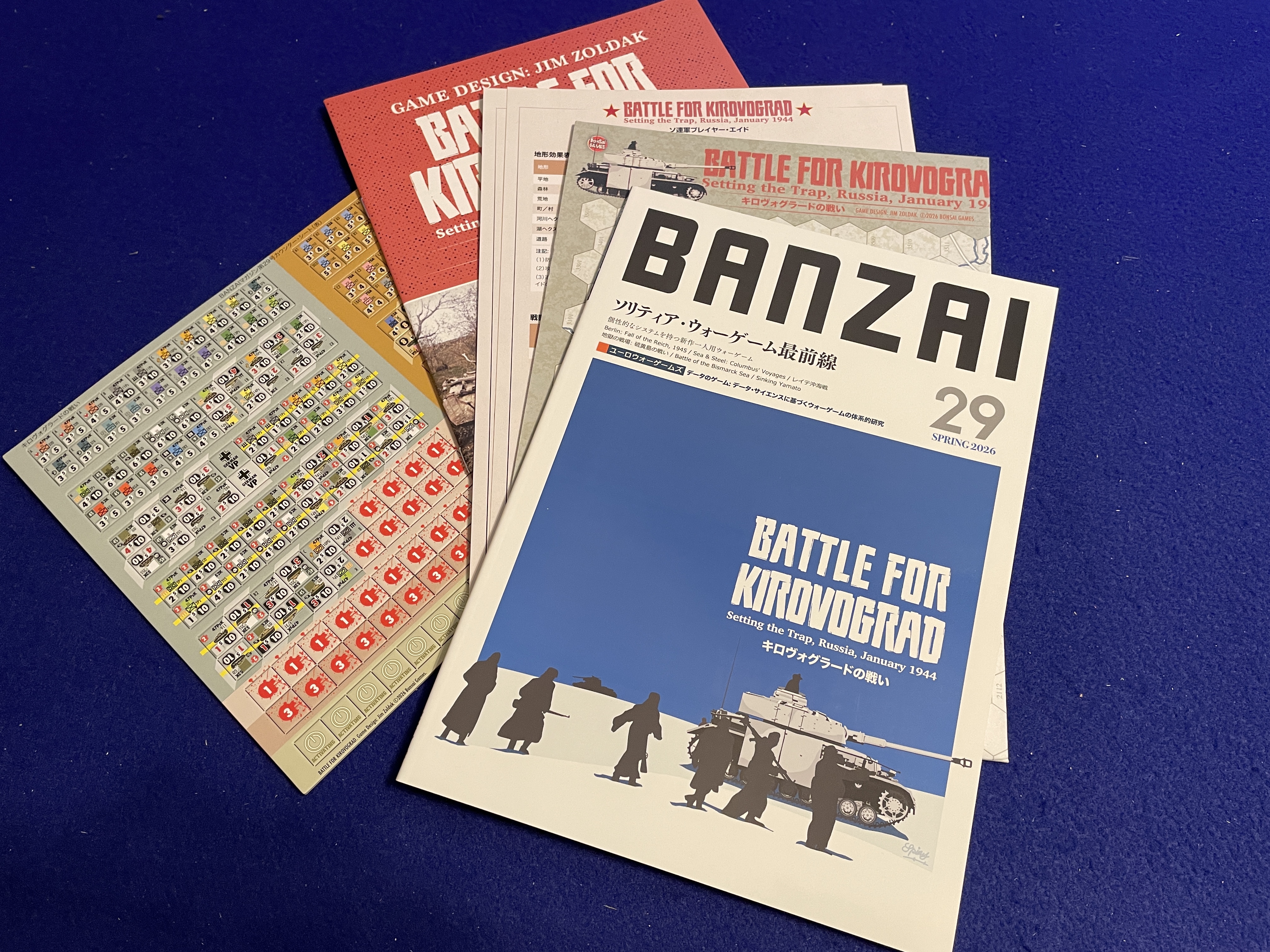
Here is the Bonsai Games blurb for Battle for Kirovograd:
Winter 1943 to 1944. The German army in southern Russia was in a very difficult situation. Soviet troops recaptured Kiev in November and continued to advance to surround the German army on the banks of the Dniepr River. In January 1944, Koenev’s 2nd Ukrainian Front Army captured Kirovgrad, a strategic supply center, and devised a plan to annihilate the 8th Army.
The appendix game “The Battle of Kirovoglad” is an operational game that depicts the Red Army offensive and the German army’s counterattack and retreat.
The designer is Jim Zordak of “Corsun Siege 2”, a siege and escape battle that occurred after this work. Unlike conventional war games, there is no separation of fixed procedures such as movement phase and combat phase, and players can freely mobilise troops during their turn to attack, or rebuild or break through the front line that has been broken by the enemy. We have adopted a game system that is ideal for reproducing fluid battles that can immediately counterattack the enemy.
Battle for Kirovograd, Bonsai Games webpage; translation Japanese to English in DuckDuckGo browser
When it comes to the Eastern Front in World War II, wargamers are most likely to play large, better known battles such as the initial invasion (Operation Barbarossa), the Battle for Moscow, or the Battle of Kursk. There were, of course, many other battles—like Kirovograd—that also have their place in history books but less often are found on the gaming table.
The Kirovograd Offensive (5–16 January 1944) was a major Soviet military operation on the Eastern Front of World War II, conducted by the Red Army’s 2nd Ukrainian Front under General Ivan Konev against German forces in the Kirovograd region of central Ukraine, as part of the wider Dnieper-Carpathian Strategic Offensive aimed at liberating Right-Bank Ukraine from Nazi occupation. The offensive sought to encircle and destroy elements of the German 8th Army, including the XLVII Panzer Corps, by launching converging attacks from the north and south to capture the key rail and road hub of Kirovograd (now Kropyvnytskyi), thereby splitting German defenses in the Dnieper River bend and supporting adjacent fronts in broader envelopments. Although Soviet forces penetrated German lines and seized Kirovograd on 8 January, rapid German counterattacks prevented the complete annihilation of trapped units, resulting in a tactical Soviet victory that advanced the front line westward by 20–30 km but stabilized the German position by mid-January amid harsh winter conditions.
Grokipedia explains the significance of the Kirovograd offensive:
The Kirovograd offensive exemplified the Soviet Red Army’s evolving operational art in late 1943, achieving localized breakthroughs through massed artillery and tank assaults but ultimately failing to execute a full encirclement of German forces due to overly ambitious objectives and the harsh winter conditions that hampered logistics and mobility. The operation highlighted Soviet tendencies toward deep penetrations without adequate flank security, allowing German panzer units to counterattack effectively and escape potential pockets. Tactically, the 2nd Ukrainian Front under General Ivan Konev succeeded in capturing Kirovograd on January 8, 1944, disrupting German supply lines, yet the failure to close the encirclement stemmed from dispersed armored thrusts that left vulnerabilities exploited by mobile defenses.
(Little) grand Kirovograd
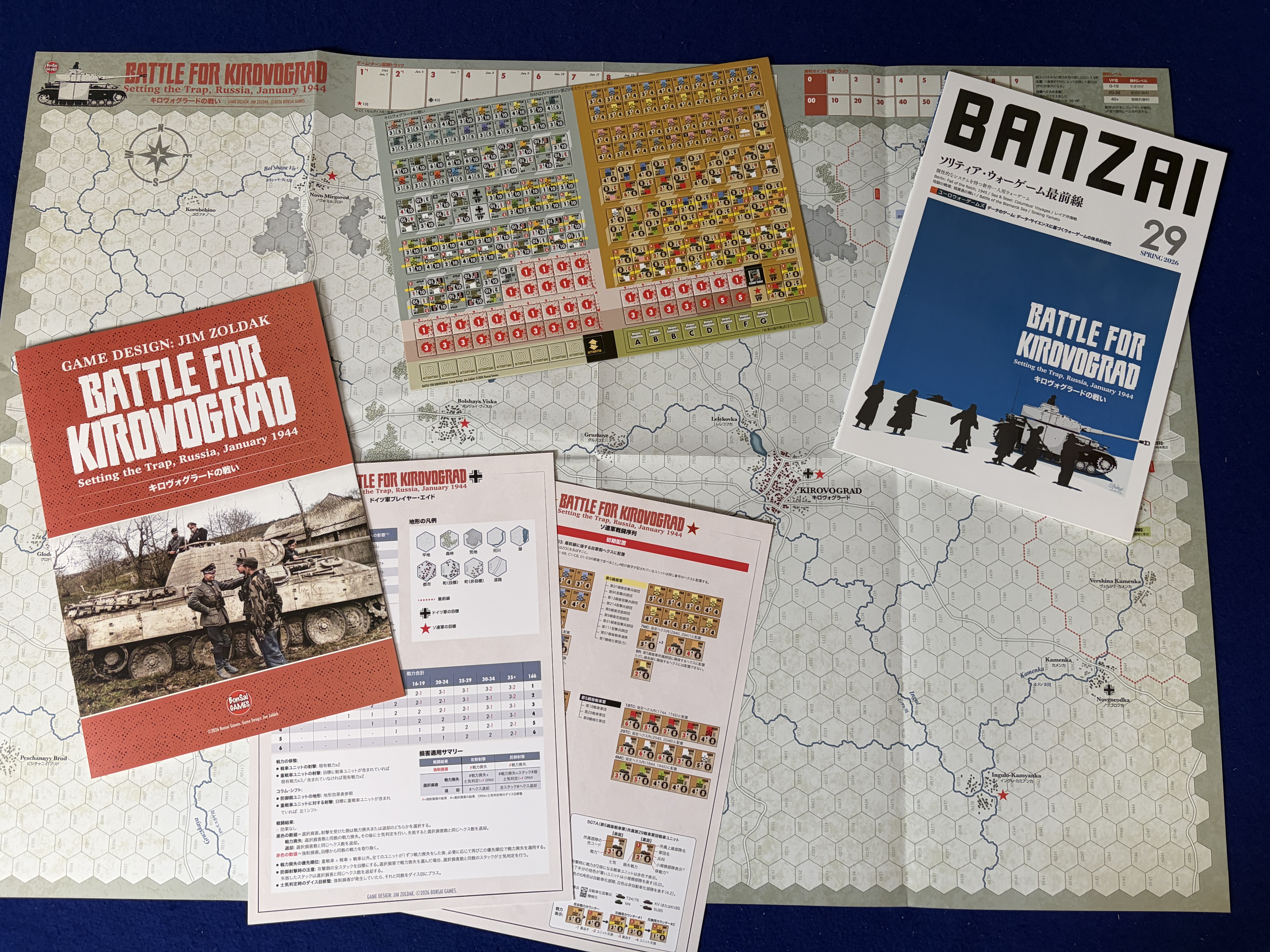
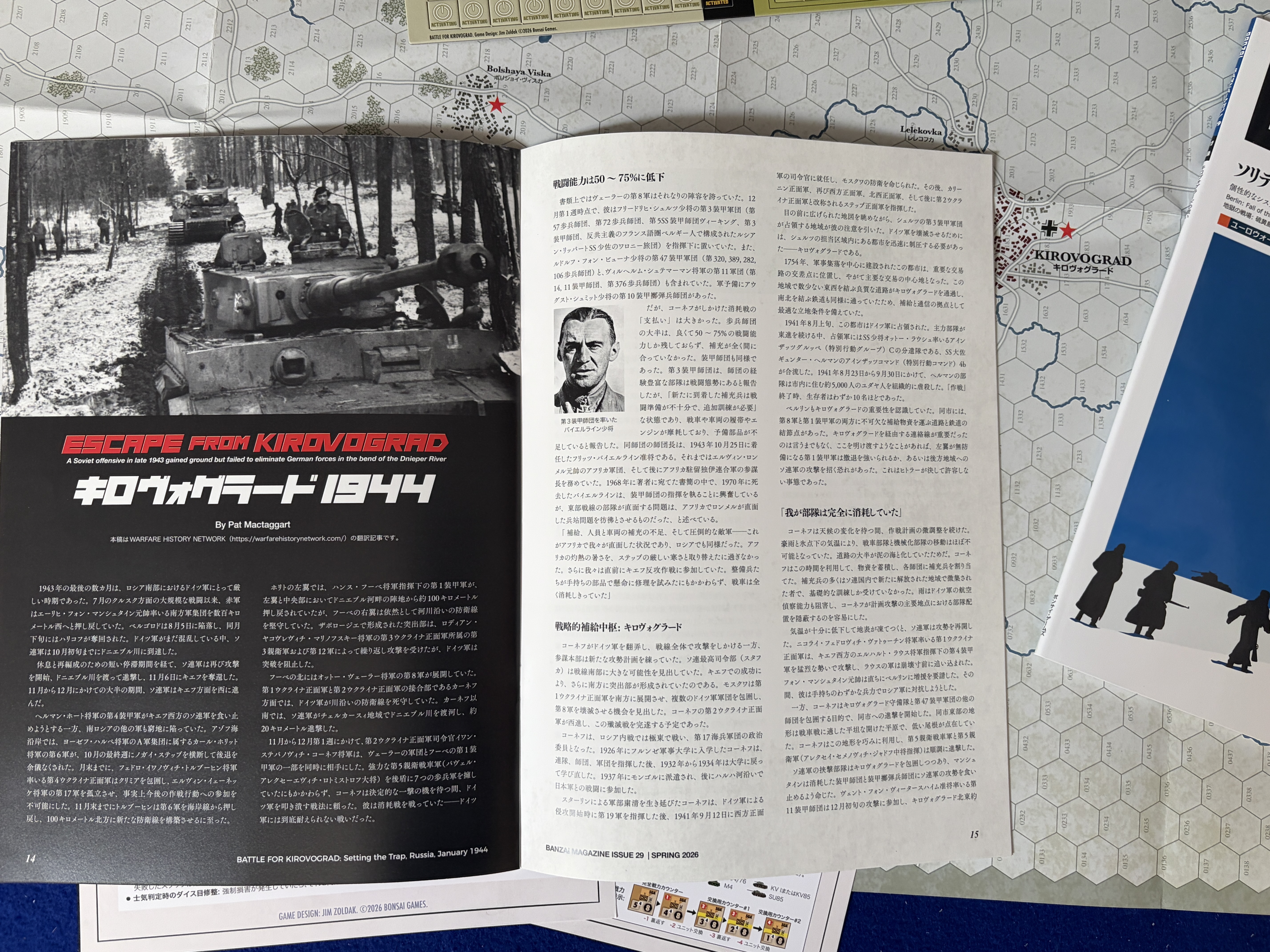
As befits a magazine wargame, Battle for Kirovograd is small on components. That said, the A1-size map is one of the larger Bonsai Games offerings coming in just a shade under 23” x 34”. The rulebook is 24 pages long divided into 10 pages of rules, three pages for an Extended Example of Play, and 10 pages of historical background republishing Pat Mactaggert’s “Escape from Kirovograd” article from 2015 published by warfarehistorynetwork.com. Two play aids are included tailored to either the German or Soviet player. The single counter sheet is 260 counters at 13mm (~9/16”) size. “Each game turn represents one day. The distance across a hex is 2 miles (3.2 km). Units represent battalions, regiments, brigades, or divisions” (1.1 SCALE).
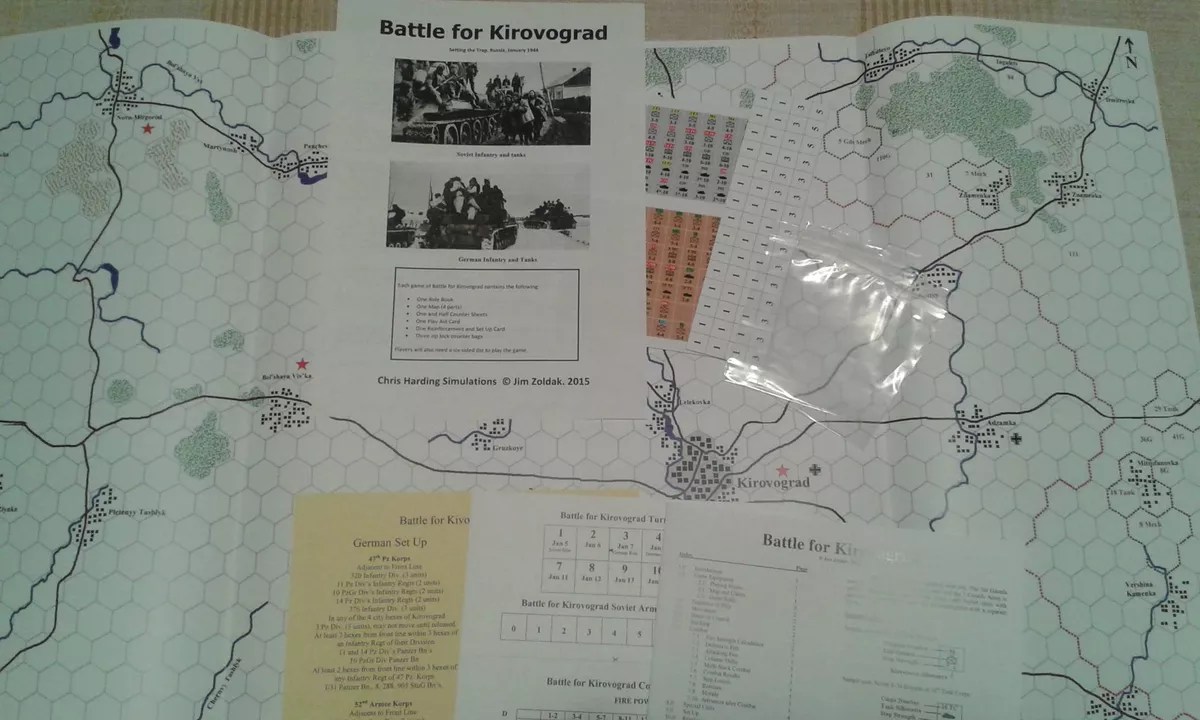
Of note, the Bonsai Games edition of Battle for Kirovograd is technically the second edition of this game. The original Battle for Kirovograd was published in 2015 by Chris Harding Simulations. The obvious quality improvement of components in the Bonsai Games edition is clearly evident—and not a backhanded swipe against the original production. We all should be thankful that publishers like Yasushi Nakaguro at Bonsai Games seeks out these older—yet enjoyable—titles and gives them the “Bonsai Treatment” so a new audience can enjoy them today.
Battle Fluid
Recall the final claims in the publisher’s blurb for Battle for Kirovograd: “Unlike conventional war games, there is no separation of fixed procedures such as movement phase and combat phase, and players can freely mobilise troops during their turn to attack, or rebuild or break through the front line that has been broken by the enemy. We have adopted a game system that is ideal for reproducing fluid battles that can immediately counterattack the enemy.”
In Battle for Kirovograd, movement and combat are integrated into an innovative game mechanism that helps recreate a battle of “dispersed armored thrusts” and “mobile defenses.” Instead of using a classic, rather vanilla, move-shoot turn phase construct, Battle for Kirovograd uses an integrated movement and combat approach where one—or multiple—units move into attack positions before resolving combat as a group. The catch, however, is that each “activation” of attackers must move and fight before another unit or group activates.
As rule 3.0 Sequence of Play of Battle for Kirovograd explains: “There are no separate movement and combat phases. During a player’s turn, that player may alternate movement and combat in any order, subject to these restrictions:
- Each unit may move once and attack once.
- A unit may move and then attack, but may not move after attacking.
- After attacking—or after ending movement without attacking—turn the unit to its activated orientation.
- Units preparing a combined attack are marked active until all participating movement is complete.
- At the end of the player-turn, turn all friendly units to the activated orientation.
- Defensive fire during the enemy turn does not prevent normal movement and attack during the next friendly turn. (3.0 SEQUENCE OF PLAY, translated Japanese to English using GPT-5.6 Luna)
The specific rules that integrate movement and combat include [translation Japanese to English using GPT-5.6 Luna]:
- 4.0 MOVEMENT – Move one unit at a time. Each hex entered costs MP [Movement Points] for its terrain and the terrain on the crossed hexside. Units may not enter enemy-occupied hexes or leave the map.
- 4.4 COMPLETING MOVEMENT
- Ending in a hex not adjacent to an enemy prevents that unit from attacking this turn.
- A unit that moves adjacent and attacks immediately resolves combat then becomes activated.
- If a unit ends adjacent and awaits other units for a combined attack, mark it active. Moving a non-participating friendly unit before resolving the attack cancels the attack and activates the waiting units. [nvb -the game’s “activation” mechanism and the important first part of the move and shoot approach.]
- 7.0 COMBAT
- The player conducting attacks is the attacker; the opponent is the defender. Combat is voluntary, with no requirement to attack adjacent enemies.
- Each attacking unit may attack once per turn; a defending unit may be attacked multiple times. A stack may attack all or part of its units, but every unit in the attacking stack is considered to have attacked and becomes activated. A stack may not select only part of an enemy stack as the target. [nvb – the second part of the integrated move-shoot construct that makes the entire integrated move and shoot activation phasing work.]
- Resolve each attack:
- Select one target hex and attacking units.
- Defensive Fire: The Defender totals the strength in the target hex and rolls once. Only units in the target hex conduct defensive fire.
- Offensive Fire: Apply defensive-fire results, total surviving attack strength, and roll once.
- If all defenders are eliminated or retreat, attacker’s may conduct combat-after advance.
- 7.4 MULTIPLE-STACK ATTACKS
- Before resolving combat, the attacker may move any number of friendly units adjacent to the target. One attack targets one hex. A unit already activated may not be moved into another attacking stack and attack again. Units that began adjacent may participate but become activated after the attack. If part of a stack fires, the entire stack is treated as having attacked.
The Design Note for Battle of Kirovograd goes on to explain what makes these rule innovative and the challenges it delivers to players:
The rules are fluid by design: players may move and fight in any order during their turn, creating breakthroughs, immediate counterattacks, and emergency line repair. Soviet success depends on breaking through before German reinforcements arrive; Germany should preserve the line, trade space for terrain, and decide carefully which encircled formations can be rescued.
DESIGN NOTE (translated Japanese to English using GPT-5.6 Luna)
While the integrated move and shoot rules are certainly the featured game mechanism in Battle for Kirovograd, other rules of interest that caught my eye—or are notably absent—include:
- No weather specific rules (it appears the designer treats the bad weather as a constant throughout the battle and any negative effects are built into other rules)
- Combat is resolved using a Defensive Fire – Offensive Fire sequencing (7.0 COMBAT, 7.1 FIRE PROCEDURE
- “…heavy tanks count triple when the target contains at least one enemy tank, otherwise double” (7.1 FIRE PROCEDURE)
- Retreats trigger morale checks (7.5 RESULTS, 7.8 MORALE)
- “When firing at a stack containing an enemy tank, heavy tanks count triple rather than double. When firing at a stack containing a heavy tank, apply one left shift.” (8.1 HEAVY TANKS)
- “Optional: mechanized/Panzergrenadier units count 1.5 times current strength when firing, rounded down. Add the strengths first when firing several units together. Under this rule, German heavy tanks firing at mechanized units still count triple.” (12.1 MECHANIZED (PANZERGRENADIER) UNITS)
Deathly fluidity
Formally, victory in Battle for Kirovograd is determined by Victory Point differential between players. Victory Points are scored for both destruction of enemy units and seizure of key objectives.
Informally, I also judge the “success” of the game design used in Battle for Kirovograd in a positive manner. The integrated move and shoot game mechanism goes far to create a fluid battle with units rushing to come together reinforce a breakthrough or make an immediate counterattack. to repair the front lines. The Soviets need to move quickly before sufficient German reinforcements arrive. The outnumbered Germans must play a careful game of balanced attacks against preservation of forces. Those tensions are present in Battle for Kirovograd and delivered using a smaller-format wargame with relatively simple rules built around an innovative move and shoot game mechanism.
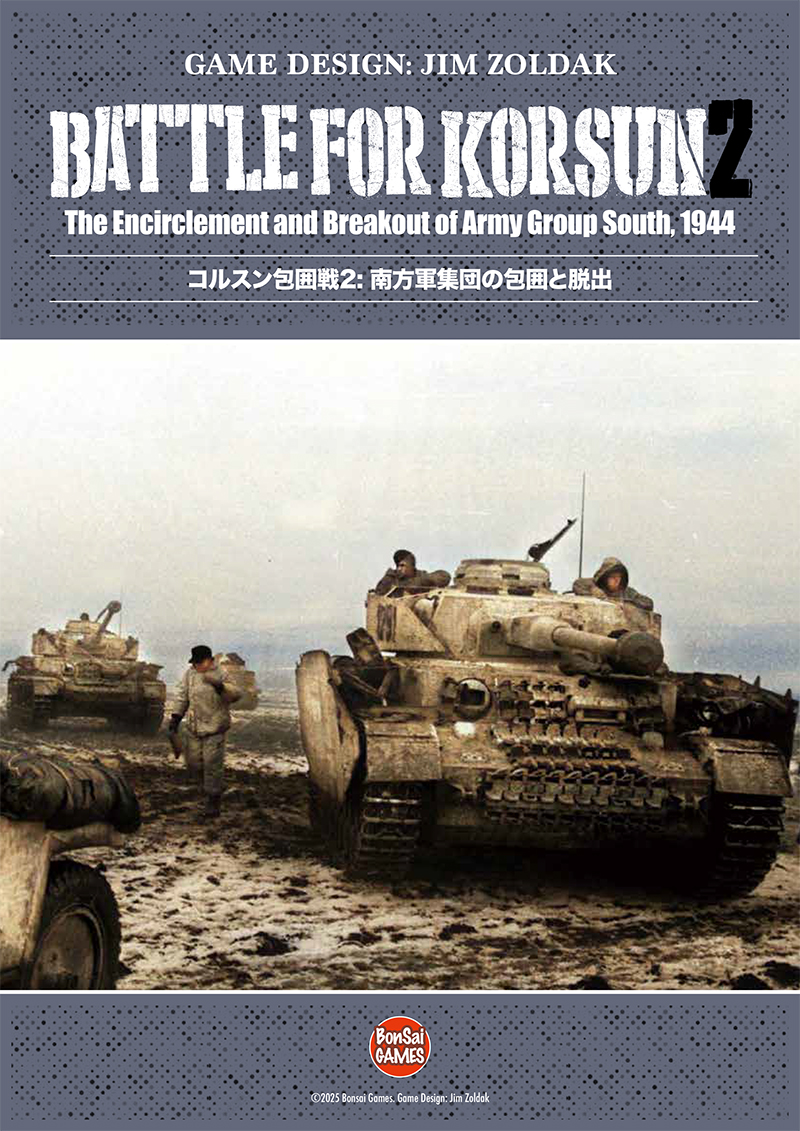
[It appears I also owe Yasushi Nakaguro of Bonsai Games an apology. Yas actually sent me Banzai Magazine Nr. 25 from early Summer 2025 where the appendix game is Battle for Korsun 2 by the same Jim Zoldak that designed Battle for Kirovograd. Unfortunately, I never got Battle for Korsun 2 to my gaming table; if I had I would have discovered Zoldak’s innovative move and shoot game mechanism earlier…and been able to enjoy it for a year longer. Sorry, Yas, I promise to work off the backlog. Your consistency in publishing—or republishing—interesting and innovative games is a great motivator to get Bonsai Games to my gaming table early and often.]
Feature image courtesy RMN
The opinions and views expressed in this blog are those of the author alone and are presented in a personal capacity. They do not necessarily represent the views of U.S. Navy or any other U.S. government Department, Service, Agency, Office, or employer.
RockyMountainNavy.com © 2007-2026 by Ian B is licensed under CC BY-SA 4.0

