
In the course of writing “Wargame SITREP 26-38” I came across a very new book (first published July 2026) about the history of Simulations Publications, Inc. (SPI). Although there is much information available on the internet, I was nonetheless intrigued. What I discovered is what I think is (hopefully) a graduate thesis that recounts the history of SPI, sometimes in business or systems engineering terms.
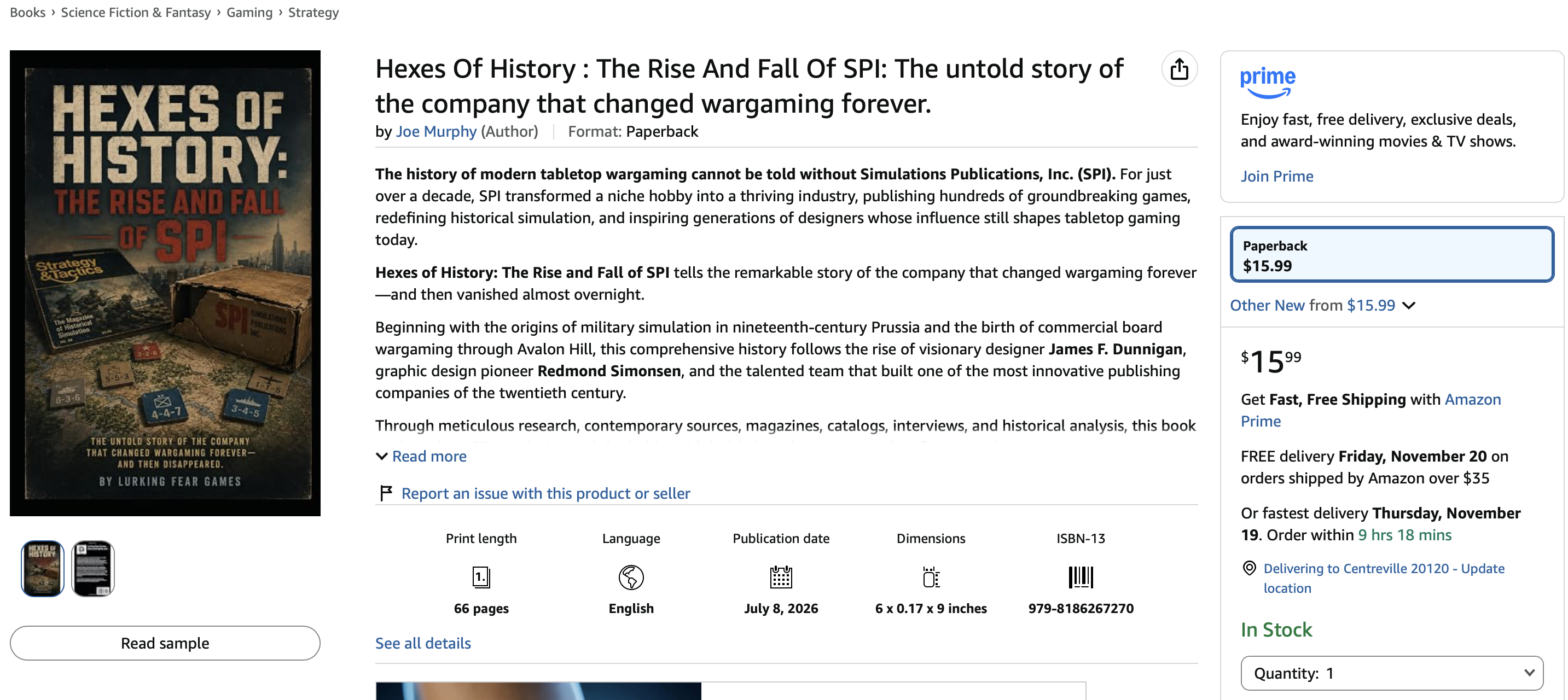
Hexes of History: The Rise and Fall of SPI is published by Lurking Fear Games using Amazon’s Kindle Direct publishing model. The book is a slim 68 pages but the font is rather small meaning the quantity of the content is more than what one might think 68 pages delivers.
Lurking Fear Games (which is not discoverable on BoardGameGeek) appears to be an imprint of Lurking Fear Publishing.

Lurking Fear Games appears to be printing under the company’s subculture “True Crime, History & Tabletop” segment of the business.

“History & Tabletop” is apparently defined as roleplaying games (RPG) and wargames.

The book cover and front matter do not name an author but the website identifies Joe Murphy as the writer.

The inside cover to Hexes of History bills the book as, “A Narrative History.” The prologue and first five chapters certainly are history-focused. These chapters trace the history of wargaming from the 1800s to the rise of SPI and the first few years (ending about 1973).
Chapter 6, “The Designers,” names but a few; Dunnigan, Richard Berg, Eric Goldberg, Greg Costikyan, and editors Dave Williams and Brad Hessel. The absence of Mark Herman is notable.
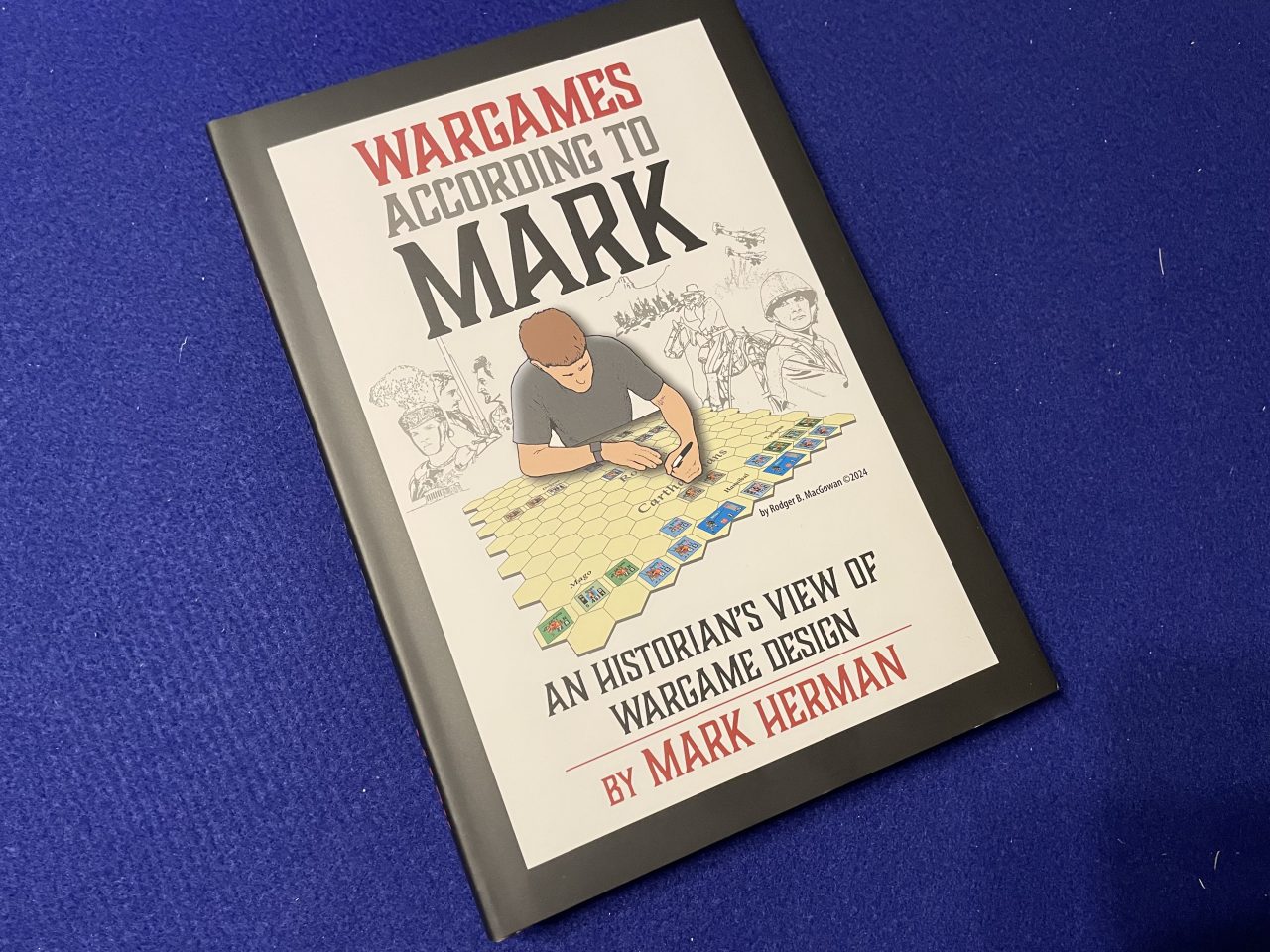
[To hear Mark Herman’s side of the story, please start with my post, “A Grognard’s view of Wargames According to Mark: An Historian’s View of Wargame Design” at The Armchair Dragoons.]
Chapter 7, “Simonsen’s Visual Empire” is a discussion of SPI’s graphics art director, Redmond A. Simonsen. The verdict is highly favorable:
By the end of the 1970s, the Simonsen system had done what few art directors in the hobby achieved; it had made a publisher’s output instantly identifiable and intellectually legible. The covers, the maps, the counters , and the magazine formed a single visual language, spoken without variation across hundreds of titles. When SPI collapsed in 1982, the languge did not die with it. Simonsen’s trainees carried the standards to companies that followed, and the modern wargame’s visual grammar—the clean map, the coded counter, the documentary cover—is, in large part, his inheritance.
Hexes of History, p. 33
The very next sentence is indicative of the narrative shift Hexes of History makes from history to business, and sets the tone for the remainder of the book:
The face of the argument was his. The ledger behind it was not. The next chapter leaves the drafting table for the desk, and asks how the empire of ink was paid for.
Hexes of History, p. 33
Chapter 8, “The Ledger,” begins with: “The previous three chapters described what SPI made, who made it, and what it looked like. This chapter describes how it was paid for—and why the method of payment contained, from the first, the seed of the company’s end” (p. 34). The key to this chapter is what the author calls “float.”
A wargame is an argument printed on cardboard. The cardboard had to be bought, the ink had to be contracted, the rent at 257 Park Avenue had to be met, and the designers had to be paid on a schedule no one in the hobby had attempted. The money for all of this did not arrive after the product shipped. It arrived before, in the form of a check from a subscriber who had paid a year ahead for issues not yet designed. The advance subscription was SPI’s engine and its trap.
…
… Dunnigan spent the twelve dollars immediately—on the next issue’s map, on the designer’s wage, on the rent—on the reasonable assumption that eleven more subscribers would send their twelve dollars next month, and that the cycle would cover the liabilities as they came due. The model was not fraud. It was float. But float only works while the inflow exceeds the outflow, and the inflow depended on a number that could not rise forever: new subscribers.
Hexes of History, p. 34
Chapter 9, “The Boom and the Leap” and Chapter 10, “The Stall” describe the end of SPI in very business-like terms. The Float stopped working; this is why.
Chapter 11 (“The Inheritance”), Chapter 12 (“The Hobby SPI Made”), and Chapter 13 (“The Standards SPI Set”) look at the legacy of SPI, occasionally in very business or systems engineering terms.
Interestingly, Chapter 13 of Hexes of History introduces a very mathematical definition of a wargame with, “These are the standards SPI set, and they function today as the baseline against which any title that claims the name ‘wargame’ is still measured, whether or not its designer has ever seen a copy of Strategy & Tactics” (p. 56).
We can model a title’s adherence to the SPI-derived baseline as a sum across the dimensions above, each scored 0 to 1 and weighted by the field’s settled emphasis:
where is source-to-rule fidelity, is visual legibility per Simonsen, is playtest rigour, and is the periodical/argument companion. The weights are the hobby’s, not SPI’s; they have shifted toward and away from as production tools democratized. But the terms of the equation are SPI’s bequest. A title scoring low on and is, by the field’s own silent calculus, not a simulation in the lineage—it is a game with a history theme. The yardstick the sorts the heirs from the impersonators, and it does so using a meter cast at 257 Park Avenue (Hexes of History, p. 58).
Chapter 14 summarizes how Hexes of History is the story of an argument. That argument is, “a premise attributed toe James F. Dunnigan: that a simulation is analysis, that analysis is an argument, and that the argument deserves a clean map and a punctual ship date” (p. 60). The book closes with:
Dunnigan encoded history as a system on cardboard because cardboard wa cheap and the argument was urgent. The system outran its publisher, as systems will. The collectors of the float (Ch. 7) became collectors of debt (Ch. 5); the designers of the method (Ch. 5) became the teachers of the field (Ch. 10); the eye of Simonsen (Ch. 6) became the eye of the hobby (Ch. 12, n.3). And the reader—the subscriber who arrived for a game and stayed for an argument—became the permanent custodian of a claim no bankruptcy could dissolve. SPI tried to sell history as an argument and ran out of subscribers before it ran out of wars (Ch. 9, n.8). It need not have worried. The wars were the excuse. The argument was the product, and the arguement, once printed, belongs to anyone who can read a map. The ledger closed. The map stays open.
Hexes of History, p. 63
The second subtitle of Hexes of History reads, “The untold story of the company that changed wargaming forever—and then disappeared” (cover). For an “untold” story, Hexes of History seems to rely heavily on secondary scholarship by using the works of Jon Peterson, Shannon Applecline, and Jim Dunnigan himself. As already mentioned, prominent SPI personalities, like Mark Herman, are noticeably absent in the book (if he is in there an index would help locate him; that is, if there was an index). My concern here is that, given Herman’s story is quite accessible, why is it not included? Does this expose an intellectual blind spot or bias? Maybe no? Maybe yes? Are there others?
Contrary to the “untold” claim, Hexes to History recaps the fairly well-documented story of the rise and fall of SPI. What Hexes of History offers today’s readers is not necessarily new information but a different framing of that story. Beginning with the assertion that Dunnigan was creating an argument as he was creating wargames, the author delivers a narrative history of SPI in business or systems engineering terms. That narrative dissonance—not to mention mathematical equations—may turn some readers away. Those who stay, however, may be refreshed to read Hexes of History and this new approach to an age-old story…
…if we can be sure the entire story is there.
Feature image courtesy RMN
The opinions and views expressed in this blog are those of the author alone and are presented in a personal capacity. They do not necessarily represent the views of U.S. Navy or any other U.S. government Department, Service, Agency, Office, or employer.
RockyMountainNavy.com © 2007-2026 by Ian B is licensed under CC BY-SA 4.0

