
Recently, I was invited by Aaron D.—Non-Resident Scholar-Practitioner and Advisor to the Wargaming Club at the Institute of World Politics (IWP) in Washington, D.C.—to observe a running of RAND Corporation’s wargame Hedgemony. The event highlighted for me the power of wargaming to reinforce learning in graduate studies…while also being fun!
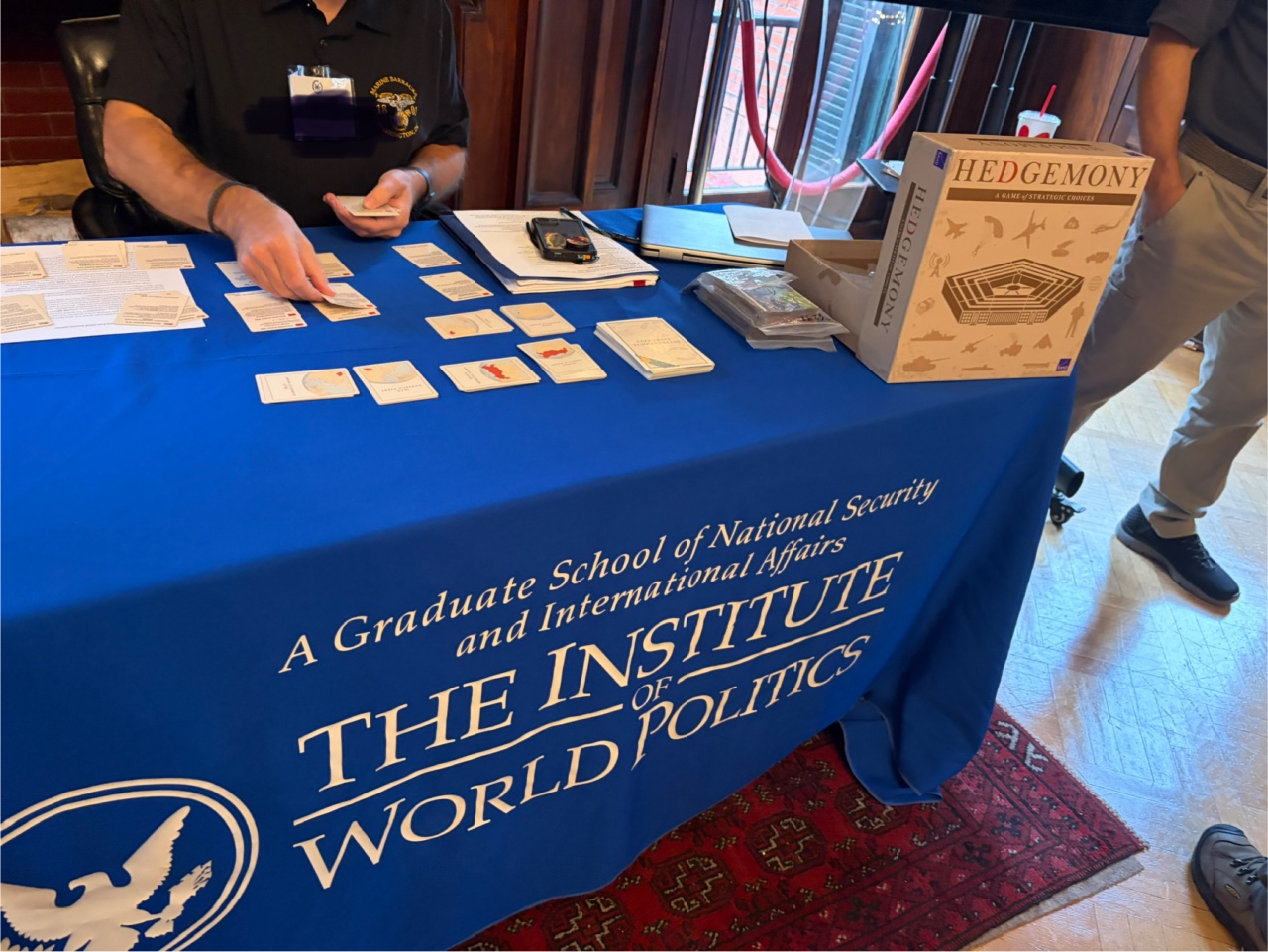
Hedgemony: A Game of Strategic Choices is a 2017 “serious” wargame from the RAND Corporation. Yes, if you look on BoardGameGeek the publication date is 2020 but the game was initially developed in 2017 for a then-Department of Defense sponsor before being “commercialized” in 2020. The RAND website describes the purpose of Hedgemony this way:
U.S. defense strategists and policymakers have the perennial challenge of developing capstone documents that can coherently articulate and guide how the U.S. Department of Defense will deliver and maintain combat-credible military forces to deter war and provide national security in alignment with national strategy. These forces must be ready to fight and prevail should deterrence fail against a variety of threats in an evolving and uncertain global security environment, and they must be able to do this with acceptable risks — both in the present against today’s threats and in the future against threats that might emerge. Key audiences for these capstone documents include defense planners, programmers, budgeters, managers, analysts, and policymakers who support the development and management of forces that can be postured and employed in alignment with a given defense strategy to accomplish objectives.
Against this backdrop, RAND researchers developed Hedgemony, a wargame designed to teach U.S. defense professionals how different strategies could affect key planning factors in the trade space at the intersection of force development, force management, force posture, and force employment. The game presents players, representing the United States and its key strategic partners and competitors, with a global situation, competing national incentives, constraints, and objectives; a set of military forces with defined capacities and capabilities; and a pool of periodically renewable resources. The players are asked to outline their strategies and are then challenged to make difficult choices by managing the allocation of resources and forces in alignment with their strategies to accomplish their objectives within resource and time constraints.
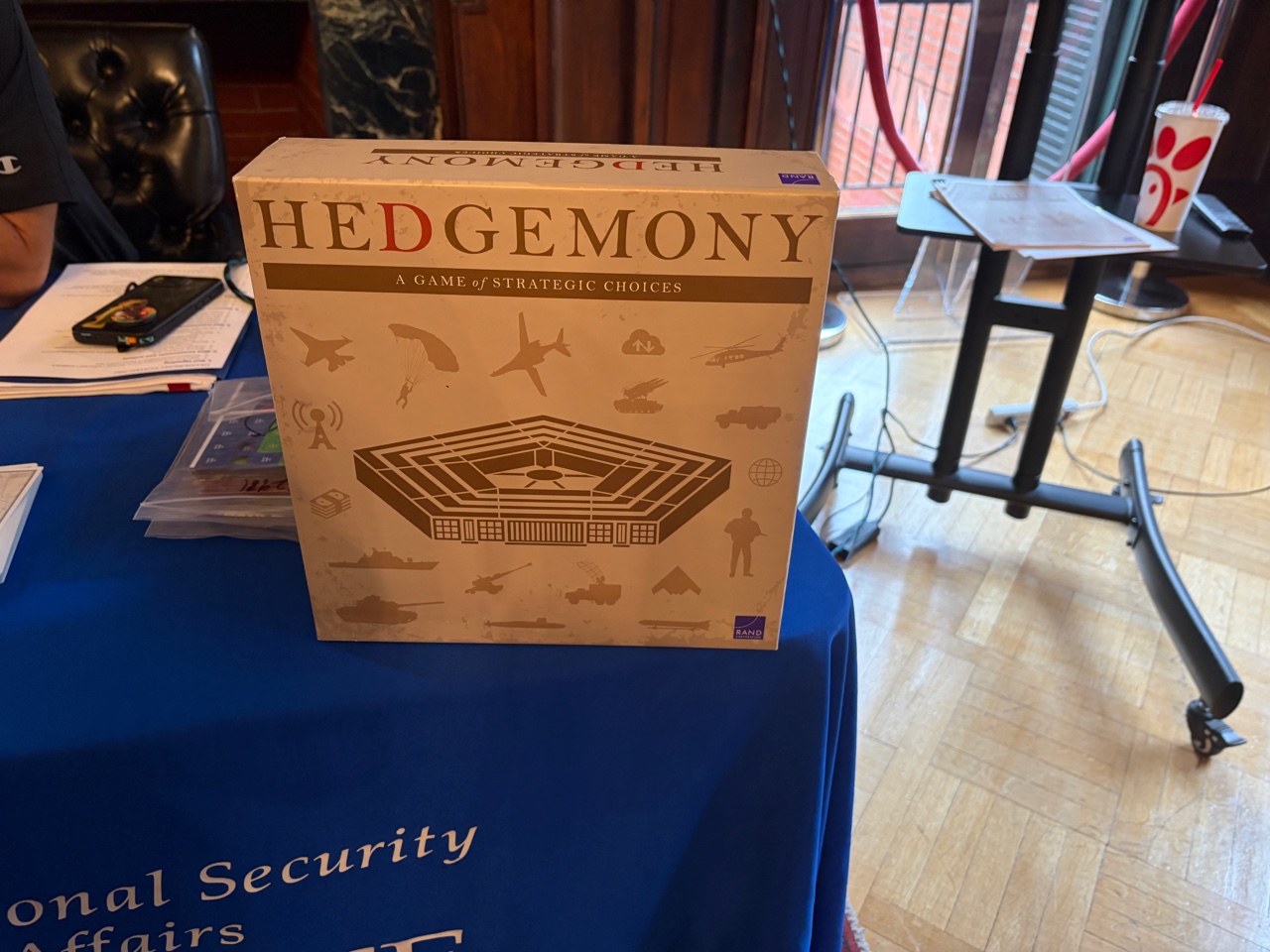
Eagle-eyed readers may have already noticed the name Hedgemony and wondered if it is a misspelling. Footnote one in the Hedgemony rulebook (available online) explains:
The name Hedgemony arose from the nature of a common challenge facing those who craft U.S. defense strategy. For the past 30 years, U.S. defense policymakers have been focused on an environment that has presented the United States with options for employment of defense forces in many different roles (such as humanitarian assistance, counterinsurgency, and major power conflict) and in many different locations (such as Afghanistan, Estonia, Haiti, Iraq, Korea, and Somalia). U.S. defense policymakers must prepare for a variety of near-term contingencies while also building U.S. armed forces for the future. The tension inherent in this set of challenges led us to think in terms of “hedging strategies”—the kinds of strategies investment professionals use to deal with uncertainty in the investment markets. This challenge also typically entails efforts to either maintain parity or achieve overmatch with one’s adversaries. Hence, we have the term Hedgemony.
Hedgemony, p. iii
The Hedgemony rulebook also explains:
This rulebook and the accompanying player guide, Hedgemony: A Game of Strategic Choices—Player Guide, describe Hedgemony, a pedagogical wargame designed for U.S. defense strategy and policy professionals, as well as graduate school faculty and students in related fields of study.
Hedgemony, p. iii
While Hedgemony has an entry on BoardGameGeek, the game design is far from your usual hobby tabletop strategy game:
Hedgemony is a global, multi-sided, turn-based, facilitated, adjudicated wargame designed to teach U.S. defense professionals how different strategy and policy priorities could affect key planning factors in the trade space at the intersection of force development, force management, force posture, and force employment. Players, representing Blue (the United States, the North Atlantic Treaty Organization [NATO], and the European Union [EU]) or Red (Russia [RU], the People’s Republic of China [PRC], the Democratic People’s Republic of Korea [DPRK], and Iran [IR]), are presented with a global situation, competing national incentives, constraints and objectives, a set of military forces with defined capacities and capabilities, and a pool of periodically renewable resources. Players are also asked to summarize their strategies and objectives in writing before play starts. The game is about players making difficult choices by managing the allocation of resources and forces in alignment with their strategies to accomplish their objectives within resource and time constraints.
Hedgemony, p. 1
Aaron recruited an elite team of players and facilitators for this running of Hedgemony. The players were all graduate students from IWP (who was the target audience of the game and hence the Blue/Green players) and nearby Georgetown (Red players), brought in by their professor Michael L. who was also the lead facilitator and, incidentally, one of the original designers of Hedgemony. He was ably assisted by John Y., also one of the original Hedgemony game designers. Jim O.—now retired but a former key player in the D.C. national security wargaming crowd—also assisted.
The intent of this running of Hedgemony was to expose IWP graduate students in a class on nuclear policy to strategic dilemmas. Given time constraints leading into the game, no players summarized their “strategies and objectives in writing before play starts”—though Michael L. mused to his students that would have been a good assignment.
As previously noted, Hedgemony was first developed in 2017 and published in 2020. The baseline scenario and various Action, Investment, and Event cards in the game are from that era looking forward. The game did not predict Russia’s invasion of Ukraine. It did not predict the current war with Iran. That said, I commend the facilitators who took the given scenario and with some set-up and initial conditions modifications created a believable current-epoch setting. To represent the war with Iran, both the US and Iran had forces “pinned” in the Middle East. The War in Ukraine was represented by Blue Proxy Forces (Ukraine) pinning a significant portion of Russia’s military while the Russian economy was reduced to show the impact of sanctions. Granted, the scenario was not a robust depiction of the current state of world affairs but it was good enough to create dilemmas for the players.
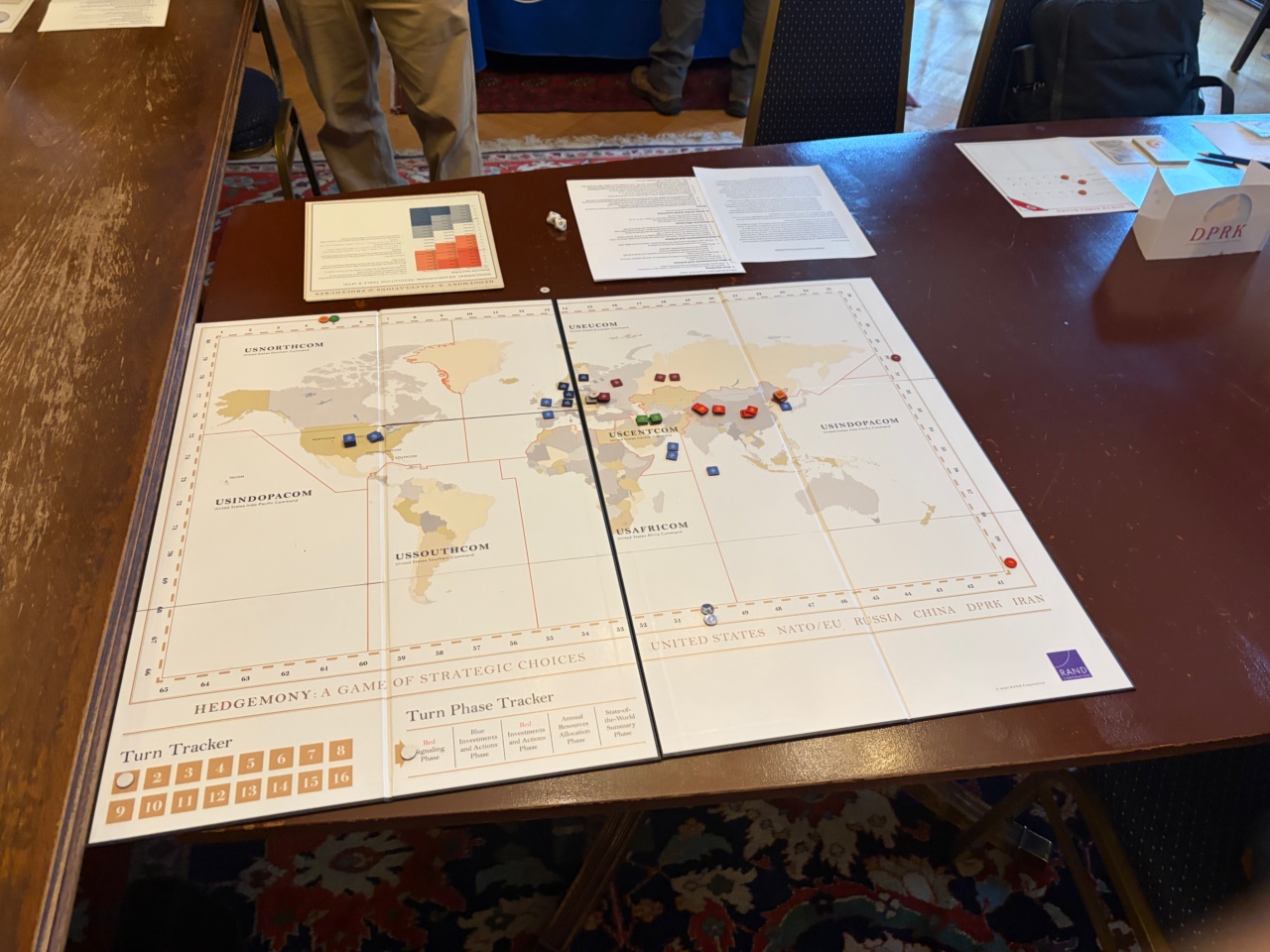
Hedge watching
A typical turn of Hedgemony is a rather straight-forward sequence of play that offers many teaching and learning opportunities:
A typical game turn in Hedgemony involves the following phases, played in sequence:
- Red Signaling Phase
- Blue Investments and Actions Phase
- Red Investments and Actions Phase
- Annual Resources Allocation Phase
- State-of-the-World Summary Phase.
At any point during the first three phases, the White Cell may also inject (or may roll a die to determine whether to inject) International Events and/or player-specific Domestic Events.
Hedgemony, p. 8
Each turn of Hedgemony starts with the Red side selecting three cards (at least one each Action and Investment cards) and then presenting an “intelligence briefing” to the Blue team. Michael and John both pointed out that the Red side is usually played by subject matter experts who then “create a narrative” of what cards are presented. Just because a card is selected and briefed does not mean it will be executed; Red players will eventually be able to play all, some, or none of their three selected cards. I must commend the Red team Georgetown students who leaned into the game, spinning some real narrative dilemmas for the Blue team!
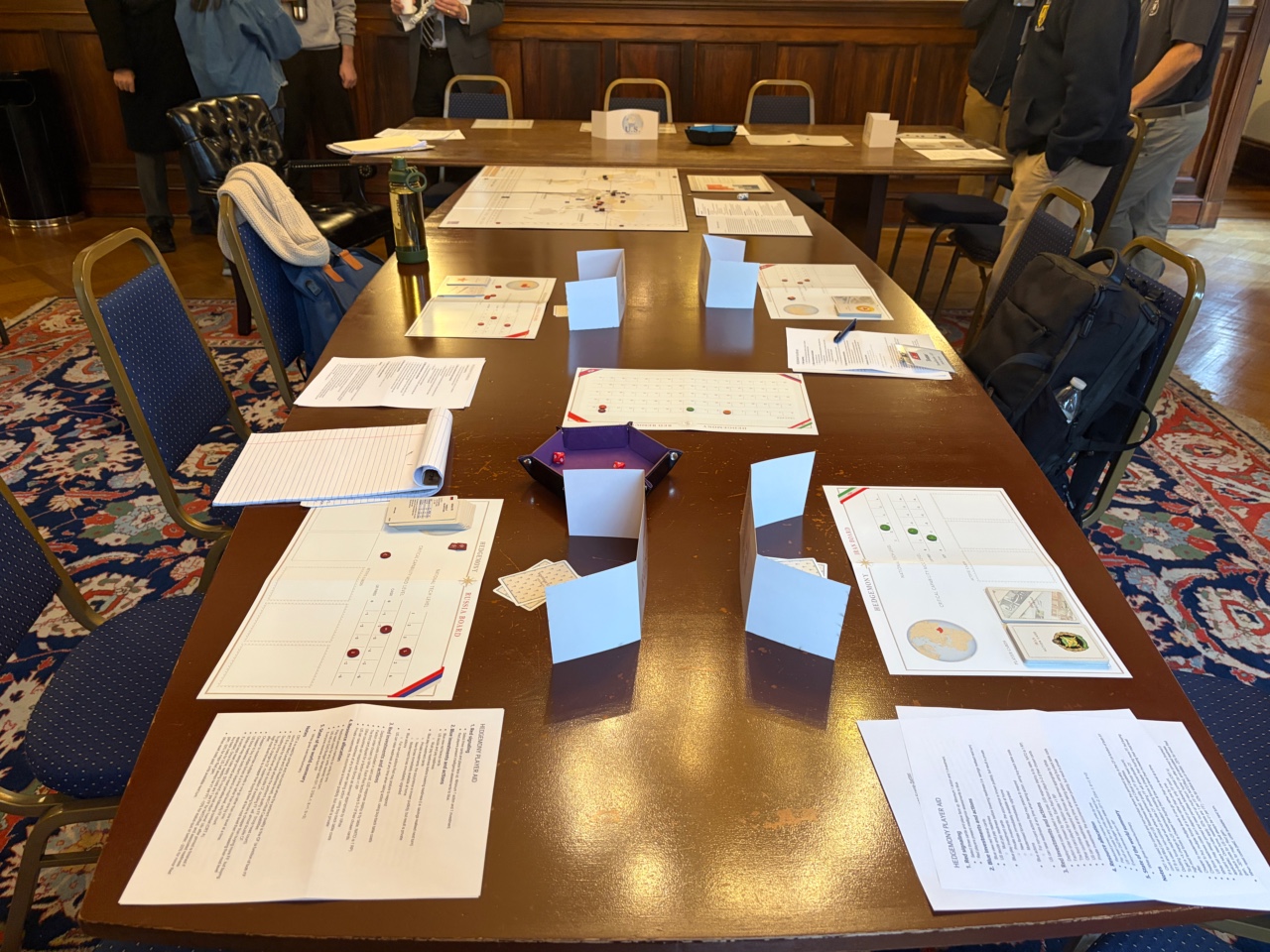
In keeping with Dr. Wayne S’s learning objectives for his class, this scenario of Hedgemony opened with a “new” card developed by Aaron which saw Russia deploy tactical nuclear weapons opposite Ukraine. This card-drop had the intended effect and immediately focused the players on nuclear issues and the War in Ukraine.
Following the intel briefing, Blue/Green executes a short planning session for selecting their Actions and Investments. This was also the time the Dr. Wayne S. discussed (coached?) learning points with the Blue team. Although the Blue team lacked a set of written policy and objectives, the probing questions and commentary from Dr. Wayne provided many learning opportunities.
[For example, at one point Russia transferred an ICBM with nuclear warhead to Iran. Dr. Wayne S. stridently pointed out to all in the room that such an act was a major breach of international treaties and agreements in place since the 1960s and should not be taken lightly. He was trying to push his students (Blue US/NATO) to react; alas, I sense the players were too unfamiliar with the game and did not explore options with the White Cell facilitators.]
Returning to the Hedgemony game sequence, Blue then executes their Actions and Investments. It was very interesting to watch Blue react to the intelligence briefing. There is an element of first-mover advantage given to the Blue player who gets to act first after Red has “signaled” their range of activity options. Next, each Red adversary gets their turn. While Blue may have moved first, they (hopefully) set conditions to create options to favorably respond to Red Actions or Investments.
During the early turns of the game, there was also a very interesting US/NATO dynamic in play; one that reflected real life more than I think the players realized. Due to the number of IWP participants, the NATO team was one IWP student and one Georgetown student. This made the Georgetown NATO player the only “outsider” amongst the IWP class. The NATO player was an ethnic mix of three NATO nationalities (Norway, Italy, Spain?) and she played the role to a tee. At one point, an obviously exasperated US player asked a question to the effect of, “You good to go? Or are you going to change your mind again?”
This IWP play of Hedgemony took place on a Saturday and was a very limited four turns played out over about 5 hours (which included a 30-minute lunch break). I was told that was a relatively average pace of play. Michael S. and John Y. noted that in a fully sponsored running of Hedgemony, similar 4-turn affairs are usually the training day in advance of a two-day playing of 10-15 turns.
I did not keep an extensive play-by-play record but here are a few highlights from this game of Hedgemony:
- The War in Ukraine dominated the early game; the US/NATO players had to deal with a special rule that forced them to decide who would finance the Ukrainians—do nothing and they lose battlefield presence.
- The Russians played a card that gave them a path to ending the War in Ukraine but it was expensive; they tried it anyway and, lo and behold, ended the war with a somewhat neutral outcome.
- The Chinese seemed content to lay low and make lots of overseas investments; had the game gone on longer the conditions for China to build bases overseas and deploy forces to the were in progress.
- The North Koreans got all uppity and made waves; they “almost” caused a war in Korea break out but it was narrowly avoided, with China breathing the greatest sigh of relief.
- Iran played the part of the spoiler rather well; after the War in Ukraine ended the Iranian player managed to “acquire” a complete ICBM from Russia and they poked at the US team every opportunity they got.
- The White Cell (facilitators), especially Jim O. who served as the Event “cardmaster” did a great job of finding the right Domestic or International event to bring out to keep the game focused on the core questions by prompting Blue or constraining Red in a believable manner; this is how the facilitators “put their thumb on the scale” to keep the game from going off the rails and failing to achieve the teaching/learning objectives.
[I mentioned to Aaron D. that, if nuclear war broke out, we could use Bruce Maxwell’s nuclear war rules from the first edition of NATO: The Next War in Europe (Victory Games, 1983). In that game, if nuclear war breaks out the rules say to douse the components with lighter fluid and apply a match. Aaron was NOT in favor of that resolution mechanic, citing the $275 per copy cost of the game and a limited IWP wargaming budget. A missed opportunity, I say….]
Scoring in Hedgemony is determined by Influence Points. At end game Michael S. evaluated each team against their victory conditions. As I recall, only China clearly achieved their victory conditions.
To be frank, however, the Influence Point scoring in this play of Hedgemony was not important. As is expected in “serious” wargaming, the After Action discussion was the real victory. After the facilitators delivered their commentary and observations, the far more interesting comments came from the players who in effect “read back” what they had learned. Hedgemony is not robust specifically designed to show grand nuclear policy but—in large part to the on-the-fly adjustment of expert facilitators— it broadly exposed the players to those issues and how they interact. That exposure is what graduate students need; that exposure is what Hedgemony delivers.
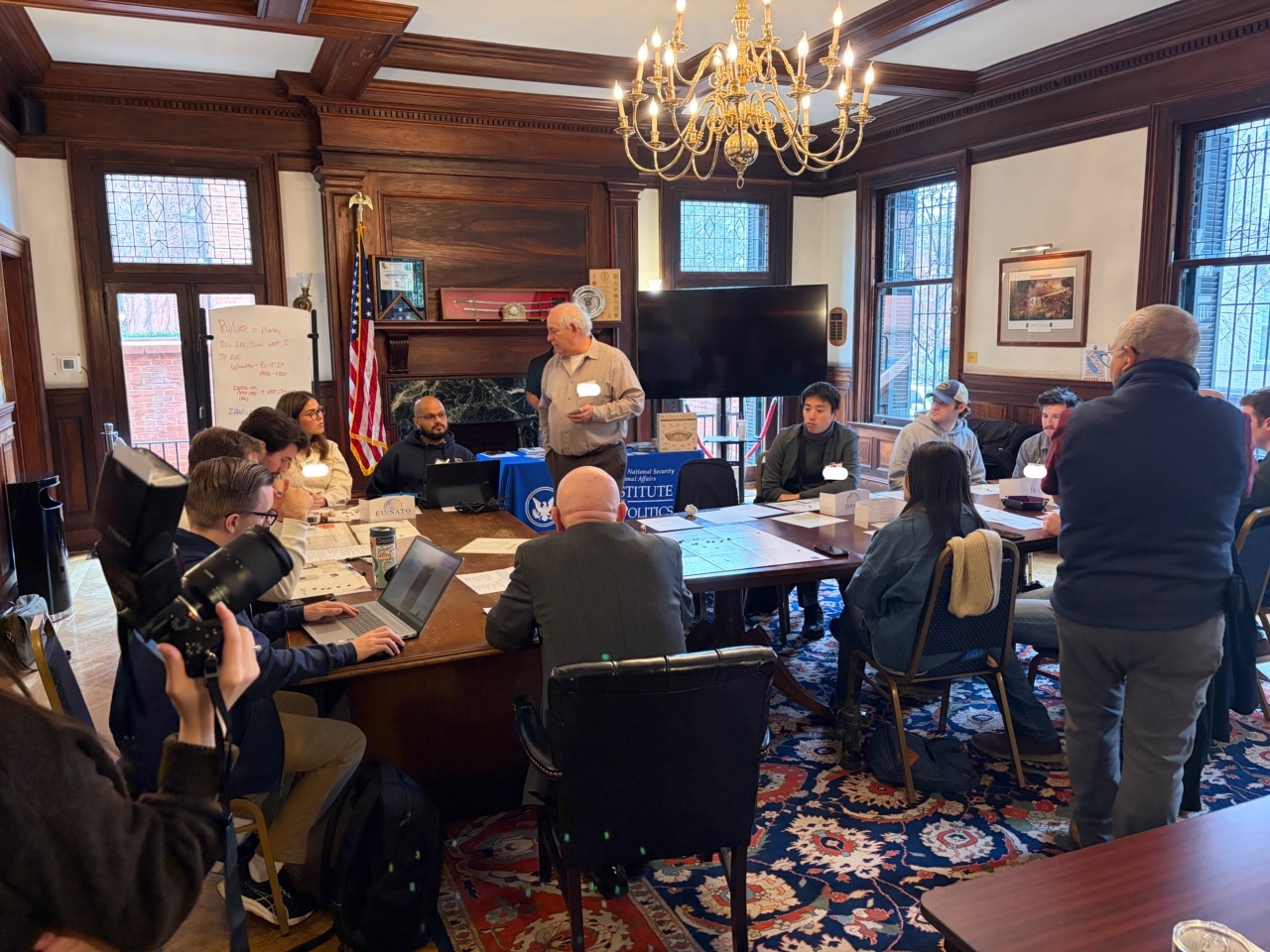
Looking ahead, Aaron mentioned plans for IWP to run another iteration of Hedgemony next spring to support a different class. That class requires a more “conventional” scenario meaning the nuclear issues so prominently exposed here are expected to be much more subdued. John Y. also mentioned that a baseline scenario update is, “in the works.” We also had interesting discussions on the impact of Super Intelligence (SI) on wargaming; in the case of Hedgemony there are explorations looking at SI-assisted adjudication and dynamic Action/Investment/Event card development.
You can buy Hedgemony but, as already mentioned, the price is a bit steep. Recognize that cost is only for acquiring a copy of the game; the investment needed in time, space, and people (players & facilitators) is the more expensive—perhaps unmeasurable—cost.
Although Hedgemony could use a baseline scenario update, the prospect of SI-enablement and assistance with readying, running, and even adjudicating the game are positive enough that I likely will request office funds to purchase a copy. My office is not made up of graduate students (though a few are pursuing a degree on their own) but of government/military professionals that could use some exposure to the strategic issues Hedgemony highlights.
Feature image courtesy RMN
The opinions and views expressed in this blog are those of the author alone and are presented in a personal capacity. They do not necessarily represent the views of U.S. Navy or any other U.S. government Department, Service, Agency, Office, or employer.
RockyMountainNavy.com © 2007-2026 by Ian B is licensed under CC BY-SA 4.0

