
1975 was the year wargame designer James Dunnigan was inducted into the Charles S. Roberts Award Hall of Fame held at Origins II.1 It apparently was also the year Dunnigan’s own wargame publishing company, Simulations Publications, Inc. (SPI) in New York released Panzer ’44: Tactical Armored Combat, Europe, 1944-45. When Panzer ’44 was released, Dunnigan and SPI were approaching 100 published games.2 All of which is to say that Panzer ’44 is highly representative of the “state of play” for tactical-scale wargames in the 1970’s. Looking back from my perspective in late 2026, it is tempting to dismiss Panzer ’44 based solely on the game’s appearance and a perception that SPI in the 1970s was more interested in quantity than quality of wargames designs. On the contrary, I see Panzer ’44 as a “paper time machine” that not only transports players back in time using a paper hex & counter tabletop wargame, but also a historical artifact to be studied to better understand the wargaming hobby.
A wargame is an attempt to get a jump on the future by obtaining a better understanding of the past. A wargame is a combination of “game”, “history,” and science. It is a paper time machine.
Dunnigan, Wargames Handbook, p. 13
Laying history flat
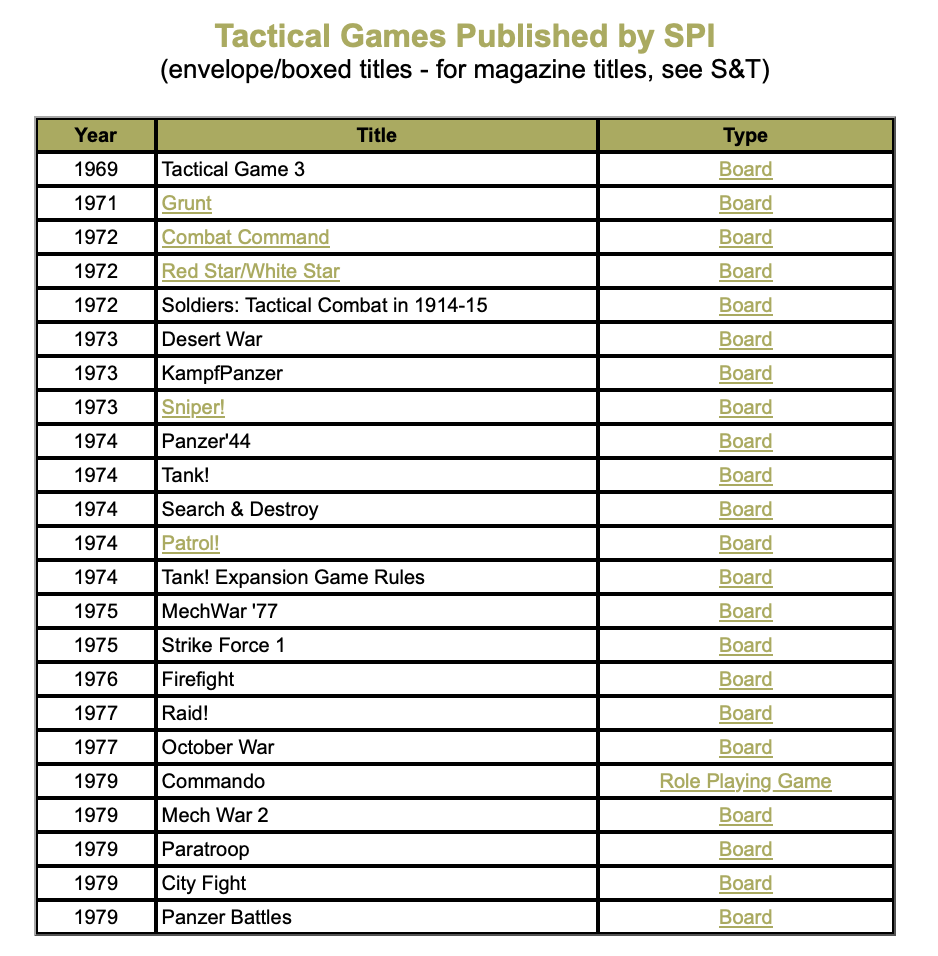
Panzer ’44 was one of the many tactical-scale wargames SPI released between 1969 and 1979. As the website tacticalwargamer.com notes:
SPI pioneered tactical games, producing Tac Game 3, the very first commercially produced tactical level board wargame, and followed it with several other titles. They printed a set of miniatures rules in S&T [Strategy & Tactics magazine], T-34, and were the first to introduce a squad-based tactical wargame in Grunt, which was also the first of the SPI magazine games to include die-cut counters. Early games were low in physical quality, particularly in comparison to Avalon Hill titles. Tac Game 3, for example, featured hand-drawn counters and a monochrome map. Rules for many early titles came printed on large fold-out sheets, and a variety of (often unwieldy) containers were pressed into service in the early years of SPI’s existence, the most enduring being the flat counter trays with clear tops that are most familiar to collectors today.
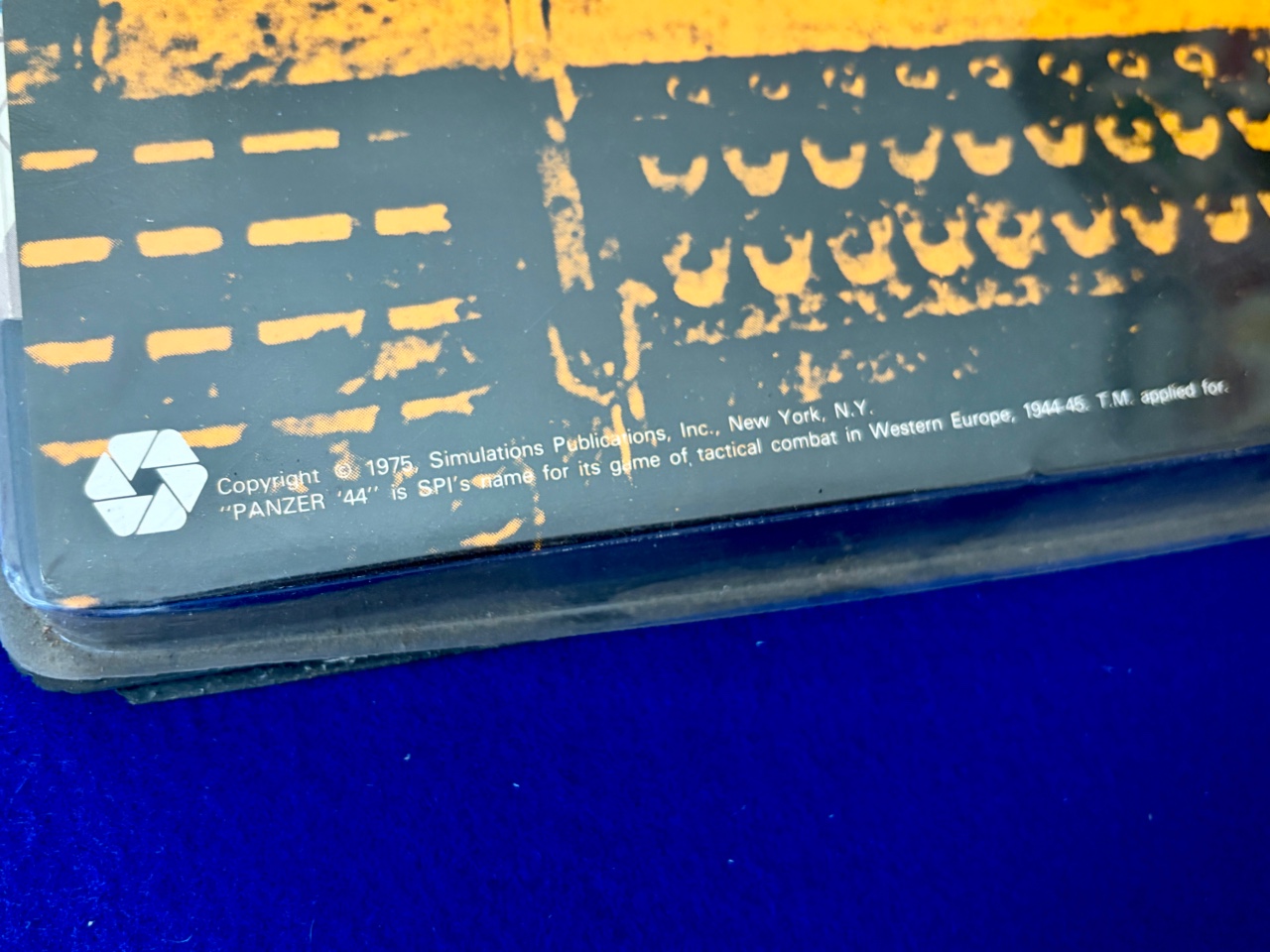
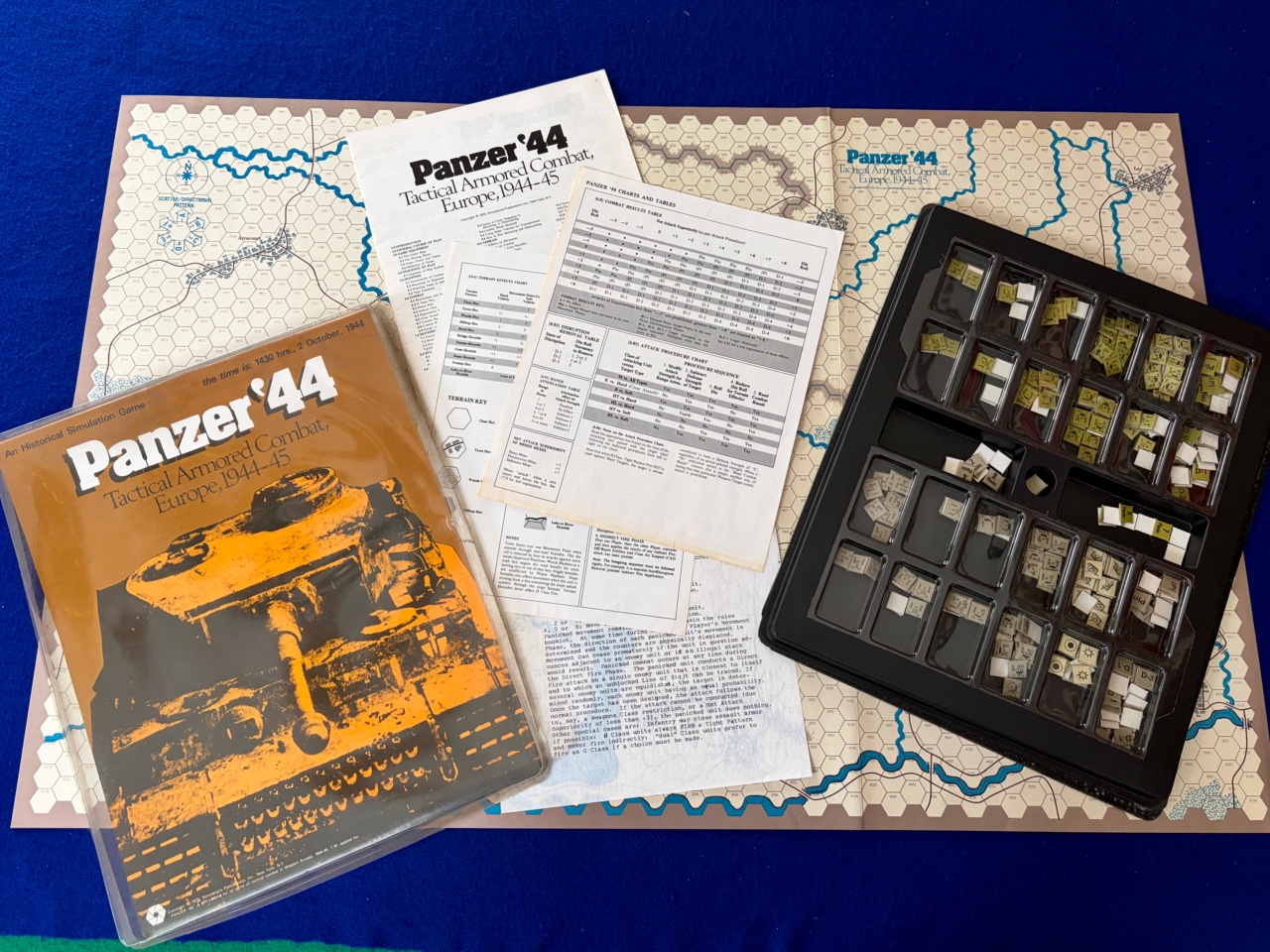
My copy of Panzer ’44 is in one of those enduring—or should I say, endearing—SPI flat tray boxes.
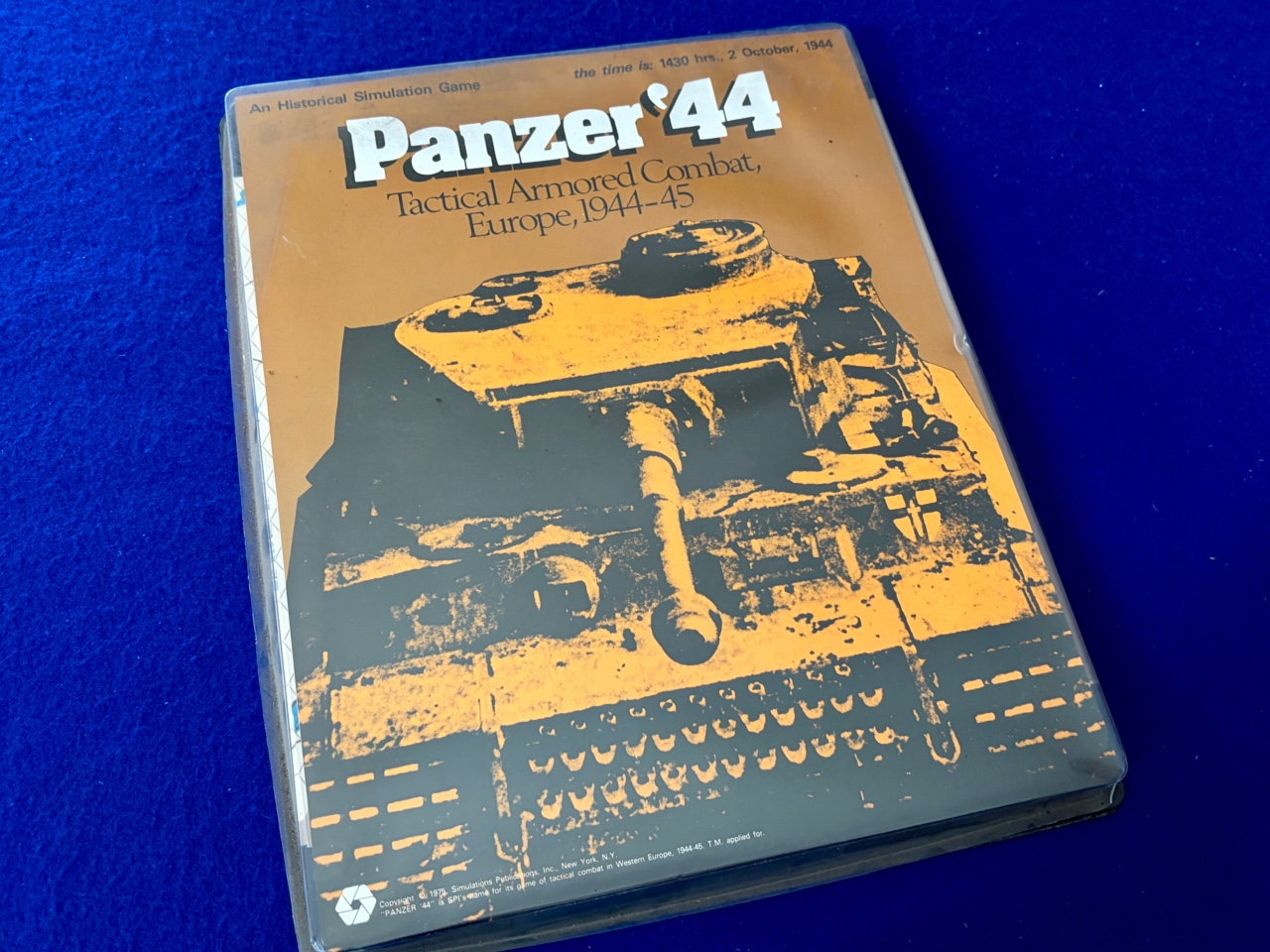
The component’s of Panzer ’44 are so few and simple it could easily be sold as a magazine wargame.
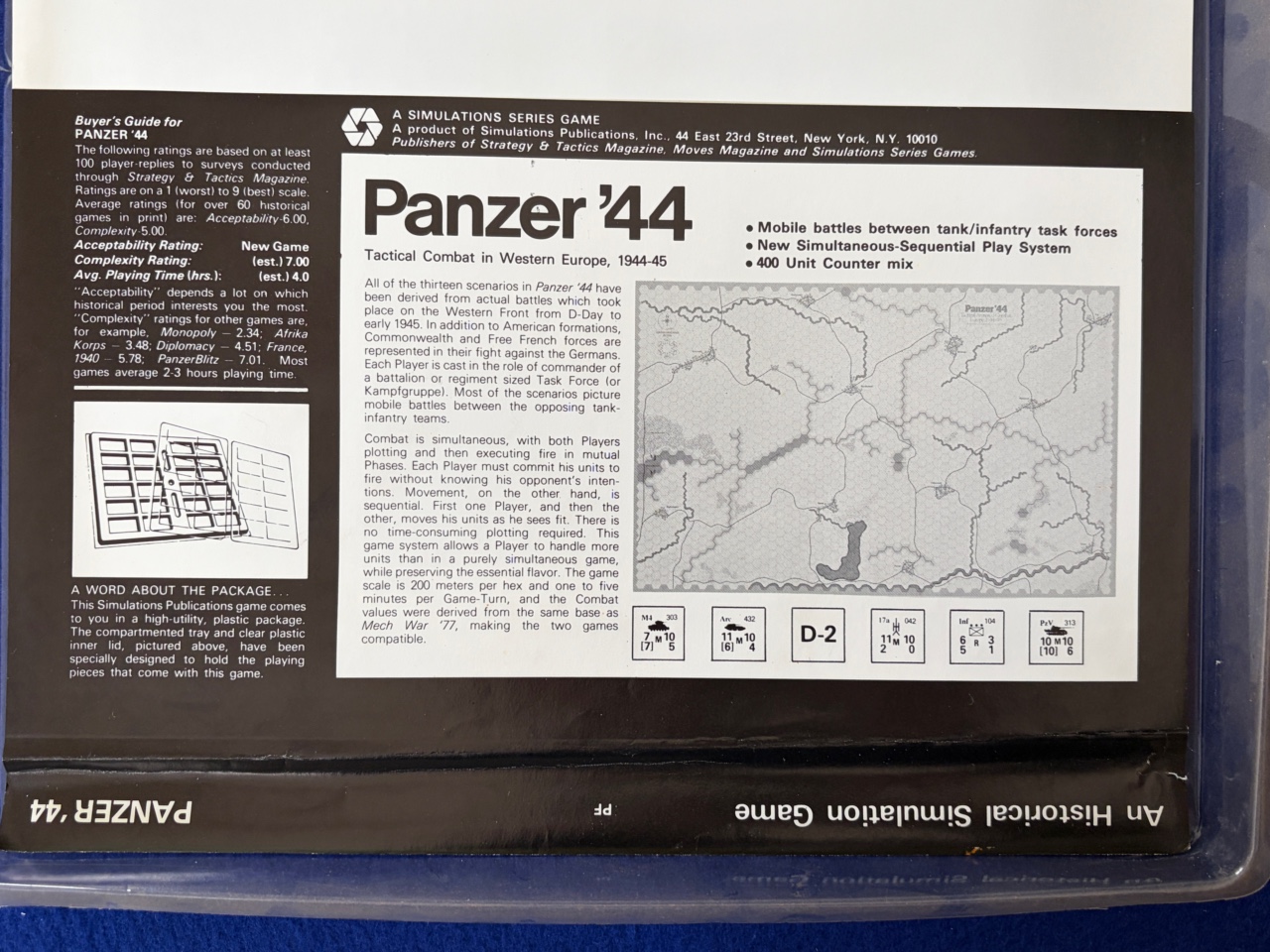
[I really love the content in the lower left of the photo, “A WORD ABOUT THE PACKAGE,” that claims the “compartmented tray and clear plastic lid…have been specifically designed to hold the playing pieces that come with this game.” The terms “specifically designed” and “with this game” makes it sound so special. Then again, is that not what makes SPI flat-pack games so “endearing” to grognards?]
The components for Panzer ’44 are a 34” x 22” map, around 400 siongle-sided counters in two colors each measuring a grognard-challenging 1/2″, a 16 page rulebook, and two identical player aids. My copy also has a typewritten(!) page of expansion rules for MechWar ’77 which used the same core game mechanisms as Panzer ’44 but was released a month later (May 1975).4
I will admit the map for Panzer ’44 is not…colorful but it is far from monotone. The 1/2” counters are small and dense with information. Icons are a mix of silhouettes and Army/NATO symbology.
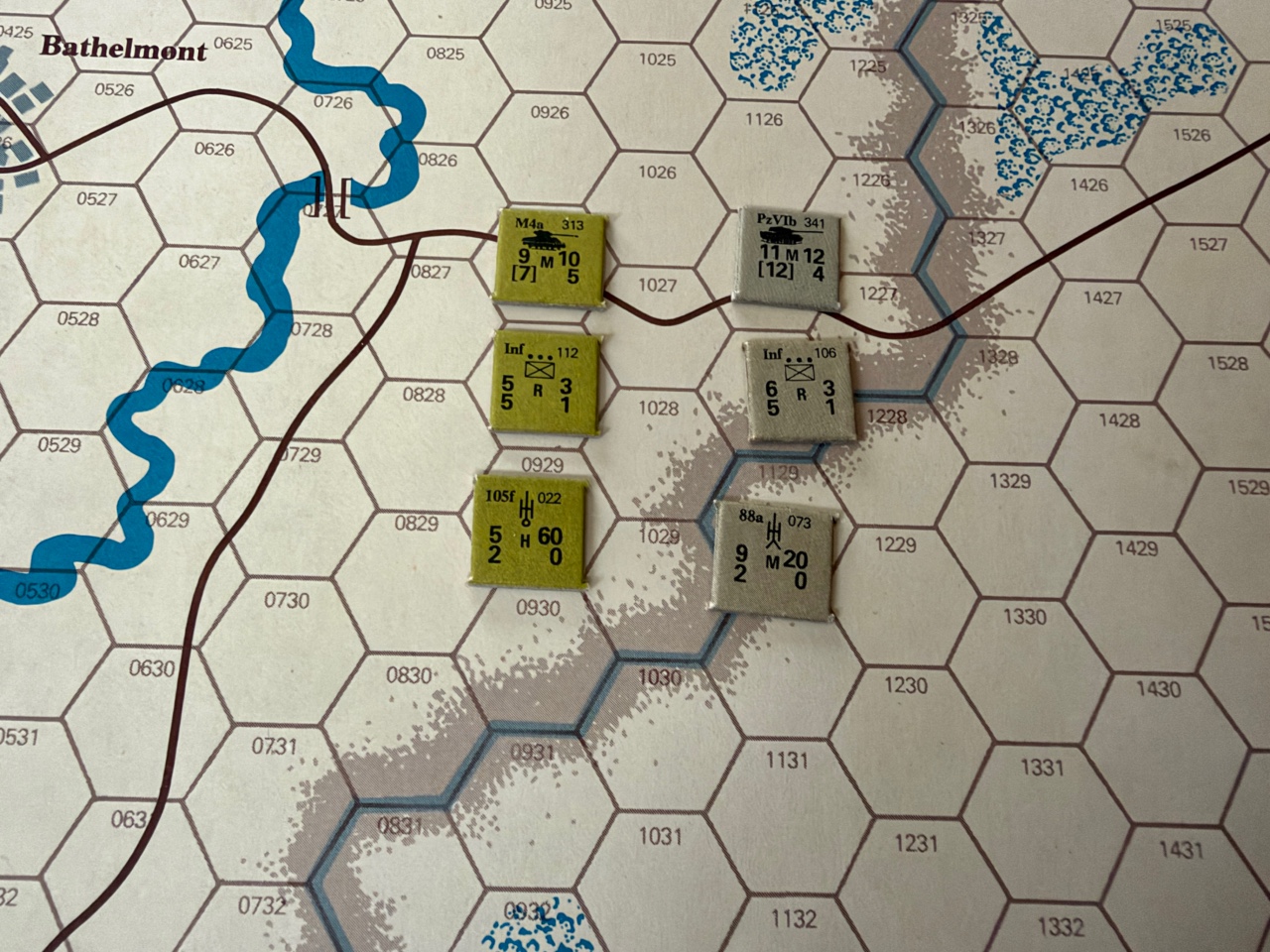
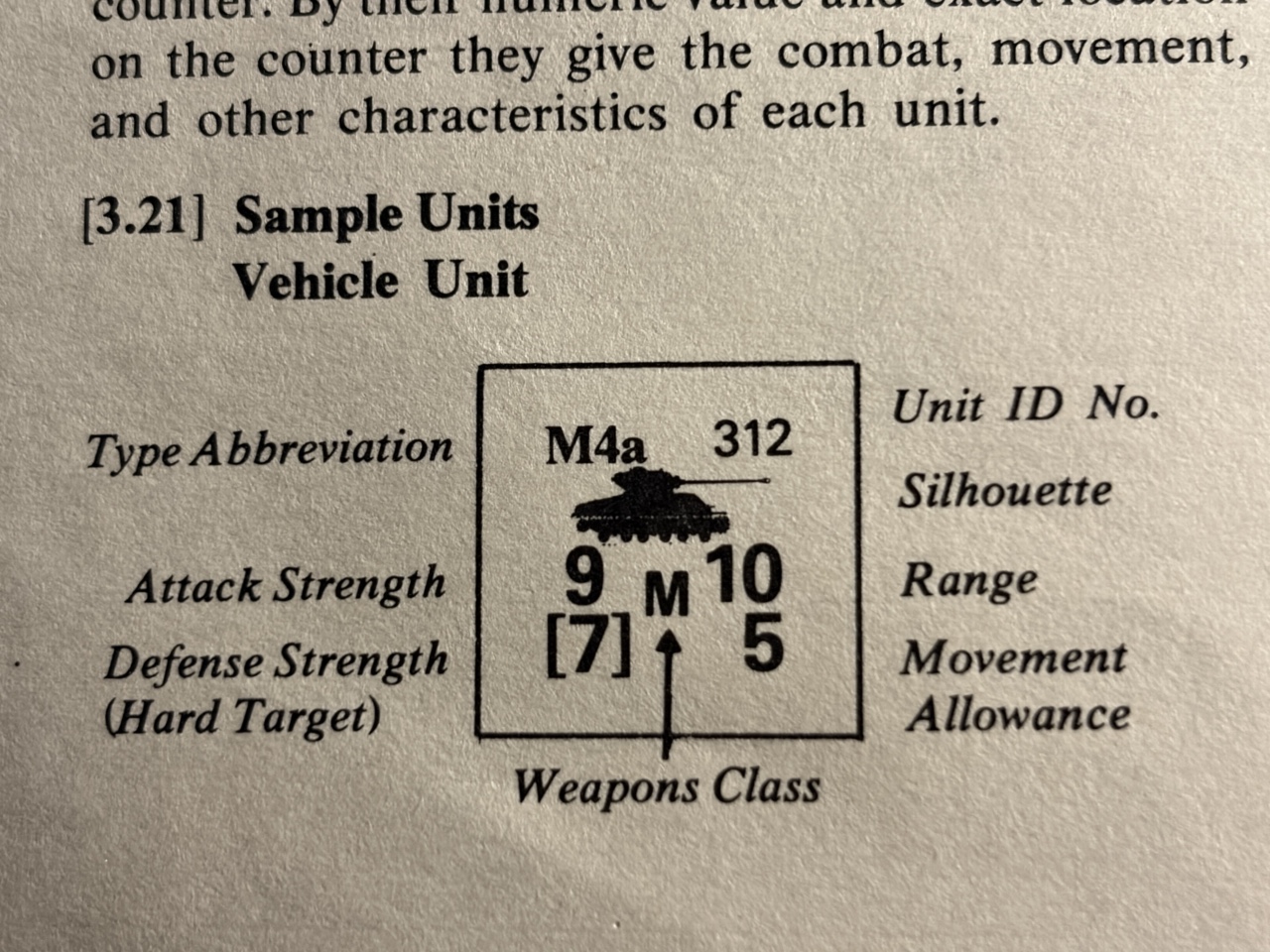
To the sometimes loud critics from today that decry the drab colors and unexciting counter art used in 1970s wargames like Panzer ‘44, I challenge them to reconsider instead their ignorance as to the “state of the art” in 1970’s publishing. Graphics designers like Redmond A. Simonsen5 actually defined the state-of-the-art for wargames, establishing standards that survive (respectfully) even to today.
That is sad news [the death of Redmond Simonsen]. Redmond had a talent that he developed and used… No other graphic artist has had as much impact on the way wargames look, and work. A one-of-a-kind guy if there ever was one.
James F. Dunnigan
Panzer ’44 as a War Engine
In his essay, “War Engines: Wargames as Systems from the Tabletop to the Computer” published in Zones of Control: Perspectives on Wargaming,6 game historian Henry Lowood describes wargames, “based on modularity and reusability of core components to produce a variety of scenarios…with a more analytical approach to historical simulation” as “War Engines.”7 As Lowood explains, War Engine designs like Panzer ’44, were intended to “compare different weapons and tactical systems” in a tactical wargame.8
[Panzer ’44 certainly is a tactical-scale wargame where each hex is 200 meters across, each turn represents from one to six minutes, and units are, “infantry platoons, artillery batteries, tank platoons, etc.” ([2.0] GENERAL COURSE OF PLAY, [3.2] THE PLAYING PIECES).]
The 400 counters in Panzer ’44 represent a staggering array of units and weapons. The German player has 27 different units or weapons systems to choose from ranging from mortars to field guns to infantry to tanks to armored cars to trucks; the Americans have 24 different selections and the British seven. Want to throw down “Four turretless Jagdtiger tanks, 128mm L55 guns; at 72 tons, heaviest tank produced in the war” ([3.22] Summary of Unit Types – German – Heavy Tank Destroyer Section) against “Five M26 Pershing tanks, 46 tons, 90mm gun; introduced in early 1945” ([3.22] Summary of Unit Types – U.S.A. – Medium Tank Platoon (351))? One absolutely can in Panzer ’44.
The wide variety of units in Panzer ’44 delivers the opportunity to play many different scenarios. A total of 14 scenarios are in the rulebook. Nine scenarios draw upon actions involving the U.S. 12th Army Group between June and November 1944 (19.0 SCENARIOS). Another five scenarios focus on the British 21st Army Group between June 1944 and March 1945 (20.0 SCENARIOS). Interestingly, there are no rules in Panzer ’44 for design-your-own scenarios; however, a search in the BGG forums reveals that Moves #29 included the article “Home Brew: Designing Your Own Scenarios for MechWar’77 and Panzer’44” by Matthew Buynowski.
As befits a War Engine, the rules of Panzer ’44 are reusable across several wargames. As mentioned above, Panzer ’44 and MechWar ’77 use the same core game mechanisms. The core rules for Panzer ’44 are delivered in a mere 10 pages, albeit in three columns with a small font.
Simultaneous-Sequential and Design for Effect
Panzer ’44 introduced wargamers to a then-new game mechanism—the “Simultaneous-Sequential Play System” noted on the insert sleeve (image above). As explained in the rulebook, “This Sequence of Play combines Simultaneous Play for Combat with Sequential Play for Movement” ([4.0] SEQUENCE OF PLAY).
[4.1 SEQUENCE OF PLAY OUTLINE]
- MUTUAL PLOT PHASE: Both players secretly and simultaneously plot the intended actions of their units for that Game-Turn (see 5.0). Each Player notes which of his units are firing. Direct Fire, which are firing Opportunity Fire, which are firing Indirect Fire and what the respective target hexes are. Then each player notes shich of his units shall move. They then allocate any Off-Board Artillery or Air Support.
- PANIC DETERMINATION PHASE: Both Players execute the Panic Procedures (see 14.0) and determine which of their units are subject to panic.
- DIRECT FIRE PHASE: First one Player, and then the other, executes Direct Fire as plotted. Pin, panic and disruption markers are then placed according to the results of both Players’ fire.
- MOVEMENT PHASE: The First Player moves all his units for which movement is plotted (The First Player is defined in each Scenario.) He may move these units as he sees fit (see 7.0) subject to the Movement Rules, interruption by opposing Player’s Opportunity Fore and the effect of Mined hexes. When the First Player is finished moving his units, the Second Player then may move all his units subject to the same restrictions. Note that a Player may only move units he had plotted to move, and that he must move every unit he had plotted to move, which is capable of moving.
- PIN AND DISRUPTION REMOVAL PHASE: Each Player removes the Pin Markers from his units. Each Player attempts to remove the various Disruption Markers from his units.
- INDIRECT FIRE PHASE: First one Player, then the other Player, executes and then applies the results of any Indirect Fire, Off-Board Artillery and Close Air Support (CAS) which has been plotted.
Doubtlessly recognizing that players of Panzer ’44 might question the Simultaneous-Sequential Play System, the first Game Note attempts to explain the design philosophy behind the rule:
PLOTTING & SIMOVE: The whole idea behind making the Players go through the plotting exercise is to introduce the element of uncertainty into the play of the game which otherwise would be impossible to create. The first prototypes of this game required the Players to plot movement hex by hex, a very laborious task. And one which was soon eliminated. It was sufficient to require a simple move notation without a detailed plot. Playtesting revealed that most movement was obvious and that a sequential execution rarely affected the course of play. Fire, on the other hand, had to be kept simultaneous and fairly detailed. When a sequential execution of Direct Fire was tried (simply plotting DF without specifying a target) it was found to give the Second Player too much advantage. He would know by process of elimination which of the First Player’s units could move and decide on that basis how to allocate his fire.
[21.0] GAME NOTES
Dunnigan’s Design Note for Panzer ’44 also reveals another “controversial” rule: Combat Results. The Combat Results Table delivers four different combat results, PIN, (P) for Delayed Panic, three progressive states of Disruption (D1-D3), and D4 or Elimination (6.82 Effects and Persistence of Various Combat Results). Rule [6.84] Accumulation of Combat Results details how Disruption accumulates until it reaches D4 which eliminates the unit. Some playtesters(?) apparently did not like this rule which led Dunnigan to write:
DESIGN NOTES: One of the more controversial aspects to this game is the Combat Results system. On its face the concept of successive disruption steps seems unrealistic. Take the case of a pair of 88’s firing on a platoon of Shermans at, say, 800 meters [4 hexes]. Assuming the visibility is good and the 88’s achieve surprise, the result, in reality, would be the destruction of one, two, three or more of the Shermans before the platoon could react. In other words, within the minute or so represented by the Game-Turn, part of the platoon would be permanently destroyed and part would remain effective. This is not what happens in the game; the platoon probably would suffer a D1 or D2 result. The disruption result puts the entire unit into a temporary “never never land” from which it will either return with it original effectiveness intact, or not, depending on a random die roll and future Enemy actions. The justification for this situation is that over a series of Game-Turns, within a limited scenario, the disruption system does represent an reflect combat attrition and does so without recourse to extensive record keeping and step-down step-up unit replacement. For example, assuming a six turn game period, a unit which suffers a D1 will not be able to fire (on the average) two of the six turns or 33% of the time. For that six turn period the unit will have suffered a 33% attrition in utility. And in most of the scenarios there are few combat situations which are sustained for more than six turns. The pin and delayed panic results express the disorganization and confusion caused by incoming fire rather than actual attrition, but the net reduction of effectiveness is equivalent.
[21.0] GAME NOTES
Dunnigan’s explanation of the Combat Results system in Panzer ’44 is a classic example of Design for Effect. While there is no single authoritative definition of Design for Effect, the general consensus appears to be something to the effect of a wargame rule that is not a strict simulation of a historical event or tactic, but is implemented within the game system because it creates a desired outcome. As Dunnigan notes, a “strict simulation” of 88’s firing against Shermans would be some degree of destruction requiring a step-down step-up system (such as flipping double sided counters which was a publishing feature beyond SPI in that day). Instead of doubling counters in the game—and necessitating the unwieldy search for the right replacement counter—Dunnigan elected to use Disruption accumulation to represent the condition, if not the detail. Personally, I am fine with Dunnigan’s design decision; then again, I am not one of those hardcore grognards that demands historical accuracy (whatever that is) and instead am fine with historical verisimilitude in the name of playability.
Engaging the Panzer ’44 time machine
To better experience Panzer ’44 I played the eight-turn scenario [19.2] SEDAN REVENGED, September 13, 1944 which is an all-armor battle that pits a French player (using US counters) against Germans. the scenario is a straight-up battler with victory determined by strength points eliminated.
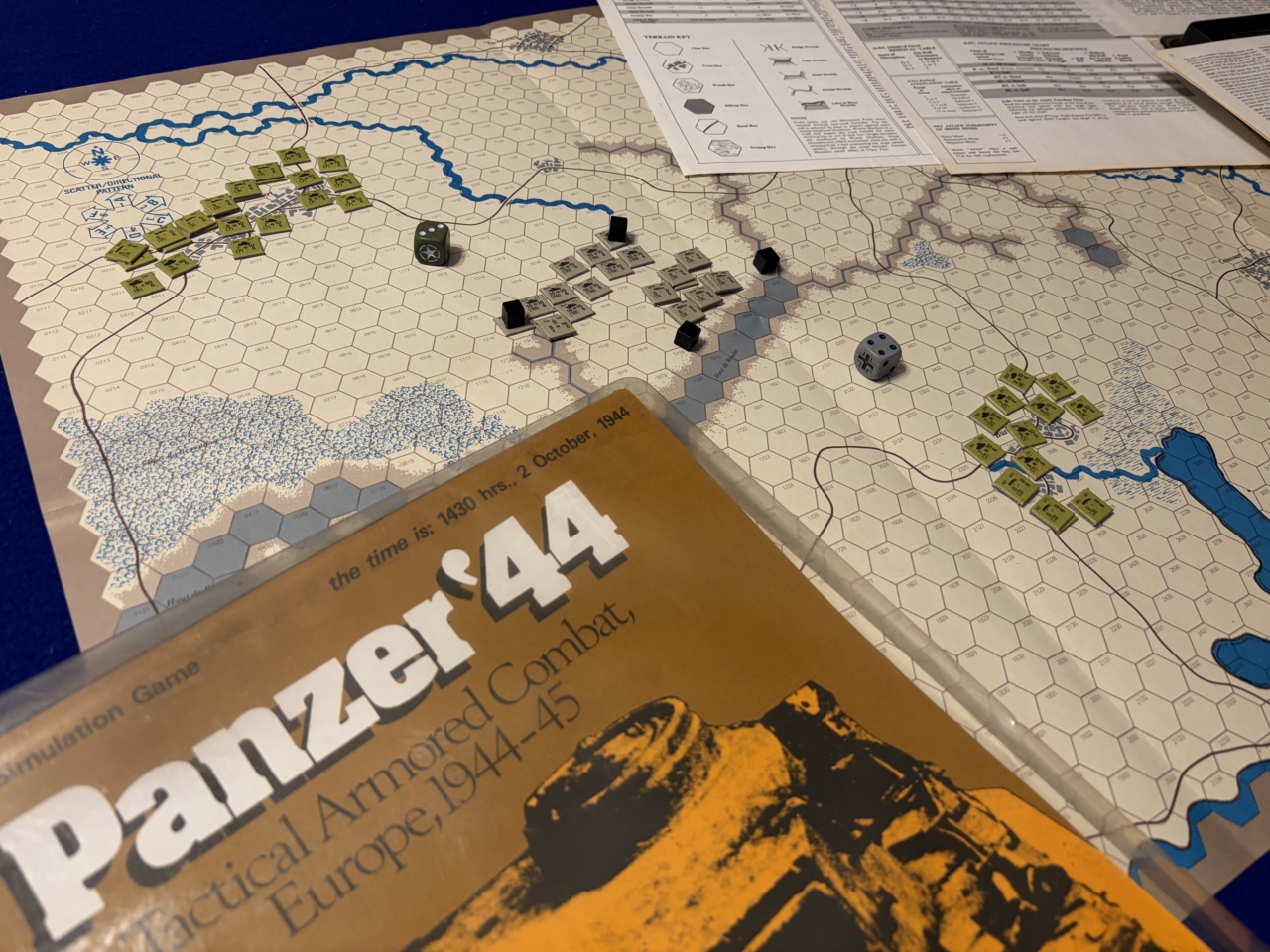
Some thoughts after playing Panzer ‘44:
Plotting – Plotting in this scenario of Panzer ’44 for 23 French units and 25 German units is…time consuming (but as a bonus you get to design your own plot sheets as none are provided in the game).
Panic – I will argue that the rules for Panic in Panzer ’44 are more controversial than the Combat Results system. Rule [14.0] PANIC is subtitled [Command Control] and represents, “real effects on the battlefield, of communications problems, misunderstood orders, human error and , sometimes, just plain physical fear, which results in units not doing what the command (the player) has ordered (plotted)” ([14.0 PANIC]). In my scenario, the German Player starts with a “30%” Panic Level (French are 10%), meaning you draw 3x Panic Chits for the German Player and a single Panic Chit for the French Player each turn; the number on each Panic Chit is cross-referenced with last hex numbers and units in those hexes are Panicked. Given hexes in Panzer ’44 are numbered North-South whereas most scenarios are fought East-West, units in line are less likely to be affected by panic as opposed to units moving in column towards the front. That said, the effects on Panicked units are severe:
- Panicked units ignore plotted actions and instead perform the Panic Movement Procedure ([14.0 PANIC], [14.1] EFFECTS OF PANIC ON UNITS WHICH WERE PLOTTED TO MOVE).
- A Panicked unit may not fire ([14.31]).
- One possible combat result is Delayed Panic (P) which means the affected unit panics on the next game turn (my emphasis, [14.7] DELAYED PANIC AS A RESULT OF COMBAT).
- Thankfully, the Panic rules are not used in a scenario until the Game-Turn after Direct, Opportunity, or Indirect Fire is used ([14.82]).
[Oil Chits]
[Eagle-eye grognards may notice that the Panic rules in Panzer ’44 rely on Panic Chits which are sets of 10 chits numbered 0-9. “Hey Rocky,” you might ask, “why not just use a 10-sided die?” Many of you younger grognards may not recall that in 1975 the United States was still in the Oil Shock of the 1973 Oil Embargo and plastic—which uses petroleum—was expensive. This was a time when wargame publishers like SPI sometimes found it too expensive to buy dice for their games so they instead gave you chits. Chits were also often substituted when a die other than the standard six-sided dice was needed. Recall that early Dungeons & Dragons sets were sold without dice. It was not until 1974 that Lou Zocchi at Gamescience first started manufacturing polyhedral dice in the United States.9]
The Panic rule in Panzer ’44 is clearly another “Design for Effect” as Dunnigan makes clear in the rule and Game Notes:
[14.52] On any given Game-Turn, it is theoretically possible for all, some or none of a Player’s units to Panic. The fact that a player has a Panic Level of, say, 20% does not mean that on every Game-Turn 20% of the Player’s units will Panic. It does mean that over an extended series of Game-Turns the total number of units which Panic will tend to average out at 20%.
[14.5] PERSISTENCE OF PANIC – [14.52]
PANIC: Panic will strike and affect a critical unit at the most inopportune time. A Player has only one defense against panic and that is overkill. If it is absolutely necessary to fire at a unit at a given point make sure you assign two, three or four units to execute the fire. If it is absolutely necessary to move and occupy a hex, make sure you have two, three or four units which can do so. A winning Player is one who assumes that a single unit will always foul up at the most inconvenient time, and plans accordingly.
[21.0] GAME NOTES
As many commentators at BGG or ConSimWorld forums note, different versions of the Panic rules for Panzer ’44 is desired by many. I agree with them, but for those that want to tinker with the rules please try playing the rules-as-written at least once. You owe it to the designer to at least try playing the game their way before you go off and attempt to solve your problem your way.
[The typewritten page in my copy of Panzer ’44 lays out a somewhat different Panic procedure, one where a random die roll determines if the Panicked unit attacks the nearest visible enemy unit or randomly moves. I am not sure where this rule comes from as it is un-cited and does not appear in the BGG forums for the game.]
Firing Procedure – Panzer ’44 does not use a classic combat-odds Combat Results Table (CRT) but instead factors, “Net Attack Superiority.” After determining the class of attacking unit and comparing it to the target type one executes a simple 5-step procedure:
- Modify Attack Strength for Range Attenuation, if applicable.
- Subtract Defense Strength of Target.
- Roll Die.
- Reduce Die Roll for Terrain Effect(s).
- Read and implement Combat Result. ([6.85] ATTACK PROCEDURE CHART).
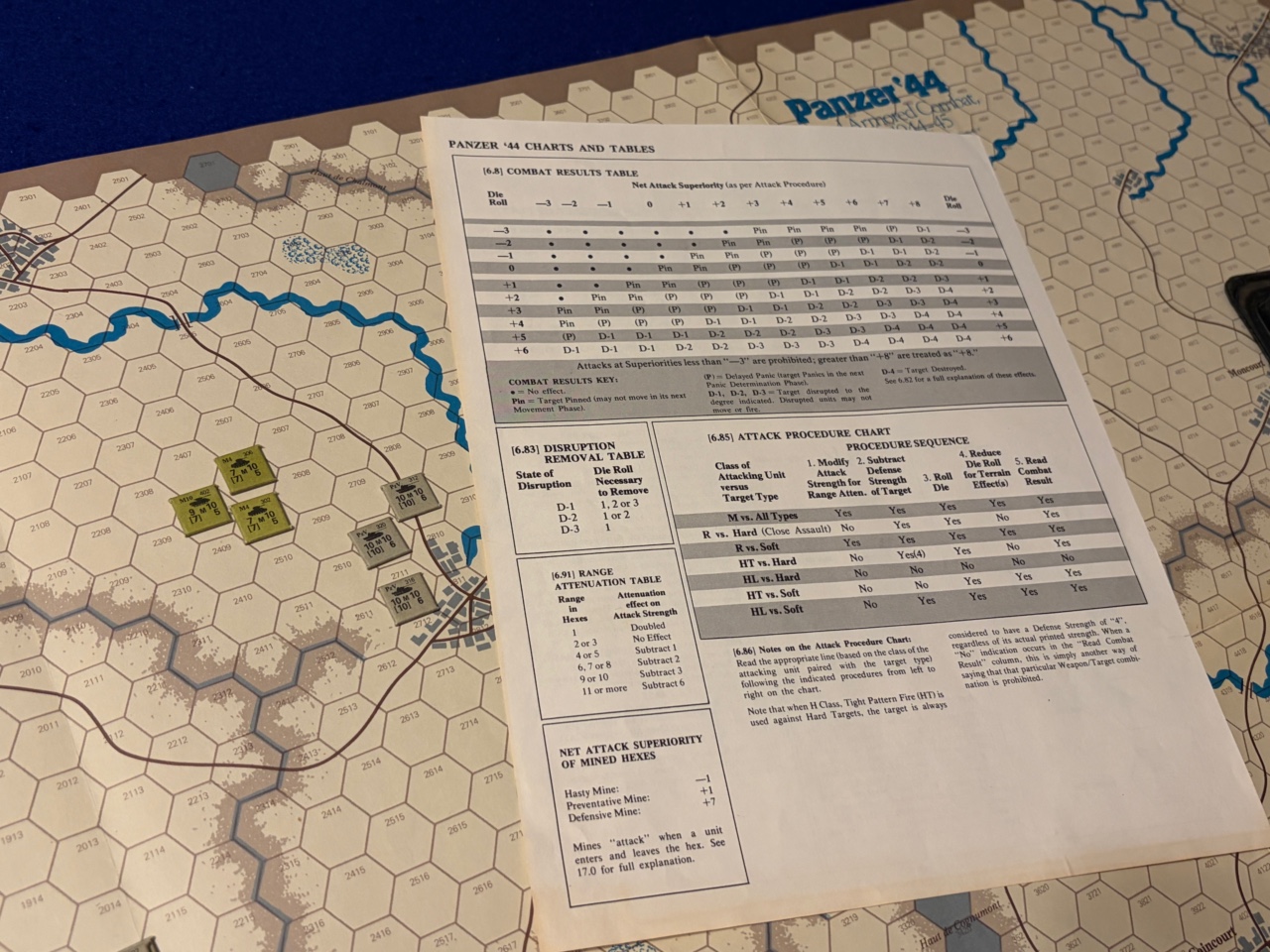
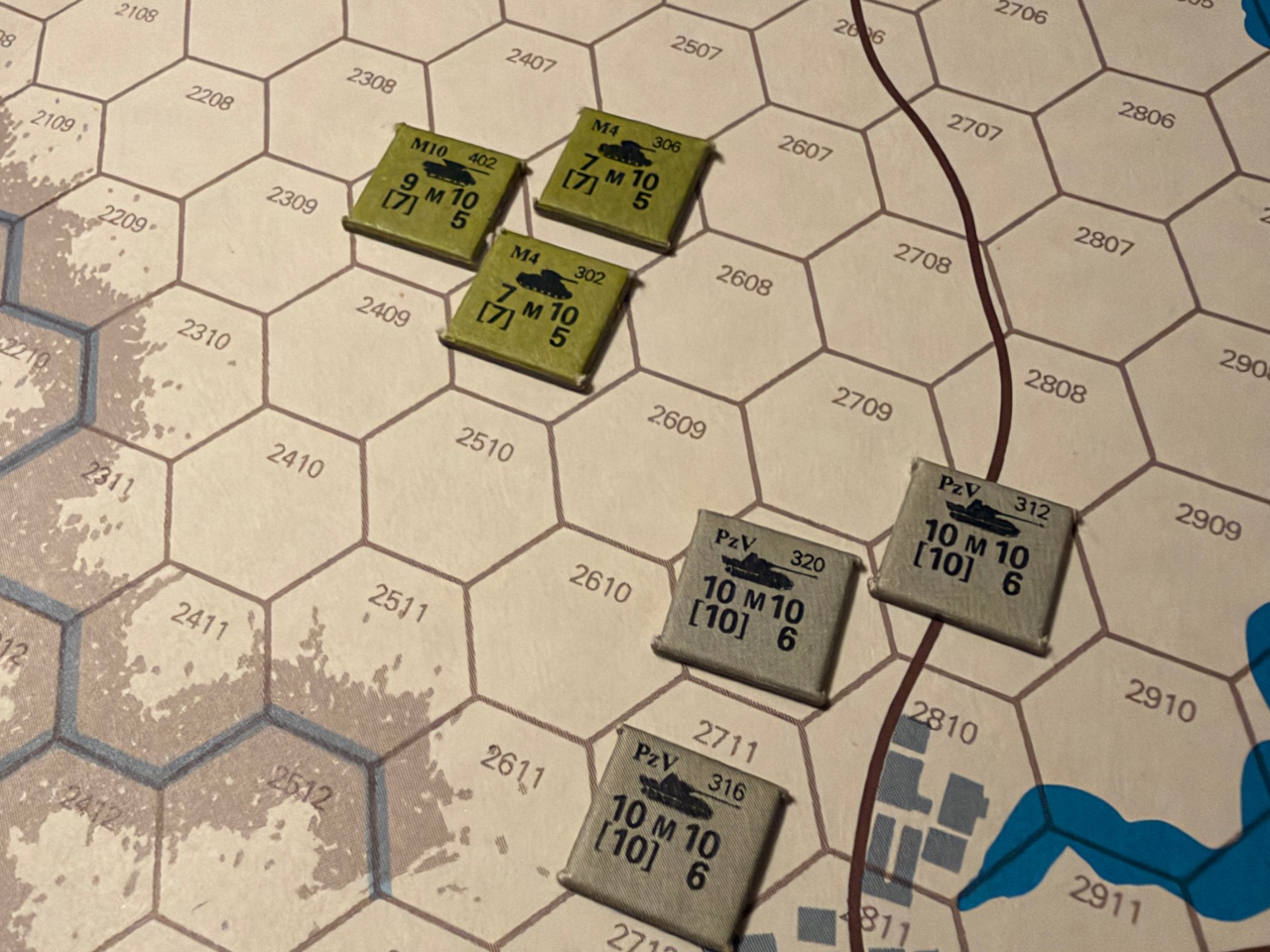
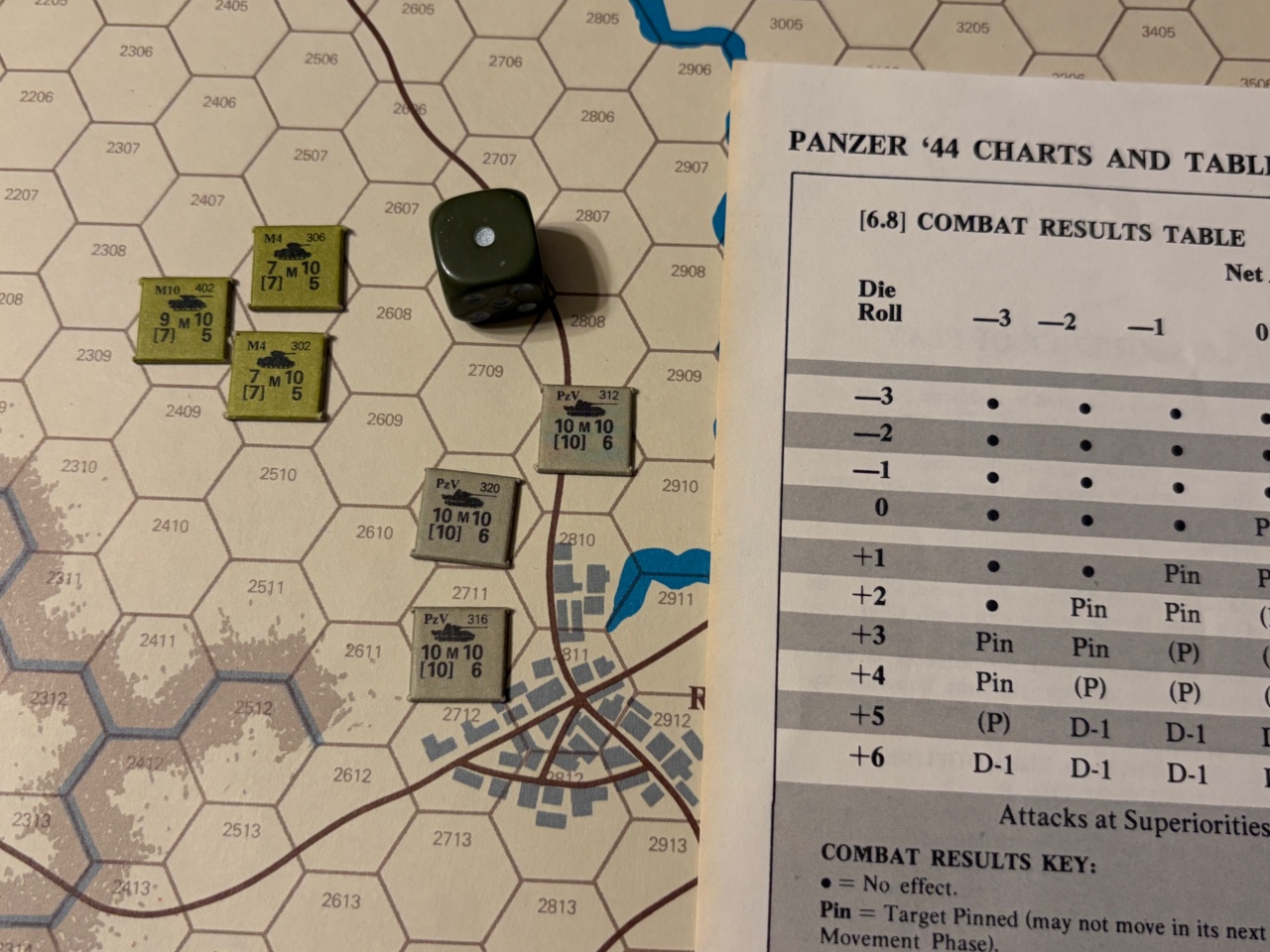
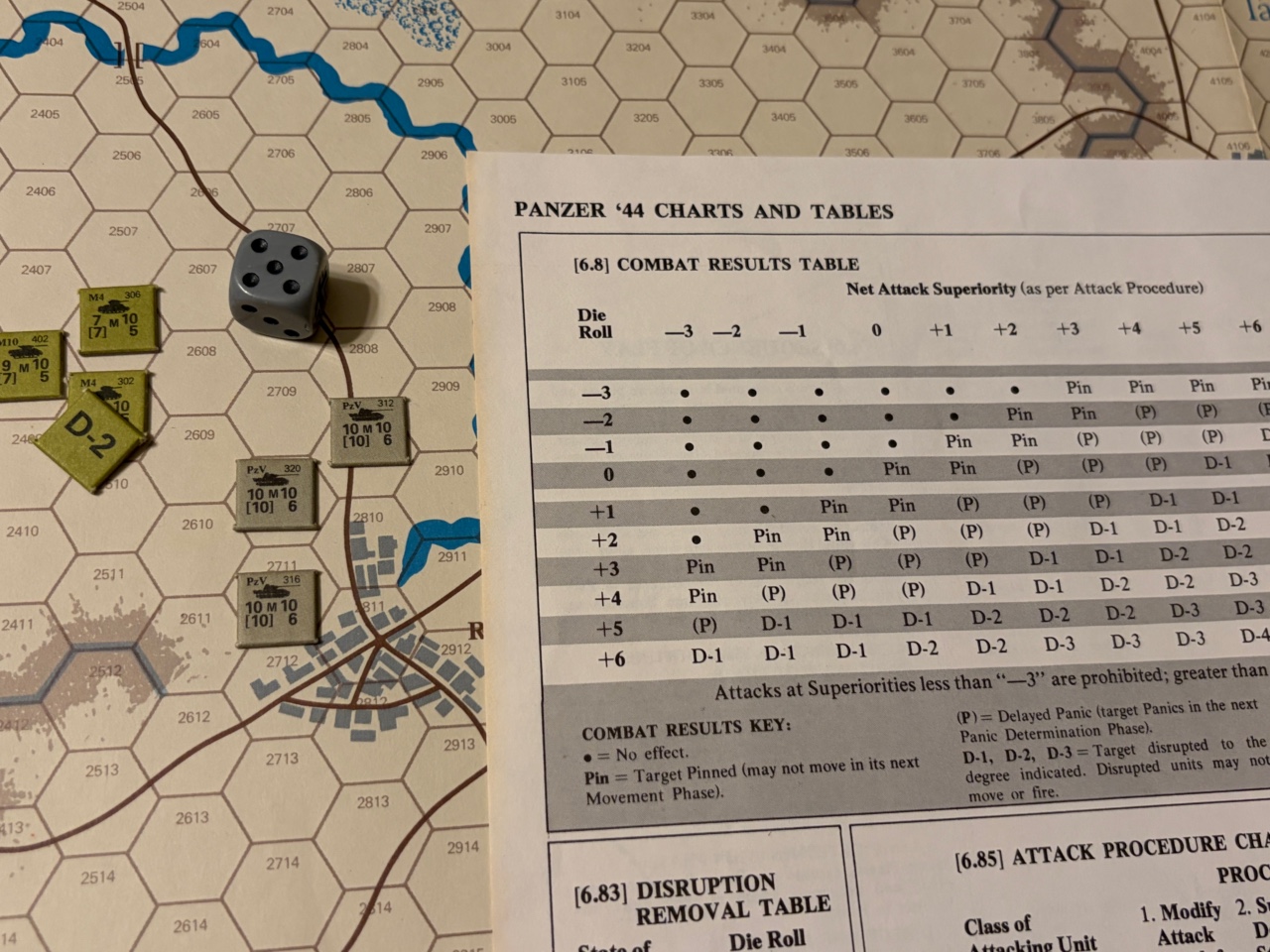
Overall, the firing procedure in Panzer ’44 is simple and quick to execute. While the firing procedures certainly are simultaneous, I am not sure they are “fairly detailed” like Dunnigan claims in Game Notes, nor do they be.
History – The “Sedan Revenged” scenario in Panzer ’44 technically recreates the Battle of Dompaire. The scenario is not, however, a strictly historical simulation as it takes place near Arracourt on the game map. After discovering this discrepancy, I wonder why SPI used an area-specific map instead of a generic geomorphic design that could represent nearly anywhere in Western Europe. It makes me wonder if Panzer ’44 was supposed to be a wargame with different scenario modules. From the final product I can only guess SPI decided against that publishing approach. It also somewhat explains why we get a scenario with the French but no French counters. More broadly, the fact Panzer ’44 can support a scenario with forces not specifically in the counter mix nor that were fought “on the map” shows how the Design for Effect philosophy extends into scenario design. If you are a rigid historian and want strict simulation in your wargames, well, Panzer ’44 will disappoint. If you, however, are the type who uses wargames to explore history in a playable game format, Panzer ’44 can be a good tool.
’44 x ’75 x ‘26
What is my verdict of Panzer ‘44?
I certainly am not ashamed to own or to (occasionally) play Panzer ’44. Panzer ’44 is not a bad game…for its time. Yes, looking back from 2026 with the benefit of over 50 years of wargame design and developments since there are different, admittedly better, ways of getting after the “Design for Effect” goals Dunnigan chased in this game. I also note that Panzer ’44 was published less than a year after SPI printed KampfPanzer which is similar in scale (units represent platoons, one turn is 3 minutes 40 seconds, and each hex is 100 meters across) and the first wargame to use the “SiMov” system which Dunnigan rapidly iterated with the later game.
Panzer ’44 may not be the prettiest of wargame design nor the best one Simonsen ever delivered but it communicates well enough for play. As a historical artifact, Panzer ’44 is a prime example of the evolution of game design and experimentation using different game mechanisms to create not a strict historical simulation, but a wargame with a suitable War Engine for players to enjoy.
A solid design at the time, had many hours of fun with it, but past its sell by date now, sadly.
BGG user @Dephinium, Nov 2003
- https://boardgamegeek.com/boardgamedesigner/1081/jim-dunnigan ↩︎
- https://www.spigames.net/spi_games_by_publication_date.htm ↩︎
- Dunnigan, James F. (2000) Wargames Handbook, Third Edition: How to Play and Design Commercial and Professional Wargames. Writers Club Press. ↩︎
- http://www.costik.com/spicom/gamesmo.html ↩︎
- “Redmond Aksel Simonsen (June 18, 1942 in Manhattan, New York – March 9, 2005 in Garland, Texas) was an American game designer and graphic artist best known for working with wargames at SPI (Simulations Publications, Inc.), where he supervised the release of over 400 games. He was a game graphics innovator and is sometimes even credited with creating the term “game designer”. He was also an editor for game magazines Strategy and Tactics, Moves, and Ares.” (courtesy BGG) ↩︎
- Harrigan, Pat, and Matthew G. Kirschenbaum, eds. (2016) Zones of Control: Perspectives on Wargaming. The MIT Press. ↩︎
- Lowood, Henry. ““War Engines: Wargames as Systems from the Tabletop to the Computer”, in Harrigan, Pat, and Matthew G. Kirschenbaum, eds. (2016) Zones of Control: Perspectives on Wargaming. The MIT Press, p. 89. ↩︎
- Lowood, p. 93. ↩︎
- https://dice.miraheze.org/wiki/History_of_Gamescience ↩︎
Feature image courtesy RMN
The opinions and views expressed in this blog are those of the author alone and are presented in a personal capacity. They do not necessarily represent the views of U.S. Navy or any other U.S. government Department, Service, Agency, Office, or employer.
RockyMountainNavy.com © 2007-2026 by Ian B is licensed under CC BY-SA 4.0

