
Before reading The Stress of Battle, if you uttered the phrases “Historical Analysis” or “human factors” I immediately would assume you were talking about the work of Col. Trevor DuPuy of (USA, Ret.), the founder of The DuPuy Institute. David Rowland’s The Stress of Battle: Quantifying Human Performance in Battle for Historical Analysis and Wargaming tells the story from the United Kingdom perspective. Rowland’s book (second edition from The History of Wargaming Project) presents the history of historical analysis (HA) in the UK as it relates to Operational Analysis (OA). In doing so, Rowland delivers not only a history of the HA efforts, but also their impact on OA, particularly as it relates to soldiers in combat. Drawing from the Conclusion of Rowland’s book, we learn:
- “Military OA evolved to meet urgent operational needs to optimise weapons effectiveness in battle and had to function within the confines of short timescales inherent in war.”
- “When it came to the development of new weapons systems, data on their application in war was derived increasingly from individuals’ military experience and peacetime trials of various types.”
- “The analysis of interactions and events within several hundreds of such battles, enabled advice to be given on more realistic OA combat modelling.” (Rowland, pp. 215-216)
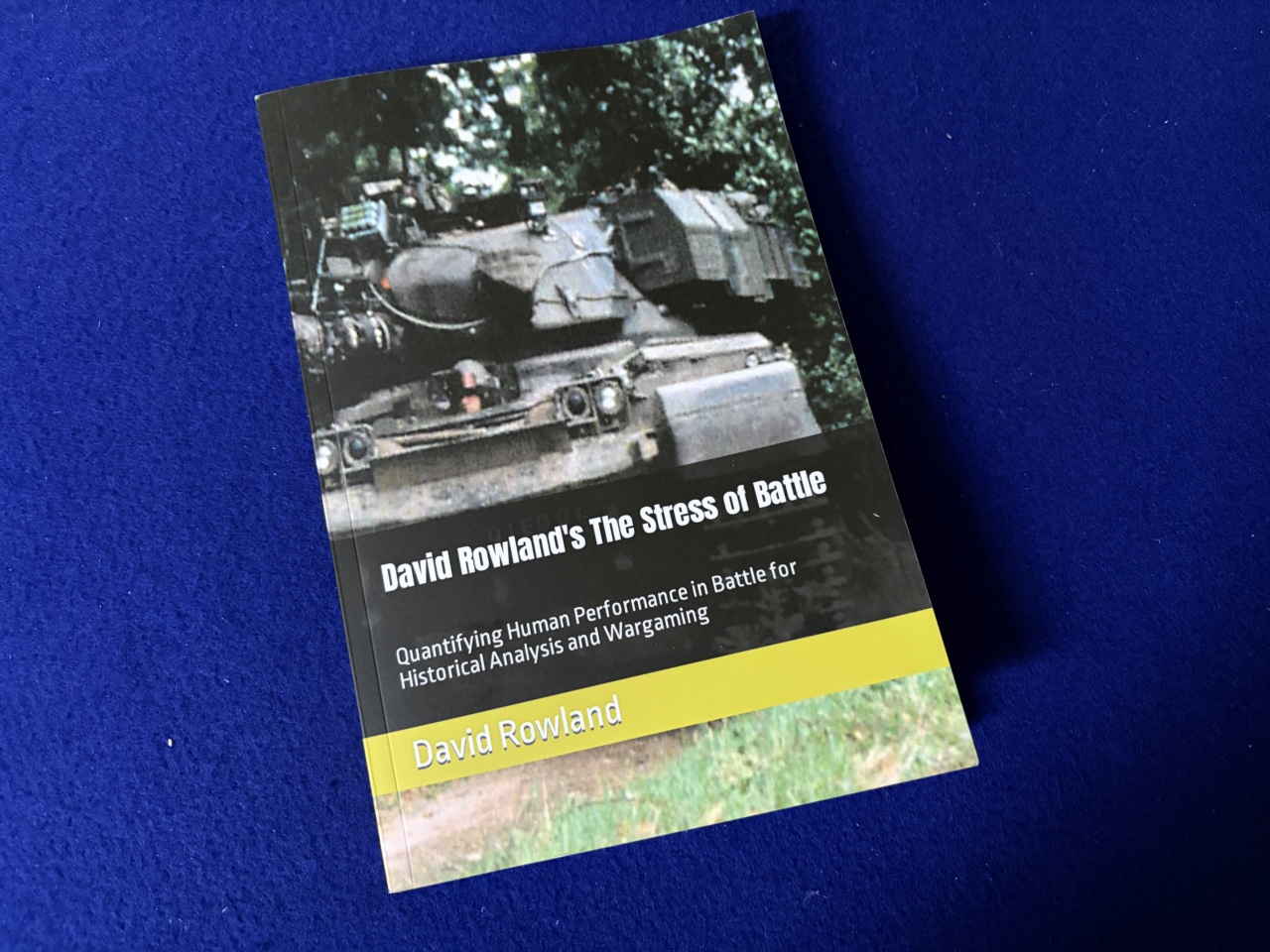
The Stress of Battle notes that in order to deliver the proper data for OA, a new data set comparing a weapon’s effectiveness in combat—simulated or real—required basic combat degradation estimates for each weapon class. This lead to:
The net result of this approach has been the ability to make empirical estimates of effects which other techniques and disciplines had been unable to tackle or quantify. This initial study thus represented a prototype of a new technique, which we term ‘historical analysis’, for developing general relationships for behaviour and effectiveness in combat.
Rowland, p. 216
Rowland in The Stress of Battle explains how Historical Analysis, “has demonstrated its ability to make quantitative assessment of the behaviour of men and organisations in real operations…” (Rowland, p. 219). This includes quantifying the effects of supervision and individual heroism and the “aggressive employment of reconnaissance elements” (Rowland, p. 220). Rowland’s conclusion: Combat effectiveness, “can be improved significantly without a change in weapon or equipment” (Rowland, p. 220).
I will be the first to admit that from the viewpoint of a wargame designer—practitioner or hobbyist—the usefulness of The Stress of Battle is not straightforward. The Stress of Battle makes the case for Historical Analysis and from there it is up to the wargame designer to decide how related analysis on combat effectiveness, heroism, combat degradation, surprise, and shock are implemented in a wargame (if implemented at all). While most every wargame uses a combat system that is traceable to some model of combat effectiveness, too many trivialize—if not outright ignore—the human element. After reading The Stress of Battle, I personally have a new respect for wargames such as Advanced Squad Leader where morale is so important. Wargames with good morale rules (i.e. representative yet playable) are often surprising (and fun) to play because the reflection of human behavior under fire is highly dramatic. How many players remember that game where that one (heroic? unit could not die. Or that one that stood ground as they were gradually worn down (combat degradation?). Or how that elite unit just could not get it together after being ambushed (surprise? shock?).
David Rowland’s The Stress of Battle: Quantifying Human Performance in Battle for Historical Analysis and Wargaming is a book that teaches wargame designers how to humanize wargames. The Stress of Battle brings home the real meaning of General George S. Patton’s saying, “wars may be fought with weapons, but they are won by men. It is the spirit of men who follow and the men who lead that gains the victory” (as cited by Rowland, p. 221). Can your wargame legitimately claim the same?
Feature image courtesy RMN
The opinions and views expressed in this blog are those of the author alone and are presented in a personal capacity. They do not necessarily represent the views of U.S. Navy or any other U.S. government Department, Service, Agency, Office, or employer.
RockyMountainNavy.com © 2007-2026 by Ian B is licensed under CC BY-SA 4.0

