
Earlier this year, I took in “player’s copies” of four much, much older Simulations Publications, Inc. (SPI) wargames: Star Force ‘Alpha Centauri’ (1974), Panzer ’44 (1975), World War 3 (1975), and The China War (1979). Here are my shorter, bite-size impressions of each.
StarForce ‘Alpha Centauri’: Interstellar Conflict in the 25th Century (1974)
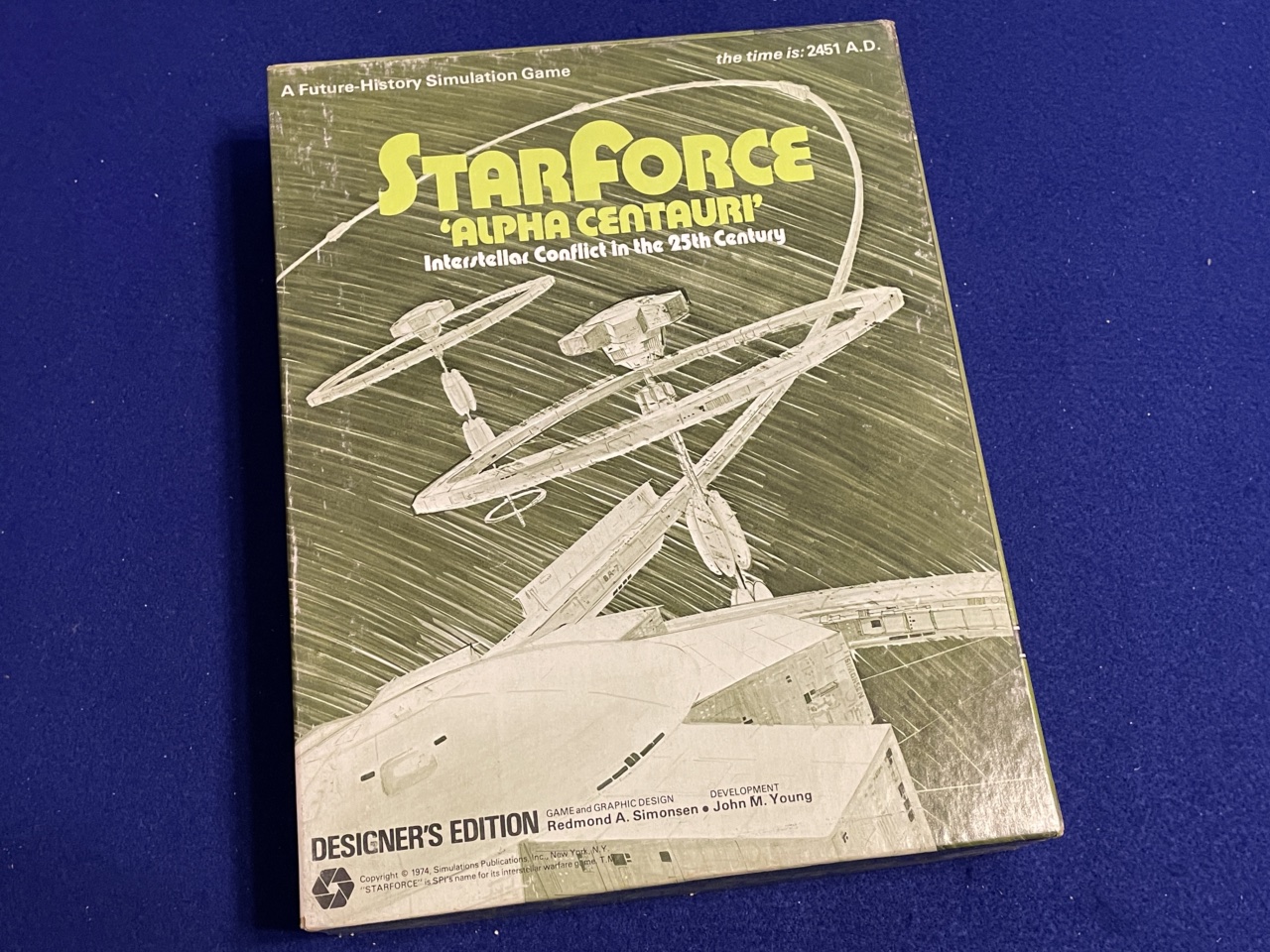
- Designer Redmond Aksel Simonsen
- Artist Redmond Aksel Simonsen
- Package Boxed
- Condition VG (Per Noble Knight – “Very Good. Used. May have medium-sized creases, corner dings, minor tears or scuff marks, small stains, etc. Complete and very useable.”)
- Scale “Each LiteZulu on the Stellar Display is one Lite [Light Year] across by one Lite deep. The Stellar Display is 39 Lites across by 43 Lites ‘deep’. The Stellar Game represents twelve hours of real time. The MiniLiteZones on the Tactical Display are one MiniLite [Light Minute] across by one MiniLite deep (one MiniLite=one third of a light-day). The Tactical Display is one hundredth of a Lite across by one hundredth of a Lite deep. Each Tac-Turn represents 30 minutes of real time” ([4.6] GAME SCALE).
- Annotated Sequence of Play
- A. Stellar Shift Plot Phase
- B. Shift Execution Phase
- 1. Safe-Shift Execution Segment
- 2. Overshift Execution Segment
- 3. Zulu Coordinate Readout Segment
- “If opposing Players do not have opposing units in the same LiteZulu, Players proceed to the following Game-Turn.”
- C. Combat Execution Phase
- 1. Initial Combat Segment
- 2. Second [and Subsequent] Combat Segments
- “Play continues through a series of Combat Segments until one Player or another has been removed from the contested LiteZulu.”
- D. Stellar Neutralization Recovery Phase
“…unlike any game you’ve ever played.”
What sort of resistance did SPI face when publishing StarForce? First they deny being predictive…
StarForce is a simulation of interstellar warfare as it might be fought in the 25th through 27th centuries. This game is not meant to be predictive, i.e. its designer does not purport that the “future” shown in its scenarios and rules will be the actual future. The game should not be viewed as an extrapolation of present day trends into the far future. Rather, the game is a set of imaginary conditions and technology which make possible far-flung interstellar societies (and conflict in those societies).
[1.0] INTRODUCTION
…then they caution grognards…
A Special Note to Experienced Gamers: It’s probable you’ll find StarForce to be quite unlike any game you’ve played. It combines some of the aspects of a naval game with those of an air game. Nevertheless, it involves control of “territory” as in a land game. Since we are all creatures of habit, it might be difficult at first to discard the game playing preconceptions developed over years of experience. The best way to approach the game is with an open mind, free of assumptions about what can and can’t be done…There are no “front lines” in StarForce, no easily discernible patterns of advance and retreat – winning strategies are based upon the proper deployment and outguessing the opponent as much as possible.
Pre-publication playtesting of the game indicated that a lack of gaming experience was actually an asset, since the novice had less to “unlearn” and could more easily adapt to the mechanics of the system.
[3.0] GLOSSARY OF TERMS FOR THE BASIC GAME
…and then they acknowledge some just outright dislike the game and refuse to play…
From a purely game playing point of view, StarForce was deliberately designed to be different. This is taking a chance since some gamers may not like the “cold bath” effect of such a strange game-system and decide to “get out of the water.” Nevertheless, the designer felt it worthwhile to explore the outer edges of hex-grid conflict simulation systems in an attempt to produce an interesting game. The science-fiction nature of the subject matter allowed this to be done.
[40.2] STARFORCE DESIGNER’S NOTES
Praised but plotting
One criticism of StarForce that I see is the dislike of the need for plotting. The rulebook actually offers an alternative rule in [37.0] SEQUENTIAL PLAY though it cautions, “Of course, Players realize the structure of the standard game is built around simultaneous plotting and that any attempt to circumvent that structure will result in distortions” ([37.5] CAUTIONARY NOTE). That caution makes rule [39.0] VERBAL PLOTTING all the more interesting:
GENERAL RULE
If Players trust each other, they may do much of the plotting for StarForce in their heads and only occasionally write down coordinates and such, each to support their memories. Combat allocations can simply be announced more or less simultaneously. This technique was used in much of the playtesting of the game and was very effective in speeding up play (particularly in the Advanced version with its two levels of plotting).
[39.0] VERBAL PLOTTING
Its own universe
The rulebook for StarForce contains an incredible amount of (to borrow a roleplaying game term) world-building. Designer Redmond Simonsen wrote a two-page spread on, “STARFORCE RATIONALE: THE SCIENCE FICTION BEHIND THE GAME STARFORCE” that is a complete future-history for the setting. The scenarios are also full of history and “setting” with the different races and their Systems and historical narrative. In researching StarForce, I also came across a 12-page article from Strategy & Tactics Nr. 45 titled, “Science Fiction Futures: A Critical Survey” that ends with this commentary:
All of this is, of course, a form of background for the StarForce game; to place it in the context of an often maligned form of literature. The use of psionic powers as a convention in sf has been mentioned and, of course, it is a key element in the game. The use of these same powers as a combat power to project enemy ships (as well as one’s own) across the galaxy is not so conventional though it certainly is not out of the context of sf. Indeed, if one accepts the notion of telekinesis (which this would be) there is no reason why minds could not exist and/or be trained to do exactly what is postulated in the game. That would certainly be as plausible as a spaceship anchoring itself in space and drawing another ship to it, if not more plausible.
Star Force ‘Alpha Centuri’ is the “strategic” game in the StarForce universe. I previously acquired the tactical game StarSoldier (SPI, 1977). Rule [41.0] THE LINK GAME in StarSoldier defines how to combine and play the two games together. Wow…
Panzer ’44: Tactical Armored Combat, Europe, 1944-45 (1975)
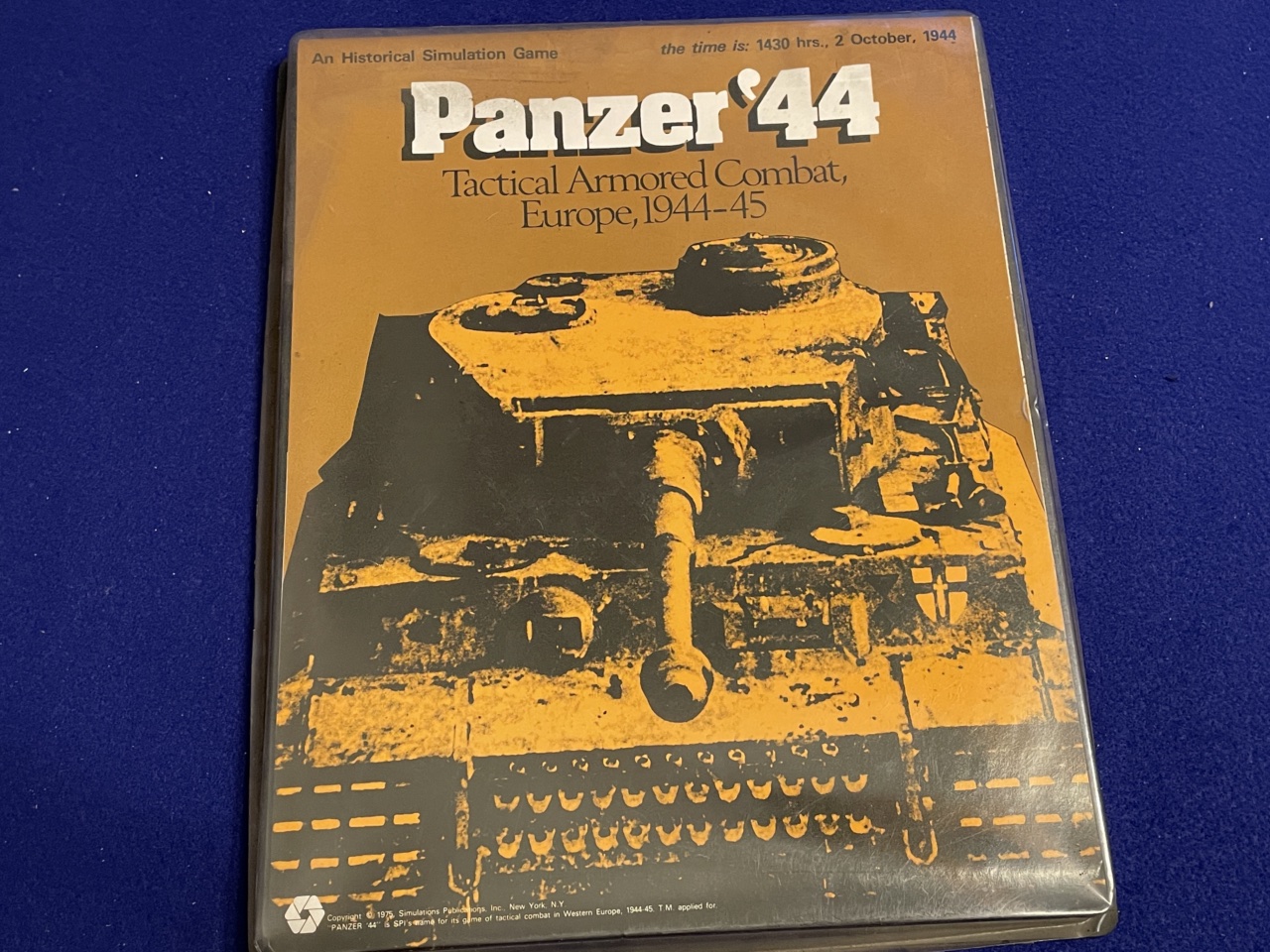
- Designer Jim Dunnigan
- Artist Redmond Aksel Simonsen
- Package SPI Flat Pack
- Condition VG (Per Noble Knight – “Very Good. Used. May have medium-sized creases, corner dings, minor tears or scuff marks, small stains, etc. Complete and very useable.”)
- Scale Each Game-Turn represents form one to six minutes; each hex represents 200 meters of terrain; units are Platoons or Sections
- Annotated Sequence of Play
- 1. MUTUAL PLOT PHASE
- Simultaneous (“SIMOVE”)
- 2. PANIC DETERMINATION PHASE
- 3. DIRECT FIRE PHASE
- Attack Strength ± (Range Attenuation) – Defense Strength = Net Attack Superiority Table Column
- Die Roll – (Terrain Modifier) = Row on Net Attack Superiority Table
- 4. MOVEMENT PHASE
- 5. PIN AND DISRUPTION REMOVAL PHASE
- INDIRECT FIRE PHASE
- 1. MUTUAL PLOT PHASE
”Controversial”
DESIGN NOTES: One of the more controversial aspects to this game is the Combat Results system. On its face the concept of successive disruptions seems unrealistic. Take the case of a pair of 88’s firing on a platoon of Shermans at, say, 800 meters. Assuming visibility is good and the 88’s achieve surprise the result, in reality, would be the destruction of one, two, three or more of the Shermans before platoon could react. In other words, within a minute or so represented by the Game-Turn, part of the platoon would be permanently destroyed and part would remain effective. This is not what happens in the game; the platoon would probably suffer a D1 or D2 result. The disruption result puts the entire unit into a temporary “never never land” from which it will either return with its original effectiveness intact, or not, depending on a random die roll and future Enemy actions. The justification for this situation os that over a series of Game-Turns, within a limited scenario, the disruption system does represent and reflect combat attrition and does so without recourse to extensive record keeping and step-down step-up unit replacement. For example, assuming a six turn time period, a unit which suffers a D1 will not be able to fire (on the average) two of the six turns or 33% of the time. For that six turn period the unit will have suffered 33% attrition in utility. And in most scenarios there are few combat situation which are sustained more than six turns. The pin and delayed panic results express the disorganization and confusion caused by incoming fire rather than actual attrition, but the net reduction of effectiveness is equivalent.
[21.0] GAME NOTES
While Panzer ’44 was apparently “controversial” for its day, today this is what a wargame designer calls, “design for effect.”
With a 16 page (3 column) rulebook, a 34”x22” paper map, two, double-sided Player Aids, and 400 counters (1/2”) today Panzer ‘44 would barely qualify as suitable for a wargame magazine. On a scale of 1 to 9, SPI rated the complexity of Panzer ’44 as a “7”—relative to many wargames since I personally would rate it as, “Medium Light (2)” using the BoardGameGeek “Weight” scale.
A bit of some sleuthing on BoardGameGeek (BGG) reveals that Panzer ’44 is effectively the World War II version of MechWar ’77: Tactical Armored Combat in the 1970’s with the “modern” warfare elements removed.
World War 3: 1976-1984 (1975)
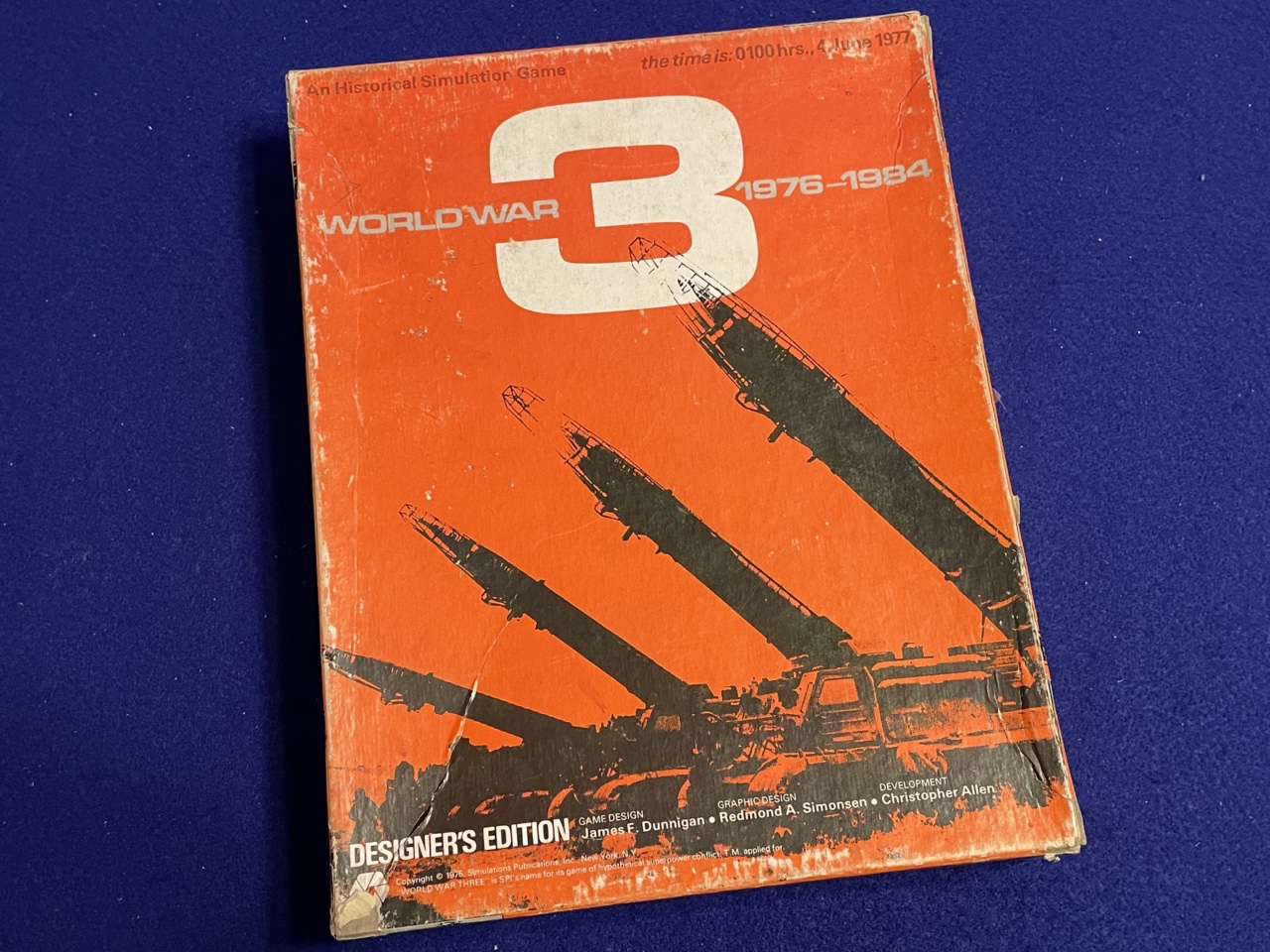
- Designer Jim Dunnigan
- Artist Redmond Aksel Simonsen
- Package Boxed
- Condition Fair (Per Noble Knight – “Very well used, but complete and useable. May have flaws such as tears, pen marks or highlighting, large creases, stains, marks, etc.”) [The Noble Knight grading scale goes no lower than ‘Fair’ but, given the box condition, one could argue for rating the condition as ‘Poor’—a true “player’s copy”.]
- Scale “Each Game-Turn represents three months (one season) of real time. Each hex is equivalent to 500 miles in distance” ([3.5] GAME SCALE).
- Annotated Sequence of Play (“…fifteen mandatory and two optional Phases…” ([4.1] GAME TURN)
- A. NAVAL STAGE
- 1. East Bloc Coalition Naval Supply [Judgement] Phase
- 2. East Bloc Coalition Naval Movement Phase
- 3. East Bloc Coalition Naval Combat Phase
- 4. Western Alliance Naval Supply [Judgement Phase]
- 5. Western Alliance Naval Movement Phase
- 6. Western Alliance Naval Combat Phase
- B. LAND STAGE
- 7. East Bloc Coalition Land Movement Phase
- 8. East Bloc Coalition Land Combat Phase
- 9. East Bloc Coalition ICBM Strike Phase (Optional)
- 10. East Bloc Coalition Strategic Movement Phase
- 11. Western Alliance Land Movement Phase
- 12. Western Alliance Land Combat Phase
- 13. Western Alliance ICBM Strike Phase (Optional)
- 14. Western Alliance Strategic Movement Phase
- C. PRODUCTION PHASE
- 15. Reinforcement Phase
- 16. Production Preparation Phase
- 17. Turn-Record Phase
- A. NAVAL STAGE
Clancy-esque
The back of the box for World War 3 reads like bit like a Clancy novel:
With the increased number of small scale conflicts throughout the world had come increased tension and strain in relationships between the Soviet Union and the United States. Each superpower felt it necessary to choose sides in the local, “conventional” wars that proliferated in the late 1970’s, until each felt small pressures from all directions. Eastern Europe, the Middle East, the Asian sub-continent, Southeast Asia, Africa and Central America were involved to various degrees, in conflict.
Then, one side (we’re not saying which) began to feel its position slipping, as its favored side in war after war became threatened, with the scale of the conflicts ever more violent. Warnings and violent talk were followed by the commitment of the first conventional land forces by a superpower. This was followed immediately by an even greater commitment from the other side, and the war of escalation was on.
The Soviet Union struck first in Europe, and overran Germany and France in a matter of weeks. Italy and the smaller countries of Western Europe were cowed into submission, and Leftist regimes came to power in each of them. However, with the larger Gross National Product, and thus, with the larger capacity to make war, the United States was in a better position to wage a prolonged war. The United States struck back in outlying areas, consolidating its gains in areas that, without a sufficient fleet, the Soviet Union could not maintain proper contact with.
Of course, the question of decisive victory was quite impossible. Because the war had “crept up” upon the superpowers, there had been no nuclear exchange, and, so far, the threats to resort to nuclear warfare had remained unfulfilled. But, if either power should become directly threatened, the possibility that it would use nuclear weapons would become a near-certainty. Thus, both sides kept their military goals small. The United States hoped to use its greater war making capacity to wear down its opponent, while the Soviet Union attempted to use its overwhelming strength to achieve lightning victories in short campaigns.
As the futility of the war became apparent, and the populations and their economies began to show signs of fatigue, the war gradually wound down to a sort of “cold war” stalemate, and, although there were thousands of miles of front lines, the unofficial orders of the frontline troops were not to provoke the enemy. And because of this unsatisfactory, but inevitable resolution, the responsible parties in the governments of both superpowers were overthrown, allowing for a gradual withdrawal of troops from the battlefields across the globe.
World War 3, back of the box
In [26.3] DESIGNER’S NOTES for World War 3 the comment is made that, “No one had ever done a game on this scale before; at least not successfully, combining playability with a high degree of realism”. World War 3 covers a 5-year war in quarterly turns; “an ambitious game” according to the designers.
Pipelines and Transit Attacks
The rules in World War 3 that immediately jump out at me are [18.0] MERCHANT SHIP PIPELINE and [13.0] NAVAL ZONES OF CONTROL. The pipeline rule is interesting in that Merchant Ship counters do not represent individual or groupings of ships but rather shipping “in the pipeline.” Destroying a merchant ship counter “breaks” the pipeline. Ships are not directly attacked but, rather, are subjected to an attack when they enter or are within the Zone of Control of another unit and are attacked as they “transit” the hex—a condition the rules call a “Transit Attack.”
“Lasciate ogne speranza, voi ch’intrate”1
I am struck by how…pessimistic Dunnigan is regarding the World War 3 game universe he designed. The [26.0] GAME NOTES are full of negative outlooks such as:
- Western Alliance ([26.1] PLAYER’S NOTES)
- “As far as land forces are concerned, NATO is lost along with all of Western Europe.”
- “The first few Game-Turns of the Naval part of this scenario will be much like the land war. The East Bloc Coalition will be unstoppable”.
- “Attempt, if possible, to withdraw all Naval units from the Mediterranean Sea…It may, however, prove impossible for the Western Alliance Mediterranean units to escape”.
- East Bloc Coalition ([26.1] PLAYER’S NOTES)
- “Land strategy for the first four Game-Turns is simple – attack, attack, attack. This is an advantage that will likely never occur again”.
- “As for the naval war, not too much can be said. There is no conceivable way to defeat the Western Alliance naval forces in the long run”.
- General Notes ([26.1] PLAYER’S NOTES)
- “A word about the ‘Armageddon” Confrontation options – don’t. [Rule [23.3] ARMAGEDDON CONFRONTATION concerns the possibility of “Global Thermonuclear War” breaking out which immediately ends the game.] The temptation to use this option is just too great. Use of this rule will guarantee a quick game, probably no more than two Game-Turns, with no true victor”. [I wonder if the Armageddon Confrontation rule was from designer Jim Dunnigan and the comment from the Developers or the or the other way around—with neither willing to cut it.]
Solo guidance
World War 3 also has guidelines for solo play (see [26.2] SOLITAIRE GUIDELINES). These guidelines are not a set of rules but exactly what they are called; guidelines to playing the game in a manner I call “two-handed solo.”
The China War: Sino-Soviet Conflict in the 1980s (1979)
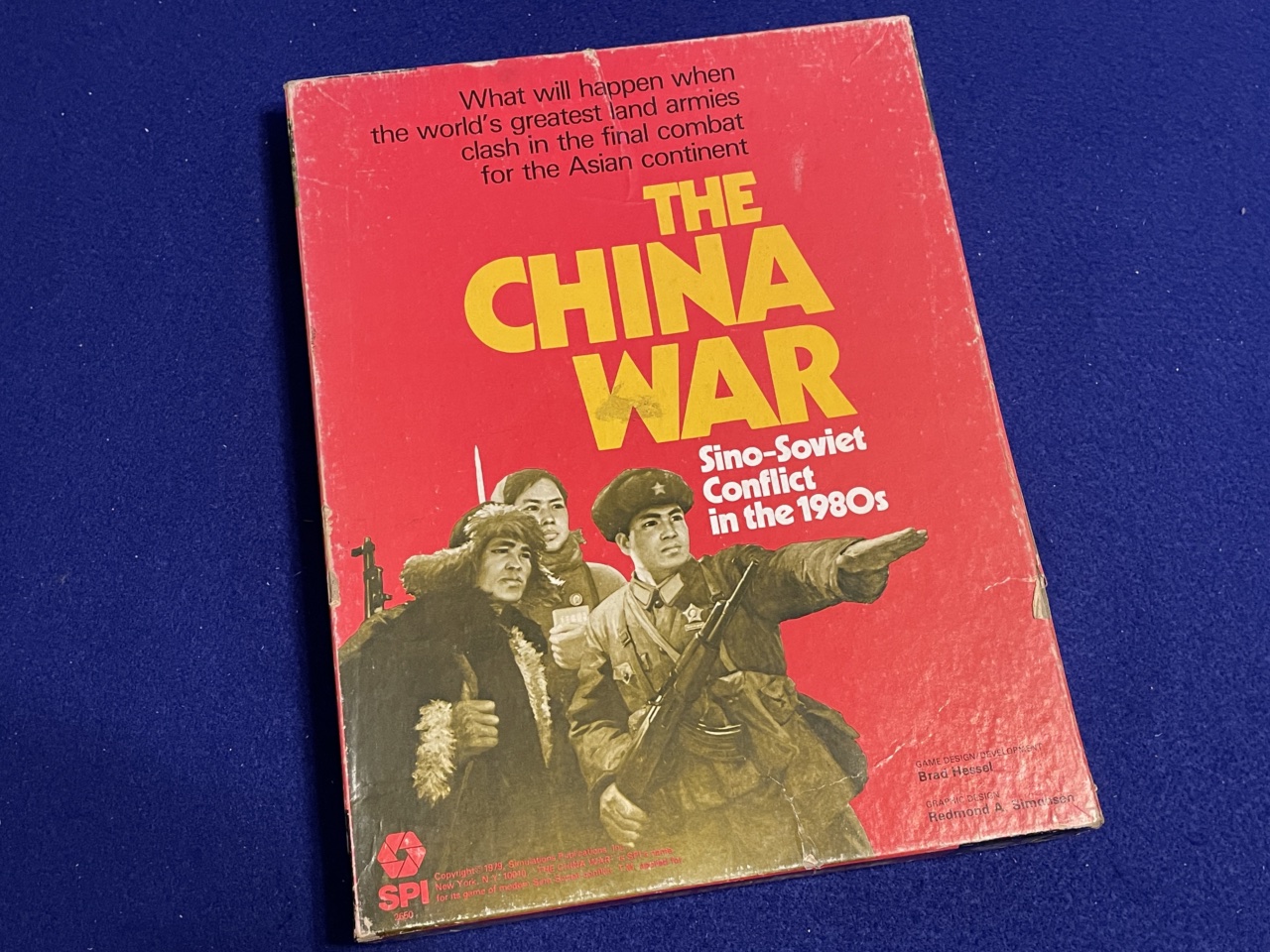
- Designer Brad Hessel
- Artist Redmond Aksel Simonsen
- Package Boxed
- Condition Fair (Per Noble Knight – “Very well used, but complete and useable. May have flaws such as tears, pen marks or highlighting, large creases, stains, marks, etc.”) [The Noble Knight grading scale goes no lower than ‘Fair’ but, given the box condition, one could argue for rating the condition as ‘Poor’—a true “player’s copy”.]
- Interestingly, there appears to be a copy of the rulebook and counters from the original magazine version of The China War in the box though only a single map is found.
- Scale Each Game-Turn represents one week; 126km/hex; units are XXX Corps and XX Division.
- Annotated Sequence of Play
- A. POLITICAL EVENTS INTER-PHASE
- B. USSR PLAYER-TURN
- 1. USSR Reinforcement/Replacement Phase
- 2. USSR Movement Phase
- 3. PRC Reaction Phase
- 4. USSR Combat Phase
- C. PRC PLAYER-TURN
- 1. PRC Reinforcement/Replacement Phase
- 2. PRS Movement Phase
- 3. USSR Reaction Phase
- 4. PRC Combat Phase
- D. GAME-TURN INDICATION INTER-PHASE
Ratio Shift
A relatively uncomplicated wargame; The China War comes with a 12-page rulebook where the core rules are a mere eight (8) pages long. The Notes for The China War notes talk to the “ratio shift” rules:
The “ratio shift” character of the combat system was the focus of some debate. We were concerned that it might prove too cumbersome in play, and indeed we managed to cut down a bit on their ubiquity. But we ultimately decided that the ratio shift system was the best means of underscoring the relative importance of such factors as training and morale (combined into the Cadre Rating) and electronic warfare.
“The China War Notes,” Rulebook, p. 11
Nowadays, using column-shifts vice die roll modifiers is a commonly seen wargame design feature; I guess in the “dark ages” of wargaming in the late 1970’s with The China War that was still a novel design choice—and in some ways experimental in usage.
Scenario [19.0] BACK TO THE MAINLAND! is a Taiwanese invasion of mainland China. My, how the times have changed….
- From Dante Alighieri‘s work Inferno, translated by Henry Francis Cary as “all hope abandon ye who enter here”, from the Italian lasciate ogne speranza, voi ch’intrate. The variant “abandon hope, all ye who enter here”, with a change of meaning, was likely chosen for its iambic pentameter. (via Wiktionary) ↩︎
Feature image courtesy BoardGameGeek
The opinions and views expressed in this blog are those of the author alone and are presented in a personal capacity. They do not necessarily represent the views of U.S. Navy or any other U.S. government Department, Service, Agency, Office, or employer.
RockyMountainNavy.com © 2007-2026 by Ian B is licensed under CC BY-SA 4.0


I’m a little confused by this piece; there is nothing in it suggesting you played any of these games.
Not full plays but what I informally call “rules fams” where I lay out the game and run through the rules. Often step through the examples of play to familiarize myself with game mechanisms. I really want to get StarForce back to the table for an officially full play.
Oh what fun you had!
Four good choices.
While all of them look interesting it is StarForce I am prioritizing to get to a full play at the gaming table.
Eventually.
I played the China War game a few years back- I still holds up OK.
Cheers,
Pete.