
Sucker!
My first clue should have been the repeating title in Amazon listing:
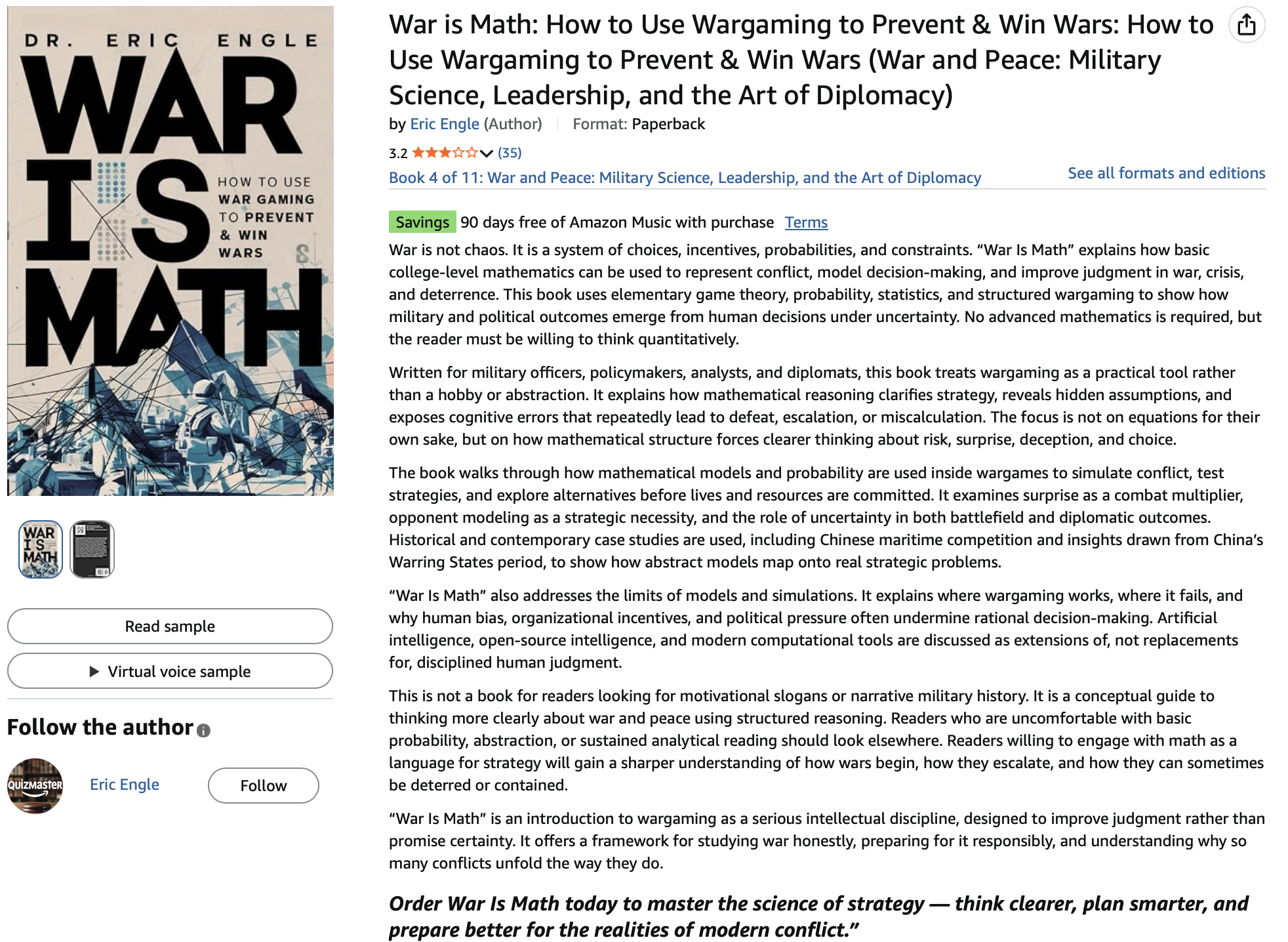
If I had only done a bit of some due diligence about the author. This is the Amazon bio:
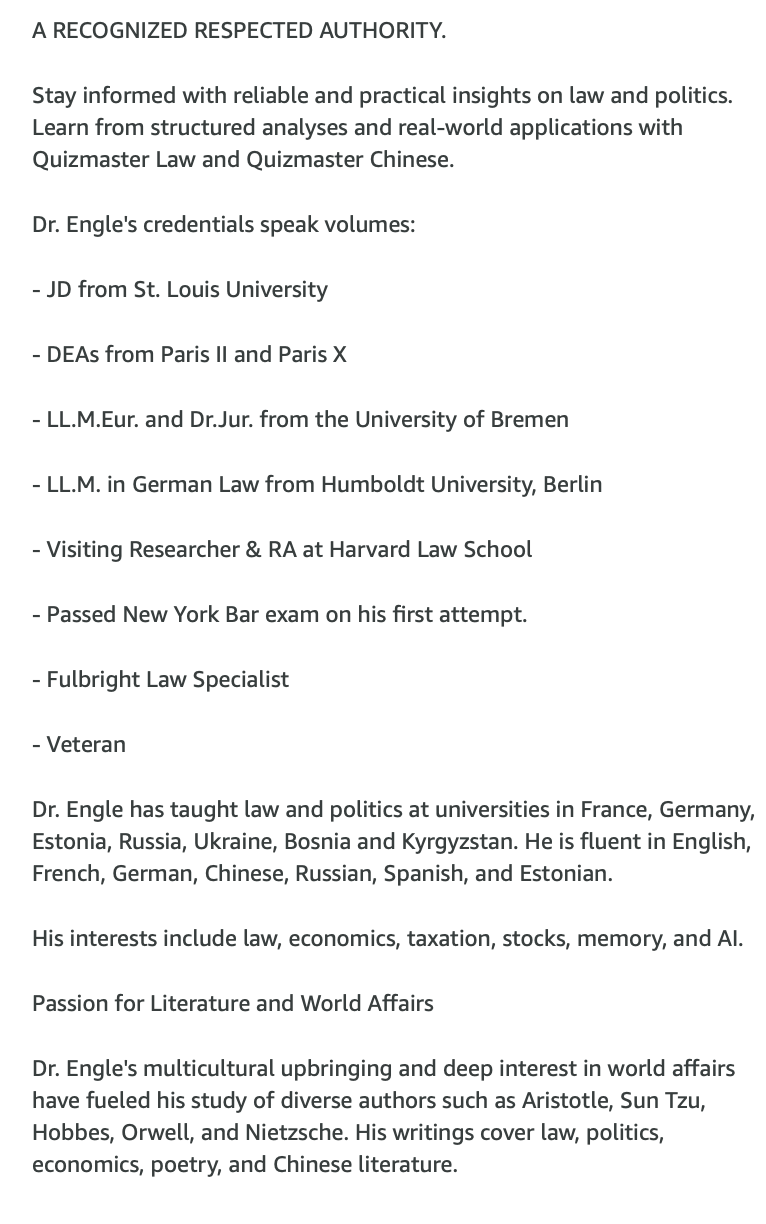
I am not sure in “Dr. Eric Engle” uses AI for writing…but it sure looks like it. The book itself a print-on-demand model. Frankly, the formatting and layout is horrible; it literally looks like somebody strung together some Word files and sent it to print. Proofreading? No indication of. Instead you get lots of repeated sections—either directly (cut-n-paste errors?) or merging two or more sections without checking to ensure they make sense (proofreader or editor—likely both—absent).
[After reading the bio and the back of the book it is very likely that that “Dr. Engle” has convinced themself that with their “impressive array of law degrees” (back if the book) combined with their “legal prowess” (back of the book) this “recognized authority” (back of the book) does not need any help writing.]
The part of Math is War that disappoints me the most, however, is the actual content.
The subtitle of War is Math is, “How to Use War Gaming to Prevent & Win Wars.” If you try to use this book all I will say is, “Good luck”; you are going to need it because this book is not a worthy resource.
The book is broadly divided into four sections: Wargaming, Math, Role Playing Games, and Conclusion.
I am not really sure “Dr. Engle” is a wargamer. The core of Section I talks to “Mathematical Representation of Combat Power.” Dr. Engle does not footnote/endnote ANYTHING so I cannot tell where he derives his assertions from. As I read this section, I see echoes of Trevor DuPuy or Christopher Lawrence or David Rowland…but with no credit to anybody. After providing exemplar case studies (as deep as a Wikipedia-like summary allows), Engle has a section titled, “Implications of these Case Studies for Wargaming” with seven considerations:
- “Intelligence mechanisms: Create systems for gathering and interpreting intelligence, allowing for the possibility of misinterpretation or deception.”
- “Preparedness levels: Implement variable states of readiness that affect unit performance and response times.”
- “Fog of war: Use hidden information and limited intelligence to create uncertainty.”
- “Special rules: Develop mechanisms for surprise attacks that can temporarily override normal game procedures.”
- “Psychological factors: Incorporate morale and leadership elements that can be affected by surprise.”
- “Time scales: Use variable time scales to represent the critical first hours or days of a conflict when surprise has the most impact.”
- “Asymmetric scenarios: Design scenarios where one side has a significant surprise advantage to explore historical ‘what-ifs.’”
It only gets worse. Further discussions in Section I are all-but-worthless. For example, “J. Wargaming Realistic Scenarios Involving Chinese Maritime Conflict” is nothing more than a list of five scenario ideas.
Section “II. Math” is a rambling/disorganized/incomplete/incomprehensible at times discussion of “The law of large numbers,” “The gambler’s fallacy,” “Regression to the mean,” “and “Bayes’ Theorem” which are not even discussed in the order listed. This whole section is really a discussion of Game Theory…but without any credit given to the pioneers in the field. That is a problem with the tone of the entire book: Dr. Engle is telling you all this because—obviously—it has never been realized before.
At this point I had to put War is Math aside because the writing was so awful and self-boasting that I could not stomach it any further. The line, “The last time I started blabbing about proof of concept was regarding generative art” pushed me over the edge.
I skipped ahead to the end to see “Dr. Engle’s” conclusion. I really wish I had started here as these three paragraphs clearly signal to me to not bother reading the book at all:
Math as the Ultimate Weapon
Ultimately, war can be accurately modeled with basic math functions: the careful calculation of probabilities, the careful calculation of the correlation of forces, the adjustment of beliefs based on new evidence, and the strategic interaction of nations trying to optimize their position. The complexity of modern warfare means no single model, no single wargame, can fully predict the future. But as we have seen, math provides the framework for understanding the chaos. By breaking down the fog of war into numbers and patterns, we gain insights that were previously hidden. It is in those insights where victory lies.
War is Math, p.. 146-147
[“War can be accurately modeled with basic math functions.” Right….]
Wargaming is not only about simulating battles to train in peace for effective deterrence and war-fighting. Wargaming is also about making better decisions and being a better leader. Nations that embrace the lessons of math, game theory, probability, and cognitive psychology will not only improve their military effectiveness, they will also be able to steer the course of history itself.
War is Math, p. 147
[I do not disagree with the two sentences but with that third sentence the Ghost of McNamara is rising…]
Victory in the wars of the future will go to those who can calculate, adapt, and think one step ahead. This book, War is Math: How to Use Wargaming to Prevent & Win Wars, has laid out the tools needed to achieve that goal. As we look toward an uncertain future, one truth remains clear: those who master the numbers can ultimately master the battlefield.
War is Math, p. 147
Spoiler Alert (finally): War is Math does NOTHING to help you “use wargaming” to “master the numbers.”
AVOID!
Feature image courtesy RMN
The opinions and views expressed in this blog are those of the author alone and are presented in a personal capacity. They do not necessarily represent the views of U.S. Navy or any other U.S. government Department, Service, Agency, Office, or employer.
RockyMountainNavy.com © 2007-2026 by Ian B is licensed under CC BY-SA 4.0

