
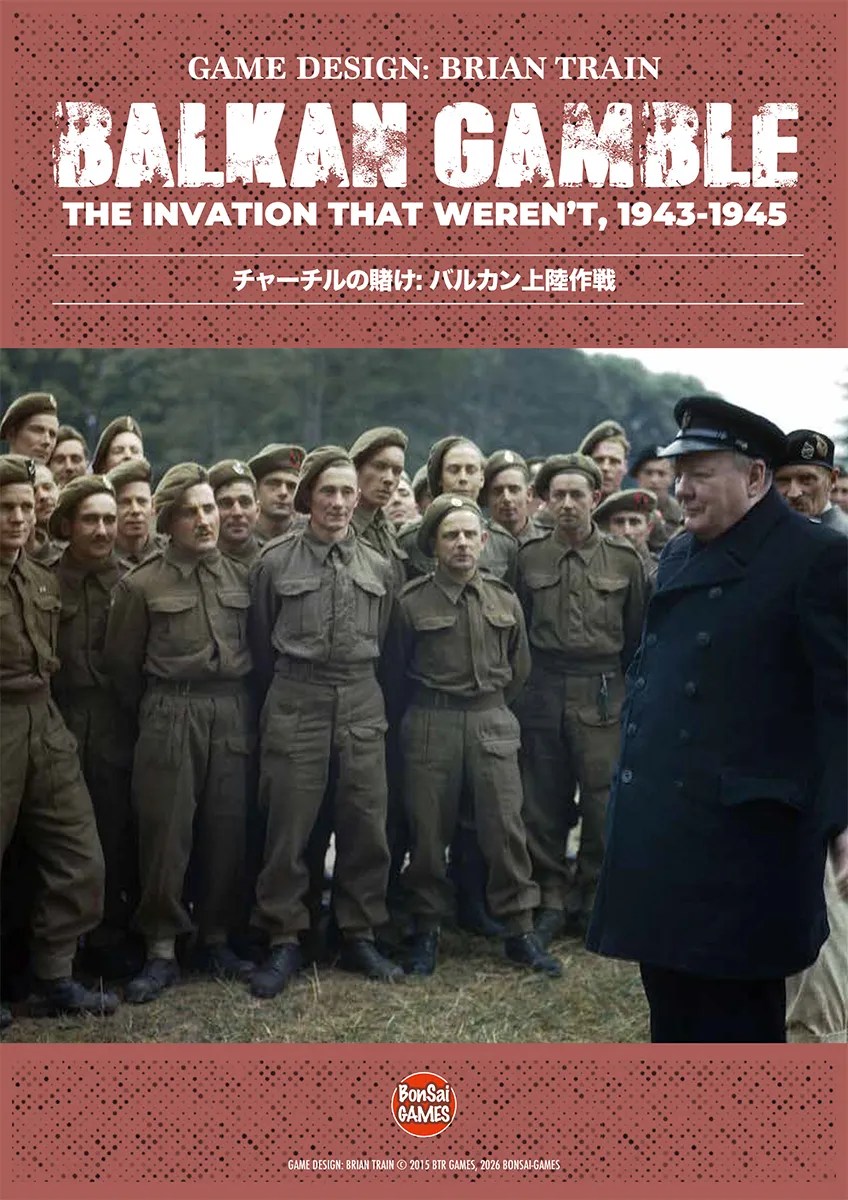
Balkan Gamble: The Invasion[s] That Weren’t is the feature game in Banzai Magazine Nr. 28 (Winter 2026). The game, by designer Brian Train, is an updated reprint of Train’s Balkan Gamble first self-published under Train’s label—BTR Games—in 2015. Balkan Gamble marries an interesting alternative history series of campaigns with Bonsai Games’ traditional high production values to deliver a thoughtful, yet playable, magazine wargame with great table presence.
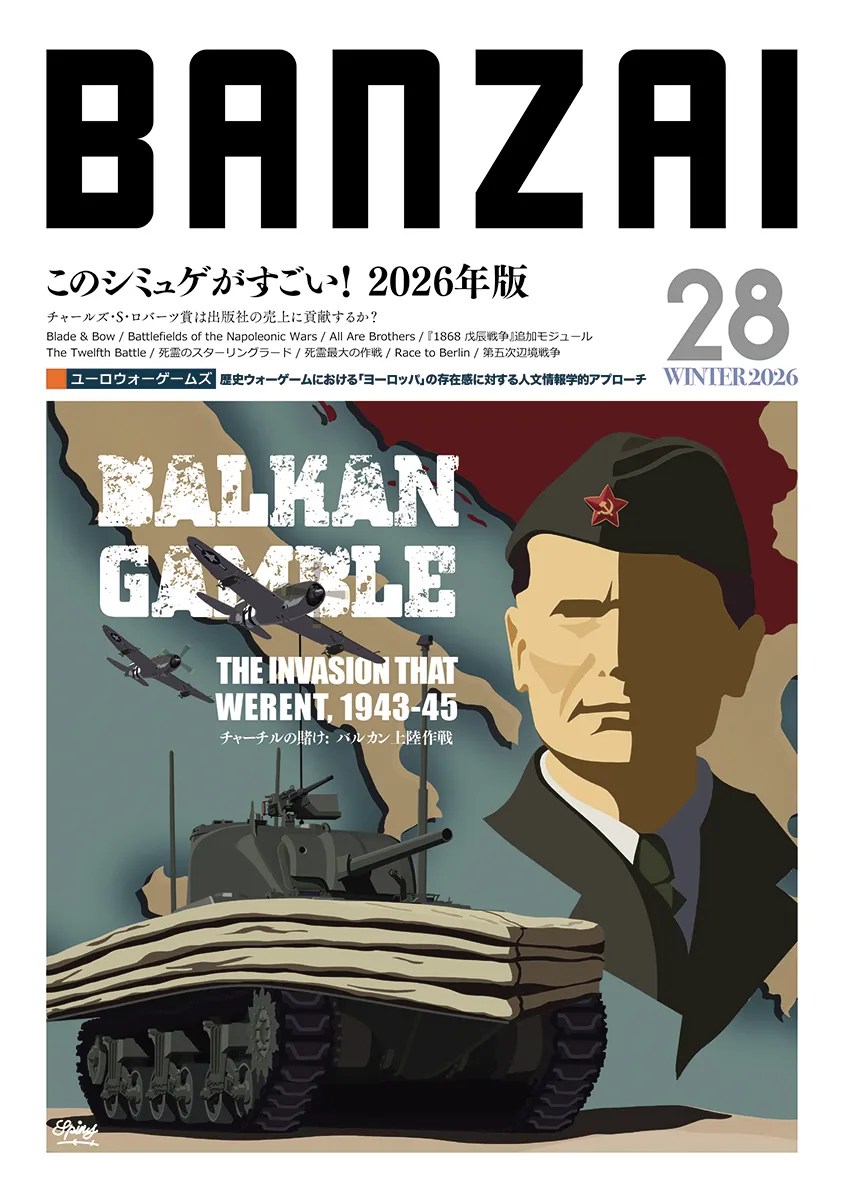
While Balkan Gamble is a historical game set in World War II and the few years after, the game leans into the “alternate history” aspect of the hobby as it features battles that truly never happened. As the introduction in the Japanese-language rulebook states:
“Churchill’s Gamble: Balkan Invasion Operation” is a two-player simulation based on a hypothetical “what if” setting: what if the Allied forces had invaded Southern Europe via Greece, Albania, and Yugoslavia during the latter half of World War II? Additionally, a hypothetical combat scenario involving a Soviet invasion of Yugoslavia in 1950 is also provided.
Balkan Gamble, Rulebook (Jpn), p. 2
The Bonsai touch
As the feature game inside a magazine, Balkan Gamble has few components. Rules, along with extended historical commentary and designer’s notes is in a 28-page, full-color, double-column rulebook. The map, measuring ~23″ wide by ~33″ tall uses portrait orientation with players sitting on the opposite short sides; game charts and tables are oriented for each player to use. A single sheet of 286 1/2″ counters completes the game.
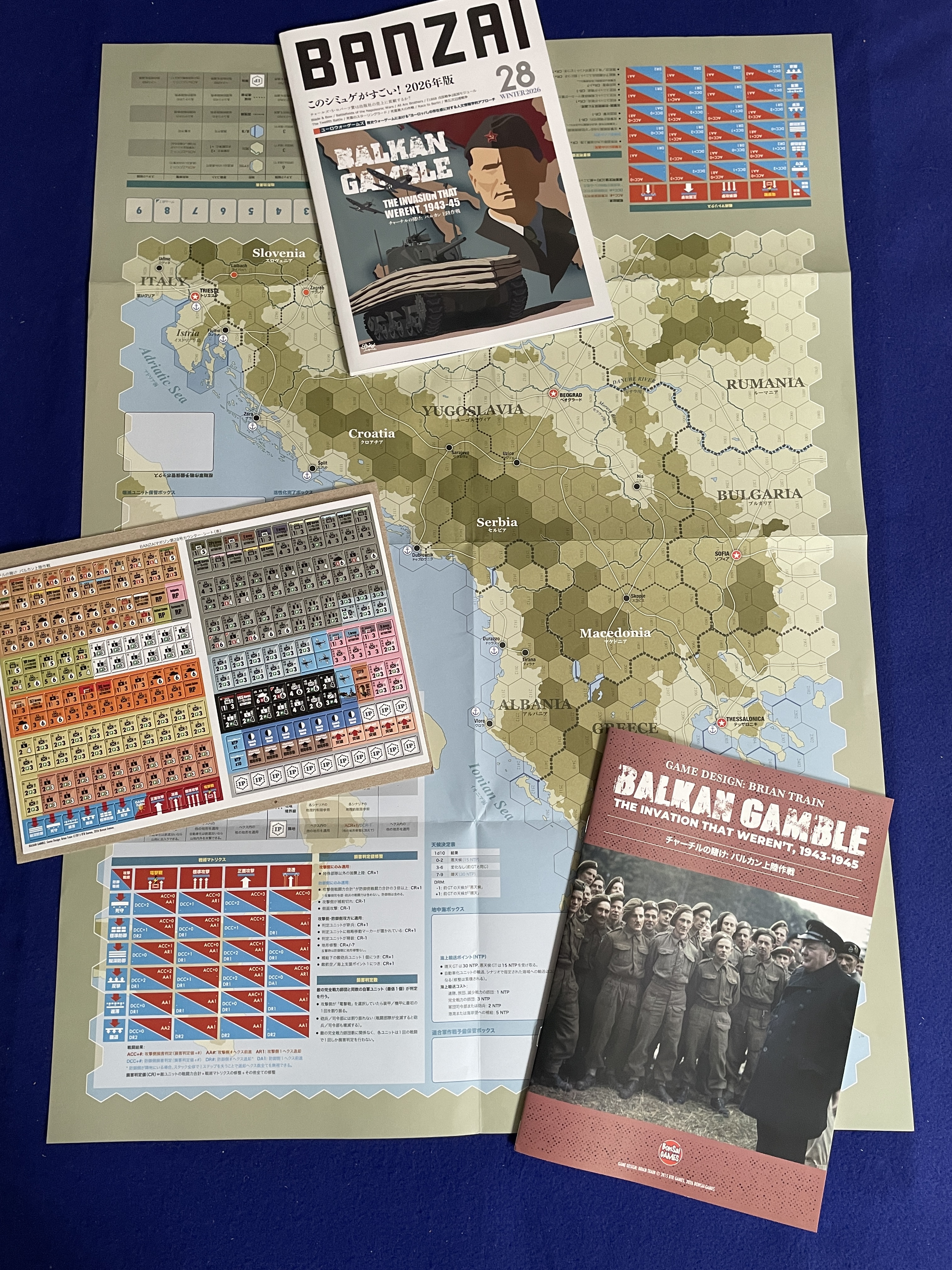
[Yes, there are a few spelling errors in the typesetting but nothing that destroys the flow of game, mind you. If you cannot find an English translation of the rules you can always use AI to translate; I prefer NotebookLM where I have a project I call “Bonsai Translations” where I keep all the Bonsai Games rules and translations allowing the AI to “learn” wargame rules language as it translates and I clean it up. I have gotten to the point where I could translate the 28-page rulebook and tables in about four hours (that includes reviewing and correcting the machine translation). The countersheet is very…fragile; as in the counters easily fall out of the sprue. Good thing is that makes you get them sorted right away…]
Train designs
If you are familiar with designer Brian Train then you undoubtably know that his wargame designs are…different. Different in that they often employ lesser-used game mechanisms in innovative ways. Different in that Train’s games often explore lesser-known or less-popular conflicts. Balkan Gamble is no exception.
The first game mechanism of note used by Balkan Gamble is chit-pull. Units are activated to move or fight when their headquarters (HQ) activation chit is drawn. Not only does the chit-pull represent the fog-of-war and friction, it also make the game very solo-play friendly. Train still, however, finds a way to make the simple chit-pull command mechanism interesting not because of the HQ drawn but what the non-formation units can do. Specifically:
- “Any friendly non-HQ unit that can trace a line of hexes free of enemy units no longer than FIVE tactical MF (ignore the effects of rivers) from the corps HQ may be “brought under command” by that HQ and used to move and/or conduct combat.”
- “If an army HQ chit is drawn, then the controlling player may immediately move by tactical or strategic movement that army HQ unit and any units that have both not yet moved and cannot, at that moment, be brought under command by any corps HQ.”
- “He may also immediately designate one corps HQ that has not yet been activated and could hypothetically draw supply from the corresponding army HQ; Either remove that corps HQ chit from the Randomizer (to be replaced in the Turn End Phase) or just remember, when it is drawn later, that that corps has already been activated.”
- “Note that though Army HQ units can command reinforcement units and out-of-command units to move using tactical movement, they can never command units to conduct combat or exploitation.” (5.1 Activating Units)
Movement in Balkan Gamble is of the Tactical or Strategic varieties. There are also rules for airborne and amphibious assaults. Nothing super-innovative in the movement rules; just a clean application of game mechanisms in simple, direct ways.
Combat in Balkan Gamble uses an Offense-Defense matrix game mechanism. In a combat action, the attacker chooses one of four red Attack Missions (Blitz, Balanced Attack, Frontal Attack, and Infiltrate) while the defender chooses one of six blue Defend missions (Standfast, Balanced Defense, Defense in Depth, Counterattack, Delay, and Withdraw). Consulting the Mission Matrix Table, players will find modifiers for Casualty Checks and advance/retreat results.
7.31 Casualty Checks. Often the units of one or both sides in a battle will have to conduct casualty checks. The units on one side must conduct as many casualty checks as there are FULL STRENGTH divisions on the other side (there is a minimum of one check when indicated, even if there is no full strength division involved in the battle). The checking player may choose which of his combat units involved in the battle must check (EXCEPTION: in the case of a Blitz attack, the attacking player must choose to make at least one casualty check on at least one of his armor units involved in the attack).
Each unit that checks will roll 1d10 and compare it to the modified Casualty Check Total (CCT). The CCT is made up of:
– the total enemy CF involved in the battle,
– plus or minus any modifiers as required by the Mission Matrix Table and
– other applicable modifiers listed in the charts.
If the die roll is equal to or less than the CCT (remember that “0” is a zero), then the unit must take a step loss. A full strength division that takes a step loss is “reduced”: flip the unit counter to show its reduced side (with white stripe and italic printing). A reduced Elite quality division that must take another step loss will be replaced by its corresponding non-divisional remnant counter (marked by its matching ID number and a small black square in the upper left- hand corner). All other reduced strength divisions and non-divisional units required to take a step loss are removed from the game: place them in the “dead pile”.
7.31 Casualty Checks
[Train is honest about his inspiration for certain game design mechanisms. In fact, for the Mission Matrix, Train explains: “I am indebted to Jim Stahler for the essence of the Mission Matrix idea from his variant article for the old Avalon Hill game Blitzkrieg in The General magazine, vol. 18 # 6 (March-April 1982). I have used it in Autumn Mist, Winter Thunder and Summer Lightning, other designs of mine on the Battle of the Bulge and the Poland 1939 campaign (Designer’s Notes).]
In play the rules in Balkan Gamble for activation, movement, and combat flow well together. Here is a narrative example of play take from the rules to help illustrate how it all works:
7.5 Example of corps operations The American 6 Corps activation chit is picked. There are three units that may be brought under command (i.e. are within 5 MF) by the corps HQ unit: the 3rd Infantry Division ([Combat Factor] CF=5), the reduced 10th Mountain Division, (CF=3), and the 6A artillery unit (no offensive CF but it will add a +1 modifier in any subsequent enemy casualty checks). A stack consisting of the reduced German 181 Division (CF=2) and a Collaborator infantry brigade (CF=2) is in a rough hex blocking the railroad to Sarajevo. The Allied player decides to use tactical movement to move the 10th Mountain into contact – the 3 Infantry and 6A artillery are already adjacent. He does not add an Air Point to the battle.
The Allied player chooses Balanced Attack and the Axis player chooses Defense in Depth. The result is 0/+1 [over] a1/ r1.
This means both sides must conduct casualty checks (with no modifier for the attacker, and a +1 for the defender, due to the missions chosen) and when the checks are done, all remaining defending units must retreat one hex and the attacking units may advance one hex.
Both players must make one casualty check. The Allied player chooses the 3rd Division – the CCT is 6 (4 total enemy CF with a +2 modifier for the rough terrain in the defender’s hex). It will lose one step on a roll of 6 or less on 1d10. The Axis player wants to hang on to his better quality units, so checks the Collaborator brigade – the CCT is 9 (8 total enemy CF, +1 for the combat mission result, +1 for the Allied artillery, +1 for being a Poor unit, and -2 for the rough terrain). Now assume the brigade was eliminated and the only unit left in the hex is the reduced 181st. This unit must retreat one hex and the US units may now advance into the vacated hex.
7.5 Example
Partisans played an important role in Yugoslavia in World War II and in Balkan Gamble they are just as important. Tito gets his own HQ; partisans are either “concentrated”—acting much like a regular combat unit—or “dispersed” with special movement and combat rules.
To conduct combat against a hex containing dispersed mode partisans, the Axis player must declare which units in or adjacent to the hex are attacking. He rolls 1d10 against each dispersed-mode partisan, trying to score equal to or less than the total CF of the attacking units, MINUS the Terrain Modifier of the partisan’s hex. (Remember that a “0” is a zero.) The partisan is eliminated if he succeeds. (Note: Croatian, Elite quality, Chetnik and SS units count DOUBLE their CF when fighting dispersed mode partisan units. German infantry divisions 369, 373 and 392 are treated as Croatian for this purpose only, but are otherwise treated as if they were German Army units.)
9.53 Combat against partisans
Battles that weren’t
One of the problems in designing a wargame on a campaign that never happened, and in some sense was never meant to happen, is to construct a plausible Order of Battle (OOB) of the troops who could have fought in it. This is even worse when that campaign is set in the Balkans, a theatre of war that saw a bewildering variety of small, exotic and often improvised units. The approach taken in this game was to discount the presence of many of these “ant” units, due to counter mix limits and their negligible effect on the overall campaign.
Designer’s Notes
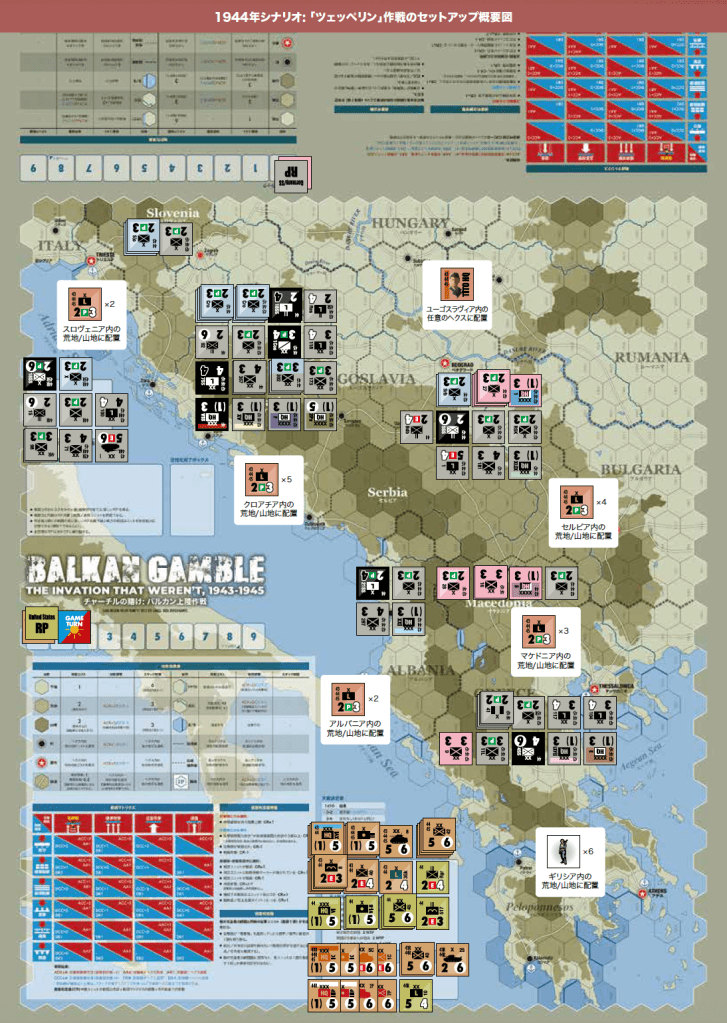
Balkan Gamble comes with four scenarios. In gracious Bonsai fashion, the setup for each scenario is an easy-to-follow graphic. This makes jumping into the game that much easier.
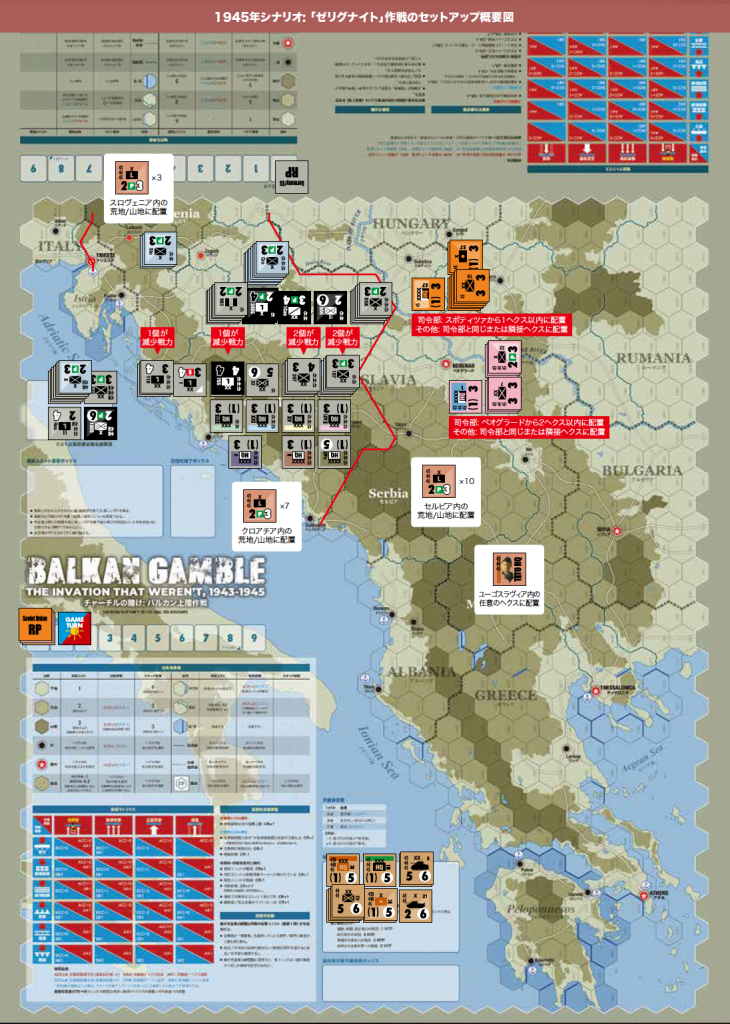
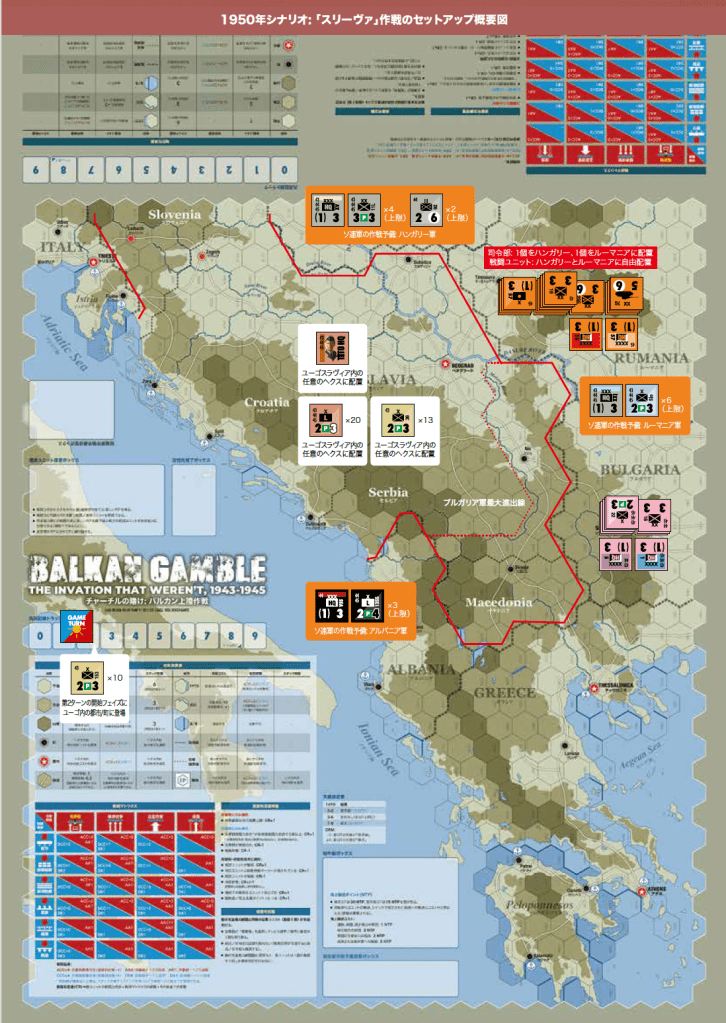
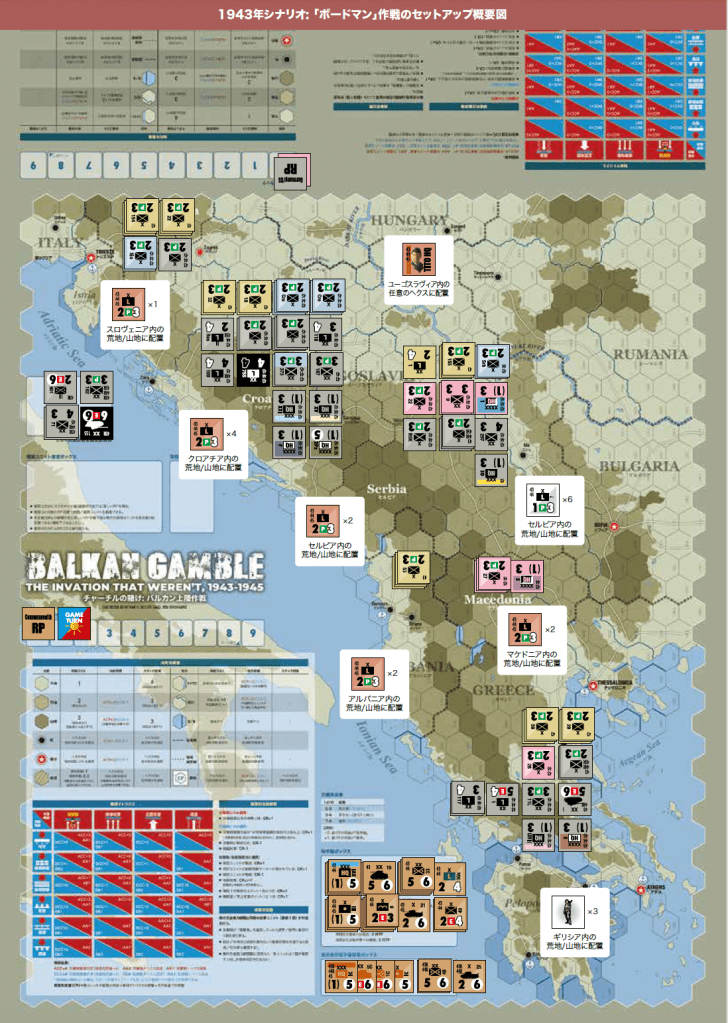
Non-historical
Not surprisingly, given the backwater nature of Yugoslavia in World War II, I do not have any books on my shelves that cover the war beyond a very superficial level. Given the entire premise of Balkan Gamble is a war-that-never-was means that every play of the game is a new discovery. This is where the simplicity of the rules for Balkan Gamble is appreciated; simple rules do not get in the way of quick, yet rich, gameplay. In other words, the simplicity of the game mechanisms makes studying the strategic situation come to the forefront of learning since time—and effort—need not be expended figuring out how to manipulate the game system. Instead, Balkan Gamble lets player jump straight into the scenario situations and see how they fare.
[My thanks to Yasushi Nakaguro and Bonsai Games for the courtesy copy of Banzai Magazine Nr. 28. I found this particular issue of Bonsai Magazine to be very strong with many great articles to include reviews/commentary/replays of Blade & Bow: The Ancient World at War, Battlefields of the Napoleonic Wars, All Are Brothers: Solferino, 1859, Battalion Class Boshin War: Higashisando Senki, The Twelfth Battle: the Caporetto Campaign 1917, Stalingrad of the Dead / The Longest Day of the Dead, Model’s Counterattack, Race to Berlin (Second Edition), and The Fifth Frontier War. Other articles of interest are “The Value Proposition of Wargaming Awards – the Publishers’ Perspective” by Jonathan Dyer (English-language version here) and in depth variants/game background/scenario for Global War, August Storm, and Jack Greene’s Togo. There is also an extended commentary by Xavier Rubio-Campillo from the book EuroWarGames titled, “A digital humanities approach to European presence in historical wargames.” There is even more; all of it together makes Banzai Magazine Nr. 28 a very strong issue. A subscription is HIGHLY recommended!]
Feature image – Milinklade in Sutjeska in June 9, 1943. Photographed by Žorž Skrigin. (Copied from the book War and Stage, Tourist Press Belgrade, 1968). The Battle of Sutjeska (or Operation Schwarz) in June 1943 was the decisive battle of World War II in Yugoslavia. Faced with Wehrmacht troops, the People’s Liberation Army finally managed to break through the German lines at Sutjeska. But three brigades and a hospital with over 2,000 wounded were left surrounded, and on Hitler’s orders, German commander-in-chief General Alexander Löhr organized their execution. It is estimated that more than 7,543 partisans died, including 597 women. Courtesy jacobin.com.
The opinions and views expressed in this blog are those of the author alone and are presented in a personal capacity. They do not necessarily represent the views of U.S. Navy or any other U.S. government Department, Service, Agency, Office, or employer.
RockyMountainNavy.com © 2007-2026 by Ian B is licensed under CC BY-SA 4.0


Thanks for the mention and link, Rocky.
it shows my age, and gives insight in my wargame collection, that the Blitzkrieg variant matrix was the first thing that sprang to my mind, as I read your description. So I was not surprised when you then let Brian explain where he got his inspiration
Thank you for the very kind review!
I have posted the English language rules and other play aids to the Files section for the game on Boardgamegeek.
https://boardgamegeek.com/boardgame/189017/balkan-gamble/files