
Amazingly, it has taken eight years for Compass Games to release the second volume of Eric Lee Smith’s American Civil War wargame series Battle Hymn. I say “amazingly” because the Battle Hymn series uses Smith’s chit-pull formation activation game mechanism which is very easy to learn and play, even solo. Battle Hymn: Volume Two – Shiloh, Bentonville and Gettysburg ’62 is the latest entry in the series which will challenge wargame players in old—yet new—ways. To me, the most interesting aspect of Battle Hymn: Volume Two is the amount of alternative history covered in the scenarios which makes the game a very “What if?” experience.
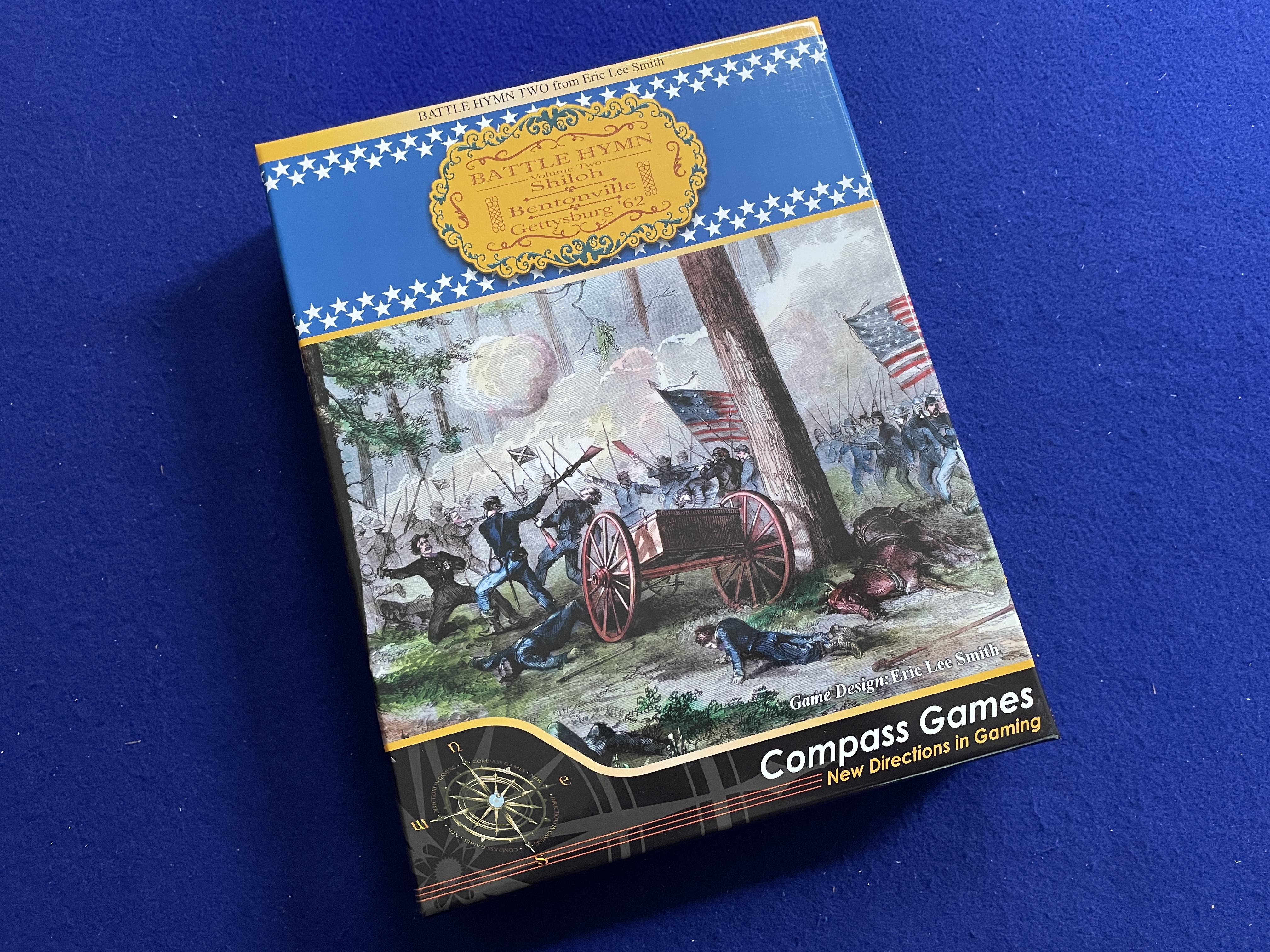
Battle Hymn: Volume Two is the long-anticipated sequel game release to Volume One and includes two complete games: Shiloh and Bentonville. Battle Hymn is the new brigade-level system based upon the latest research into Civil War combat. This new entry to the series introduces an extension map for Gettysburg (Volume One) for a complete alternative history of the entire battle.
Compass Games website
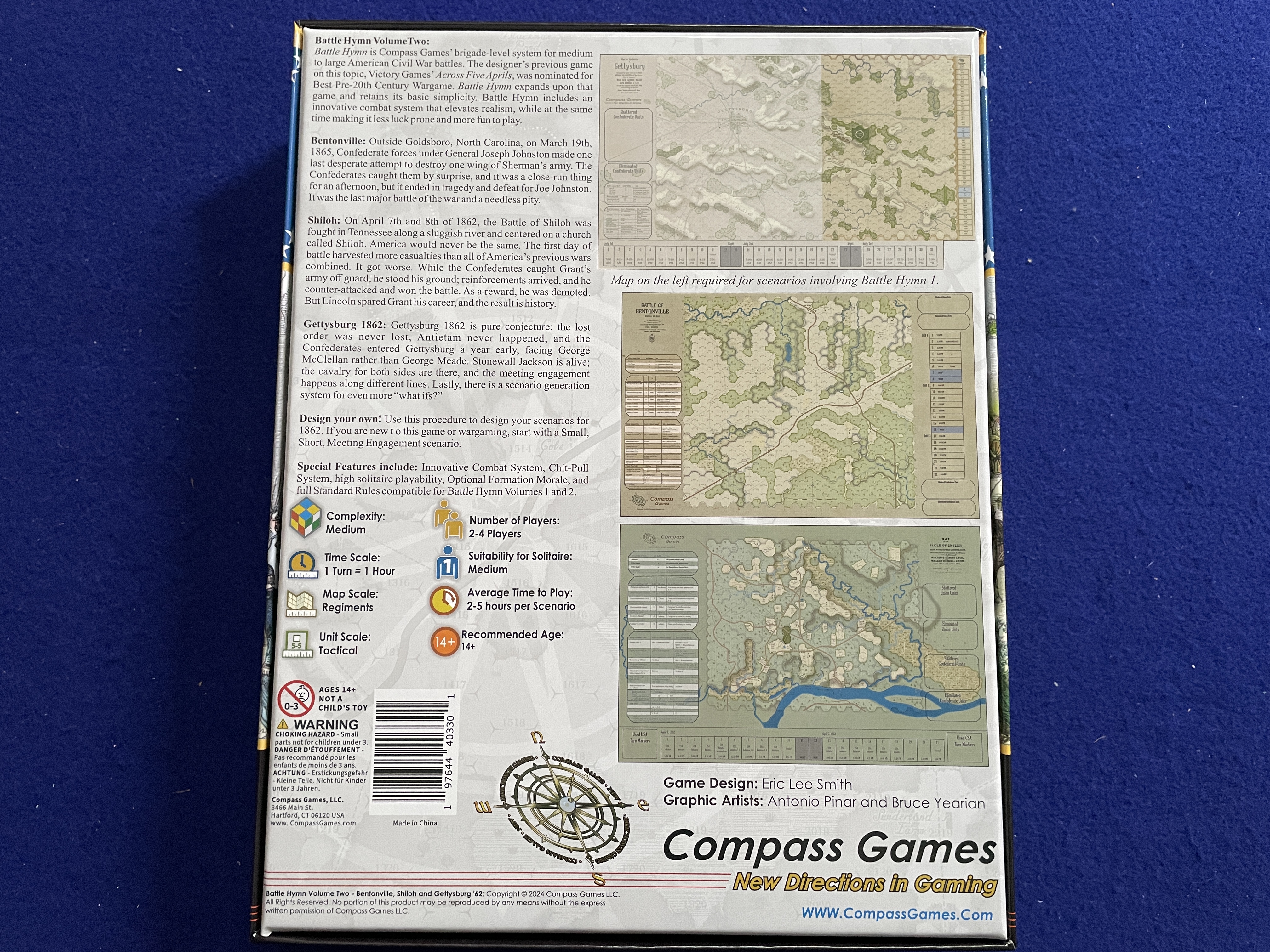
Battle Hymn: Volume Two is a grand tactical-scale wargame of the American Civil War where the unit of engagement is the brigade or battery. Here are the basic game facts about Battle Hymn: Volume Two as described on the Compass Games website.
- Complexity: Medium
- Solitaire Suitability: Medium
- Time Scale: 1 turn = 60 to 90 minutes depending on the day
- Map Scale: 1 hex = 300 yards across
- Unit Scale: Brigades, with some regiments
- Players: one to two, best with two
- Playing Time: 1 to 3 hours (scenarios), 5 to 8 hours (campaign)
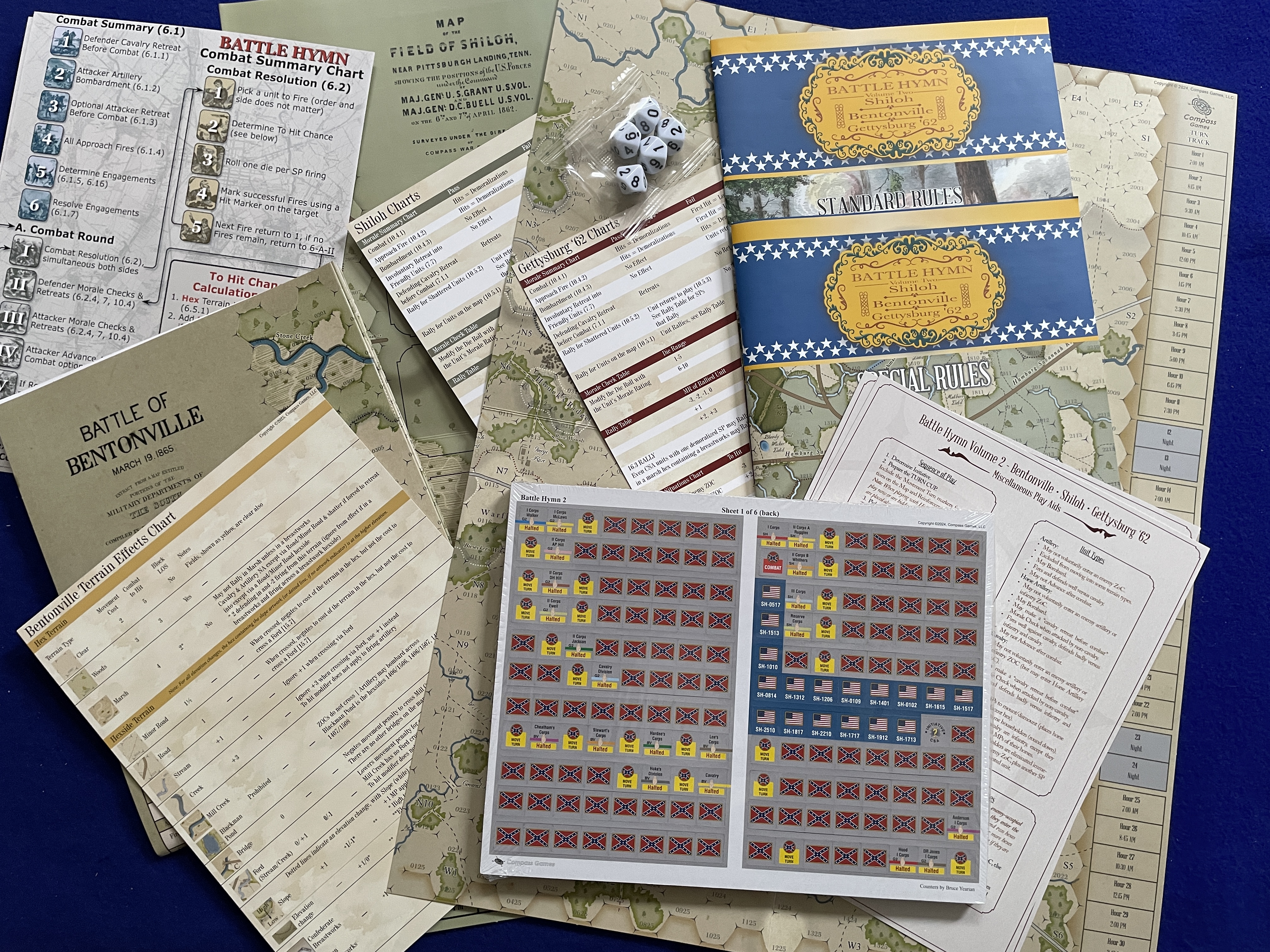
Battle Hymn: Volume Two comes in a standard bookcase size box that is 2 inches deep. The contents are listed as:
- 3 Game maps: two 22” x 34” maps and one 22” x 17” map
- 5 10-sided dice (use more if you have them!)
- 2 identical player-aid cards
- 2 identical Sequence of Play cards
- 6 chart cards, two for each battle (Note: These are included as 3 double-sided charts, for a total of 6 chart pages)
- 1 Standard Rules booklet
- 1 Special Rules booklet
- 6 sheets of 5/8” playing pieces
The Standard Rules booklet for Battle Hymn: Volume Two is a 20-page affair laid out in two-columns. The font is easy to read and the illustrations are in full color. The most important rule is not really a “rule” as much as it is a procedure. The chit-pull game mechanism used to activate formations is not found in a separate rule but is incorporated in rule 4. Sequence of Play. Each formation has an individual Movement Marker. After determining Initiative, players place all their Movement Markers and their single Combat Turn Marker into a Turn Cup. Importantly, the player with the Initiative does NOT place their Combat Turn Marker in the Turn Cup but keeps it aside as they will get to choose when to use it (and if not used when the Turn Cup is emptied it is then automatically played).
The balance of the Standard Rules in Battle Hymn: Volume Two are pretty much as one finds in many wargames. Movement is by Movement Points with Terrain Effects Chart. Combat uses a d10 with the Base Chance to hit determined by the terrain with modifiers for certain hexsides, surrounding Zones of Control (ZoC), and unit types engaged. Each Strength Point is a die roll; one needs to roll-low to hit. Hits reduce Strength Points and require a Morale Check. Possible Morale Check results are Retreat or Demoralized. When every Strength Point of a unit is Demoralized the unit is Shattered and when all Strength Points are Hit the unit is eliminated. To be fair, the rules for Combat are laid out on a Combat Summary card for each player but will require referencing the Terrain Effects Chart and [Scenario] Charts card which is a bit of a shuffle.
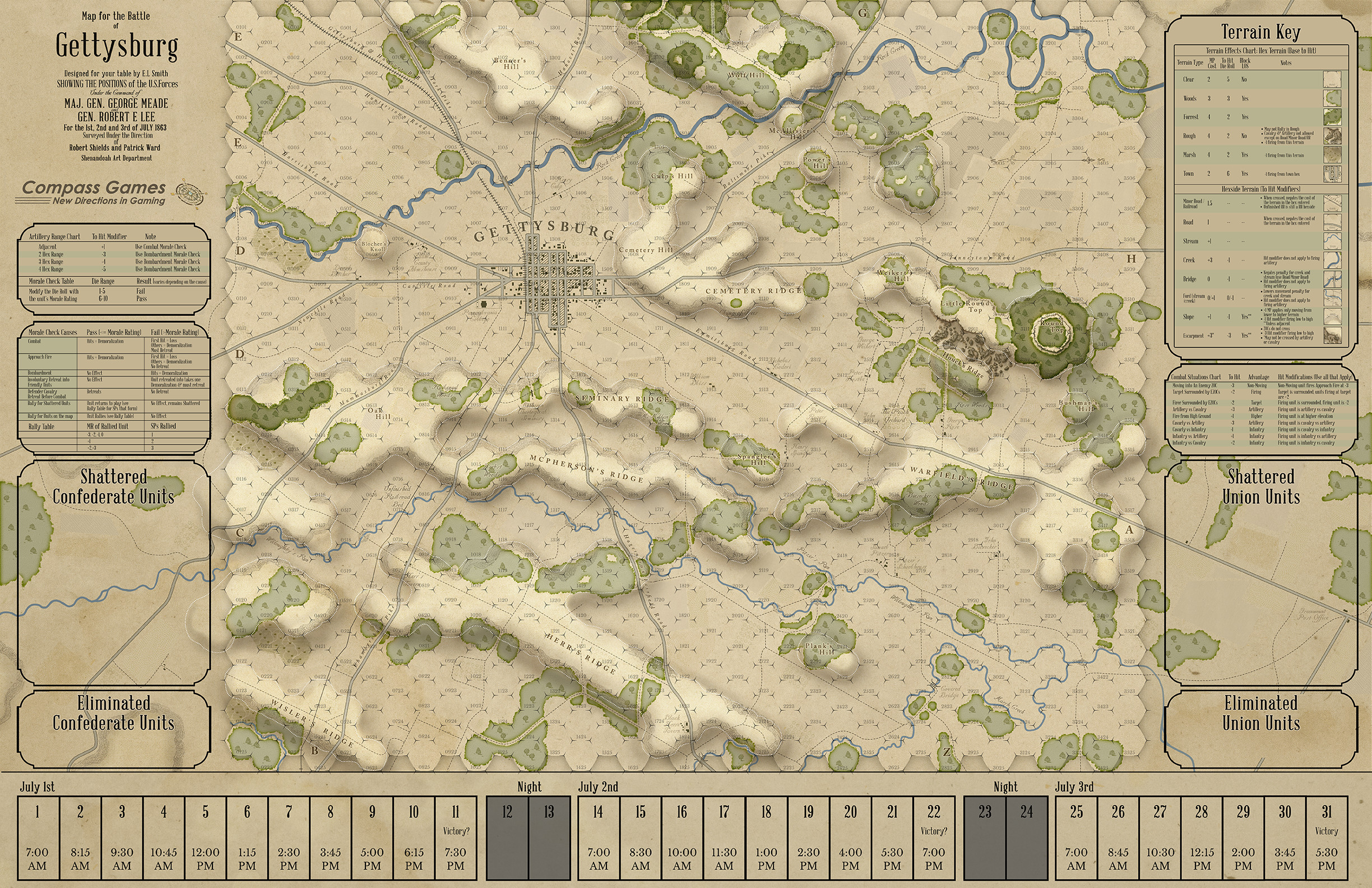
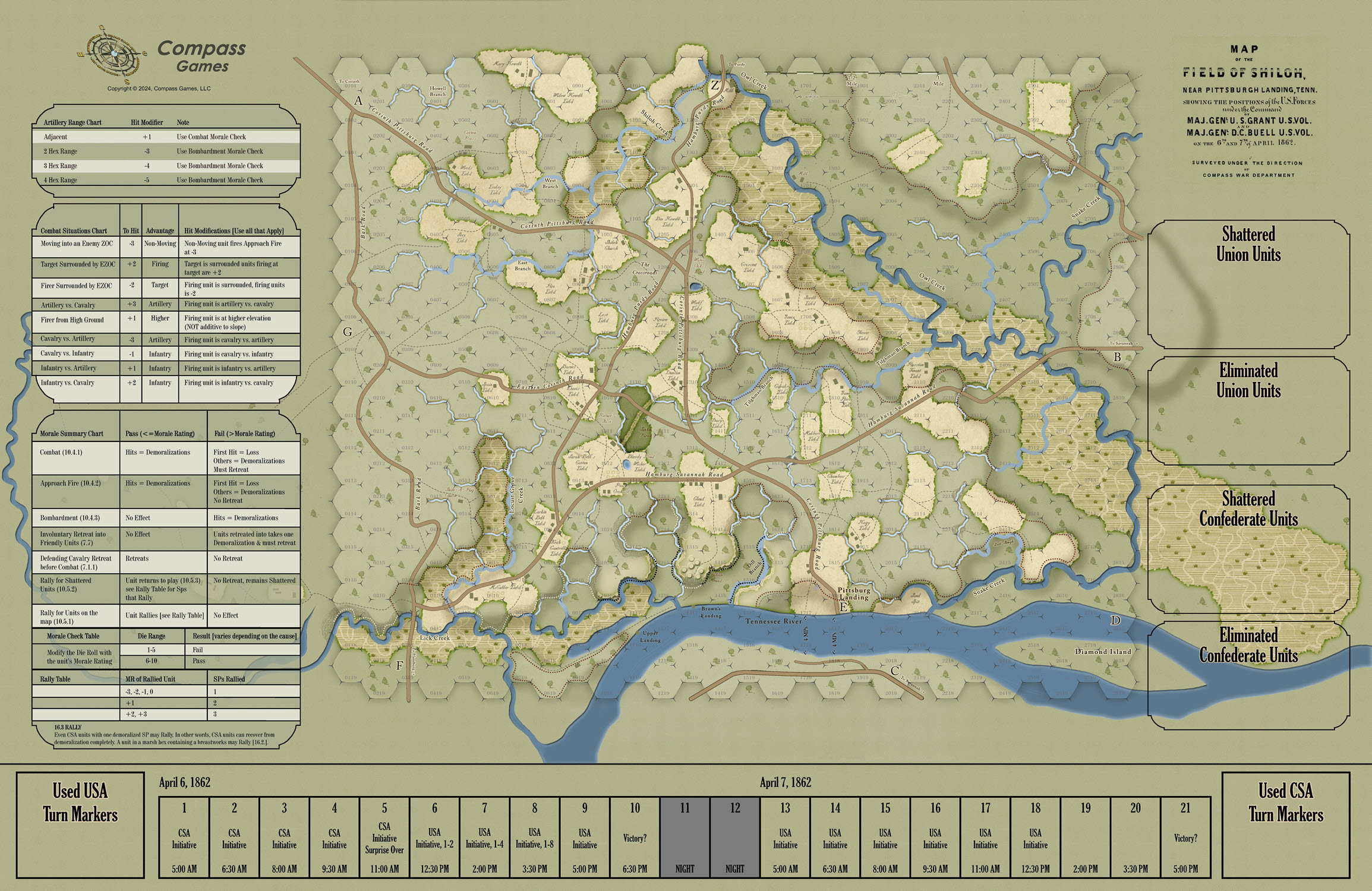
[Maps…period]
[In 2018 when writing my first impressions of Battle Hymn: Volume One I wrote, “I also have to say the map for Battle Hymn is one of the most gorgeous maps I have ever seen in a wargame. Done in ‘period style’ it is extremely pretty.” Unfortunately, artist Rick Barber left us in 2021. The new maps for Volume Two are a both homage to Barber and a new direction. Of the two volumes, I believe the Volume One maps are more beautiful but the Volume Two maps are a bit more player-friendly.]
The Special Rules for Battle Hymn: Volume Two is where the new game really shows off it’s potential. The 45-page book not only introduces several scenario-related new Markers (as well as additional Markers for Volume One) and Optional Rules but also the three Volume Two scenarios: Bentonville, Shiloh, and Gettysburg 1862 and 1863.
The first scenario in the Special Rules for Volume Two is “Bentonville: The Last Huzzah” (note to Compass Games editor – the order in the rulebook is different from the box cover). There are actually four (4) Bentonville scenarios. “Last Charge” is a historical scenario focused on the end of day one of the battle and good for learning. “Sherman’s Fury” explores the ahistorical possibility of Sherman attacking on day two. “The Trigger” is another ahistorical situation where Sherman goes all-in on the attack after General Mower advanced without orders. “Mower’s Fury” is a historical scenario focused on day three of the battle.
“Shiloh: Modern War Arrives” is the second set of scenarios in Battle Hymn: Volume Two. Like “Bentonville” there are multiple scenarios (4) as well as a full campaign. The “Shiloh” set of scenarios also introduces new rules in each scenario; a form of programmed learning if you will. “The First Morning” is historical and is designed for quick setup and play. The special rules are for Marsh terrain, the Tennessee River, and the Sunken Road and Thicket. “The Hornet’s Nest” takes place after the initial attack. “The Gunboats” introduces the Union wood-clad gunboats Lexington and Tyler. “The First Day” basically puts the first three scenarios together into a single scenario. “The Second Day” is another long scenario but now with the challenge of Weather and Mud. Technically, there are two “The Second Day” scenarios: a Historical version and an alternate “Beauregard Stands.” Finally, “The Full Campaign” simulates the complete 21-hours of the battle. I strongly recommend using optional rule 17.10.3. Lew Wallace Drifts to simulate the historical anxiety of not knowing exactly when or where Lew Wallace’s division will arrive.1
The third set of scenarios, “Gettysburg 1862 and 1863” are incredibly interesting. Rather than making Battle Hymn: Volume Two yet “another” Gettysburg battle wargame, the 1862 scenario is:
…pure conjecture: the lost order was never lost, Antietam never happened, and the Confederates entered Gettysburg a year early, facing George McClellan rather than George Meade. Stonewall Jackson is alive; the cavalry for both sides are there, and the meeting engagement happens along different lines.
Introduction to Special Rule 18, Battle Hymn: Volume Two
To bring the conjecture to the gaming table, four scenarios and one Optional Rule are used in Volume Two battles for Gettysburg 1862. Most interestingly, scenario 18.2 “McPhearson’s What If” is based on historian James M. McPhearson’s essay in The Collected What If?2—a speculative (alternate history) book. Scenario 18.3 “The Designer’s What If?” is Eric Lee Smith’s version of history that riffs off McPhearson’s work. The fourth scenario is actually to variants for Battle Hymn: Volume One to use two maps for battles on the first, second, and third days of the historical Battle of Gettysburg as well as the multi-day campaign game. A fifth historical variant named, “On to Baltimore” which is an extension of the campaign game. An optional rule for Jeb Stuart’s Cavalry adds yet another “What If” factor into your Gettysburg battles be they in 1862 or 1863.
Special Rule 19 in Battle Hymn: Volume Two allows players to create their own 1862 scenarios. As the rule warns, however, “Not all scenarios you generate will be balanced, and some may be wildly imbalanced, so don’t hesitate to tinker with the results until you get a game that feels both interesting and potentially well-balanced” (Special Rule 19). An excellent example of a Create Your Own scenario is the first of the Gettysburg 1862 scenarios which was created with the Create Your Own system.
Battle Hymn as War Engine
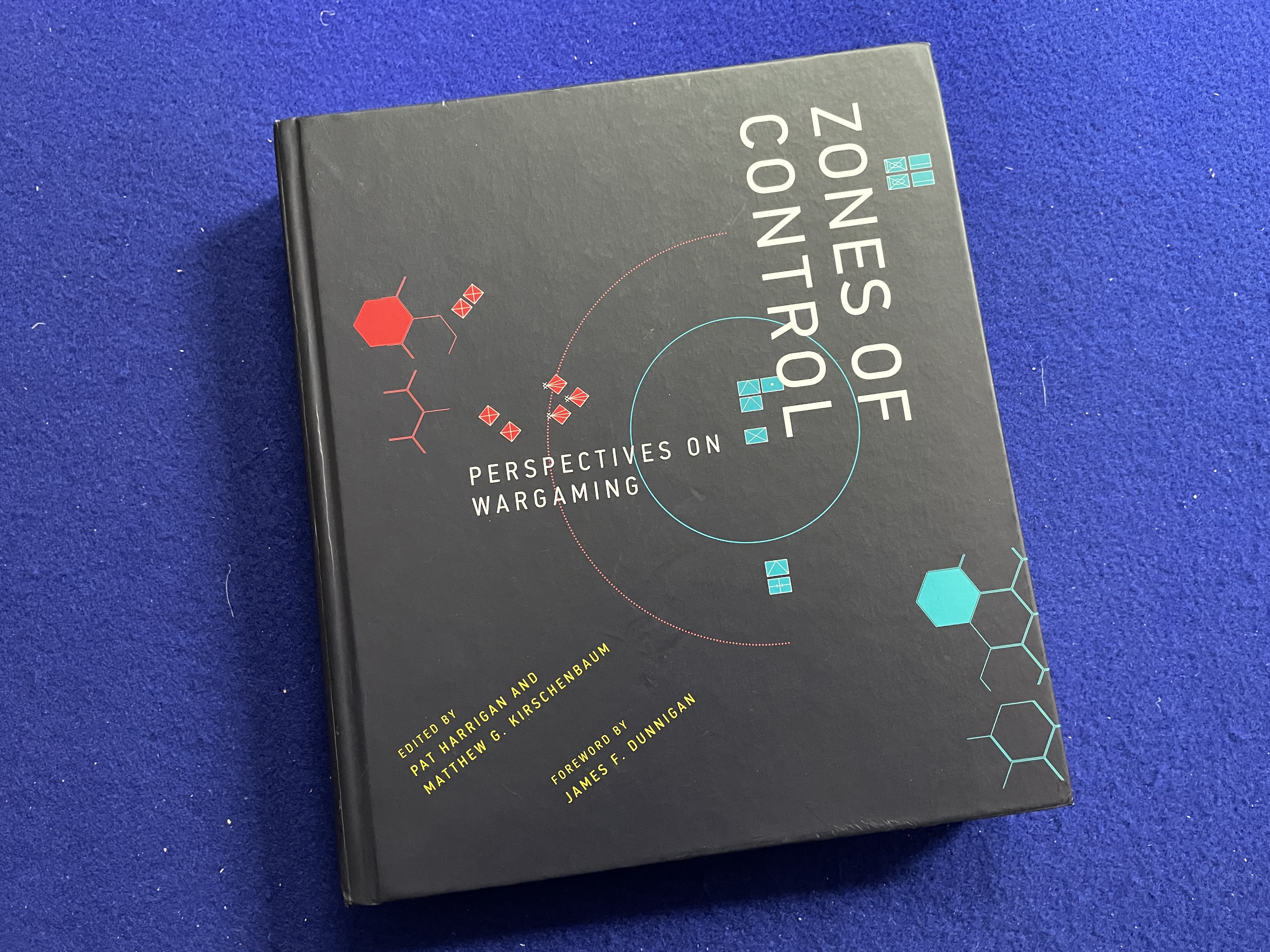
In the essay “War Engines: Wargames as Systems From the Tabletop to the Computer” found in Zones of Control: Perspectives on Wargaming3, Henry Lowood describes the difference between a monograph wargame and war engines. In a monograph wargame, “every game stood alone, covering a single conflict situation with a bespoke system, components, and rules” (Harrigan & Kirschenbaum, p. 89). War Engines started with PanzerBlitz where:
In contrast to monographic games, PanzerBlitz introduced the game system as a generator for multiple mini-games. Wargamers came to call these mini-games “scenarios,” possible borrowing the term’s currency among RAND’s Cold War gamers to describe synopses of imagined or hypothetical political crisis or military situations. Henceforth, I will call this combination of system + scenarios a “War Engine.”
Harrigan & Kirschenbaum, pp. 93-94
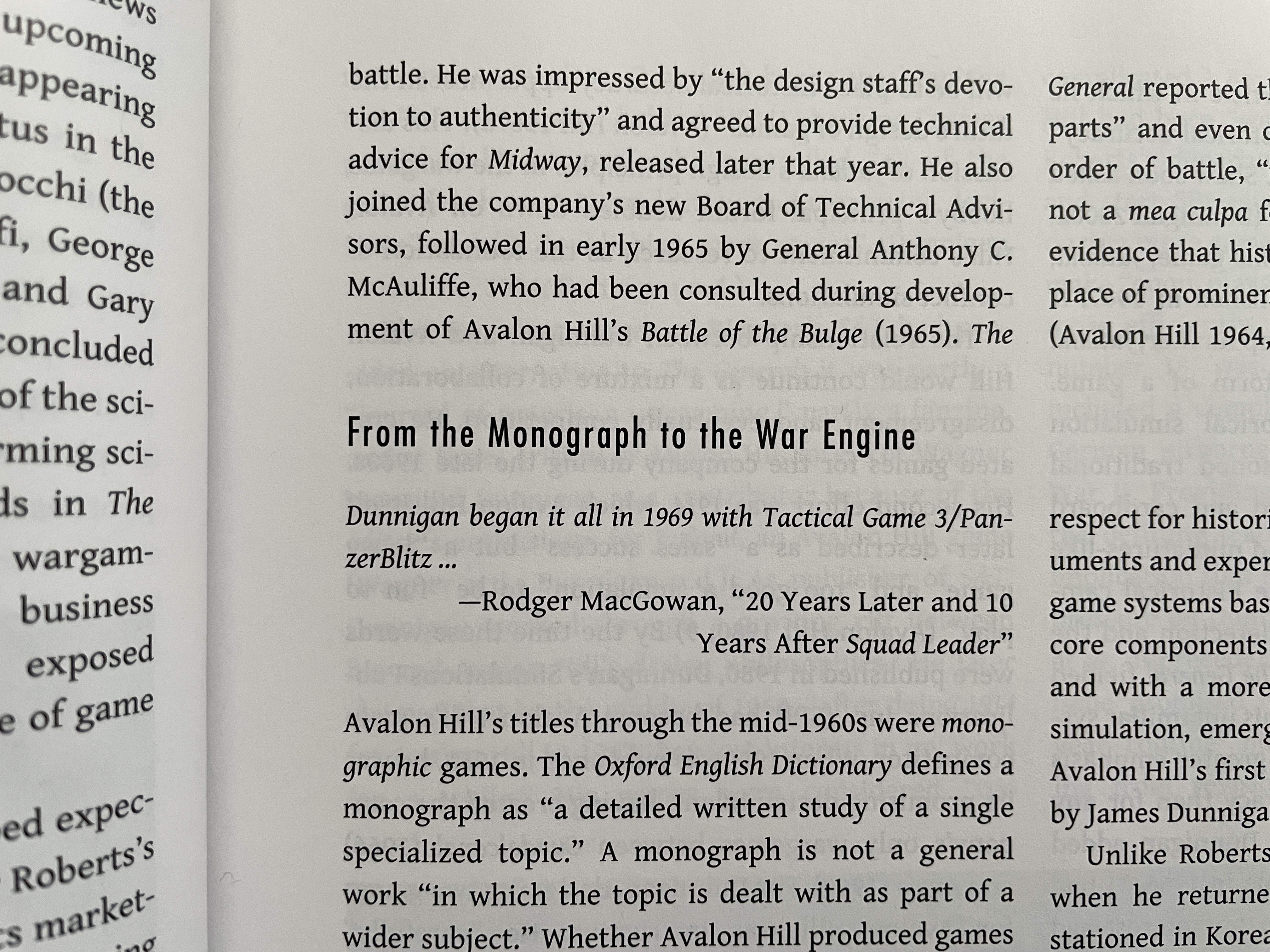
As if Battle Hymn: Volume Two was not already enough of a War Engine wargame with it’s many scenarios, the Create Your Own system turns it into a mass-production engine. Famed wargame designer, developer, and publisher James Dunnigan almost certainly would be proud of Battle Hymn: Volume Two as it is a direct spiritual successor to his Tactical Game 3 which took wargaming from simple historical narration into historical analysis:
The new game [Tactical Game 3] reflected his interest in extending historical study into a more experimental, “analytical” format. For Dunnigan, “analytic history differed from the more common narrative history in that it, like the games, took a more numbers oriented and ‘systems’ approach.
Harrigan & Kirschenbaum, p. 93
Many American Civil War wargames are War Engines with multiple scenarios or campaigns. Few, however, do what Battle Hymn: Volume Two does and give players the ability to not only modify a scenario but to make their own. The Battle Hymn series of wargames, built upon relatively simple game mechanisms and a chit-pull mechanic for showing the friction of war, by itself is an extremely replayable game with many scenarios and campaigns. The addition of the Create Your Own scenario rules ensures endless replayability making Battle Hymn: Volume Two the ultimate “What If?” wargame.
- As the Lew Wallace Drifts optional rules states: “The blame for his meandering is still argued. His reputation never recovered, but he did go on to write Ben-Hur, the best selling novel of the 19th century.” See, wargames are educational! ↩︎
- Cowley, Robert, ed. The Collected What If? Eminent Historians Imagine What Might Have Been. New York: G.P. Puntnam’s Sons, 1999 & 2001. ↩︎
- Harrigan, Pat and Matthew G. Kirschenbaum, eds. Zones of Control: Perspectives on Wargaming. Cambridge, MA: The MIT Press, 2016. ↩︎
Feature image The Battle Of Shiloh Painting by Henry Alexander Ogden via fineartamerica.com
The opinions and views expressed in this blog are those of the author alone and are presented in a personal capacity. They do not necessarily represent the views of U.S. Navy or any other U.S. government Department, Service, Agency, Office, or employer.
RockyMountainNavy.com © 2007-2026 by Ian B is licensed under CC BY-SA 4.0

