
When it comes to my acceptance or “buying into” science-fiction settings in roleplaying games (RPGs) I tend to be generous; after all, who is to say that something obviously fiction is unrealistic? That said, if I am to accept a setting it still has to be “reasonable”—whatever that means—to me. As a long-time Traveller RPG player the past 47 years of the brand has been tumultuous at times with different editions and timelines. I have no qualms saying that the current IP holder, Mongoose Mong00$e Publishing is not a favorite of mine, usually because of their price point. When I saw Bundle of Holding offering a package centered on the sourcebook The Imperial Navy I jumped in hoping that even Mong00$e could not (totally) screw up a pillar of the Traveller RPG universe.

True to form, however, Mong00$e and I again—to put it in Traveller-terms—misjumped.
My main issue with The Imperial Navy is that, while the parts I am most interesting in reads somewhat like military analysis, it is very shallow. The Imperial Navy appears to draw upon the thinking of Sir Julian Corbett, specifically in a discussion of doctrine where, “…the primacy of national strategy, which must be soundly based in theory and integrate all aspects of national power under civilian direction: Navy, Army, communications, merchant shipping, economics, law, and culture” (Lambert, p. 3) as well as other military thinkers, such as Clausewitz and Sir Basil Henry Liddell Hart. Yet, in doing so, The Imperial Navy reads likea series of pithy sayings haphazardly assembled into something supposedly representing considered military thought.

[So what?]
[At this point you likely are already saying, “Rocky…who cares? This is a GAME!” Please understand that my Traveller RPG legacy comes from a very old place where the creators of the game respected the military and ofter were decent military analysts in their own right. I always enjoyed the world-building of Marc Miller and Frank Chadwick, amongst other GDW luminaries. I always was confident they approached their world-building with a bit of academic rigor. Mong00$e, on the other hand, seems very cavalier when it comes to the scholarly groundings of their settings. The Imperial Navy is just the latest example of their scholarly laziness; just how hard can it be to read just a bit of Corbett or Mahan and think through how their work can—or cannot—be applied to this sourcebook?]
Mong00$e navy
At 186 pages The Imperial Navy is not all bad. Just parts. The Introduction of The Imperial Navy explains the navy of the Third Imperium in this manner:
- “The Imperial Navy is commanded by professional naval officers who receive political direction from the senior nobility.”
- “Direction comes down to the navy from the Emperor by way of archdukes and the sector and subsector dukes, but the navy commands its own ships and vessels.”
- “Political direction – officially at least – takes the form of indicating what the desired outcome is and any additional considerations, then allowing the navy to get on with the job.” (Politicians define the ends…)
- “Once the navy has received its directions, it is expected to make every effort to deliver a desirable outcome.” (…the navy determines the means.)
- “The two main areas of concern for the navy are internal security and defence against external threats.”
- “Where warfighting means concentrating combat power – and therefore budget Credits – the internal security of the Imperium requires dispersal.” (Combat power = budget Credits? McNamara is smiling from his grave.)
- “Perhaps the single greatest challenge facing the Imperial Navy is time.” (Communications across interstellar distances is a defining characteristic of the Traveller universe and part of what makes it unique to adventure in.)
- “In the event of major conflict, the enemy will make strikes and thrusts with concentrated forces. Attempting a piecemeal response simply guarantees the destruction of the assets assigned.”
- “The current strategy emphasizes defence in depth, with warfighting assets concentrated in sector fleets ready to respond to news of an attack or move to a crisis zone.”
- “To facilitate this doctrine the Imperial Navy uses a two-tier system for its own assets. … The basis of this strategy is that ‘the sector fleet fights wars, the subsector fleet keeps the peace’.” (In Traveller terms this is almost literally the division between ‘Battle’ and ‘Adventure’ class warships.)
- Both the sector and subsector fleets are backed up by what are still known as ‘Colonial’ assets.”
- “The majority of jump-capable Colonial vessels loaned to the Imperial Navy are assigned to the local subsector fleet.”
- “In addition, there is a ‘reserve fleet’ of vessels stored and awaiting reactivation.” (‘In ordinary’ to use an Age of Sail term.)
- “In wartime, alterations to the basic fleet structure are necessary but the navy spends the vast majority of its time in conditions of relative peace.” (Dougherty (2023), pp. 2-5)
The first line of the chapter, “The Role of the Navy” repeats the Introduction: “The role of the navy is to serve as a political instrument for the leaders of the Third Imperium” (Dougherty (2023), p. 13). Not exactly how I would put it but—knowingly or not—it does draw upon the work of a great naval strategist, Sir Julian Corbett.
“The Role of the Navy” lays out the broad missions of the Imperial Navy including:
- Presence
- Law Enforcement and Internal Security
- Diplomacy and Soft Power Projection
- Protection of Commerce and Other Interests
- Intervention and Peacekeeping
- Warfighting (Dougherty (2023), pp. 13-16)
I really thought I was doing fine until that last section of the “Role of the Navy” called “Warfighting.” Here my acceptance became challenged:
Warfighting is defined as any large-scale confrontation, internal or external. Whether a full-scale invasion by a foreign power or a rebellion by a couple of worlds, these situations require multiple ships or fleets, which in turn imposes logistical an communications burdens. Most operations are carried out by task forces or single ships and might be considered routine even if they become dangerous. Wars, on the other hand, require the navy to operate as a navy, with multiple levels of command, control and political oversight.
The Imperial Navy, p. 16
So let me read back to you what I think the above passage asserts: a combat operation by a single ship or task force is not “warfighting” for in a “war” one must have multiple-levels of command exerted over large groupings of ships all subject to political oversight.
Ok…
“The Role of the Navy” chapter is followed by “Fighting an Interstellar War.” In this chapter, Dougherty channels his inner-Sun Tzu with many pithy sayings. In broad outline form—again with my frisking comments—”Fighting an Interstellar War” reads:
- “Fighting a war is not merely a matter of smashing up the other sides’s major warships.”
- “There are two ways to win a war. The first is to totally annihilate the opposition.”
- “The second way to win a war is to persuade the opposition to stop fighting.” (What about deterrence and NEVER fighting in the first place?)
- “Persuading the enemy to stop fighting is a difficult business in some cases.”
- “If the enemy cannot yet be persuaded that peace is in its best interests, the navy is charged with accruing more and more advantages until the diplomatic wind changes.” (“Accruing advantage” sounds like an accounting—not a warfighting—term.)
- “When the Imperial Navy goes to war it has a set of goals distilled out of centuries of experience.” (Much has been written on warfare in the Traveller universe so this section should not be starting out blind.)
- “Avoid Losing” (DUH! NO KIDDING! Where is the goal to WIN? Perhaps the most disappointing line in the entire book…)
- “Concentrate Forces” (Corbett has much to say on this issue which I will explore more deeply below.)
- “Conduct Reconnaissance and Maintain Communications”
- “Strike at the Decisive Point”
- “Create Conditions for Victory” (I am not aware of anything approaching a ‘Theory of Victory’ in the Traveller literature; perhaps it is time to frame the Fifth Frontier War in such terms? Dougherty kind of tried in The ICS Papers: The Fifth Frontier War but failed.)
- “REALITIES OF INTERSTELLAR WAR”
- “When a navy commander enters combat, they fight with what they have.”
- [On travel time lag] “During those two weeks or more, almost anything could happen.”
- “These two factors – logistics and communications – drive the strategy of all successful naval commanders.” (This is what makes the Traveller setting unique; it really is a throwback to the Age of Sail where messages travel at the speed of courier. EMBRACE IT!)
- “One solution to this problem is the ‘crust’ strategy.” (A backhand swipe at the wargame Fifth Frontier War and the initial setup. I strongly believe that Marc Miller and company took the NATO defense of Europe strategy in the late-1970s (Active Defense) and projected it into Fifth Frontier War. Active Defense was replaced by Air-Land Battle in the early 1980s but at the time Fifth Frontier War was in development Active Defense was THE strategy.)
- “… By the time news of the attack reaches the admiral in charge of the region the attacking force can already be elsewhere.” (Another example of why looking at naval warfare during the Age of Sail can be enlightening.)
- “The only viable solution is to start out concentrated.” (Ignores lessons from the Age of Sail…)
- “Experience has shown that the most effective way to handle large naval forces is by way of a cycle: Concentration, Deployment, Dissipation, Reconcentration.” (Seemingly a contradiction to the previous maxim?)
- “Over time, a force may be required to detach elements which are subject to the usual communications lag.”
- “NAVAL ENGAGEMENTS”
- “The navy must be prepared to fight a variety of engagements.” (One would think this drives ship design…)
- “There are numerous ways to defeat or neutralise a naval force.” (‘Neutralise’ is not a very helpful term; the classic combat effects are the Four-Ds: Deny, Degrade, Disrupt, and Destroy.)
- “Neutralisation can also be achieved by deception, perhaps causing the enemy force to be out of position and unable to reach the combat are in time to make a difference, or by interrupting communications.” (This is not necessarily a characteristic of an “engagement” (battle) in space but a characteristic of a campaign.)
- “Attacks on bases or lines of supply can neutralise part or all of an enemy force, which may lead to the defeat of another component.” (Finally a reference to Corbett!)
- “Defeat can be inflicted without confronting the main enemy force head-on.” (Sir Basil Henry Liddell Hart’s indirect approach.)
- “To be meaningful, any naval engagement must further this agenda [strategic situation].”
- “Naval engagements are to a great extent consensual; that is, both forces want to fight.” (I argue this does not automatically apply in the Traveller universe, especially given the need for refueling, which often acts as a forcing function.)
- “No volume of empty space can be considered much of an objective.” (How does this square with Invasion: Earth where there are three space movement boxes representing Close Orbit, Far Orbit, and Deep Space; movement through a box stops if occupied by enemy units.)
- ‘System control’ has slightly different meanings in peace and war. … Instead, ‘system denial’ is sought, whereby a sufficient threat is posed to enemy vessels that operating there is hazardous.” (This thought forms an entire chapter called, “Orbital Denial” in The Fifth Frontier War: The ICS Papers.)
- “A full-scale naval war is a highly complex situation in which commanders attempt to control their own key systems and take control of enemy territory.” (I wish Dougherty looked at this with a maritime-like Corbett-lens rather than a land-domain Clausewitz approach as the pithy conclusion almost certainly would be more nuanced.)
- “However, wise commanders know they do not have to win everywhere; they must win somewhere and avoid defeat everywhere else.” (“Win somewhere” really should be “win where it matters.”) (Dougherty (2023), pp. 17-22)

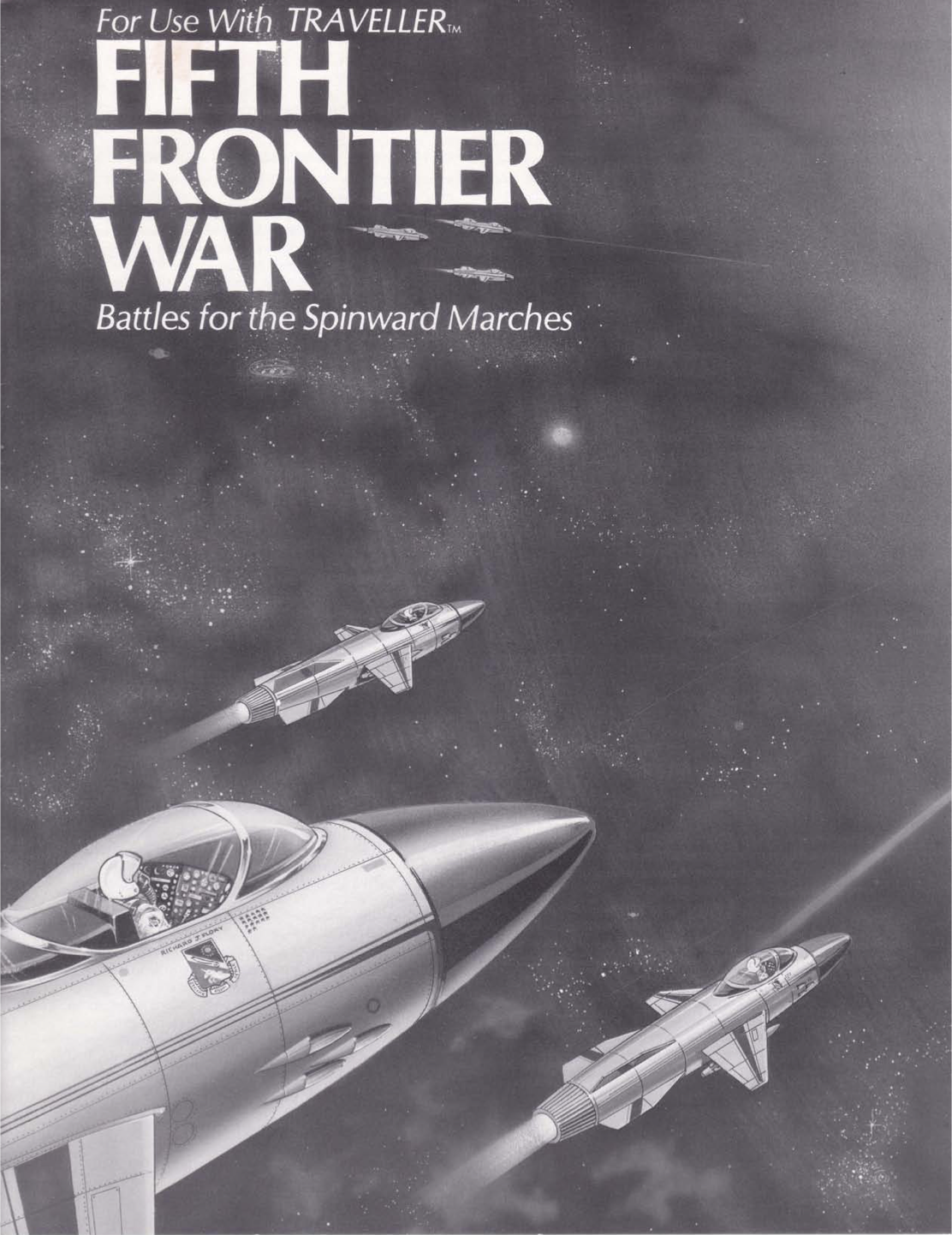
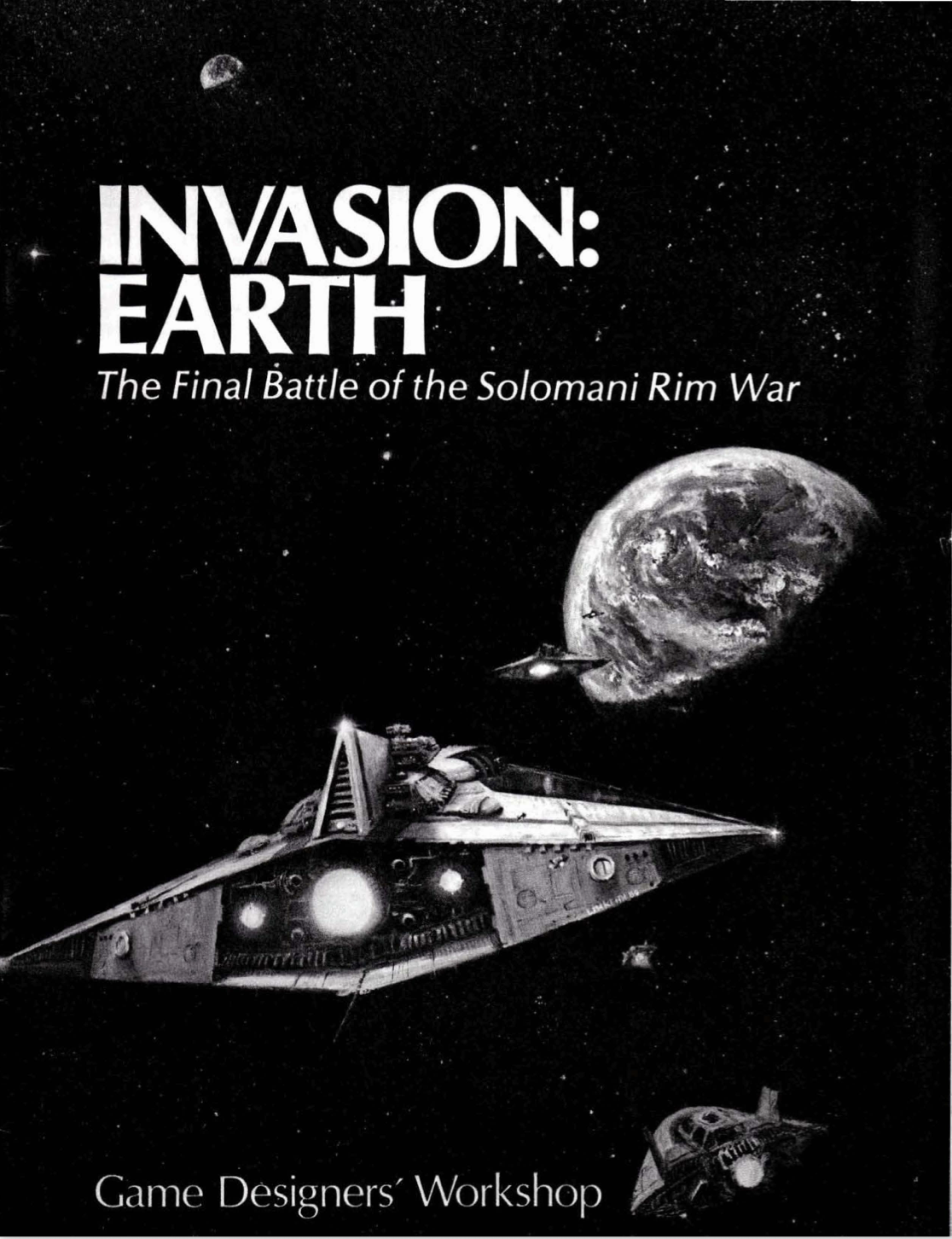
Klein on space warfare
For Dougherty’s sake, he is unfortunate that I read The Imperial Navy not long after reading Space Warfare: Strategy, Principles and Policy (Second Edition) by John J. Klein (Routledge, 2025). The book, focused on orbital warfare, is not a perfect translation to interstellar war but it is a decent place to start. In particular, Part II of Klein’s book, “Corbett in Orbit: Strategic Principles of Space Warfare” seemingly is applicable to the Traveller universe in general and The Imperial Navy in particular.
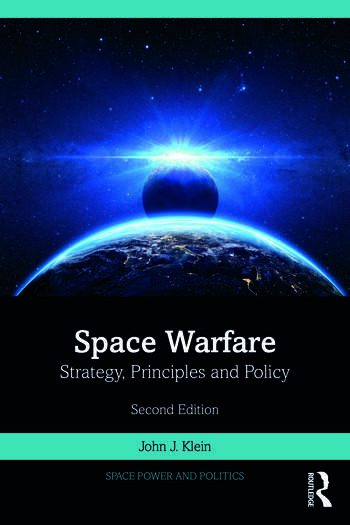
“Space is Tied to National Power”
Klein agrees that Clausewitz is important to understanding war but cautions, “The overarching strategy of war cannot be considered in isolation to itself, and therefore, actions leading up to the opening of hostilities will help define and determine the actual military strategy used” (Klein, p. 70). With a slight rewording, Klein’s words are equally applicable orbital warfare as they are to the Imperial Navy:
If the space domain does, in fact, have implications for [Imperial] power as postulated previously, then it stands to reason that space should also have implications for each instrument of [Imperial] power—diplomatic, economic, information, and military. … In those cases when [Imperial] objectives can be achieved through non-military means, like diplomatic, information, and economic efforts, this is effectively winning without fighting.
Adapted from Klein, p. 70
“Celestial Lines of Communication”
“Communications Routes” appears in the rules for the Traveller RPG from the earliest days. Here is how that rule appeared in the White Facsimile Edition of Traveller: The Classic SF RPG Rules (GDW/Far Future Enterprises, 2001) based on the 1977/1979 Little Black Books version:
Communications Routes: Within the subsector, local governments will have established communications or trade routes connecting some (but not all) worlds. These routes serve as a conduit for messages between businesses and between governments as well as between people. The[y] also serve as the basic routes that liners and large freighters travel.
Book 3 Worlds and Adventures, p. 5
The Book 3 definition of Communications Routes is not that different from what Klein calls celestial lines of communications (CLOCs):
Generally stated, CLOCs are those lines of communication in, from, and to space used for movement of trade, material, supplies, resources, personnel, spacecraft, electromagnetic transmissions, and some military effects. … Because ensuring one’s access to and use of lines of communication in space are vital, the primary objective of space warfare is to protect and defend one’s own lines of communication, while limiting the enemy’s ability to use its lines of communication.
Klein, p. 85
Dougherty a writes, “Attacks on bases or lines of supply can neutralise part or all of an enemy force, which may lead to the defeat of another component.” These mentions of bases or lines of supply fits well into Klein’s CLOC construct:
Lines of communication are frequently understood relative to two or more points or locations. For CLOCs related to spacecraft and their travel (physical communications), launch locations [Downports], on-orbit locations [Highports], and any landing sites or return locations [Bases] help define a spacecraft’s operation and function.
Adapted from Klein, p. 90
“Command of Space”
Dougherty noted, “‘System control’ has slightly different meanings in peace and war.” Klein goes deeper into the issue by looking at the command of space as a strategic concept:
Space serves as a conduit for terrestrial and celestial-based movement and transfer, and due to its critical value, those with interests in space will attempt to preserve and enhance their continued access to and use of celestial lines of communication (CLOCs) when needed to support the instruments of [Imperial] power—diplomatic, economic, informational, and military. It also includes the ability to prevent or deny the enemy’s freedom of access to his or her celestial lines of communication space or at least minimize the most severe consequences an adversary can deliver along them.
…
…command of space as a strategic concept includes more than just goals achieved through military operations. Command of space can be enhanced using all instruments of [Imperial] power, not just the military component. The concept acknowledges that by extensively using space for a variety of activities, a state, non-state entity, or group can play a prominent role in shaping [interstellar] treaties regulations, or customary [interstellar] law.
Adapted from Klein, pp. 113-114
Concentration
Klein’s definition of concentration and space warfare reads thusly:
Within the context of space warfare and strategy, concentration means that space forces, firepower, or other desired effects should be focused to defeat an adversary, defend against its attack, or neutralize the threat the enemy poses. … The principle of concentration underscores that when offensive actions are imminent or necessary, the most practical force should be focused against the adversary.
Klein, p. 193
Whereas Dougherty asserts concentration is an absolute (“The only viable solution is to start out concentrated.”), Klein channels Corbett and points out three historical problems with concentration:
First, concentrating naval forces at sea has the effect of causing the enemy’s fleet to avoid a decisive battle, especially under conditions where their destruction is likely. … Second, the more one concentrates naval forces, the fewer are the number of sea lines of communication that can be secured and controlled at one time. Third, the more one concentrates a superior force, the more difficult it is to conceal one’s whereabouts and overall operational intent. Because of these reasons and through analogy to maritime strategy, it is understood that a truly useful and ultimately successful strategy of space warfare requires the continuous balancing between dispersal and concentration. (Emphasis in original)
Klein, p. 193
Here, I must admit, Dougherty is not a totally lost cause. His line, “Where warfighting means concentrating combat power – and therefore budget Credits – the internal security of the Imperium requires dispersal” is close to the spirit of dispersal and concentration but narrowly framed in the concept of budget not warfighting. Dougherty’s assertion that, “Experience has shown that the most effective way to handle large naval forces is by way of a cycle: Concentration, Deployment, Dissipation, Reconcentration” is, however, seemingly contradictory with the previous maxim.
The rest of the story
At this point, you likely are asking what I thought about the rest of The Imperial Navy. After all, I am taking deep exception to 14 of the 186 pages – less than 10% of the content. Here are my quick-thoughts on the other chapters:
- “Organisation of the Imperial Navy” – This chapters revisits the ‘crust’ strategy discussion by reframing it as a defeat-proofing methodology that in turn leads to ‘fortress worlds’ that did not appear in the earliest source materials. Ok…
- “Commanding the Fleet” – More organization; missed the chance to highlight roleplaying opportunities (even I need to remember that Traveller is an RPG and NOT a wargame).
- “Naval Bases” – Fair plot hook material but no real relation to the earlier strategy chapters.
- “Ships and Craft” – Nothing really inspiring though I do appreciate the attempt to connect jump-range with Strategic Mobility as found in the table on page 42.
- “Naval Operations” – From a strategy perspective this chapter includes a helpful discussion of “orbits” as in Local out to 10 planetary diameters distance, shared Local-Imperial out to 100 diameters distance (minimum safe Jump range), and Imperial absolute beyond 100 planetary diameters.
- “Shipboard Operations” and “Ship Handling” – Not much different than that found in High Guard and other naval sourcebooks.
- “Tactics” – Well illustrated but I wonder how many people really play with the vector movement systems used by the basic Mayday or my preferred Power Projection: Fleet. I will not even ask if there are Squadron Strike: Traveller players out there.
- “Equipment and Weaponry,” “Personnel,” and “Naval Procedures” – Again, very High Guard repeated sections.
The next chapter in The Imperial Navy is “The Old Expanses Sector Fleet.” The Old Expanses sits to coreward to the Solomani Rim on the galactic east of the Third Imperium. The interesting aspect of this chapter is the subsector map in page 151. While every planetary system is noted with an outlined hex, the highlighted sytems are those with an Imperial Naval Base. There are no communications routes noted (as seemingly is the disappointing norm in Mong00$e mapping). As a depiction of celestial lines of communication (CLOCs) the map is quite…poor. For example, the headquarters of the Old Expanse Fleet is at Depot in the Ultraneta system (Old Expanses 1213)—which is not highlighted on the map.
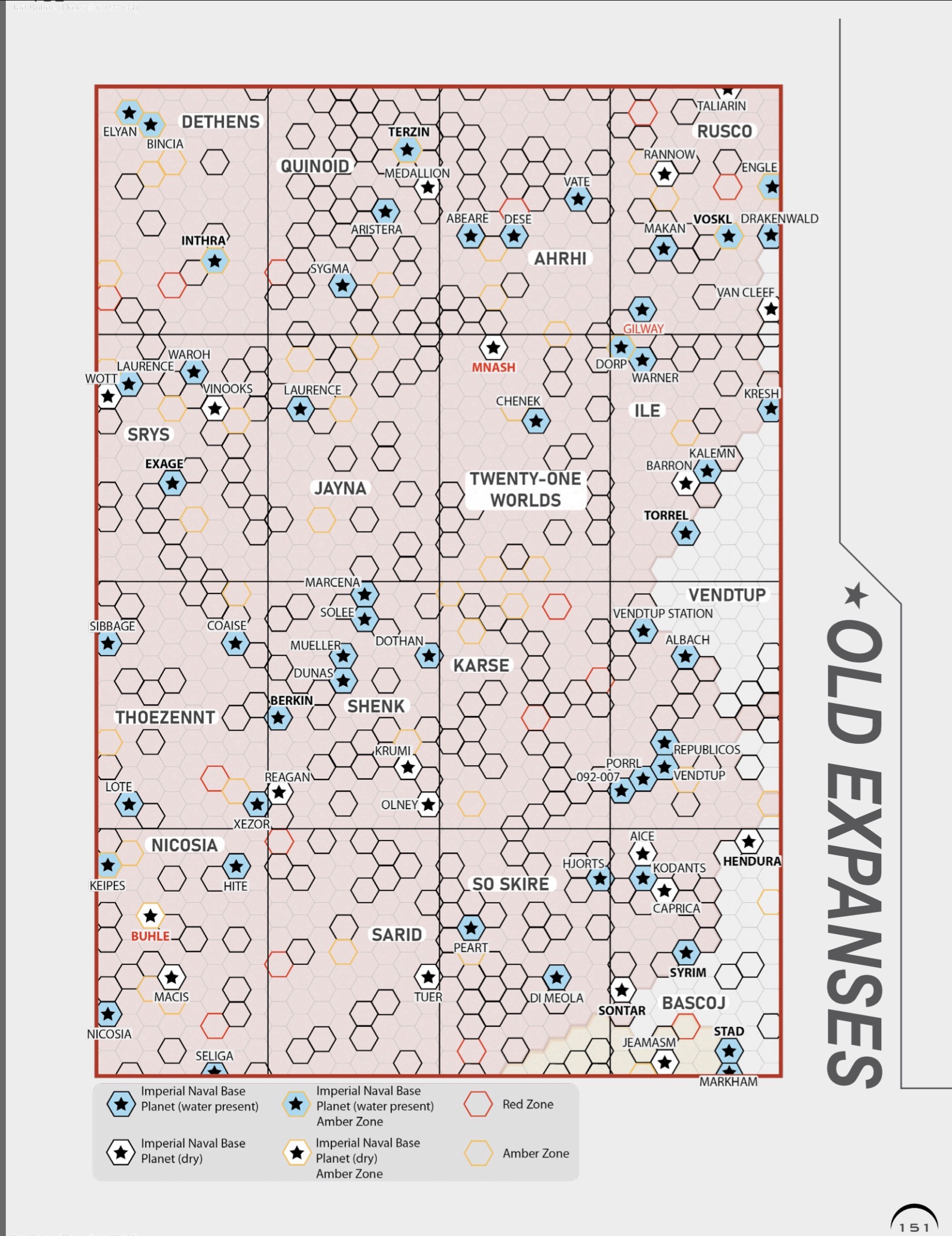
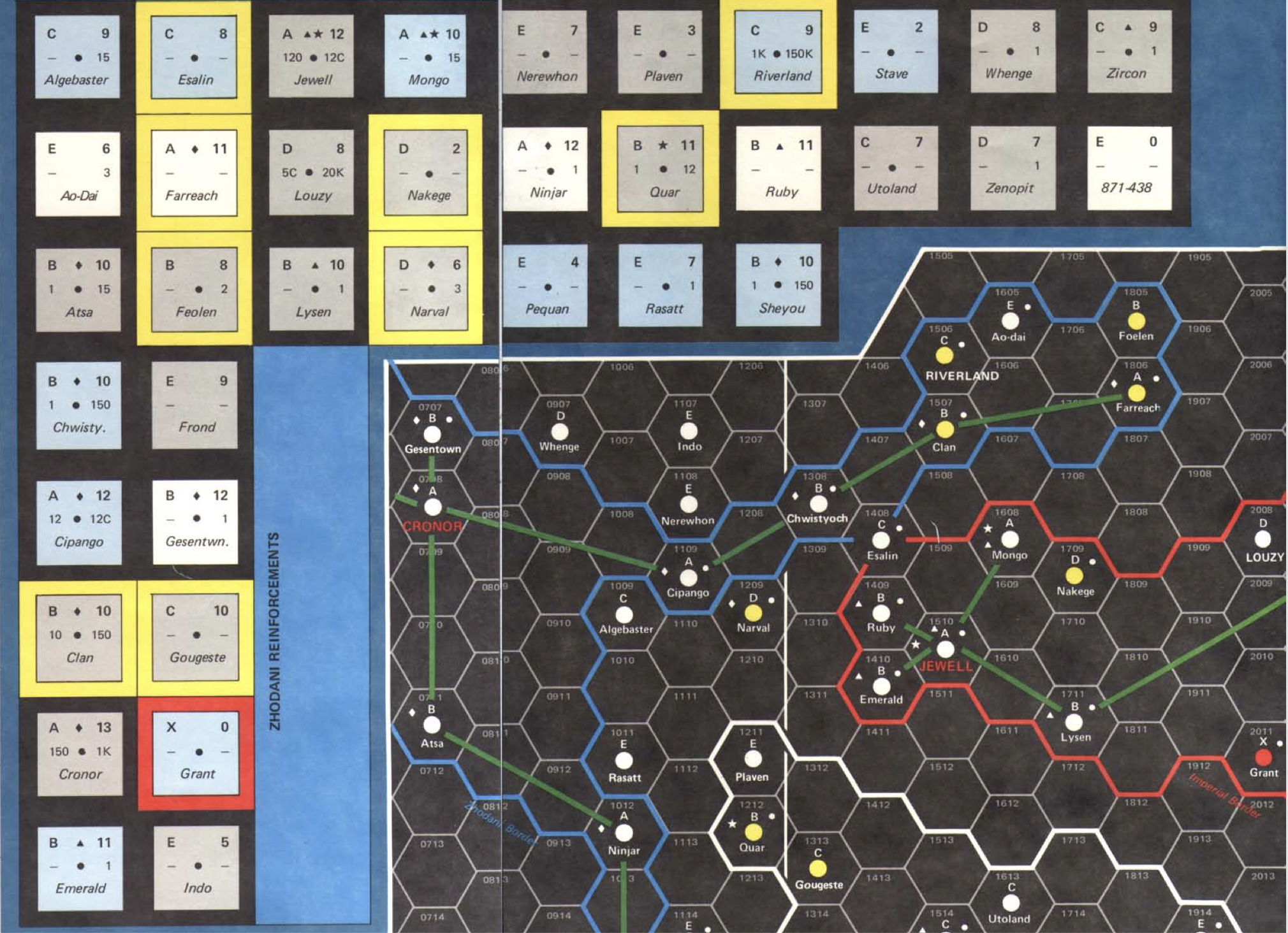
The poor Old Expanses map in The Imperial Navy and Dougherty’s assertion that, “A full-scale naval war is a highly complex situation in which commanders attempt to control their own key systems and take control of enemy territory” got me thinking about victory points, Communications Routes, and celestial lines of communication (CLOCs). In the wargame Fifth Frontier War the victory points awarded for control of a system is computed this way:
Victory is based on victory points (VPs), which are awarded for the capture and control of worlds. VPs are awarded based on the current situation on the stellar display at the point victory is calculated. A player gains VPs for controlling worlds outside his states’ borders. For each enemy subsector capital controlled, VPs equal to twice its tech level number are awarded. For example, the Zhodani player would receive (10 x 2 =) 20 VPs for controlling Regina. Subsector capitals are: Cronor (hex 0708), Querion (hex 1018), Gram (hex 1627), Jewell (hex 1510), Frenzie (hex 1520), Lanth (hex 2123), Regina (hex 2314), and Rhylanor (hex 3120), as marked on the stellar display. For each other enemy world controlled, VPs equal to its tech level number are awarded. For each independent world controlled, VPs equal to half its tech level number are awarded. For example, the Imperial player receives (7 x 1/2 =) 3 1/2 VPs for controlling Utoland (hex 1613). For purposes of this rule, an enemy world is a world controlled by the enemy player at the start of the game, and an independent world is a world controlled by neither player at the start of the game.
Fifth Frontier War, Rulebook,p. 15
For example, Jewell (Spinward Marches 1106) is worth 24 Victory Points (Tech Level 12 x 2 [Subsector capital]).
[How Important?]
[As a grognard, it is in my nature to tinker with rules when they do not make sense to me. The Fifth Frontier War approach to victory points seems rather coarse and lacking in depth. The only measures of merit for a system when computing VP are Tech Level and capital status. It seems crazy to me to that a world like Dinom (Spinward Marches 1811) at Tech Level 10 but with a “Poor” D-class Starport that cannot build spacecraft is worth the same 10 VP as Extolay (Spinward Marches 1711) at the same Tech Level 10 but with a “Good” B-class Starport that can build spacecraft. This is a case where I feel the Importance Extension (Ix) is valuable. The Importance Extension I use is found in the Worlds section of the Traveller 5.0 rulebook. The Importance Extension takes into account Starport type, Tech Level, Trade Classification, population, and bases. If one was to add (or subtract) the Importance Extension to the VP tally in Fifth Frontier War then Dinom (Ix = -1) would be worth 9 VP while Extolay (Ix = 2) would be worth 12 VP. The Jewell system, worth 24 VP in Fifth Frontier War, with an Ix = 5 would be worth 34 VP ((12+5) x 2). Additionally, if one was to take a subsector map and overlay it with a heat map of VP value (as modified by the Importance Extension) I am certain it would give one a new—and invaluable—perspective of CLOCs in the Traveller universe.]
Future-History
Sir Julian Corbett’s contributions to naval strategy began with his studies of naval history. Understanding history is key to understanding strategy. As Klein writes:
Much of the present represents echoes of the past, thereby underscoring the necessity to study, debate, and understand historical events. A greater understanding of space warfare based upon historical underpinnings facilitates the development of improved competitive strategies, as well as leading to sound counterstrategies of future aggression.
Klein, p. 279
It pains me that Mong00$e ignores so much of the rich military history of Traveller. When Mong00$e does embrace it, it does so in a half-hearted, seemingly cavalier manner that feels superficial. Maybe that works for most Mong00$e Traveller players but for me, well, this grognard takes issue.
So give me the original Miller and Chadwick and Wiseman version of Traveller. Add in a healthy dose of The Clement Sector from Independence Games and HOSTILE or other alternate settings from Zozer Games or Stellagamma Publishing. Most of all, if you are going to pretend that you understand military strategy and doctrine in the Traveller universe, do so with some scholarly rigor not pithiness.
Works Referenced
- Dougherty, M. J. The Fifth Frontier War: The ICS Papers. Swindon, Wiltshire: Mongoose Publishing Ltd., 2025.
- Dougherty, M.J. Traveller: The Imperial Navy. Swindon, Wiltshire: Mongoose Publishing Ltd., 2023
- Klein, John J. Space Warfare: Strategy, Principles and Policy (Second Edition). London: Routledge, 2025.
- Lambert, Andrew D., ed. 21st Century Corbett: Maritime Strategy and Naval Policy for the Modern Era. Annapolis, MD: Naval Institute Press, 2017.
- Miller, Marc W. Fifth Frontier War: Battles for the Spinward Marches. Bloomington, IL: Game Designers’ Workshop, 1981.
- Miller, Marc W. with Frank Alan Chadwick, and John M. Astell. Invasion: Earth – The Final Battle of the Solomani Rim War (Traveller, Game 5). Bloomington, IL: Game Designers’ Workshop, 1981.
- Miller, Marc W. Traveller: The Classic SF RPG Rules (Classic Traveller Reprint Series, Books 1-3). Bloomington, IL: Far Future Enterprises, 2001.
- Miller, Marc W. with Robert Eaglestone and Don McKinney. Traveller5: Science-Fiction Advengture in the Far Future. Bloomington, Il: Far Future Enterprises, 2013.
Feature image “Traveller – Plankwell-class Dreadnought (v1.1) by Shadowstate
The opinions and views expressed in this blog are those of the author alone and are presented in a personal capacity. They do not necessarily represent the views of U.S. Navy or any other U.S. government Department, Service, Agency, Office, or employer.
RockyMountainNavy.com © 2007-2026 by Ian B is licensed under CC BY-SA 4.0


Enjoyable read, thanks for your insight and perspective!