
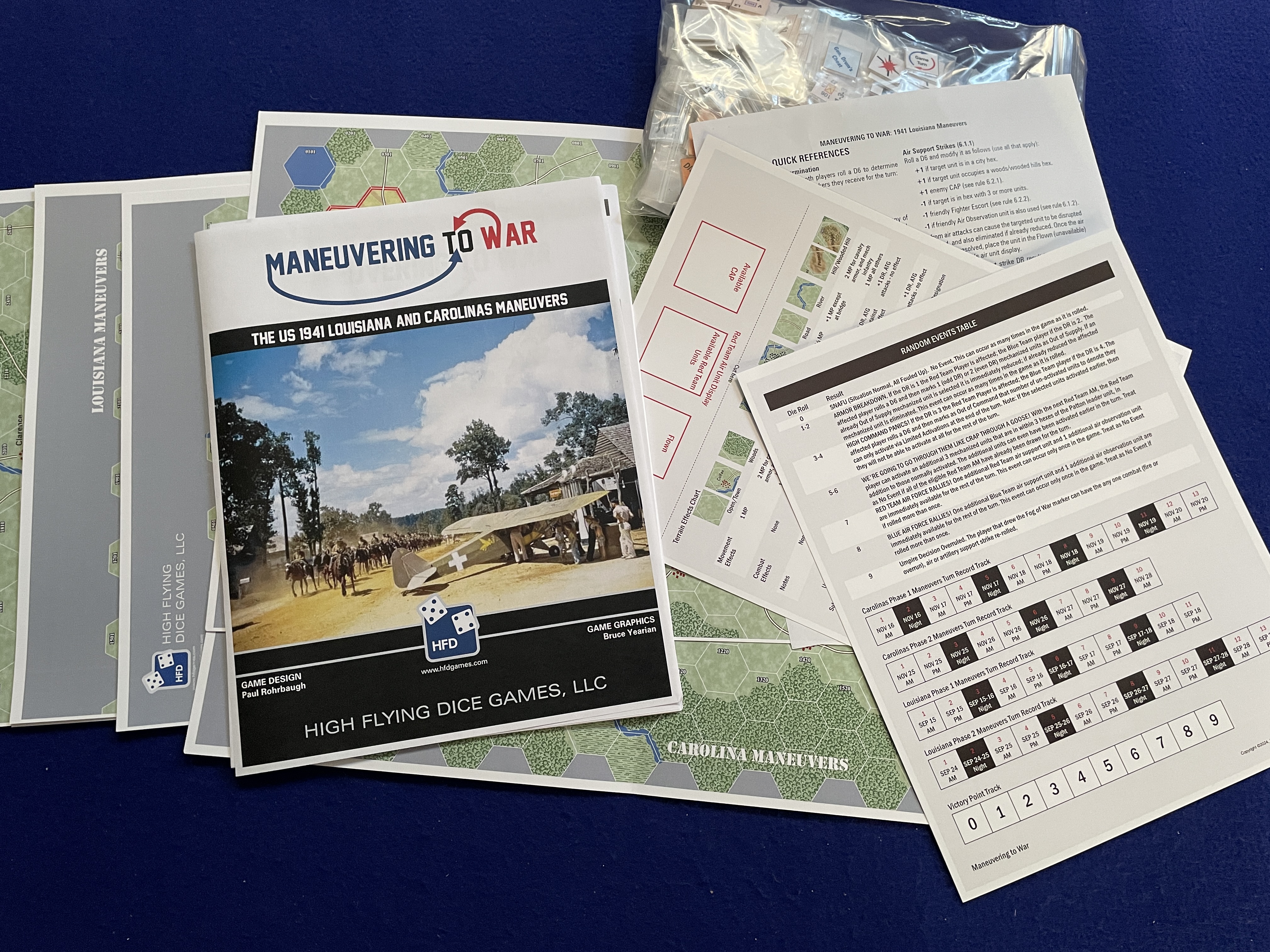
My first encounter with Maneuvering to War: The US 1941 Louisiana and Carolinas Maneuvers by Paul Rohrbaugh from High Flying Dice Games (2024) was the excellent review by Aaron Danis for The Armchair Dragoons in June 2024 (see Aaron Danis, “First Impression of Maneuvering to War by High Flying Dice Games”, The Armchair Dragoons, 4 June 2024). So impressed was I that I ordered my own copy of the game. As I was reading the rules to Maneuvering to War I went, of course, to the designers notes where Rohrbaugh’s words intrigued me:
A set of wargames about wargames? Well, why not? As I read more about the 1941 US Army Maneuvers, I became convinced that creating games on the 1941 US Army Maneuvers would be a great method by which to teach and learn more about these little-known event in US history. The 1941 US Army maneuvers were unscripted with commanders and officers at all levels expected to show initiative and innovation.
15.0 Designer’s Notes
While Aaron does an excellent job focusing in on the game components and mechanisms—effectively how well the game plays—I want to relook at Maneuvering to War from a different perspective. Specifically, I want to focus not necessarily on game play but the historical situation by asking how well Maneuvering to War gets after designer Paul Rohrbaugh’s stated intent of recreating the challenges facing the US Army in the 1941 Louisiana and Carolinas Maneuvers.
Realism
When addressing the question of “realism” in Maneuvering to War, Aaron Danis answers the question in this manner:
So how does the game do in simulating maneuvers where no one was killed in combat? I think very well, as long as you understand a few key points. The U.S. Army was in transition from a World War I legacy force. The 2 armored divisions were a new construct and far from being the flexible Combat Commands of 1944. The Army was switching from the “square” two-brigade infantry divisions of World War I to triangular infantry divisions based on regimental combat teams. You can see the differences in the differences in mobility (1 MP vs 3 MPs, respectively). This also was the last hurrah for the horse cavalry, as the self-contained combined arms armored cavalry regiments that would become so versatile and indispensable during WWII showed their potential.
Danis, “First Impression of Maneuvering to War by High Flying Dice Games,” The Armchair Dragoons, 4 Jun 2024
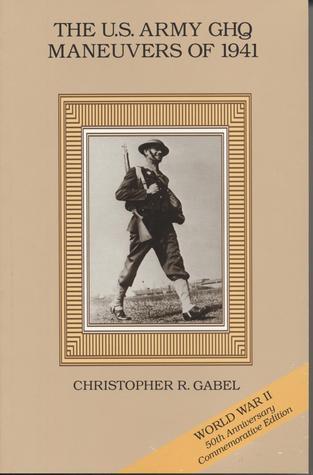
I want to dig into those changes a bit deeper using Rohrbaugh’s Maneuvering to War. I also draw heavily upon the monograph Aaron strongly recommends reading: historian Christopher R. Grabel’s The U.S. Army GHQ Maneuvers of 1941 (United States Army Center for Military History, CMH Pub 70-41-1, 1992).
PMP in ‘41
The Louisiana and Carolina Maneuvers were the culminating events of the Protective Mobilization Plan (PMP) drafted in 1937-1938 and implemented between 1939 and 1941. As Grabel relates in his seminal monograph:
The objective of this plan [PMP] was the raising of a small but combat-effective Army as quickly as possible in time of emergency. This was to be accomplished by fleshing out existing Regular and National Guard units, concentrating first on the most nearly combat-ready units.
Grabel, p. 9
As Aaron alluded to above, a major part of the change required in the Army was a restructuring of the infantry division. The square division—built around two brigades—was a relic of World War I trench warfare. Replacing it was the triangular division named as such “because nearly every echelon within the division possessed three maneuver elements, plus a means of fire support” (Grabel, p. 10). Equipping this new force was also a challenge; in 1941 many of the National Guard units affected by the PMP were not yet reorganized and woefully under-equipped as, “virtually every type of equipment was obsolete, or scarce, or both” (Grabel, p. 13).
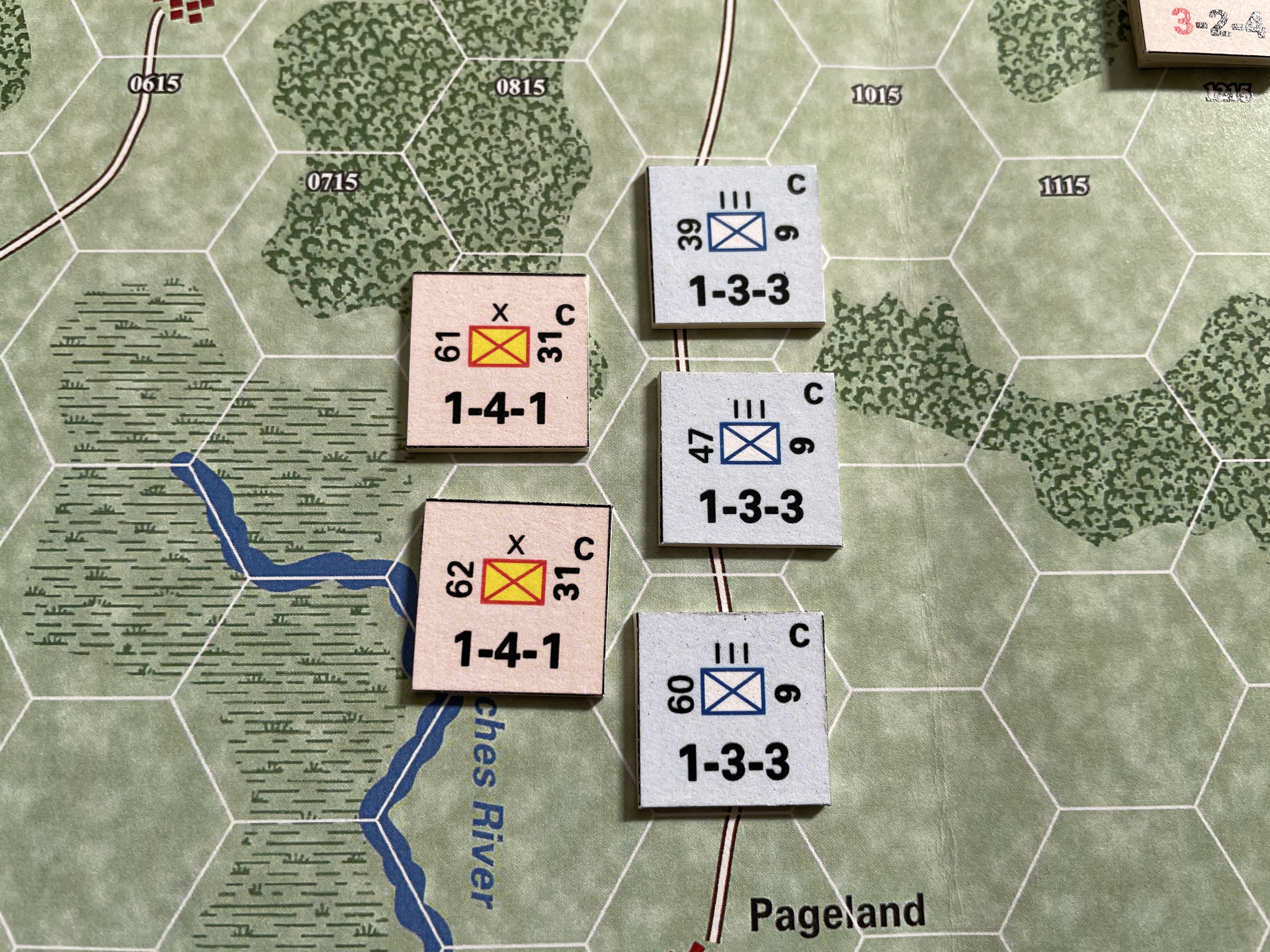
[In Maneuvering to War the differently organized infantry units are instantly recognizable. The “old” square divisions are two brigade-size units rated 1-4-1 (Armor Attack Factor (AAF) – Infantry Attack Factor (IAF) – Movement Factor (MF)) whereas the new triangular infantry divisions are depicted using three regiments each rated 1-3-3.]
Grabel has a lengthy discussion of the training required under PMP. Suffice it to say that the training the units received before the namesake maneuvers in Maneuvering to War was the same as the past, but different. Prior to the 1941 maneuvers training for the (new) regimental or brigade combat teams culminated at the division level. As Grabel points out:
The completion of division training marked the conclusion of the combined training phase. In World War I there had been no training beyond that stage, but the GHQ [General Headquarters] schedule for the summer of 1941 entailed combining divisions into corps and corps into field armies, with free maneuvers punctuating each phase.
Grabel, p. 19
Which brings us to 1941 and Maneuvering to War…almost.
Mech War ‘41
The period of American protective mobilization (1939-1941) coincided with Nazi Germany’s great tide of conquest in Europe. Spearheading Germany’s seemingly invincible military machine were her panzer (tank) divisions. These were powerful, mobile formations that exemplified the principles of speed, surprise, and shock. Henceforth, any nation with pretensions of military greatness must come to terms with mechanization—the large-scale employment of armored fighting vehicles.
Grabel, p. 22
[In Maneuvering to War the 1st and 2nd Armored Divisions make an appearance. What the game does not communicate is just how “new” these forces were. As a matter of fact, the two divisions each had a unique legacy and were far from a “unified” formation as the counters in the game might lead one to believe.]
The 2nd Armored Division was actually the senior formation as it drew its legacy from the National Defense Act of 1920. Grabel explains just how…backwards this formation originally was:
The National Defense Act of 1920 assigned all tanks to the Infantry, where the tank’s role was to “facilitate the uninterrupted advance of the riflemen in the attack.” Doctrine called for medium tanks to advance immediately behind a rolling barrage, their objective being the enemy antitank positions. Light tanks, accompanying the infantry, would help subdue machine gun positions and other enemy strongpoints. This doctrine, while logical, did little to explore the potential of the tank as a weapons system. Obsolete equipment and chronically short funding prevented infantry from doing more. By 1940 the Infantry’s tank establishment totaled eight battalions.
Grabel, p. 22
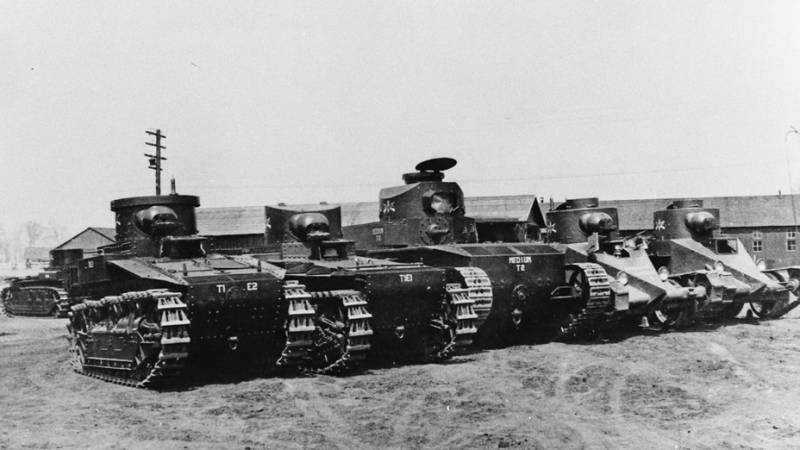
For the 1940 Louisiana Maneuvers (a year prior to those depicted in Maneuvering to War) the Infantry branch pooled seven of the eight tank battalions into the Provisional Tank Brigade. But before we talk about the Provisional Tank Brigade further lets look at the 1st Armored Division.
The 1st Armored Division came from a different legacy—the Cavalry. In 1930 the Cavalry branch created an experimental mechanized force. The 7th Cavalry Brigade (Mechanized) eventually grew into a combined arms force with, “two cavalry regiments, an artillery battalion, observation aircraft, and, in 1940, even an attached regiment of infantry” (Grabel, p. 23).
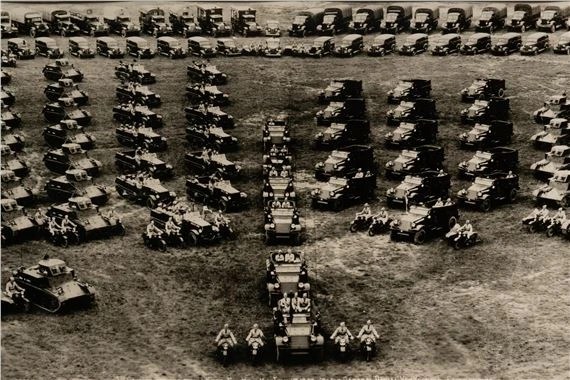
The April 1940 Louisiana Maneuvers [a year before Maneuvering to War] brought the Provisional Tank Brigade and the 7th Cavalry Brigade (Mechanized) together as a provisional mechanized division. At the same time the 1940 Louisiana Maneuvers played out, German blitzed into France. As Grabel notes, “This [German] campaign made it clear to all that mechanization had established a new era in warfare” (Grabel, p. 23).
What happened next is one of the great moments of Army innovation. On the last day of the April 1940 Louisiana Maneuvers, General Magruder (Provisional Tank Brigade) with General Chaffee (7th Cavalry Brigade) and other interested armor officers, including one Colonel George S. Patton, met to discuss the creation of an American mechanized branch (Grabel, p. 23). In just a few months—July 1940—the Army stood up a new Armored Force consisting of I Armored Corps with two armored divisions: the 1st Armored Division build around the 7th Cavalry Brigade and the 2nd Armored Division built around the Provisional Tank Brigade. General Chaffee was charged with the design and establishment of the two armored divisions (Grabel, p. 24).
At this point I was expecting that the US armored force would mimic the German model so successfully employed in Europe. Grabel himself writes, “It would of been natural for Chaffee to copy the organization and doctrine of the German panzer division” (Grabel, p. 24).
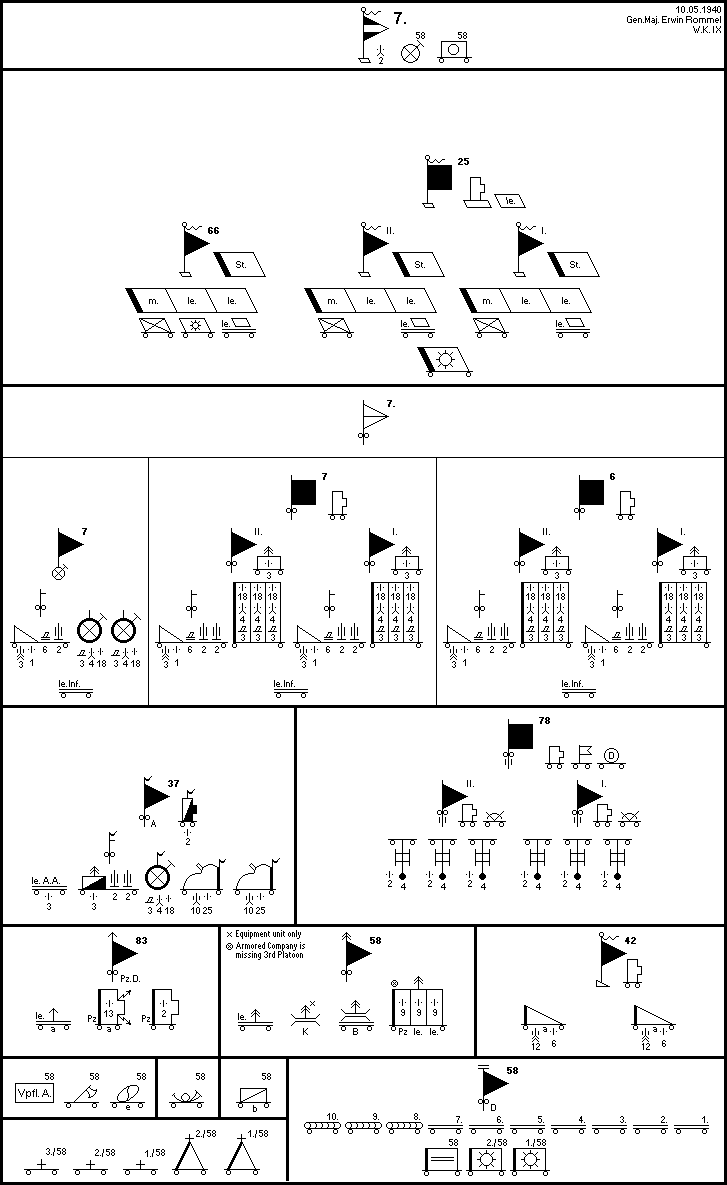
Mimicking the Germans, however, is not what Chaffee decided to do. As Grabel explains:
The [US Army] 1940 armored division differed markedly from the panzer division, however, in that it could not subdivide into battle groups. Under Chaffee’s scheme, the armored division’s principal fighting element was the strike echelon consisting solely of the armored brigade. It was his intent that the brigade’s two regiments of light tanks would conduct rapid, deep envelopments of the enemy while the medium regiment (two battalions as compared to the light regiment’s three) provided support and tackled major centers of resistance. Infantry and engineers were found in the support echelon which existed primarily to protect lines of communication, secure captured objectives, and prepare the way for the strike echelon’ decisive attack. There is no indication that Chaffee expected infantry, artillery, and armor to fight side by side in the Kampfgruppe manner. Overall, the 1940 armored division reveals that Chaffee valued speed and mobility of his light armored regiments over the firepower, staying power, and protective armor of the other elements, an attitude that was consistent with his Cavalry background. Simply stated, the principle of combined arms was not effectively observed.
Grabel, p. 25
While the US Army brought new tank designs into service such as the M2 and M3 Light Tank (not to be confused with the M3 Medium Tank) the service also identified a need for motorized transport for infantry. Thus was born the M3 Halftrack. [Wow, the US Army certainly seemed to like “M3” in 1940.] The Army also wanted motorized artillery but, alas, that was a ‘chassis-too-far’ and the Army had to make due with towed artillery behind those M3 Halftracks (Grabel, pp. 27-28).
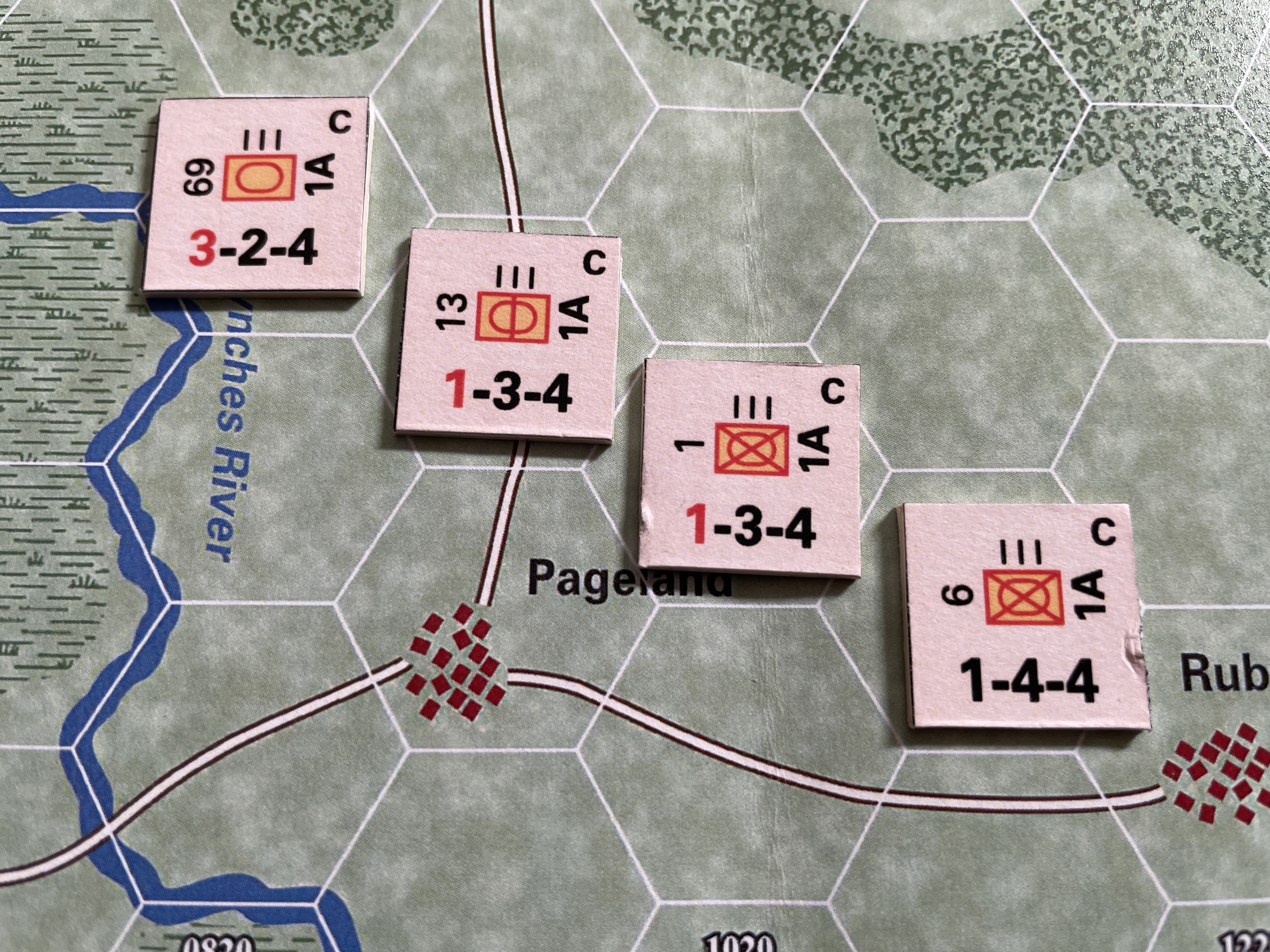
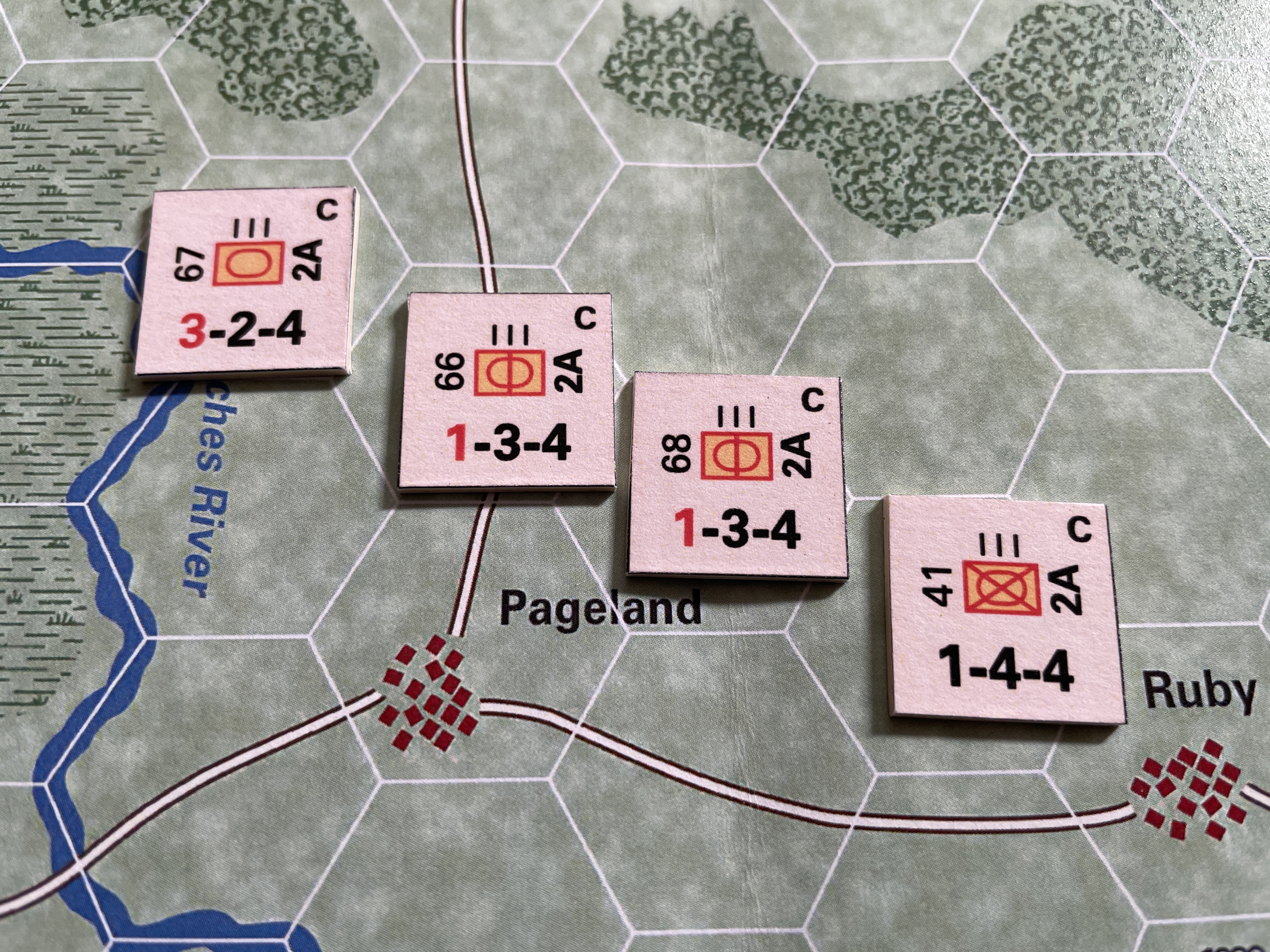
[In Maneuvering to War the easiest way to see the 1st and 2nd Armored Divisions is to look at their appearance in the Carolinas Maneuvers scenarios. The 1st Armored Division appears with four regiments: the 69th Medium Tank (notionally equipped with the M3 Medium rated 3-2-4)1, the 13th Light Tank (M2 Light rated 1-3-4), and two Mechanized Infantry Regiments (1st and 6th) with M3 Halftracks rated 1-3-4 and 1-4-4. The 2nd Armored Division likewise has four regiments but differs slightly with the 67th Armored Regiment (M3 Medium), the 66th and 68th Armored (M2 Light), and a single Mechanized Infantry Regiment (4th). In Maneuvering to War artillery is not depicted as a unit but the effect is reflected through the use of Artillery Support Markers. Engineers are not represented at all.]
At the same time the new US Army armored divisions differed from the German Wehrmacht, the US Army 4th Infantry Division reorganized along German lines. In the French campaign of 1940, the US Army took note of the German use of motorized infantry—truck-mounted—to protect the flanks and rear of armored formations plunging deep behind enemy lines (Grabel, p. 28). As Grabel goes on to explain:
The 4th Infantry Division, chosen to become the prototypical motorized division, began to reorganize in 1941. By that time, however, the motorized concept had undergone a complete revision. When it emerged from the transition process, the 4th no longer resembled a triangular division; rather, it had become essentially a light armored division. With two infantry regiments, 1 mechanized regiment, 2,600 vehicles, and 14,000 men, the 4th Motorized Division was not a defensively oriented support unit as originally conceived—it was a powerful, highly mobile offensive weapon in its own right.
Grabel, p. 29
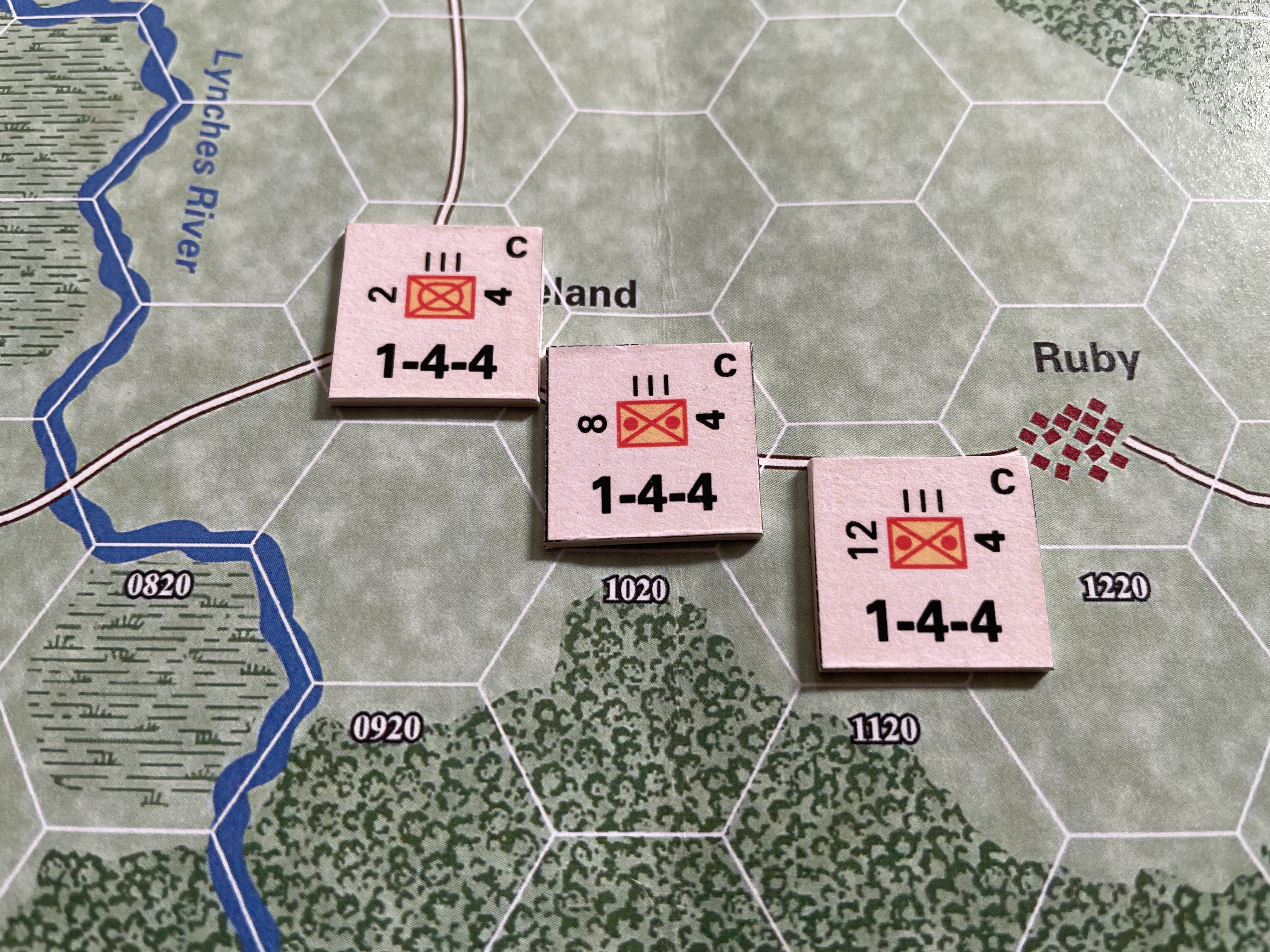
[In Maneuvering to War the 4th Infantry Division is again best represented in the Carolinas Maneuvers scenario. Here it appears as three regiments; a single mechanized infantry (rated 1-4-4) and two motorized infantry regiments likewise rated 1-4-4.]
Although the Cavalry in a way birthed the new US Army armored divisions, in other ways this arm of the service proved…as stubborn as a mule. As early as 1931 then-Chief of Staff Douglas MacArthur declared, “Modern firearms have eliminated the horse as a weapon, and as a means of transportation he has become, next to the dismounted man, the slowest means of transportation” (Grabel, p. 29). After 1938, the Cavalry—begrudgingly—modernized with the development of a horse-mechanized corps reconnaissance regiment. The mechanized squadron used motorcycles, scout cars, and Bantams aka jeeps. A second squadron was designated horse-portee and rode horses though for long distance travel they embarked in trucks. Come 1941 and the creation of the Armored Force the days of horse cavalry seemed numbered. The performance of the Cavalry Divisions in the 1941 Maneuvers was key to their future (Grabel, pp. 29-30).
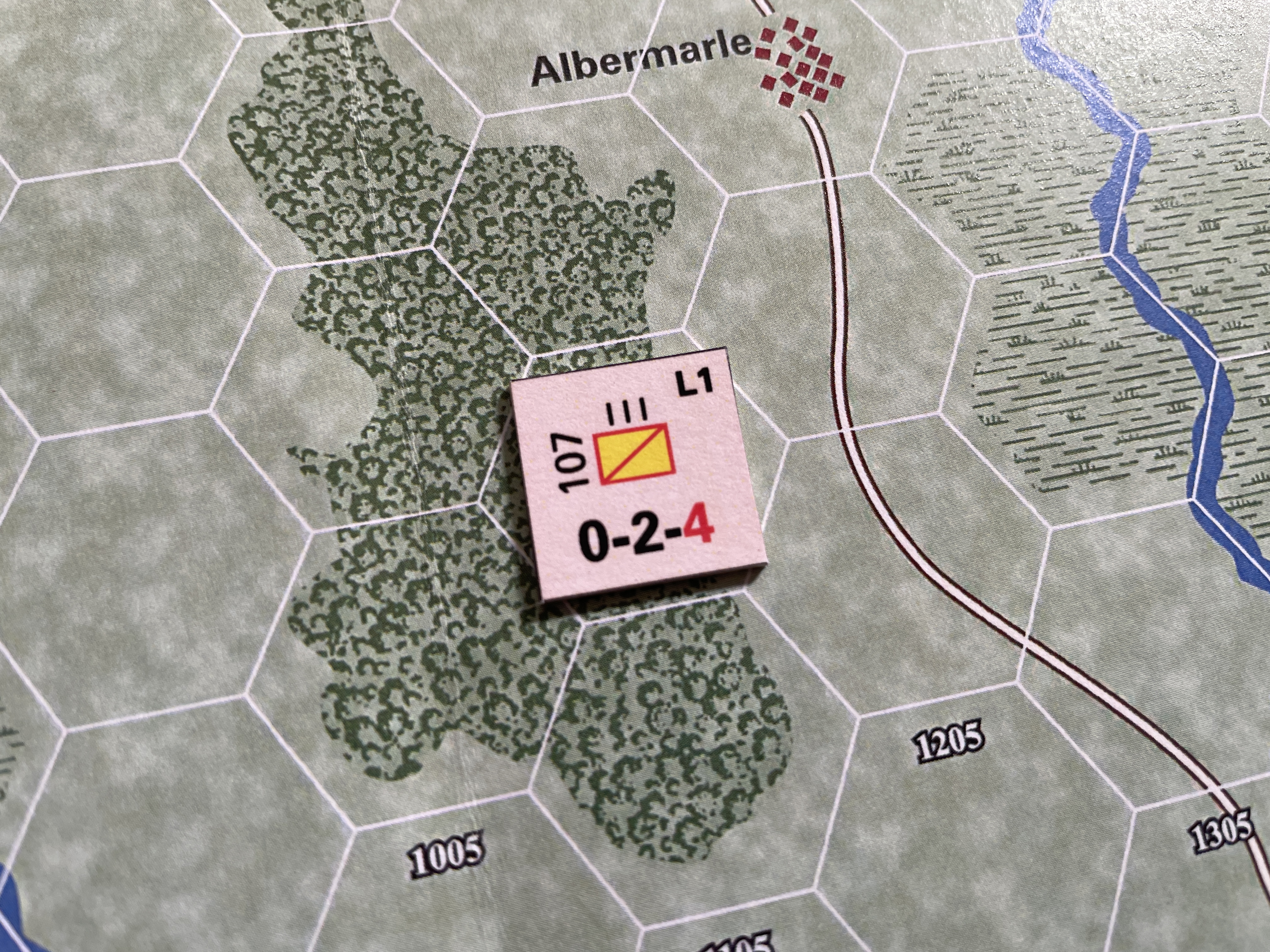
[Cavalry units appear in Maneuvering to War as either battalion or regiment-size units rated 0-2-4; that is, with no combat power against armored units.]
Where is the AT at?
As Grabel points out, “Even as mechanization eclipsed one arm [Cavalry], it gave rise to another. To wage decisive armored warfare, the Army needed a means of neutralizing hostile armored forces” (Grabel, p. 30). Logically this should be the role of antitank guns, but the field had been grossly neglected by the Infantry branch. The specialized 37-mm gun that appeared in 1939 was a direct copy of a German version and those in service were distributed among infantry regiments and artillery battalions (Grabel, p. 31).
General McNair, on the other hand, envisioned regimental antitank companies. His views were based, as Grabel points out, on:
…the inaccurate notion that armored forces equated to massed tanks (as opposed to combined arms task forces) and that antitank guns should likewise be pooled in order to defeat them. …each infantry division should possess a battalion of antitank guns to serve as a highly mobile antimechanized reserve in support of the regimental antitank companies. With enemy armor neutralized by its antitank elements, the division would otherwise be free to get on with offensive operations.
Grabel, p. 32
By 1941 McNair’s views became “grander.” McNair proposed the creation of an independent antitank arm where antitank units actually took the fight to the enemy by possessing “an offensive weapon and organization.” Yet, while McNair believed antitank units could defeat armored forces, others, like Chaffee, believed only armored forces could take on armored forces (Grabel, p. 33). The test for antitank doctrine was to be the 1941 maneuvers.
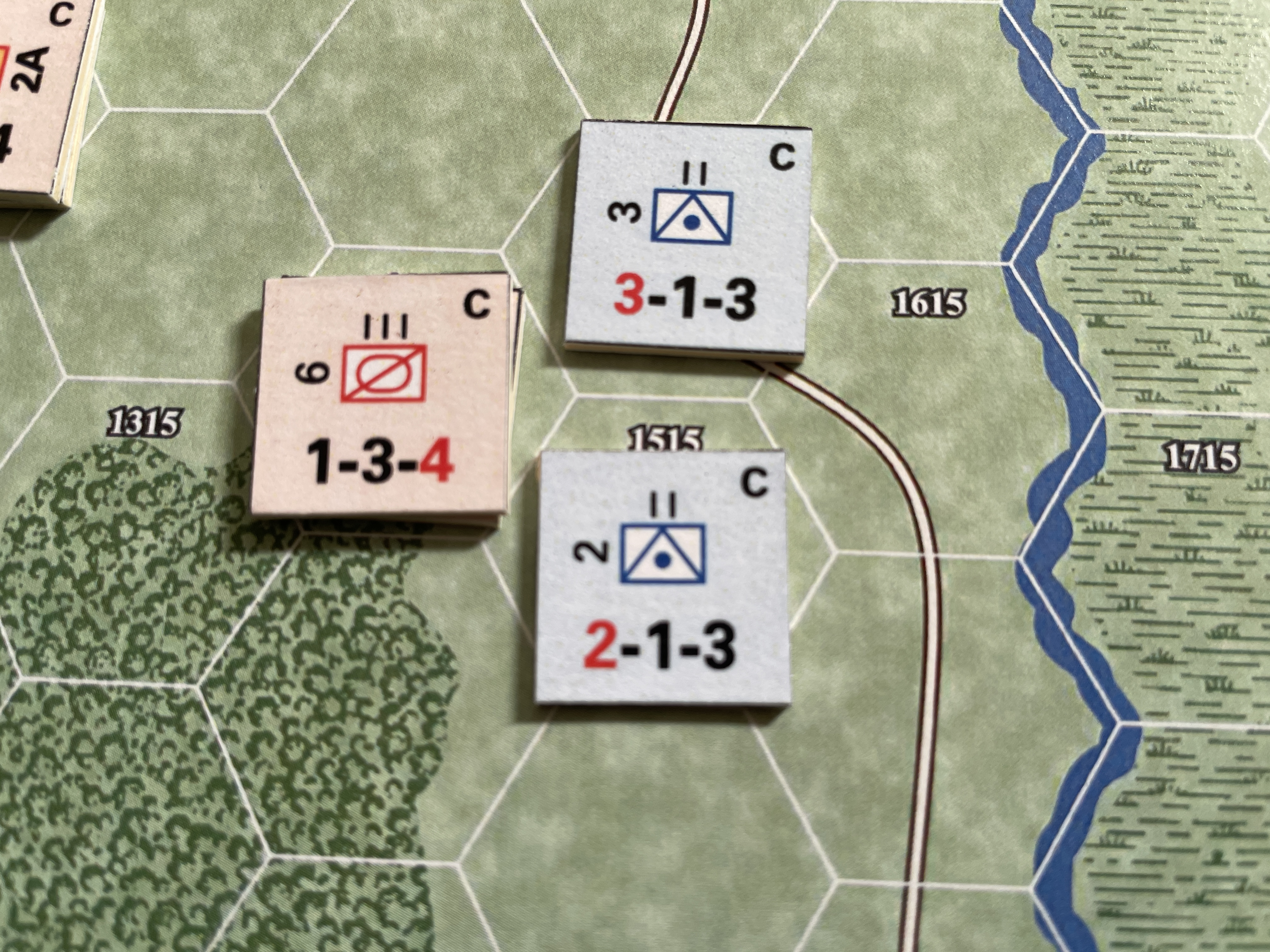
[Antitank guns appear in Maneuvering to War as battalion-size formations rated 3-1-3 or 2-1-3.]
Flour bombing
31. AIRPLANE ATTACKS. Both fire and bombing by airplanes against ground targets desirably should be indicated by visible means, such as small paper bags of flour or similar material. Lime water and certain other sprays also are useful.
UMPIRE MANUAL, General Headquarters, U.S. Army, February, 1941
At the same time the Protective Mobilization Plan was transforming the Infantry and new Armored arms of the US Army, the Army Air Corps was likewise expanding. In fact, they were over-expanding. In May 1940, President Roosevelt called for an air corps of 50,000 airplanes backed by production of 50,000 aircraft per year. In July 1940, Congress authorized an air corps of 54 groups totaling 3,149 combat aircraft. By March 1941 the Air Corps grew to an authorized strength of 84 groups with 7,799 airplanes. In June 1941, the Army Air Corps, previously on par with the Infantry, Cavalry, and Field Artillery arms, became an autonomous agency in the War Department. Maj. Gen. H.H. Arnold, Chief of Staff for Army Air Forces, was equal to the Army chief of staff and the chief of naval operations (Grabel, p. 36).
The question of what air power was to do was in great flux. The War Department in a training circular for 1941-42 specified three missions for the Army Air Forces: be a “separate [i.e. strategic] striking force”, be an element of regional air defense (a hemispheric defense mission), and lastly to be, “a component of combined arms in close support to ground operations” (Grabel, p. 41). The first mission was the domain of the new B-17 bomber. The second was carried out by fighters.
The third, ground support mission, was carried out by…almost nothing. In 1939 the Air Corps phased out the attack plane category and by 1940 began replacing single-engine attack planes with a twin-engine light bomber, the A-20. As part of the March 1941 authorization of 84 air groups, General Marshall ordered that it include aircraft similar to the German Ju-87 Stuka dive bomber. Come June 1941 the service had yet to acquire such an aircraft and it took the Assistant Secretary of War for Air to force the Army Air Corps to accept its first dive bomber, the A-24. The A-24 was in fact a redesignated Douglas SBD Dauntless dive bomber from the US Navy (Grabel, p. 39).
As the Louisiana and the Carolinas Maneuvers approached, the close support arm of the Army Air Forces was woefully unprepared. Training emphasized, “operations at altitudes above 20,000 feet, including combat maneuvers, visual and photographic reconnaissance, aerial gunnery and bombing at or near the service ceiling of the aircraft” (Grabel, p. 41).
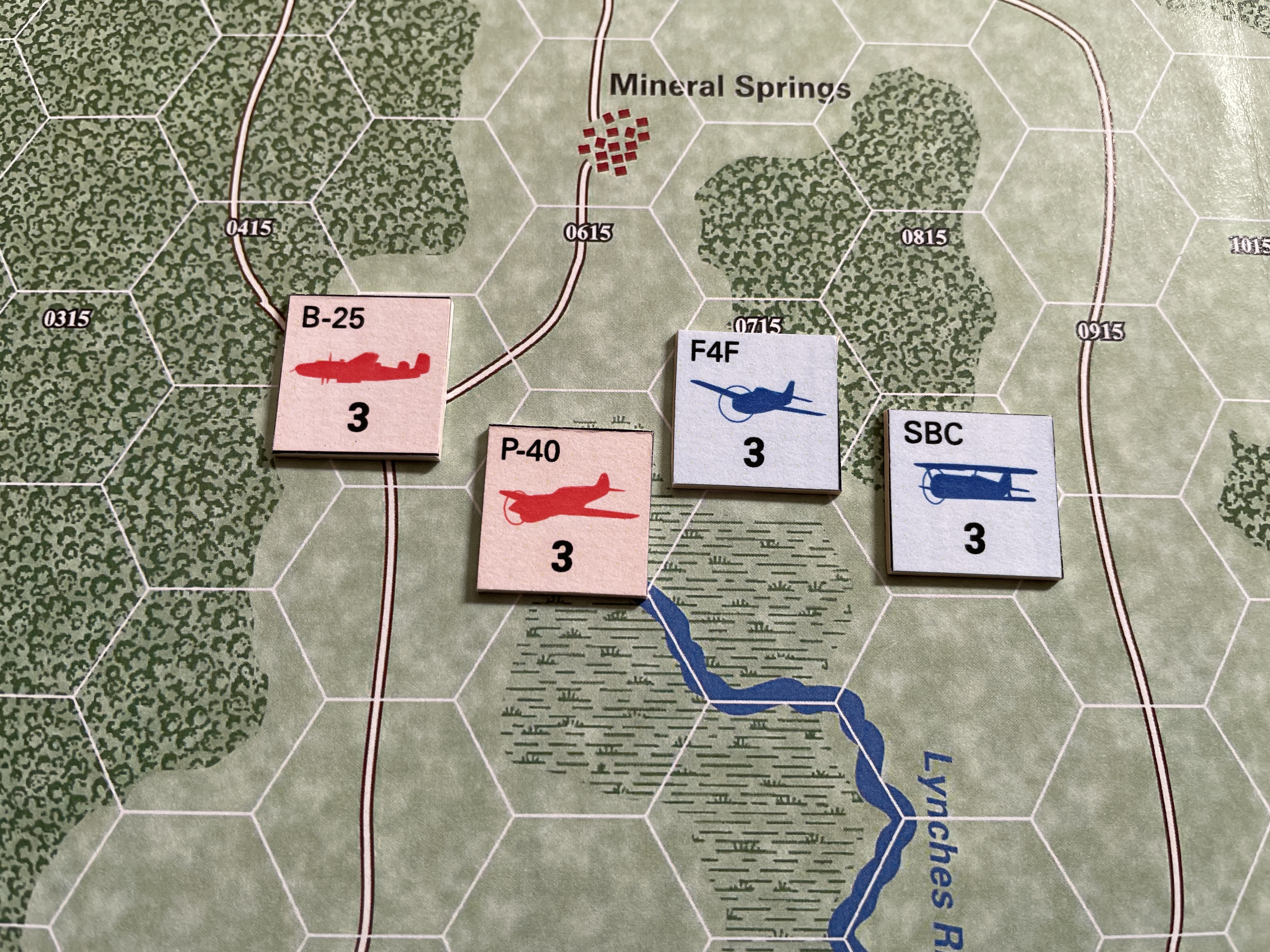
[In Maneuvering to War the aircraft depicted are P-40s and B-25s for the Red Team and Navy F4F and SBC for the Blue Team. These counters are very much an abstraction; the US Army brought B-25 and B-26 medium bombers, A-20 light bombers, A-24 dive bombers, as well as P-39, P-40, P-43, and P-38 fighters. Even the US Navy participated by sending three fighter, four dive bomber, and one torpedo squadrons (Grabel, p. 56).]
Umpire of war
Maneuvering to War designer Paul Rohrbaugh writes in his Designers’ Notes:
In the game, units are judged to be reduced or eliminated as umpires did in the field. The combat results are reflections of how the judges ruled, so in that manner these board games can reflect in a very real way what could and did happen in Louisiana and the Carolinas in the summer and fall of 1941.
15.0 Designer’s Notes
The rules governing the Louisiana and the Carolinas maneuvers were published in the 1941 GHQ Umpire Manual written by General McNair that one can find online. The role of the umpire was laid out in Section II SYSTEM OF UMPIRING:
10. BASIS OF UMPIRING.-The outcome of combat is essentially the sum of the outcomes of many encounters between small units of the opposing forces. It follows that realism in maneuvers can be obtained only by painstaking umpiring of the actions at all points of contact. The great mass of umpires should be with or among small units which are or will be in contact with the opposing forces, Umpires at the headquarters of the director or of large units can exercise no proper influence on the progress of a maneuver and should be kept at a minimum (par. 34).
Umpire Manual, para. 10
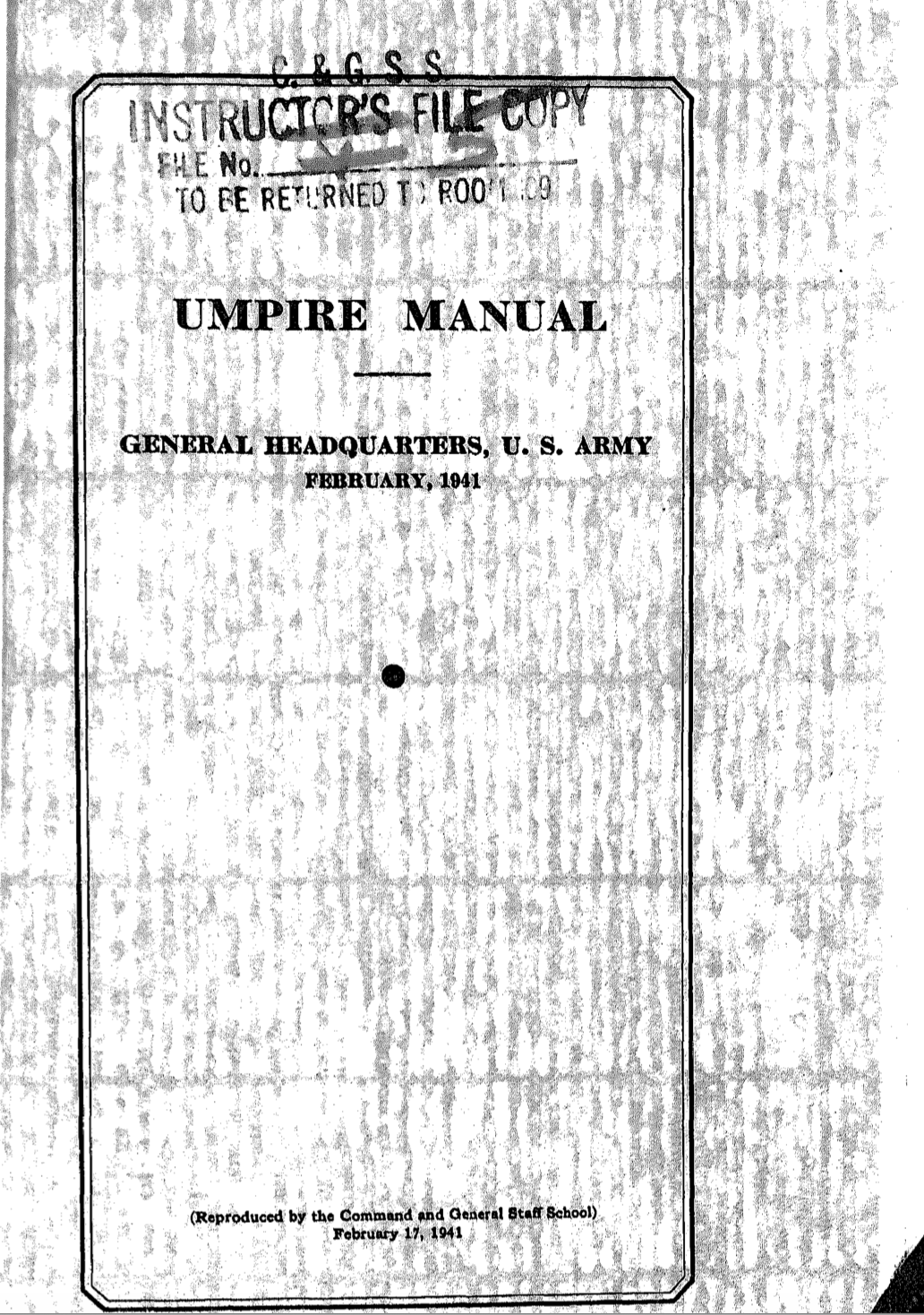
[“Painstaking umpiring of the actions at all points of contact” sounds like an adjudication system in a wargame, eh? In Maneuvering to War it is in the Operations Phase that actions—and their outcomes—are determined.]
“When opposing forces approach contact-and occasionally under other conditions-a decision by umpires is required, in order that there may be tactical realism” (Umpire Manual, para. 10). The “Sequence of Play” found in the Umpire Manual for adjudicating combat between units proceeded this way.
- Opposing umpires display white flag; units halt actions.
- Opposing umpires meet and confer.
- A decision is made where (1) One force advances and the other retreats, or (2) Neither force advances. (Umpire Manual, para. 10)
[The Sequence of Play in Maneuvering to War is found a rule 5.0 and consists of four (4) phases: 5.1 Activation Marker Phase, 5.2 Air and Artillery Unit Determination Phase, 5.3 Operations Phase, and 5.4 End Phase. The umpire actions in the Umpire Manual are more like those found under rule 7.4 Fire Combat, specifically 7.4.1 Fire Combat Procedure .
The Umpire Manual also expressed concern with the pace of umpiring, or what modern wargamers might call the playability of the game:
The interruption of action, in order to permit decisions, delays the maneuver. Such delays, however counteract the natural tendency of maneuvers to progress more rapidly than actual combat. Moreover, it is only by frequent and considered decisions, based on facts at points of contact, that a maneuver can afford correct and useful training commensurate with the effort and expense involved.
Umpire Manual, para. 12.b.
[Play of Maneuvering to War is divided into turns which represents about eight (8) hours of time; see 4.0 Game Scale. Moreover, the “frequent and considered decisions” are driven by Activation Markers and a limited selection of actions in the Operations Phase of a turn in Maneuvering to War.]
Firepower
The Umpire Manual focuses on infantry actions in a sub-section titled, “Fire Power”:
13. GENERAL—a. In general combat progresses as does the infantry, and infantry progresses according to its fire power.
b. All infantry element should be permitted to advance only when it has decisive superiority of fire as compared with the elements immediately opposing it. This superiority never should be less than 2 to 1, and generally should be 3 or 4 to 1. If the defender has good cover and field of fire, or if the attacker has little cover, them should be no hesitation in requiring a superiority of 5 to 1, or even more.
c. The tendency is to favor the attacker, permitting him to advance with only a small fire superiority, whereas war experience has shown conclusively that a determine defender, well placed, can delay or even stop a greatly superior force.
d . The machine gun is especially effective in defense, and every effort must be made to ascertain and weigh fairly those which are effective in a given situation. Machine guns should be supplied abundantly with blank ammunition, and must fire sufficiently to reveal their presence to opposing troops and to umpires.
e. The situation may be such that a sound decision can be reached only by dividing the action into parts which are distinct so far as fire power is concerned, For example, one company may attack another company frontally, which is one action and need not be divided. The fire power is about the same for both forces, and tho decision is a stalemate. But, if the attacking company employs one platoon frontally and two platoons to envelop, the situation is quite different and must be divided into two actions. The frontal attack is stopped, but the enveloping attack quite possible may be decisively superior in fire power and should be permitted to advance. Thus the attacking company may be successful by virtue of its maneuver.
Umpire Manual, para. 13
In the Umpire Manual the strength of a unit was a straight-forward calculation using the equipment of a unit; “The number of weapons can be tallied readily by company umpires, and includes only those weapons whose fire is effective in the situation being decided” (Umpire Manual, para. 14.b). The Umpire Manual directs:
e. Infantry fire power is determined by rifle company. Fire power of heavy weapons is added to that of the company supported. The total, modified for artillery and tank effect (pars. 15 and 16) and for losses (par. 17) is the basis of a decision according to paragraph 13 b above.
Umpire Manual, para. 14.e
The Umpire Manual includes an example Rifle Company that computes out to a firepower of 150 points (Umpire Manual, para 14.f.).
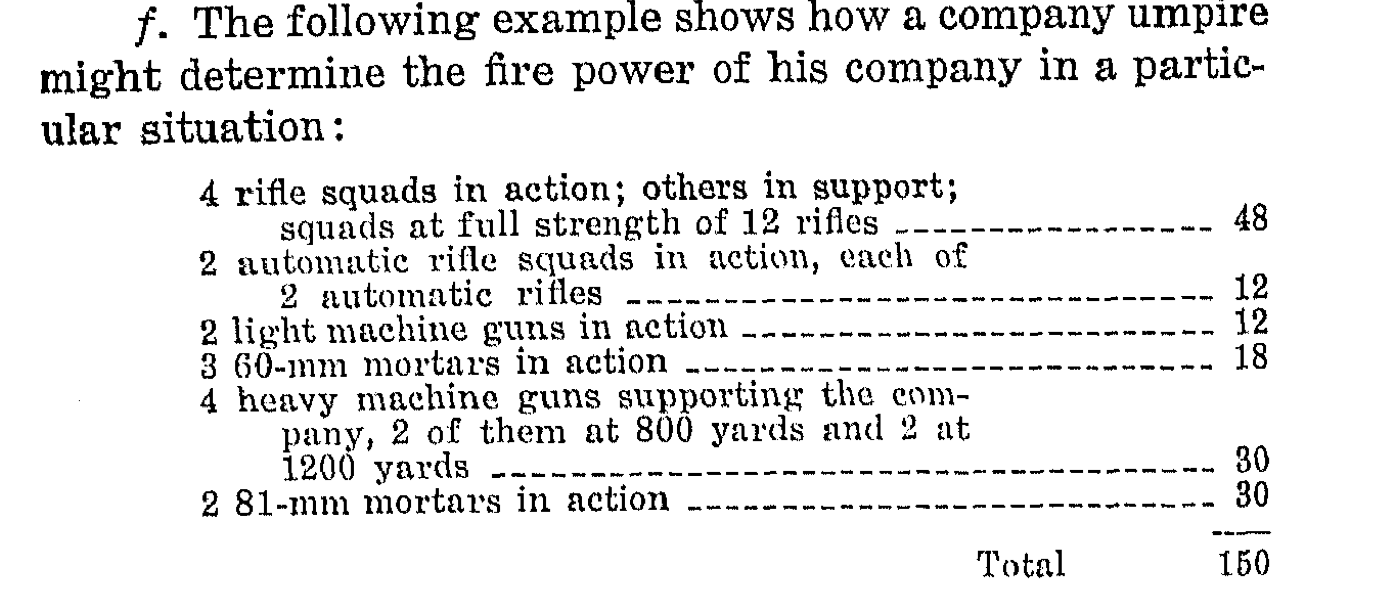
[Maneuvering to War does not explain how it derives the AAF and IAF factors. Using the metric in the Umpire Manual, the fire power of an infantry brigade in a square division compared to an infantry regiment in a triangular division is not that different—and both are rated 1-4-X in Maneuvering to War. The primary difference, however, is the fact the square division has only two brigades with a Movement Factor of 1 whereas the triangular division has three regiments that are much more mobile with a Movement Factor of 4.]
[While the firepower of units in Maneuvering to War as compared to the Umpire Manual are relatively similar, the adjudication of combat in the Umpire Manual and Maneuvering to War are very different. Whereas the Umpire Manual uses a combat power odds comparison—like so many classic wargame Combat Results Tables or CRT—Maneuvering to War combat is resolved by comparing a die roll (with die roll modifiers) against the Attack Factor in question. If the modified die roll is ≥ the firing units AAF or IAF, a hit is scored.]
[So, if one is not comparing combat power ratios how does one make achieve “decisive superiority” in Maneuvering to War? Rule 7.4.1 Fire Combat Procedure specifies, “All units resolve their attacks individually” so even if three infantry regiments (1-4-4) attack a single infantry brigade (1-4-1) each has only a 2:3 chance of scoring a hit. Instead of adding combat power together, units need to take advantage of the die roll modifier (DRM) for Concentric Attack (optional rule 14.1) which gives a -1 DRM for attacking a unit from opposite sides of their hex. The use of optional rule 14.2 Combined Arms is also strongly recommended. When an armor or antitank unit combines with an infantry unit to attack combat is resolved using highest attack factor of the attacking units regardless of target unit type. Whereas a 3-2-4 armor regiment attacking an infantry regiment would usually use the IAF of 2, when combined with a 1-4-4 infantry regiment the armor unit attacks using the higher IAF factor of 4. Alas, I find no rules for concentric attack nor combined arms in the Umpire Manual.
“They’re killing my boys!”
Per the Umpire Manual, losses were assessed as a straight formula over a given time:
War experience indicates that an infantry regiment may sustain extreme casualties as great as 15% during one day of severe combat. While losses of a particular portion of the regiment might exceed this proportion, the figure affords a useful check on the total casualties assessed by company umpires.
Umpire Manual, para. 18.a
In order to facilitate training, the Umpire Manual directed that casualties not leave their units. Instead, future fire power was reduced according to the casualty percentage.
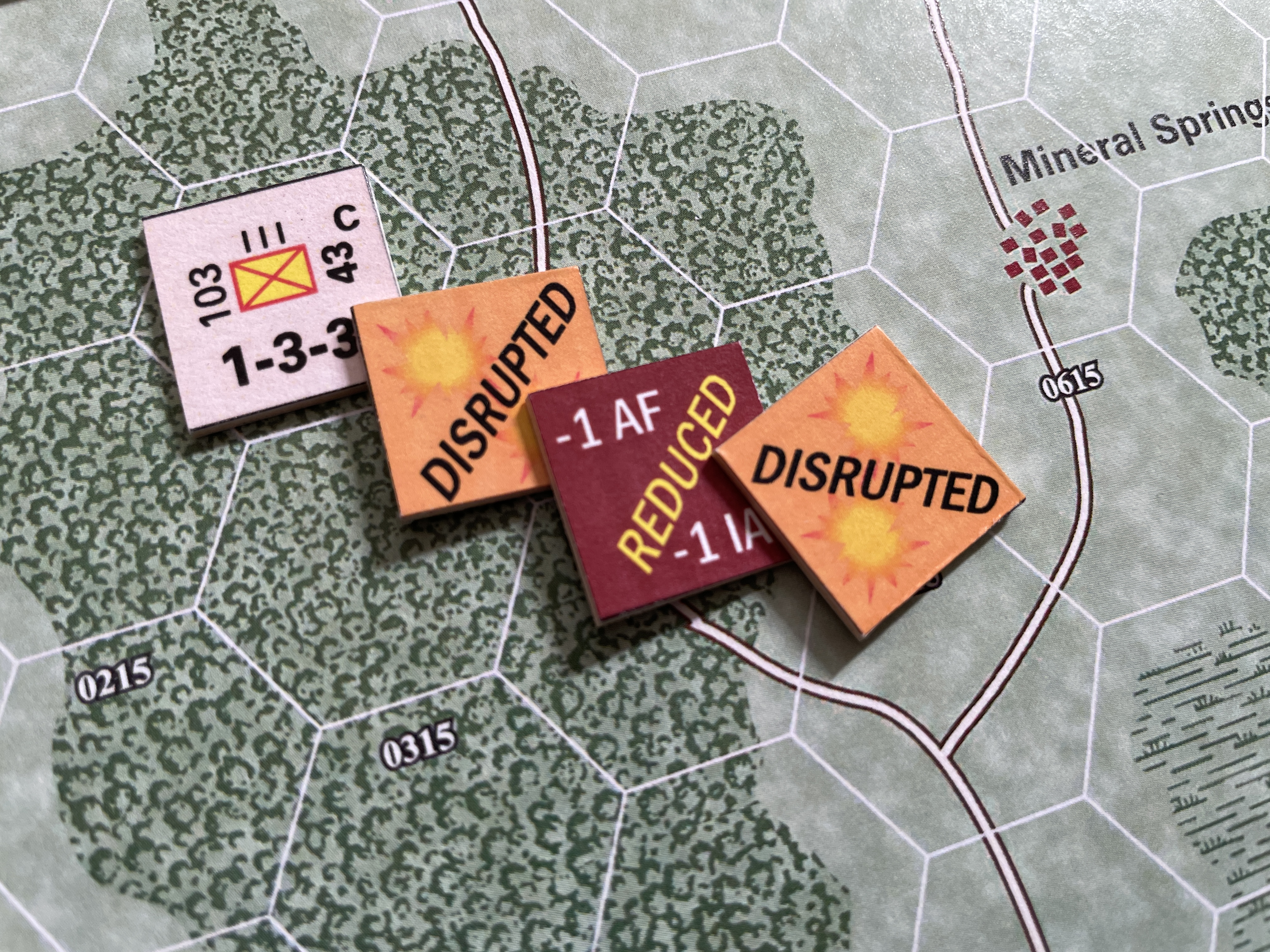
[Maneuvering to War takes a similar yet different approach to combat casualties. Per rule 7.4.2 Fire Combat Effects, a hit unit is marked as Disrupted and may not move or fire for the rest of the turn. A Disrupted unit hit again becomes Reduced with reductions in AAF an IAF factors. A reduced unit that is hit again is again Disrupted and if hit once more is eliminated.]
Outside the company
Although the Umpire Manual focused heavily on infantry—with the rifle company the unit of measure—rules for other arms and key equipment types were also considered.
[Designers, developers, publishers, and players of wargames almost certainly will find the prequel SPI Case System paragraph numbering format used in the Umpire Manual as equally familiar and frustrating. Familiar in that rules can be referenced by specific paragraph and not pages, and frustrating in that the rules for most anything other than infantry seem tacked on with little apparent “playtesting” or “development.” While rules for Maneuvering to War use what I term a “loose” SPI Case Numbering System they are, by comparison, relatively consistent internally.]
Cavalry
The Umpire Manual specified, “The fire power of horse cavalry dismounted is determined as for infantry” (Umpire Manual, para. 14.g). When fighting mounted, the firepower is determined as per the infantry but losses are assessed at a different—usually higher—rate. The Umpire Manual does not appear to provide any guidelines for losses from horse cavalry attacking armored units or vice versa (see Umpire Manual para. 20 HORSE CAVALRY).
[In Maneuvering to War a Cavalry regiment is rated 0-2-4 which reflects no firepower against armored units.]
Field Artillery
15. EFFECT OF ARTILLERY. – Artillery fire affects infantry action in two ways-one direct and one indirect:
a. When an infantry element actually is under artillery fire (par, 27), its fire power will be taken as reduced by one-half so long as the artillery fire continues. Thus, in the example above, if one rifle platoon of two rifle squads and one automatic rifle squad in action were under artillery fire, thefire power of the company would be reduced by 15.
b. When artillery is in position and is taken under well placed fire by the opposing artillery counterbattery fire-such fire neutralizes the artillery subjected to it. Thus counterbattery fire assists the infantry by interrupting artillery fore against the infantry.
Umpire Manual, para. 15
Field Artillery has a very limited effect on armored units per the Umpire Manual. To wit, “Armored vehicles passing through a battery concentration- 2% of vehicles in each case.” (Umpire Manual, par. 21.b).
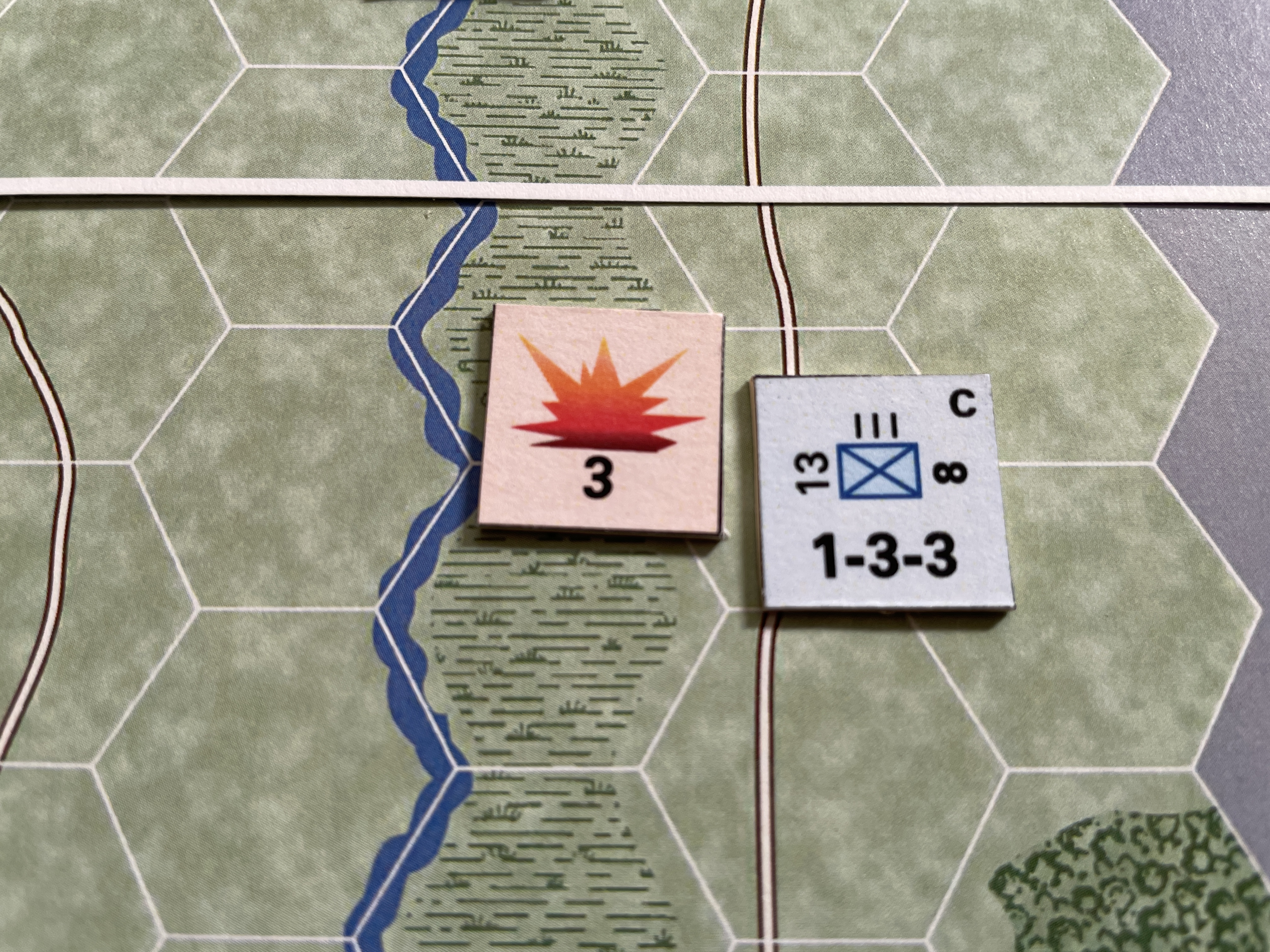
[As noted previously, artillery in Maneuvering to War is abstractly represented through the use of artillery assets. Per rule 6.3, the number of Artillery Support Markers available each turn is determined by a die roll; there is no direct correlation to unit formations on the map. Artillery strikes can be placed within 5 hexes of a normal status Headquarters (HQ) and attack one enemy—even armored—in a hex with an AAF or IAF of 3. After determination of die roll modifiers, a roll ≥ the Artillery Support factor is a hit.]
Tanks
In the Umpire Manual tanks are treated rather simply and their effectiveness is measured relative to infantry:
16. EFFECT OF TANKS — Tanks in action will be taken as neutralizing infantry within 100 yards of any tank. The fire power of such infantry against opposing infantry is reduced to zero while tanks are present.
Umpire Manual, para. 16
When tanks overrun infantry, defined as a tank is within 100 yards of any infantry unit, the infantry suffers losses of 3% per attack (Umpire Manual, para. 18.c).
When a tank versus tank battle takes place, the Umpire Manual directed, “…losses in inverse ration of strengths of opposing forces. Example: 30 blue tanks against 20 red tanks—losses in ration of 2 blue to 3 red” (Umpire Manual, para. 21.d). This follows from the rules for Tank Umpires (para. 40.h.) which actually has the firepower rules for tank vs. tank combat:
(1) Losses will be assessed only at ranges less than 300 yards. Vehicles which do not engage within this range will be disregarded.
(2) Relative strength will be determined by the number of usable guns which are effective against armor (par, 21. b ).
(3) It is to be assumed that combat at close range will result in rapid destruction of the weaker force; and unless maneuver demonstrates that certain elements would have escaped, complete destruction should be ruled.
(4) Losses of the stronger force will be determined from those of the weaker force (par. 21 d ).
(5) Example: Blue-30 guns engaged. Red-20 guns engaged. Engagement lasts 5 minutes. Red is destroyed, Blue loses two-thirds as many vehicles as Red.
Umpire Manual, para. 40.h
[Maneuvering to War has rules for neither the “complete destruction” of the weaker force nor losses assigned to attackers. As noted above, rule 7.4.2 uses a Hit-Disruption-Reduced-Disrupted-Eliminated process against the defending unit; an attacking unit is never disrupted, reduced, or eliminated by making an attack.
Antitank guns
Rules for antitank guns are scattered about the Umpire Manual with some are in unlikely places. Antitank guns appear in the table of contents referenced at paragraph 22:
22. ANTITANK GUNS.-a. Losses of antitank guns will be assessed only as they are overrun by armored vehicles. A gun is overrun when an armored vehicle reaches the gun without being ruled out of action by a tank umpire.
b. While armored attacks are frequently supported by machine guns and cannon and there will be losses of antitank guns due to such fire, antitank guns offer a difficult target, losses will be comparatively small, and it is impracticable to determine them.
c. Possess of antitank guns are assessed by the nearest company umpire-not by tank umpire. Guns lost are ruled out of action for the day. They may return to action on the following day, in order to avoid undue loss of training.
Umpire Manual, para. 22
The effectiveness of antitank guns in actually found in losses to Armored Vehicles section. As originally written in the February 1941 version of the Umpire Manual: “b. While various means of antitank defense are effective in some degree, only antitank guns, mines, aircraft, and armored vehicles themselves will be recognized in maneuvers. Effective antitank guns are the caliber 50 machine gun and cannon of all calibers” (Umpire Manual, para. 21.b). A change dated dated 10 June 1941 modified that paragraph to read:
b. (1) While various means of antitank defense are effective in some degree, only antitank guns, mines, aircraft, and armored vehicles themselves will be recognized in maneuvers.
(2) The vehicular .50 caliber machine gun is effective from stationary vehicles and ground mounts (except as in (3) below) and against scout vehicles and armored half track vehicles at ranges up to 500 yards. It is ineffective against tanks at all ranges.
(3) The caliber .50 machine gun of infantry heavy weapons companies is effective against light tanks at ranges up to 1000 yards.
(4) The 37-mm antitank gun is effective from ground mounts and from stationary vehicles against light tanks at ranges up to 1000 yards and against medium tanks at ranges up to 500 yards.
(5) The 75-mm antitank gun is effective under similar conditions as the 37-mm antitank gun.
Change, GHQ Umpire Manual, 10 June 1941
[Given the scale of the map in Maneuvering to War—5.5 miles per hex in the Louisiana Maneuvers and 4 miles on the Carolinas map—the ranges used in the Umpire Manual are not useful when adjudicating combat. What I find most interesting is that the 37mm and 75mm antitank guns were treated as equally effective; no difference for range or lethality against different classes of armored units. In Maneuvering to War antitank guns appear in company-size formations rated 3-1-3 or 2-1-3.]
Airing it out
The GHQ Umpire Manual was clearly written as an infantry-first set of rules with strong connections to the Horse Cavalry and Field Artillery branches. Antitank guns are given their due. Armored vehicles, then new, were incorporated into the Umpire Manual but in a bit of a haphazard manner that likely reflects the struggle between innovation and doctrine. Nowhere is that struggle better seen then in the rules for aircraft.
The original February 1941 version of the Umpire Manual and changes through July 1941included aircraft, but in a very minor manner. Losses to Infantry attacked by low-flying aircraft are detailed; when in column and surprised 10% losses or no surprise 5% loss. When deployed or bivouac the loss rates change to 3% and 1%, respectively (Umpire Manual, para.18.c). The same loss rates apply to mounted cavalry (para 20.a) and armored vehicles (para. 21.d).
Paragraph 24 of the Umpire Manual details losses to aircraft from anti-aircraft weapons. What I find interesting is not the effectiveness of the gun but how losses were adjudicated given some damage effects were listed as fractions or ratios:
For a single airplane, the fractional loss will be taken to the nearest 1/4 and the airplane considered either destroyed or undamaged according to lot. Example: loss of 3/4 airplane. Mark three slips of paper destroy and one no damage. The one drawn is the decision.
Umpire Manual, para. 24.b
On 21 August 1941—just three weeks before the Louisiana Maneuvers kicked off (21 September)—GHQ issued an Aviation Supplement to Umpire Manual. This 31-paragraph, 12 page supplement expanded rules for reconnaissance and observation aircraft, bombardment aircraft, pursuit aircraft, as well as other topic of concern to the air. Here are some of the rules that stood out to me.
- Under Reconnaissance and Observation Aircraft, paragraph 12. IMPROPER EMPLOYMENT – “Observation aircraft should not be employed on pursuit, dive bombing, or low-altitude horizontal bombing missions. If such missions are ordered, air umpires will assess double the losses given for aircraft designed for the purpose. Bomb racks will not be assumed” (Supplement, para. 12)
- Under Bombardment Aviation paragraph 18. NUMBER OF MISSIONS – “An air umpire will permit a squadron to perform not more than two flying missions per combat crew per 24 hours” (Supplement, para. 18). Pursuit aviation (aka fighters) was limited to flying no more than six of every 24 hours (Supplement, para 23).
- Under Miscellaneous, paragraph 30 AIR FIGHTING – “b. An air fight will be limited to five minutes from the first assault. Individual fights should not be discourages since they afford good training, but such actions must be within the five minute limit and a t all times more than 3,000 feet above the ground. At lower altitudes, a single assault by the attacking airplane, within effective range but not closer than 500 feet will suffice for umpiring” (Supplement, para. 30.b).
[In Maneuvering to War aircraft are covered under rules 6.1 Air Support Units and rule 6.2 Fighters. The number of Air Support Units (bombardment and pursuit aircraft used for ground support) in a given turn is determined by a die roll. Per 6.1.1 Air Support Strikes each Air Support Unit earned can be used once to attack an enemy occupied hex where it attacks one unit within. Like other combat resolution in Maneuvering to War a die roll (with modifiers) is made against the Attack Factor of the Air Support Unit to determine if a hit is made. There is no antiaircraft fire rule in Maneuvering to War; however, if the attacking Air Support Strike rolls a modified die roll of [6] or greater the defender is awarded a Victory Point as they “shot down the attacking aircraft.]
[Rule 6.1.2 Air Observation in Maneuvering to War details the bonuses an air observation unit adds to a friendly Air or Artillery strike. Like the Aviation Supplement, observation aircraft cannot attack.]
[Fighters in Maneuvering to War are covered under rule 6.2 where they can fly two missions: Combat Air Patrol (CAP) as detailed in 6.2.1 or Fighter Escort under rule 6.2.2. CAP units can immediately respond to the placement of an Air Support Strike where it does not directly shoot down attacking aircraft but instead gives a +1 die roll modifier to the attack (lessening the chance of a hit while likewise increasing the chance of the Air Strike being shot down). If the Air Support Strike has a Fighter Escort, the Escort and CAP “dice off” with the loser returning to base. If the CAP is chased off there is not +1 CAP modifier; if the Fighter Escort is not returned the attack proceeds with a -1 die roll modifier.]
Modern umpire
While Maneuvering to War is a fairly detailed depiction of the 1941 US Army Louisiana and the Carolinas Maneuvers, the game does include rules that “go beyond” the GHQ Umpire Manual. Specifically, I am looking at the rules for Command, Rally and Recovery, and Supply.
6.4 COMMAND. Rule 6.4 Command specifies command ranges for activating a unit. There is no counterpart restriction detailed in the Umpire Manual; it appears GHQ was content to let “normal operations” dictate the command span of leaders.
[The rules limit an undisrupted Headquarters to a Command Range of 5 hexes—roughly 20-25 miles depending on the map. As it was, the Signal Corps was as much in its infancy as armor. When General Marshall testified in front of Congress he foreshadowed communications problems in the coming 1940 maneuvers,
…he was not referring to war at all but to the first of the great Louisiana maneuvers, which was about to engage 60,000 troops along the Sabine River boundary with Texas. Preceded by IV Corps maneuvers at Fort Benning, this May exercise tested tactical communications more thoroughly than anything else had since World War I. As a result, it re-emphasized their inadequacy. The absence of numbers of men all properly trained and equipped raised the specter of failures which could occur in war.]
Dulany Terrett, The Signal Corps: The Emergency (To December 1941), United States Army Center for Military History, CMH Pub 10-16-1, 1994, p. 152
9.0 RALLY AND RECOVERY. This rule covers the removal of Disrupted markers from hit units by making a Rally activation (see 9.1 Rally Activation). Rule 9.2 Replacements details how units are flipped from Reduced back to “full strength.” This is directly contrary to the Umpire Manual which specifically states, “Assessed casualties will be considered as not replaced during the maneuvers” (Umpire Manual, para. 17.e). There were exceptions such as that for antitank guns (“Guns lost are ruled out of action for the day. They may return to action on the following day, in order to avoid undue loss of training” (Umpire Manual, para. 22.c).
10.0 SUPPLY. The Supply rule is the classic wargame “trace a supply route or suffer a penalty” rule. The Umpire Manual has no such supply rule but, given the Maneuvers were fought in realistic field conditions, supply was needed but not adjudicated by the umpires. The closest one finds in the Umpire Manual is paragraph 33 PRISONERS which accounts for capturing isolated units.
Conditional victory
Finally, I return to my original inquiry asking how well Maneuvering to War gets after designer Paul Rohrbaugh’s stated intent of recreating the challenges facing the US Army in the 1941 Louisiana and Carolinas Maneuvers. My answer is framed by designer Paul Rohrbaughs stated intent in the Designer’s Notes, repeated here:
In the game, units are judged to be reduced or eliminated as umpires did in the field. The combat results are reflections of how the judges ruled, so in that manner these board games can reflect in a very real way what could and did happen in Louisiana and the Carolinas in the summer and fall of 1941.
15.0 Designer’s Notes
“…judged to be reduced or eliminated as umpires did in the field.” Maneuvering to War uses a different combat adjudication method that does not use combat power ratios or percentage loss attrition like that found in the Umpire Manual.
“The combat results are reflections of how the judges ruled,… .” Same as above; with the combat adjudication systems so radically different it is challenging for me to say Maneuvering to War reflects the Umpire Manual either in letter or spirit.
“…these board games can reflect in a very real way what could and did happen in Louisiana and the Carolinas in the summer and fall of 1941.” Generally speaking, the battles that unfolded in Louisiana and the Carolinas in 1941 are broadly comparable to the battles one can play out in Maneuvering to War. That is, as long as one looks not much deeper than the order of battle and a few special rules.
Most importantly, what Maneuvering to War has difficulty reflecting is not found in the Umpire Manual. As Grabel observes:
Although originally conceived as a training device, tile GHQ maneuvers had their most lasting impact in the area of doctrine. Infantry and artillery doctrine, which the maneuvers validated (although execution left something to be desired), emerged relatively unchanged. Armor benefited enormously from its embarrassments in Louisiana and the Carolinas. The trend toward closer cooperation among tanks, infantry, and artillery that began with the 1942 division reorganization continued with yet another restructuring of the armored division in 1943. The 1943 division had three combat commands and three battalions each of tanks, infantry. and artillery. The sixteen armored divisions activated in World War II proved in combat to be sound, organizationally and doctrinally.
Grabel, p. 188
Using a wargame to demonstrate the evolution of doctrine is a difficult task. It is also very unpopular as it almost certainly requires detailed rules and restrictions on players that limit player agency. It is easy to read Chaffee’s vision of an armored division in battle (“…the brigade’s two regiments of light tanks would conduct rapid, deep envelopments of the enemy while the medium regiment (two battalions as compared to the light regiment’s three) provided support and tackled major centers of resistance.”) but it is hard (impossible?) for most wargamers to play Maneuvering to War in that manner absent rigid guidelines (restrictions?) on play.
[An example of this doctrinally-driven game rules is the most powerful combat modifier in Maneuvering to War: rule 14.2 Combined Arms. The rules states, “Whenever an armor or anti-tank and infantry unit attack (overrun or regular fire combat) the same target, use the highest AF (IAF or AAF) of the attacking units when resolving the combat, regardless of the target unit’s type.” This infantry-armor combined arms doctrine was not the way the US Army did business in 1941. As Grabel writes, “General McNair had provided I Armored Corps and its two divisions with the opportunity to strike decisive blows in battle, which they largely failed to do, for a variety of reasons. Thereafter, McNair relaxed his emphasis on armor and stressed instead the traditional infantry-artillery team as the centerpiece of ground combat” (Grabel, p. 188). Rule 14.2 Combined Arms is certainly not based on the Umpire Manual or even US Army doctrine of the day, but appears almost as a wish from the designer to see the armor-infantry team come together in the Maneuvers in an ahistorical manner.]
If Maneuvering to War included rules resticting player to doctrinal (even experimental doctrine) play, very few likely would really want to play that wargame for it has become a simulation. A simulation almost certainly devoid of joy. No. Thank. You.
After all this…discussion—and especially that last sour note—do I recommend owning or playing Maneuvering to War? Absolutely, if for no other reason than to be a young George S. Patton leading a brand-new 2nd Armored Division in your own Kobyashi Maru moment.2 Or to show General Lear that his slow, plodding attack plan is no match for decisive initiative. In Maneuvering to War you get to write the script between Red and Blue in a battle that feels like World War II—but is not. Enjoy playing Maneuvering to War for the toys each team is given; but leave the doctrinal arguments for another day.
- According to rule 5.3 Operations Phase – Movement and Fire a red Movement Factor (third rating) means the unit can move at half allowance and conducts any fire combat at half-strength. Note also that rule 5.3 references a “white” Movement Factor but it appears the counters use red instead. The red factor in the first rating (Armor Attack Factor) means the unit can conduct AF fire at half strength and move at half movement allowance. The red Armor Factor effect is not explicitly referenced in the rules but a logical implication of the above reference. ↩︎
- Per the Designer’s Notes for the Louisiana Phase 2 scenario Patton was, “Extremely frustrated in the first maneuver by terrain and numerous umpire rulings that his tanks were devastated by AT ambushes. Patton resolved to find another way to victory. Before the start of the second round of maneuvers, General Patton scouted the bridges, roads, and intersections to the west of the Sabine River, and paid gas station attendants along his planned route of march out of his own pocket to provide fuel to any of the tanks and vehicles that would stop there. This flagrant circumvention of the rules resulted in the 1st [sic – should be 2nd] Armored Division surprising the Red Team by suddenly appearing in their rear area and then driving on Shreveport with only token resistance to oppose them.” ↩︎
Feature image courtesy RMN
The opinions and views expressed in this blog are those of the author alone and are presented in a personal capacity. They do not necessarily represent the views of U.S. Navy or any other U.S. government Department, Service, Agency, Office, or employer.
RockyMountainNavy.com © 2007-2026 by Ian B is licensed under CC BY-SA 4.0


Patton beat Kobayashi Maru before Kirk.
Rocky, great review, better than mine! Also, great job finding the umpire manual! You really dug in on this. Paul Rohrbaugh will be happy.
Thanks! It all started with your review (which is excellent).
The UMPIRE MANUAL is an interesting artifact of how the Army “played” war. I can also imagine how it upset Patton… .