
Replicant Rebellion is a expansion for Blade Runner: The Roleplaying Game from Free League Publishing. The expansion delivers a setting and rules for player-characters to be members of an underground movement where they bacically operate under cover. The core game mechanism is “Heat” which is a measure of how much pressure, or exposure, the player-character has at that moment. Whereas player-characters in the Blade Runner core rulebook are from Replicant Detection (Rep-Detect) units, in Replicant Rebellion characters are police, replicants, or other humans that are part of the Replicant movement. Replicant Rebellion attempts to portray a setting that is morally ambiguous in an effort to challenge players and turn your Blade Runner RPG adventure or campaign into one where the difference between good and evil is up to the players. In execution, however—and with no pun intended—Replicant Rebellion still drives a black-and-white political agenda., particularly in the metagame.
Usually, I dislike “message” games, be they progressive wargames, boardgames, or even roleplaying games (RPGs). I especially dislike games that outright favor one perspective or seemingly drive players to a certain (often political) conclusion. That is not to say that the subject games’s perspective is always wrong; often it is correct. What I look for in my games is not the validation of my own political/social/economic viewpoints but the exploration of the subject. That is often hard to do as designer’s developers do not always offer a balanced perspective. Replicant Rebellion comes close to being neutral but an unfortunate and heavy-handed (from my perspective) overplay by the writers and Free League Publishing actually removes some of the morally gray areas of play and creates a black-and-white, very noir-esque, condition that drives players to extreme positions.
As the dramatic ad copy for Replicant Rebellion promises:
The streets are teeming with Blade Runners, attacking from every angle. Wallace Corp has LA under its private microscope, scalpel at the ready. The city is reeling from the return of Replicants just a year ago, and one controversy could spark an anti-Replicant brushfire, rallying the seething mobs into an outright civil war with humans and Nexus on both sides.
You are a member of the Replicant Underground, a decentralized network of independent rebels dismantling the machine one cog at a time. The Underground is everyone and no one. Human and Replicant. Soldiers, smugglers, street rats, senators, and saboteurs. Grizzled vets, off-grid ghosts, even a few born yesterday. Quite literally.
Replicant Rebellion website
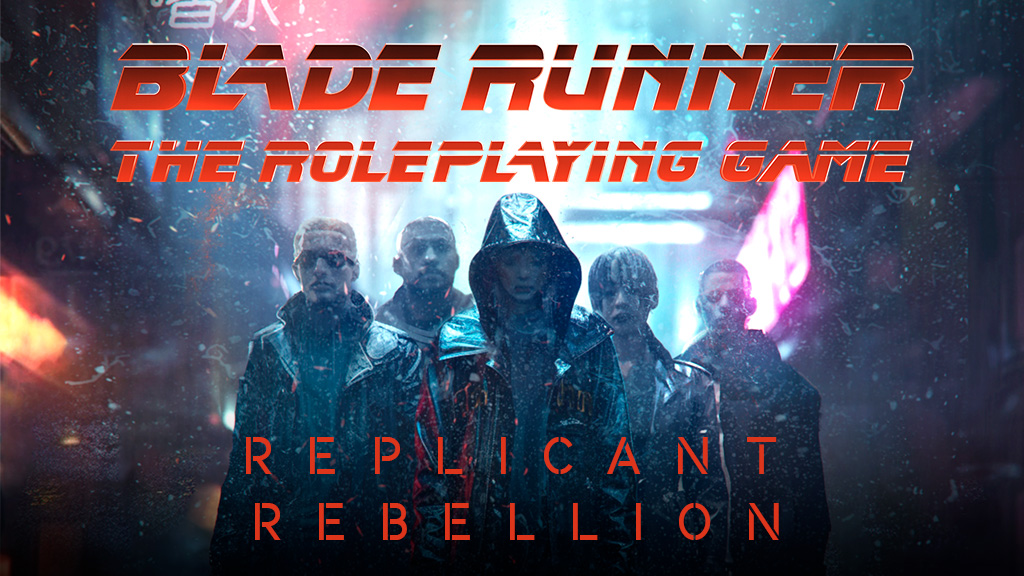
Rep-Detect or Rebellion
The core rules for Blade Runner: The Roleplaying Game focus in on the characters of the original Blade Runner movie in the Replicant Detection (Rep-Detect) Units:
Set in the year 2037, the Core Rulebook begins the adventure shortly after the Wallace Corporation debuts the new Nexus-9 Replicants on Earth, giving you the choice to play as either human or Replicants.
As a member of the LAPD’s Rep-Detect Unit, you’ll face impossible choices and find beauty and humanity in the stubborn resilience to keep fighting. To persevere through pain. To agonize over itches you can’t scratch. To do questionable and extraordinary things, chasing after fleeting moments of love, hope, and redemption to be lost in time like tears in rain.
Other than that, it’s just a normal day on the force, so get to work and grab some noodles on the way. That stack of cases won’t crack itself. It’s a shame you won’t live long enough to solve them all.
But then again, who does?
Blade Runner: The Roleplaying Game website

There are some commentators/critics of the Blade Runner RPG that intensely dislike that the main character archetypes in the core book exist to hunt another sentient being. When Free League advanced the Blade Runner RPG timeline into the Replicant Rebellion they took note of that one-sided viewpoint and created an alternative.

From a product perspective, Free League Publishing describes Replicant Rebellion this way:
Welcome to the Replicant Rebellion expansion for Blade Runner The Roleplaying Game. An evocative cat and mouse race of provocateurs and powder kegs lit to explode, expose, and oppose the establishment, one way or another. In a neon-noir city of dazzling lights and moral contradictions, it’s you on the streets, walking a razor’s edge between reform and revenge, and bearing the burdens of having too much to lose for a cause expecting you to sacrifice it all. Yet regardless of the price, the Rebellion must live on.
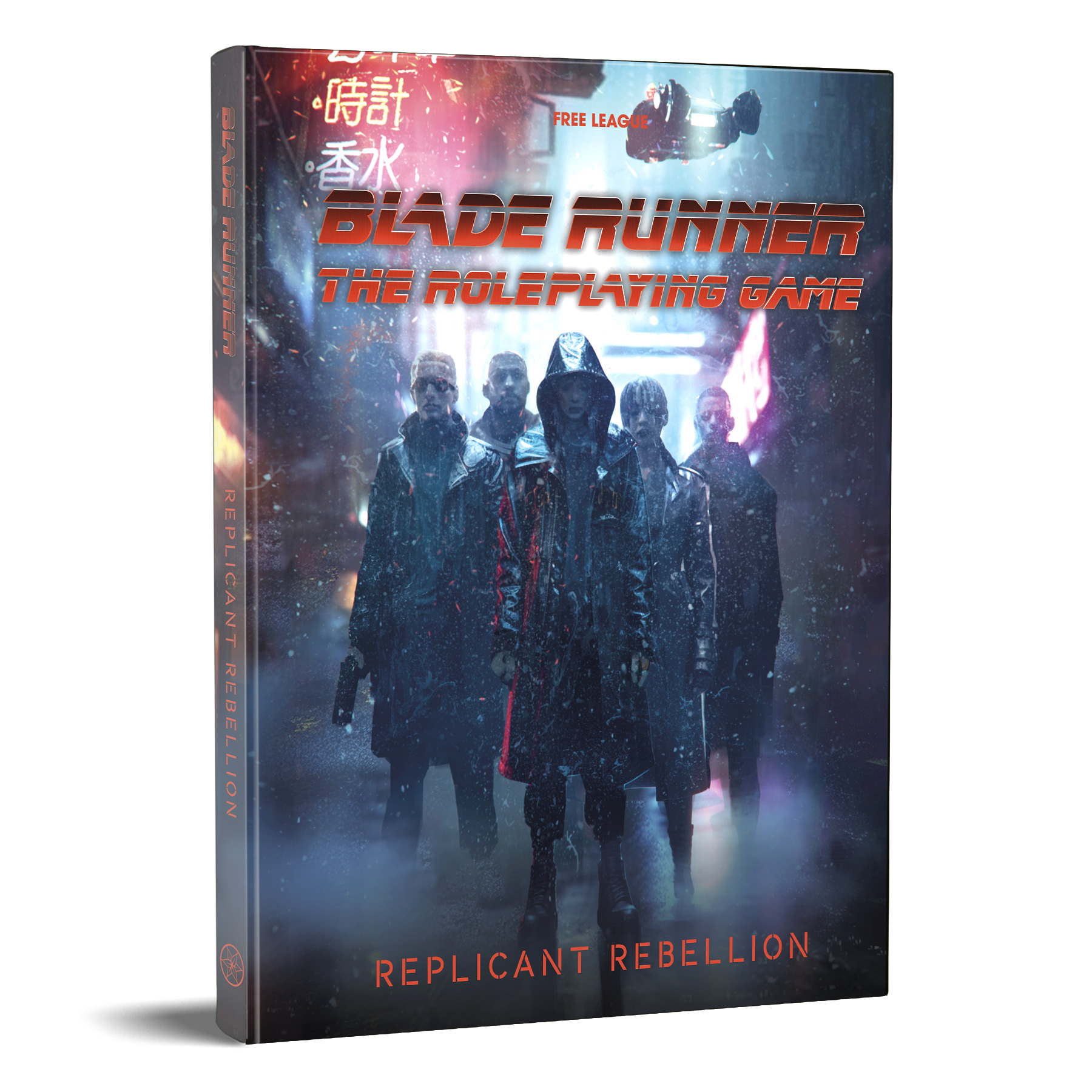
As opposed to the core Blade Runner RPG where the characters are likely part of a Rep-Detect Unit, Replicant Rebellion casts the players into the Replicant Underground. The Replicant Rebellion expansion provides background setting information on the Underground’s history, assets, and operations. It also offers new player character archetypes and specialties as well as new gear and weapons. As befits a setting where operating undercover is part-and-parcel of your daily life, there are new rules termed “Heat” that help you see how good—or bad—the heat is searching for you. Nearly half of the Replicant Rebellion expansion is taken up by five Operations (adventures) which can be strung into a campaign if needed.
Between good and evil
Taking a cursory look at Replicant Rebellion, players easily can see the setting as the opposite of the core rulebook. Replicant Rebellion is very upfront regarding the setting dichotomy between the core rulebook and the expansion when the preface states, “You may ask why you should portray someone the core rulebook expected you to take down, no questions asked… ” The preface goes on to state, “Anyone can be a hero, a villain, or a rebel in someone else’s story. Our story is written by those few moments we get to choose which one, for whom, when, and why” (Replicant Rebellion, p. 3).
The most important of the “few moments we get to choose” in Replicant Rebellion is not a rule but part of the setting background. Covered on just two pages of the 170 page expansion in the “Benefits and Hazards” chapter there are two call-out text boxes; one is “Sympathy Movement” on page 62 and the second is “Empathy Movement” on page 63. This differences are stark:
- In the Sympathy Movement, “We reject any law, authority, or enterprise that denies Replicants the same individual rights and dominion as any other contributing citizen of the system” (Replicant Rebellion, p. 62).
- The Empathy Movement, while on the surface somewhat non-evil, has a hidden secret: “Festering inside this non-profit organization is the Human Supremacy Agenda… a shadow cabal of extremists, orchestrating the misinformation campaign spreading the old prejudices and paranoia like a malignant cancer. These puppet masters are in fact evil” (Replicant Rebellion, p. 63).
The Sympathy/Empathy split clearly is the manifestation of the ad copy statement where characters are, “walking a razor’s edge between reform and revenge.” On one hand, I see the Sympathy/Empathy split as a tremendous roleplaying opportunity. Just how much do you support—or not—the Replicant Rebellion? What is the form of that support/opposition? Can you take the heat? Those questions are inherently a gray area—and tremendous opportunities for player exploration.
On the other hand, I think Free League Publishing overplayed their hand with the Empathy Movement. By casting (the hidden element) of the movement as a “genetic purity and supremacy” group that is “in fact evil” they certainly created a villain faction but, at the same time, drive players into a black-and-white roleplaying decision space rather than leaning into the gray areas. Granted, one can play as a member of the Empathy Movement that does not understand the uglier side of the organization, but Free League openly provides metagame “guilty knowledge” of the factions deepest, darkest secret. Doing so (intentionally?) limits player agency.
With all that in mind, will Replicant Rebellion ever make it to my RPG gaming table? Likely, yes…but with caveats. The original character conceits—and their associated morale gray areas—in the core rulebook remain very interesting to me. The Heat game mechanism in Replicant Rebellion and playing a rebel in a future-noir derived setting is very interesting. I would be happier if Free League had leaned more heavily into the murky gray areas of the various movements instead of openly pushing to the extremes. What sort of adventure it could be to be one of those moderates that supports the Empathy Movement only to discover adeeper, uglier truth? To discover the real villain is not the Rep-Detect Units or the Wallace Corporation but your own tribe?

So maybe Replicant Rebellion is not a total loss…but to keep to the gray areas between good and evil it needs careful play.
Feature image courtesy Free League Publishing
The opinions and views expressed in this blog are those of the author alone and are presented in a personal capacity. They do not necessarily represent the views of U.S. Navy or any other U.S. government Department, Service, Agency, Office, or employer.
RockyMountainNavy.com © 2007-2026 by Ian B is licensed under CC BY-SA 4.0


<YAWN> It’s not even worth the effort to pirate it.
How does one send you a direct email? I publish War Diary Magazine and would like to speak to you. My email is wardiaryeditor@gmail.com.
Will reach out SEPCOR. 📧