
In “The Voyages of the Battleship Bismarck” found in issue Nr. 32 of War Diary Magazine, Paul Comben asks, “how simple can a wargame get and still possess validity?” Comben uses Bismarck Solitaire Deluxe from Worthington Publishing to explore his answer. Comben, like you, really needs to play Waturu Horiba’s The Battle of Leyte Gulf (BonSai Games, 2026)—another solitaire naval wargame—for another exciting experience exploring that very question. Like I did, one likely will find that The Battle of Leyte Gulf is not only a small and simple game but also a very valid design for exploring the Battle of Leyte Gulf, though likely not in the way most assume.
Little big game
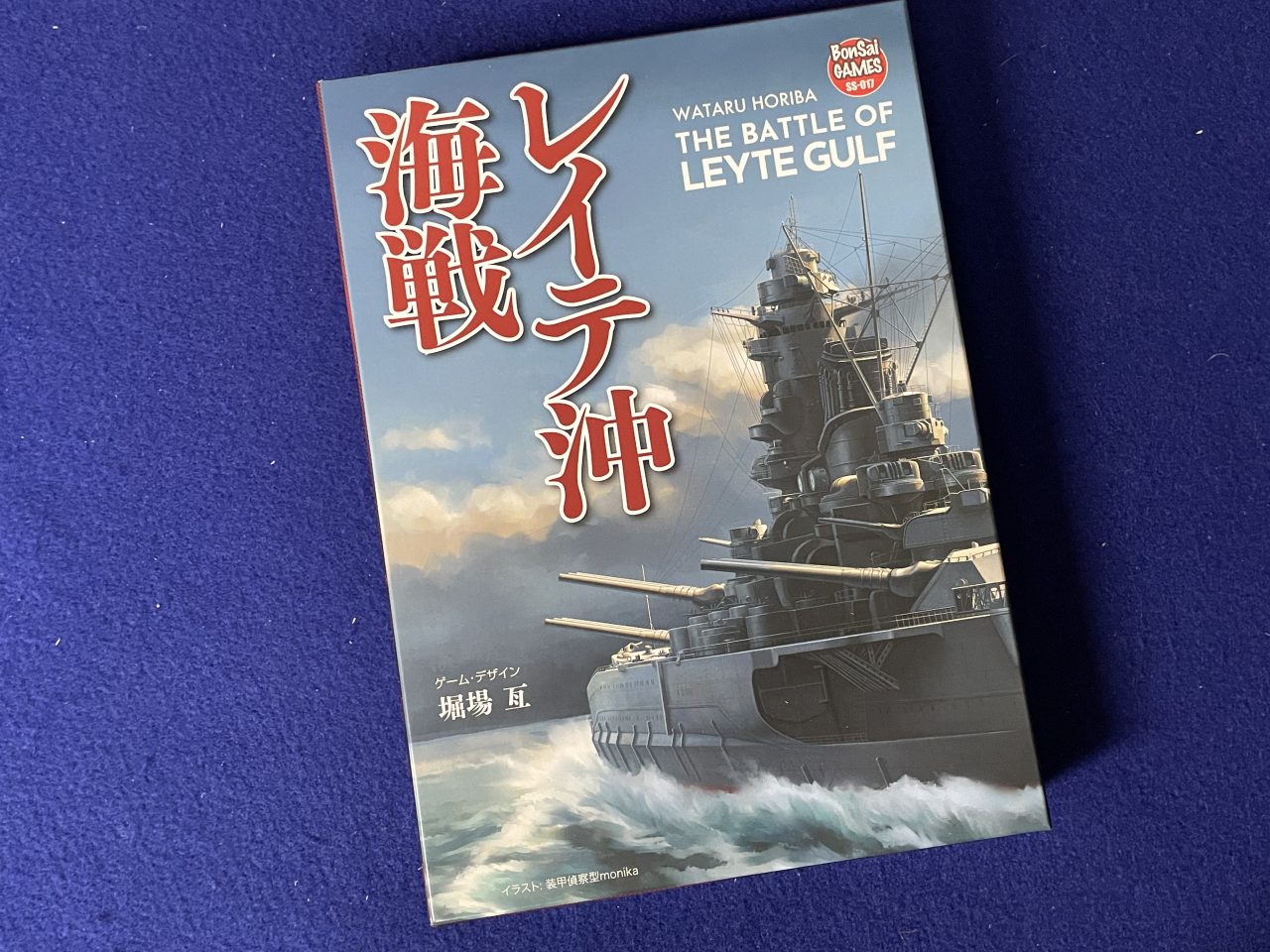
Once again, it is through the generosity of Yasushi Nakaguro that The Battle of Leyte Gulf by Waturo Horiba published by BonSai Games in 2026 sailed into my wargaming collection.
“Even if it means crushing the Combined Fleet in this battle, if it means securing the Philippines, I have no regrets.”
In October 1944, the Japanese Navy launched Operation Sho-Go, mobilizing all its forces to intercept the US forces attempting to recapture the Philippines. This resulted in the Battle of Leyte Gulf (Battle of the Philippine Sea), the largest naval battle in history, in which nearly 300 ships from both the Japanese and US navies clashed.
In “The Battle of Leyte Gulf,” you lead the Japanese Navy into the final battle against the American fleet. You can freely assemble the Kurita, Nishimura, Shima, and Ozawa fleets and plan their routes and attack timings. Can you make the Combined Fleet’s final sortie a “swan song”?
*This work is a newly revised edition of “The Battle of Leyte Gulf,” which was published as a special supplement to MC☆Axis Vol. 46 (Autumn 2017 issue).
The Battle of Leyte Gulf, ad copy, BonSai Games (AI translated)
For a wargame on the largest naval battle in history, The Battle of Leyte Gulf is surprisingly small. The game is packaged in a small box measuring ~6.25” x 9”. Inside, one finds a small 12-page, digest-sized rulebook, a sturdy quad-folded mounted map that lays out to small-ish ~16.5” x 11.75”, a small IJN Fleet Display player aid, a half-sheet of 130 small half-inch counters, and two small 9mm d6 die.
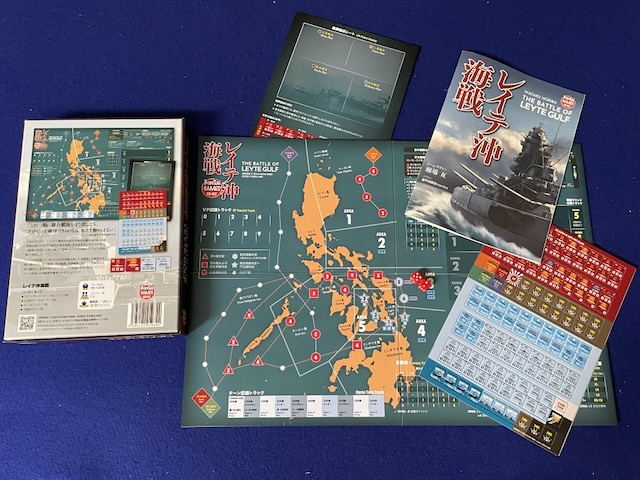
[I must say the thick mounted map was the biggest surprise when unboxing The Battle of Leyte Gulf. BonSai Games very easily could get away with a simple folded paper map. The deluxe mounted map, however, transforms The Battle of Leyte Gulf into a premium gaming experience.]
Little lonesome
The Battle of Leyte Gulf is a solitaire wargame. The solo player takes on the role of the overall commander of the Imperial Japanese Fleet in Operation Sho-Go, the operation to defend the Philippines from the US invasion fleet. In The Battle of Leyte Gulf, the solo player must decide how the Japanese navy will divide ships amongst four Fleets. The Fleets then proceed to approach the American armada, hopefully drawing off the American aircraft carriers and allowing your surface forces to get in amongst the invading troop transports and escort carriers supporting the landings and wreak havoc.
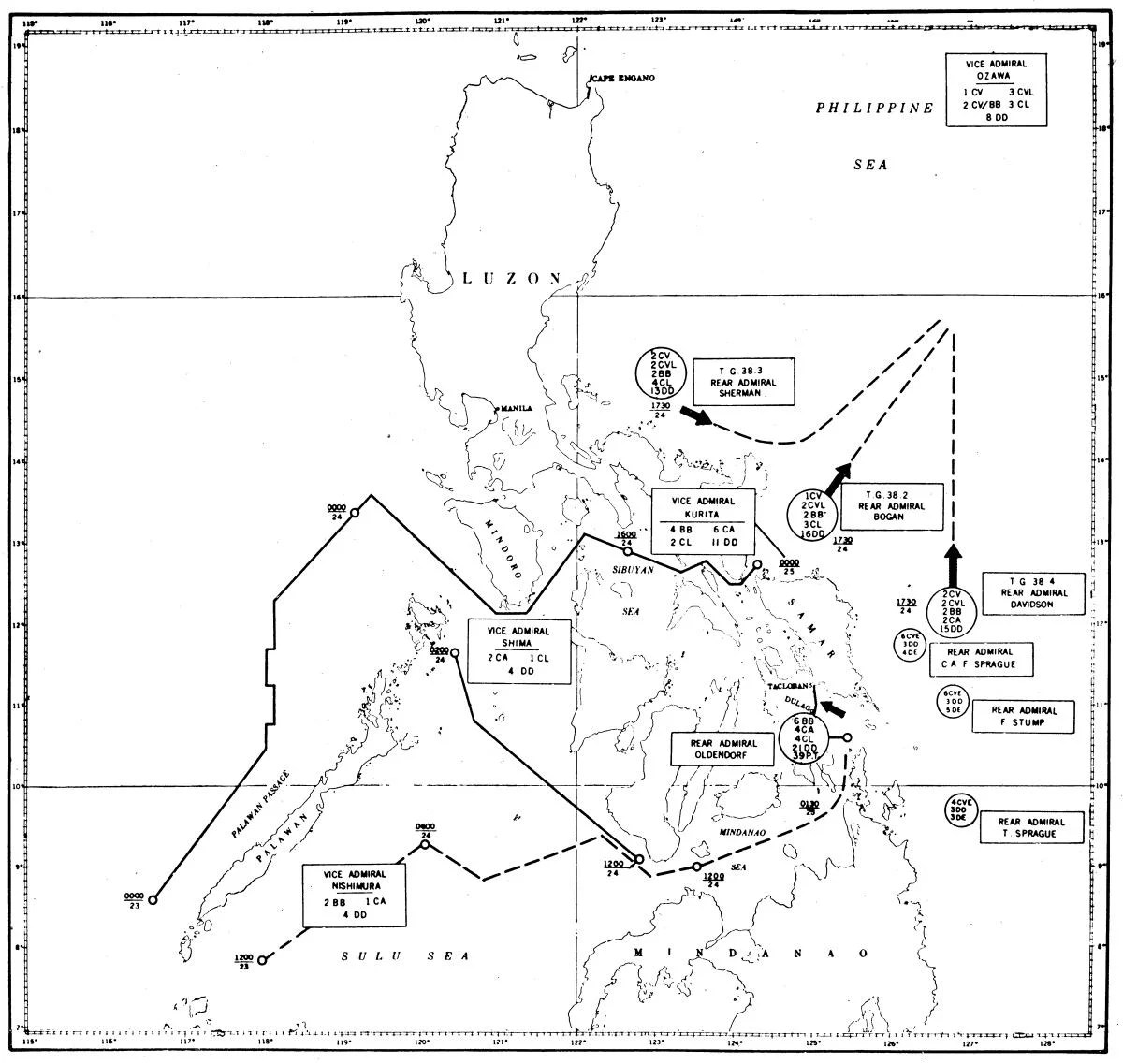
Like many solitaire wargames, The Battle of Leyte Gulf moves in a procedural manner. The four Fleets advance along pre-designated point-to-point routes across the area map. With each point entered there is a chance the Americans will detect the Fleet. Depending on the point there are different chances for the Americans to detect with either submarines or aircraft. This takes just a few die rolls to determine. Once a Japanese Fleet is sighted the American Fleets or aircraft will react. If surface forces ever meet in the same area there is a chance for combat.
Little big battle
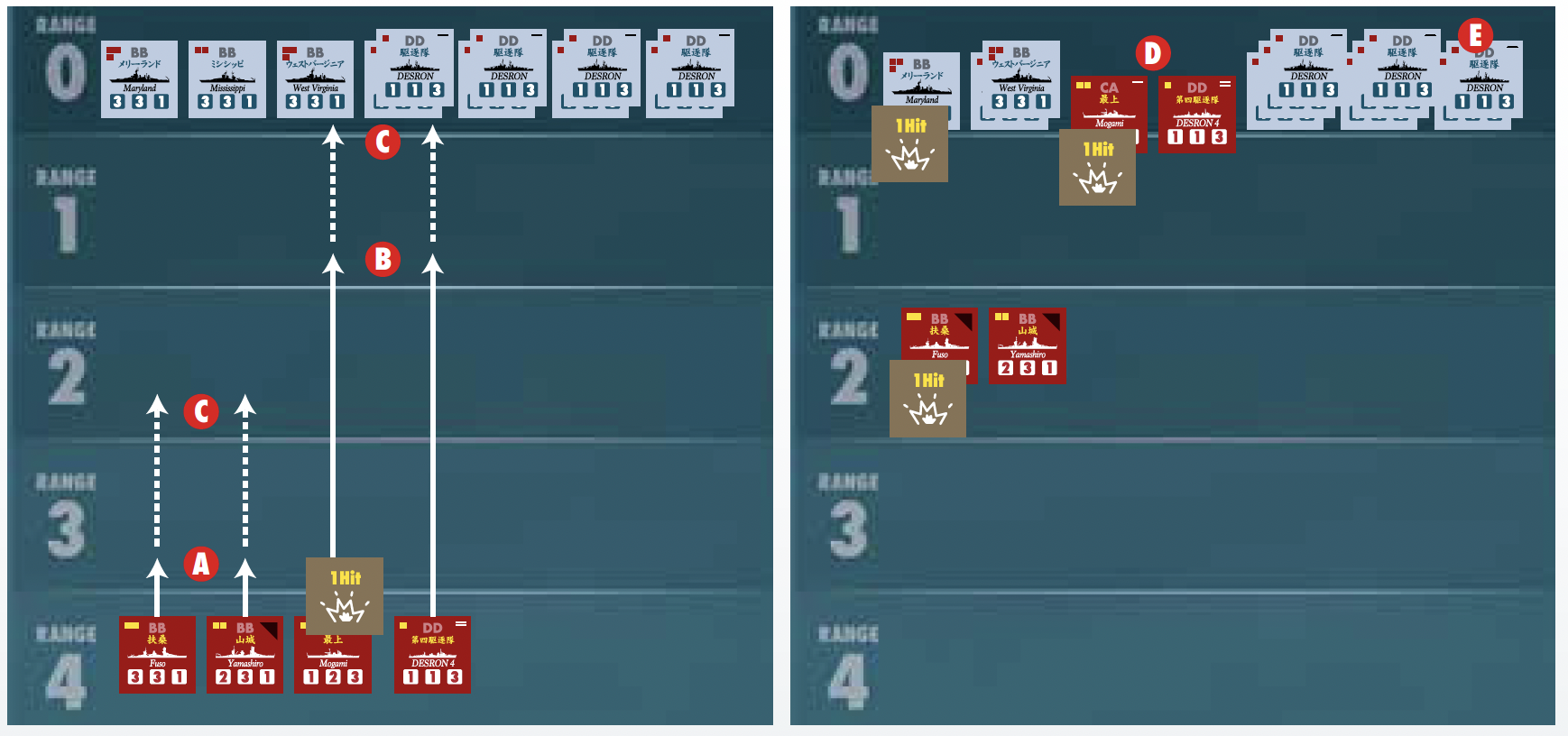
Combat in The Battle of Leyte Gulf comes in three varieties; submarine, air and surface. Submarine and air combat are very simple to resolve with a just a few die rolls with few modifiers. These rolls determine the number of hits as there is no anti-submarine or anti-air warfare explicitly modeled. Surface Combat is (just) slightly more complex as it is based on what I am going to call a “Battlelines with Range Bands” combat adjudication model.
Little game, big question
As mentioned above, I started out playing The Battle of Leyte Gulf with doubts as to whether this small wargame on the largest naval battle in history had—riffing off Comben’s War Diary article—any validity. When I started reading the rulebook I was very doubtful that “the largest naval battle in history” could really be reduced to a half-sheet map, just over 100 counters, 12 pages of rules, and be a solo experience.
It was not until I went back into the RockyMountainNavy library and reread Mark Stille’s Leyte Gulf: A New History of the World’s Largest Sea Battle1 that my doubts about game design validity disappeared. Stille analyzes the Battle of Leyte Gulf by focusing on the principal Japanese forces involved. With regard to the Americans, Stille writes, “The Americans were mainly reactive to the Japanese, so their operations are examined in the context of the Japanese operations” (p. 13). This is similar to the scoping of The Battle of Leyte Gulf which appears to use the same intellectual approach; the battle was largely a Japanese initiated activity with the Americans reacting. Similar to how Stille frames his analysis, so too does Horiba in The Battle of Leyte Gulf frame the player’s role.
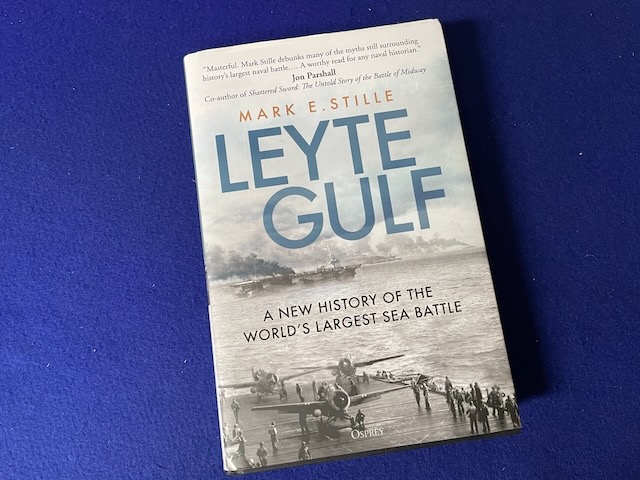
In his book, Stille focuses on mistakes made by both sides during the Battle of Leyte Gulf. Stille asserts:
The overarching American mistake was their divided command structure…The bifurcated command structure and a general lack of awareness of what each fleet was doing led to Halsey’s controversial decision [to pursue Ozawa’s carrier decoy force] and prevented the Americans from bringing their full power to bear.
Stille, p. 7
Rather than recreating the Americans using two (or more) players or complex communications rules, in The Battle of Leyte Gulf the American actions are reduced to reactive die rolls. While some might argue this robs the Americans of agency, in a solo game without a player there is no agency to worry about—it is a valid modeling approach.
For the Japanese, Stille argues it was always the plan that was the mistake:
The biggest mistake of all was the famous Japanese plan named Sho-Go (Victory Plan) devised by Toyoda. He admitted after the war that his plan was against accepted wisdom, but he felt he had to commit the Combined Fleets’ remaining strength before it became irrelevant. In fact, with so little chance that his plan would achieve a strategic result and so high a probability that the Combined Fleet would be destroyed in the process, Toyoda should not have accepted battle under the conditions prevailing in October 1944. The Imperial Navy admitted to the Imperial Army that the plan was an “all-or-nothing” operations. The planning basis of for Sho-Go was complete and utter desperation – not the best ingredients for success.
Stille, pp. 7-8
Stille’s book helped me to understand that the real question The Battle of Leyte Gulf gets after is not whether the Japanese can win the Battle of Leyte Gulf—they cannot—but rather an exploration of a myth. As explained by Stille:
Even though Sho-Go has no prospects of success, and the battle was an undisputed victory for the Americans, there is still controversy attached to it. Almost 80 years after the event, the myths created around the battle continue to gain strength.
Stille, p. 8
The first myth from the Battle of Leyte Gulf is one that surrounds the Americans and their reaction to the Ozawa decoy fleet. The Battle of Leyte Gulf accepts that the Ozawa decoy fleet is nothing more than a diversion; the Ozawa movement track never enters the area with the transports because it is a diversion and nothing more. Yet, it is a very important diversion that is essential to the real question in The Battle of Leyte Gulf. As Stille explains:
The clever diversionary aspects of Sho-Go has been treated like it provided the Japanese with victory or at least the foundation of victory. It did neither, but it did provide Kurita with the opportunity to exploit the divided American command structure and enter the Philippine Sea unchecked….
Stille, p. 8
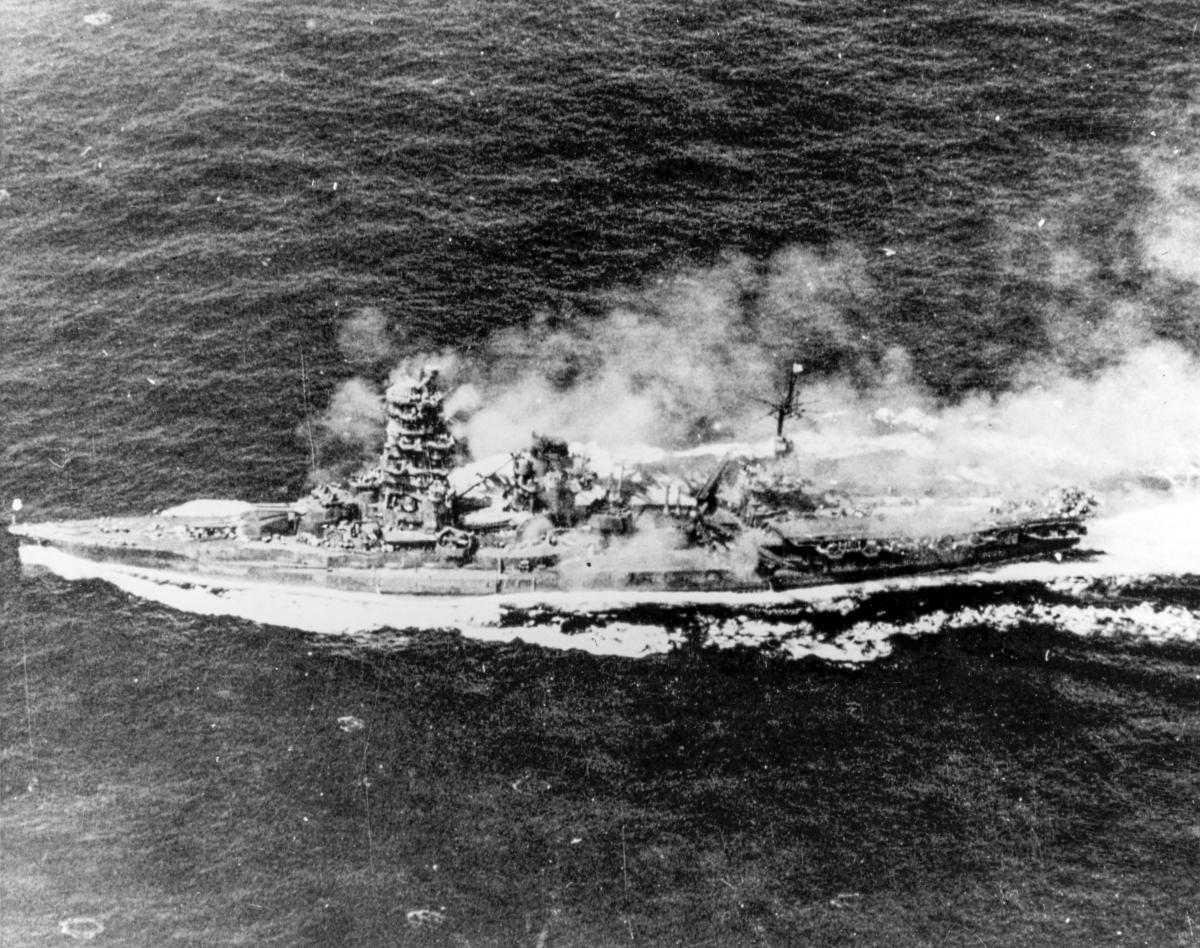
That is the story The Battle of Leyte Gulf recreates. Can you, the Japanese player, get to the American transports? More simply stated, can you do better than the historical result?
“[Kurita entered the Philippine Sea unchecked] where he fell upon a group of American escort carriers known as Taffy 3. In the resulting Battle off Samar, the Americans sustained heavy losses but denied the Japanese an immediate victory. This led directly to the second key controversy of the battle, when Kurita failed to press his attack to destroy Taffy 3 and then steam into Leyte Gulf in accordance with Toyoda’s plan.
Stille, p. 8
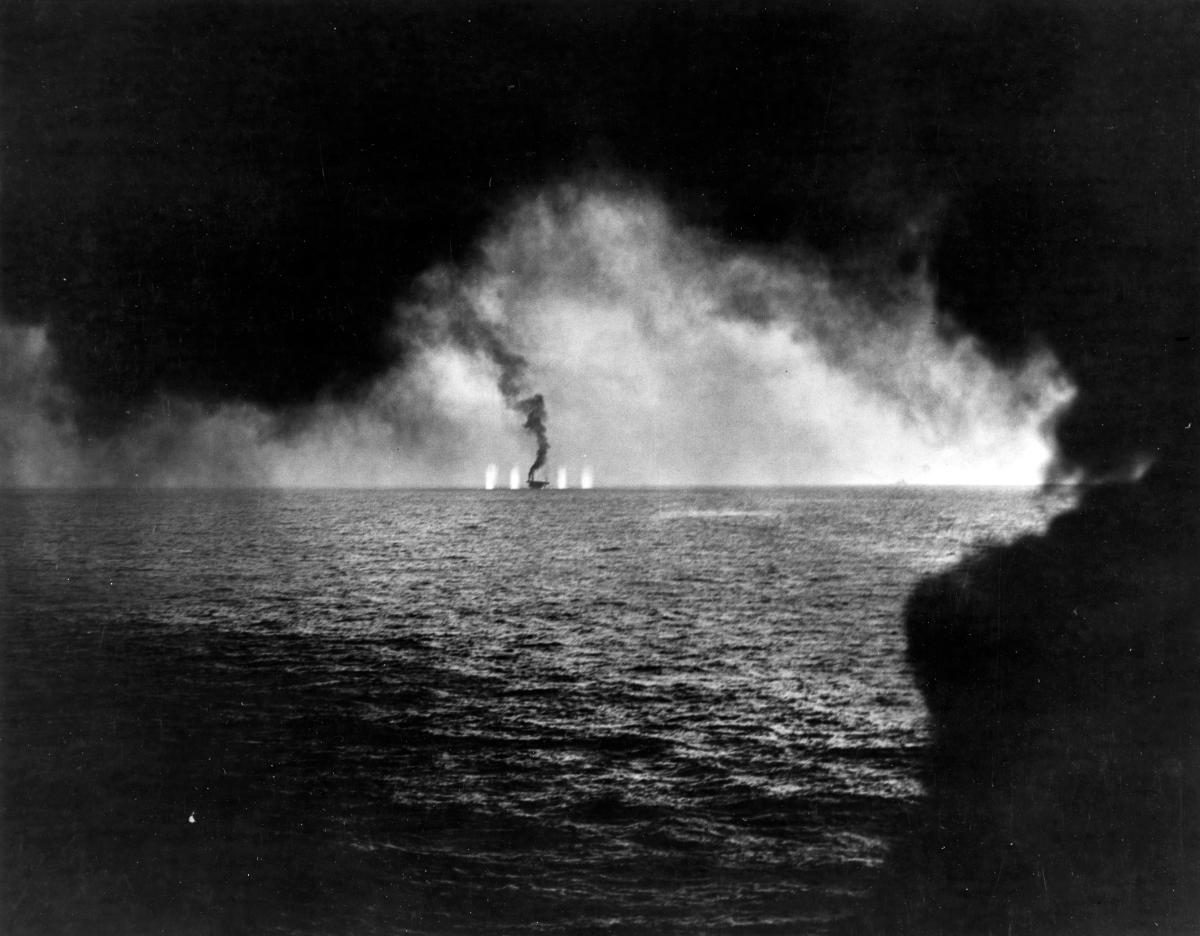
The Battle of Leyte Gulf certainly allows the Japanese player to try to do better than the historical result. At the same time, however, going beyond the historical result exposes the limits of wargaming. One common criticism of wargames is that they are too impersonal and ignore the humanity of any conflict. It is easy to press an attack—even a suicidal one—when it is only cardboard counters on a paper map. That same attitude is another Battle of Leyte Gulf myth. As Stille explains:
The next myth is one that is hardly even examined. It is generally assumed that Kurita acted stupidly by not pressing into the gulf when he had the chance. By declining to do so, he threw away victory. On the contrary, Kurita did not act stupidly. He carefully considered his options and acted out of conscience by deciding not to throw away the lives of his men. He realized the futility of Sho-I. Because it offered no prospect of success, Kurita was totally justified in declining its suicidal design.
Stille, p. 11
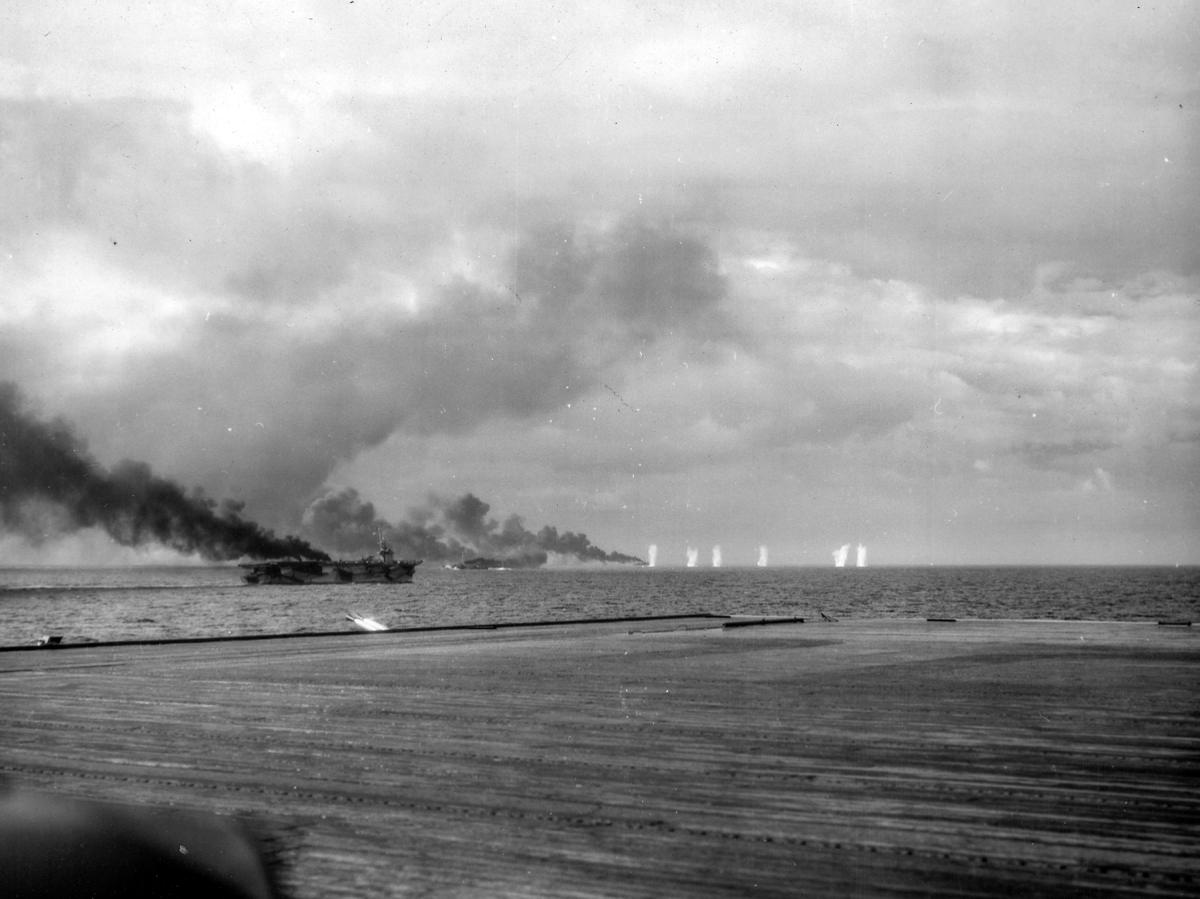
The Battle of Leyte Gulf, while offering the player the chance to “better the historical result” by getting in amongst the transports and sinking them, actually incentivizes the player to not be suicidal. In “Victory Conditions” the Japanese player earns Victory Points (VP) for hits on US ships (+1 VP per hit) and sinking battleships and escort carriers (+1 VP per ship sunk) as well as sinking transports (between +1 to +5 VP). The player also loses VP for his own ships sunk (-VP equal to Durability rating), for a Fleet that avoids combat (-5 VP), and for each Fleet wiped out (-10 VP). The rules note that a score of -4 to +5 VP (“Draw”) was the conscientiously-driven Kurita historical result.
In War Diary Nr. 32, Paul Comben asked, “how simple can a wargame get and still possess validity?” The Battle of Leyte Gulf answer is, “small and quite simple” using a solo game with the Americans reduced to reactive die rolls and the Japanese player in some aspects “running on rails” with a plan that was never going to be successful. One must realize The Battle of Leyte Gulf never asks if the Japanese can win but rather how well they can execute the Sho-Go plan without committing suicide. As Stille asserts, Kurita’s answer was not stupid, but a morally correct one decided under the most stressful of conditions. The Battle of Leyte Gulf cannot create that same stress but, in a very small package, delivers a similarly large moral quandary for the player to address.
Like a valid wargame should.
- Stille, Mark (2023) Leyte Gulf: A New History of the World’s Largest Sea Battle. Oxford: Osprey Publishing. ↩︎
Feature image courtesy RMN
The opinions and views expressed in this blog are those of the author alone and are presented in a personal capacity. They do not necessarily represent the views of U.S. Navy or any other U.S. government Department, Service, Agency, Office, or employer.
RockyMountainNavy.com © 2007-2026 by Ian B is licensed under CC BY-SA 4.0


1 thought on “Wargame SITREP 26-26 ~ Validity and little lonesome Leyte with The Battle of Leyte Gulf (Watura Horiba, BonSai Games, 2026)”