
In late 2025 I acquired two “player copies”1 of the 1980 Avalon Hill English edition of Fortress Europa: The World War II Western Front Invasion Game. Though I started playing wargames in 1979, Fortress Europa was not in my collection back then as my gaming group focused mostly on tactical-scale wargames. In fact, the only real European theater World War II wargame that I recall playing back in those days was Rise and Decline of the Third Reich2 by John Prados again from the Avalon Hill Game Company. As I look over Fortress Europa today—with the benefit of nearly 50 years of grognardiness behind me—I see a wargame that is simple in design, unpretentious in appearance, yet subtly complex. Fortress Europa is a design that communicates the essence of the history in a relatively small and easy to understand game system. Fortress Europa is an excellent example of what I call “simple complexity” in wargame design; i.e. a wargame design that is simple to learn and execute but nonetheless provides a great complexity of decisions for players.
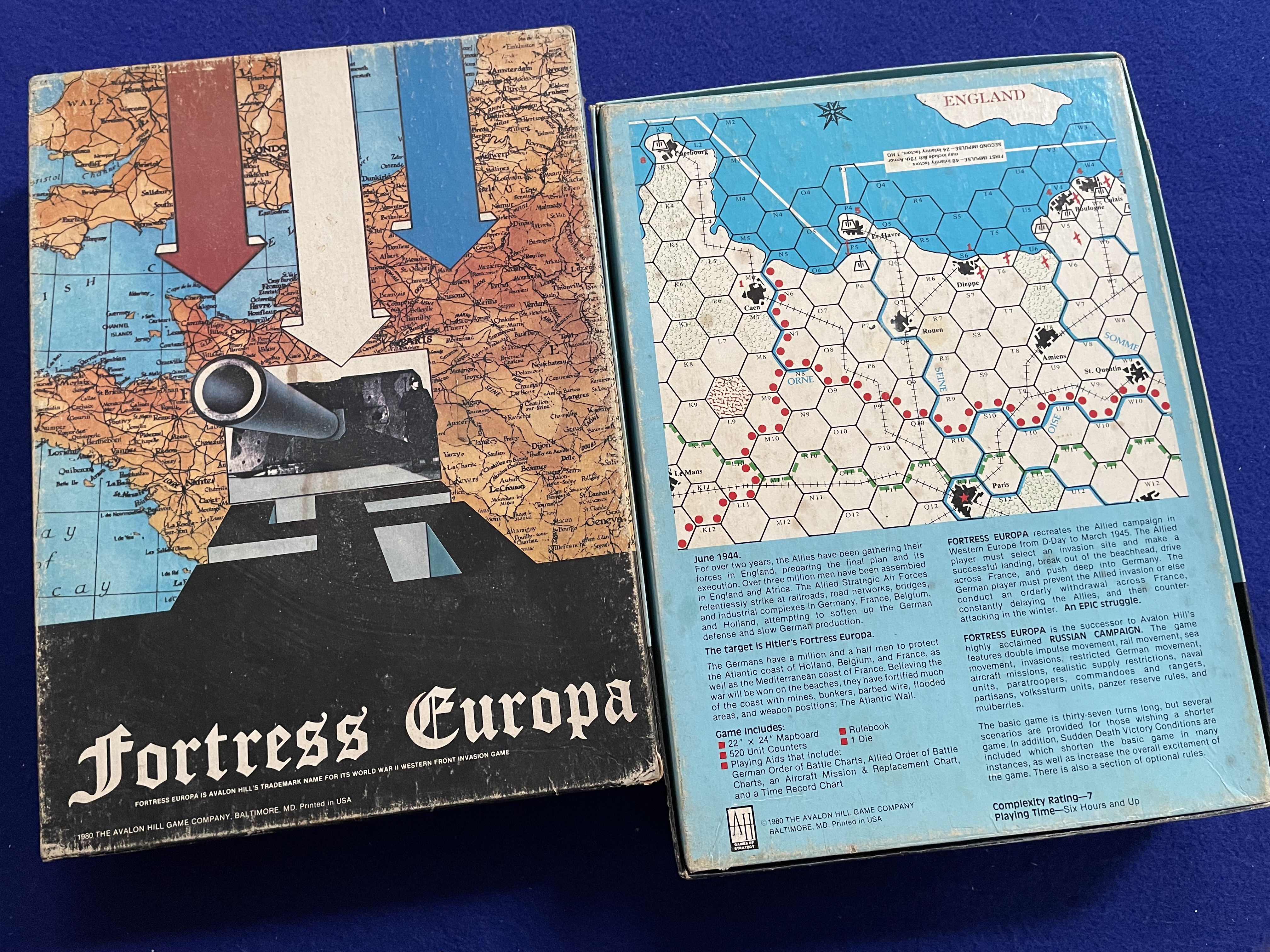
[Apologies in advance, but those of you looking for in-play photos of Fortress Europa will be disappointed with my posting here. I could make the excuse that my gaming table was disrupted by the arrival of family and I was forced to tear down before I got the glamour shots but, well, that’s just an excuse, eh?]
Golden age wargame
Looking at the credits for Fortress Europa is literally a review of the Who’s Who of the golden age of wargaming:
- Original Game Design (Jedko 1978 edition) – John Edwards
- Avalon Hill Redesign – Alan R. Moon, Richard Hamblen
- Developer – Alan R. Moon
- Artwork – Dale Sheaffer, John Edwards
- Box Art – Rodger MacGowan
- Production Coordination – Don Greenwood, Thomas N. Shaw
For a game as epic as the topic Fortress Europa covers the contents of the box are rather spartan. The mapboard is a somewhat small 22″ x 24″ three-piece mounted affair, the counters are two sheets, five Player Aids, and a 16-page rulebook. All that was shipped in a standard Avalon Hill bookcase game box with a die included (now long since lost).
[There are some critics out there who openly scoff at the color palettes used by Avalon Hill in the early 1980s and use them as an example of the poor quality of wargames of that era, especially in comparison to the blinged-out, plastic excreting titles of today. Sorry, not only is that criticism in poor taste it also fails to recognize the “state of the art” of those days. Oh, by the way, the truth is that too many plastic excrement behemoths of today are the ones often done in poor taste and obviously place appearances over playability. No thank you!]
By the rules…
[Of note, I learned and played Fortress Europa using two sets of rules; the “1st Edition” rulebook that was in the box and a Second Edition downloaded from the internet. The Second Edition is more of a consolidated errata version than a new rulebook; helpfully the changes in the Second Edition are marked with a large dot to the side of the rule. I also downloaded a fan-made set of solitaire rules that I looked at but ultimately did not use.]
The rulebook for Fortress Europa, though 16 pages long, delivers the core rules in a mere 11 pages. The introduction is a short 1/6th of a page (each page is 3-columns). Units have two ratings: Combat and Movement. The distance across each hex is unspecified but each turn is one week of time. The Sequence of Play is:
- Weather
- Air Allocation
- Allied Phase
- Replacements
- Movement
- Combat
- Second Movement
- Second Combat
- German Phase
- Replacements
- Movement
- Combat
- Second Movement
- Second Combat
- End of Turn
As is common in wargames of that period, in Fortress Europa one finds stacking limits (three units in clear, city, or fortress terrain; two units in rough; and one unit in mountain, alpine, or flooded terrain. The game also uses a classic six-surrounding hexes Zone of Control rule.
The core game mechanisms used in Fortress Europa are simple and direct. Movement in Fortress Europa is governed by terrain. There are also rules for Rail and Sea movement. Combat in Fortress Europa is a simple odds-based Combat Results Table (CRT). Terrain effects on combat are reflected by a doubling or halving of combat factors; there are no die roll modifiers. Reinforcements arrive based on the turn and Replacements are driven by a Replacement Chart.
Though the core game mechanisms in Fortress Europa are simple and direct, that is not to say all the game rules are plain vanilla. The rules for Military Districts, Invasions, Air Missions, Supply, and special units are simple to implement and usually written in a short and direct manner. Each, however, brings across a key historical element that adds thematic flavor to the game at the cost of low rules overhead.
9. MILITARY DISTRICTS. Most German units in Fortress Europa are not set up by hex but in an area defined as a Military District. This simple rule gives the German player not only a degree of flexibility but also invests the player from the beginning in the disposition of their forces.
12. INVASIONS. Yes, invasions as in plural. Up to two per game of Fortress Europa.
17. AIR MISSIONS. Aircraft are assigned in Fortress Europa against one of nine missions during a turn. The Allied player almost certainly will discover that they never have enough aircraft for all missions; if some missions are not serviced the impact can be…painful.
[For example, rule 17.10.7 V1 Site Attack states that if the Allied player does not allocate an aircraft to this mission, or if the mission is cancelled by the German air assignment, then, “the British lose half their replacement factors for that turn (rounded down). Armored replacements are the first factors lost. When all six V1 sites have been captured, aircraft no longer have to be allocated to this mission and no replacements are lost.” For the Allied player one can ignore this rule…at their own peril.]
18. SUPPLY. The basic rules for supply in Fortress Europa are of the simple, “trace a supply line to a Headquarters and from there to a port (or Mulberry) that does not exceed a certain length” variety. Units that are out of supply loses one step (and units usually only have two-steps). That, however, is not the most interesting supply element of the rules. The interesting element is found in rule 18.7 SUPPLY CAPACITY (SC) as further defined by rule 18.7.1.
- “18.7 In addition to rule 18.1 [supply line length], the Allies are also limited by the number of units that can be supplied in Europe, shown by the current level of the SUPPLY CAPACITY (thereafter referred to as SC), as shown on the Supply Capacity Chart. Note: If the SC is over 40, players can keep track of it on a piece of paper.”
- “18.7.1 During an invasion turn, all invading Allied units are considered in supply for the whole turn. At the end of the Allied player’s second impulse of the turn of the first invasion the SC is set by adding the total of the mulberry and any ports captured during the first turn and subtracting the total number of Allied units remaining in Europe (see 20.15 [Paratroopers] and 21.1 [Commandoes and Rangers] for exceptions).”
On all subsequent turns the SC in Fortress Europa is lowered or raised based on certain trigger conditions such as units which land (reduce SC), units destroyed (SC raised), ports or mulberrys placed or captured, and other factors. If the SC is zero at the beginning of a turn no new units can enter Europe unless units already present are removed; if below zero units must be removed to bring the SC back to zero or more. That, my grognard friends, is a simple way to enforce supply limits without resorting to artificial accounting for oil or the like. Further, the fact SC is set by the success (or failure) of the Allied player makes their investment in the rule automatic; you reap what you sow—no more, no less.
Special units. These “chrome” rules in Fortress Europa account for the various capabilities of special units such as 20.0 PARATROOPERS or 21.0 COMMANDOES AND RANGERS. Other units, such as 22. COASTAL DEFENSE UNITS or 23. TRAINING DIVISIONS or 24. PARTISANS or 25. VOLKSSSTRUM and 29. MULBERRIES are handled with one to six rules elements. Low rules overhead for great thematic impact.
One special unit rule in Fortress Europa that stands out is 28. PANZER RESERVE. This rules pulls seven Panzer units out of combat on the November I turn and places them in a Reserve Holding Box where they can receive replacements. On the first German impulse of the December I turn the German player must make a choice:
- “A) Bring all units in the Panzer Reserve up to full strength and add all destroyed armored divisions (and any SS armored units of any size) to the Reserve at full strength, and then forfeit his armored replacements (including any accumulated armored replacements) for the rest of the game. OR“
- “B) Continue to replace units in the normal manner, keeping his Reserve units as they are.”
Regardless of choice A or B, the German player in Fortress Europa returns the Panzer Reserve to the board in any December, January, or February turn. That is how you get let players decide if there is going to be an Ardennes Offensive/Battle of the Bulge or maybe another offensive of their choice. In other words, a winter 1944/1945 German offensive with an armored spearhead depends on the player, not a railroading rule!
31. Optional Rules. This set of 15 optional rules in Fortress Europa are not strictly needed for play but given each is just one or two rules elements adding them to the game does not add significant rules overhead but does add thematic flavor.
How to win
I absolutely enjoy the Victory Conditions rules in Fortress Europa as they strongly empower players to make decisions as to how to win. Basically, the Allies and Germans must secretly select seven of twelve objectives for the September I turn and five of nine objectives for the January I turn. If all the chosen objective are met at the designated time then victory is automatic. Of the five scenarios, the first three all start in June 1944 and each ends at a different time (33.1 “To the West Wall’ is twelve turns; 33.2 “Breaching the West Wall” is 28 turns; and 33.3 “Invasion” is seven turns long). The last two scenarios start with a historical Battle of the Bulge and then either ends quickly (33.4 “Battle of the Bulge” is four turns long) or goes longer (33.5 “On to Berlin” is eleven turns long). There are also optional rules to extend the game beyond March 1945. Regardless of the scenario played the victory conditions are chosen by the players. Now that is player agency!
Two score and six years ago…
My Avalon Hill edition of Fortress Europa is 46 years old. Given the game was published as an Avalon Hill bookcase wargame with mounted maps, Fortress Europa is almost certainly representative of what a “regular product line” wargame for Avalon Hill was back in that day or what one might call, “state of the art.”
How far the “state of the art” in wargaming has come in nearly 50 years. If the 1980-version of Fortress Europa were republished today, it likely would be no more than a magazine insert game (assuming one gives up the mounted mapboards). That is not to say the 1980 edition is overproduced; rather, it is my way of saying that so many of today’s wargames are, by comparison, vastly overproduced. What advantage does a huge mounted map, pre-rounded counters, multiple and many player aids, a full color rulebook with extended examples of play, and maybe even plastic bits and bobs deliver that my old version of Fortress Europa cannot?
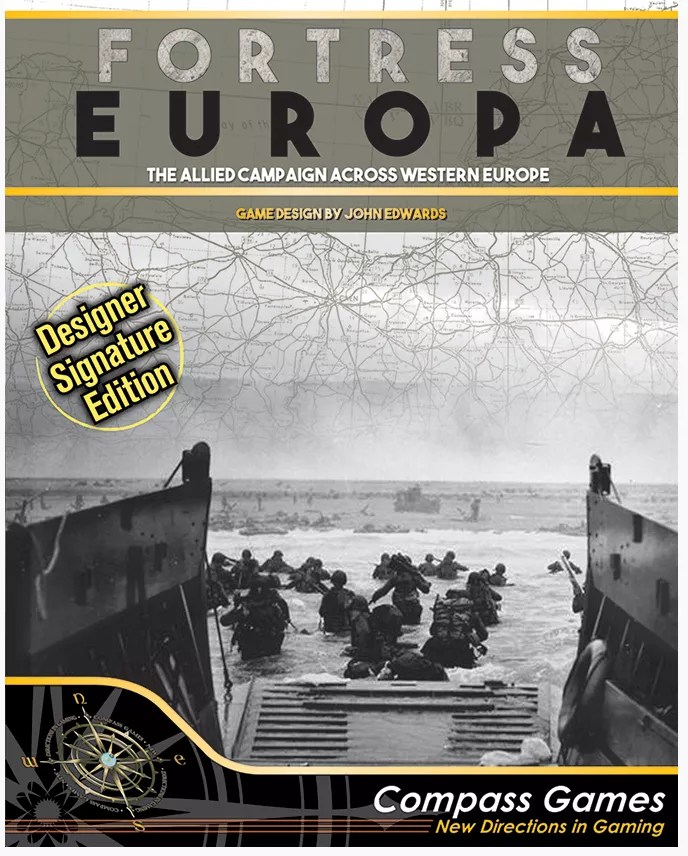
[In 2019 Compass Games gave Fortress Europa their “Designer Signature Edition” treatment. I do not own that game but from the information on BoardGameGeek it appears the Compass Games edition featured a larger map for larger counters, redesigned player aids, and rules clarifications. I make no judgements on that edition other than to say the cover art—reflective of a modern move to hold down costs by limiting original (i.e. more expensive) artwork—is not as inspiring as the first editions.]
My old version of Fortress Europa reminds me that the core of a good wargame is not the physical components but the game design. For Fortress Europa in particular, I see a rather simply produced wargame with a somewhat vanilla game system embellished with a small but reasonable amount of chrome that delivers a game full of player decisions, not just opportunities for die rolls. I honestly had more fun playing Fortress Europa than I expected—and perhaps deserved—in great part because the rules are easy to learn and easy to manipulate. Most important, however, while the rules are simple the decisions of the players not only determine the outcome of the game but in several important ways set the core conditions of the conflict. That is what makes Fortress Europa so interesting to me; it is a historical game but one where the players not only determine the outcome but also truly make the history too. Fortress Europa is truly a Golden Age of Wargaming title where YOU make the decisions.
- Unlike the common defintion of a “player copy” which is a used, yet complete, copy of a boardgame I use the term “player copy” to refer to a used copy of a wargame that is in Good—or even a bit Poor—condition as evidenced by a well-played set. ↩︎
- Used copy recently acquired; subject for a future review. ↩︎
Feature image courtesy RMN
The opinions and views expressed in this blog are those of the author alone and are presented in a personal capacity. They do not necessarily represent the views of U.S. Navy or any other U.S. government Department, Service, Agency, Office, or employer.
RockyMountainNavy.com © 2007-2026 by Ian B is licensed under CC BY-SA 4.0


Very well written review Rock. And I agree with your assessment. It’s a cool game. I recently broke it out to just look over the components and was reminded of just the kind of things you mentioned here. After reading your review, I may need to get a game of Fortress Europa going soon. Happy Easter.
Above comment by Jay.
That’s a nice little review. I prefer lower level tactical games and figures and scenery to counters, but on the strength of that I could be persuaded to try that title.
Cheers,
Frank