
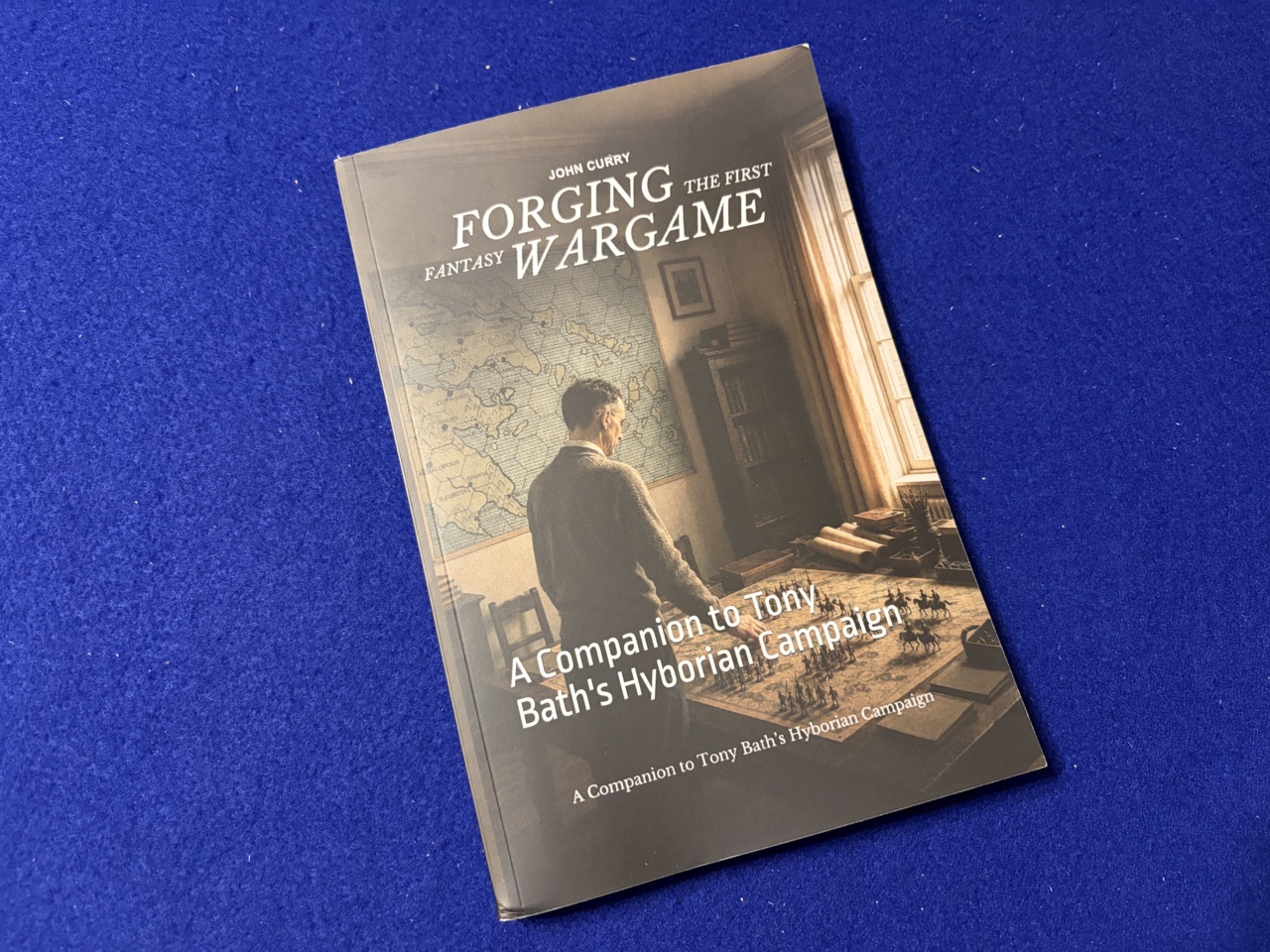
For those Dungeons and Dragons roleplaying game (RPG) players who worry Forging the First Fantasy Wargame sets out to rewrite the history of the RPGs, I point you to the following:
The question of whether Bath’s work directly influenced the creation of Dungeons & Dragons remains complex. Despite clear similarities, there is no definitive evidence that Gygax or Arneson borrowed Bath’s rules or setting when developing D&D. It may instead represent a case of parallel eveolution within a shared wargaming culture. Roleplaying historians argue that the influence on D&D came indirectly from the broader miniatures-wargaming community rather than through direct transmission.
What is certain, however, is that Bath’s wargaming rules significantly shaped Chainmail when they were published in 1971; they were the immediate precursor to D&D. Gary Gygax openly acknowledged Bath’s medieval and ancient rules as formative influences. Chainmail’s medieval mass-combat system drew heavily on these earlier rule sets, and its “fantasy supplement”—introducing heroes, wizards, and mythical creatures—extended concepts that Bath helped pioneer.
Bath published articles on Hyboria from 1967 onwards, demonstrating his campaign pre-dated the public release of Original D&D in 1974. As John Peterson notes in Playing at the World, there is no direct evidence that Gygax or Arneson used Bath’s rules or setting when creating D&D. However, both emerged from the same miniatures-wargaming culture, and Bath’s campaign was widely known, admired, and discussed. His long-form narrative approach helped normalise the idea that wargames could be character-driven and open-ended—a cultural influence widely acknowledged by historians of the hobby.
Bath & Curry, pp. 13-14
Forging the First Fantasy Wargame is mostly an in-game retelling of the actual campaign that RPG players might relish. The book divides into four parts.
- The first part—39 pages—provides in-game information (such as biographies) as well as details of the metagame; that is, how Bath’s Hyboria Campaign started and where it sits amongst various wargames and RPGs.
- The second part—129 pages—are the retelling of the Hyboria Campaign in 16 chapters that focus “what” happened but also provide the gaming “how” or “why” the outcome occured.
- The third part—50 pages—provides much of the political and military background of Hyboria, agains with game design commentary liberally sprinkled in.
- The final part—21 pages—are appendixes that cover amphibious campaigns to Medieval Rules to Micro Ancients rules to Bath’s unpublished magnum opus on World War II to his Society of Ancients legacy.
The one “first” that perhaps matters the most is flagged in Forging the First Fantasy Wargame at the beginning of “Appendix B: Medieval Rules by Tony Bath”:
These rules were almost certainly the earliest medieval wargaming rules ever produced, predating the rules in Featherstone’s 1962 War Games book, though the exact date of the typed version is unknown. Every medieval ruleset in use today can be traced—however distantly—back to this ‘ancestor’.
Bath & Curry, p. 228
For wargame (and RPG) designers there is more that likely is of interest in Forging the First Fantasy Wargame as it tells of what was, truly, a full campaign system:
For Bath, the campaign was far more than a series of battles. It was a complete strategic and administrative simulation—tracking army wages, arms production, supply lines, morale, political dynamics, and even family lineages. His rules and mechanics were remarkably advanced for their time, incorporating movement, logistics, reinforcements, character traits, economic resources, and detailed battlefield engagements.
Bath & Curry, p. 9
Bath’s Hyborian campaign in Forging the First Fantasy Wargame possessed many—then unique—characteristics:
- “Bath’s Hyboria was one of the earliest wargames to incorporate what we would now recognise as role-playing elements.”
- “A defining feature of Bath’s work was the construction of a richly detailed fictional world.”
- “Although Bath’s roots were firmly in traditional wargaming, his increasing focus on individual leaders and characters marked a significant shift.”
- “This movement toward character-level agency laid essential groundwork for later RPG design, where the player’s character becomes the primary lens through which the world is experienced.”
- “The Hyborian Campaign also pioneered the idea of long-form, open-ended play.”
- “Central to Bath’s system was the role of the umpire.” (Bath & Curry, pp. 12-13)
I am not sure that Bath’s Hyboria Campaign as related in Forging the First Fantasy Wargame would even be possible today. In Bath’s campaign, the players played the leaders of the army, some of whom were able to do heroic actions and others who were…plain. This is a game where great leaders arose from the test of campaigning, not in character generation because the player fudged a few stats or from gaining XP while acting as a murder hobo.
It is the history of Hyboria—the campaign design—that interested me the most when reading Forging the First Fantasy Wargame. As a historian at heart (my undergraduate degree) I love learning about the history of game design in our hobby, be it the wargaming (hobbyists and practitioners), boardgaming, or RPG branches.
The sad part is that too many modern RPG players brainwashed by Wizard$ of the Coa$t almost certainly will pass on Forging the First Fantasy Wargame because the title includes the word “wargame.”
Your loss, snowflake.
Feature image courtesy RMN
The opinions and views expressed in this blog are those of the author alone and are presented in a personal capacity. They do not necessarily represent the views of U.S. Navy or any other U.S. government Department, Service, Agency, Office, or employer.
RockyMountainNavy.com © 2007-2026 by Ian B is licensed under CC BY-SA 4.0


The conventional wisdom is that role playing games (that is, the first one, Dungeons and Dragons) evolved from the “fantasy” supplemental rules section of a set of medieval miniatures rules called Chainmail, designed by Gary Gygax and Jeff Perren and published in 1971.
The question is, where did they get their inspiration from?
As Curry points out Tony Bath and Hyboria had a lot to do with it, but there was more I think.
Strategy and Tactics magazine ran “The Siege of Bodenburg” minis campaign and rules in 1967 (Volume 1, #6-10) and Jon Peterson (in Playing at the World) claims this was some of the inspiration for Chainmail.
https://boardgamegeek.com/boardgame/26603/siege-of-bodenburg
Featherstone, Morschauser and Grant were all established miniatures wargame rules writers by then; Jack Scruby’s War Games Digest had suggestions for medieval games by the late 50s and early 60s; Tony Bath started Slingshot in 1965 – what was there that was fantasy/ Tolkienesque in any of that?
Bath’s Hyboria did not have magic, monsters or the supernatural in Hyboria… it was a large and elaborate “imagi-nation”.
Phil Barker’s early ancients rules did not have these non-historical elements either.
https://websites.umich.edu/~beattie/timeline2.html
The above says the first suggestion of a Tolkienesque game is by Leo Cronin in Wargamer’s Newsletter in 1966, and the first display of fantasy miniatures in battle – “Middle Earth” is at a show in 1970. I remember seeing a little writeup of these miniatures in (I think it was) The Last Whole Earth Catalog from 1971.
But there’s also the statement in the above, “David Weseley, Midwest Military Simulation Association, runs first fantasy role-playing game” in 1969.
Who is this, now?
Dave Arneson was part of the Midwest Military Simulation Association along with David Wesely who created an early role-playing game called Braunstein that Arneson developed into Blackmoor.
https://en.wikipedia.org/wiki/Braunstein_(game)
Arneson and Gygax went round and round about who was most responsible for D&D and the founding of role-playing games in the US.
But Wesely came up with the original concepts, at least as applied to a tabletop/ entertainment/ rules-based setting.
Role-playing itself is as old as childhood!
And finally, there is the other Philip Barker, that is Prof. MAR Barker who invented his “Tekumel” mythical land in 1940 and never stopped fiddling with it – his Empire of the Petal Throne game was first self-published in 1974, then it was the second role-playing game published by Tactical Studies Rules, after Dungeons and Dragons in 1975.
(However, Barker is an unperson now, and dead, but his brain went wonky and soft before it ceased functioning completely.)