
Herman, Mark, Mark Frost, and Robert Kurz. Wargaming for Leaders: Strategic Decision Making from the Battlefield to the Boardroom. McGraw-Hill, 2009. (280 pages)
If one mentions the name “Mark Herman” to hobby wargamers today, they likely recognize the name from his many popular games. In fact, BoardGameGeek credits Mark Herman with 98 titles.

Hobby wargamers, being, well, you know, hobbyists, tend to focus on the commercial wargame portion of Herman’s ludology. In 2024, Herman published Wargames According to Mark: An Historian’s View of Wargame Design (Studiolo Designs) which is an outstanding source for learning about designing wargames. [Note to Self: Why have I not already done a formal book review of this book? SLACKER!]

In Wargames According to Mark, when Herman discusses his time as a freelance designer between 1987 and 2024, he starts with a very off-handed statement: “My professional wargaming for the Department of Defense is recounted in my other book…” (Herman, p. 31). That other book is Wargaming for Leaders: Strategic Decision Making from the Battlefield to the Boardroom.
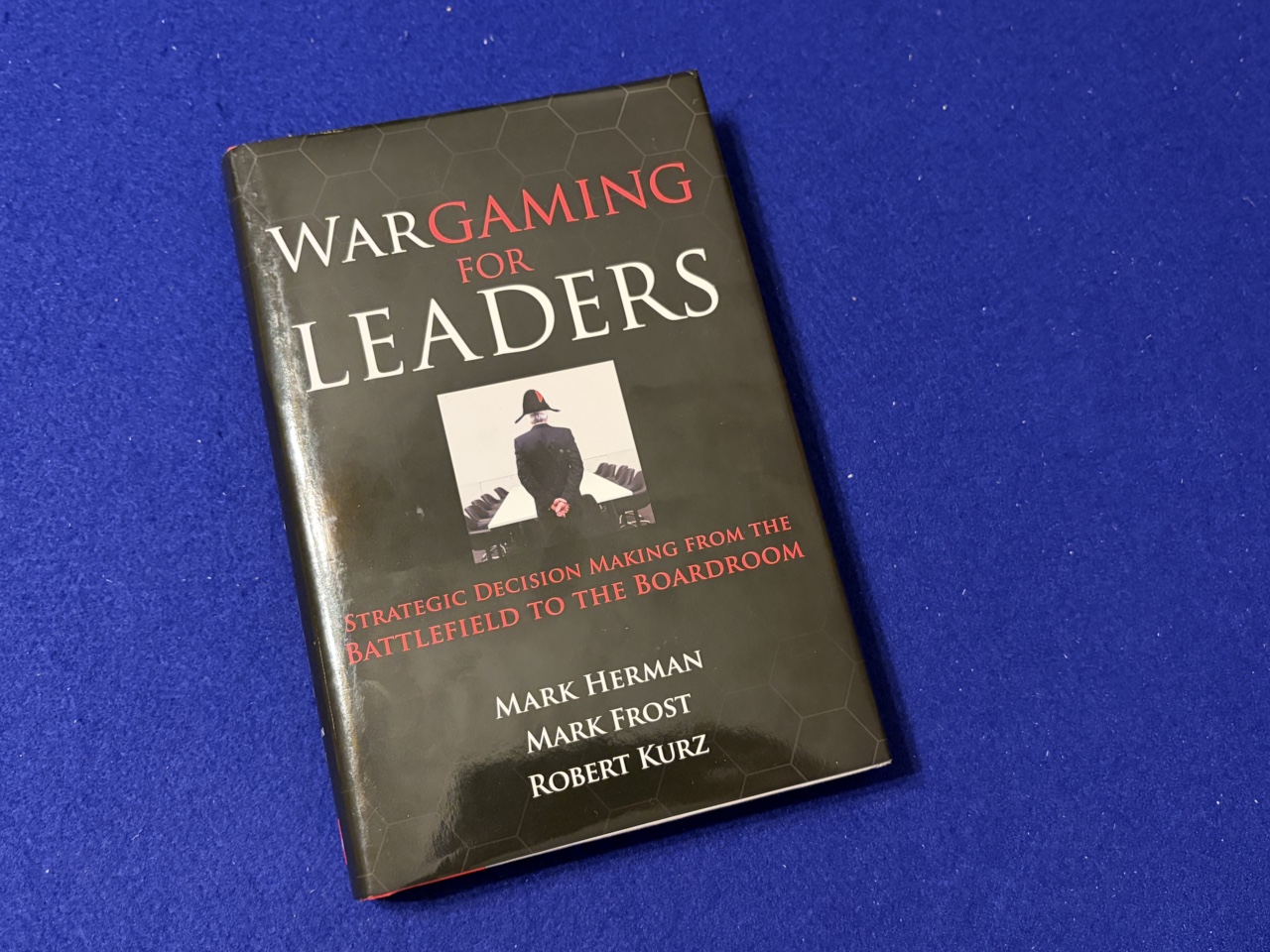
Wargaming for Leaders was published in 2009 and Herman, far from being just a “freelance designer”, was fully immersed in the corporate world as a Booz’er beltway bandit.1 As the “About the Authors” section of Wargaming for Leaders relates:
MARK HERMAN
Mark Herman is a Booz Allen Hamilton vice president based in McLean, Virginia, who leads the firm’s modeling, simulation, wargaming, and analysis work. He has more than 30 years of experience designing and developing wargames on a variety of strategic and boardroom topics for the U.S. Department of Defense and Fortune 500 companies.
Herman, et al., “About the Authors”
As the book title declares, Wargaming for Leaders is not for game designers or hobby wargamers. Herman and his coauthors instead aim to inform professional wargaming, or those more commonly referred to today as “wargame practitioners.”
Herman starts with chess and brings us into his profession:
When a game of chess begins, the two opponents have complete information: All the warriors are on the chessboard, and they can be moved only according to a strict set of rules.
Modern wargaming—what we and our colleagues do for our clients int eh military, large corporations, and nonprofit organizations around the globe—differs in one essential way: The participants do not have complete information when they play on e of our wargames because we deisgn wargames to reflect the real world; in the real world, decision makers almost always are forced to make choices that are based on incomplete information. An economist, Thomas Schelling, got a Nobel Prize in 2005 for his work applying game theory to the interactions of people and nations. A central point of his “impossibility theorem” states: “One thing a person cannot do, no matter how rigorous his analysis or heroic his imagination, is to draw up a list of things that would never occur to him.”
The genius of modern professional wargaming is that it embraces the impossibility theorem and provides a methodology to get at the things that one leader, no matter how visionary, cannot grasp on hsi or her own. How? Not by relying on computers, which we use mainly in a variety of supporting roles. Instead, we bring together the real experts on the issue at hand and allow them to “experience” the future in a risk-free environment and find answers to questions that had not been on their radar screens before they began the wargame.
…
The power of these minds interacting with one another—what we call “cognitive warfare”—leads to unexpected and often startling outcomes. As you will see in this book, our wargames for government, corporations, and nonprofit groups address many of the vital issues facing leaders in the public and private sectors in the United States and around the world. We do not promise miracles; we leave such matters to a higher authority. Also, what happens in our wargames does not necessarily reflect the organizational policies or real-life reactions of the participants. However, there is no question that the creative and visionary act of cognitive warfare produces powerful results. If you are a decision maker in any organization or enterprise, large or small, public or private, of if you aspire to leadership, as yourself this question: IF I could look into a telescope and glimpse the consequences of a course of action before the point of no return, before committing blood and treasure, would I do so?
Herman, et al., pp. 3-4
All of which is to say that Wargaming for Leaders is not about wargame design—though it is touched on in places—but more on use cases for wargaming as accomplished by practitioners, not hobbyists. The use cases discussed are broadly divided into Military Wargames, Wargames for Business, and Global Crisis Wargames.
Wargaming for Leaders is filled with many passages that are endlessly quotable. Amongst my favorites is this extended pull-quote:
We insist with the passion of zealots that wargames do not predict the future. They pose plausible scenarios; players take those scenarios, discuss how to proceed and work through the issues, and then, sometimes, it is that players who point to an actionable outcome. Sometimes that outcome in a game winds up predicting a corporate decision in the future even if the decision in the real world is not to act.
Herman, et al., p. 148
In the course of my graduate studies in wargaming, finding readings that go beyond defense wargaming is somewhat limited. In the past six years more articles and books that look at wargames beyond defense are being published, but a comprehensive look at wargames for sponsors beyond defense like Wargaming for Leaders has yet to emerge. Though written closer to 20 years ago, Wargaming for Leaders deserves consideration for inclusion in every wargame practitioner’s library.
Oh yeah, hobby wargamers could also learn a thing or two.
- “Beltway bandits” describes a private business or political entity that operates inside the Beltway, the interstate highway that encircles Washington, D.C. FIRST KNOWN USE January 25, 1978, Washington Post “Some “Beltway bandit” ought to be hired to put one team of computer experts to work designing crime-proof defenses.” politicaldictionary.com ↩︎
Feature image courtesy RMN
The opinions and views expressed in this blog are those of the author alone and are presented in a personal capacity. They do not necessarily represent the views of U.S. Navy or any other U.S. government Department, Service, Agency, Office, or employer.
RockyMountainNavy.com © 2007-2026 by Ian B is licensed under CC BY-SA 4.0

