
Engelstein, Geoffrey, and Isaac Shalev. Building Blocks of Tabletop Game Design: An Encyclopedia of Mechanisms. CRC Press / Taylor & Francis Group, 2020. (517 pages)
As if I do not have enough reading to do for my Graduate Certificate in Wargaming classes at the Virginia Tech School of Public and International Affairs, I am compelled to keep building my personal wargaming library. One of the courses I am taking is SPIA 5304: Introduction to Game Theory & Wargaming (3 credits) in which one starts the process of designing a wargame. The design process is in a team and my partners are not as steeped in gaming as I am. So I acquired a copy of Engelstein and Shalev’s Building Blocks of Tabletop Game Design: An Encyclopedia of Mechanisms.
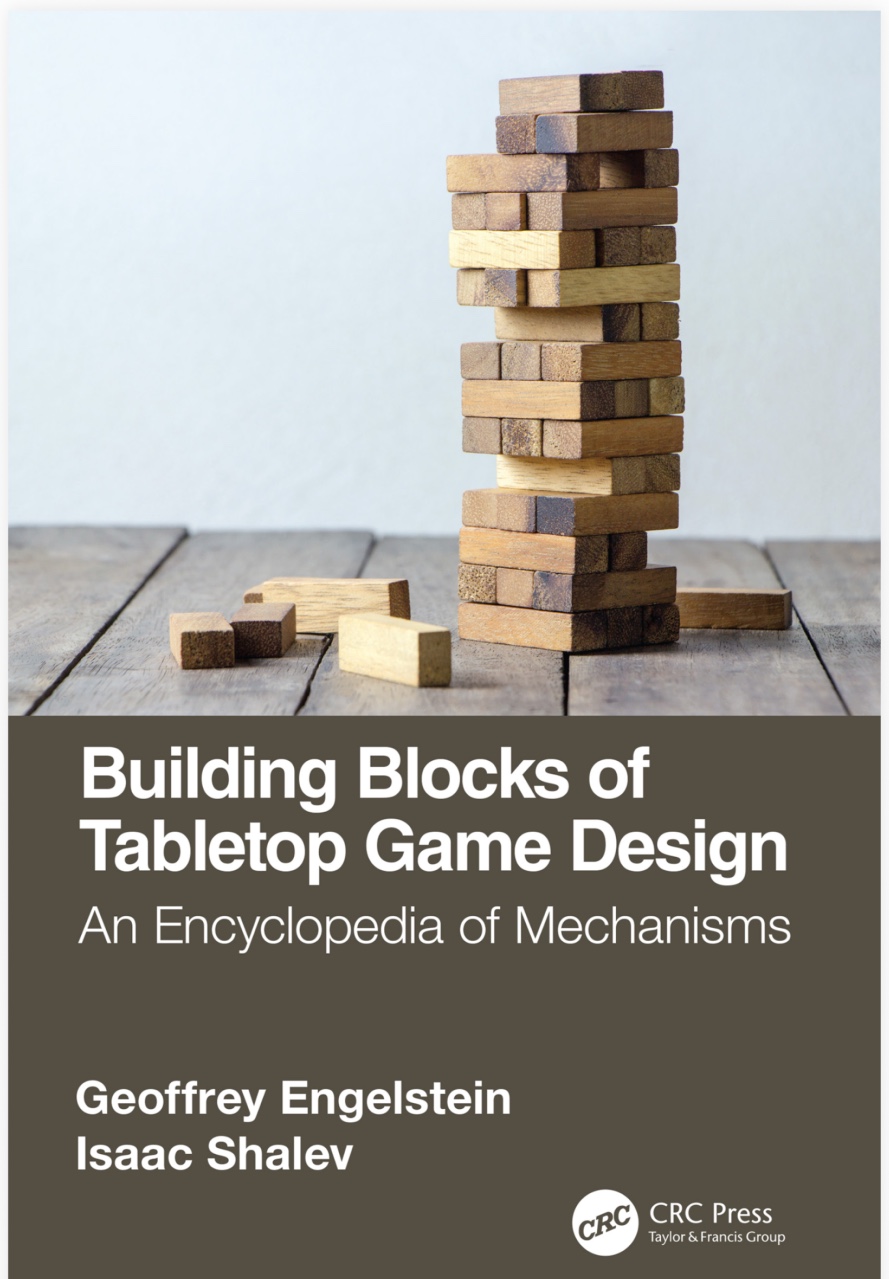
Game designer and Arts Professor Eric Zimmerman in the Foreword writes that Building Blocks of Tabletop Game Design is, “A manual for game mechanics. A foundation for structural analysis. An inspiration for new ideas. A sourcebook for teaching game design” (Engelstein & Shalev, p. xiv). For my team in class, I certainly see it useful as, “inspiration for new ideas” and “a sourcebook for…game design.”
True to the subtitle, Building Blocks of Tabletop Game Design an encyclopedic listing of game mechanisms lightly organized into 13 major chapters with between five and 24 game mechanisms listed under each:
- Game Structure (example mechanism: STR-01 Competitive Games)
- Turn Order and Structure Terminology (example mechanism: TRN-09 Simultaneous Action Selection)
- Actions (example mechanism: ACT-17 Events)
- Resolution (example mechanism: RES-04 Ratio/Combat Odds Table)
- Game End and Victory (example mechanism: VIC-09 Player Elimination)
- Uncertainty (example mechanism: UNC-06 Communications Limits)
- Economics (example mechanism: ECO-11 Upgrades)
- Auctions (example mechanism: AUC-14 Dexterity Auction)
- Worker Placement (example mechanism: WPL-01 Standard Worker Placement)
- Movement (example mechanism: MOV-08 Drift)
- Area Control (example mechanism: ARC-03 Troop Types)
- Set Collection (example mechanism: SET-02 Tile-Laying)
- Card Mechanisms (example mechanism: CAR-06 Drafting)
As a classic grognard wargamer the bleeds SPI red blood and has Avalon Hill blue varicose veins where a wargame is a hex map with cardboard counters and a 3:1 combat odds tables rolled using 2d6, many of these game mechanisms might seem foreign. If you do not know of a wargame with a certain mechanism in it, I am certain the Eurogamer members of our tribe (or those out on the left-coast reservation) will be more be more than happy to point you to such a game.
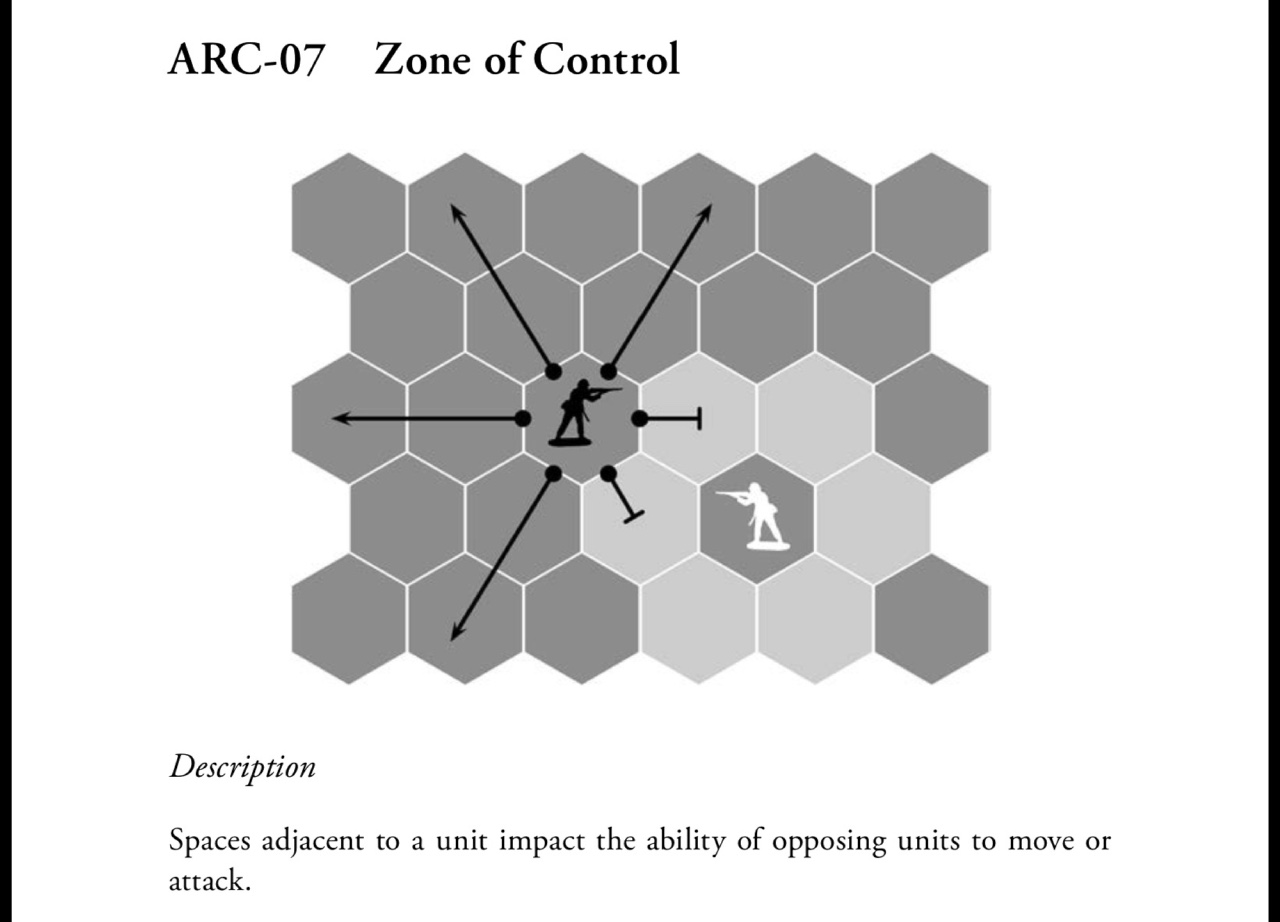
Each game mechanism is a relatively short entry usually covered in 2-3 pages. Some have simple graphics, like Area Control (ARC)-07 Zone of Control.
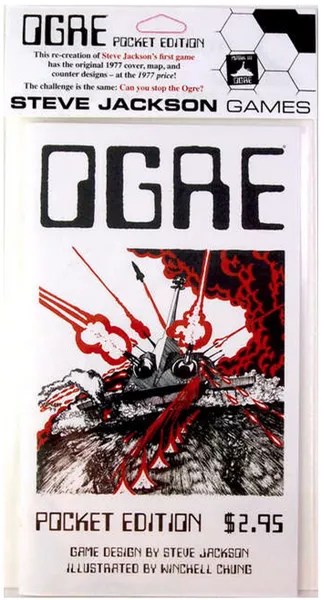
For example, OGRE: Pocket Edition (SJ Games, 2013), a republication of the original 1977 OGRE wargame, uses the following game mechanisms:
- STR-01 Competitive Games
- TRN-01 Fixed Turn Order
- RES-04 Ration/Combat Events Table
- VIC-02 Victory Points from Player Actions
- UNC-10 Variable Setup
- MOV-01 Tessellation
- MOV-04 Movement Points
- ARC-03 Troop Types
- ARC-07 Zone of Control
- ARC-08 Line of Sight
To be clear, I did not pick up Building Blocks of Tabletop Game Design and expect to randomly pick a mechanism here or there, drop them into an AI/ Super Intelligence tool, and have a wargame magically appear at the other side. No, Building Blocks of Tabletop Game Design is a tool to understanding game design by giving the reader/designer an introduction to a broad array of game mechanisms. It is up to the designer to decide which ones are useful…or not.
Feature image Pexel Free Photos
The opinions and views expressed in this blog are those of the author alone and are presented in a personal capacity. They do not necessarily represent the views of U.S. Navy or any other U.S. government Department, Service, Agency, Office, or employer.
RockyMountainNavy.com © 2007-2026 by Ian B is licensed under CC BY-SA 4.0


Do you have the 3rd edition that’s just come out?
I’ve still got the 2nd.
Either way, an invaluable resource for helping you try to get that little wiggly thing out of your head and onto paper.
Second edition…I could not bring myself to spring for the latest at double the cost.