
Nine centuries ago the stars on the road home died one by one, turning into mirrored spheres of metal. The gates fell silent, and the fleets sent to find out why never came back. Ever since, the Verge has been on its own: a scattered sector of worlds, stations and dead colonies, where Guilds control the air people breathe and the great blocs fight over trade routes and relics of the old empire. There are no aliens out here, only people, and the long dark between the stars.
I admit it: I am a collector of science-fiction roleplaying games (RPGs). Thanks in part to this week’s Black Friday/Cyber Monday sale at DrivethruRPG I added yet another title to my collection—a digital copy of The Khyros Verge – Core Rulebook and Scenarios written by Ade Sant and published by Santy’s.
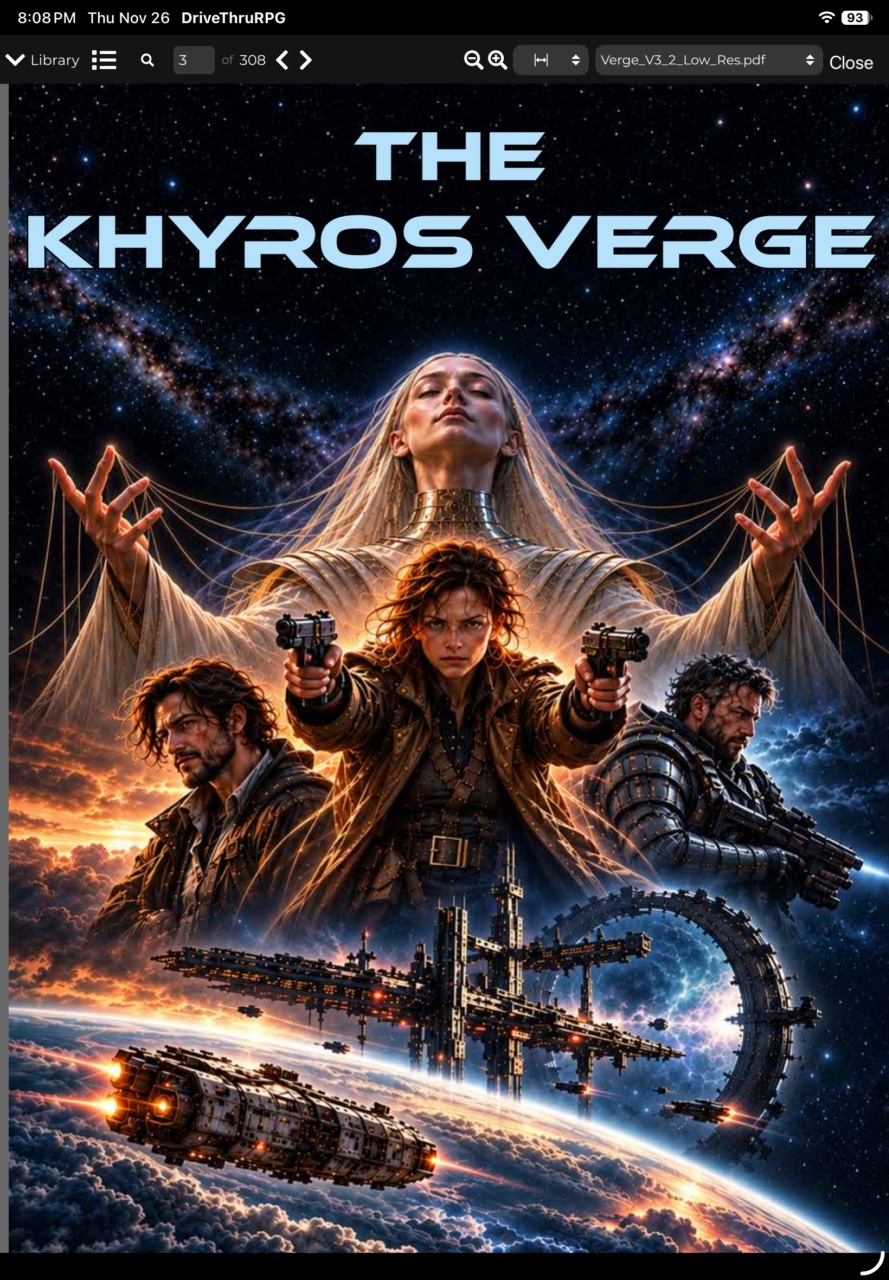
The Khyros Verge is a comprehensive collection of rules, setting, scenarios, and supplements that deliver a complete RPG game experience that draws on multiple—and varied—science-fiction tropes. The core of the game engine starts with the Classic Traveller 2d6 but with updated variations. Character generation is far from the “die in character creation” of Classic Traveller. Psionics is an integral part of the setting and technology is not that far into the future. The central sci-fi conceit—Faster-than-Light Travel—is explained with “The Fold.” In a nod to tropes of ALIEN, fear and horror get a game mechanism called Resolve. As for the setting of the Verge, I see lots of elements of Babylon 5 and The Expanse…and much more.
When I play an RPG I usually try to keep to the rules and setting of the game—at least at first—to try to understand the message or experience the designer is trying to communicate. With The Khyros Verge, however, I am not sure I want to play as the designer seemingly intends. That is because it all comes down to survival versus chance for me.
Verge about
The Introduction to The Khyros Verge explains the three core elements of the setting:
- “People. Every faction, every station and every deal is made of people with thier own needs and fears. The crew’s enemies are rarely monsters. They’re usually just someone who wants the same thing.”
- “Survival. Air costs money. Fuel can be bad. The ship always needs something. A good session can end with the crew richer, or just alive.”
- “Mystery. The Fold, the Hush, the dead stars and the silent Spire. The Verge is full of questions, and this book doesn’t answer them all. Some answers are for the Referee to choose. Others are for the crew to find” (p. 1).
That dark is the Fold, a tangled, half-living dimension that leaves its mark on everyone who crosses it. Old hands never jump cold, and they’ll tell you the first breath after a jump always tastes of copper. They speak quietly of the Hush, the thing that listens between worlds, and every faction has its own theory about what it is. The Choir, part faith and part intelligence network, believes the Fold itself is divine. Where others fear the Gift, branding those who have it Ghosters or Spooks, the Choir calls it the Calling, and it is the only faction that openly trains the Gifted, in hidden enclaves marked on no chart.
[Throughout this post I am going to make many references to the Classic Traveller RPG because, 1) the Traveller Little Black Books (LBB) was my first-ever RPG and, 2) the XD6 game system is a spiritual successor to Classic Traveller. Thus, as the later comes in many ways from the former, comparisons can be made to show how far one has come as compared to the other.]
Game Verge
The Khyros Verge core rulebook (308 pages) contains both the core rules and the setting. The game engine uses Stellagama Publishing’s “XD6 SRD” [System Reference Document] which is perhaps better understood as the Open Game License (OGL) or Creative Commons Attribution (CCA) license versions of Classic Traveller with some updated game mechanims. In this case, The Khyros Verge uses the CCA-licensed version of, “roll 2D, add a skill, and succeed on 8 or more” (p. 1). The XD6 system also uses Advantage and Disadvantage: “+1D and -1D are Advantage and Disadvantage dice. Roll an extra die, then keep the best two or the worst two” (p.1). In a break from the Classic Traveller core game mechanism, a character earns Advantage/Disadvantage dice in several ways:
- “Archtype: +1D when your archetype’s training or experience applies. Never on Combat rolls.”
- Talents: +1D in specific situations.”
- Faction Boons: occasional +1D or other edges.”
- Hero Points: spend one for +1D.”
- Conditions: darkness, fatigue, wounds, bad gear, a lurching deck.”
- Difficulty: how hard the task is.” (p. 4)
Difficulty in The Khyros Verge is rated on a scale of “Easy (+1D) to “Impossible (-4D)” (p. 4). For myself, the concept of building a dice pool and then picking the two highest/two lowest dice for the success/failure took a hot minute to wrap my Classic Traveller head around.
The Khyros Verge also leans into what I call the “fails play on” school of RPG play styles: “A failed roll means things go wrong, not that the game stops. The Referee decides what failure looks like. Often it is one of these:
- You fail, and something gets worse.
- You succeed, but it costs you time, money gear, or Stamina.
- You fail, and someone notices.” (p. 4)
Character Verge
Character creation in The Khyros Verge uses a combination system with Archetypes and point-buy. The ten-step process calls for both player choices and (few) die rolls. Again, for someone like myself steeped in the iron-man1 rules of Classic Traveller character generation this is very…different.
| Step 1 | Concept | Player | “Decide who you are in a sentence.” |
| Step 2 | Origin | 1D | “Decide where you come from.” |
| Step 3 | Archetype | Player | “Choose one of the twleve archetypes of the Verge and a faction title.” |
| Step 4 | Faction Link | Player/1D/D66 | “Choose a faction and how you are tied to it. Roll a Boon and a Complication.” |
| Step 5 | Skills | Player | “Spend 5 points across seven skills.” |
| Step 6 | Talent | Player | “Choose one Talent. Soldiers and Mystics gain extra abilities.” |
| Step 7 | Ties | Player | “Name three people who matter to you.” |
| Step 8 | Derived Values | Deterministic | “Work out Stamina, Encumbrance, Resolve and the rest.” |
| Step 9 | Equipment | Player | “Take an equipment package or buy your own gear.” |
| Step 10 | Finish | Player/Referee | “Name, look, motive, and your place on the crew.” |
Those players familiar with Classic Traveller should immediately realize that with just seven skills, the real distinguishing characteristics of characters are in the Talents they may possess. The Khyros Verge includes Talents divided into three groups: Combat (21), Character (23), and Professional (31). Most Talents, “give +1D in a specific situation” and can stack with archetype bonuses. Players can gain Talents outside of character generation through experience (p.26).
Advancement through experience is yet another manner the rules for The Khyros Verge depart from Classic Traveller. The same can be said of Hero Points (Chapter 5) which are used as a metacurrency when playing The Khyros Verge.
Combat in The Khyros Verge starts with the standard, “roll 2D and add skill; 8 or greater is a success” but adds in the Advantage/Disadvantage dice (from archetypes, Talents, Conditions, or combat situations) that change the number of dice rolled.
Psionics. Telepaths. The Force. Whatever you want to call it in The Kyhros Verge it is “The Gift” and it can be used for good or bad. Different Factions have different attitudes (and even different uses) towards The Gift. Not to be confused with Cybernetics (Chapter 11).
Verge tech
The technological setting of The Khyros Verge describes itself as “Early Interstellar or older”:
Throughout this book, equipment, weapons, implants and machines list a Tech Age: the point in a civilisation’s [sic] development when the technology first becomes possible.
Most of what the Verge uses day to day is early Interstellar or older, so for most items the Tech Age changes nothing about whether you can buy it.
The Khyros Verge, p. 1
For myself, what I see in The Khyros Verge is a setting in the not-so-far future but with faster-than-light (FTL) travel. In many ways the setting appears comparable to the reimagined Battlestar Galactica television series.
The major science-fiction element of The Khyros Verge is faster-than-light travel using The Fold.
Ships in the Verge don’t skim through hyperspace. They dive into the Fold; a tangled dimension of gravity and memory. Whether it is warped physics or something alive, nobody knows. Every jump leaves its mark on ship and crew alike.
The Khyros Verge, p. 112
Spacers have three rules: Never jump cold. Never listen to the whispers. Never answer your own voice.
In The Khyros Verge a Standard Fold Drive is not that much different than the Classic Traveller Jump-1 as it travels, “Up to 3 parsecs per jump. A week in the Fold. Recharges in 1D days” (p. 112). When traveling in The Fold, there is also a chance the player-character will suffer Jump Sickness. Accumulating too many Jump Sickness Points (JSP) means your brain is foggy (-1D on all rolls for every JSP above 0) until recovered (p. 113).
For real space (Newtonian) travel, ships in The Khyros Verge are not rated for Maneuver Drives ala Classic Traveller but instead with a Travel Multiplier which modifies the time it takes to move through a system. If ship combat occurs, it is run as a chase (see p. 114). Players play ship bridge positions during battle. Taken as a whole, the space combat rules in The Khyros Verge effectively limit space combat to 1v1 ship battles.
Building a ship in The Khyros Verge is very much an optimization exercise vice an engineering challenge. Ships are described in terms of Endurance2, Armour, Crew, Cargo3, Guns, and Agility with eah sually described by a multiplier or +/-D. Increasing/adding one often is at the cost of reducing another. Fast, simple, and not very technical.
Money Verge
The Khyros Verge leans heavily into the Merchant Prince or Star Trader genre of Traveller RPGs; that is, trade is where one makes their fortune, or more likely, struggles from contract to contract. Shipping freight, passengers, or engaging in speculative trade can be the road to financial freedom but, nore often, a slow death sentence.
[I am interested to see how players take to (or not) the setting demands and rules for Trade in The Khyros Verge. My personal experience is that many players prefer to use Trade as a kind of side-quest; a way to raise money when between other—more lucrative—jobs and when money for standard fees like yearly maintenance are coming due. Given the Trade rules are nearly 10% of the entire core rulebook it seems like Trade is an important element of play.]
Verge horror
Classic Traveller was first published in 1977 and the original setting—followed by the Third Imperium setting—heavily leveraged the Golden Age of pulp science-fiction for inspiration. As such, Classic Traveller pre-dated the release of the movie ALIEN in 1979 and The Thing in 1982. Both ALIEN and The Thing prominently featured horror and fear, which The Kyhros Verge incorporates using the Resolve: “Resolve is your ability to keep going in the face of the inexplicable. It works like a skill for Horror rolls” (p. 150)
Where in the Verge?
THE FORGOTTEN EDGE
The Khyros Verge was never meant to be a frontier.
A thousand years ago, it was a shining rim of human expansion; a corridor of linked colonies, refuleing stations and beacon systems joining the Core Sectors to the Outer Expanse. Hundreds of ships passed through its lanes every day, riding the jump gates from one system to the next.
Then, in a single century, the lights went out.
Now the Verge stands alone. It is a patchwork of Guild powers, struggling colonies and uncharted places, held together by greed, faith and memory. To the Core Sectors on the far side of the Dead Belt, it is a graveyard. To the people who live here, it is home.
The Khyros Verge, p. 153
In Traveller RPG terms, The Khyros Verge is a small-ship, single-sector setting. In addition to the planets there are Factions, each described in meta-game terms of Guns (military power), Whisper (spies and influence), Credit (money and debt), Hold (unity, loyalty, stability), Holdings (assets), and Ambition (faction goal). While each faction has its planets, the neutral zone, so to speak, and the site of the dead Jump Gate is Port Horizon, quite literally the “tavern” where most adventures in The Khyros Verge begin.
Most roads lead to Port Horizon, an orbital city welded together from the wrecks of lost arks and tethered above the storm world Resona. Here you pay ten credits a day just to breathe, every faction keeps an office, and once a day every channel on the station falls silent for a minute for the ones the void has taken. Down in the Choke, the Underdecks’ black-market bazaar, a one-eyed former Tetherhand named Katha Brin keeps order with a pipe wrench. And sooner or later every spacer ends up at the Emberline, a pilots’ bar built in the gutted cargo bay of an old hauler. Its owner, Rhea Conn, is a retired freighter pilot with a mechanical hand and a sharp sense of fairness. She keeps a wall of metal plaques, one for every ship lost to the Fold, and when someone toasts a name, the lights flicker once in reply. Enemies drink three seats apart here, because Rhea’s rule is simple: drink, talk, and take the fight outside.
Survivor’s chances
I really want to like the setting of The Khyros Verge. There are five themes that permeate this setting:
- Isolation
- Decay
- Power without Law
- Faith and Fear
- Making a Living (p. 246).
Those five themes operating in concert with one another make for an interesting setting. What I do not like, however, is some very modern “defeatist” advice from the creators of The Khyros Verge:
The Verge is a frontier that has been abandoned, not one that’s waiting to be tamed. It was once a bright edge of human space. Now it’s cut off, slowly running down, and haunted by things nobody understands. Its people aren’t pioneers. They’re survivors.
The Kyros Verge, p. 246
“They’re survivors.” Defeatism. Why keep going; all hope is lost. Those words are really confusing considering the introduction of The Khyros Verge:
This is a place for people who make their living in the cracks: smugglers, salvagers, mercenaries, fixers, pilgrims, runaways, and anyone with a ship and more debts than sense. The Verge is not kind, and it is not fair. But it is full of chances, for those brave or desperate enough to take them.
The Khyros Verge, p. 1
Now, granted, the “They’re survivors” line comes from the advice to the Referee for running The Khyros Verge.4 The “full of chances” is in the introduction, and intended to draw players into the game. Why does that feel like a bait & switch to me? Now, I perfectly understand that I have bought my copy of The Khyros Verge and I can take the setting and play in any direction I want, designer be damned. But does the designer really intend for us to have an adversarial relationship from the start?
Who knows? Personally, I do not care either. Good thing I don’t need their permission to run MY table the way my players and I want to.
Verge haul
For a special price of $6.97, The Khyros Verge – Core Rulebook and Scenarios package from DriveThruRPG delivers immense quality for YOU to game around with. In addition to the Core Rulebook, amongst the other 11 items in the bundle you get:
- Short Hauls – 29 Quick Scenarios (68 pages)
- Spaceship Sheets
- A character generation quick-reference sheet
- Full characters sheets (sides A and B)
- Vehicle Record Sheet
- A Space Combat Tracker (player aid)
- Two versions of the Sector map; black & white and full color
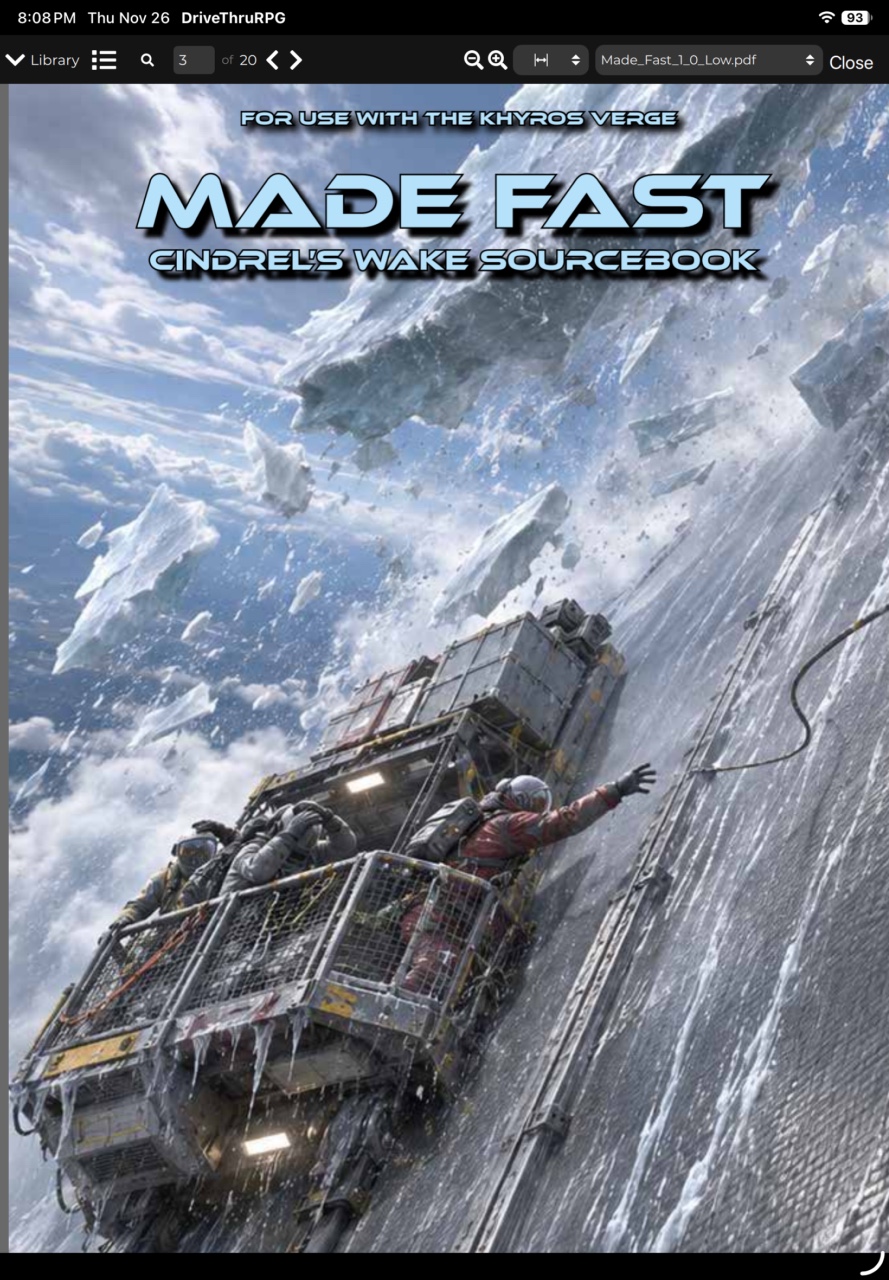
- Made Fast – Cindrel’s Wake Sourcebook.

- I am a strong believer in the chance of “dying in character creation” version of character generation in Traveller. ↩︎
- Or it is Propellant? Rules start mixing terms…. ↩︎
- Payload? ↩︎
- Whoops! Players are not supposed to know that. Oh, well… ↩︎
Feature image courtesy Santy’s
The opinions and views expressed in this blog are those of the author alone and are presented in a personal capacity. They do not necessarily represent the views of U.S. Navy or any other U.S. government Department, Service, Agency, Office, or employer.
RockyMountainNavy.com © 2007-2026 by Ian B is licensed under CC BY-SA 4.0

