
The helicopter is the most significant new weapon on the modern battlefield.
AIR CAV, Standard Rules, p. 1
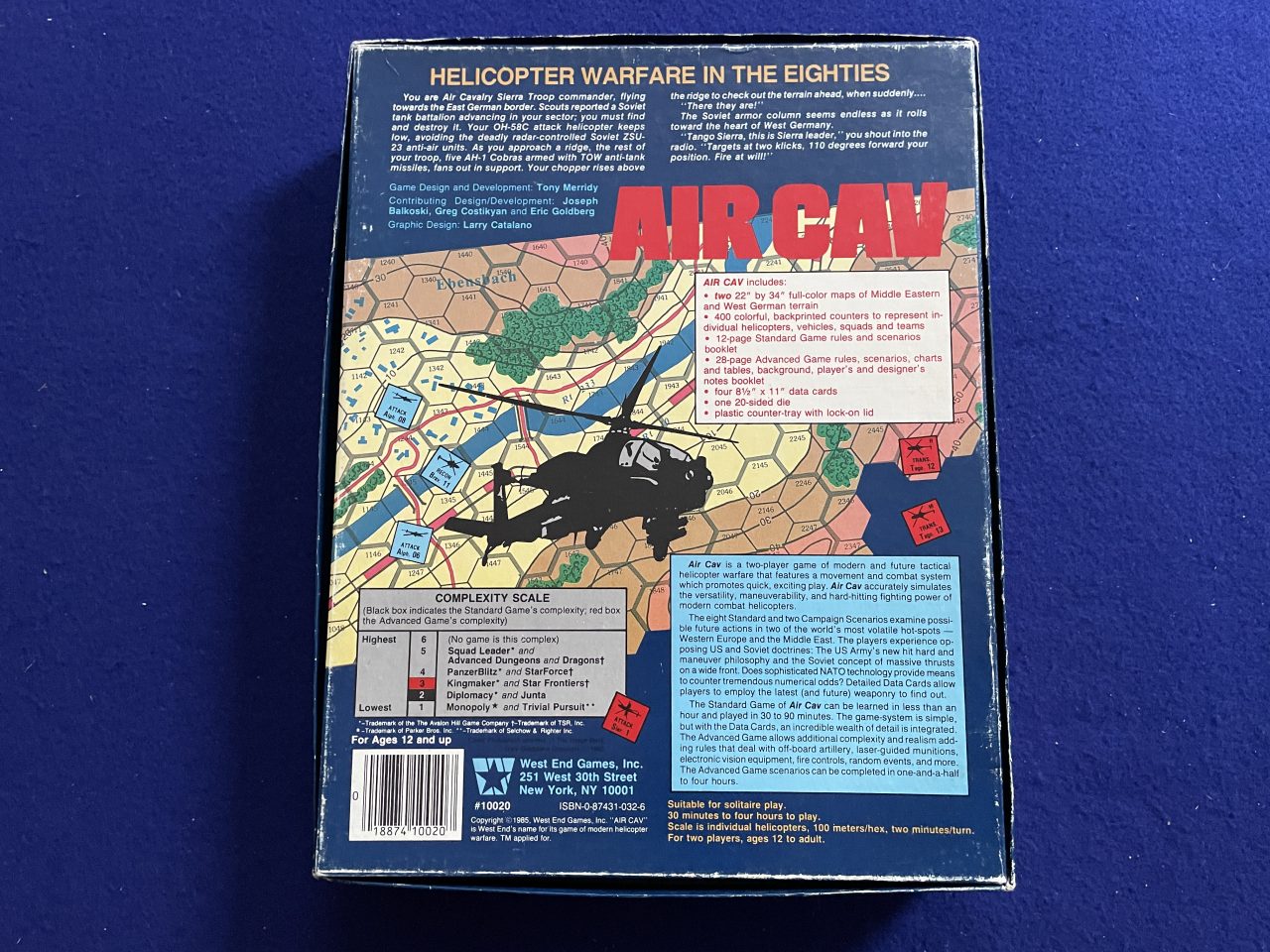
…thus starts the Introduction for the wargame Air Cav: Helicopter Warfare in the Eighties from West End Games published in 1985. Given the 1980’s was full of wondrously new weapons—the M1A1 Abrams tank, the M2 Bradley Infantry Fighting Vehicle, and the Multiple Rocket Launch System (MLRS) just to name a few ground systems—to say that the helicopter is “the most significant” is certainly a bold claim. Air Cav seeks to explore—and bolster—that claim through a wargame with a very tactical frame of reference before moving up to a grand tactical, if not near-operational, viewpoint in the campaign game. Air Cav, by design, mixes playability and “accuracy” but with a mixed outcome.
Tactical helos
Air Cav is, by scale, a very tactical wargame:
- “…each game turn represents 2-minutes…”
- “…each hex represents 100 meters…”
- “Most counters represent individual helicopters or vehicles, or infantry squads or teams.” (Standard Rules, p. 2)
West End Games apparently was cognizant of concerns (from wargamers?) that Air Cav appeared as more of a simulation than a wargame. They addressed that issue head-on in the Introduction:
Air Cav is at once a game and a simulation. The various helicopters are portrayed as accurately as a game permits, and play flows quickly and smoothly. There is an impressive amount of information in this package (a look at any data card confirms this); we have presented it as simply as possible. To this end there is a Standard and Advanced Game. Those seeking an evening’s fun can play two or more standard scenarios once the rules are understood. The player looking for more realism can read past section 9 and find a more complex undertaking, requiring more time and a greater understanding of the subject.
Standard Rules, 1. INTRODUCTION, p. 2
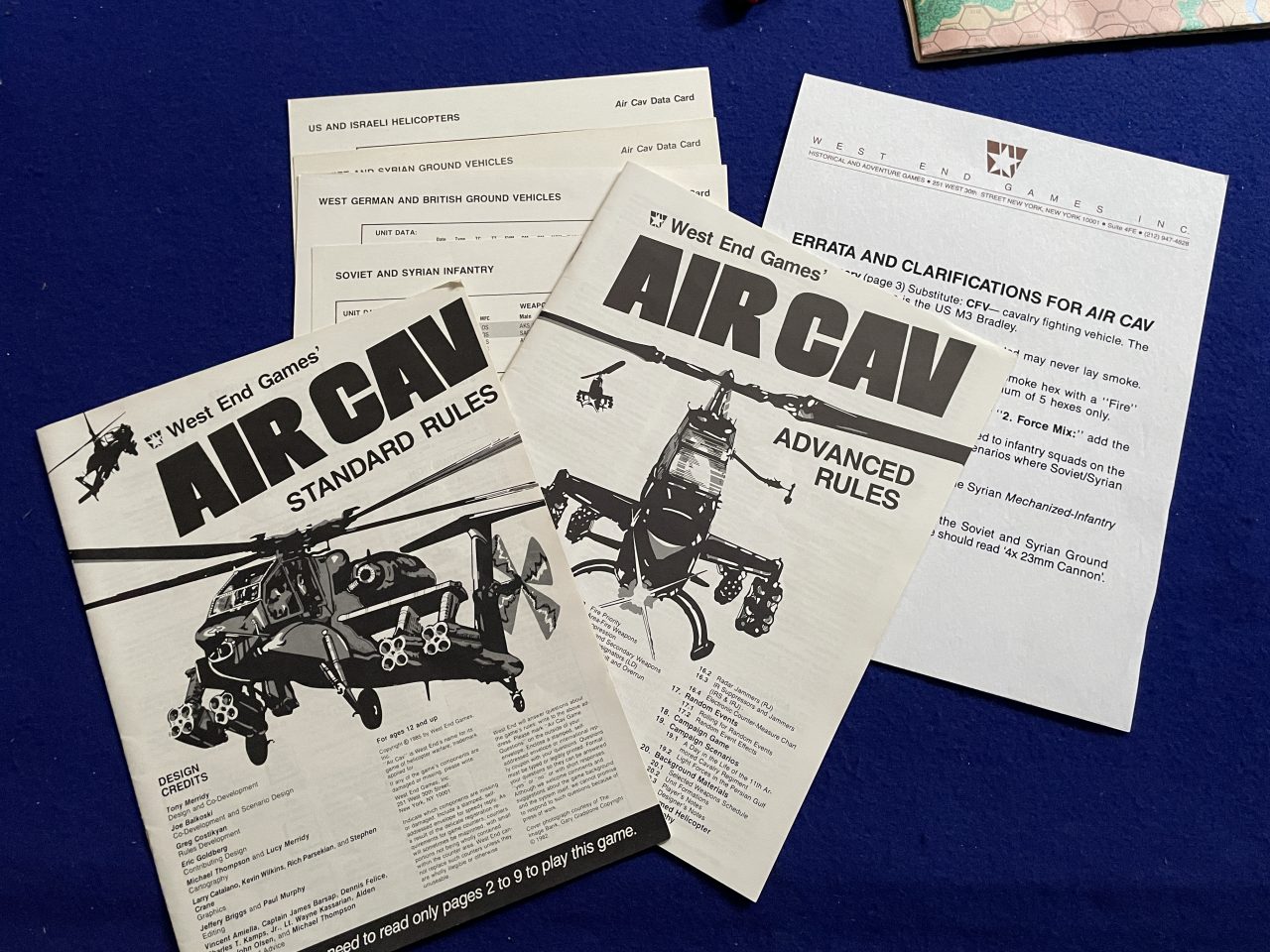
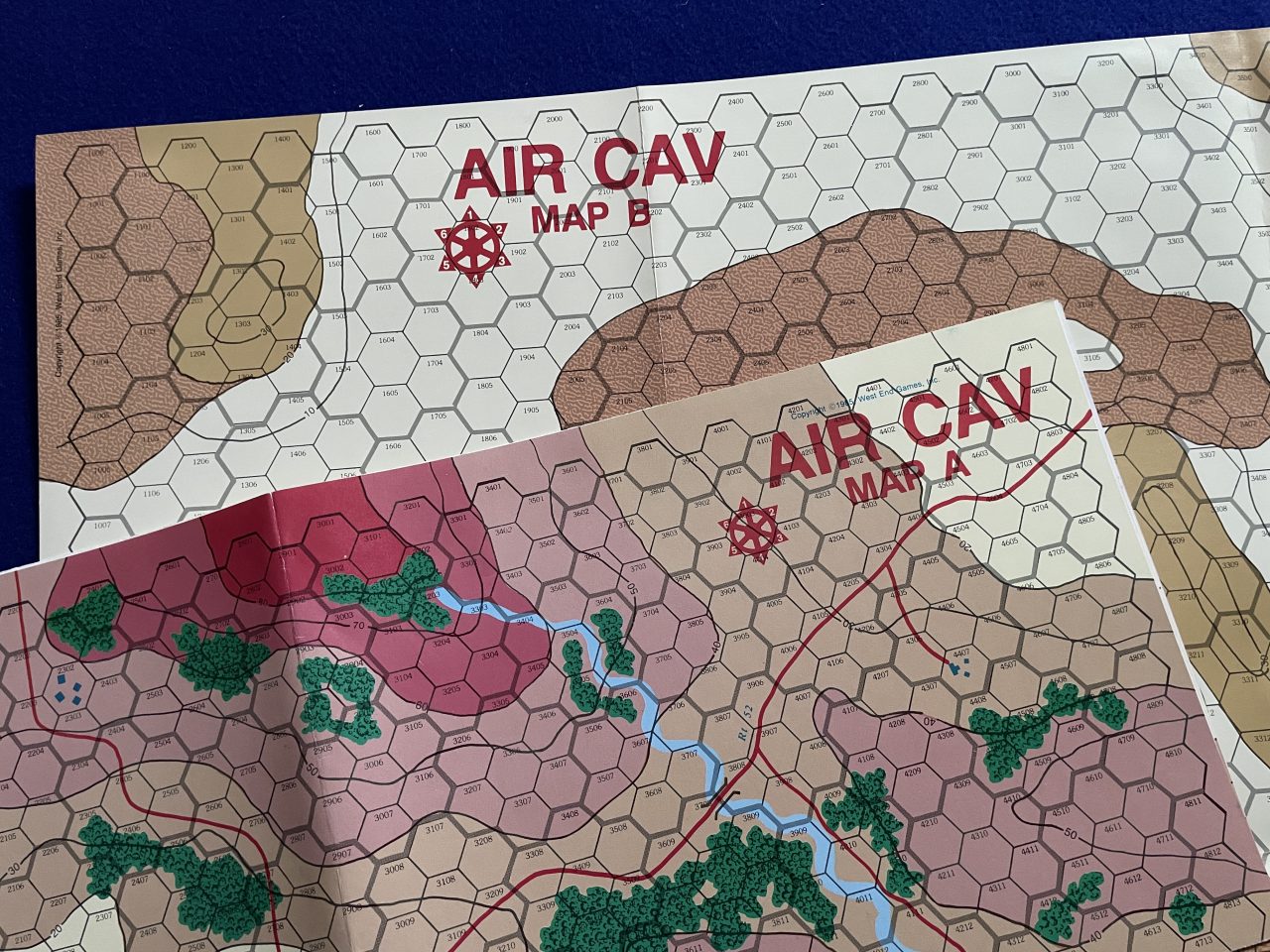
Component-wise, Air Cav is fairly plain for a wargame. A simple box with a paper map, several cardstock player aids, and two rulebooks sold for $19.95 when released. For a wargame that claims, “various helicopters are portrayed as accurately as a game permits” I find it interesting that the counters for Air Cav are…generic. Then again, it is not too much of a stretch of the imagination to envision production cost concerns even back in those days.
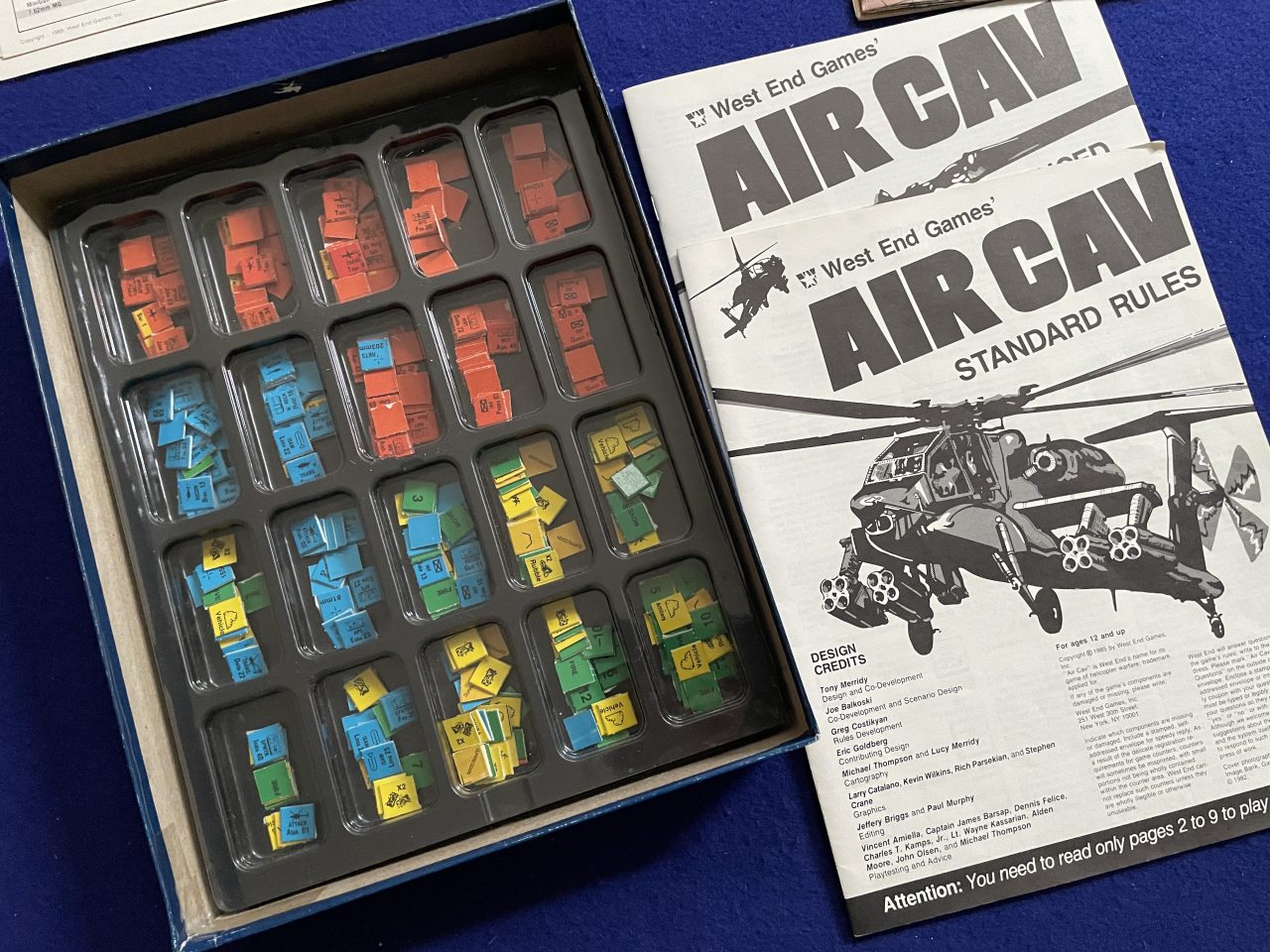
(2.32) Counters are “generic”. For example, the blue attack helicopter counters are used to represent a variety of helicopter-types (including the British Lynx, the West German BO-105, the Israeli 500M Defender, the American Apache, and others) depending on the scenario chosen.
Standard Rules, p. xx
Gaming Air Cav
When playing the Standard Game of Air Cav two game mechanisms particularly stand out to me; Initiative and Operations Points. A third element of play—data accessibility—also raises some concerns. If playing with the Advanced Rules then four other game mechanisms are noteworthy; Advanced Observation, Formations, Fire Control, and Electronic Counter-Measures (ECM).
Initiative
[See (4.1) Operations and Sequencing]
In Air Cav there is no specific rule for Initiative; instead, the rule is implied under (4.1) Operations and Sequencing which directs: “(4.12) During the Initiative Phase, each player rolls a die. The player who rolls the higher number is the first active player in the ensuing Operations Phase” (emphasis in original). The active player may pass or choose one unit to conduct operations. If both players consecutively pass the Operations Phase ends. Whenever an active unit completes an operation inactive units may fire upon it (called opportunity fire, see (4.16)). If opportunity fire destroys the active unit, the inactive player immediately becomes the active player. This dueling active-inactive player exchange keeps Air Cav from degenerating into just another game of IGO-UGO alternating boredom.
Operations Points
[See (4.2) Kinds of Operations and (4.3) Operations Points]
When the active player in Air Cav activates a unit, it has 12 Operations Points (OP) to expend. Players must refer to the Operations Cost Chart (4.4) and cross-reference the Operation Type (Fire/Movement/Reaction/Advanced Movement) unit type to find the OP cost. The cost is usually displayed in NATO or Israeli cost and Soviet/Syrian cost. Some combinations are prohibited and others are paid for with the expenditure of additional OP. For example, for an Attack-Recon helicopter like the AH-64 Apache to fire its gun cost 1 OP, to fire a Missile or Rocket is 3 OP, and to conduct a Pop-Up attack is 4 OP. Doing any of those actions as an opportunity fire costs +1 additional OP. If it is not immediately obvious, the need for an active unit to save some OP to spend when inactive is a lesson quickly learned in play.
Data accessibility -or- chart-flipping with the Devil
Initiative determination in Air Cav—a simple dice-off with no modifiers—shows the obvious desire to speed play. The 12 OP “action budget” apparently is also designed to speed play. What does not speed play in Air Cav is what I term “data accessibility” or the player’s tableau of unit data. While Air Cav announced, “…an impressive amount of information in this package (a look at any data card confirms this)” the organization of the game data is…challenging. The Devil really is in the details.
The example following (7.3) Resolving Combat in the Standard Rules of Air Cav helps understand—but does not fully explain—the sheer amount of chart-flipping needed to play. The situation is, “The OH-58C Kiowa is directing opportunity fire at a Soviet infantry squad which has just moved into a woods hex and has expended 8 OPs.” Frisking further sentences reveals:
- “The Kiowa is firing a minigun machine gun from a range of 10 hexes.”
- Opportunity fire of a minigun by an Attack-Recon Helicopter costs 1 OP (Fire – Gun – Attack – Attack/Recon Helicopter) +1 OP (Opportunity Fire) per (4.4) Operations Cost Chart.
- “Reading across the top of the Combat Table [found on the US AND ISRAELI HELICOPTERS, Air Cav Data Card] find the column marked 10-14 (the span in which 10 is found). When this column is cross-indexed with the minigun MG the result is a BKN [Basic Kill Number] of 7.”
- Not mentioned in the example but the BKN is modified by -1 using the Opportunity Fire (OpF) column of the COMBAT TABLE for the minigun.
- “The Soviet Infantry is target type E (-1 to the BKN) and is located in a woods hex (-1) against a moving target (-1).”
- The Soviet infantry target type is found on the SOVIET AND SYRIAN INFANTRY, Air Cav Data Card, Unit Data table.
- The woods hex modifier (“Wd/S”) is found on the COMBAT TABLE for the minigun.
- The moving target (MvT) modifer is also found on the COMBAT TABLE for the minigun.
- “The FKN is 3 (7-1-1-1-1 = 3).”
- That only took looking at five (5) cross-references across three (3) different tables to find all the modifiers.
Note that this is in the Standard Game of Air Cav; if using the Advanced Rules the need for cross-referencing only increases.
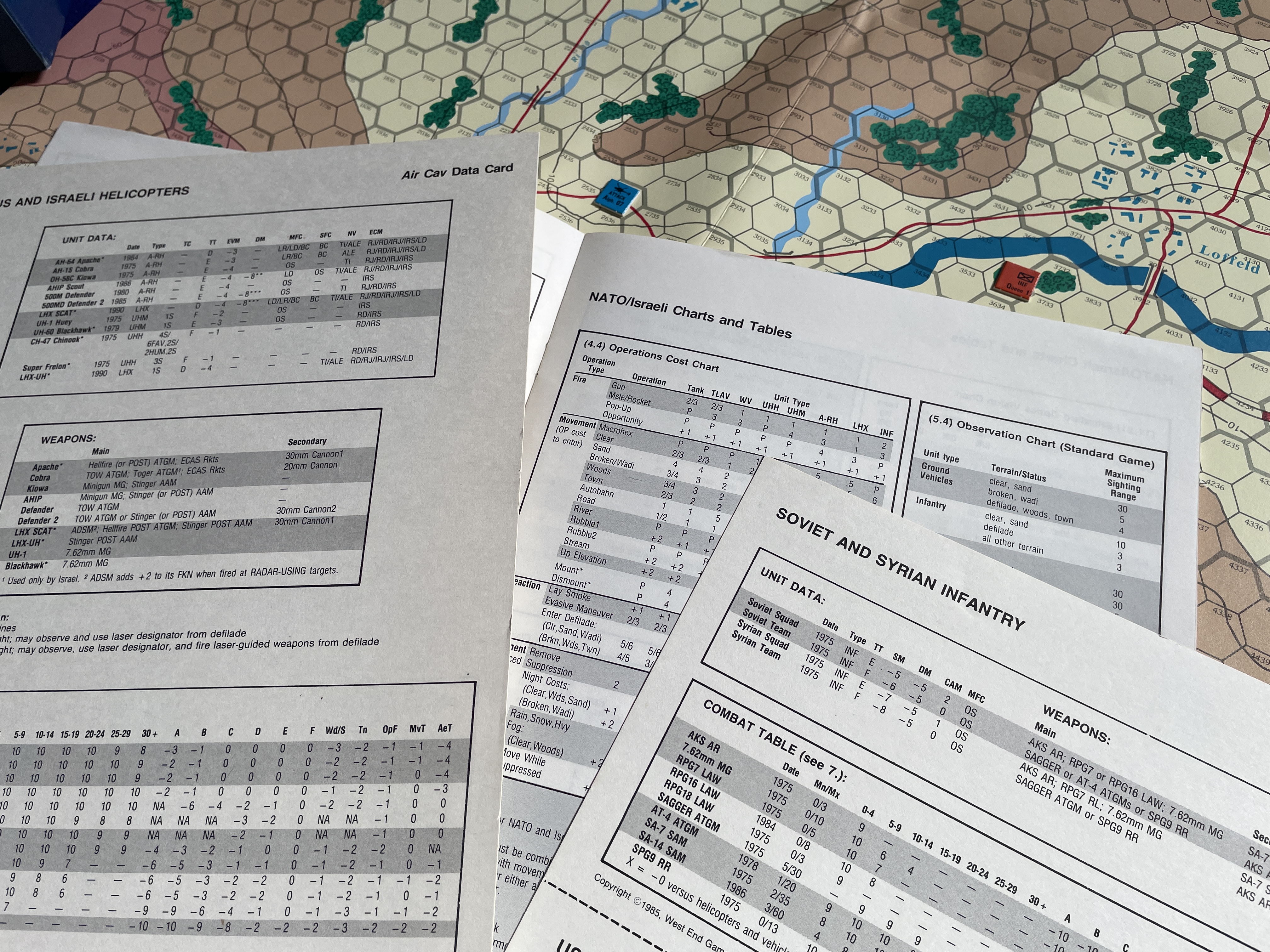
[Cards and Tables]
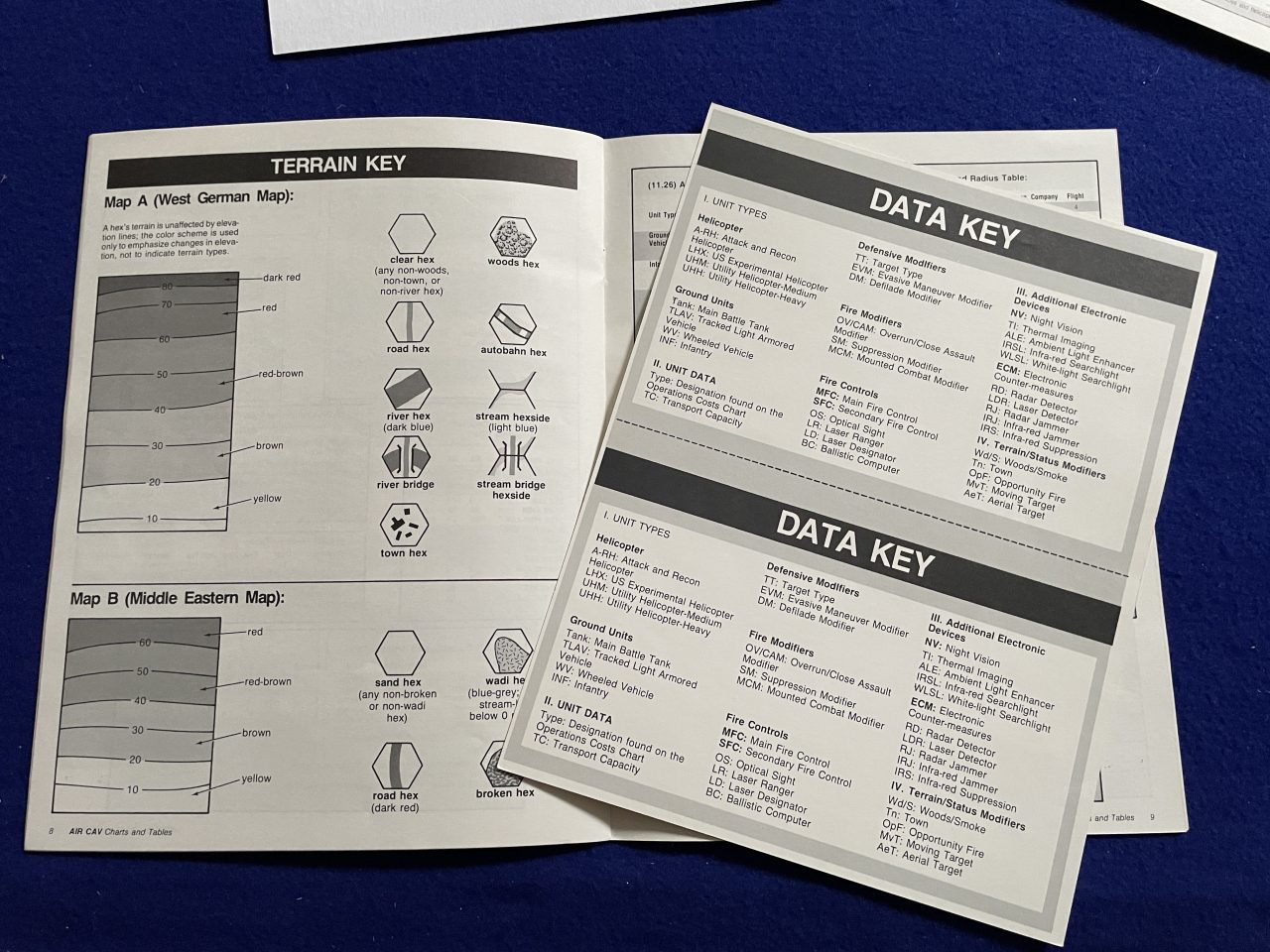
[When playing Air Cav, each player is given a minimum of two, double-sided Data Cards and one four-page tables handout. The first Data Card has Helicopters on one side with Unit Data, Weapons, and Combat Table. The reverse side, Ground Vehicles, again has Unit Data/Weapons/Combat Table. A second half-size (but still double-sided) Data Card has Unit Data and Combat Table for Infantry on one side and a Data Key—literally a glossary of abbreviations—on the reverse. The four-page handout has one page used in the Standard Rules and three more for Advanced Rules. The Standard Rules tables on page 1 are (4.4) Operations Cost Chart, (5.4) Observation Chart (Standard Game), and (7.6) Weapon Category Chart. The next two center facing pages are eleven different charts/tables used in the Advanced Game including, (11.21) Standard Optics Vision Chart, (11.22) White Light Searchlight Vision Chart, (11.23) Infrared Searchlight Vision Chart, (11.25) [Nationality] Thermal Imaging Vision chart, (11.26) Ambient Light Enhancer Vision Chart, (11.35) Weather Table, (12.28) Command Radius Table, (12.29) Leader and Pilot Initiative Table, (15.22) [Nationality] Artillery Table, and (16.5) Electronic Counter-Measures Chart. The final page is a greyscale Terrain Key with Map A (West German Map) at the top and Map B (Middle Eastern Map) at the bottom. A separate four-page booklet has a two-page Master Weapons Table and two Operations Displays (US and Soviet) for Campaign Game 1 and Campagin Game 2 on the final two pages. Even if playing only the Standard Game that still as many as 13 different charts/tables over four pages of data cards and booklets needed for play.
Advanced Observation
[See 11. ADVANCED OBSERVATION]
In the Standard Rules for Air Cav, observation is covered in rule 5. OBSERVATION. The standard game rule for observation covers the basics; observed and unobserved units, Line of Sight (LOS), and maximum sighting ranges. The data reference used is (5.4) Observation chart (Standard Game) though I note it is missing a key modifier, found in rule (5.35), that states a unit with a “Move” marker, “may be observed at a range 2 hexes beyond the normal maximum sighting range” (emphasis in original). Rule 11. ADVANCED OBSERVATION adds in rules for weather (11.3) and Skylining where, “A unit silhouetted against the horizon…can be observed more easily” ((11.4) Skylining). Two other forms of advanced observation use equipment; (11.1) Special Vision Equipment and (11.5) Radar. This more detailed treatment of using phenomenology other than that requiring the Mk 1 Eyeball is refreshing. The drawback, as ever in Air Cav, is the many tables needed for play. Indeed, looking at the four-page player handout, most of the charts/tables on the two center-facing pages are in support of the Advanced Observation rules alone.
Formations and commands
[See 12. FORMATIONS, particularly (12.1) Formations and Leaders, (12.2) Command, and (12.4) Formation Operations]
Rules for Command and Control (C2) usually introduce greater complexity in play but also create a powerfully interesting decision space for players. In Air Cav, units are arranged in Formations with designated leaders. To conduct fire and movement operations a unit must be within the command radius of a leader. Force-command leaders command any unit within their command radius while platoon-command leaders can only command their platoon. Force leaders can command platoon leaders who can in turn command their units in a daisy-chain range fashion if necessary. Units that are not in command can conduct only Reaction Operations; unless, that is, their platoon leader makes a command check (or a pilot initiative check if a helicopter). Most powerfully, formation may be activated as a single entity (with limits—some of which are severe). The Formation and Command rules go a long way towards showcasing the advantages of Western doctrine and training when using advanced weaponry. For example, in rule (12.42), “when a formation performs an operation, all units in the formation must perform the same operation.” If the formation wants to fire, “each [unit] may fire.” The rule continues:
They may fire different weapons if the owning player wishes. When a Soviet or Syrian formation performs an operation, every unit must fire at the same target. When a NATO or Israeli formation does so, the unit may fire at different targets.
Advanced Rules, p. 3
Fire Control and ECM
[See (14.1) Fire Control, (14.2 ) Preventing Fire Control, and 16. ELECTRONIC COUNTER-MEASURES (ECM]
In Air Cav, Fire Control and its counterpart, ECM, are complimentary rules to 11. ADVANCED OBSERVATION. Whereas advanced observation introduces technology for observation, (14.1) Fire Control brings technology to Fire Combat. Firing requires not only a weapon but a means to aim or guide it—Fire Control. Fire control comes in five technology flavors: Optical Sights (OS), Ballistic Computers (BC), Radar (R), Laser Designators (LD), and Laser Rangers (LR). Units also have Main Fire Control (MFC) and Secondary Fire Control (SFC) means. [I almost accused Air Cav of missing the obvious new tech wonder—guidance using Global Positioning System (GPS)—until I considered that the first widespread use of GPS in combat was in DESERT STORM which was six years in the future when Air Cav was published, much less researched.]
The rules for Air Cav are clear that in order to shoot at a target it must be seen. Hence the Advanced Observation rules are integral. The Players Notes for Air Cav shows just how much the designer held the combination of a laser-guided anti-tank guided missile [ATGM] when paired with a laser designator: “Laser Designators: Beware! The combination of laser-designators and laser-guided missiles (Advanced Game) is the deadliest anti-armor system in the game” ((20.3) Players Notes).
In Air Cav an entire rules section, 16. ELECTRONIC COUNTER-MEASURES (ECM) is devoted to preventing Fire Control. ECM effects are of two broad types; they “counter-observe” or disrupt the fire control solution. Some ECM means do both.
In a game as detailed as Air Cav, the somewhat simplistic approach to ECM may seem a bit surprising. The Designer’s Notes, however, deliver a hint of explanation:
AIR CAV recreates the effects of electronic counter-measures as accurately as possible within the scope of the game. In addition, much information on the latest equipment is classified and nobody (except the experts) knows how the latest ECMs will work on a real battlefield. Moreover, further detail would bog play and be difficult to assimilate.
(20.4) Designer’s Notes, Advanced Rules, p. 15
Tactical missions…and up
There are eight standard scenarios in the standard game rules for Air Cav. The eight are not presented in any sort of programmed-play order; in fact, the first four use the European map and the later for the Middle East map. Players are encouraged to experiment in introducing advanced game rules. The Master Weapons Chart and Data Cards can be used to create your own scenarios, though no guide to how to do so is provided.
The focus of the standard scenarios is very, very tactical:
The time and map scale of Air Cav produce a purely tactical game. Typical scenario force mixes place players in the roles of low-ranking officers — platoon leaders or, at highest level, company commanders. At these levels, players quickly grasp (usually the hard way) the realities of modern battlefields and the validity of the modern military dictum: “What can be seen can be killed.” For forces to survive in Air Cav, players must use subtleties of contemporary low-level tactics and profit particularly from prudent use of terrain in fulfillment of objectives.
(18.1) Introduction, Advanced Rules, p. 7
Perhaps the most interesting aspect of the standard scenarios in Air Cav are the narrative introductions. While using narrative over a detailed information dump may seem obvious to grognards today who grew up on Clancy and Coyle and the like, I will point out that Air Cav was published in 1985 or about a year before Clancy’s novel Red Storm Rising with the Harpoon wargame-derived chapter “Dance of the Vampires” appeared.
The Campaign Game of Air Cav, introduced in advance rule 18. CAMPAIGN GAME, is not just a way to string the eight standard scenarios together. The Campaign Game has a loftier objective:
Due to Air Cav’s tactical scale, players are not aware of the “big picture” as seen from brigade, division, corps, or army HQs. To allow players to examine these higher command levels, two “campaign” games are presented in Air Cav which introduce the fundamental principles of cavalry and helicopter operations in contemporary ground warfare doctrine. Each campaign game consists of a series of separate, distinct engagements, utilizing variable forces and terrain, in which player represent battalion/squadron or regimental commanders instead of the low-ranking officers represented in the normal scenarios.
(18.1) Introduction, Advanced Rules, p. 7
This setup for the Campaign Game in Air Cav is then followed by a somewhat lengthy (full column) backgrounder on the then-new “AirLand Battle 2000” or “Army 21” doctrine. The backgrounder does a fair job of explaining the doctrinal differences regarding helicopters in the US military (“Due to amazing mobility and lethality, the tank-killing helicopter is a linchpin of Airland Battle doctrine…”) and the Soviets (“Depending on the nature of the objective, forces attempting redovaya taktika [daring thrusts] may be heliborne, airborne, or fast-moving armored columns which are to brush aside enemy resistance.”).
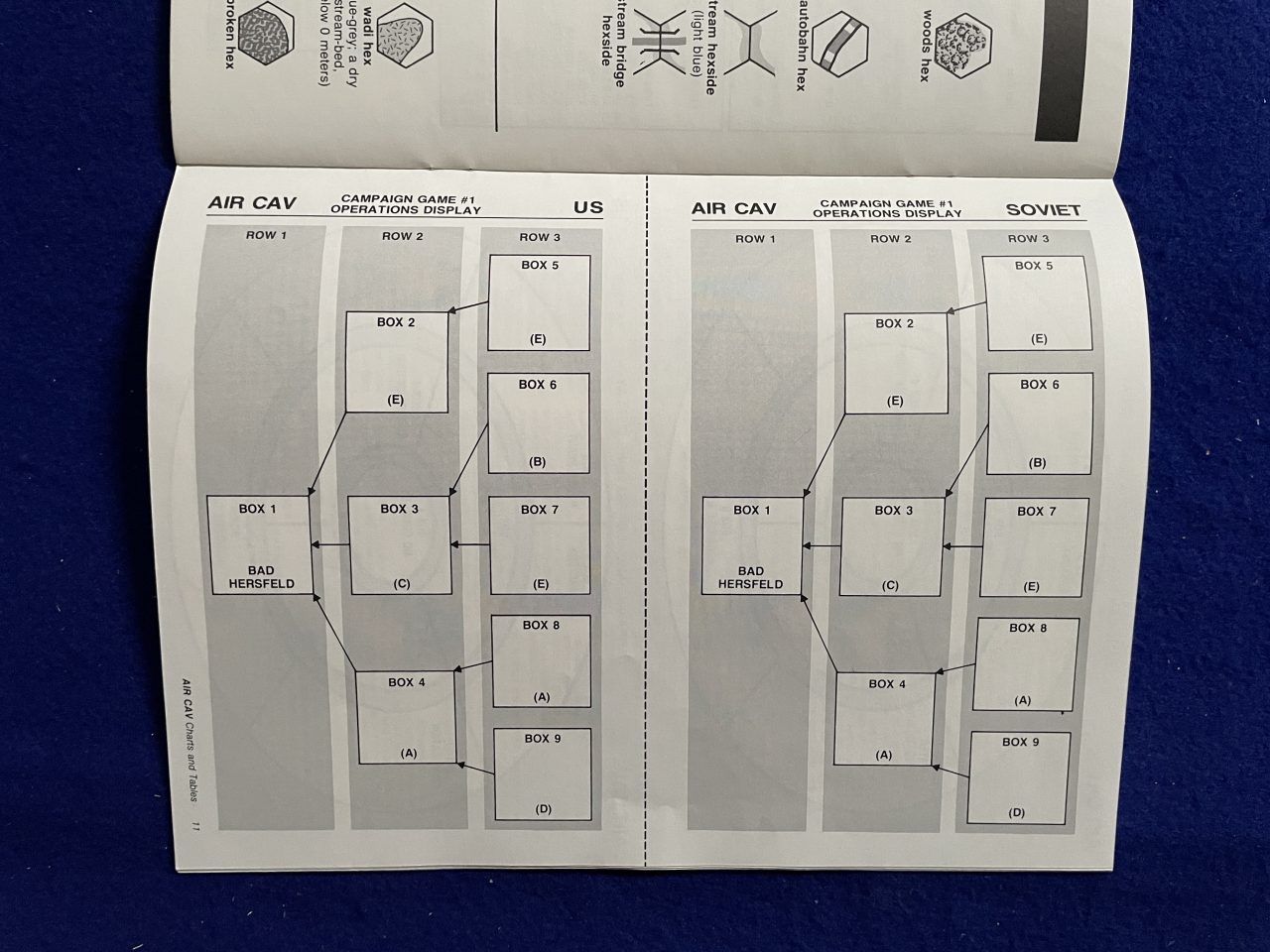
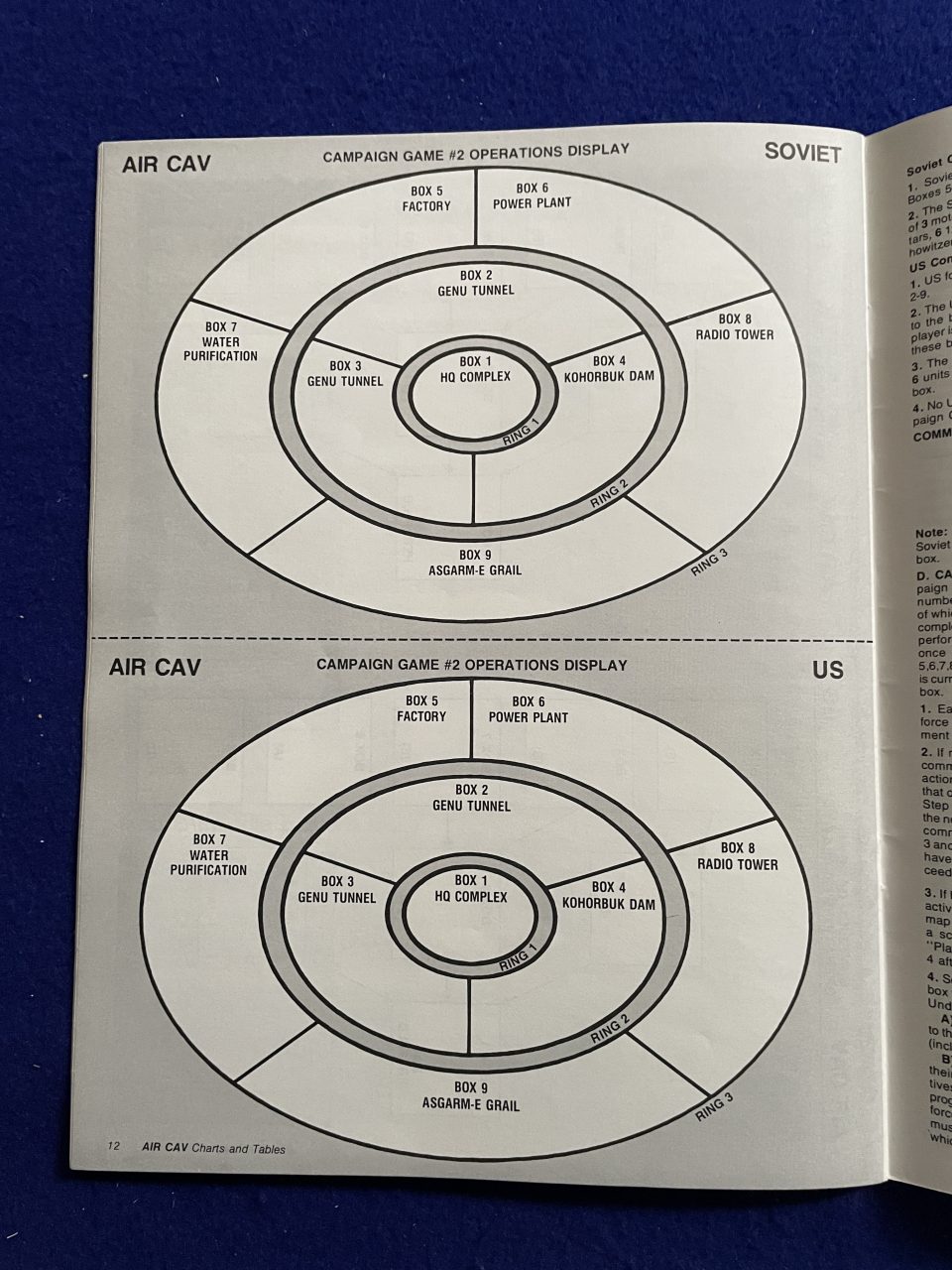
Air Cav comes with two Campaign Games; “A Day in the Life of the 11th Armored Cavalry Regiment” played on the European map and “Light Forces in the Persian Gulf” played on the Middle East map. The former uses a “collapsing-box”, point-to-point, campaign display to portray the advancement of Soviet mechanized forces. The later uses a “target rings” display to show the nine potential battle locations with the winner determined by control of each for variable victory point values.
Round and round like a whirlybird
Let us go back to the Introduction for Air Cav and evaluate its claims now that the entire game has been learned and processed:
- “Air Cav is at once a game and a simulation.” TRUE.
- “The various helicopters are portrayed as accurately as a game permits, and play flows quickly and smoothly.” MOSTLY TRUE; many equipment detail are presented (though abstractly in some cases) in a game that flows with a bit more
back-n-forthinterruptions than I expected. - “There is an impressive amount of information in this package (a look at any data card confirms this); we have presented it as simply as possible.” PARTIALLY FALSE; although the amount of information presented in vast, the many tables and charts and constant need for cross-referencing is not a simple (to use) presentation.
- “To this end there is a Standard and Advanced Game. Those seeking an evening’s fun can play two or more standard scenarios once the rules are understood. The player looking for more realism can read past section 9 and find a more complex undertaking, requiring more time and a greater understanding of the subject.” TRUE…as long as one is not looking for a programmed learning methodology or build-your-own scenario guidance.
For a tactical-scale wargame that claims to be very detailed, Air Cav actually does not really live up to that billing. Granted, there is a vast array of units (helicopters and vehicles) and plenty of weapons (from anti-tank guided missiles down to the M16 carbine [no, really]) but, as many details are presented, when translated into game components or integrated into game mechanisms the details are often abstracted at higher levels. Air Cav has numerous helicopters detailed but at the end of the day it really just comes down to an Attack-Recon Helicopter with a named ATGM firing at a tank that has been binned into one of a defensive few categories.
While conceptually the sequence of play in Air Cav looks—and can be explained—in simple terms in action my games have devolved into a constant round robin of active-inactive player alteration. The active Soviet player is moving but is stopped mid-operation by the opportunity fire of an American helicopter that destroys the Soviet vehicle and takes the initiative, but then is fired upon using opportunity fire of a Soviet anti-aircraft gun that takes the initiative back, only to be fired upon by an American tank that destroys the gun and takes the initiative and…you get the point, yes? Further, each and every time a unit uses OP there is a marker to be added, adjusted, or otherwise fiddled with, not to mention the constant flipping of counters from unobserved to observed sides not only when observed or hiding but when the player just wants to check what is under that stack of counters in that hex or flipping data cards or player aids to look up something in one of the many charts and tables. All of which to say that the complexity in playing Air Cav is not in the details of the units—nor even really in the game mechanisms—but in complexity that comes from physically fiddling with components. Over the years since Air Cav released, helpful players built and made available data cards for units that consolidate much of the data needed for play in a more presentable manner. These “after-market” accessories are essential to make Air Cav fully live up to the promise that the game, “flows quickly and smoothy.”
Air Cav – Detailed yet abstract information in a game designed to flow but challenged with with physical complexity. Recommended…but with caveats.
Feature image courtesy RMN
The opinions and views expressed in this blog are those of the author alone and are presented in a personal capacity. They do not necessarily represent the views of U.S. Navy or any other U.S. government Department, Service, Agency, Office, or employer.
RockyMountainNavy.com © 2007-2026 by Ian B is licensed under CC BY-SA 4.0


You likely never saw Air Cobra, the game that Air Cav was cut down from. That one was FIDD-DULL-EEE… turns with a span of less than a minute, missiles that flew across the map bit by bit, and far more charts than what you were dealing with here.
No…never saw that one. Sounds like a manual flight/combat simulator. Sometimes it is understandable why computer flight/combat sims displaced tabletop games.
I can practically hear the theme music from Air Wolf in the background.
Too bad there are no Airwolf stats. Maybe search BGG for one?