
In Next War: Reimagining How We Fight author John Antal talks about the U.S. military at a turning point. Although many pundits want to say this is all new, Anatal points out “what is new” has older roots:
The US military is at an historic turning point. technological convergence, in the synergy of micro-miniaturization, computing power, robotics, and sensors, is altering the methods of war. Of these, artificial intelligence (AI) is speeding up this paradigm shift. Our AI today is still “narrow,” and simple, but it enables a wide array of smart, autonomous weapons that swim, drive, and fly through the battlespace. For many, the concept of ubiquitous sensors, robotic tanks, loitering munitions, unmanned combat aerial vehicles, long-range precision fires, and AI-enabled kill webs seem to have appeared overnight. This is not the case. These capabilities have evolved over the decades. Consider the Goliath (Leichter Ladungstäger SdKfz 302), an electronically powered robotic weapon developed by the German Army during World War II; it was nicknamed a “bettle tank” by Allied soldiers. Connected by wire to a joystick controller, one soldier could maneuver a Goliath toward a target and then command-detonate the mine with precise accuracy. During World War II, Germany manufactured 7,564 Goliaths and although it was not the first use of robots in war, it is an example of a robotic system deployed and used in combat. Since then, significant progress has been made in the creation of robotic combat systems. Robotics and AI are clearly on the verge of revolutionizing military operations and ushering in a period of hybrid human-machine intelligent systems warfare.
Anatal, pp. x-xi
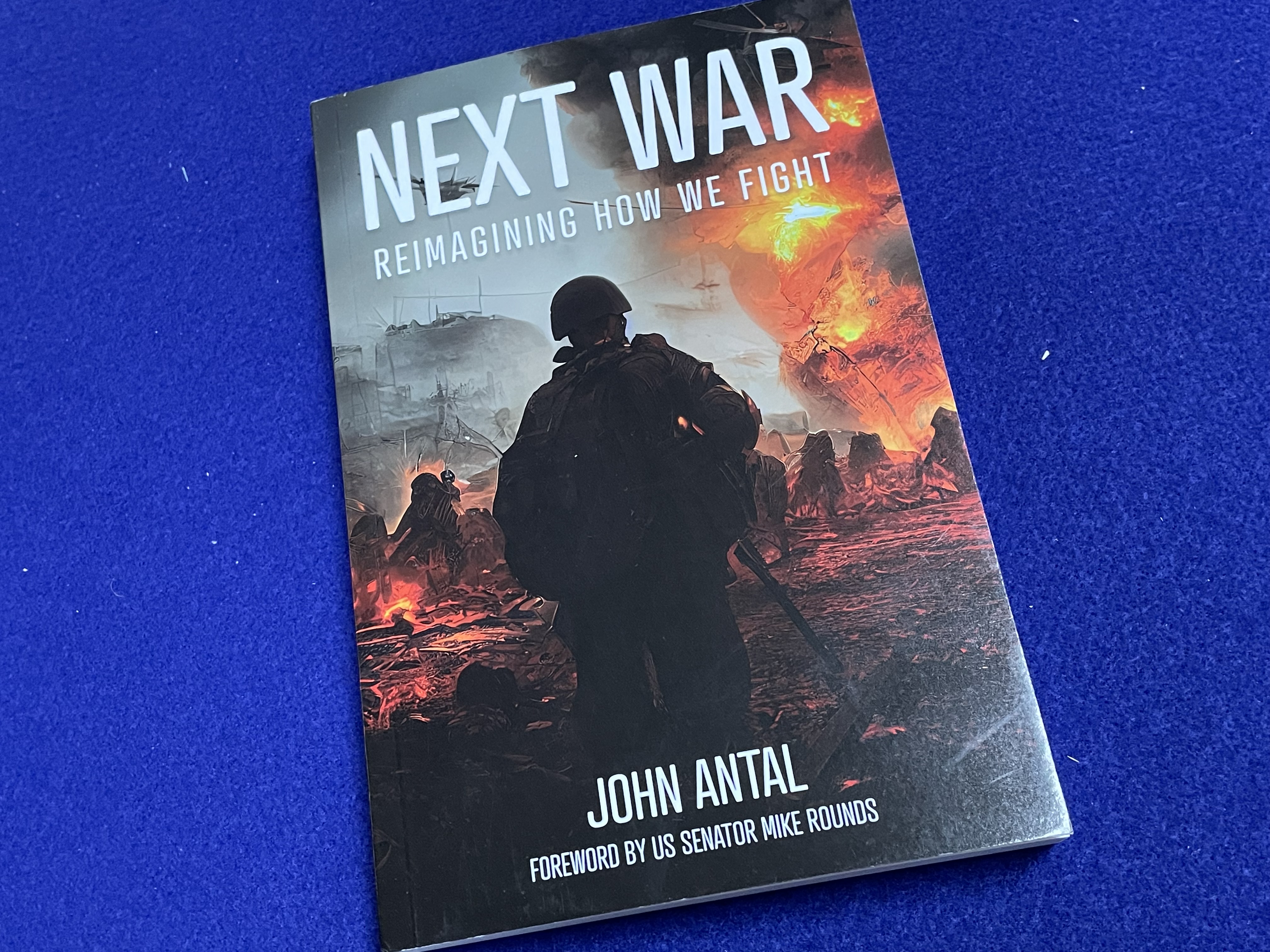
To guide the reader’s study of the changing methods of war, Anatal points to the “Nine Disrupters” of warfare.
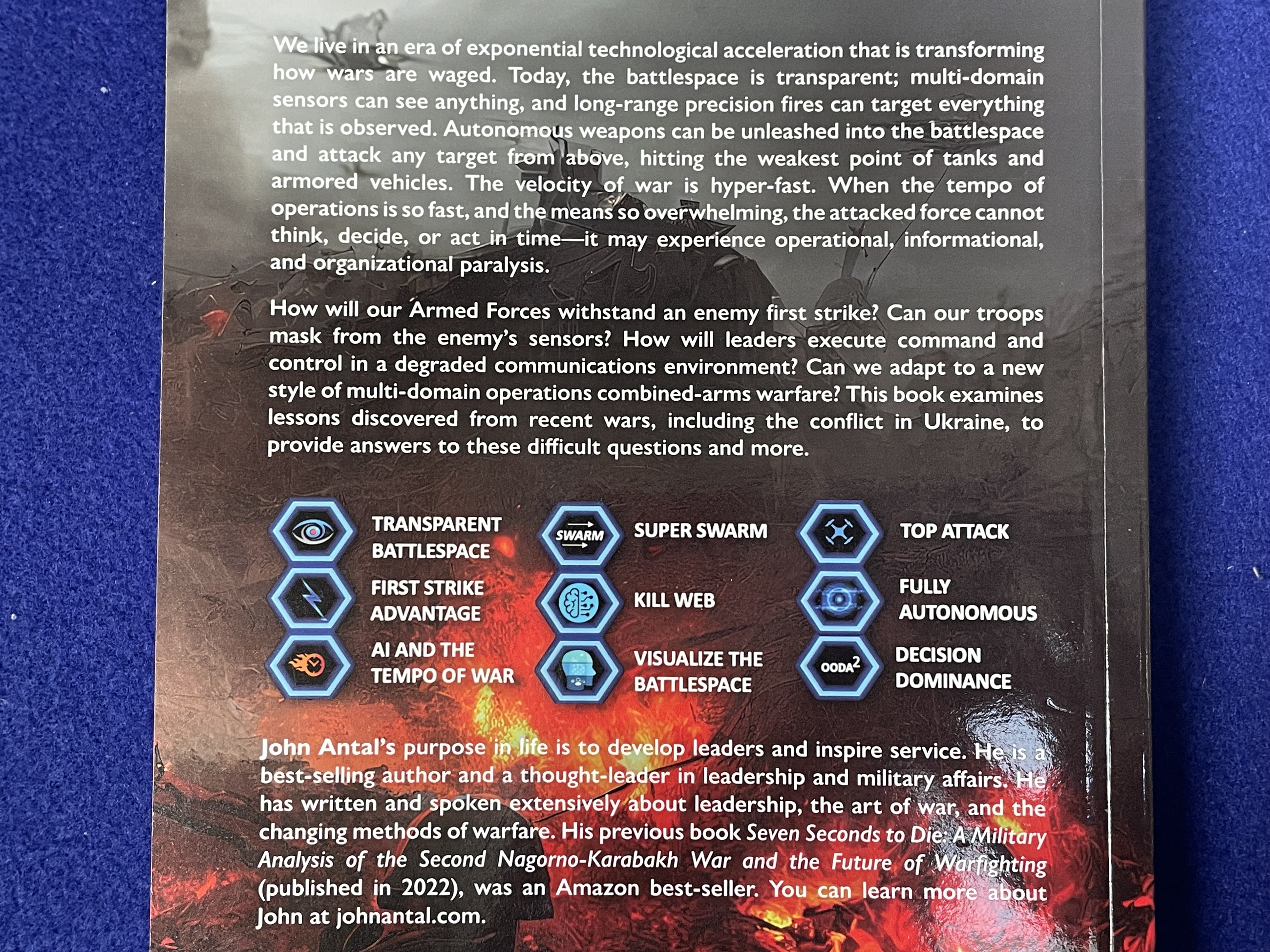
From a wargamer perspective, Next War: Reimagining How We Fight offers tantalizing insights into the modern or near-future battlefield. The challenge, of course, is how to depict one or more of the Nine Disrupters in a wargame. Antal helpfully uses a form of FICINT (Fictionalized Intelligence) in hypothetical accounts to build understanding. Those hypothetical accounts are great starting points for wargame design development.
Recommended.
Feature image courtesy RMN
The opinions and views expressed in this blog are those of the author alone and are presented in a personal capacity. They do not necessarily represent the views of U.S. Navy or any other U.S. government Department, Agency, Office, or employer.
RockyMountainNavy.com © 2007-2024 by Ian B is licensed under CC BY-SA 4.0 
 Rocky Mountain Navy Gamer
But oh what fun it would be to develop those disruptor game systems! 🙂 The pattern of what we see in the real world, notably in Ukraine, would definitely shape any such initial guidelines in a game. (I am playtesting another designer’s game where during the development process we started with single drones but drone swarms have since been added!). In a way its like Near Space in a Cyberpunk or Cyberpunk-style campaign where the near future has expanded commerce (and so likely warfare) into Near Space, so the “near sci-fi” of the disruptors expands our current real-world game rules. Tactics will change and be explored in ways in games we have no way of knowing. A true voyage of battle-discovery!
Hi Rocky,
guess what, I am reading this same book and I thought to post a follow up on our previous discussion re: next war wargaming.
I am a bit of a fan of Antal’s books (I have copy of his 1990s COYA “Armor Attacks”), but as I am reading it I would suggest also to contrast it with Jack Watling’s “The Arms of the Future: Technology and Close Combat in the Twenty-First Century”. The latter book has a thumping introduction in which Watling rightly identifies the problems of the kind of “speculative fiction” that books like the one by Antal (or the one by Snarre that you reviewed recently) use as a device to provoke the reader. He doesn’t write it with all the words, but what that intro spells out to me is some of these authors (Mick Ryan for instance) are trying to convince us of something relying on an “if by whiskey” logical fallacy.
Anyways, great bite-sized piece Rocky, and I also enjoyed Snarre’s review. I guess that there isn’t anything quite like that out there. But you were totally on point noting the shortcomings of the book (like Toffler’s work, a bit of a “intellectual fad”). I reckon that this obsession with (remote) ISR and data collection encourages a very pat conclusion: that whomever has the most sophisticated C4SIR system (or kill web) will see everything coming, anticipate every opponent move, and direct in a super-effective and timely fashion actions to counter those moves.
I think this conclusion is dangerous and is leading to misinterpreting the war in Ukraine quite a bit (see the “transparent battlefield” nonsense), and has led astray nations like Israel quite a bit.
Looking forward to your future writing!
Well, as luck has it I also just read Watling’s The Arms of the Future and will be making some comments on that book, John Antal, and especially Mick Ryan who absolutely tore up the “transparent battlefield” with a devastating observation about the early days of Ukraine’s Kursk offensive. My comments will be posted in a few weeks…
Fantastic Rocky, looking forward to that.