
Grand scale vision
I enjoy wargames from Multi-Man Publishing (MMP), especially their Standard Combat Series (SCS) line. Yet, as much as I enjoy MMP games, I owned no wargames in their Battalion Combat Series (BCS) until I acquired Inflection Point: Battles for Kalach, July 1942 and Battle of Chir, December 1942. Sadly, Inflection Point is one of the last games designed by the late Dean Essig, the long-time Lion of MMP, who passed in 2024. Despite their deep loss, developers Carl Fung and Joe Linder brought Inflection Point to print in 2025.

As Inflection Point is my introduction to BCS, before my first play I took a moment to note what BCS is:
The Battalion Combat Series (BCS) is a simulation of grand tactical warfare from the advent of mechanized armies in the late portion of World War I to the present.
It was created to show that warfare at this level has its own distinct nature and behaviors. A level wedged between tactical and operational warfare. It is neither a large scale version of one, nor a small scale version of the other.
BCS attempts to find the best balance between simulation accuracy and playability and not compromise either unduly.
Introduction, v2.0 Series Rules
Part of the reason I chose Inflection Point as my entry into the world of BCS is from the ad copy. I like wargames that explore dynamic periods in tactical developments. In Inflection Point:
These two battles show the progression of the Red Army into an offensive army that could start fighting toe-to-toe against the invaders. For the Germans, the days of blitzkrieg successes were waning and were being put on the defensive. There was a marked inflection point around Stalingrad.
The game showcases this change in quality and capability between the armies. Units famed for fighting at Stalingrad are here – 24th Panzer and 100th Jäger Divisions as well as the 62nd Army. With rules on crucial air supply that was needed to sustain the German offensive, to stubborn Soviet command in the form of Colonel Konstantin Zhuravlev, players will be able to recreate these pivotal battles. The steppes of Southern Russia are accurately depicted, with rivers, balkas, and small hills being crucial in the otherwise flat terrain. With offensive and defensive possibilities for both sides in both battles, there’s tense decision making in order to win and change the fate on the Eastern Front.
Inflection Point, ad copy
Somewhere along the way I read that Inflection Point, and particularly the Battle of Chir, made for, “an ideal introduction for new BCS players”; a comment echoed in the Inflection Point game booklet. I also admit that acquiring Inflection Point at an introductory price of $63 was a helpful consideration; a new copy from MMP presently retails for $112.
A full battalion’s worth of gaming
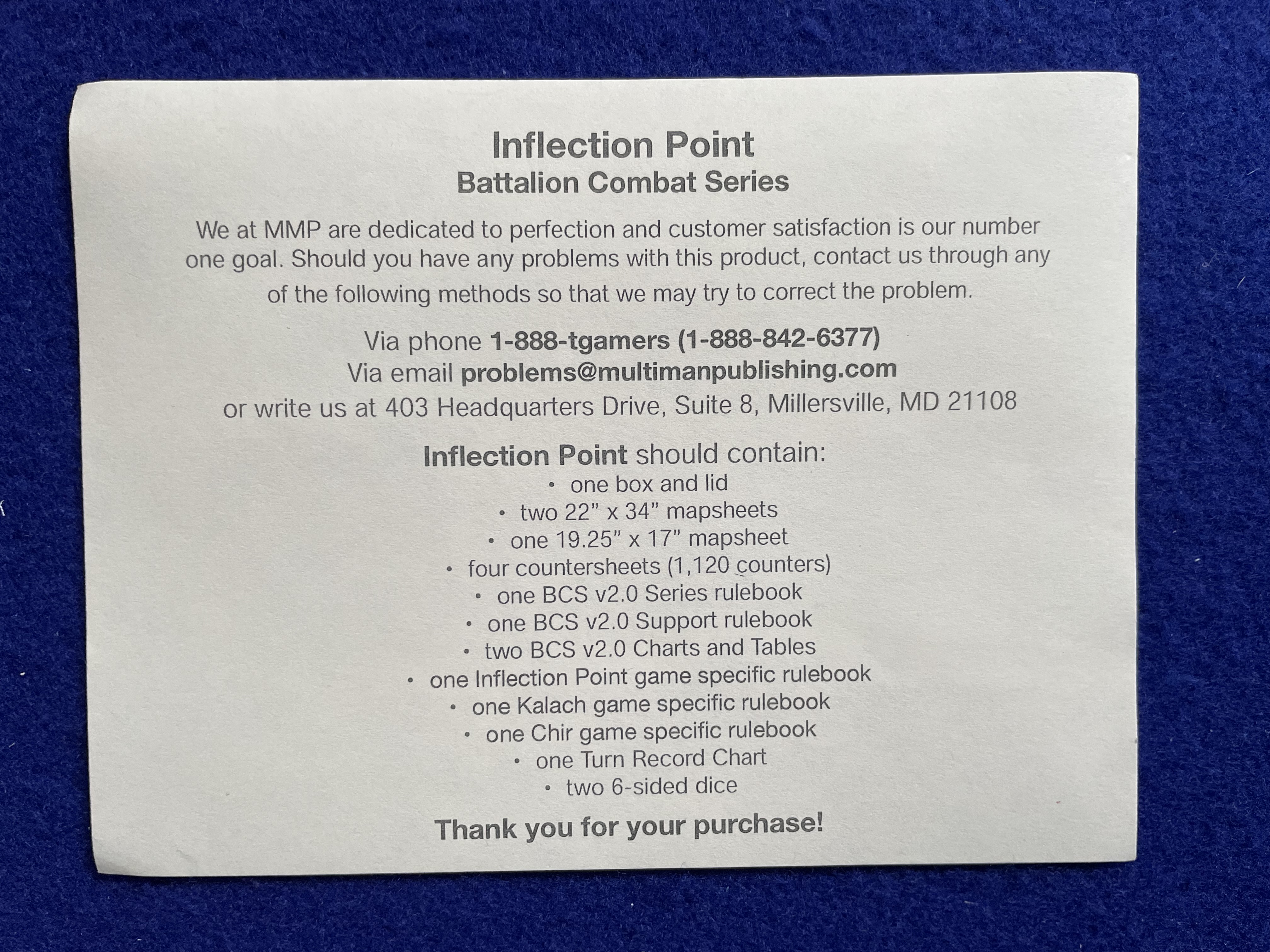
Inflection Point is not a small product. As befits a series wargame with two battles the box is filled with plenty of materials—three maps, four counter sheets, three Player Aids, Series Rules with a Support Book, two Game Rules (one for each battle) and an Inflection Point Game Specific Rulebook that effectively is 12-pages of Designer’s Notes.


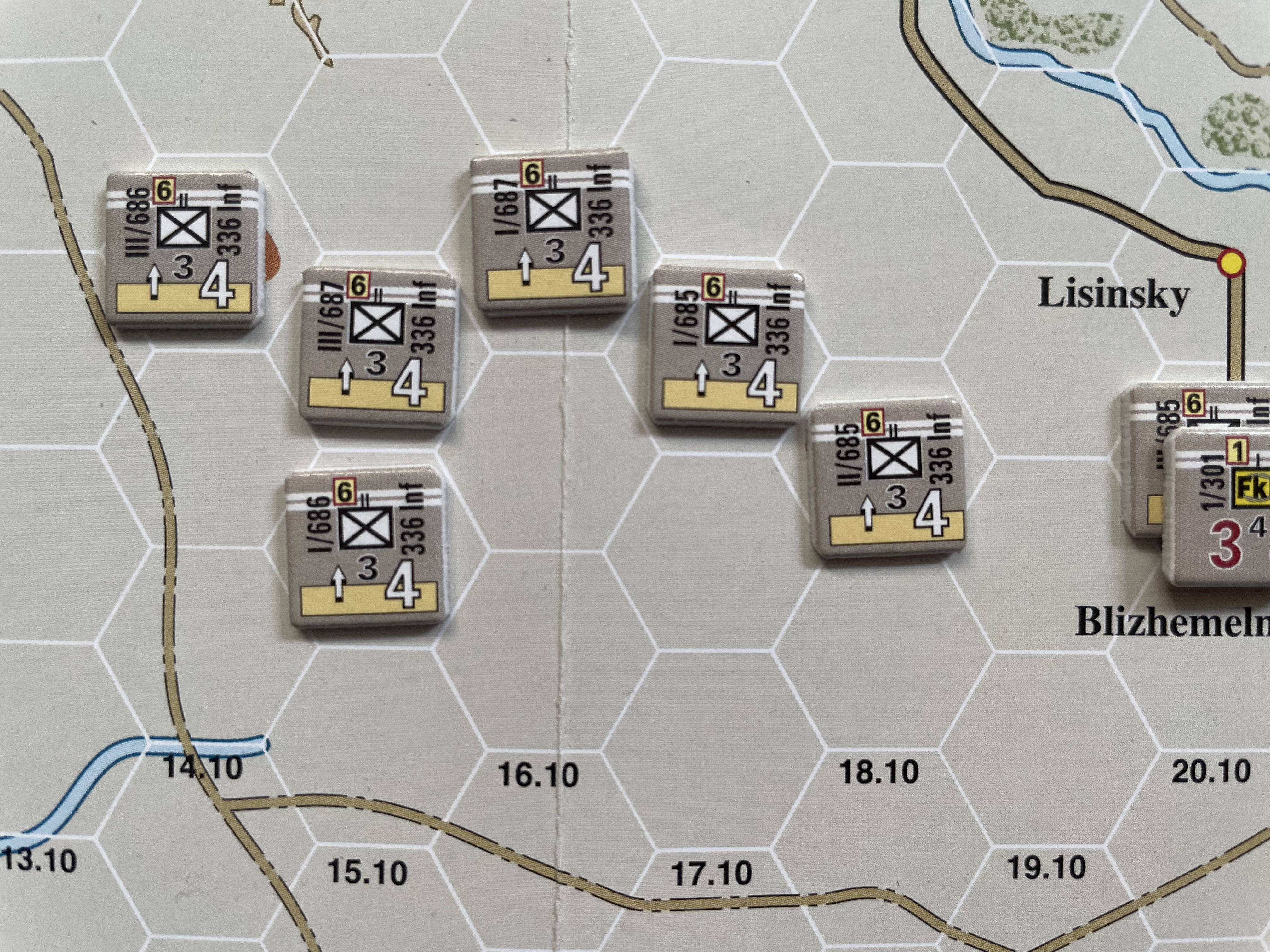
Helpfully, when setting up the Battle of Chir in Inflection Point, MMP made sure that German counters used a double-white line while the Soviet counters got a double-red line to distinguish them from the counters for the Battle for Kalach.
Learning OCS
There is lots—and I mean lots—of printed material in Inflection Point. The v2.0 Series Rules (SR) is 48 pages, the v2.0 Series Support Book (SSB) is 24 pages, the Inflection Point game specific rulebook is 12 pages, and each scenario booklet is four pages. That’s 90 pages of printed material to consider. Fortunately, while looking over the table of contents of the Support Book I saw a chapter titled, “BCS Rules—Read This First.”
So I did.
As a matter of fact, I read most of the v2.0 Series Support Book for Inflection Point first, and I strongly recommend new (and even veteran) gamers to BCS start here too. The Series Support Book is an excellent introduction to the design philosophy and game mechanisms underpinning the BCS system. BCS attempts to show warfare in a manner that many wargamers might not immediately recognize; reading the “why” of BSC before the “how” is helpful to learn the game. The “Read This First” chapter is, in effect, a semi-programmed learning approach to the rules. The Series Support Book recommends following the learning approach in “Read This First” before reading the later “Complete Activation Example.” Personally, I found following the “Read This First” process and reading the “Complete Activation Example” with the Charts & Tables player aid in hand was a very effective way to orient myself to the BCS system.
While the v2.0 Series Rules for Inflection Point uses a three-column layout over its 48 pages, the actual rules, so to speak, are not as numerous as they first appear. Although section “1.0 Basics” has rules, these nine pages more teach key concepts of the BCS system then they actually define rules of play. Section “2.0 Game-Turn Sequence” is where the rules of play truly start and are shorter than I expected especially when one considers the many helpful graphics or text call-out boxes with amplifying information:
- 2.0 Game-Turn Sequence – 4 pages
- 3.0 Formation Activation Sequence – 6 pages
- 4.0 Movement – 5 pages
- 5.0 Combat – just over 7 pages
Section “6.0 Odd Situations” (just under 3 complete pages) has some rules that do not apply to Inflection Point or others that are very optional. After section 6.0 there are 13 pages of Glossary, examples, Series Index, and charts to assist in play. All of which is to say that the “rules” for playing the Battalion Combat Series are about 25 pages—a very manageable (approachable?) learning challenge.
That is not to say, however, that Inflection Point is necessarily an easy game to learn. Rather, playing by the rules requires an attention to detail that some wargamers may not be comfortable with. The added complexity in many cases comes not from overly detailed rules, but from grokking how a rule expresses a key game concept, like front-line logistics, that is often ignored by both wargame designers and players. Personally, as just one example, I admit it took most (all?) of my first learning game for me to understand how Support on a Headquarters display works with a unit on the map.
A “first” Battle of Chir
The Battle of Chir scenarios in Inflection Point are played on a half-sheet map (19.25″ x 17″) and use no more than about 90 Soviet and 60 German unit counters, respectively. There are actually three Battle of Chir Scenarios: 5.1 Battle of Chir River (Campaign – 10 turns), 5.2 Tormosin Offensive (Small – five turns), and 5.3 Attack of the Fifths (Medium – 4 turns). As this is my first learning game I started with the five-turn Small scenario that uses only a portion of the Chir map; that is, the 20 western rows of hexes.
Setting up Inflection Point is quick if you keep your counters organized. Organizing counters should be easy as each formation has a separate and distinctive color scheme. Set up is also an opportunity to admire the research behind Inflection Point; again, like most every MMP wargame, the order of battle is meticulously detailed. I will say, however, that physically the counters in Inflection Point are a bit “soft” which means they often have corner tufts when separating. The counters not only require, but demand, corner rounding especially given the small 1/2″ counters take up a full 1/2″ hex on the game map.

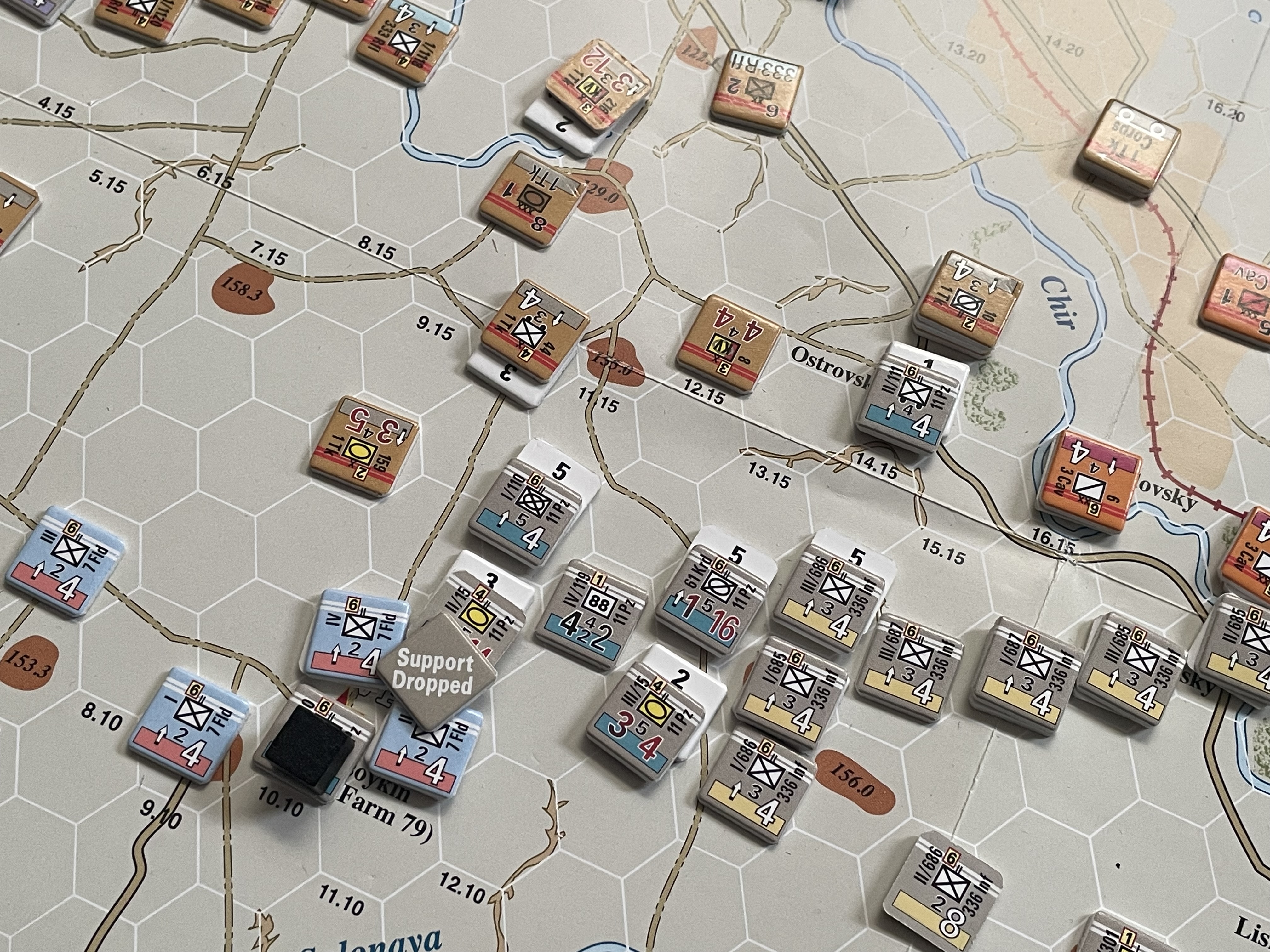
Fortunately, as I was starting my learn of Inflection Point, Joel Toppen, aka @PastorJoelT on X, posted his own play through of the Chir campaign. One thing I noticed was the use of a player aid called a HQ Card. Each HQ Card provides a place to lay out Headquarters Support chits vice spreading them out on the map as the Series Rules show on page 7. I found several different versions of HQ Cards in the BoardGameGeek Files section for Inflection Point; I went with BGG user jrrb2k’s version as I feel it is the best laid out of the several options.


My first turn of playing Inflection Point was very slow as I took a great deal of time to walk through the Activation of each formation. As a learning game, my tactics in this Chir scenario were horrible as I focused on “manipulating the model” over “fighting the battle.” My first few Activations required several resets as I misunderstood or misplayed a key rule. The v2.0 Charts & Tables was extremely valuable during this learning time as this player aid has most of the procedures for an Activation or Combat laid out meaning the rulebook need only be referenced for more detailed explanations.

Once I got through several rounds of learning games, my play through of Inflection Point highlighted to me several strengths of the BCS model. The first lesson was command and control—of Formations. The “BCS Rules—Read This First” article in the v2.0 Series Support Book includes the line, “Understanding Formations is central to playing any BCS game” (SSB, p. 9). Doug Fitch in “BCS Primer: Tips for Playing THe Battalion Combat Series” in the v2.0 Series Support Book expands on that thought further when he writes, “In BCS, you move Formations around the map, you do not simply push pieces. The command and logistical system BCS uses will punish you severely for not thinking in terms of Formation” (SSB, p. 11).
The second major lesson taught by the BCS in Inflection Point is logistics and supply. Few wargames go beyond what Dean Essig called an “accountancy-based system of Supply Points” (SSB, p. 2). Even a “logistics” wargame like Supply Lines of the American Revolution: The Northern Theater, 1775-1777 (Hollandspiele Games, 2017) or the war-themed racing boardgame 1944: Race to the Rhine (Phalanx, 2014) where logistics is the focus comes at the expense of the core combat model; indeed, one could argue the logistics game mechanisms in Supply Lines or Race to the Rhine all-but-replace the combat resolution model. That is certainly not the case in Inflection Point and the BCS rules. In a BCS game the players must be conscious of their Main Supply Route (MSR) and protect it at all cost. In play I found myself pondering the enemies MSR and looking for opportunities to cut them and force a negative SNAFU roll modifier which in turn means less Full—or even Partial—Activations for that Formation.
[Coincidentally, as I spent a week learning and playing Inflection Point I came across an X posting from user @gameape from Japan that looked at probability of results of SNAFU rolls based on the die roll modifier (DRM). As shown in the graphic below, @gameape may be onto something when he says, “Maybe you can still put up a decent fight?”]

My five-turn play through of the Tormosin Offensive along the Chir River in Inflection Point was a Soviet Victory with three of five Victory Point hexes controlled at the end of the game. While the game was a Soviet victory, it was actually a very near-run situation. Levering the Germans out of the two-hex city of Surovikino was difficult; initial frontal assaults that drained attackers were quickly seen as fruitless. After the MSR for KG Stpfld was cut the defenders proved less resilient with fewer opportunities to Activate in order to rearrange defenses and suffering from a die roll modifier (DRM) favorable for the attacker with an MSR Blocked. Eventually, many KG Stpfld units were simply cut off from the Headquarters with “No Safe Route” in BSC terms and “Isolated” which eats away Steps. Then there was the matter of getting Soviet reinforcements across the map and into the battle with MSRs that were “crossed streams” or “mixed formations” as one Formation passed through another.

[In this play of Inflection Point I also continued my streak of low die-rolling. I swear that my average die roll on 2d6 was maybe a [4] or [5]. I started out the game with a single pair of Soviet and German dice each but quickly brought out several more pairs for each side to have a pool of dice to draw from in order to keep the evil dice gremlins away. By the end of the game a “rotation” of six dice per side saw the rolls return to an “average” of [7] or [8] but, again I swear, those were the top rolls. I am not sure I rolled a set of “boxcars” ([12]) the entire week—that is, of course, until I rolled for the photo below…]

BCS elegance
In the Designer’s Notes for the v2.0 Series Support Book in Inflection Point, the late Dean Essig wrote:
There are quite a few mechanics in this system that go against the grain of traditional wargame fodder. All were carefully chosen to show what they are designed to show, and tempered by exhaustive testing. All contribute to my goal of giving the player an insight into this level of warfare he’s been denied until now.
Designer’s Notes, SSB, p. 5
My play of the Battle of Chir, Tormosin Offensive in Inflection Point was not only an opportunity to learn the rules but also very entertaining. I found myself struggling (in a good way) to try and keep “a tidy battlefield” with Unit Blobs and MSRs neatly separated. I found myself watching the Fatigue level of each Formation like a hawk less it become “unavailable” at a key juncture of the battle because it needed to take a Recovery Activation. I started to understand how BCS encourages players to look at different types of attacks—not everything is simply “drive up the an adjacent hex and roll on a Combat Results Table.” I was also reminded that, though historians and grognards tell us that Chir was an armored battle, tanks did not make up a major part of the fighting forces. If you are looking for swirling tank battles on the steppes of Russia, go play Jim Day’s Panzer 2nd Edition from GMT Games (2012); if you are looking for how the Russians and German campaigned in late 1942 then Inflection Point is your gateway to understanding.
After my clunky start it was nice to see that by the third or fourth Activation of the first turn I felt like I was starting to grok the core game mechanisms behind Inflection Point. Doug Fitch writes in the article, “BCS Primer: Tips for Playing the Battalion Combat Series” in the v2.0 Series Support Book that, “While the game mechanics are quite elegant, previous gaming experience can hinder, rather than help, your attempt to learn the system” (v2.0 Series Support Book, p. 11). I am forced to agree. Playing Inflection Point in the Battalion Combat Series is not as hard as the many rules seemingly indicate but they do require grognards to “play by the rules” and not “assume” that they know how a rule works based on past experience with other wargames. Strictly sticking to the Sequence of Play and the steps of a Normal Activation feels cumbersome at first but the process quickly becomes second-nature in part because the sequence of events feels natural, not directive. Inflection Point conveys the elegance of the Battalion Combat Series in a very playable game that requires some intellectual investment up front but the payoff from that investment is a tactical/strategic challenge delivered in a highly enjoyable play experience.
Good thing I have the next BCS game from MMP, Arracourt, already on pre-order. Maybe you can help get Arracourt: Battle for Arracourt, 1944 to print with a pre-order of your own…

All images by RMN unless otherwise credited.
Feature image courtesy RMN
The opinions and views expressed in this blog are those of the author alone and are presented in a personal capacity. They do not necessarily represent the views of U.S. Navy or any other U.S. government Department, Service, Agency, Office, or employer.
RockyMountainNavy.com © 2007-2025 by Ian B is licensed under CC BY-SA 4.0
 Rocky Mountain Navy Gamer
That’s a mighty fine-looking dice tray!