
Thanks to the generosity of publisher Yasushi Nakagoro, this year I took in several Bonsai Games titles. August Storm: The Soviet-Japanese War, 1945 by designer Javier Romero appeared in the Mid-Summer 2025 issue of Banzai Magazine Nr. 26. I finally got the chance to get August Storm to my wargaming table and discovered a small magazine wargame on an under-gamed topic that that is not super complex and playable in an afternoon.

Political storm
In the Introduction of the rules to August Storm, Designer Javier Romero states the game, “is based on the theories of historian Takeshi Hasegawa (also rendered as “Tsuyoshi Hasegawa”) who wrote it was the Soviet declaration of war, not the atomic bomb, that ultimately led to Japan’s surrender” (1.0 Introduction). On 8 August 1945, the Soviet Union declared war on Japan and invaded in Operation August Storm. Historically, during the Soviet offensive the Japanese army performed very poorly, sometimes with whole units surrendering to the Soviets without firing a single shot. (“Manchukuo.” Accessed October 16, 2025. https://www.newworldencyclopedia.org/entry/Manchukuo). Japan ultimately surrendered on 15 August (Turn 3 in August Storm) but it took some time for the ceasefire to take effect (hence the variable game length of between four and nine turns).
Taking a wargaming table by storm
August Storm first appeared in Command Magazine Japan Nr. 142 in August 2018. Bonsai Games brought August Storm back in the summer of 2025 in Banzai Magazine Nr. 26. As a magazine game the components are few: an A1 sized map (roughly 23″ x 33″), 198-piece countersheet with 9/16″ counters, two Player Aid cards, and a 28-page rulebook.
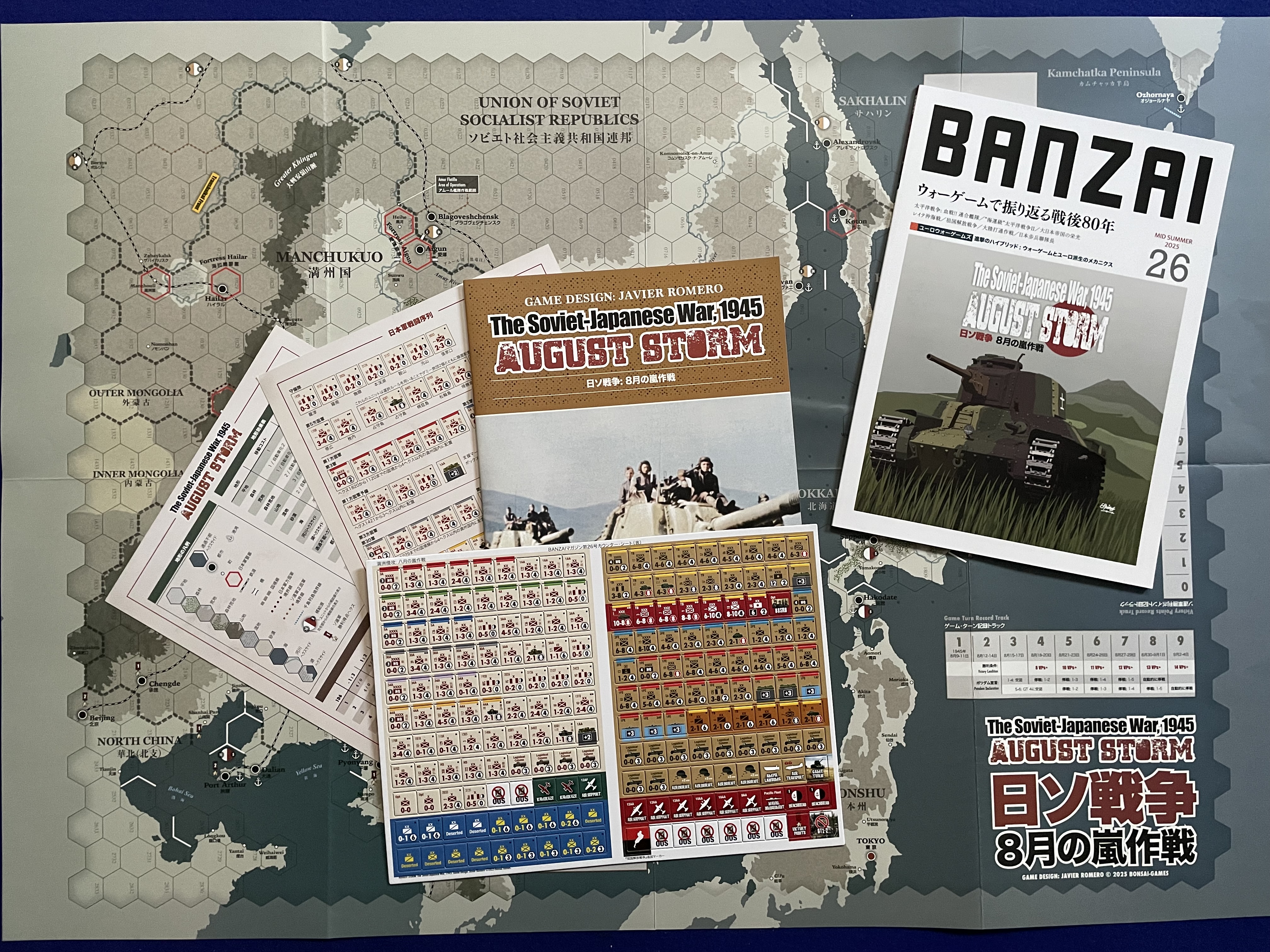
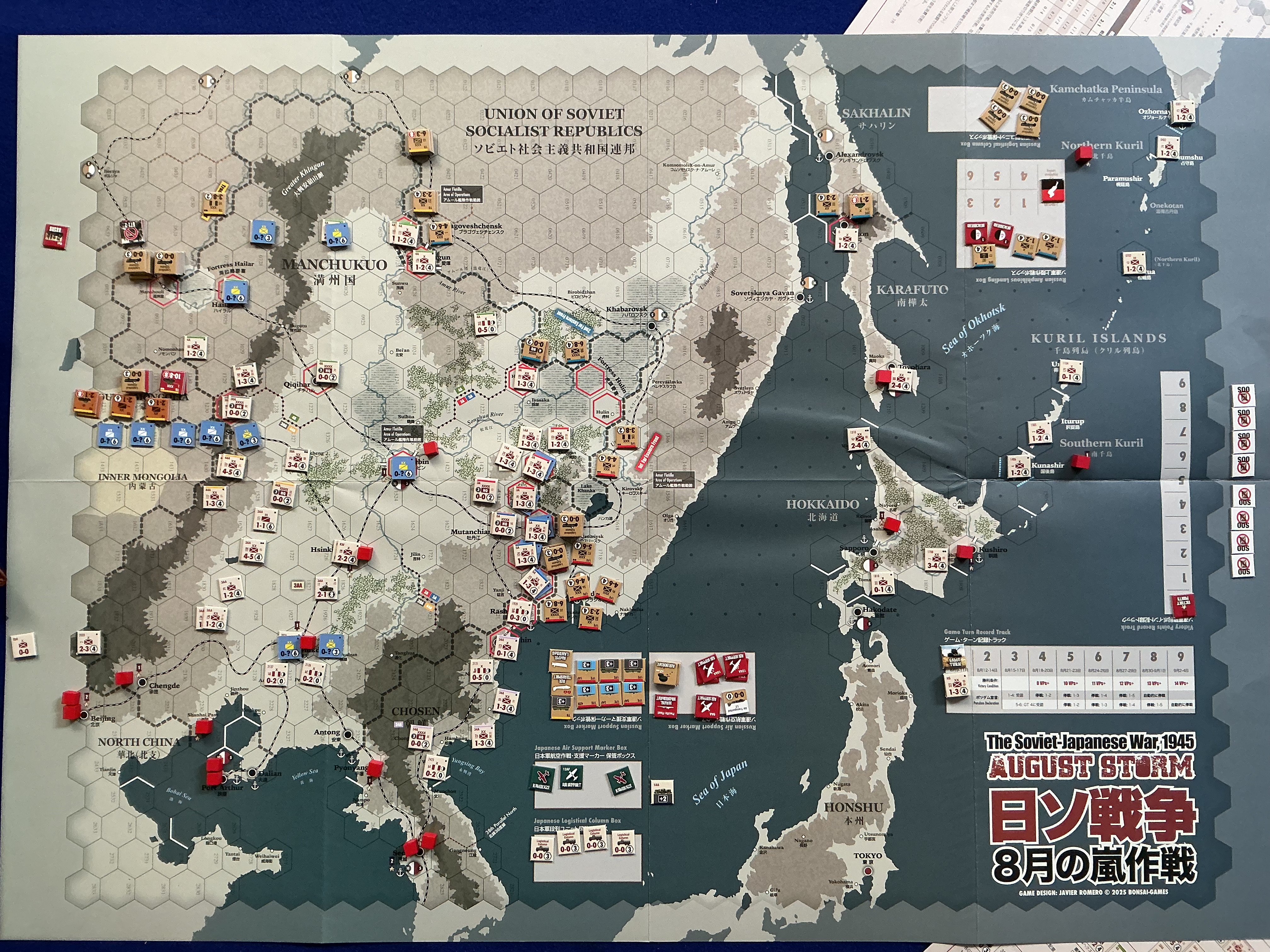
In August Storm, each hex is 90 km across and counters represent Divisions/Brigades for the Japanese and Corps/Divisions for the Soviets or an air army of 200-400 aircraft. Each turn is three days of time. The overall counter density at set-up is low as each side starts with 80-90-ish units. The hexes on the map are a generous 7/8″ that comfortably fit the 9/16″ counters with plenty of holding boxes for markers also laid out. The “gutter”of used space around the map edge helps “frame” the game which makes it look great on the table.
The rules for August Storm are not very long, taking up 13 pages of the rulebook (an English translation the designer posted on BoardGameGeek is 22 pages). The Japanese rulebook also includes a four-page Extended Example of Play and a nine-page historical backgrounder. As I was new to August Storm and unsure about opening strategy I used a nice two-page spread showing an initial setup in the Example of Play to “set” my first game.
Storm-ing dice
Play of August Storm is rather straight-forward. The Sequence of Play is a very simple Soviet Move/Combat followed by Japanese Move/Combat and an End of Turn Phase checking supply and victory. Basic Zone of Control and stacking rules are used, though in a wrinkle Mechanized units that enter an Enemy Zone of Control can continue movement by paying a single Movement Point. A Terrain Effects Chart (TEC) is used for movement; the rules again are very simple and uncomplicated.
If there is any complexity in the rules for August Storm they are found in section 10.0 Combat. Combat resolution uses an odds-based Combat Results Table (CRT) with a few notable differences from usual combat resolution game mechanisms:
- Combat Odds. One difference I noticed is that if the attacker is stronger than the defender the final odds are rounded down but if the defender is stronger than the attacker the final odds are rounded up.
- Untested Units. Manchuko and Inner Mongolia Army units have a “?” for defense strength when first deployed and are turned face-up when attacked. Some units will have a defense strength of 1 or 2 while others are marked “Deserted” which are immediately removed from the game.
- Column Shifts on CRT. Instead of the usual die-roll modifiers, modifiers in combat are shown via column shifts on the CRT. Different terrain causes different column shifts—usually to the left in favor of the defender—while other factors such as supply, Air Support, or Naval Gunfire and the like can shift left or right depending on if it is the attacker or defender employing it.
Combat results (rule 10.10) in August Storm are expressed simply in terms of Attacker/Defender step losses—there are no Retreat results. Instead, an “Overkill” game mechanism is used for hits in excess of those needed to destroy an enemy unit which states:
- “Attacker’s Overkill: Should the attacker suffer overkill, the defender’s damage is reduced by 1 for each undistributed point of damage.”
- “Defender’s Overkill: Should the defender suffer overkill, the attacker may conduct a breakthrough (10.12) and advance through the breach (10.13).”
The most important game mechanism in August Storm is perhaps that “Defender’s Overkill” result. The actual rule is a bit more complicated than stated above; players need to understand the interaction of rule 10.11 Advance After Combat, 10.12 Frontline Breakthrough, and 10.13 Breakthrough Progress”
- In combat, if all defending units in a hex are eliminated, the attacker may use 10.11 Advance After Combat to move into the target hex.
- If “Defender Overkill” resulted in 2 or more undistributed step losses, the advance becomes a Frontline Breakthrough (10.12).
- In a Frontline Breakthrough (10.12) the undistributed overkill hits are converted into movement points for use by attacking units.
- If the units in a Frontline Breakthrough occurs, the Soviet player can take any Mechanized or Calvary units that are not adjacent to a Japanese unit and did not participate in combat and advance them up to half their movement as long as they pass through the “target hex” of the original combat. During this Breakthrough Progress enemy Zones of Control are ignored and the Breakthrough mechanized units cannot attack.
Taken together, the rules for Defender’s Overkill, Advance After Combat, Frontline Breakthrough, and Breakthrough Progress is how the Soviets truly “advance” towards their Victory Point cities in August Storm. As Romero notes in 15.0 Designer’s Notes, Soviet tanks advanced at an average of 80 km per day, or about three hexes. This means that, In Manchuria/Korea and on Sakhalin, 13 Victory Points are “within reach” given four or five turns of “average” advance (another four Victory Points are reachable with amphibious invasions).
Storm-ing to victory
As mentioned above, a game of August Storm will run for between four and nine turns. The actual end of the game is determined by two die rolls; the first is for when the Japanese accept the Potsdam Declaration and a second when the Ceasefire actually takes effect. Depending on the turn the game ends, the Soviet player needs to hold a variable number of Victory Points to win. If the Soviets have not earned the needed number of Victory Points, the Soviet player then gain points for “Japanese hunting,” as ordered by Stalin.

Why Storm?
I have mixed opinions of August Storm. On one hand, the game is relatively simple to learn and play with some interesting mechanical twists, such as Frontline Breakthrough and Breakthrough Progress, that not only feel thematically appropriate but also are fun in play. On the other hand, August Storm feels a bit like what I imagine clubbing seals would be; done for no reason and unsatisfying. In many ways August Storm is not a wargame as much as it is a race game; that is, a race for the Soviets to see how fast they can accumulate Victory Points. If Soviets cannot win by seizing cities then they gain extra for “hunting” Japanese units. The question posed by August Storm is not “if” the Soviets will win, rather, the question is “by how much.”
I am also unclear how August Storm showcases the end of war theories of Takeshi Hasegawa. The “political” decision to accept the Potsdam Declaration and Ceasefire timing are driven by dice and not player agency. It does not matter if the Soviets are doing good or bad on the battlefield for the die rolls will always be the same. As is so often the case, soldiers on the battlefield fight at the whims of the politicians. In August Storm the players are the soldiers and the politicians are…dice.
August Storm; a wargame with interesting rules but a setting that is ultimately unsatisfying to play.

Feature image courtesy RMN
The opinions and views expressed in this blog are those of the author alone and are presented in a personal capacity. They do not necessarily represent the views of U.S. Navy or any other U.S. government Department, Service, Agency, Office, or employer.
RockyMountainNavy.com © 2007-2025 by Ian B is licensed under CC BY-SA 4.0
 Rocky Mountain Navy Gamer
hey, whaddaya know?! 🤠
https://armchairdragoons.com/japan-surrender/
Many years ago I devised a corps/army system based on chit pull formation activation and near-diceless combat resolution.
I was going to use it for an August Storm game but events intervened and I ended up using it games on the Bulge (designed 2002), Poland 1939 (designed 2009) and the Allied invasions of the Med that weren’t (designed 2006).
I always thought about going back and doing what I originally intended one day, but now that Javier has covered it I don’t feel I have to.
This was the third largest campaign of WW 2 as well as the shortest and the last, but militarily it is not so satisfying.
I think an interesting game could possibly be made on the logistical efforts to build and support the campaign in the months leading up to the execution date – these were truly remarkable and were done over a small number of single-track railways!