
Topical
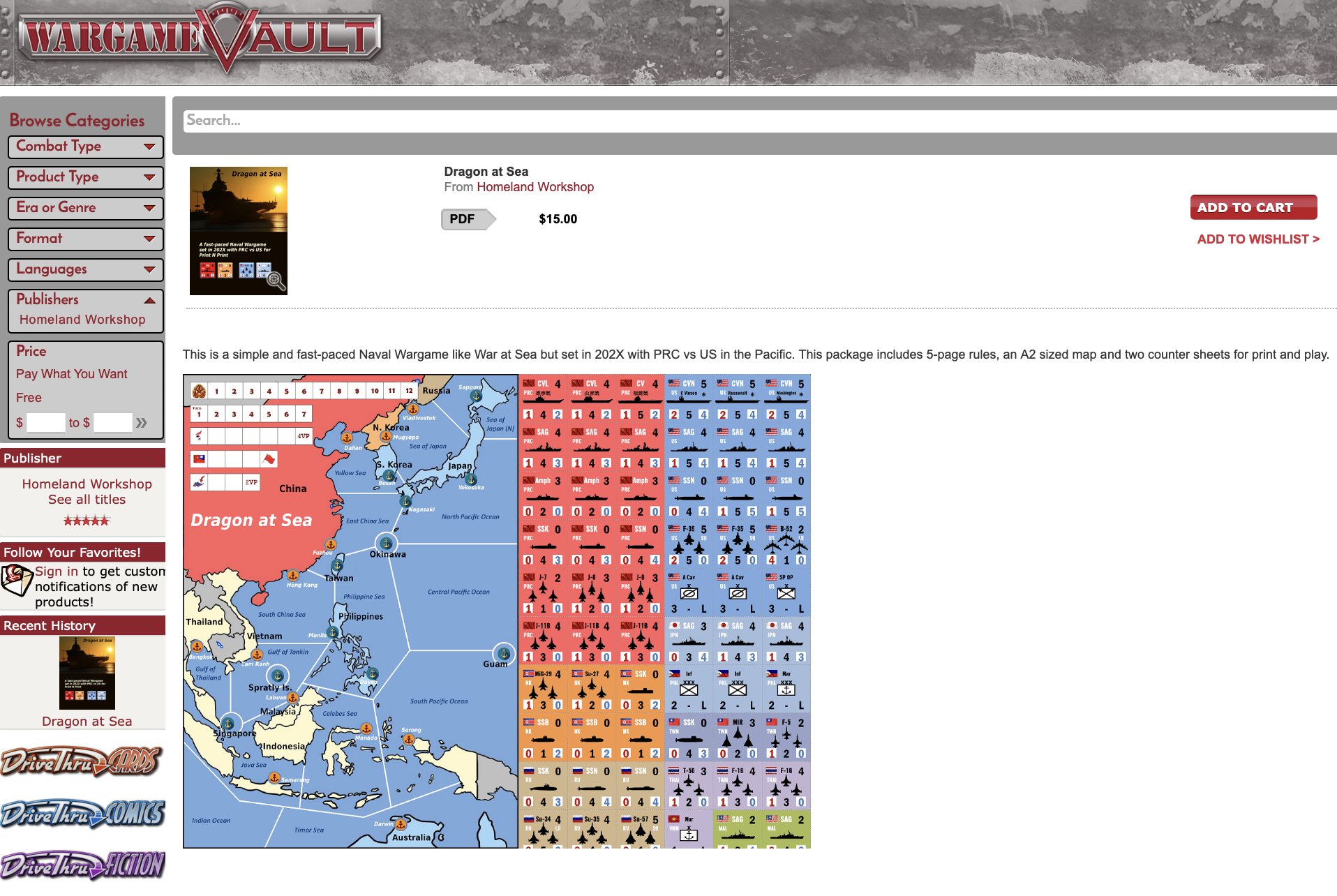
Available on WargameVault is a Print-n-Play (PnP) title called Dragon At Sea. Designed by David Cheng, the game touts itself as, “An exciting naval wargame about China vs US in the Pacific in 202X.” The description of BoardGameGeek relates, “Game map is area based like the classic game War at Sea. Game map is A2 size. The game has 352 counters.” The title sells for $15. Given the topic I jumped at the chance to explore this game. That is a decision that I now…regret.

Look at the small print
Dragon at Sea is a simple wargame. The four-part map prints out to A2 size or a bit under 24″ x 17″. The two countersheets deliver 330 counters and markers. At first glance that appears to be a robust wargame.
Then you get to the rulebook for Dragon at Sea...all five pages of it. In a single column. That is a very slim set of rules; even the 1976 War at Sea rules were six, three-column pages. Yes, there is a game in those rules…barely. The rules explain the six-Phase game turn and presents rules for resolving Air and Naval Combat or Ground Combat. I think the rules are (barely) sufficient for play but the way they are presented—bulleted lists with few headings—makes finding a rule difficult. For example, the movement rules for Naval units are in the Counter Explanation section. Stacking rules are seemingly an afterthought (though in red text) in the description of an Air and Naval Base. Invasion rules (yes, they are there) are buried in the Ground Combat Resolution section.

Broadly speaking, Dragon at Sea suffers from an identity crisis. Not highlighting the Invasion rules is a particularly egregious offense as that game mechanism is the real determinant of victory. While the game lasts seven turns, the status of three Invasion tracks (Taiwan, Korea, and Singapore)—not naval forces in this “naval combat” wargame—are the real judge of victory. When resolving Ground Combat in a named area, whenever a roll of 1, 2, or 3 is made the marker on the Invasion Track is moved one box in that side’s direction (to a maximum of three boxes in a combat). If the marker ever moves off the right end (PRC side) of the Invasion Track the Invasion ends and the PRC player scores Victory Points (VP). Given the centrality of Invasion to victory, I wonder as to why this very important rule, key to unlocking the core strategy of Dragon at Sea, is buried like a minor sub-point in the secondary Ground Combat section of this “naval wargame?”

Frankly, for a game that touts itself as a “naval wargame” the Victory Conditions force players to focus on anything but. The only player to “score” VP in Dragon at Sea is the PRC player. The game ends instantly if the Taiwan Invasion completes or if the PRC player scored eight or more VP by game end. The PRC scores by completing Invasions, controlling Blue bases, and sinking US CVN/CVX. Nothing else matters is this “naval wargame.”
Little fire
Looking back at the nearly 1,900 posts over the past seventeen years on this blog, you will almost certainly see that I rarely call a game bad. Even with games I do not like I try to find something positive to say. Many designers have, after all, poured their hearts into designing and testing and publishing a game. If nothing else they deserve warm recognition for that effort.
I have a hard time to find much to speak warmly of when considering Dragon at Sea. Yes, the game is simple. Yes, it is a dice-chucker. Yes, it plays relatively fast although the many counters seem to dogpile across the map. I guess there is a strategy to be used to attack bases and push forces into Invasion Tracks for combat. Yes, all that is there…in a very underwhelming game that seems to have little real direction other than to throw lots of dice around the table…
…and I paid $15. While Dragon at Sea is something of a wargame, I certainly do not feel that I got $15 worth of game. I am not talking about physical components—this is clearly marketed as a PnP title. No, I mean the quality of the game experience delivered comes up way short of what I think a $15 PnP should be. Compare Dragon at Sea to most any title from Hollandspiele or Tiny Battle Publishing or Flying Pig Games around that same price point. There is no comparison. Dragon at Sea is grossly overpriced.
I am going to try to end on a positive note here and say Dragon at Sea is a very simple dice-chucking wargame themed around a future-ish conflict in the Pacific. Play Dragon at Sea if the topic strongly appeals to you and you like plenty of dice-throwing in your games. I respectfully, however, strongly recommend waiting for a deep sale.
Feature image courtesy Pexels free photos
The opinions and views expressed in this blog are those of the author alone and are presented in a personal capacity. They do not necessarily represent the views of U.S. Navy or any other U.S. government Department, Service, Agency, Office, or employer.
RockyMountainNavy.com © 2007-2025 by Ian B is licensed under CC BY-SA 4.0
 Rocky Mountain Navy Gamer
I also bought a copy and printed it. During this same time, I happened to be watching YouTube videos about PRC military hardware and noticed that the parameters on the PRC units bore little semblance to reality. I guess the game developer really loves mainland China. I also edited the rules somewhat. Why are there two maps, one good enough and one really tarted up?
🫣
😬