
While simplicity is a principle of war, the plan can not be so simple and repetitive that the enemy can easily defend against it or defeat it.
Williams, Gary H., Lieutenant Commander, U.S. Navy (1997) “Operation Linebacker II: An Analysis in Operational Design,” Newport, RI: Naval War college
In an August 2020 column for the website University XP, the topic of player agency was discussed and this definition offered:
Player agency is about giving players the interactivity to affect and change the game world. Though agency, players have power to influence and change what is happening in the game. It provides them control (or at least of sense of it) of what will happen next.
This means that players should be given the ability to make decisions in the game. But these decisions shouldn’t be trivial – at least from the player’s perceptive. It isn’t just about choosing a particular skin or a hat for a player’s avatar. Instead, it’s about making sure that your players can make meaningful decisions in the game.
“What is Player Agency?”, universityxp.com, 20 Aug 2020
The wargame Dec 1972 – Linebacker II designed by BJ Mills from Cadet Games (2024) is not only a look at a historical event—the December 1972 Christmas bombing offensive in Vietnam—but also an interesting study in player agency. The degree of player agency—or lack of such— in Linebacker II delivers a wargame that is more a guided historical recreation than a sandbox for exploring alternative outcomes.


“Anything less will only make the enemy contemptuous” – President Richard Nixon
Operation Linebacker II was an eleven day air campaign during the Vietnam War dedicated to bringing the Hanoi back to the negotiating table. While much is written about the heroism of the B-52 pilots of the U.S. Air Force (USAF) Strategic Air Command (SAC), there are just as many (if not more) criticisms of the campaign plan. Those criticisms often center on the inflexible planning for the B-52 bombers which was conducted from SAC Headquarters in Nebraska. As Williams relates:
During the first phase of the operation (18-20 December) the plan was executed exactly as written with no provision for change to conform to the present environment. The reason for the repetitive plan was because SAC felt the lead time needed to develop a new plan and implement it was too prohibitive. Additionally, it was believed that utilizing the same route in and out of the target area as before would benefit the more inexperienced crews.
Williams, p. 12
The B-52 aircrews, in effect, had no agency and when losses mounted their morale suffered. The wargame Dec 1972 – Linebacker II likewise has agency issues. In the case of the game, however, the challenge is player agency.

BUFF gaming
This is how Cadet Games summarizes Linebacker II:
Linebacker II lasts up to 11 campaign nights (basically, multi-step game turns). Each campaign night contains several phases, simulating the complex events of the historialy night raid air campaign against North Vietnam from Dec 18—Dec 29, 1972. The NVA [North Vietnamese Army] player organizes their air defense assets and attempts to inflict aximum losses on the US forces. the US player executes a series of raid waves using B-52 bombers and a host of supporting aircraft each campaign night, inflicting damage on multiple stratgic targets in North Vietnam.
At the end of each campaign night or phase, the US player checks to see if their cumulative bomb damage points and subtracts any loss points to get their victory point score. If the score meets the required total, the campaign continues for another night or phase. If not, the NVA player has won the contest.
Linebacker II, Summary of Play
SAC planning
The sequence of play for Linebacker II is fairly straight forward with each night (turn) played out through the course of three broad arcs. The first is what I call the planning or organization arc.
- Chance Cards. Each player will roll a die for a Chance card. Yes, you read that right; players need to roll a chance device to determine if a Chance card is drawn which has the chance of being helpful or hurtful.
- NVA [North Vietnamese Army) Air Defense Air Defense Organization Phase. The NVA player places their defense around targets using a combination of anti-air artillery (AAA), surface-to-air missiles (SAMs), and fighters.
- SAC HQ Planning Phase. “Both sides first choose and then present their SAC HQ planning cards…” (Linebacker II Sequence of Play).
- 1st Raid Wave Planning Phase. “The US player consults the playbook or the effective SAC HQ Plan parameters an builds the next wave plan on a Raid Wave Attack and Support Plan Layout” (Linebacker II Sequence of Play).
In this arc of Linebacker II players certainly posses player agency and are making meaningful decisions. The NVA player decides on their defensive arrangement while the US player decides on targets, routes, numbers of bombers in the raid, and supporting aircraft.
The SAC HQ Planning Phase in this arc of Linebacker II is very important and has the greatest impact to player agency of any step in this phase. The rule is (unfortunately) not clearly written so there is much room for confusion. Basically, the cards on the SAC Headquarters Planning Layout are all the tactical restrictions placed on the US player. Each turn, both players chooses a variable number of Planning Cards. If the NVA player “matches” the US card the tactical restriction remains in effect. If the US Planning Card is unmatched by the NVA, the restriction is “covered up” on the Planning Layout board and the restriction lifted for the night. For the first few nights, the US player no or few Planning Cards available while the NVA starts with their full deck. The result is that the US player will suffer from many tactical restrictions simulating the strangling rules from SAC HQ. As the game goes on, however, the US player gets more Planning Cards while the NVA player gets fewer. The result is that the US player will be able to avoid more of the tactical restrictions. Indeed, in the later turns, the SAC HQ Planning Phase is dropped as the US player has no restrictions at all. Thus, as the game progresses, the US player potentially gains more player agency (fewer tactical restrictions) while the NVA player looses their influence over the US player.

The US player also suffers from a lack of player agency on turns 1-3 of Linebacker II thanks to the rules for the Raid Wave Planning Phase. The rule specifies that, “The Raid Wave Plans for the first 3 Campaign Nights (9 waves total) must be executed according to the historical SAC HQ plan—the details are in the Playbook” (Rulebook, p. 14). In much the same was as SAC choose repetitive routes to assist inexperienced crews, Cadet Games delivers pre-planned nights to assist inexperienced players. As the rule goes on to state, “Creating the raid wave plans from the wave maps in the Playbook helps the US player learn how to plan a raid. After the first 3 nights, they wil have some experience doing it” (Rulebook, p. 14).
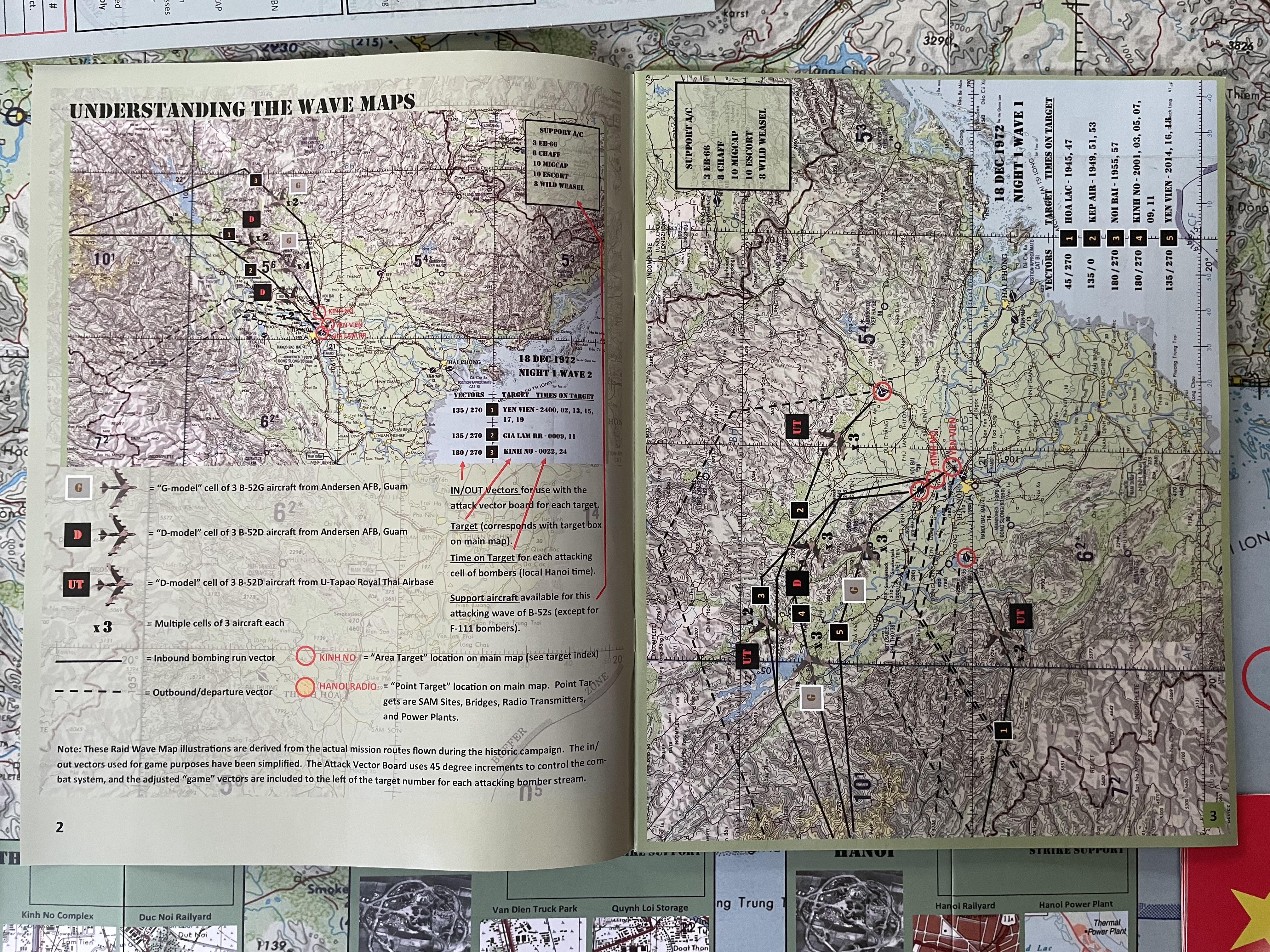
Riding the support(ing) wave
In the first arc of a night in Linebacker II all the action takes place “off-map” on the SAC Headquarters Planning Layout (SAC HQ Planning Phase) and the Raid Wave Attack & Support Plan Layout (Raid Wave Planning Phase).
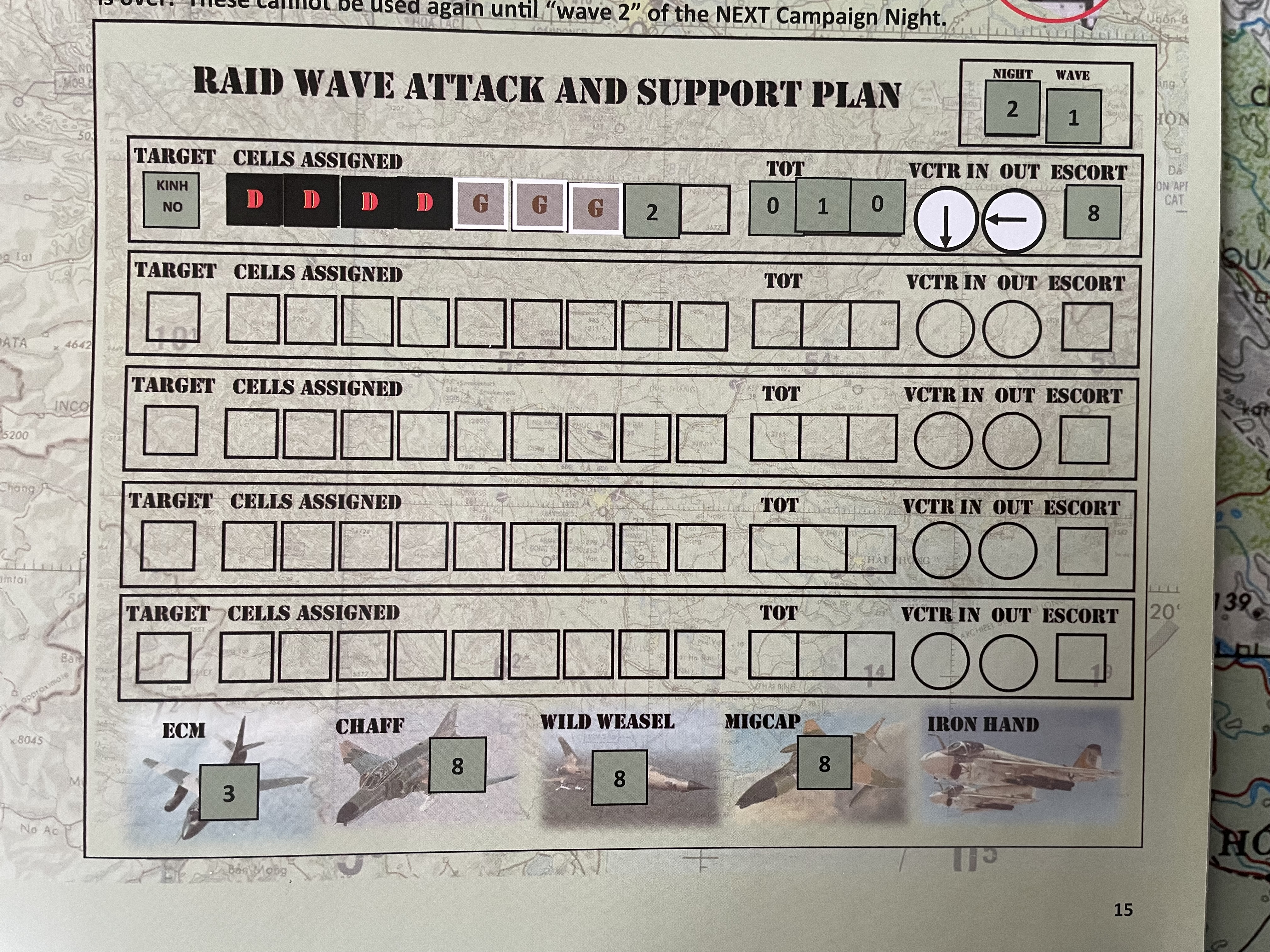
In the second arc the action move to the main map…kinda. The Raid Wave Support Action Phase has five segments:
- F-111 Strike Segment. F-111 strikes are placed on the board and each resolved with a single die roll.
- Standoff Jamming Segment. Standoff jammers are added to the game board; that is, unless they have a bad die roll and abort.
- MIGCAP Flight Segment. The US player places their fighter cover on the board which can be engaged by SAMs.
- Chaff Flight Segment. Chaff aircraft can be engaged by SAMs; those that remain drop chaff patterns.
- MIG Scramble. The NVA player scrambles as many fighters as they want to engage Standoff Jammers, Chaff, or Bombers. MIGCAP [MIG Combat Air Patrol] can try to intercept.
While the second arc of a night of Linebacker II has many actions, there is little real player agency involved. At best, the NVA player decides how many SAMs to shoot (each SAM has a limited amount of ammo every night) and if they are going to scramble MIGs. The US player is really only executing the plan; the only real decision to be made is whether any MIGCAP will try to intercept (like that is a real decision…their entire job is to intercept).
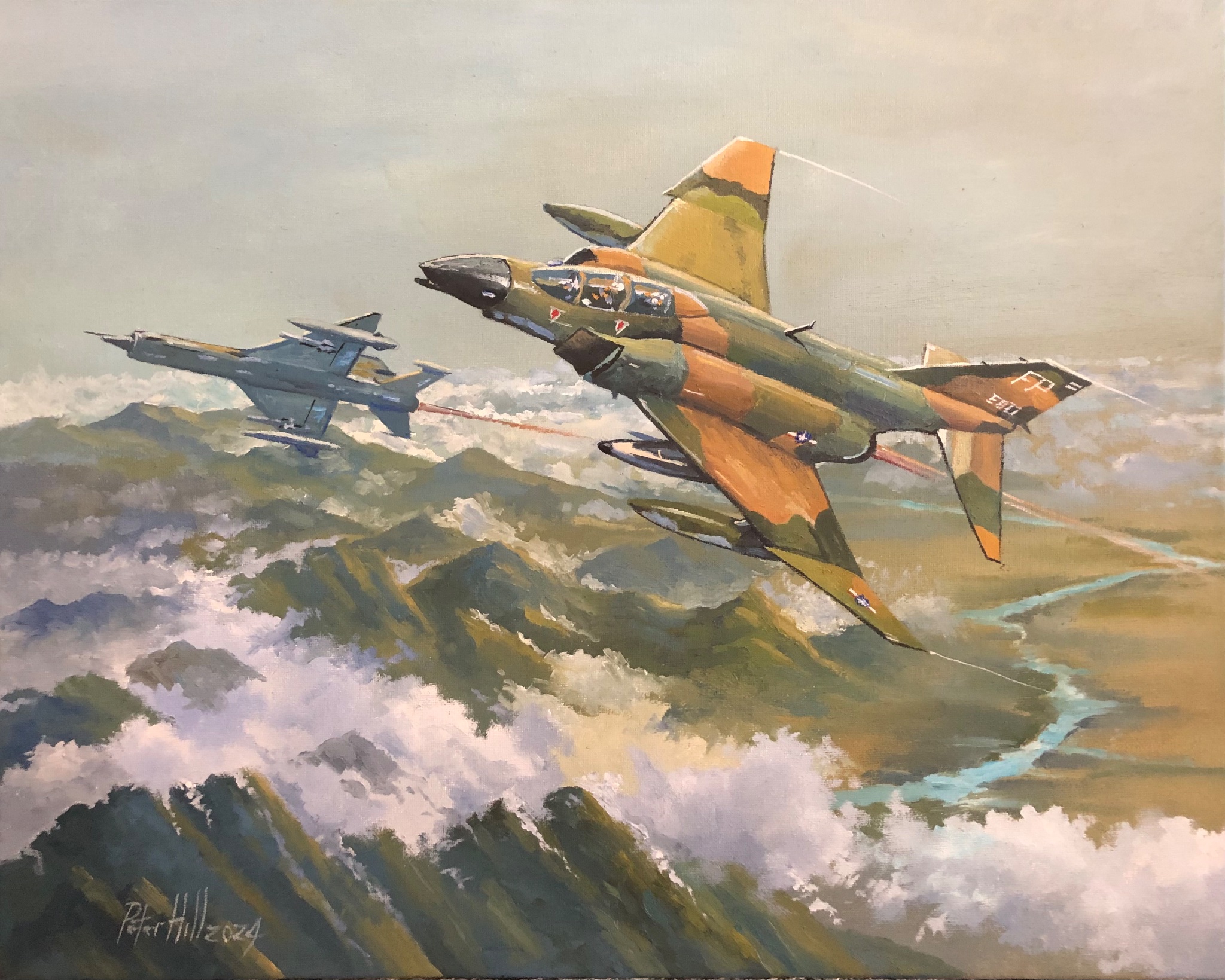
TOT
The third arc of a game turn/night of Linebacker II is the heart of the combat system. As each target area is resolved, play moves to the Attack Vector Board and the SA-2 Engagement Track with yet another five-segment sequence of actions:
- SAMs fire vs. Wild Weasel and Escort. The SoP aid says “ADS” but the Playbook list Wild Weasels. More die rolls.
- Wild Weasels vs. SAMs. Yet more die rolls.
- AAA vs. Wild Weasels. More yet more die rolls.
- MIGs vs. Target Area Escort Flights. Assuming they were not intercepted by any MIGCAP.
- Target Bomb Run. This is where all the support and tactics come together for the US player…or not.


In this third arc of a night in Linebacker II the US player is basically “running on automatic” while the NVA player has limited agency mostly in the decision as to how many SAMs to launch in the Target Bomb Run segment. There is a very fun Optional Rule called “NVA Decision Timer” which forces the NVA player to, 1) Quickly chose to fire SAMs pre-release or during the Post Target Turn (PTT) and then, 2) Quickly decide how many to fire. If the NVA player waits too long the decision is no SAM fired.

The Big Board
After each wave in Linebacker II the score needs to be calculated on—you likely guessed it—yet another board. In this case the Campaign Victory Point Track is used. Recall that the US player has to score a sufficient number of points each night to avoid defeat.
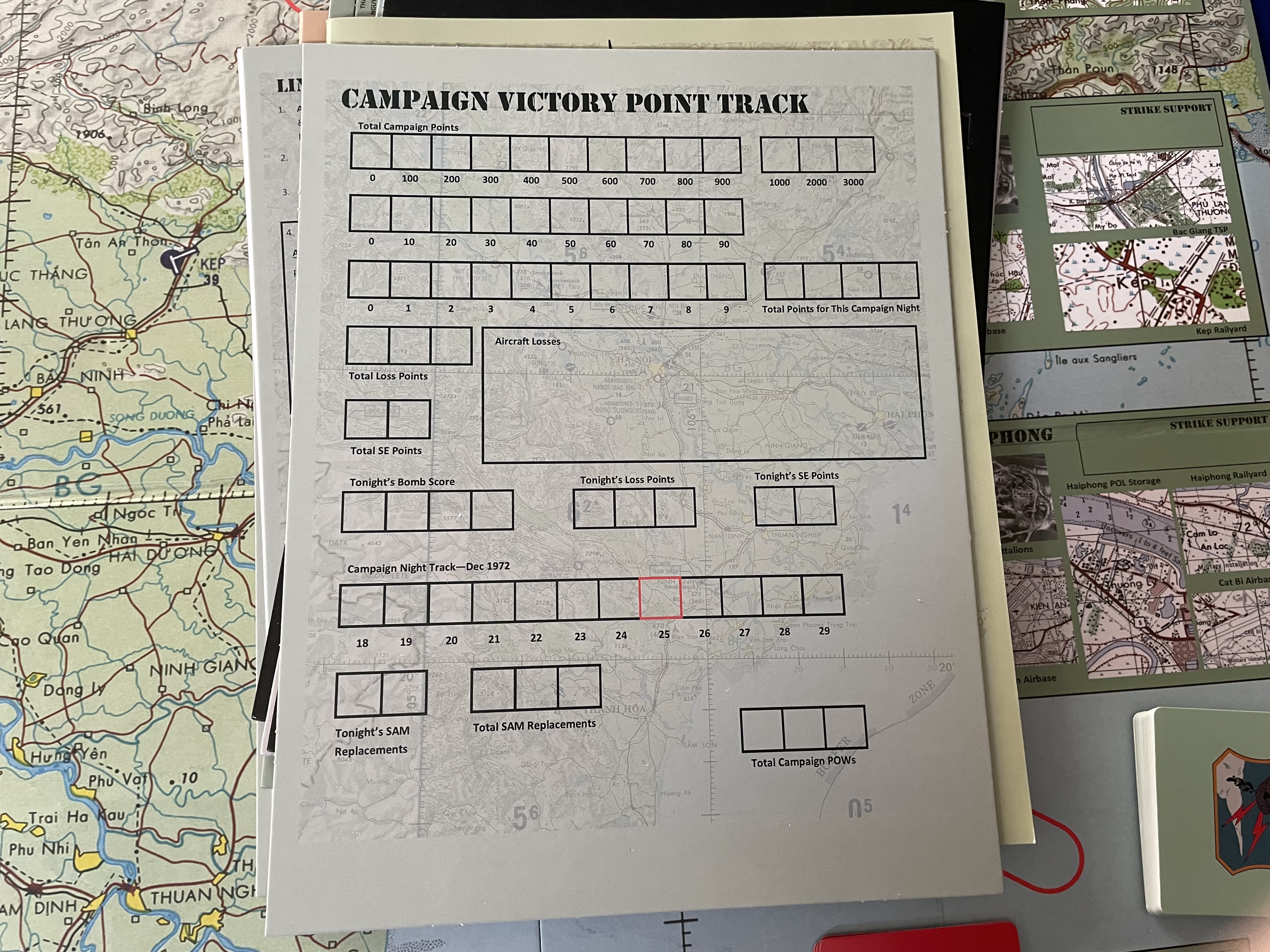
“Russians don’t take a dump, son, without a plan.” – Admiral Painter, The Hunt for Red October
…and apparently the US player in Linebacker II must do the same. When it comes right down to it, Linebacker II is less a wargame of tactical actions than it is a planning exercise. Each night starts with the NVA player planning their defenses while the US player plans their strike waves. The US player will also learn what—if any—tactical restrictions they will suffer under for the night. Then, the players start executing the plan but with only a few decision to be made. The heart of the night sees battle fully joined but the action is basically “run according to plan” with few decisions, again mostly from the NVA player.

Given each side in Linebacker II runs on a plan each night, one would expect that the solitaire rules would act in a similar manner. Linebacker II includes two sets of solitaire rules, one for an automated NVA player and a second for an automated US player. Personally, when playing alone, I prefer to set up the NVA defenses then plan the US strike waves. I will then play as the NVA player and let the ‘bot’ run the US side as I feel the NVA player has more meaningful decisions to make during the execution phase of a game night.
BUFF (Big Ugly Fat Fellow) gaming
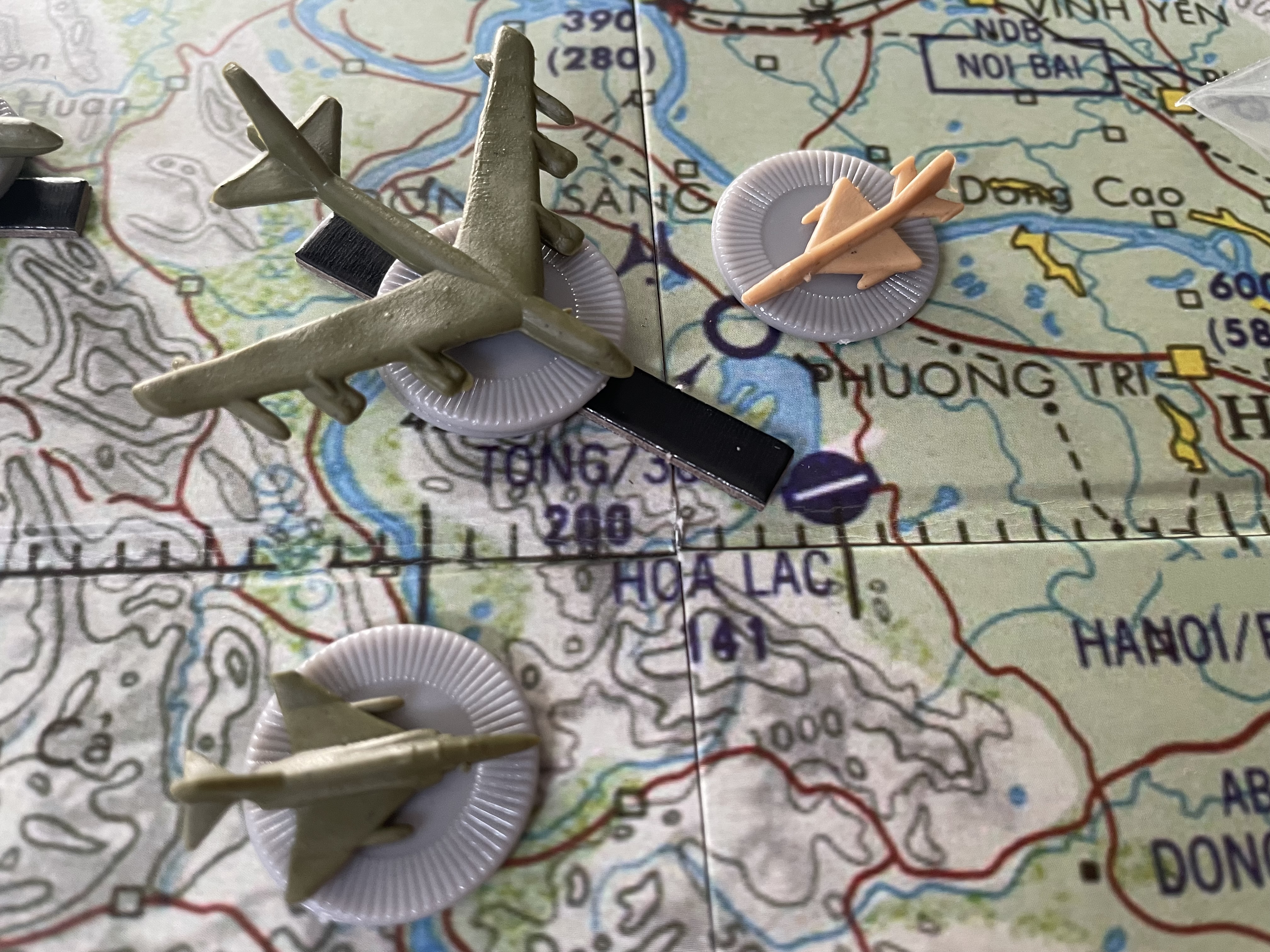
A few comments about the game components of Linebacker II are needed. Overall the components are nice. The mounted mapboard looks like an aeronautical chart should. The side boards are functional though I wish they came on just slightly heavier cardstock. The counters are small but that works here given the lack of detail on each. The cards are again functional though, again, I wish they were on slightly heavier cardstock. The game also comes with vector tracks to show the ingress of each wave into the target. Aesthetically they look good on the map board but functionally they do little.
The rulebooks for Linebacker II are…fair. I personally do not like the wall-o-text layouts. Some rules are, frankly, poorly written (SAC HQ Planning in particular) and take lots of patience to parse through. I also feel that some rules are just plain missing or buried within another rule. For instance, the availability of aircraft for missions is certainly affected by aircraft losses or damage and, if out of Guam, prior missions. Finding the specific rule on each is difficult as some of the rules apparently do not exist. At best, one might be able to extrapolate the needed rule from the historical setup materials but with no small challenge doing so.
The primary components of Linebacker II are the many miniatures. Plastic bombers and fighters and AAA and SAMs (oh my!). The minis bring a large toy factor to Linebacker II. That said, the many minis are small; perhaps smaller than some expected.
Linebacker II comes with 22 d6 dice. At first one might see that as too many but realize that most are used as SAM missile counters to keep track of SAMs available. The game engine itself only requires 2d6 and a single d12.
Finally, understand that with the many side boards that Linebacker II is a bit of a table hog; my usual 3′ x 4′ gaming table is too small to fit them all.

“Maximum effort”
During the Operation Linebacker II offensive, SAC aircrews were restricted in their agency. As Williams quotes:
SAC was an extremely centralized operation with a tightly regimented chain of command. The idea of bomber crews suggesting changes in tactics was heresy in a service whose training emphasized strict guidelines and controls essential to their primary function as a nuclear deterrent force.
Williams, p. 13
Among the several lessons learned during Operation Linebacker II, Williams lists a final one as, “Superiority in quantity and technology can not be relied upon to compensate for failure to adequately apply proper operational design” (Williams, p. 16). The wargame Linebacker II appears to have taken that last lesson to heart and delivers a game that is focused on designing a plan over playing out tactical nuances. Indeed, in their quest to be historically accurate, Linebacker II seemingly goes to extreme efforts to limit player agency making the product less a wargame and more a simulation.
As abstract as the game engine for Linebacker II is at the same time it is almost too historically accurate. The game rules implicitly, and often explicitly, try to stay to the letter of the history but in doing so force players into the historical situation with little ability to make their own story. The game pushes players to play out history as it was, not how it could of been. The lure of being able to make your own story is there but often driven to the background in the name of historical accuracy.
If you are a wargamer that loves planning your battles and want a relatively simple wargame to play out your plans in order to see the results then Linebacker II will likely interest you. If you are, alternatively, a wargamer that loves technical and tactical details and wants to see for yourself the interaction of platforms, weapons, and tactics then Linebacker II is perhaps best avoided. Regardless of why you play Linebacker II, recognize that player agency in the game resides mostly within the planning portions of the game and and not the execution phases. As compensation, however, any game played will look good on the gaming able with plenty of little plastic toys models to push around.
Feature image “High Road to Hanoi” by Jack Fellows
The opinions and views expressed in this blog are those of the author alone and are presented in a personal capacity. They do not necessarily represent the views of U.S. Navy or any other U.S. government Department, Agency, Office, or employer.
RockyMountainNavy.com © 2007-2024 by Ian B is licensed under CC BY-SA 4.0
 Rocky Mountain Navy Gamer
Interesting review- whilst I’d love to play it once I can’t see it getting many replays so am leerring about investing.
Cheers,
Pete.
Excellent point.
That, in a nutshell is the difference between a game and a simulation, I would imagine.
Regards, Chris.