
We are Pomon, peaceful farmers in service of the Queen, building The Langstroth Hive. Our mission is to serve the Queen wisely and explore the galaxy. We build our hive stronger with Farms as we seek Recruits and occasionally Develop wonderful new technologies while we Explore for water, fiber, and pollen to make the Wax and eventually sacred Honey. We curry the Queen’s Favor with elaborate Carvings of Honey or Dances of celebration. But we must work quickly in the Flow before the Dearth comes upon us and a new cycle of hibernation begins.
A New History of the Mellifera, Pomon Edition

Beeeessss…innn…spaaacccee
I have a soft spot in my wargaming heart for Stonemaier Games. It goes back to 2017 when I picked up Scythe (Stonemaier Games, 2016) and discovered a whole new generation of boardgames I had missed out on. This year I literally doubled-down on Stonemaier by acquiring two of their new games. The first, Expeditions: A Sequel to Scythe, though Scythe in name is not an expansion but a wholly new game based in the same setting. I also took in Apiary, the debut effort of designer Connie Vogelmann. Apiary is a “competitive, worker-placement, hive-building game about hyper-intelligent bees in space.” As the publisher’s blurb explains:
In Apiary, each player controls one of twenty unique factions. Your faction starts the game with a hive, a few resources, and worker bees. A worker-placement, hive-building challenge awaits you: explore planets, gather resources, develop technologies, and create carvings to demonstrate your faction’s strengths (measured in victory points) over one year’s Flow. However, the Dearth quickly approaches, and your workers can take only a few actions before they must hibernate! Can you thrive or merely survive?
Apiary publisher’s blurb
In the RockyMountainNavy home, worker-placement boardgames are hit and miss; as in what many call a “hit” are often a “miss” at our gaming table. The RockyMountainNavy Boys and myself bounced hard off Raiders of the North Sea (Garphill Games, 2015) despite all the accolades, and the very thematic One Small Step (Academy Games, 2020) started strong but eventually ran out of tabletop delta-v. Early plays of Apiary, however, seemingly indicate that Stonemaier and Connie Vogelmann may have reversed that negative trend. Apiary is a thematic medium-weight, worker placement, engine building boardgame that not only is good-looking on the gaming table but also, 1) Easy to learn thanks to use an innovative mix of tried and true game mechanisms, 2) Helps players understand useful strategies and better communicates scoring than many Euros, and 3) Sports a solo mode that is easy to manipulate but still delivers interesting play.
A buzy worker placement game
Some critics describe the game play of Apiary as “nothing new.” Those critics derisively point out the core game mechanisms are a remix of tried and true design choices with nothing “new” to offer discriminating elitist gamers. In some respects that is a fair criticism. The core game mechanism in Apiary is what one generically expects in a worker placement game. On your turn you either, 1) Place a worker bee, take the action, and gain benefits or, 2) Retrieve worker bees and gain other benefits.
What makes Apiary different, however, is one subtle change to the usual worker placement mechanism; worker bees don’t block spaces from being used again. Placing a worker bee in an occupied space “bumps” the occupying worker bee to a lower box for that action or back to the hive where it can remain active (with an increase in strength) or go to a Landing Pad where the worker bee doesn’t gain strength but also can’t work until retrieved. While powered-up worker bees can do more during an action, a worker bee that exceeds a strength of 4 and is bumped must Hibernate. When enough worker bees hibernate (exact number based on player count) the game ends. The winner is the hive faction with the most points.
While the core game mechanisms of Apiary are rather straight-forward and easy to learn, the theme is where the real variety of play is introduced (Hear that? That’s all the Eurogamers rolling in their Catan game boxes at theme in a game). In Apiary every player plays a different faction with a different hive. The game includes 20 different factions and five different starting hives. That’s already 100 different starting combinations. How your faction builds its hive in space is up to you. The pathway to victory has many avenues: explore planets, gather resources, develop technology, grow your workers, expand the hive, and carve or dance to gather the Queen’s Favor. The rules for how to do each action are simple; the strategy behind applying those rules to gain points is wide open.
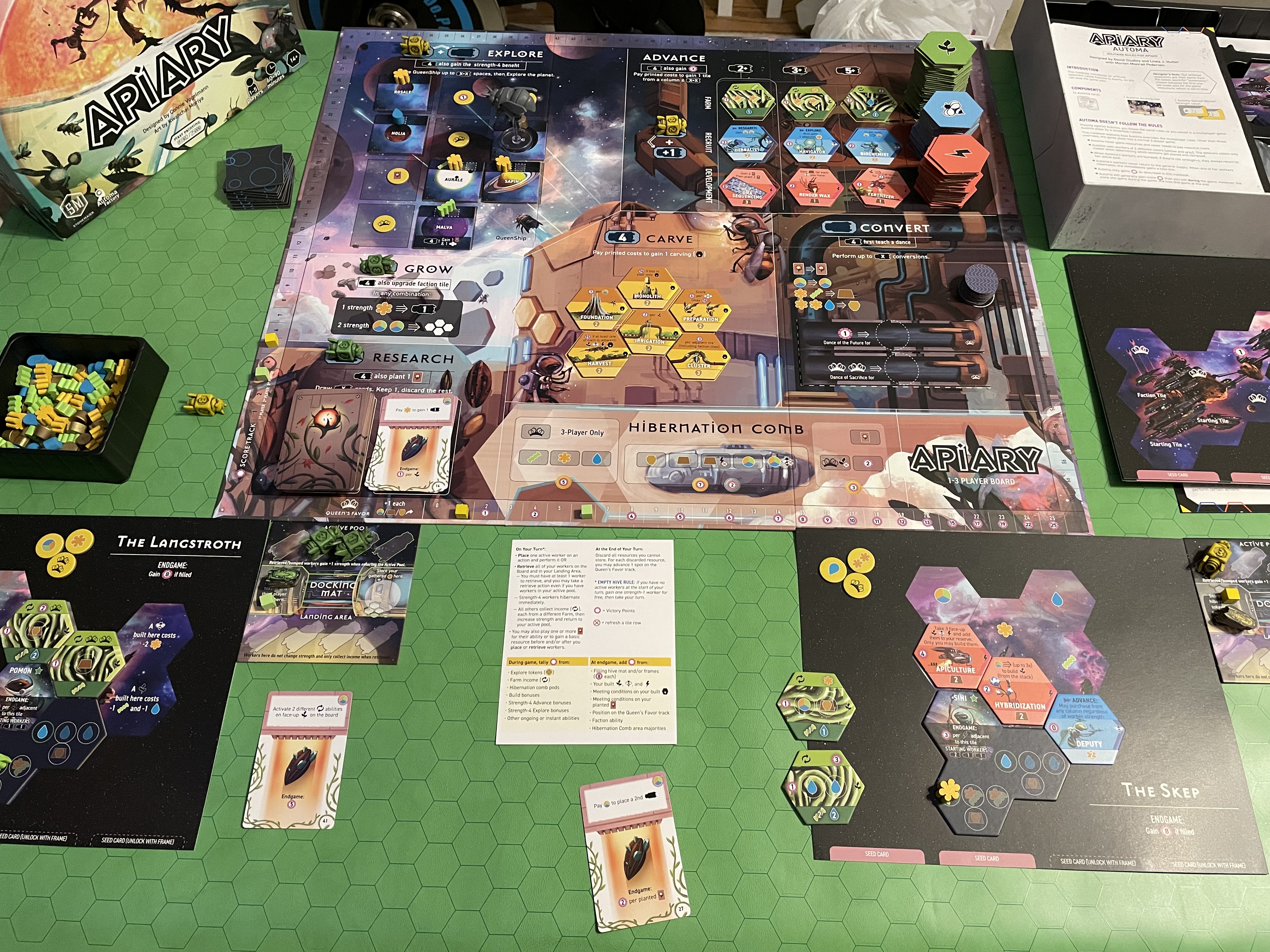
Buzy from the start to finish
One fault I often find in worker placement or engine building boardgames is that players don’t know what to do at the start of the game. This often means players stumble for a few turns until the game engine “clicks” for them only after which meaningful play decisions can be made. Unfortunately, as that eureka moment varies greatly from individual to individual, too many gamers get “left behind” by other players who find their game engine first and move ahead—often for the win. To it’s credit, Apiary seems to “click” faster with players making meaningful (i.e. point scoring) actions come sooner. I think the quick understanding of Apiary comes from the direction to use the starter factions for your first games. Each starter faction has an endgame bonus from building certain tiles next to the starter space. These “suggestions” naturally lead players to try to gain the bonuses, which in turn help to jumpstart the scoring engine for that faction.
Another common hurdle too often faced in the RockyMountainNavy home when playing some boardgames—and especially trendy Eurogames—is that scoring can be obscure. That is, obscure in that the final scoring is not always apparent from a look at the visible game state. Even my beloved Scythe has this issue; the final score requires calculations depending on the level of Popularity times territories plus resources and money. Yes, the information needed to calculate the final score is usually open, but a point conversion step is needed. More than once I have have triggered the end game thinking I was comfortably ahead only to (ruefully) discover that I had miscalculated the scores and I was behind…and the loser. Apiary avoids the worst of this issue by using Victory Points as a common in-game currency. Many Victory Points are tallied during play, and those points tallied at the game end can be seen by opponents on the board or on the Hive Mat which is open information. While it is still possible to miscalculate the score, the common currency of Victory Points and open information makes bad math less likely to happen. Thus, Apiary players can avoid unpleasant surprises at end game that too often lead to an (undeserved?) overall negative impression.
I automa bee buzy
Like many Stonemaier Games, Apiary comes with an Automa, or solo rules. The 14 double-sided cards have everything the Automa needs to do during play. The Automa has no Faction or Hive, just a Docking Mat. Executing the Automa actions are quick and easy; the intent behind the Automa actions are not to duplicate another player but to make changes to the board state as if other players were there. Plays against the Automa can seem to go by rather quickly because there in no opponent pausing (feet stuck in wax?) to consider moves and strategy. Playing the Automa is a great way to learn Apiary because the player focus is singly on themselves.
See bees
Apiary is also a very beautiful looking game on the gaming table. The artwork by Kwanchai Moriya (who has done artwork for wargames!) reinforces the theme in a way that appears distant enough to be fantastical but still close enough to be relatable. My major criticism of One Small Step was the extensive iconography used that was really too complex. Although Apiary also uses extensive iconography, the icons tend to be self-explanatory or consistent in style and meaning. The pleasing, yet functional artwork and graphics help draw players into the game as it reinforces the easy to learn and execute rules.
Working for sweet success
Apiary is well on its way to achieving sweet success in the RockyMountainNavy hive. It is successful exactly because it is a familiar, yet different worker placement boardgame that is not only easy to learn but in some respects self-teaching of strategy scored using a common—and mostly visible—currency of Victory Points. Add to that an Automa for solo play that also is a great teacher of the game and it becomes easy to understand the buzz around the game. For the RockyMountainNavy hive that is the defintion of a hit.
We are Sini. We are scientists in The Skep. We serve the Queen by developing new technology. Our Apiculture allows us to build what others can’t, and our Hybridization transforms resources into Farms for free. We have a strong Deputy that leads our Advances in ways others cannot. It is our destiny to best all others in the Flow, and we will Hibernate peacefully in the Dearth confident that we earned the Queen’s Favor.
Honey for the Queen Justifies the Means, Mellifera, 1 Million AD (After Dearths)
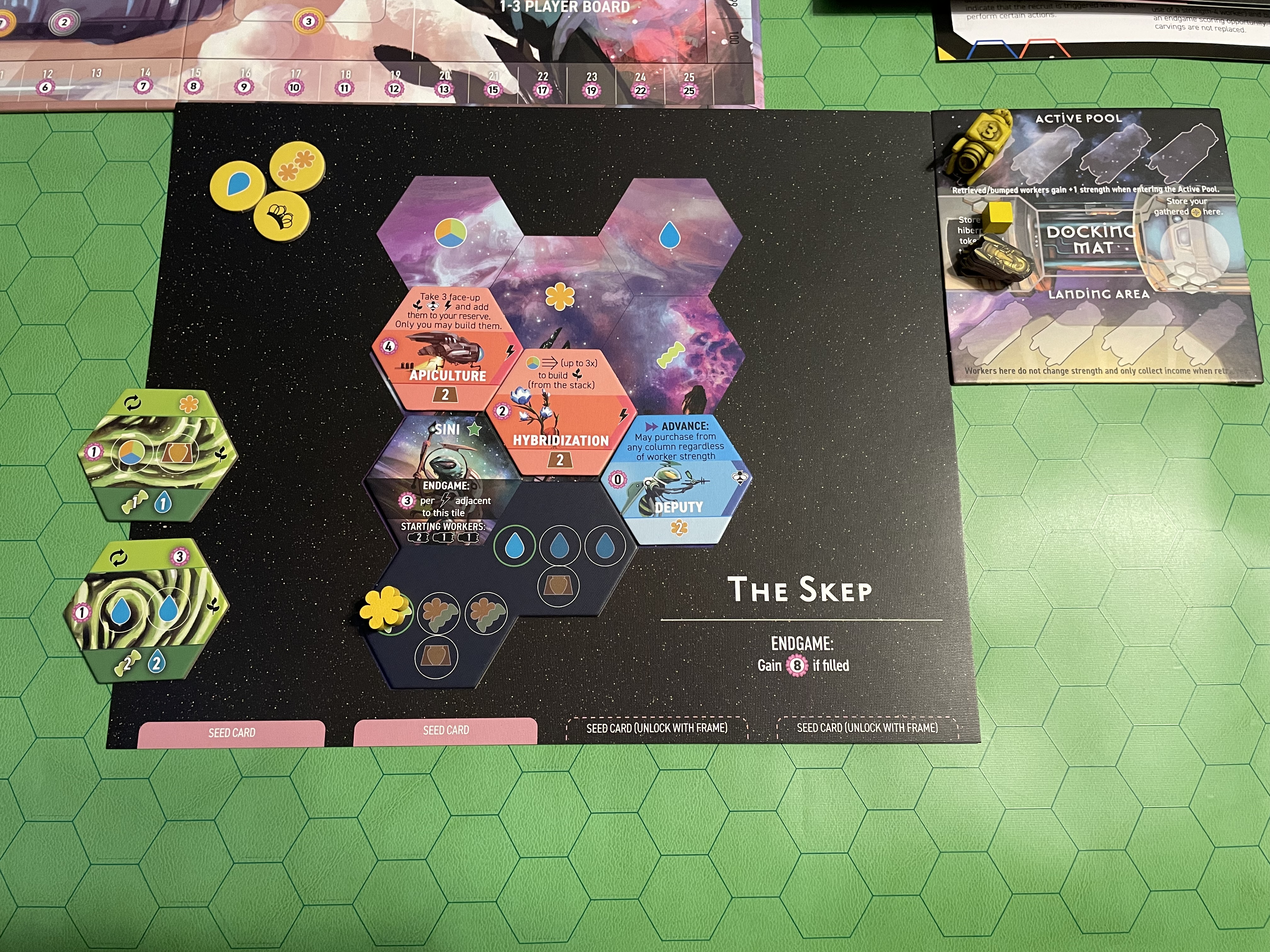
Feature image courtesy RMN
The opinions and views expressed in this blog are those of the author alone and are presented in a personal capacity. They do not necessarily represent the views of U.S. Navy or any other U.S. government Department, Agency, Office, or employer.
RockyMountainNavy.com © 2007-2023 by Ian B is licensed under CC BY-SA 4.0 
 Rocky Mountain Navy Gamer
2 thoughts on “Boardgame Bulletin 23-27 – How Apiary (Stonemaier Games, 2023) has kept me buzy lately”