
The number one reason I ordered the new wargame release Conquering the Valley: Cross Keys/Port Republic by designer Claude Whalen from Tiny Battle Publishing (2023) is because every time I drive down to see the youngest RockyMountainNavy Boy at Virginia Tech (Go Hokies!) we stop at Starbucks at the Port Republic exit of I-81. So in some weird fashion I feel a real connection to this game. It also doesn’t hurt that Conquering the Valley uses designer Hermann Luttmann’s Black Swan system to replicate “the Fortunes of War, the Friction of War and the Fog of War”1 using card draws instead of chit pulls in a game somewhat alike to the legendary Blind Swords system and excellent for two-handed solo play.

Conquering the Valley is a wargame that both Grognards and new-to-wargaming players will very likely enjoy. The game offers a fair decision depth to challenge Grognards while the streamlined gameplay can get new players into the system quickly.
Small Battle, Big Play
Conquering the Valley is the latest title published in the Shattered Union series of American Civil War games from Tiny Battle Publishing. The goals of the series is laid out at the very beginning of the Shattered Union Series Rulebook:
Shattered Union is a series of American Civil War wargames designed to be accessible to all gamers of any experience level. The game system aims to provide a playable wargame experience in about three hours. Yet, the emphasis to provide a realistic simulation of a mid-19th Century battlefield remains a priority as well. This series will cover some of the most important engagements of the American Civil War, but battle that are nonetheless not well represented in the gaming world (for various reasons). This series intends to provide playable simulations of those key battles and campaigns, allowing players to experience those clashes which helped determine the fate of the United States and its shattered union.
Shattered Union Series Rulebook, 3

Accessible
Accessibility in Conquering the Valley comes in two forms; rules complexity and format. The first is related to playability and realism, while the second is cost. There is much to discuss when it comes to playability and realism, which I will go into more below, which allows a focus on cost for the moment.
Conquering the Valley is published by Tiny Battle Publishing, an imprint from Mark H. Walker. Mr. Walker actually publishes games through two game publishers—Tiny Battle Publishing (TBP) and Flying Pig Games. The website for TBP describes the company this way:
Tiny Battle Publishing is the brainchild of Mark H. Walker focusing on small footprint games (usually 88 counters, 1-2 game maps, 8-16 pages of rules). Working with talented designers, new and established, such as Hermann Luttmann, Brian Train, Greg Porter, and Mark himself, Tiny Battle releases affordable games on a wide variety of subjects: historical, sci-fi, you name it.
Many companies open folio lines for such games, but Mark felt that would confuse customers as Flying Pig Games produces boxed games with thicker, bigger counters (Big Package. BIG Fun). Tiny Battle Publishing’s games look awesome, professional and top notch, but they are printed in small quantities at an American printer in the Northeast (not that we have any problem with overseas printers). This minimizes the initial cash outlay, but also limits the die-cut counters to 38 points, and the packaging to a Ziploc bag (Small Package. BIG Fun).
About TBP
While TBP started out doing folio games more recent releases, like Conquering the Valley: Cross Keys/Port Republic, or the first Shattered Union Series game, The Hill of Death: Champion Hill (Herrmann Luttmann, Tiny Battle Publishing, 2022) are boxed games with more than 88 counters and 8-16 pages of rules. The real difference between Flying Pig Games and TBP is not the packaging, but the general quality of the components. Comparing the two imprints, Flying Pig Games prints games with higher quality components whereas TBP publishes using comparatively lower quality components. To be clear, I am talking relative quality and quantity, not absolute; even the “lower quality,” smaller TBP games are good-quality components.
For example, here is how A Most Fearful Sacrifice 2nd Edition (Flying Pig, 2022)2 compares component-wise to Conquering the Valley (TBP):
| A Most Fearful Sacrifice 2nd Edition | Conquering the Valley |
| 1 – Full color rulebook | 2 – Maps each 17″ x 22″ |
| 1 – Full color scenario Book with THIRTEEN scenarios. Nine use one of the two maps, four use both. | 189 – Counters |
| 2 – Game Maps totally FIFTEEN SQUARE FEET of gaming goodness | 39 – Playing Cards |
| 4 – Sheets of a total of 352 13/16” (that’s big) counters | Player Aid |
| 1 – 5/8” counter sheet (176 counters) for the admin markers | 1 – Series Rulebook |
| 90 – Cards to activate corps, initiate planned events, trigger unplanned events and create fog of war. | 1 – Game Module Rulebook with FOUR scenarios. |
| 1 – Player Aids | 5 – Six-Sided Dice (Red, White, Black, Blue and Gray) |
| 2 – large, 11″ x 17″ Command Displays | A box to stuff it in |
| 6 – Dice (2 red, 2 black, 2 white) |

The difference in component volume and quality also leads to a difference in price; A Most Fearful Sacrifice 2nd Edition lists on the Flying Pig website at $135 while Conquering the Valley is sold by TBP for $55. Indeed, as I write this post I could buy three of the four American Civil War games on the TBP website for a few dollars less than the cost for a single copy of A Most Fearful Sacrifice. The savings can be more if one waits for a sale (usually later in the year) or, as in my case, one picks up a game in the series when available at a pre-order discounted price.

Playable, Realistic Wargame Experience
Though Conquering the Valley may be the more “budget” option of Mark Walker-published America Civil War wargames, the smaller footprint and rulebook does not mean it is less playable. Although I certainly wish the rulebook was a bit clearer in spots, the core game mechanisms are very clean. Further, I’ll come right out and say it; Conquering the Valley is not realistic. I would argue that better wargames—like Conquering the Valley—are representative of the American Civil War but to call them a “realistic simulation” is true hyperbole. That said, the gameplay of Conquering the Valley delivers a balanced, playable experience of combat in the American Civil War.
The core game mechanism in a Shattered Union Series game like Conquering the Valley is the Activation Card. Every turn, the Activation Card Draw Pile is constructed with a combination of Formation Activation Cards, Event Cards, Command-in-Chief Cards, and Wild Cards.
Formation Activation Cards. In Conquering the Valley, each formation—usually those assigned to a significant commander—has five Formation Activation Cards. These cards are a combination of Attack, Defend, or Maneuver orders. The ratio of Attack-Defend-Maneuver cards depends on the commander. For instance, Union Corps Commander Fremont has 1x Attack, 2x Defend, and 2x Maneuver Formation Orders cards. Jackson, on the other hand, has 2x Attack, 1x Defend, and 2x Maneuver Formation Orders Cards. A Formation Activation Card can also show a Command Test which is a randomized way to determine how many units of the Formation are actually activated. The combination of Formation Orders and Command Tests convey a sense of what particular commanders were like, more aggressive commanders will have more Attack orders and more organized staff can activate more units. A “realistic” look at the various personalities in a “playable” format.
Event Cards. Event Cards are key events that “break the rules” of movement or combat in some favorable way.
Command-in Chief Cards. A C-in-C card activates units (the number usually determined by a Command Test) but any of the three Formation Orders can be issued.
Wild Cards. There are two Wild Cards in Conquering the Valley; Fog of War and Friciton of War. Neither are favorable to a player.
The construction of the Activation Card Draw Pile every turn is important. In the first scenario of Conquering the Valley, “Ewell Does His Job (Cross Keys Historic)” the Draw Pile is “seeded” thusly:
- Each player adds their Command-in-Chief card.
- Each player selects two (2) Formation Activation Cards.
- Each player selects one (1) Event Card.
- Each player randomly (and blindly) adds three (3) other Event Cards to the Draw Pile.
- The two Wild Cards are added.
The resultant Draw Pile is 16 cards, of which each player contributed four “known” cards and three randoms plus the two Wild Wild Cards. The Draw Pile is now shuffled and every Activation Phase the top card is drawn and the action begins. Generally speaking, each card will be played in the order drawn (though there are rules for Held cards). Every turn the Draw Pile is “reseeded” and the process repeats.

Another important game mechanism in Conquering the Valley (and again, the entire Shattered Union Series), is the order of Fire and Movement. Within the Activation Phase of turn, the Fire Combat Step comes just before the Movement Step which is followed by the Close Combat Step. This order is important to remember because one cannot assume they will order units to simply march up to an enemy unit and fire on it. As noted in the rulebook, “Units thus need to be positioned for firing in advance.”3 Is that realistic? I am sure one could find more than a few wargamers amateur historians4 and even some professional ones, that would call that “unrealistic” in some manner. At the end of the day it doesn’t really matter because it is—literally—the “rules of the game.” Realistic or not, the fact that Fire Combat occurs before Movement in Conquering the Valley is the physics of this wargame setting and a condition players need to account for in their planning and execution of the battle.
With few exceptions, most everything needed to play a turn of Conquering the Valley is “visible” during a turn either on the board, on the cards, or on the Player Aid. Of particular note, the use of those five different colored die is easy to see on the Player Aid for combat. I personally feel that those different color dice—by themselves—go further than most any other game mechanism to streamline play of the entire game.
Fire Combat Example. Trimble’s 21st Georgia (Firepower =10, Cohesion =4) under an Attack Order fires on Sahel’s 8th New York (Firepower=11, Cohesion =2) which is yet to activate.
- Firing Hex and Target Hex are SAME elevation with clear Line of Sight.
- Range is 1 hex or “Effective” range.
- The 8th New York is in “Woods” terrain which is considered “in Cover” and shifts the Combat Results Table (CRT) one column LEFT.
- Starting CRT column is “10-12” based on Firepower but shifted one column LEFT for Cover so the “6-7” column is used.
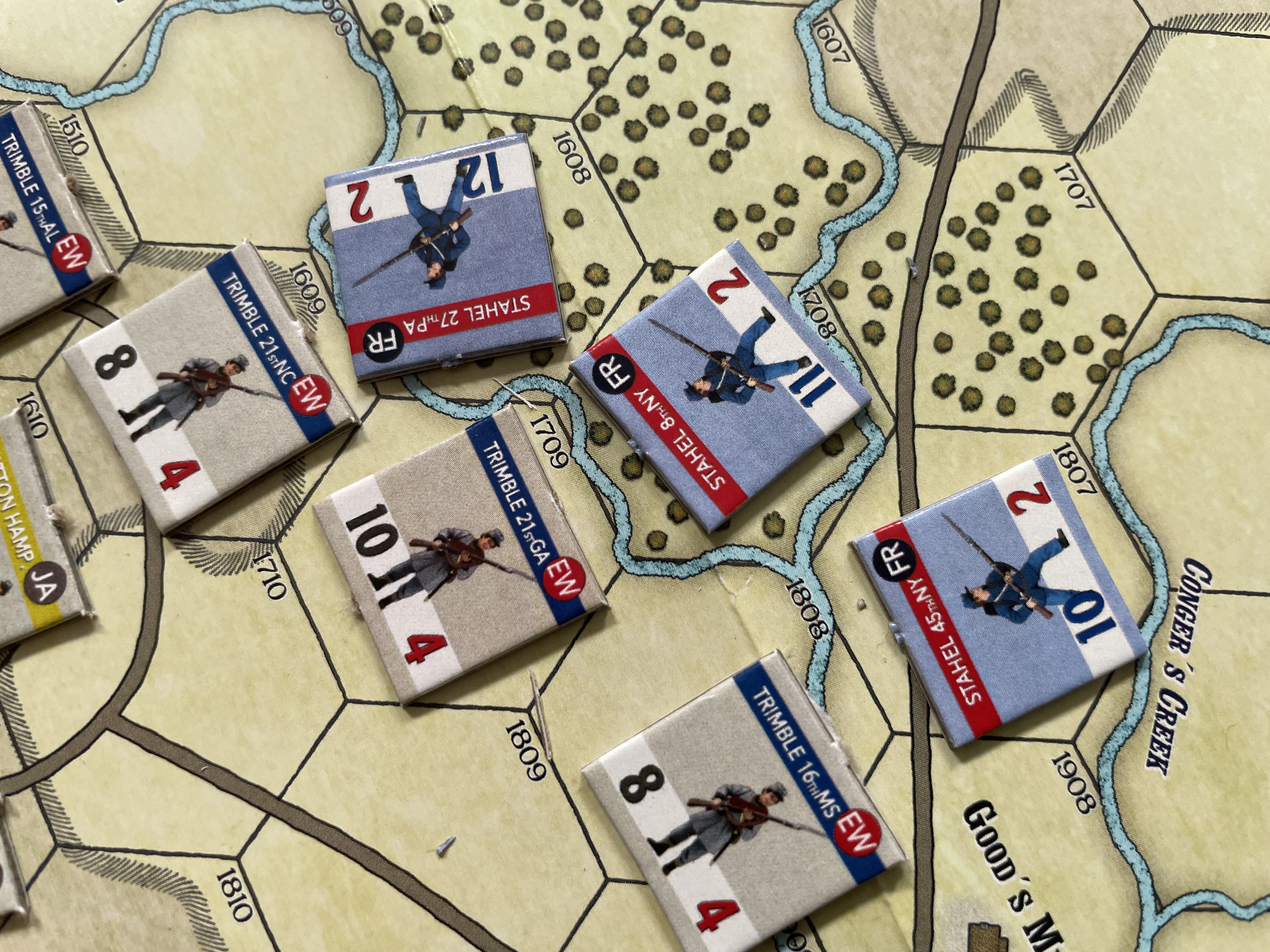
Dice are rolled…
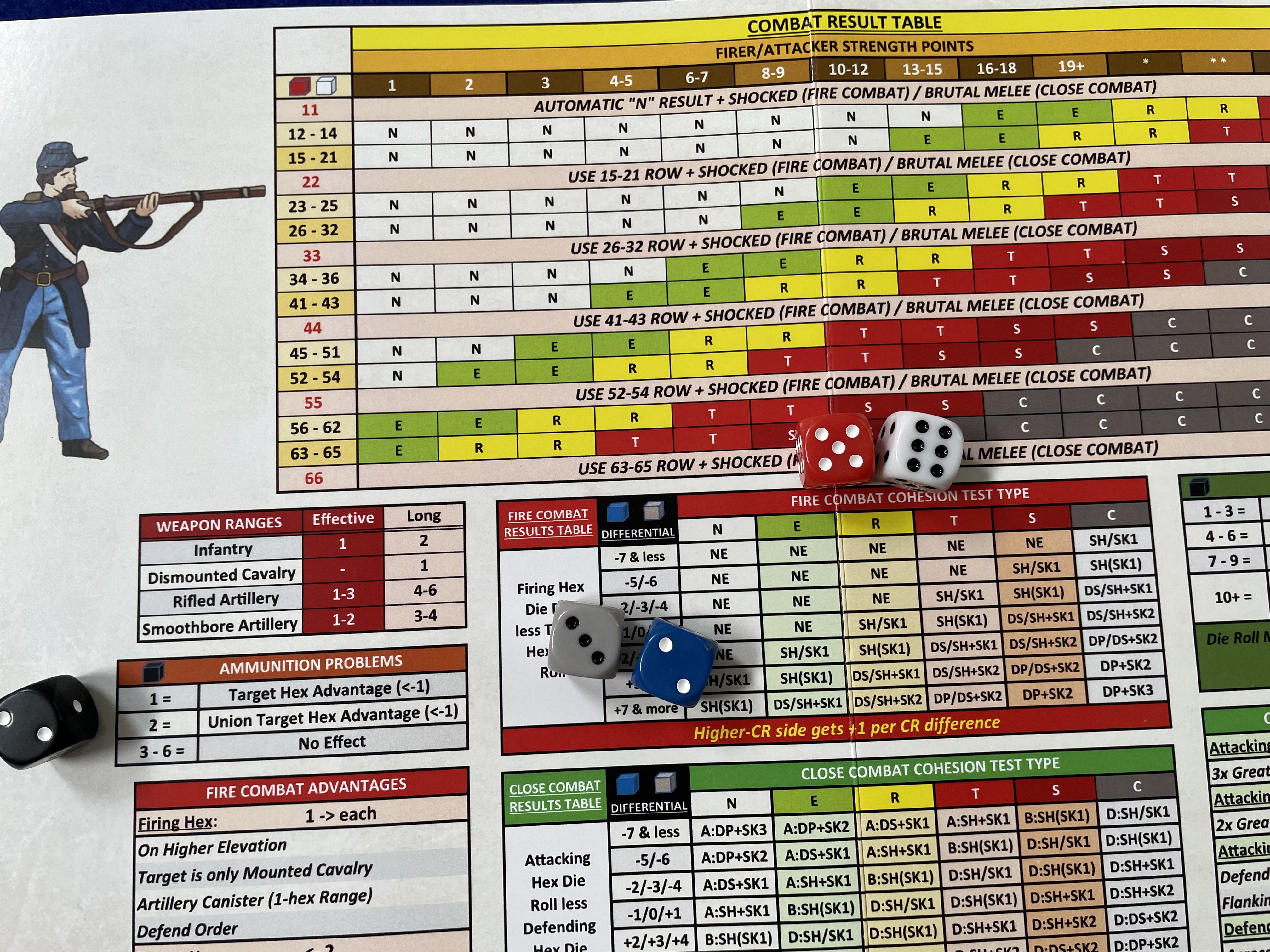
- BLACK DIE results in “Union Target Hex (<-1)” which will shift the CRT column one to the LEFT.
- Final CRT Column will be “6-7.”
- RED and WHITE DIE are read as “56” and give result of Cohesion Test; reading down 6-7 column and cross-referencing 56 the result is “T” or “Tough.”
- As the Confederate player is firing one starts with the GRAY DIE roll of “3” to which the Cohesion Rating Modifier of +2 is added (21st Georgia has a Cohesion of 4 which is +2 compared to the 8th New York’s Cohesion of 2); a Die Roll Differential from the BLUE DIE adds another +1 for a final result of +6.
- Reading across the “+5/+6” row of the Fire Combat Results Table the result is “DS/SH+SK2” which means the firing player can choose the left or right result.
- The firing player elects to use the right side result of “SH+SK1” which means the 8th New York is Shaken and it must “Skedaddle” (retreat) two hexes.
- As the 8th New York had to Skedaddle it cannot fire back (Firefight).
Some Rough Edges
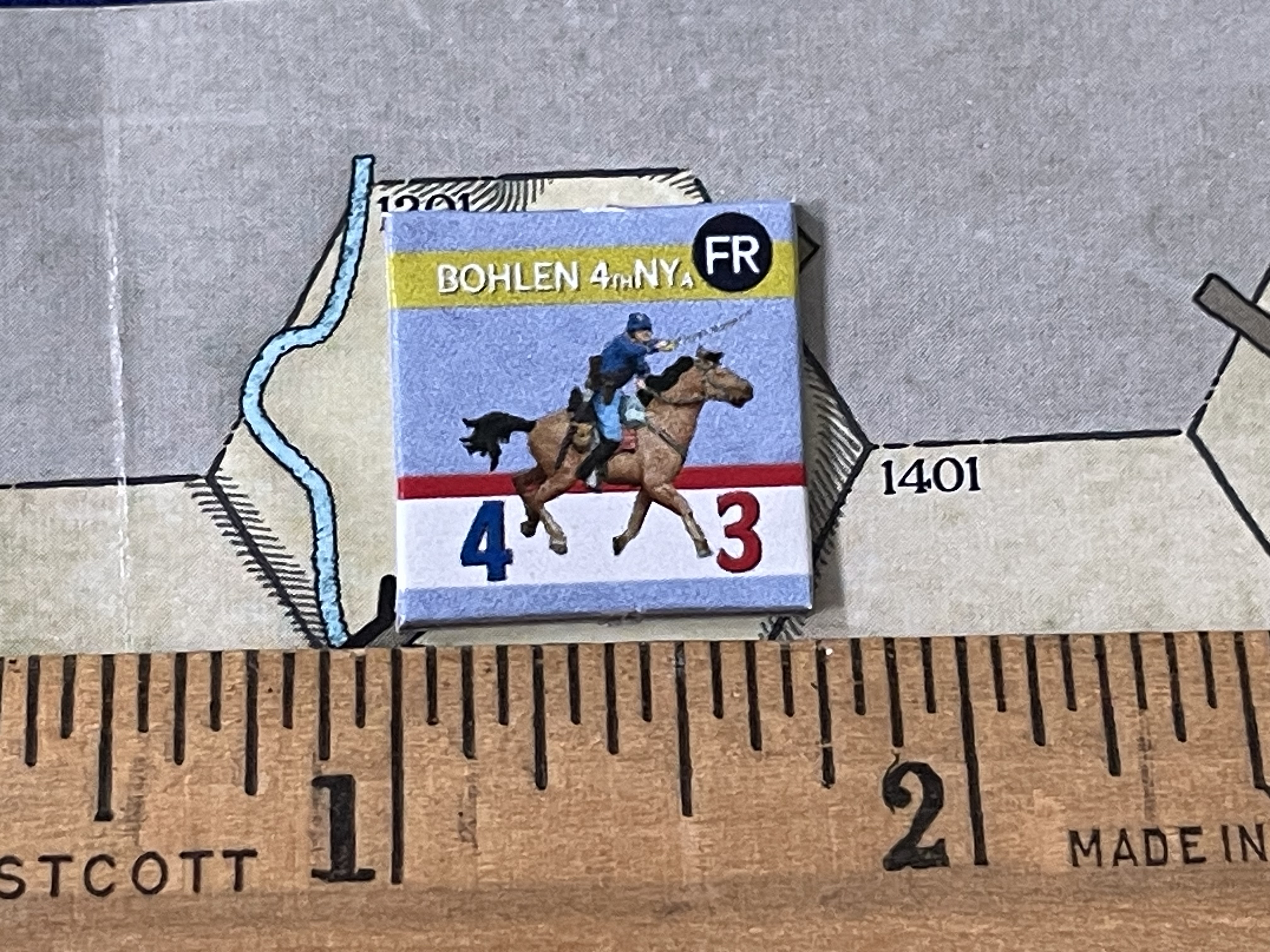
As much as I enjoy Conquering the Valley the game is not without a few rough edges. The first rough edge is that the counters in Conquering the Valley are hard to read. Sure, the overall size is about 3/4″ but the unit names are very, very small and hard to read. Indeed, there are a few units that use an appended letter, such as the 4th NY-a Cavalry (mounted) (4-3) where that appended letter is nearly impossible to read. I’m sure it looked fine on a nice 32″ or larger monitor when one was reviewing the layout, but once printed it is virtually invisible on the counter.
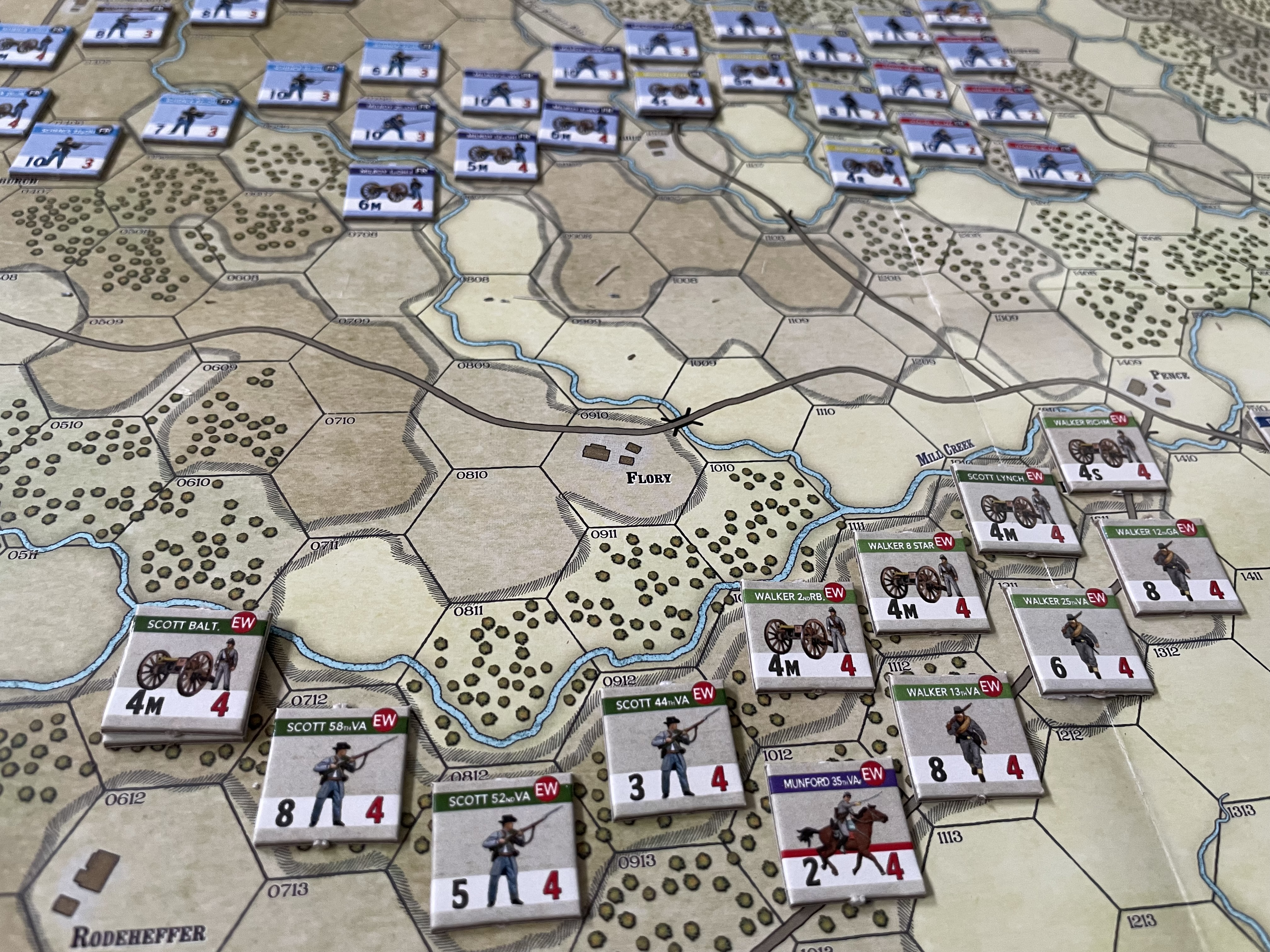
Another rough edge of Conquering the Valley that closely relates to the first is the scenario set up instructions. For each scenario, the set up instructions are arranged by hex rows and not by units. For example, in the first scenario “Ewell Does His Job (Historic Cross Keys)” the Union set up starts as:
- 1st WV Calvary (mounted) (4-3): 0206
- 1st CT Cavalry (mounted) (2-3): 0207
- 1st OH-K Artillery (4-4m): 0305
…and so forth.
While I see value in set up instructions that “follow the hexes” that only works if it is easy to quickly grab the right counter and not have to hunt for it. What is most recognizable on each counter is the Corps and Brigade assignments, with a large Command-in-Chief identifier in the top right of the counter and a color-coded Brigade. This C-in-C/Brigade organization is how I store my counters. Yet that same organization is NOT how the counters are assigned in the scenario set up.
Now, I love studying my Civil War history but, sorry, I don’t know off the top of my head that at Cross Keys the 1st West Virginia Cavalry was part of Milroy’s Brigade assigned to Fremont’s Mountain Department. I venture to guess this problem stems from topic and component over-familiarity on the part of designers, developers, and even playtesters. I feel this problem could easily be seen by the publisher if they handed a copy (even one punched and sorted in some fashion) to a blind playtester and said, “Set this up” while timing it. I am sure it would be painful to watch, much like me trying to set up my first game. For game that is supposed to be playable in about 2 hours, taking most of another hour to set up even a small scenario needlessly puts off the enjoyment; indeed, it starts the game off on the wrong foot.
There are other small issues in Conquering the Valley, but I consider most others “wrinkles” more than rough edges. Yes, the rulebooks need another pass by an editor. Yes, I wish there was a graphical terrain effects chart and not just a wall-of-text. Yes, some of the unit names in scenario lists don’t match counters. Those wrinkles I can work through and even overlook in some ways. The rough edges, however, make gameplay much harder that it should be and directly interfere with my enjoyment of the game.
Shattering Play
For new players or wargamers with less experience, the game system doesn’t have too challenging a learning curve and the overall balance of the scenarios keeps games tight and engaging. For more veteran Grognards that same Black Swan system creates interesting decision points and challenge players strategic and tactical thinking. Though Conquering the Valley is not a flawless game without rough edges and wrinkles, the streamlined gameplay and interesting decisions driven by the card pull Black Swan system makes for an excellent war game.
Conquering the Valley is a wargame that both Grognards and new-to-wargaming players will very likely enjoy. The game offers a fair decision depth to challenge Grognards while the streamlined gameplay can get new players into the system quickly.
RockyMountainNavy
- Description for A Most Fearful Sacrifice, Flying Pig Games, 2022. ↩︎
- A Most Fearful Sacrifice: Three Days at Gettysburg is also the Winner of the 2022 Charles S. Roberts Award for Wargame of the Year. ↩︎
- Shattered Union Series Rulebook, 6. ↩︎
- For the record, and unlike some fellow wargamers, I applaud the presence of amateur historians in our hobby niche. ↩︎
Feature image courtesy RMN
The opinions and views expressed in this blog are those of the author alone and are presented in a personal capacity. They do not necessarily represent the views of U.S. Navy or any other U.S. government Department, Agency, Office, or employer.
RockyMountainNavy.com © 2007-2023 by Ian B is licensed under CC BY-SA 4.0 
 Rocky Mountain Navy Gamer
1 thought on “Wargame SITREP 230830 N3 Ops – Second Black Swan Conquers Even With Rough Edges in Conquering the Valley (Tiny Battle Publishing, 2023)”