
How many times do you let the look of the box cover of a hobby game lure you into buying without taking a close look at the actual game? That’s what happened to me in a hobby store recently when I saw Ramen Fury (designers Forest-Pruzan & Prospero Hall, Mixlore/Asmodee 2019). Drawn in by the gimmick packaging, instead of finding a spicy card game I was fed a stale, freeze-dried gaming experience by a group of chefs with a menu of games I previously found too bland for my tastes.
The Gimmick
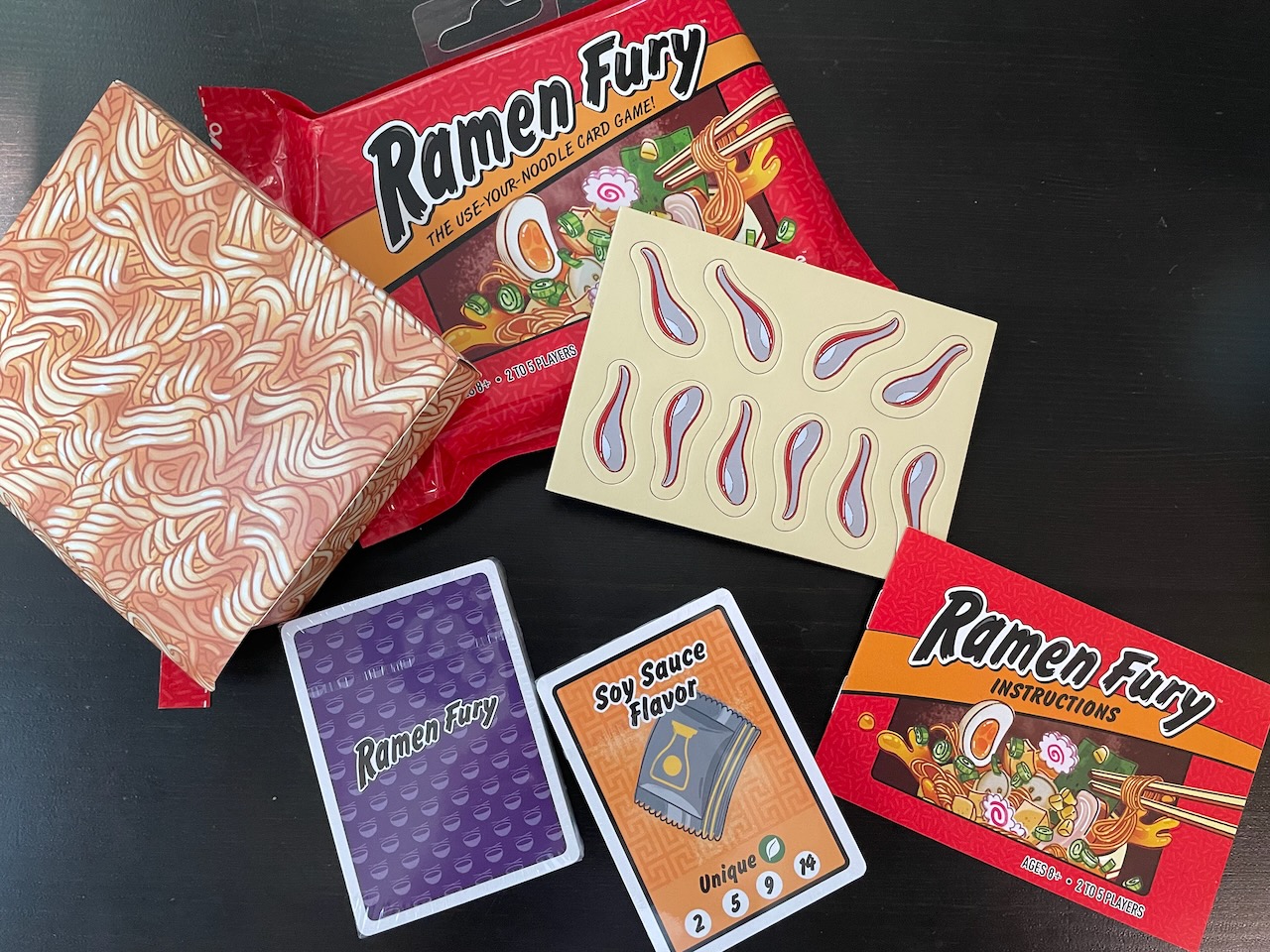
Ramen Fury stands out because of the packaging. Looking very much like a bag of uncooked ramen on the shelf, one cannot help but smile. Not only does the game look like a bag of ramen, it even feels like it when hefted. The ramen packaging theme continues inside the box resealable bag with an inner box that looks like that block of uncooked ramen. The game components—bowls and ingredient cards along with little punch-out spoons—have artwork that reminds me a bit of Sushi Go. Unfortunately, the great thematic execution of the packaging is as good as the game gets.
The Game
Maybe because of the artwork and seemingly related theme I guess I kinda expected Ramen Fury to play like Sushi Go. Instead, Ramen Fury delivers basic gaming ingredients put together in a way that produces a game with no real flavor. The goal of Ramen Fury is to assemble bowls of ramen using flavors and ingredients. The flavors are your scoring mechanisms; different flavors score in different ways though assembling a bowl with unique ingredients or pairs or three of a kind or some other combo. Every turn players take two actions from a menu of six (taking double portions—the same action twice—is allowed).
In Ramen Fury ingredients come in proteins and vegetables. There is also garnish (worth one point) and Chili Peppers which are negative points unless used with the Fury Flavor. Players can use their spoons to “spoon” an ingredient from the top of any bowl (own or opponents) and move it about. The Chili Peppers are the “take that” ingredient of the game since players will want to get rid of the negative point scoring. Other actions allow players to collect (put in hand) or add ingredients to their bowls or restock (new cards) or eat their bowl to lock in the scoring. You can even dump your bowl and start from scratch. Much like cooking ramen, there is nothing complicated about the rules for Ramen Fury.
The Taste
With the thematically rich packaging and simple game play, Ramen Fury seems like it should be an easy-to-learn, quick-to-play, lite family filler game. On the table, however, Ramen Fury is quite bland. There is little actual player interaction other than the occasional “take that” when the Chili Peppers come out or when an ingredient is spooned off. Ramen Fury is playable by 2-5 players but I cannot recommend low player counts—definitely not two players and even three might be too few. At the lower player counts the distribution of flavors and Chili Peppers seems off; restock will be taken often to lay out a better pantry of cards and the abundance of Chili Peppers heats up head-to-head cook-offs more than many might be comfortable with. Ramen Fury seems better at higher player counts where it comes off as less of a family game and more of a party game; i.e. a game with little actual strategy that is more social event than game. When you break down all the ingredients of Ramen Fury what I see is a point salad game…but with tasteless, gluten-free noodles.
The Spice
On a bit of a sarcastic note, as someone who has lived and traveled in Asia I don’t understand why spice in a bowl of ramen is seen as bad like in Ramen Fury. I don’t take chili peppers in all my ramen (my personal rule of thumb is “the redder it is the hotter it is”) but the treatment of spice in Ramen Fury makes me tempted to say this is an Americanized-version of what somebody thinks ramen is. Given the game was co-created / designed / developed in France maybe it’s not just a sad American stereotype. Hmm…
The Chefs
I was so taken in by the packaging for Ramen Fury that I ignored the biggest warning sign not to buy that was right in front of me. Simply put, games designed by “Prospero Hall” are mostly inedible to me. For those of you who don’t know, Prospero Hall is not a person but a design studio out of Seattle. They seem to specialize in hobby boardgames that exploit are built on licensed pop culture IP. The Prospero Hall game design approach seems to be to take a licensed pop culture IP and build a hobby boardgame around it that is simple enough to be carried in mass-market game channels. Think a step above Monopoly but not quite as elegant as Catan or Ticket to Ride. Like the many Di$ney or Hollywood licenses they leverage, Prospero Hall games tend to be saccharine-sweet on looks with little depth of play.
With Ramen Fury I now (much to my shame) have five Prosper Hall titles in my stomach collection, none of which I rank higher than a 5 (“Average game; slightly boring, take it or leave it”) on the BoardGameGeek ranking scale. For comparison, my overall rating average is 6.60 for 947 games making every Prospero Hall title “below average” and in the lower 12% of my collection.

Add to Pantry?
At this point there are probably a few who are calling me a food game snob for only liking “boutique” hobby games. I admit I am fortunate enough that I haven’t had to eat at McDonalds play many Parker Bros. games in recent years. Why would I eat a TV dinner when I can enjoy a gourmet meal (often at an affordable price)? The same philosophy goes for my gaming….
I cannot recommend Ramen Fury. While the packaging is eye-catching, the game play has no spiciness.
Feature image courtesy RMN
The opinions and views expressed in this blog are those of the author alone and are presented in a personal capacity. They do not necessarily represent the views of U.S. Navy or any other U.S. government Department, Agency, Office, or employer.
RockyMountainNavy.com © 2007-2023 by Ian B is licensed under CC BY-SA 4.0 
 Rocky Mountain Navy Gamer
I’m not into card games, but on a related note I was just talking about a game where you build three-dimensional sushi rolls from plastic components, using chopsticks. Sign me up for that one!
I played the Korean version of that game recently. We call it “Kimbap.” The best part is we use real ingredients and then eat it afterwards. 🍣🥢