
Littoral Commander: Indo-Pacific by designer Sebastian Bae and published by The Dietz Foundation is by far the best in a very strong, highly competitive lot of wargames published in 2023 I have acquired so far this year. If you will forgive me for the comparison, my love affair with Littoral Commander has been something like a wedding. With just a little adjustment, the wedding rhyme, “Something old, something new, something borrowed, something [color]” accurately describes Littoral Commander: Indo-Pacific for me. The wedding rhyme helps me explain how this wargame “marriage” of old, new, and borrowed joins into a very purple outcome.
Always the bridesmaid, never the bride
My extended commentary on Littoral Commander: Indo-Pacific has been a long time coming. My engagement with the game started in January 2022 when I pre-ordered the title. In February 2023 I attended CircleDC and was fortunate enough to play Littoral Commander in a game facilitated by the designer himself. My copy of Littoral Commander was delivered in late April 2023. It is now July—some three months later—and only now am I getting around to writing out my deeper thoughts on the game. Part of the reason for the delay is Real LifeTM; I spent several of the weeks between now and the game’s arrival doing things like vacation and attending my niece’s wedding in Seoul. With ~450 guests—a battalions worth—the wedding took place in a top-tier downtown hotel complete with a seated three-course meal. It was certainly grand (in scope and cost!) and took much tactical planning. You know, like Littoral Commander…
Wedding plans
No better example of how Littoral Commander is old, new, borrowed, and purple can be found than the very first scenario—”Meeting Engagement.” The Scenario Book description of “Meeting Engagement” starts with this Designer’s Note (nvb: Ian Brown is the scenario designer):
This is an introductory scenario with a minimal number of units and Joint Capability Cards (JCCs). Its purpose is to allow players to learn how the units and JCCs interact with each other, and with enemy forces. Players who are new to the LC game system are highly encouraged to play through this scenario first prior to attempting other more open-ended scenarios. This is principally aimed as a learning demonstration.
“Meeting Engagement,” Designer’s Note (Ian Brown)
The “Meeting Engagement” scenario in some ways can be thought of as the players first engagement with the game. If they enjoy what they see the deal is sealed and their marriage to Littoral Commander begins.
Something old represents continuity
The “old” in Littoral Commander is perhaps more favorably described as “classic.” At first glance, the game looks like a classic hex & counter wargame.
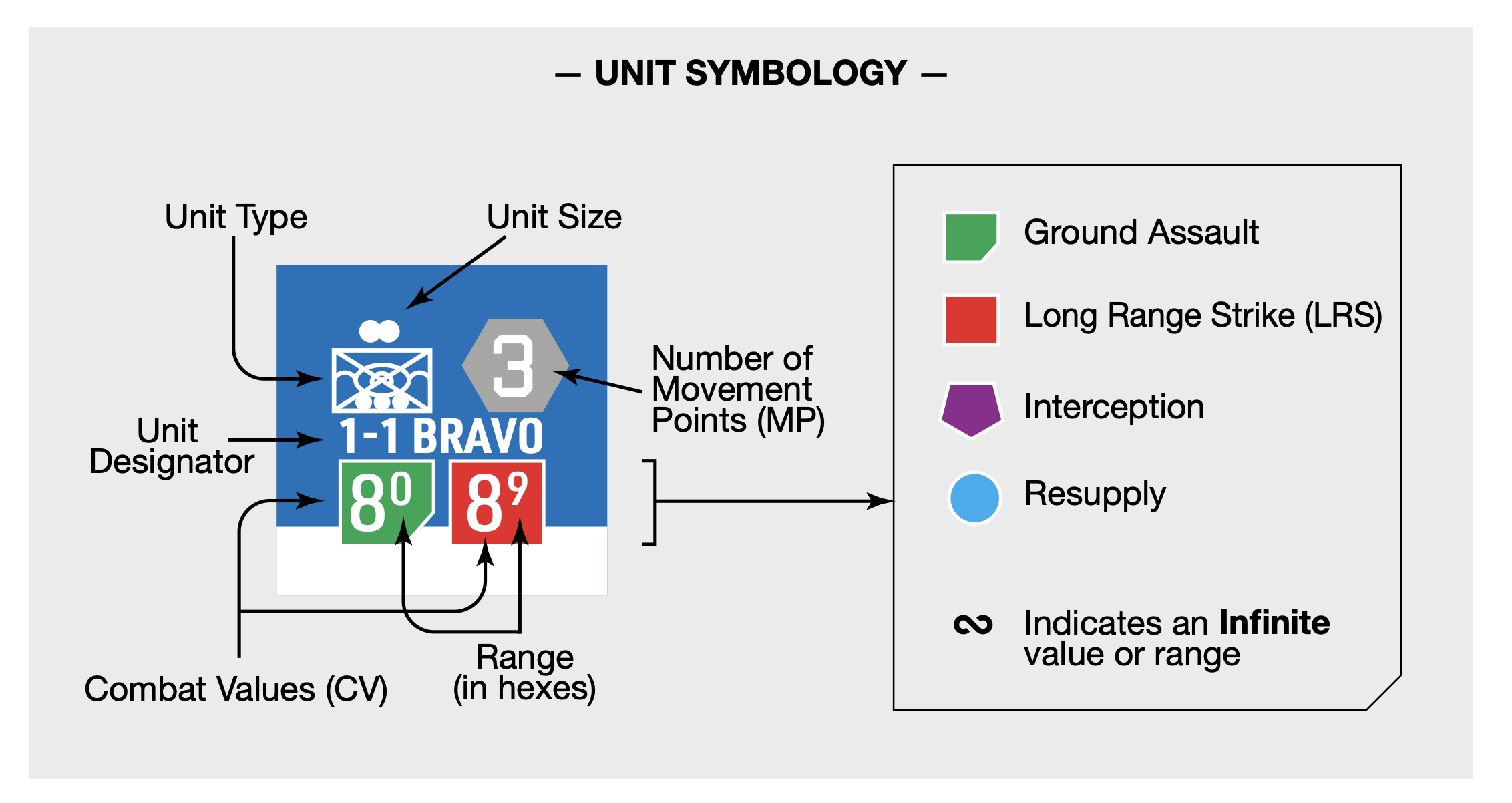
The unit counters used in Littoral Commander are classic in the information presented:
Each unit in LC is represented by a double-sided counter. The back displays a unique symbol for the PLANMC/PLAN or USMC/USN. The front displays the unit’s type, size, Combat Values (CV), combat ranges, MP [Movement Point] allowance, unit designator, and Resupply Value (RV), if applicable.
4.2 Unit Symbology
The counters are supplemented by unit cards to keep track of hits and ammunition and provide flavor text:
Each individual player has a unique Unit Tracker for each unit assigned to them, which allows a player to keep track of each unit’s HP [Hit Points] and supply levels. If a unit has more than one type of CV (for example, ground assault and LRS), each type will have its own supply level.
4.3 Unit and Formation Tracker

The map board uses hexes that show the different terrain that affects movement and combat. I have seen some people complain about the color scheme used. In addition to being very color blind-friendly (important if you want the game to be playable by a diverse group of players) there is logical reasoning behind the design of the map:
The LC terrain classification system (the color/number coding) aggregates terrain effects – which means most of the geographic features visually depicted are largely cosmetic. Most features, such as rivers and bridges, were included for general geographic awareness, potential for scenario specific rules, and future advanced rules.
4.1 The Map
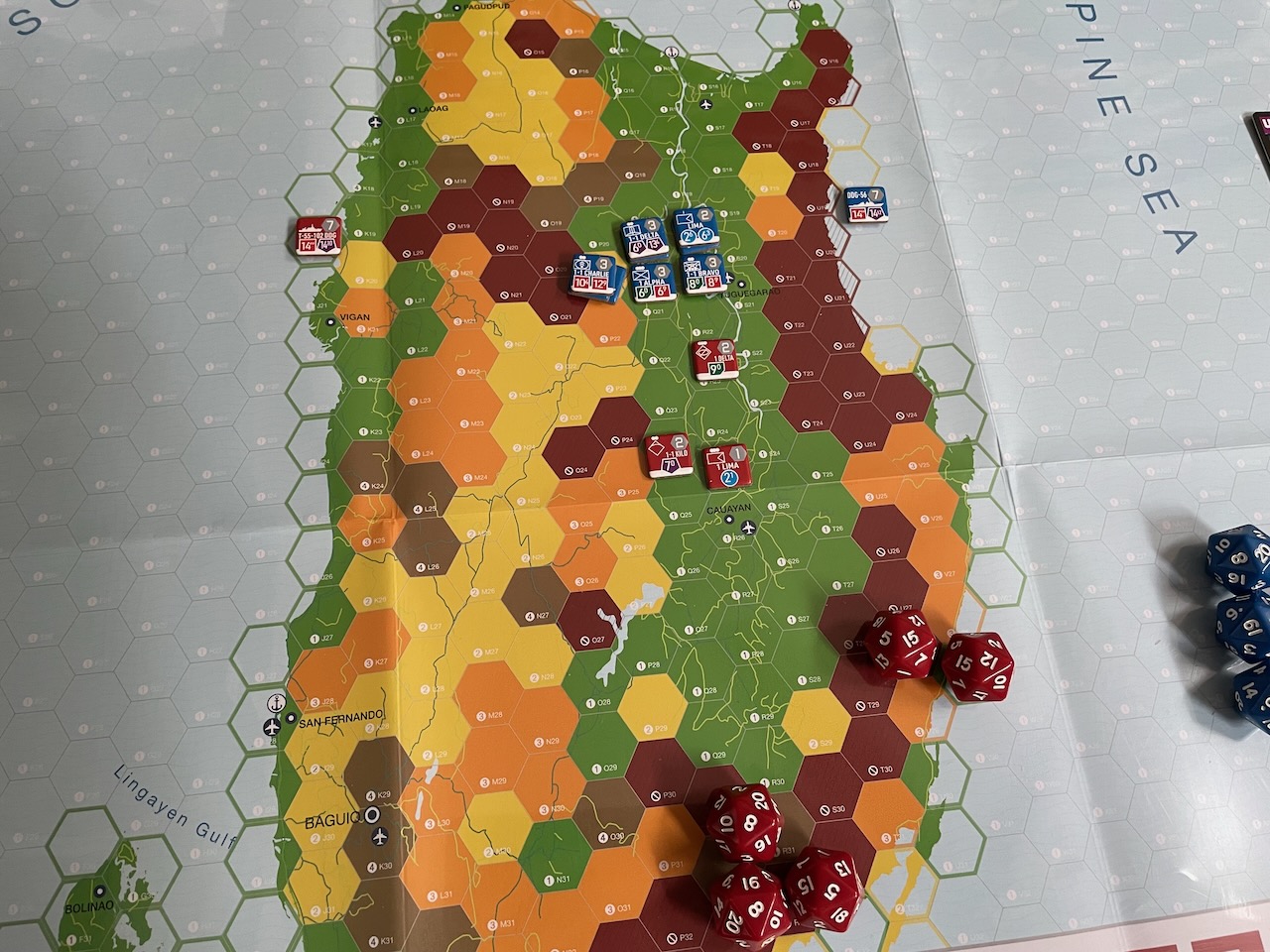
The scenario itself is also a very classic type of battle found in so many wargames. “Meeting Engagement” takes place on the Luzon map and pits elements of a Marine Littoral Regiment (-) and a U.S. Navy Arleigh Burke-class guided missile destroyer (DDG) against a People’s Liberation Army Marine Corps force supported by a single Type-55 DDG. This is a simple 3-turn scenario with the winner determined by the side that destroys the most enemy units.
The assigned forces are very similar:
| USA | PLA |
| Infantry Platoon | Mech Infantry Platoon |
| ACV [Amphibious Combat Vehicle] Section | Air Defense Platoon |
| HIMARS [High Mobility Artillery Rocket System] Section | Light Tank Platoon |
| MRIC [Medium Range Intercept Capability] Section | MLRS [Multiple Launch Rocket System] Battery |
| Logistics Company | Logistics Platoon |
| Arleigh Burke DDG | Type 055 DDG |
Wargamers or students who have played wargames commercially or as part of professional military education (PME) will very likely find the use of counters with unit cards and a hex map very familiar. This approach describes the units in an easy-to-understand manner that is quick to teach and intuitive to play.
The combat system in Littoral Commander is admittedly not your classic old-school odds-based combat results table (CRT) but neither is it a ground-breaking new approach. When making an attack, the player takes a number of d20 equal to the amount of supply for that particular strike type they wish to expend. The combat value is the number—equal to or less than—that must be rolled for a hit. The most important part of the combat system is that it is easy to teach and understand; the d20-based combat and dice-pool easily translates probability into a tangible roll to score a hit.
For example, using the USMC Infantry Platoon unit card seen above, the player decides they want to conduct a Long Range Strike (LRS) using the red combat value against a target four hexes away (the superscript 9 in the red combat value is maximum range). The unit card shows one red cube as the maximum LRS supply. After expending the cube, the player takes a single d20 and must roll a 6 or less (30% chance) to hit. On the other hand, if the Infantry Platoon was in the same hex as the enemy unit, it could engage in Ground Assault using the green combat value. Assuming it was fully supplied with five green cubes, the player could chose to make up to five attacks each of which uses a d20 requiring a roll of 6 or less to hit.
For grins, I went ahead and played out the “Meeting Engagement” scenario in an “old-school” fashion using only the units deployed on the board and without any other game features (described in a bit). Given designer Sebastian Bae used The Salvo Equation from retired U.S. Navy CAPT Wayne P. Hughes2 as an underlying design feature of the combat model, the scenario played out in a somewhat, shall I say, classical attrition manner with both sides advancing to contact (the REVEAL and Zone of Reconnaissance rules limit detection). Once combat was joined, however, victory went to the side that struck effectively first. Played in the classic fashion, Littoral Commander is nothing really special; if this was the complete game I am sure the title would quickly be consigned to many player’s nursing home shelf of games never to be seen again.
Something new represents optimism for the future
The greatest “new” in Littoral Commander is an unabashedly open attempt to use a wargame for education first and entertainment second. In the world of wargame practitioners, there are generally considered to be three major purposes for wargames: educational, experiential, and analytical. A fourth purpose of wargames—entertainment—is usually left to the realm of hobby gaming.1 Littoral Commander: Indo-Pacific, is a unique wargame that actually bridges between the goals of wargame practitioners and hobby gaming. Billing itself as, “A Grand Tactical Educational Wargame,” Littoral Commander is not only a useful professional military education tool but also a very entertaining game in its own right. As the introduction relates:
Littoral Commander: Indo-Pacific (LC) is a 2- to 6-player wargame that explores future tactical concepts, emerging technologies, and all-domain warfare. The wargame is designed to be accessible to both professional military and hobbyists. Extensive wargaming experience is not necessary. LC offers fast-paced, accessible, and flexible game play meant to be fun and competitive, while also serving as an “intellectual sandbox” on “what-if” conflicts that could arise in the Indo-Pacific region. LC: Indo-Pacific explores hypothetical scenarios of conflict between the U.S. Marine Corps (USMC) and the People’s Liberation Army Navy Marine Corps (PLANMC) in the year 2040 and beyond.
When creating LC, the design team emphasized three underlying principles: accessibility, engagement, and adaptability. The game play emphasizes coordinated team planning and rapid player action cycles. With experience, you can create your own scenarios!
1.0 Introduction
Unlike so many wargames that are designed for two-player, head-to-head play, Littoral Commander is—from the start—focused on team play. Units are organized into Task Forces each of which is intended to be played by a different player. The Sequence of Play (3.0) specifically calls for a Planning Stage (3.01) which is describes as: “This is the stage where teams discuss their initial plans and coordinate their actions for the wargame. A full Planning Stage occurs only on the first turn. Feel free to shake hands, bump fists, or shout that the Planning Stage has ended.”
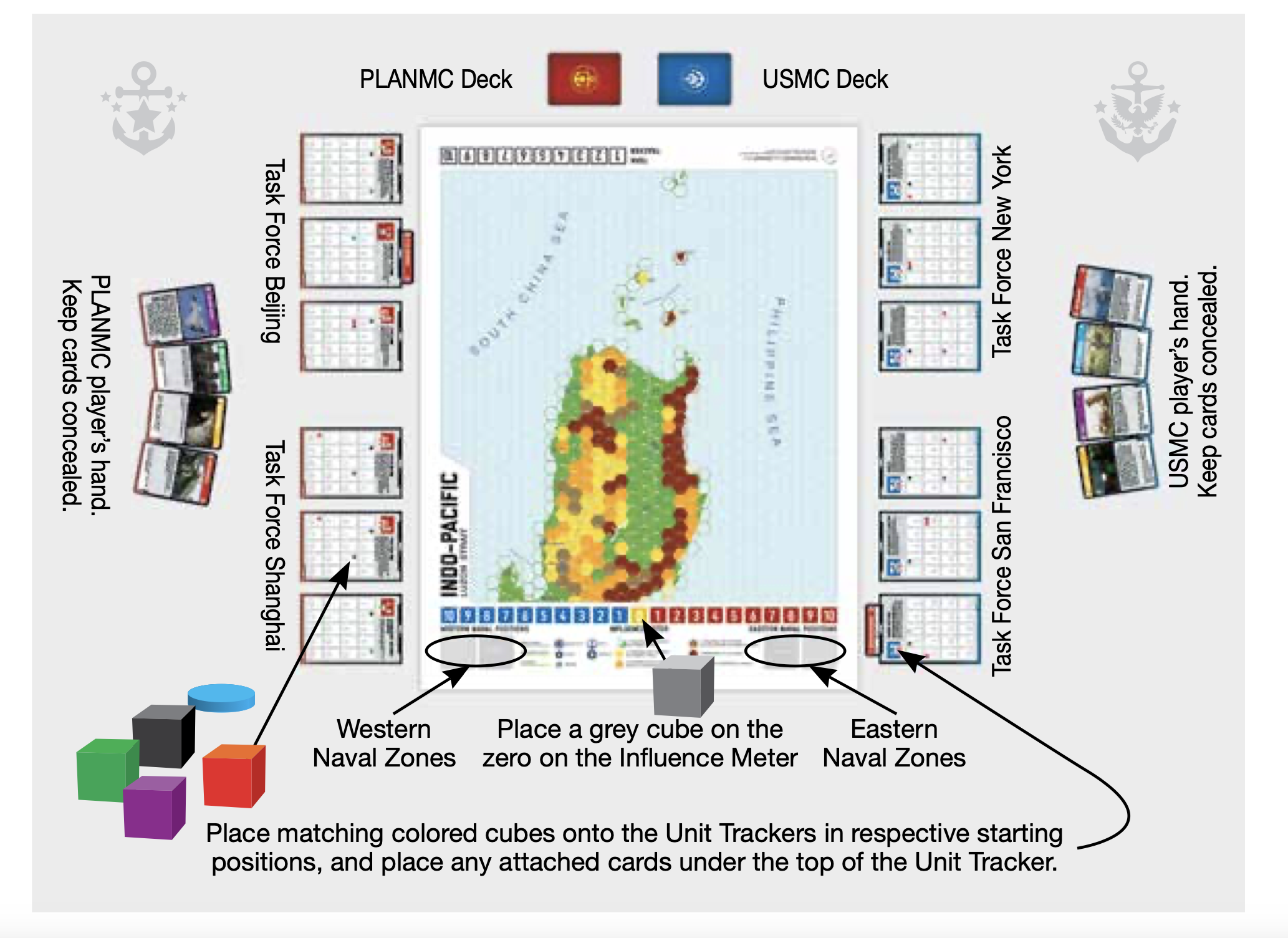
This comradely-wargaming is exactly what designer Sebastian Bae intended Littoral Commander to be from the start. That, and an intent for the wargame to be an “intellectual sandbox.” As he writes in a Designer Diary found on BoardGameGeek:
Littoral Commander: Indo-Pacific (LC) is not your typical wargame – both in its origins and its purpose. I originally designed Littoral Commander – previously known as “Fleet Marine Force” (FMF) – in 2020 as an educational wargame for professional military education (PME). As a former Sergeant in the U.S. Marine Corps and present-day professional game designer for the defense enterprise, I wanted to create a wargame that explored the future of warfare in a way that was both informative and engaging.
Designer Diary – Littoral Commander: Indo-Pacific
Sebastian goes on to describe the deeper motivations behind the design of Littoral Commander:
To fully understand Littoral Commander, one must understand the transformative change the Marine Corps is undergoing. Under Commandant General David Berger, the Marine Corps is implementing a service-wide transformation called Force Design 2030 (FD2030), which aims to redefine and modernize how the Marine Corps trains, equips, and operates in contested littoral and maritime environments. A central element of FD2030 is the Marine Littoral Regiment (MLR), a newly formed unit that emphasizes long-range fires, integrated air and missile defense (IAMD), and intelligence, surveillance, and reconnaissance (ISR) capabilities.
Moreover, the MLR and associated concepts such as Expeditionary Advanced Base Operations (EABO) and the Stand-In-Force (SIF) are only part of a wider transformation of the Marine Corps. These concepts served as the foundation for my design. Littoral Commander was designed to be an intellectual sandbox that would enable Marines to explore, test, learn, and expand on the core tenets of FD2030. How will the Marine Corps fight in the future – this lies at the heart of Littoral Commander.
…
In the end, Littoral Commander is not your typical game night wargame; it is an educational tool that enables players to explore the future of warfare and the Marine Corps’ role in it and the wider Joint Force. While the game does not offer a comprehensive or definitive vision of future warfare, it provides an intellectual sandbox for players to engage with complex problems and devise their own solutions. The game mechanisms were designed to be intuitive and easy to learn, while also providing enough complexity to enable players to explore the nuances of modern warfare. My hope is that you will give it a chance and maybe it will teach you something new.
Designer Diary – Littoral Commander: Indo-Pacific

Some, uh, chowderheads might be tempted to accuse Mr. Bae of playing cheerleader for General Berger and FD2030. Those that do so likely don’t understand the impact a well-designed wargame—even an unclassified one—can have on actual warfighting. No better example exists than that of Mark Herman and his wargame Gulf Strike (Victory Games, 1983):
Wargaming featured prominently in US efforts during the 1990-91 war in the Persian Gulf. On the morning of August 2nd, with Iraq’s conquest of Kuwait still not complete, the Pentagon looked around for some quick wargaming on what was going on and what it all meant. The only kind of wargame that could get results quickly was a manual game, a commercial manual game that could be bought in a game store. The game used was Gulf Strike. Mark Herman had designed this game on potential wars in the Persian Gulf during the mid 1980s. The game had already been updated once a few years later and was still in print. Mark had, for several years, been working for one defense consulting firm or another, so the Pentagon knew who he was and what he could do. The Pentagon approached Mark at 10 AM on August 2nd, he was under contract at 2 PM and the game began at 3 PM (using various Pentagon Middle East experts as players). Before the day, Iraq had conquered Kuwait, but the wargamers in Washington knew Iraq was doomed. The results of this manual game were the basis of most of the decision making during August.
Wargames and the 1991 Iraq War
Designer Sebastian Bae is intensely optimistic about FD2030 but also understands that it may not work in the end. He also strongly believes that the better Marines and fellow advocates of the Corps understand FD2030, the more likely they are to understand what it takes to make it work, or where it might need adjustment. Littoral Commander is a clear reflection of that optimism.
Something borrowed represents borrowed happiness
To set Littoral Commander apart and to make it a very attractive wargaming soulmate, designer Sebastian Bae “borrowed” some game mechanisms that are not usually found in wargames. The most important game mechanism borrowed is deck-building/hand management as seen in the Joint Capability Cards ( 9.0 JCCs):

Joint Capability Cards—JCCs—form the heart of Littoral Commander. These cards represent new weapons, capabilities, other services, and the ability to communicate and coordinate—or disrupt—your or your enemy’s forces.
As mentioned in “something new,” teams acquire JCCs using Command Points to build their deck. Some scenarios pre-designate several JCCs, but all scenarios strongly encourage players to design their own JCC deck as they feel is appropriate. During the Actions Stage, one of the four possible Core Actions is Play a Joint Capability Card (3.31). When to play a JCC is a variation of the hand-management game mechanism.
Loving next-gen warfare
The “Meeting Engagement” scenario is a useful way to get to know the different JCCs and see how they change play. Both teams start with the following six JCCs:
| USMC | PLAMC |
| Tactical Network (blue) | Tactical Network (blue) |
| Combat Air Patrols (purple) | Combat Air Patrols (purple) |
| Unmanned Ground Vehicles (UGVs) (green) | Unmanned Ground Vehicles (UGVs) (green) |
| V-Bat (Tactical UAS) (yellow) | Tactical Unmanned Aerial System (UAS) (yellow) |
| MARSOC HALO (green) | HALO Insertion (green) |
| Tactical Cyber Attack (blue) | Tactical Cyber Attack (blue) |
Both teams are then given six Command Points (CP) to buy additional JCCs. In my game, the USMC purchased:
- Anti-tank Missiles (green) for 1 CP
- Precision Strike Missile (PrSM, red) for 1 CP
- MILDEC [Military Deception] (blue) for 2 CP
- Close Air Support (red) for 2 CP
The idea here was to increase one unit’s Ground Assault combat value using the anti-tank missiles and add additional Long Range Strike firepower to the HIMARS. The MILDEC was intended to soak up hits while Close Air Support would whittle the enemy down at range.
The PLAMC side chose a different set of JCCs:
- Maritime Militia (yellow) for 1 CP
- YJ-18 Anti-Ship Missiles (red) for 1 CP
- Scatterable Mines (red) for 2 CP
- CH-901 Swarm (red) for 2 CP
The PLAMC concept was to use the Maritime Militia to locate the U.S. DDG and then strike it with the YJ-18s thus removing the longest-ranged strike system for the USMC. The scatterable mines would channel enemy movement and the drone swarm added long range strike to a unit otherwise without.
This play through of the “Meeting Engagement” scenario using the “borrowed” JCC deck-builder/hand-management game mechanisms unfolded much, much differently from the classic version.
[Of note, each player/Task Force has three (3) Action Points each to spend during their turn of the Actions Stage. The USMC player starts with the Initiative and goes first.]
Turn 1
USMC Task Force San Francisco (MRIC Section, Logistics Company, DDG)
- The USMC start by using the Combat Air Patrol JCC to conduct a LRS against the Type-55 DDG; the PLA Combat Air Patrol JCC fails to NULLIFY the strikers and then the Type-55 fails to DETECT the strike (so no air defense roll allowed) after which the strikers roll two hits (1-13) on two strike dice and sink the Type-55 outright. (1 Action Point – AP)
- Resupply Task Force Miami. (1 AP)
PLAMC Task Force Shanghai (MLRS w/Tactical UAS / Scatterable Mines / YJ-18 Logistics Platoon, DDG)
- Use the Maritime Militia JCC to locate the U.S. DDG (success). (1 AP)
- YJ-18 anti-ship missile JCC strike of four dice (LRS: 1-13); the U.S. DDG gambles and only expends four air defense (IAMD: 1-12) and in the dice-off the PLA scores two hits but the air defense successfully stops both. (1AP)
- Resupply Task Force Beijing. (1 AP)
USMC Task Force Miami (Infantry Platoon w/ UGV JCC, ACV Section w/ATGM JCC, HIMARS Section w/PrSM JCC)
- VBAT launched. (1 AP)
PLAMC Task Force Beijing (Mech Infantry Platoon w/UGV JCC, Air Defense Platoon Section, Light Tank Platoon w/CH-901 Swarm JCC)
- Air Defense Platoon Section shifts to cover MLRS. (1 AP)
- Mechanized Infantry Platoon and Light Tank Platoon advance. (2 AP)
Turn 2
USMC TF Miami
- Play Tactical Cyber Attack JCC (success) which REVEALS the PLA MLRS and Air Defense Platoon and adds a second blue cube to the PLAMC Tactical Network JCC card; all PLA LRS or Intercept now have a +4 die roll modifier. (1 AP)
- With the MLRS now revealed, the USMC HIMARS section using the attached Precision Strike Missile JCC lets lose and destroys the MLRS; even the presence of the PLAMC air defense platoon section can’t prevent the outcome (the +4 DRM on Intercept from the degraded Tactical Network means the air defenders must roll a 1-3 on a d20 to successfully defend…they don’t). (1 AP)
- The V-BAT moves and reveals the PLAMC Mechanized Infantry Platoon. (1 AP)
PLAMC Task Force Beijing
- The PLAMC plays the Tactical Cyber Attack JCC (success) and reveals the USMC ACV Section; this action also degrades the USMC Tactical Network. (1 AP)
- The Light Tank Platoon charges ahead into the hex occupied by the ACV section (this is a Move and/or Initiate Combat Action for 1 AP).
- The Light Tank Platoon has an attached CH-901 Swarm JCC which has LRS: 1-12 but range 0; the JCC is played for the last Core Action point spent. (1AP)
- In the ensuing combat, the PLAMC leads with the LRS from the CH-901 Swarm JCC using six orange cubes for six strikes which should hit on 1-12 but are degraded to 1-8 thanks to the degraded Tactical Network (!); the USMC MRIC counters with six interceptors (normally 1-13 out to range 4 but degraded (!) to 1-9) and in the ensuing dice-off the degraded MRIC can’t stop everything and the ACV takes a hit which is absorbed by the MILDEC.
- The Light Tank Platoon now initiates a Ground Assault with attacker and defender both committing their entire green cube supply (five) to the battle; the ACV section has the Anti-Tank Missile JCC attached which increases the Ground Assault combat value by 6 for a total of 14 versus the Light Tank Platoon combat value of 9—the Light Tank Platoon scores three hits and the ACV Section is destroyed in what turns out to be a pyrrhic victory as the light tanks are destroyed in return.
USMC TF San Francisco
- Resupply MRIC. (1 AP)
- The U.S. player uses the Close Air Support JCC to go after the PLAMC mechanized infantry platoon (previously revealed by the V-BAT JCC); the PLA Combat Air Patrol JCC once again whiffs the NULLIFY attempt and the CAS JCC scores two hits on two LRS dice reducing the unit from 4 hit points (HP) to 2 HP. (1 AP)
- DDG-51conducts a LRS against the Mechanized Infantry Platoon using five strike dice (1-14) scoring four hits and completing the destruction of the PLAMC Mechanized Infantry Platoon. (1 AP)
Given the PLAMC has no offensive capability remaining they concede the scenario.
Something purple represents…jointness
The combination of something old, something new, and something borrowed in Littoral Commander leads players to deploy and fight using formations that are composed of more than just the Marines. A key to success is to bring in the other services and field a true purple set of units found in a joint force. Littoral Commander not only shows the potential of FD2030, but how a Joint Force built around a Marine Littoral Regiment might fight.
In many ways, Littoral Commander takes stories of future wars that otherwise might be only found in a fictional intelligence book, like Mick Ryan’s White Sun War: The Campaign for Taiwan3, and shows it on the gaming table. The “Cavalry 2030” in White Sun War is not specifically found in Littoral Commander but with the addition of a few custom-made JCCs it could be…
So, Lee’s unit was part of the “Cavalry 2030” program. In essence, the old six-Bradley structure of the cavalry troop had been expanded to eight vehicles. But the vehicles were very different. Externally, they looked like familiar cavalry fighting vehicles. But inside, they had been totally stripped and refitted with an all-electric drive system, vehicle mounted counter-drone systems, and AI-driven secure communications networks. [Imagine a unit counter/tracker with a modest Ground Assault combat value, a limited Intercept capability maybe only against UAS, and an ability to cancel a Tactical Cyber Attack or some electronic warfare directed against it dependent upon a successful die roll.]
…
The investment in unmanned ground combat vehicles (UGVs) over the past half-decade was finally paying off, Lee thought. Her unit had been the beneficiary of many upgraded systems. She particularly liked the M5 Ripsaw autonomous combat vehicle, and its more recent upgrade, the M5 Mark II RipShark. [The Unmanned Ground Vehicle JCC would automatically be attached, perhaps with an upgrade for the Ripshark.]
…
After a moment, James came back up on the radio to break the silence.
James continued, “One other thing, Captain. I just received a call on the squadron command net. They want us back at the headquarters locations as soon as possible.”
Lee nodded to herself, silently acknowledging the order to move. It was normal for the different elements of the cavalry unit Lee was part of to meet after training missions to conduct debriefs and discuss what they had learned. Such meetings were very useful—Lee and her troopers were also fortunate enough to have a lieutenant colonel in command of the squadron who allowed them to fail in training if it meant learning.
Not all her previous bosses had been like that. She was pondering this when James spoke again. This time, his words did surprise her.
“Apparently, we are being detached from our squadron. And get this: The rumors say that we will be going to work for the Marines.”
White Sun War, Forward, pp. 6-14

- Appleget, Jeff, Robert Burks, and Fred Cameron. The Craft of Wargaming: A Detailed Planning Guide for Defense Planners and Analysts. Annapolis, MD: Naval Institute Press, 2020; p. 5.
- See Hughes, Wayne P. (CAPT, USN ret.), and Robert Girrier (RADM, USN, ret.). Fleet Tactics and Naval Operations. Third Ed. Annapolis, MD: Naval Institute Press, 2018; pp. 262-293.
- Ryan, Mick. White Sun War: The Campaign for Taiwan. Havertown, PA: Casemate Publishers, 2023.
Feature image courtesy of RMN
The opinions and views expressed in this blog are those of the author alone and are presented in a personal capacity. They do not necessarily represent the views of U.S. Navy or any other U.S government Department, Agency, Office, or employer.
RockyMountainNavy.com © 2007-2023 by Ian B is licensed under CC BY-SA 4.0 
 Rocky Mountain Navy Gamer
2 thoughts on “Wargame SITREP 230704 N3 Ops – Something old, new, borrowed…and purple? Engaging with Littoral Commander: Indo-Pacific (The Dietz Foundation, 2023)”