
TLDR: Skirmish combat with cards in space.
Longer version – In Undaunted 2200: Callisto, players play either the Lunar Frontier Authority (LFA) or a local mining branch—called the ‘Breakers’—in a head-to-head, card deck building, skirmish wargame. If you are a fan of the Undaunted series you almost certainly need no further motivation to pick up and play this game. If you are new to the Undaunted series, Undaunted 2200: Callisto evolves the series not only into space but with fresh game mechanisms guaranteed to entertain.
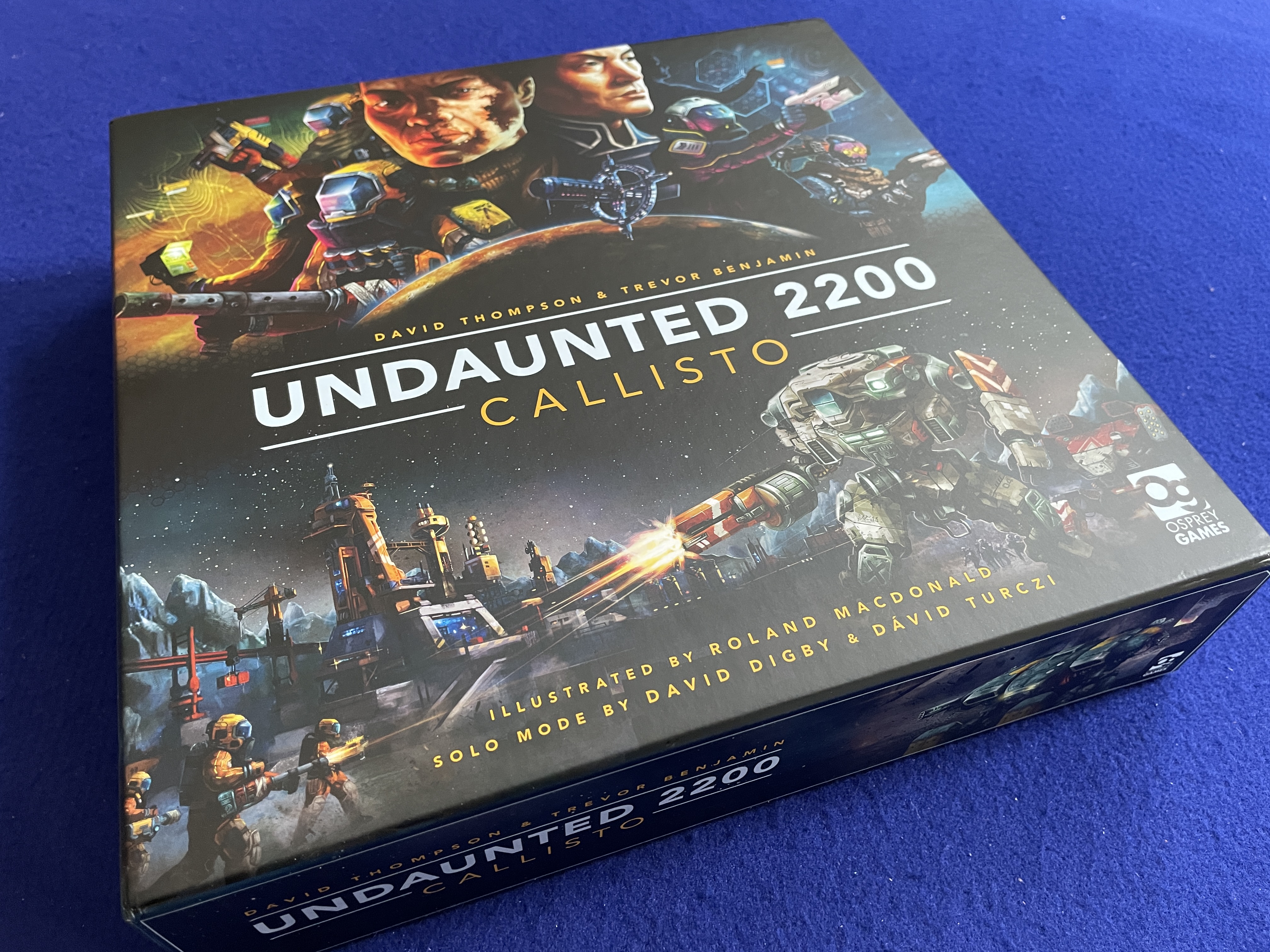
This is how the introduction in the rulebook of Undaunted 2200: Callisto by David Thompson and Trevor Benjamin from Osprey Games (2024) describes this far-future entry in the Undaunted series:
In Undaunted 2200: Callisto you will command either the Breakers making a stand or the LFA’s security forces attempting to bring the situation under control. Across a series of scenarios you will battle to claim, hold, and destroy certain objectives. Each scenario plays out on a different map either on the surface of Callisto or in the space stations orbiting above it: you will need to master these territories to gain advantageous positions to achieve your objectives. To control your fighters, vehicles, and mechs, you will be playing cards from your personal deck; but as injuries mount, you will have to bolster your deck with new cards to reinvigorate your tiring forces.
Rulebook, p. 3
For returning Undaunted players there are three key elements changed from previous entries:
- “Control: control works in the same was as in Undaunted: Stalingrad: you can take control of a space that your unit’s combat counter is on [you cannot perform this action if your opponent controls the space and has a unit there.]”
- Dice and Elevation: Callisto uses d8s, d10s, and d12s depending on whether you are targeting a higher [d8], level [d10] or lower [d12] target.”
- “Additionally, in Callisto no faces on the die are automatic hits. If you roll a 10, it simply counts as 10.” (Rulebook, p. 3)
As I do not own Undaunted: Stalingrad (2022) but most of the other Undaunted series—Undaunted: Normandy (2019), Undaunted: North Africa (2020), and Undaunted: Battle of Britain (2023)—I come to Callisto with some familiarity but not a great depth of knowledge. As such, I looked at Callisto with somewhat fresh eyes…
…and like what I see.
Cards at the core
The core game mechanism in Undaunted 2200: Callisto is built around the cards. There are three types of cards in the game:
- “Combat cards represent individual people, vehicles, and mechs under your command, and each is associated with a combat counter.”
- “Command cards represent people and assets that are not represented on the board, such as commanding officers. They are not associated with combat counters.”
- “Interference cards represent breakdowns in communication caused by the chaos of battle, made worse by spreading your forces over a large area.” (Rulebook, p. 7)
In Callisto, combat cards are played from your deck to seize the initiative, to move, or to shoot. This is the heart of the Undaunted game turn economy; cards are spent for their abilities or to be recycled into you deck for action. Cards are played to, 1) Play an Action , or 2) “Ready” a unit; that is, to recover from Suppression, or 3) “Hunker Down” which returns the card to Supply.
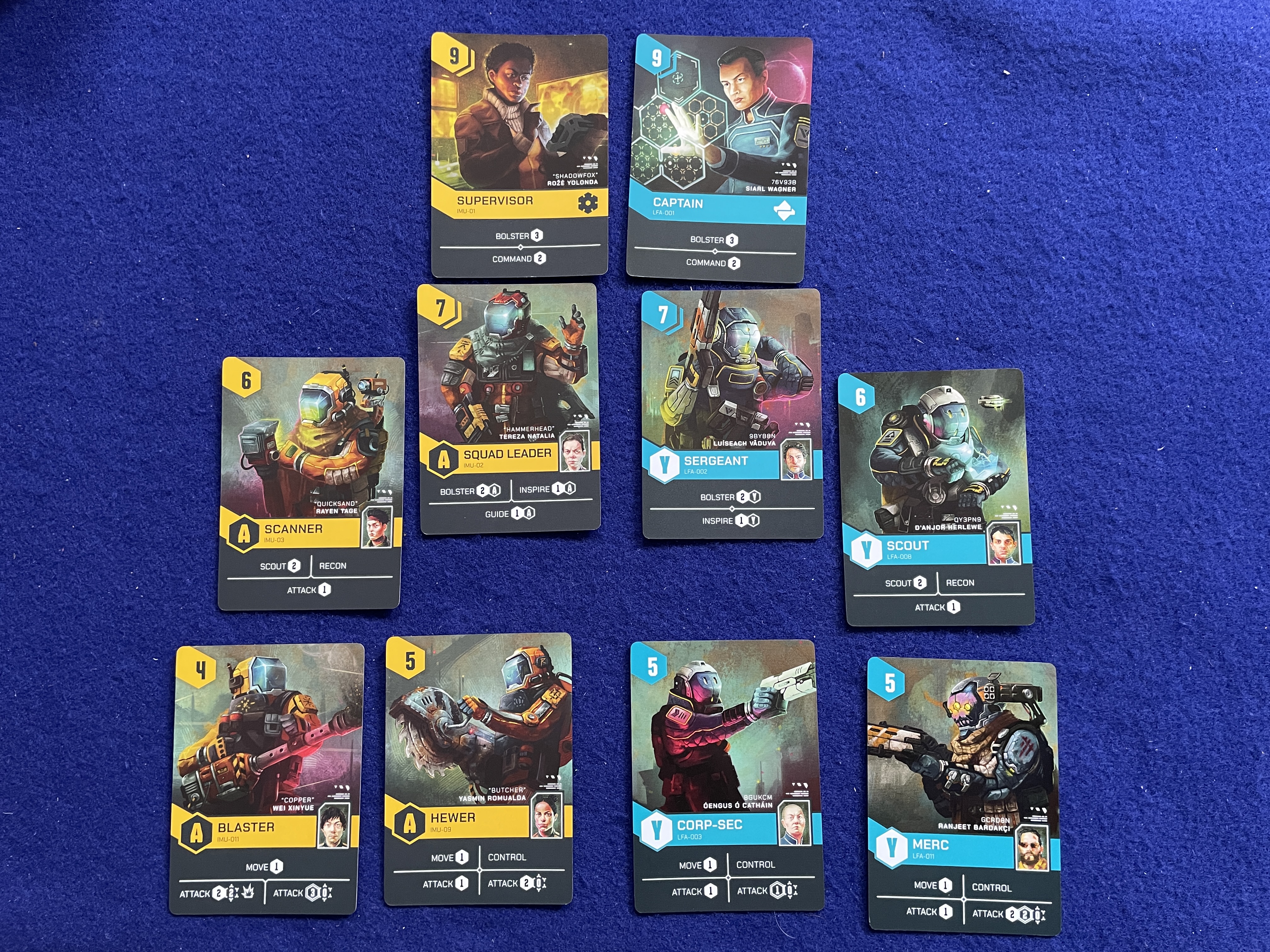
Different combat cards in Callisto have different mixes of abilities. This makes each member of the squad unique in that they clearly have a role derived from their skills—shown as the Actions available. Every Combat or Command card has a tailored mix of Movement, Support, or Combat Actions.
There are three different Movement actions in Callisto. Aside from the standard Move action, the Scout action is perhaps the most important (if not the most important action in the whole game). Your units can only enter a space if it controlled or scouted. This makes Scouts invaluable for only they can “scout” the terrain to enable movement. Of course, every time they Scout your deck gains an Interference card which forces a useless non-Action; such is the Fog of War!
Support actions in Callisto is where command shines through. The Bolster action adds a card from your Supply thus providing more future Action possibilities. Command actions adds cards to your hand for immediate use. Inspire actions act in much the same way. The Pathfind action is, in effect, a directed Scout action. Spending a Control action is how one converts a scouted and occupied area to their control. Recon actions are a necessary activity as it purges Interference cards; too much Interference “clogs” your deck and prevents timely actions.
Combat in Callisto is likewise very simple and driven by the cards. The Attack action is just that; the Attack action indicates the number of attacks where a die roll must equal or exceed a Defense Value. Pulse actions are a special attack that not only might cause a casualty but also moves the target. Finally, Suppress actions do not inflict casualties but do slow down units.
Pros (not ProtoGen) & cons (but not convicts)
Pros
Deck Construction: I enjoy the deck construction game mechanism in the Undaunted series as it showcases the challenges of activity and command in combat in a relatively straight-forward manner. A common refrain of leadership is, “use the cards you are dealt.” In Undaunted 2200: Callisto that is literally what you do; cycle your deck!
Campaign: The campaign system in Callisto uses eight scenarios of increasing difficulty to teach the game.
New Heights: This is the first Undaunted series game I encountered with the different elevations for combat; simple game mechanism (different dice) is an easy to understand way to show the difference shooting from above/below makes.
Solo: The Solo game system relatively easy to use as it supplements—but does not replace—the core multi-player game design.
Cons
After scenarios: While the programmed learning scenarios are great, once played there is not an “advanced” or “full rules” version. With eight pre-programmed scenarios played with two sides and up to four players this theoretically means there are 32 different “roles” one could play across the scenarios. Is that enough non-repeatability? Add in the solo rules where where the player choses which side to play in a scenario and that is another 16 different games. Will anybody every play more games than that? If that was to happen then the lack of “build your own” scenarios will be felt.
Indifferences
Theme: As thin as the Jovian atmosphere; Callisto could have been set in just about any hard-ish sci-fi setting and the art would work. At the end of the solar illumination cycle, the theme serves only to unify the artwork.
Unboxing
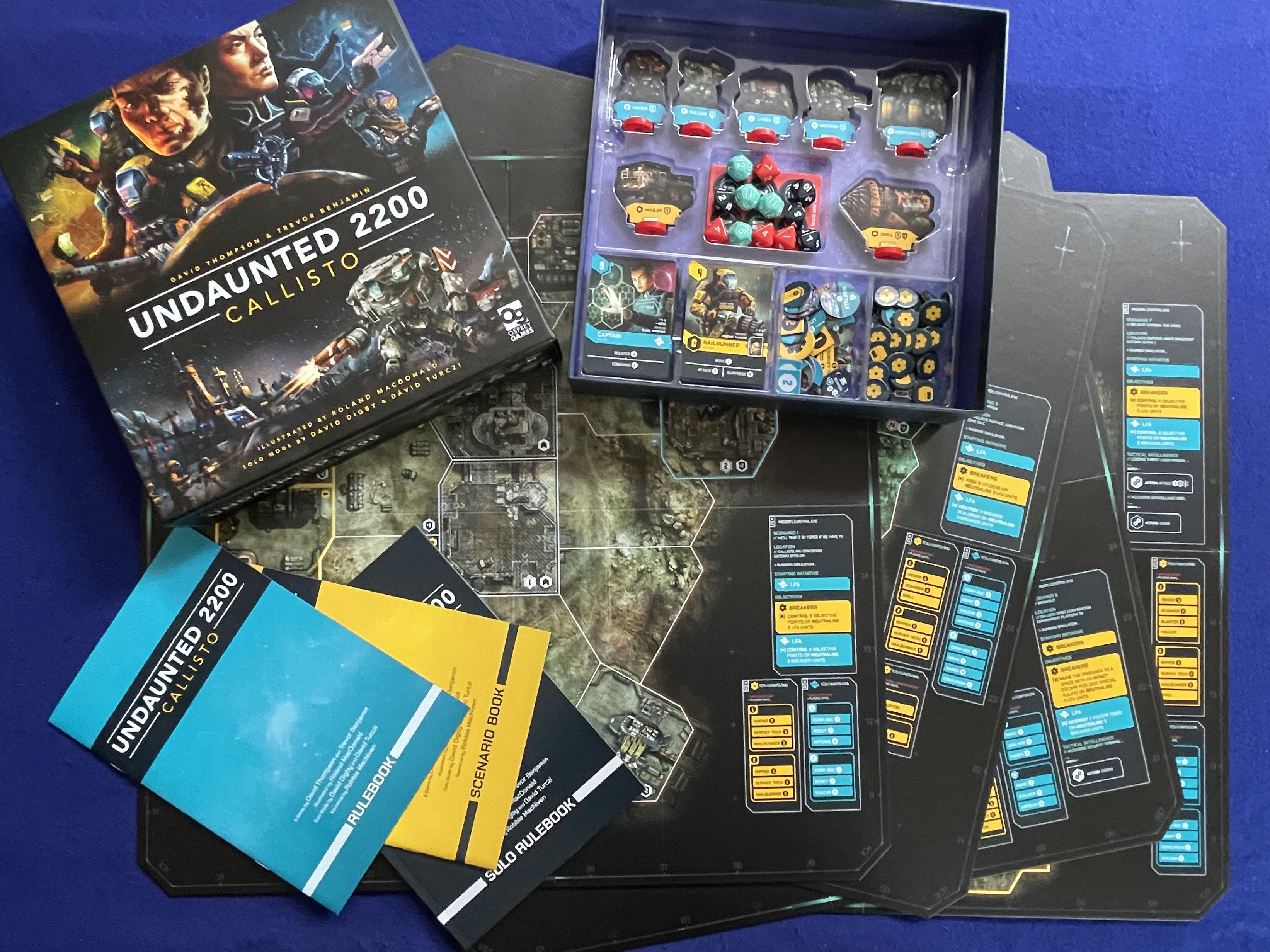
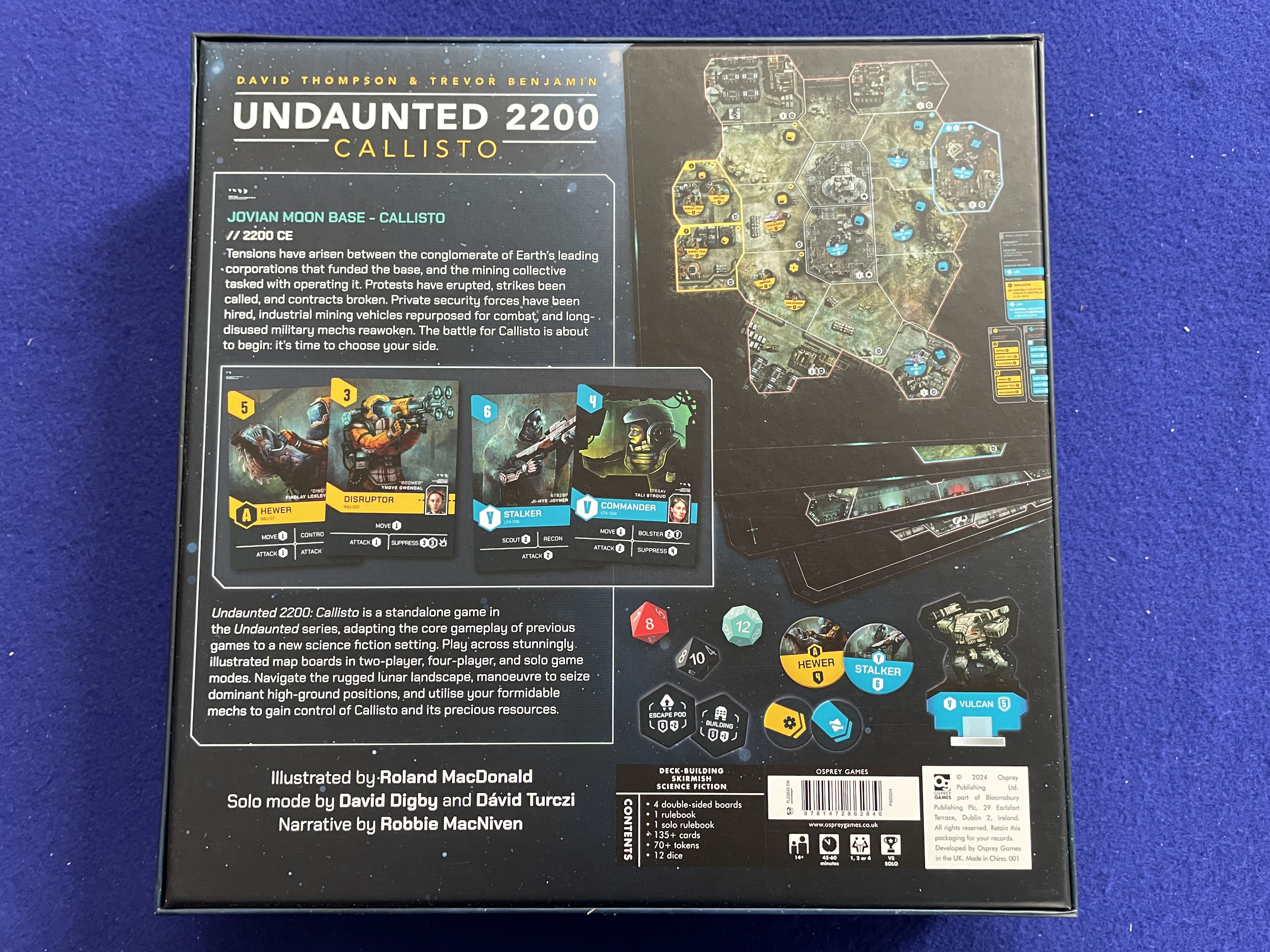
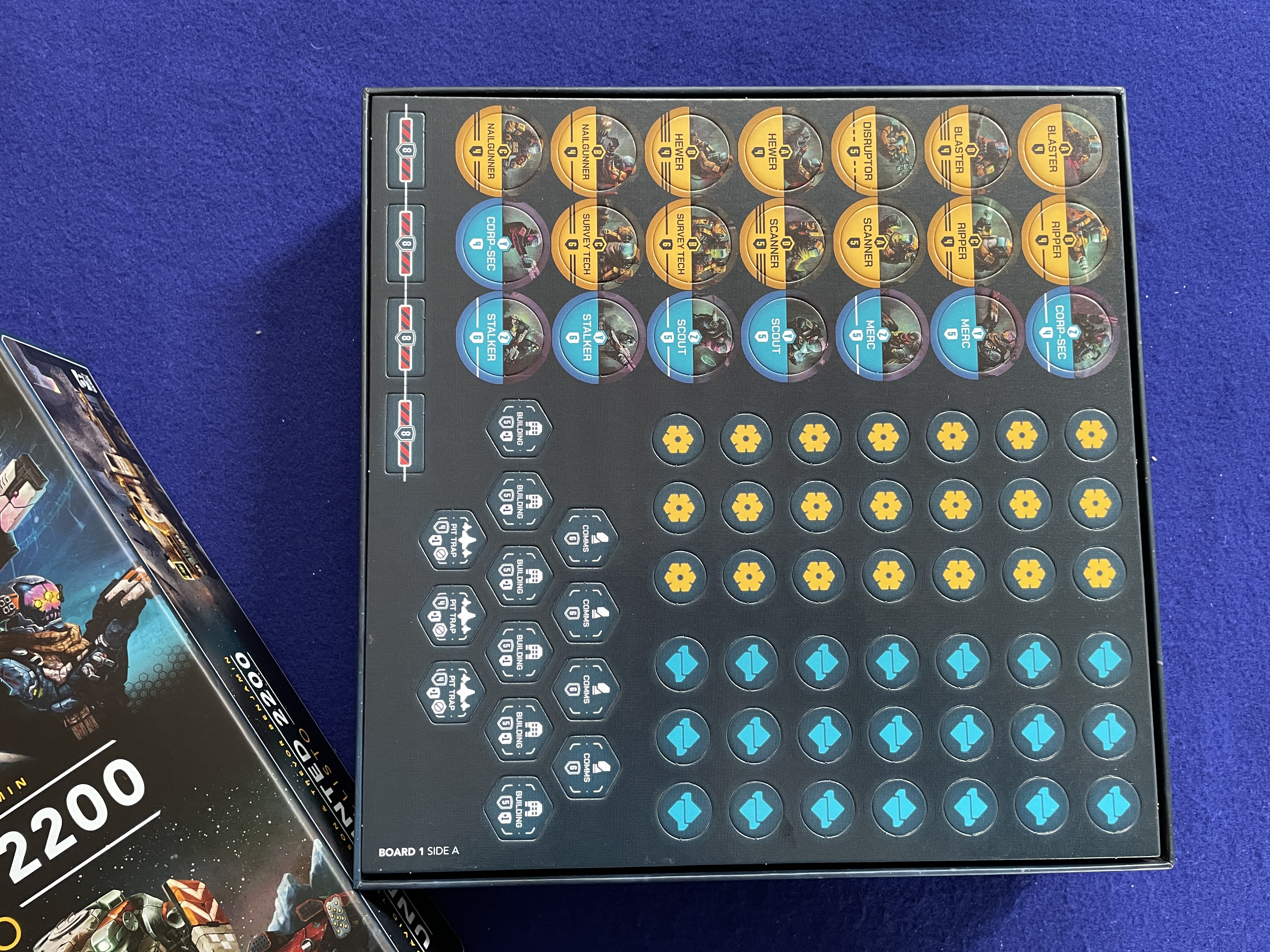
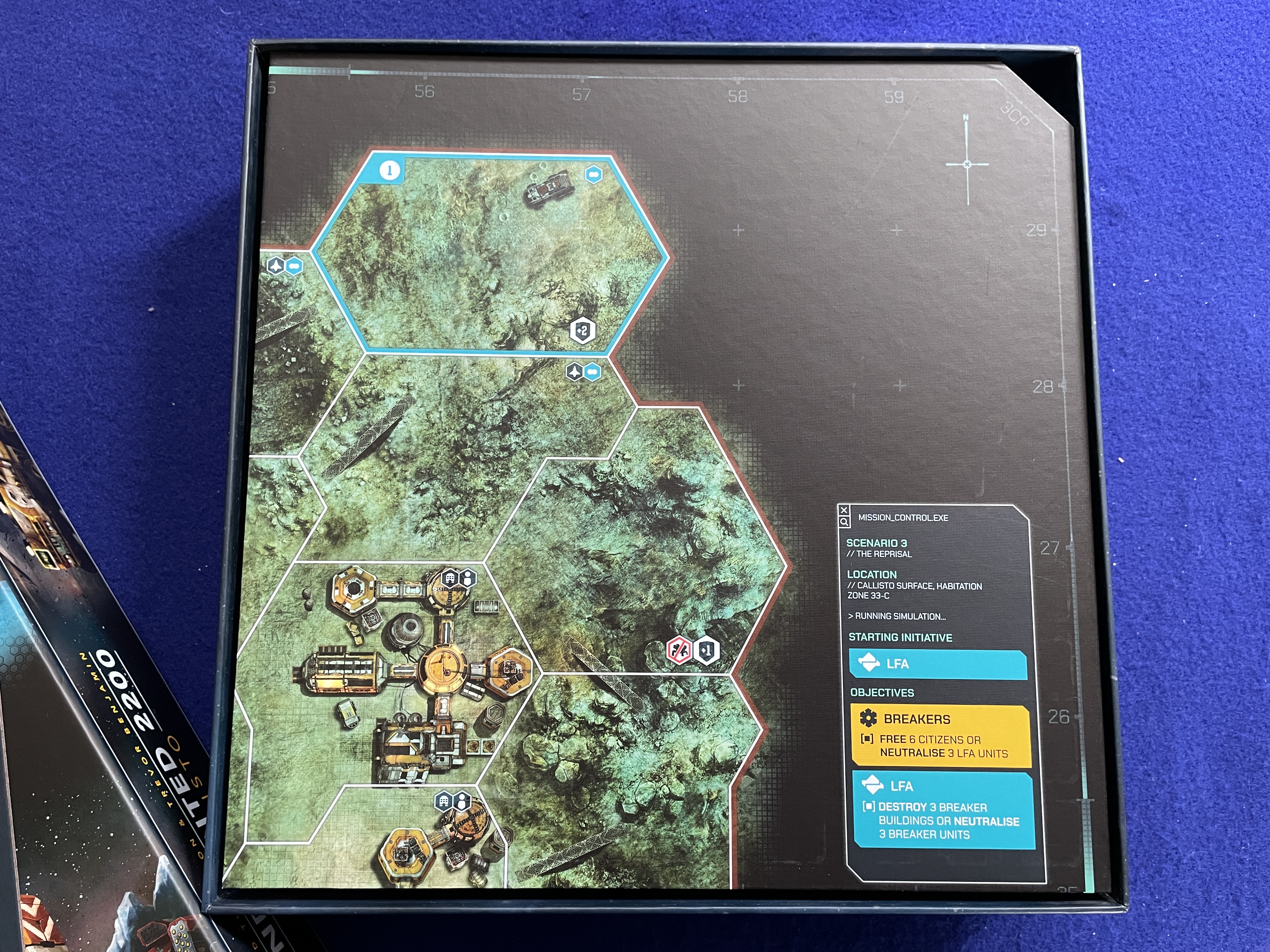
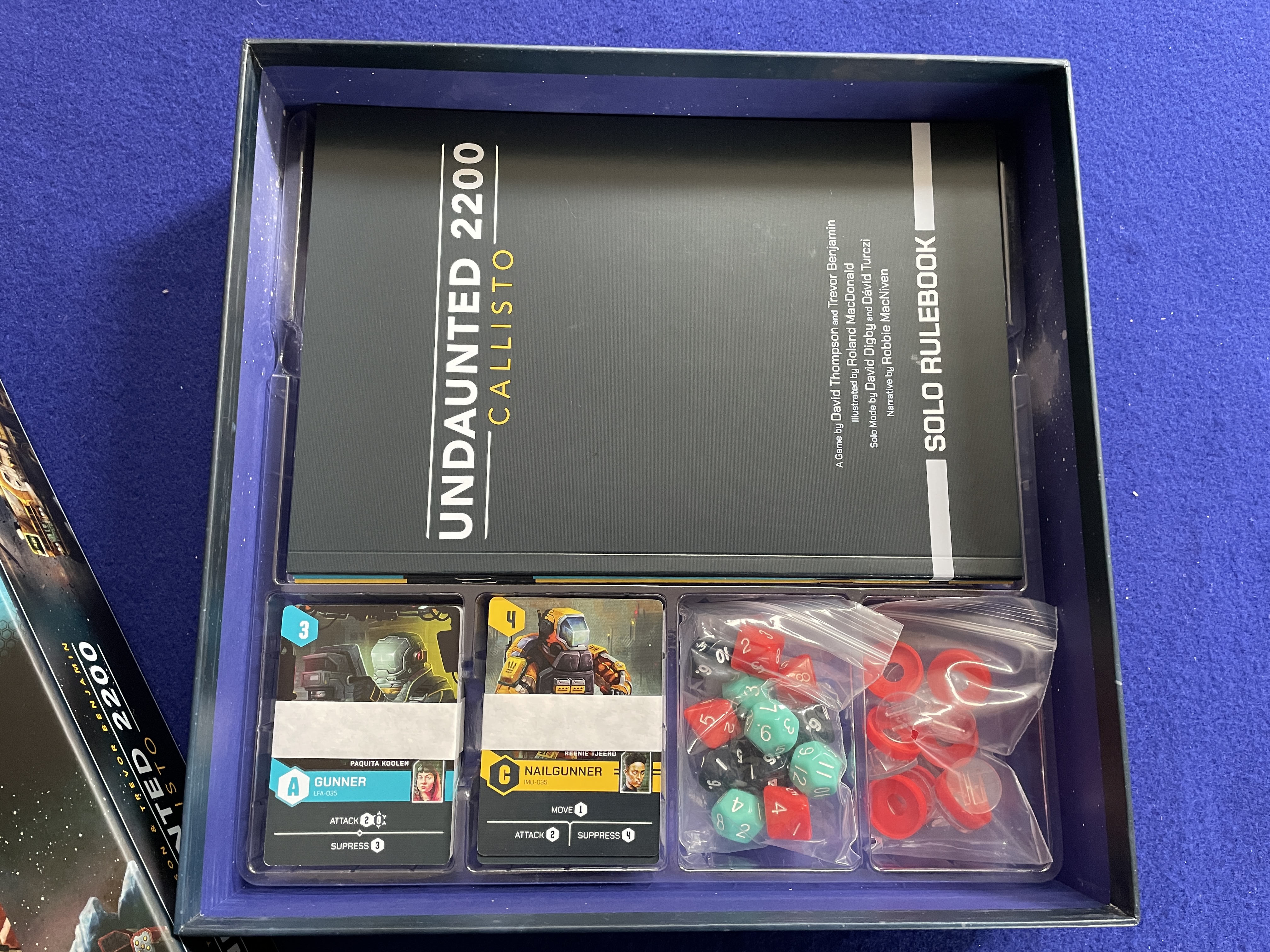
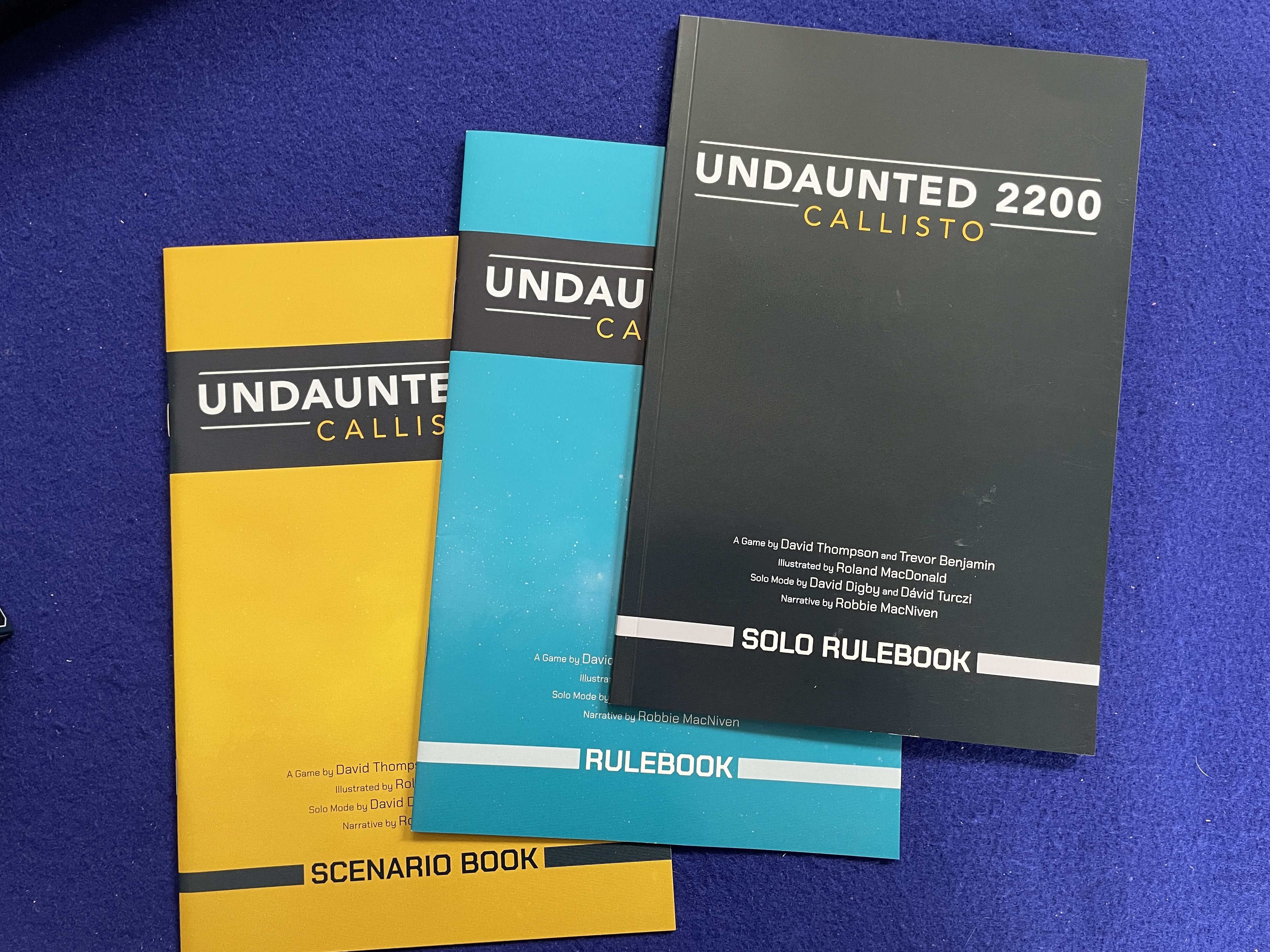
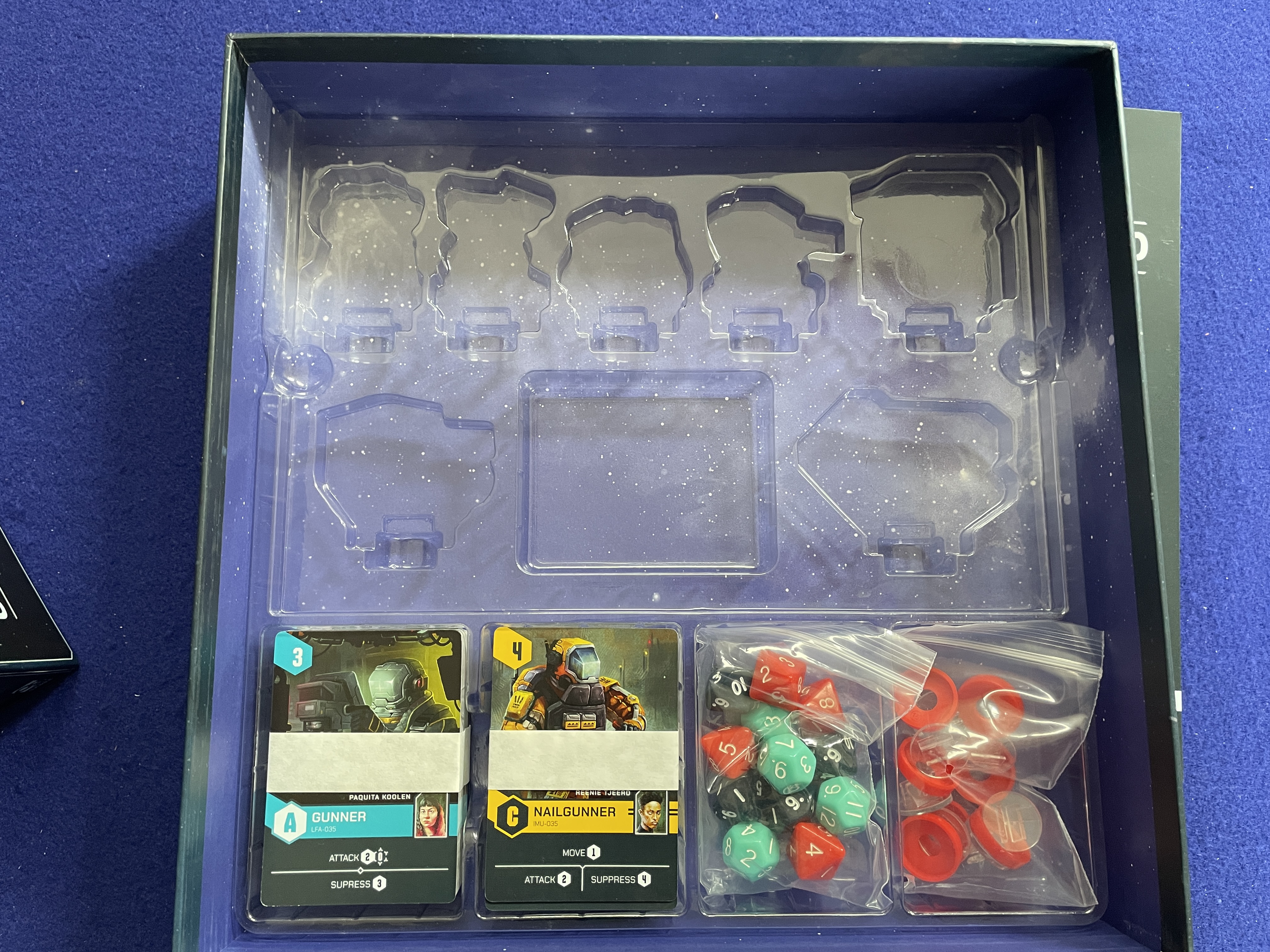
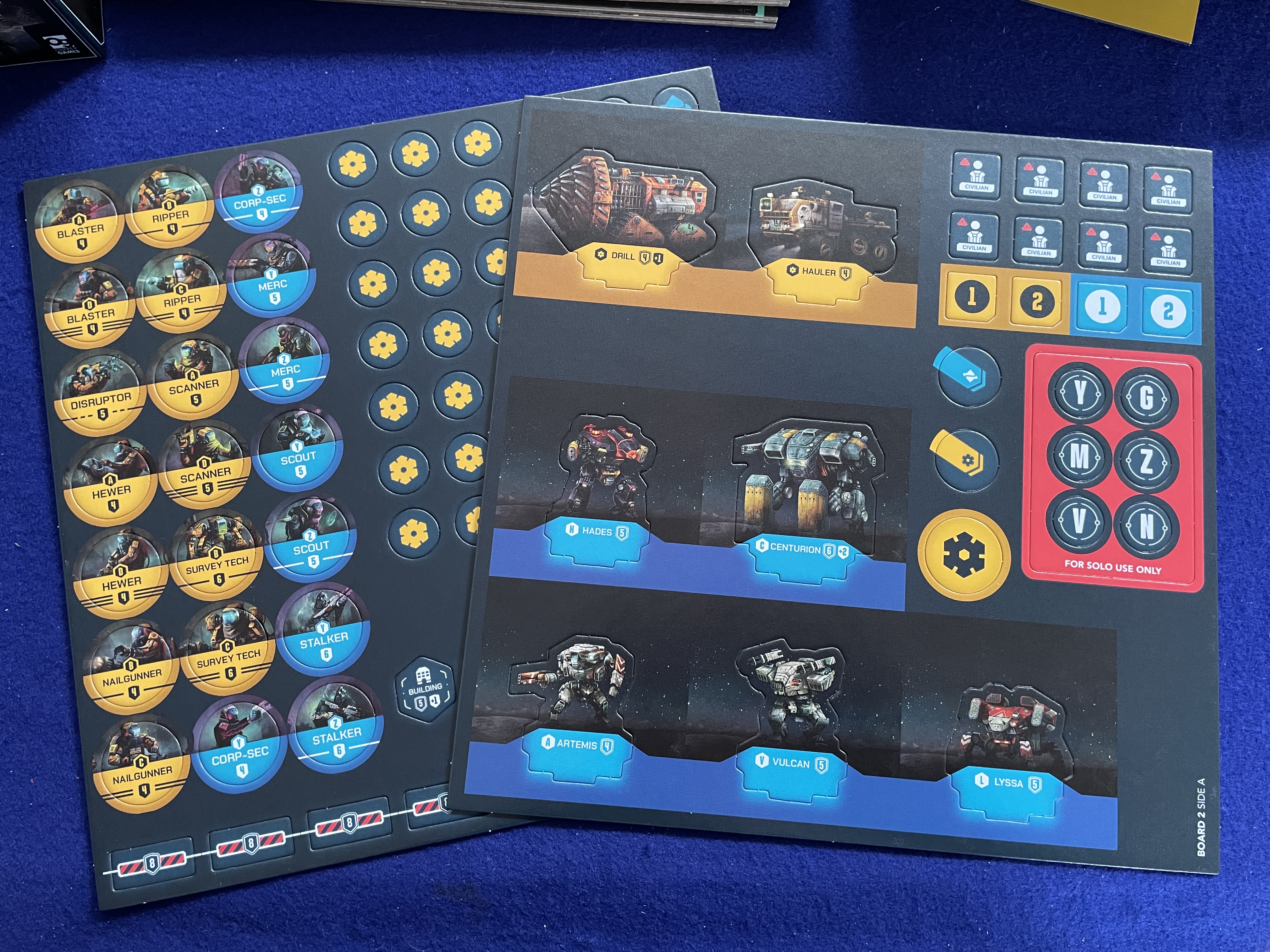
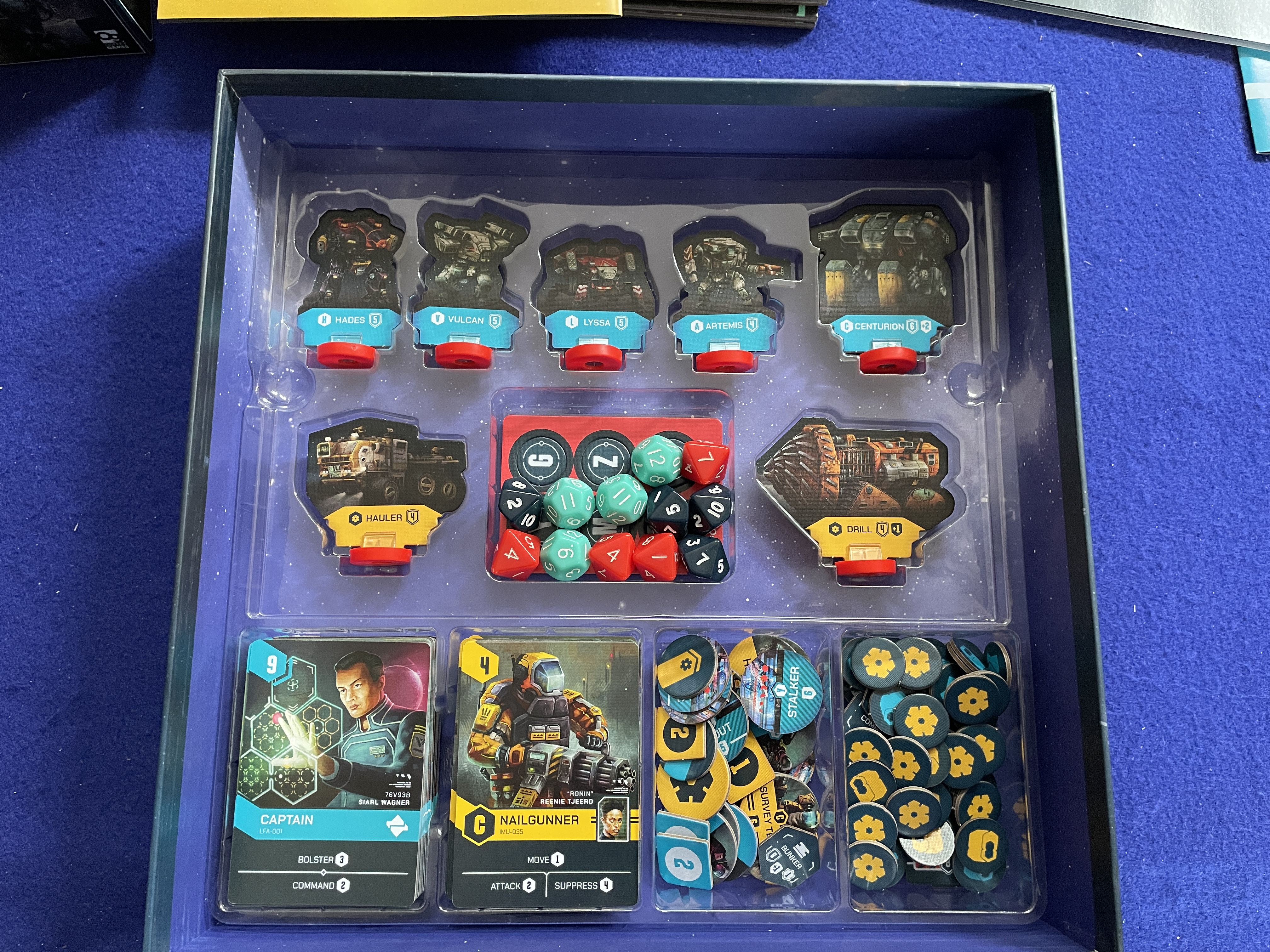
Undaunted 2200: Callisto is a “chunky” game. When they say, “Contents: 4 double-sided boards, Rulebook, Solo Rulebook, 135+ playing cards, 70+ tokens, 12 dice,” it does not tell you that the boards are mounted maps, or that the there are actually three rulebooks (Core rules = 24 pages, Scenario Book = 28 pages, Solo Rulebook = 64(!) pages), nor that the tokens are thick chitboard. It is as if they almost put miniatures into this game! I appreciate the RockyMountainNavy Boys gifting me this game because at $85 retail it is a bit steeply priced…but oh-so-worth it!
Family weekend civil warring
Of maybe interest to some, I note that Undaunted 2200: Callisto is categorized as a Wargame on BoardGameGeek. While I happen to agree with that categorization, I also recognize that some might instead insist that Callisto is a strategy boardgame. I am cognizant of some fellow wargamers who insist that science fiction themed wargames are not a thing; those are often the same wargamers that insist on calling such games “historical conflict simulations” or the like.
Personally, I often approach a wargame as a learning opportunity. I often use wargames to learn or analyze a situation with the aim of studying the subject via the medium of a game. This approach inevitably leads to questions of realism or authenticity. A common counterpoint against my chosen approach is that wargames—and games in general—are often so abstract that they risk teaching the wrong lessons; that is, unless one wants to go deep into Modeling & Simulation (M&S). There are some wargame practitioners who insist that wargaming is a form of M&S but I disagree; they certainly both occupy a spectrum of gaming to simulation to modeling.
All of which is to say Undaunted 2200: Callisto is a good wargame. Is it realistic? I cannot answer that question because IT’S SCIENCE FICTION. Is it a fun game that creates a tension between a Government/Corporate entity that seems relatively better equipped than the rebellious working class? Sure. Is it a model or simulation of how such a conflict might be fought? Hardly. At the end of the day Undaunted 2200: Callisto is a card-driven boardgame that thematically captures the essence of the chosen conflict. If you want to play Callisto to gain insight into lessons learned for fighting on moons in the far future, just STOP. If, on the other hand you are searching for a medium-lite, two-player, family boardgame with some “take that” as replacement/substitute/alternative to a First Person Shooter video game, then Undaunted 2200: Callisto should be on your gaming table.
Undaunted 2200: Callisto is an ideal game for a “civil” family weekend gaming session. The programmed -play approach makes teaching the game to a newbie that much easier and the building campaign keeps them interested in more than a single game. For myself, the solo mode is also very welcome as finding time for even a family weekend session is challenging. As much as I fear reaching the point of having played out the game—going through all the solo scenarios for both sides—the reality is that I will be lucky to get halfway through all those games. Even if I only play half of the solo scenarios, it still will be enough to qualify Undaunted 2200: Callisto as a success.
Feature image courtesy RMN
The opinions and views expressed in this blog are those of the author alone and are presented in a personal capacity. They do not necessarily represent the views of U.S. Navy or any other U.S. government Department, Service, Agency, Office, or employer.
RockyMountainNavy.com © 2007-2026 by Ian B is licensed under CC BY-SA 4.0
 Rocky Mountain Navy Gamer
1 thought on “Wargame SITREP 26-06 ~ Civil card war with Undaunted 2200: Callisto”