
Modern Armoured Warfare in Banzai Magazine Nr. 27 (Fall 2025) gives players the opportunity to refight two armored campaigns in small footprint wargames of medium-low complexity which are playable in less than three (3) hours.
…and I was there (once and almost)
In January 1991 I was in the US Navy aboard the aircraft carrier USS America (CV-66) and part of Operation Desert Storm. We started the war in the Red Sea before transiting late in the conflict to the Persian Arabian Gulf just in time to support the ground war which is the focus of the Operation Desert Storm wargame. USS America is not on the game map but I want to imagine that one of the air power counters represents my contribution but, alas there are counters for the Air Force and RAF but not Naval Aviation. It is an oversight I am willing to overlook given the tightness of the overall game design of Modern Armoured Warfare – Operation Desert Storm.

By the time 1995 and the War in Bosnia rolled around I was assigned to the Pacific and missed out. I almost, however, was sent to Aviano in 1998 when I was put on standby to deploy as part of my Naval Reserves commitment. Ultimately, I was not activated but it was close. Perhaps that was for the better because, as the wargame Operation Storm shows, that conflict was far from clean with many civilian atrocities complicating the fight.
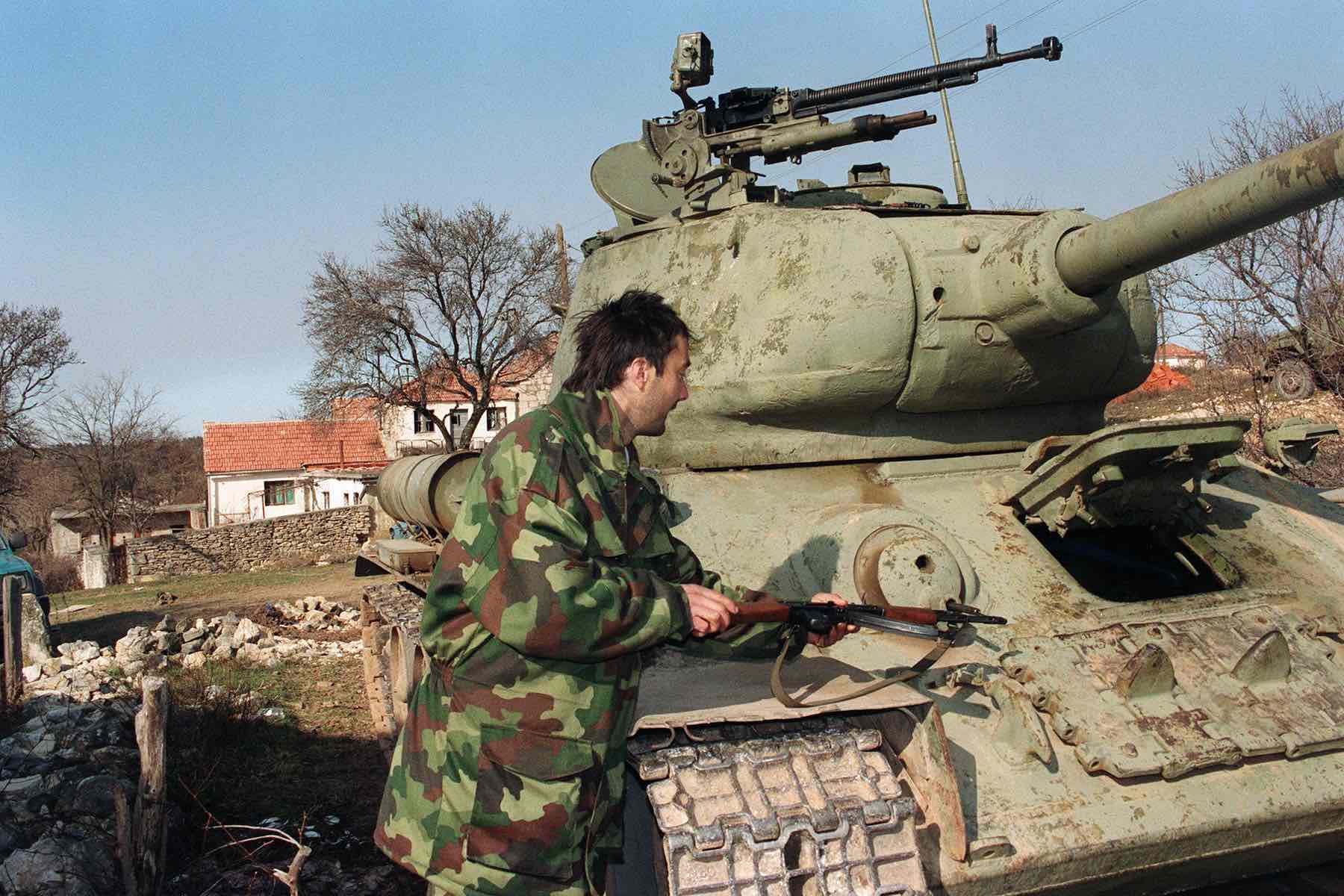
Loaded magazine
I am very fortunate the publisher Yasushi Nakagoro of Bonsai Games thinks I write reviews his readers appreciate. I am very fortunate because Yas keeps me updated with the latest version of Banzai Magazine where every issue includes a wargame. Thus I am now playing Modern Armoured Warfare from Banzai Magazine Nr. 27 (Fall 2025):
The appendix game “Modern Armoured Warfare” is an operational-level wargame that utilizes a common game system to recreate armored battles that occurred—or might have occurred—after World War II. Players lead operations as commanders, but must contend with the fact that war aims—and thus victory conditions—can shift due to political reasons and the influence of real-time changes in international opinion. You must maximize limited resources to strive for victory.
This collection includes two games:
Operation Desert Storm: Recreates the 1991 conflict. In history, this is often called the “100-hour war” because the Coalition Forces defeated the Iraqi army in just four days.
Last Blitzkrieg in the 20th Century: Operation Storm: Recreates the 1995 offensive carried out by Croatia and Bosnia-Herzegovina against the Republic of Serbian Krajina.
Game Specifications: Estimated Play Time: 1–3 hours / Players: 2 / Solitaire Suitability: B (Hidden information rules are non-existent or have minimal impact) / Difficulty: ★★☆☆☆
Game Engine
Both of these Modern Armoured Warfare games use a common set of rules and “Game Specific Rules.” In this respect, Modern Armoured Warfare is not unlike a Standard Combat Series game from Multi-Man Publishing.
The Standard Combat Series (SCS) enables both experienced and beginning players to enjoy simple to play and quick to learn games. Each game is a quick-start, complete simulation: rules, a detailed color map, 280 counters, and everything else needed to recreate the campaign in question.
The core rulebook for Modern Armoured Warfare is 28 pages in Japanese and includes:
- “Core Rules” 1.0 – 9.0 (5 pages)
- Operation Desert Storm game specific rules 10.0 – 22.0 (6 pages)
- Operation Storm game specific rules 10.0 – 21.0 (8.5 pages)
- Historical commentary rule 22.0 (2.5 pages)
- Extended Example of Play (4 pages)
- Front/Back cover (2 pages)
Each “game” uses a 23.25″ x 16.5″ map. Two player aid cards are included with Desert Storm on one side and Operation Storm on the other. The counter sheet is 260 units and markers roughly evenly divided between the two games.
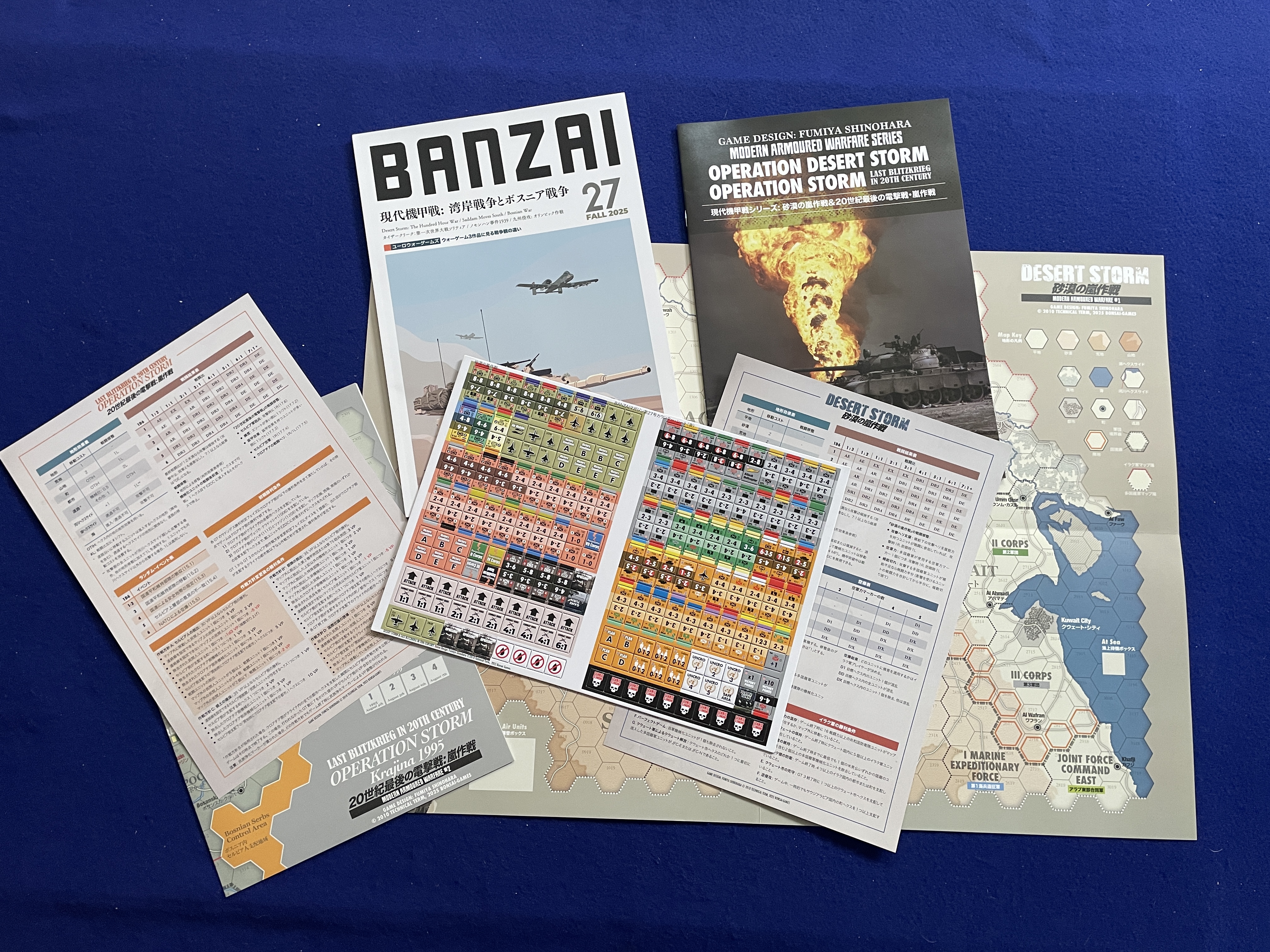
The core game rules for Modern Armoured Warfare are used in both games and deliver the basic game engine. In the following nonagon each side corresponds to a chapter of the Modern Armoured Warfare Core Rules.
               1.0 Introduction
             /                  \
   9.0 Disruption                 2.0 Components
    and Recovery                 /                \
          /                                        3.0 Game Setup
        8.0 Combat                                and Hex Control
         \                                         /
          7.0 Movement                     4.0 Sequence
            \                                of Play
             \                                 /
              6.0 Zone of             5.0 Stacking
             Control (ZOC) ------------------
Unit Counters: Combat units are rated by Offense, Defense, Movement, and a “Proficiency Level” (alternatively called “Training Level”).
Sequence of Play: The game is played in a series of turns with first-mover determined by initiative or rule. In the core game, each player’s turn is a sequence of Event / Movement / Combat / Recovery.
Zones of Control (ZoC): ZoC rules are pretty much as expected; non-Disrupted units exert a ZoC extending into the six hexes surrounding a unit except when blocked by terrain. Enemy units entering a ZoC must stop. Units in a ZoC can move but not into another ZoC. In combat units are not required to attack the unit which ZoC they are in; however, units cannot retreat into or through a ZoC. Notably, a ZoC is not nullified even if friendly units are present.
Movement is paid for in Movement Points charged by different terrain types.
Combat is odd-based with column adjustments on the Combat Results Table from Support or the like.
Combat Results are expressed in unit losses or Retreat hexes; units can be Disrupted. Rules for Advance after Combat and Armoured Breakthrough are present.
Taken as a whole, I personally rate the core combat rules in Modern Armoured Warfare as low complexity. (★☆☆☆☆).
100 hours in about 3
The “game specific rules” in Operation Desert Storm for Modern Armoured Warfare seemingly are detailed but in reality add little overhead to gameplay.
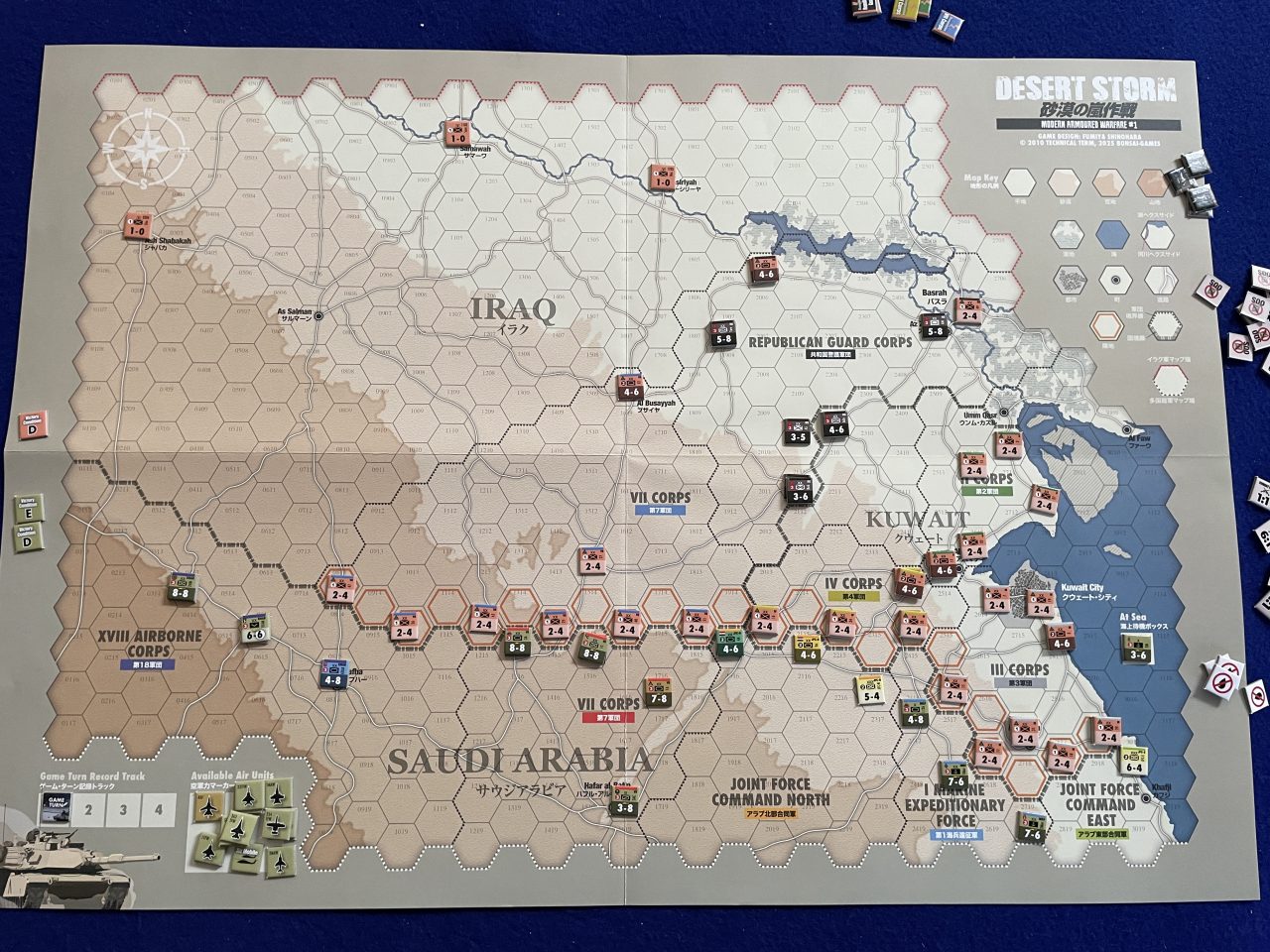
10.0 Introduction – The game scale in Operation Desert Storm in 1-day per turn, Divisions/Brigade-sized units, and 18 km/hex. A Garrison unit-type is introduced (no movement but ZoC). The game is played over the course of no more than four (4) turns.
11.0 Game Preparation and Hex Control – Set up is free-form within Deployment Areas.
12.0 Victory Conditions – Perhaps the heart of the game. Victory conditions are variable and randomly drawn at game start. Certainly enhances the replayability of the design. The rule specifies:
Before the start of the game, the Coalition Forces player draws 2 Coalition Forces Victory Condition markers randomly. The content of these markers constitutes the Coalition Forces’ victory conditions for this game.
Similarly, the Iraqi side draws 1 Iraqi Forces Victory Condition marker randomly before the start of the game, and this content constitutes the Iraqi side’s victory condition.
Victory Condition markers that were not drawn are not used in this game, but there is a possibility they may be used due to a Random Event (13.0). The player does not reveal the Victory Condition marker(s) they drew to the opponent until the game ends.
At the end of the game, the side that has achieved the greater number of victory conditions wins. If the number of achieved conditions is equal, the result is a draw. If the same condition was drawn twice (for the Coalition Forces), meeting that condition counts as satisfying two conditions.Operation Desert Storm 12.2 Victory Conditions
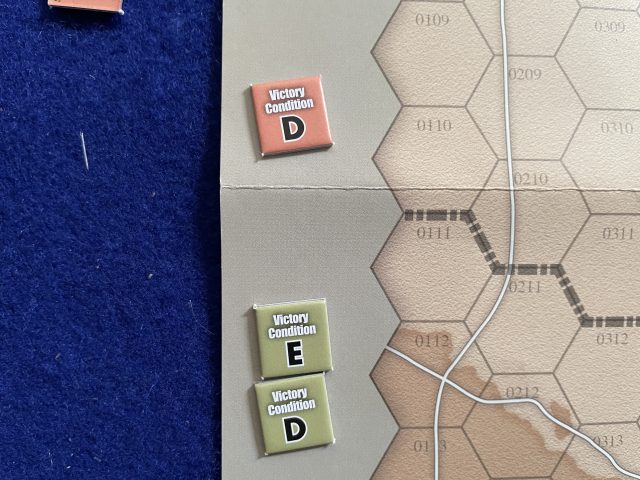
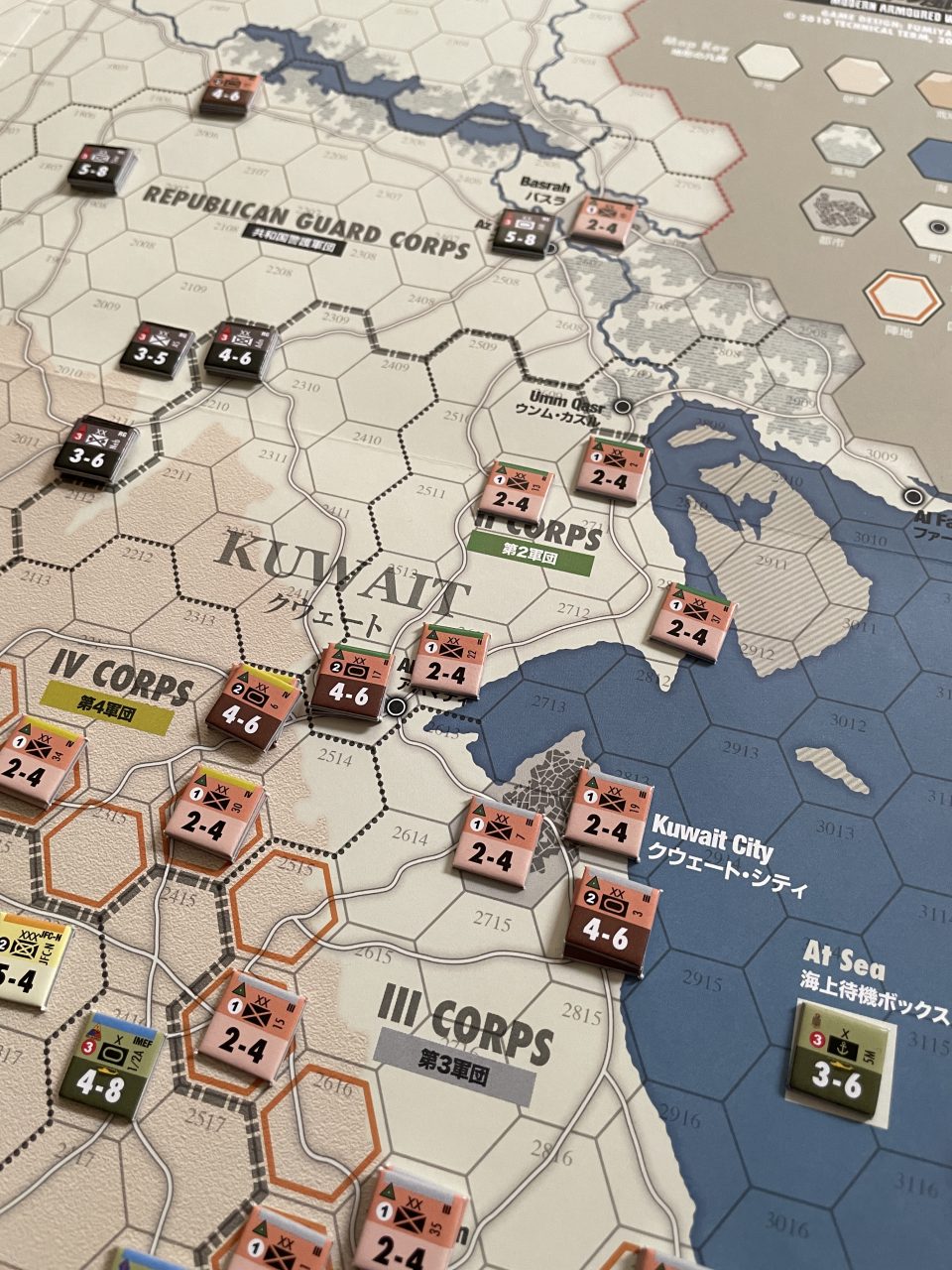
(Random Victory Chit Draw – Coalition (green chits) needs to D) Destroy at least 5 Republican Guard units (black counters in right picture) and E) Hold Basra (right picture, top center). The Iraqis (tan chit) must D) Hold at least one hex of Kuwait City at end of Game Turn 3. In regular 2-player game the drawn chits are not revealed until end game. Photos by RMN)
13.0 Sequence of Play – Slightly modified from core game rules; the Coalition player is always the first player. Each turn begins with a Random Event Phase (both players) followed by the Coalition executing Air / Movement / Combat / Recovery Phases. The Iraqi player follows with Movement / Combat / Recovery Phases (no Air Phase).
14.0 Stacking Limits – Two (2) units per hex.
15.0 Random Events – Six random events that can occur multiple times in the game. Some are good, some are bad, some end the game early so players are pushed to always be winning.
16.0 Special Movement concerns units moving off the map (“no return”).
17.0 Special Rules Concerning Combat covers situations like multiple nationalities (17.1) and column shifts from terrain, supply, training, and Air Power (17.2-17.5) as well as Retreat off the map (17.6).
18.0 Air Power – Air Power in Operation Desert Storm is abstracted in Air Points. Air Points can be used for:
- Air Strike (executed during the Coalition Forces Air Operation Phase).
- Movement Interdiction (placed during the Coalition Forces Air Operation Phase).
- Combat Support (executed during the Combat Phase of both sides).
- Movement Support (executed during the Coalition Forces Movement Phase).
- Supply Support (executed during the Coalition Forces Recovery Phase).
Rules 19.0 Recovery Phase and 20.0 Iraqi Forces Surrender and Coalition Forces Out of Supply are closely related as the recovery of Disrupted units and surrender of Iraqi units are closely related.
21.0 Amphibious Operations is a special rule for the 5th Marine Brigade of the Coalition player.
22.0 Optional Rules offers two choices: 22.1 Change in Victory Conditions and 22.2 Iraqi Forces C2 (the later rule warns, “This rule is significantly advantageous to the Coalition Forces.”
While the game specific rules for Operation Desert Storm are 33% longer than the core rules, they only marginally add complexity to play, leading me to call the game as medium-low complexity (★★☆☆☆).
Lightening Storm
Operation Storm focuses on the 1995 Battle of Krajina. As the historical game commentary explains:
In 1995, Serbian forces seized Srebrenica, a UN-protected “Safe Area” in Bosnia, resulting in a massacre where more than 3,000 people were killed. This atrocity caused international opinion to shift sharply toward condemning the Serbian forces. The Bosnian government, fearing a similar outcome in the Bihać region of northern Bosnia—which was also under siege—secretly requested assistance from Croatia to help break the encirclement. Croatia had already unilaterally scrapped the 1991 ceasefire agreement in 1993 and had carried out repeated attacks on Serbian-controlled areas. Due to the continued state of unrest and the fact that the UN force’s mandate was set to expire within the year, the Croatian side desired to clear out the remaining Serbian-controlled areas within its borders. As part of this effort to liberate their territory, they decided to implement a major offensive to break the siege of the Bihać pocket and recapture the Krajina region.
On August 4, 1995, the Croatian Army launched an offensive across the entire 600 km military border with the Republic of Serbian Krajina. The main force of the offensive was led by Guard mechanized brigades, which had been given priority in training and equipment, and these brigades successfully broke through the front lines on the northern, central, and southern fronts.
In contrast, the response of the Army of the Republic of Serbian Krajina to the Croatian offensive was extremely slow. Effectively remaining a mere collection of local Serbian militias, they were unable to mount a rapid response in the opening phase of the conflict; furthermore, plagued by internal political conflicts that undermined their military unity, they were defeated piece by piece by the Croatian Army, which had received thorough training based on U.S. military doctrine.
22.0 Historical Notes, p. 23
11.0 Game Preparation and Hex Control – The game specific rules for Operation Storm (also called “Krajina 1995”) are very similar to Operation Desert Storm. Like the previous game, Operation Storm is played out over four turns. The game scale in “Krajina 1995” is 1 day per turn, units of Battalion to Brigade size, and 7 km per hex. Operation Storm also uses several game specific Markers of interest that helps make this game very different from its issue companion:
- Serbian Operation Policy (12.3)
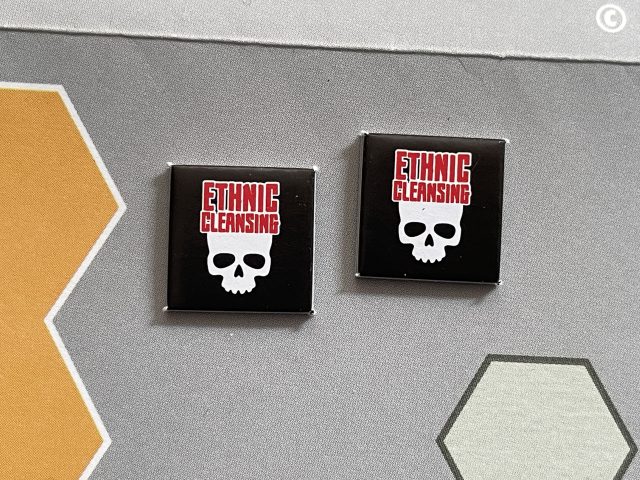
- Ethnic Cleansing (19.4)
- Attack Helicopter (17.7.5)
- Air Power (17.7.4)
- UNCRO (18.0)
- Safe Area (15.3)
- Civilian (Unit) (19.1)
- Victory Point (12.4)
- Foreign Mercenary (21.0)
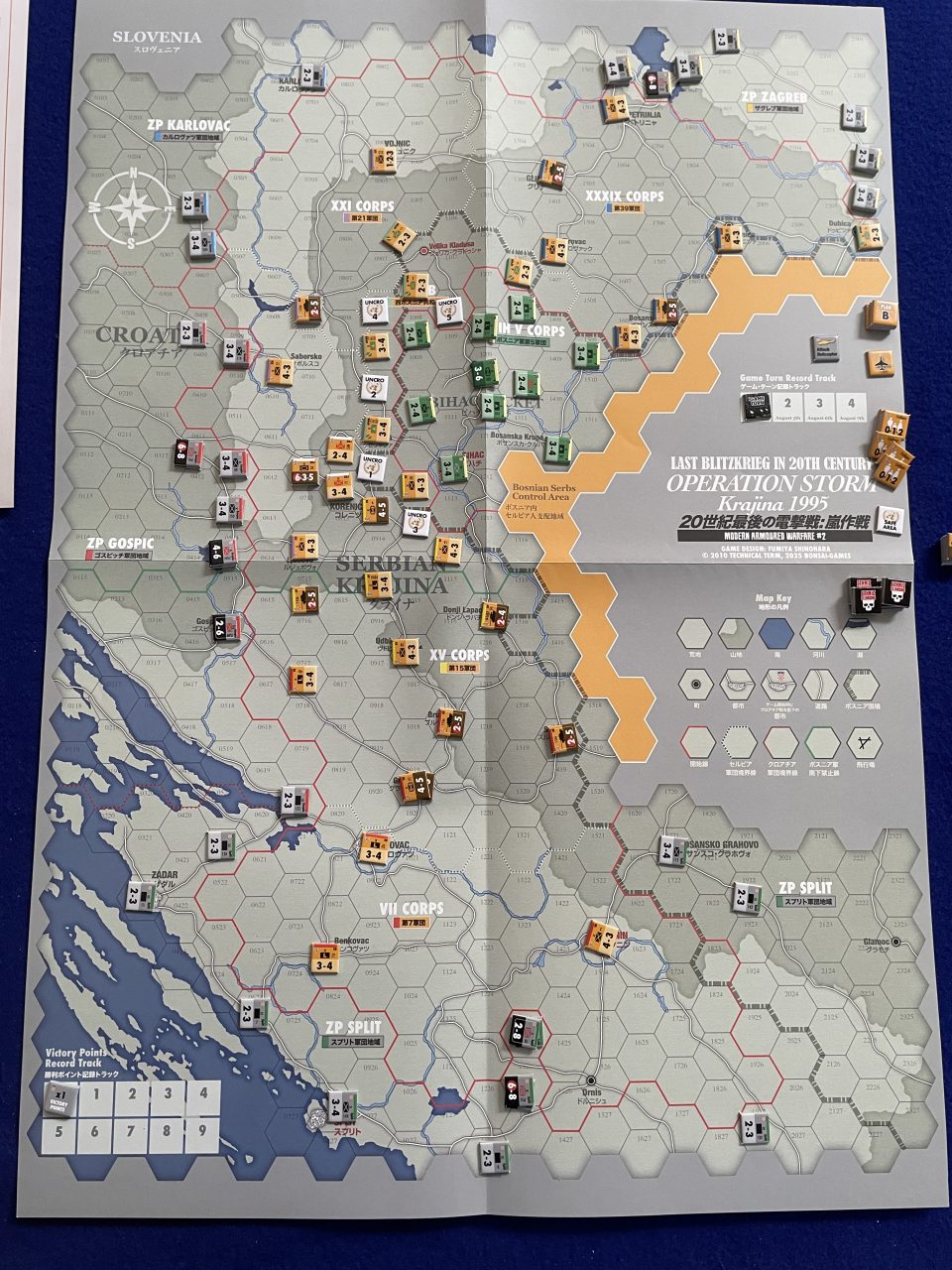
12.0 Victory Conditions – Unlike Desert Storm that calls for players to satisfy specific Victory Conditions, Operation Storm uses a very traditional Victory Point (VP) scoring system. That is not to say, however, that Operation Storm is simply a point-salad VP race. “The course of the game dictates that the Croatian side will conduct an offensive and attempt to control important hexes on the map. The Serbian side acts to prevent the Croatian side from achieving their victory conditions and attempts to achieve their own victory conditions” (12.1). In Operation Storm the Serbian Victory Conditions—and VP scoring—can change as a result of fluidity in Serbian Operation Policy (12.3). This is perhaps the most challenging rule in the game not because it is technically complex but because when the Serbian Operation Policy changes (there are four (4) possible policies) the scoring of Victory Points change. The players may think they have a good strategy and plan for victory only to see the Policy shift and force an immediate change in strategy that the players may—or may not be—ready for.
13.0 Turn Sequence is modified to give the Serbian (second player) additional options as well as add Civilian Movement (i.e. refugees) to mix up a game turn.
14.0 Stacking Limits – Two (2) units per hex.
15.0 Random Events – Another six possible variants to spice up your game; most involve the United Nations (UN) or NATO Airstrikes.
16.0 Special Rules for Movement and 17.0 Special Rules for Combat focus on game specific rules from the much different terrain and the impact of artillery and air power. In certain situations, some units may also become Confused which is similar to Disruption but with interesting game differences. Interestingly, for a battle called “The Last Blitzkrieg in 20th Century” the Armoured Breakthrough rule (8.14) is ignored for this game.
18.0 UN Peacekeeping Forces introduces rules for United Nations Confidence Restoration Operation in Croatia (UNCRO) markers.
19.0 Civilians and Ethnic Cleansing may be a bit of a hard rule for some players to deal with. At the most broad level, depending on the Serbian Operation Policy civilians units may become casualties and some of those casualties may be from an atrocity. I can see where some players may be offended that atrocities are reduced to Victory Points (VP) but, given the lack of other game mechanisms to deal with the issue, the use of VP is perhaps the most simple—though a bit callous—approach to the problem.
Rules 20.0 Reinforcement and 21.0 Optional Rules are nothing remarkable but thematically appropriate.
The game specific rules in Operation Storm, especially the Serbian Operation Policy, are somewhat more complex than those used in Operation Desert Storm. I grade the complexity of this rules set as medium (★★★☆☆).
Mini-blitz
Once you get the rules translated (I strongly recommend Google’s NotebookLM) learning and playing both games of Modern Armoured Warfare is quick and easy. As Yas said to me in direct correspondence, the game is “simple”; that does not mean, however, that Operation Desert Storm and Operation Storm are unchallenging games. The core game engine might not be exotic but it certainly is functional—and adaptive as the game specific rules demonstrate.
The relatively simple and even “familiar” rules of Modern Armoured Warfare and thematic yet not-so-crunchy game specific rules create an interesting wargame that is playable—even in a first play—at comfortably under four (4) hours. This makes Modern Armoured Warfare a very good candidate for convention play.
Although the starting conditions in each game are straightforward, the randomly drawn victory conditions in Desert Storm and the fluid Serbian Operation Policy in Operation Storm, as well as Random Events, all-but-ensures that no two games of either title will be the same. In Desert Storm in particular the varied Victory Conditions also create rich opportunities for alternate history.
Modern Armoured Warfare and Banzai Magazine Nr. 27 are, unfortunately, sold out at the time of this posting. If you, however, ever get a chance to acquire the the game I strongly encourage you to do so regardless of you being a newbie wargamer or a grognard.
A special thank you to Yasushi Nakaguro of Bonsai Games that provided me a review copy. Thanks, Yas!
Feature image courtesy Bonsai Games
The opinions and views expressed in this blog are those of the author alone and are presented in a personal capacity. They do not necessarily represent the views of U.S. Navy or any other U.S. government Department, Service, Agency, Office, or employer.
RockyMountainNavy.com © 2007-2026 by Ian B is licensed under CC BY-SA 4.0
 Rocky Mountain Navy Gamer