
Red Christmas
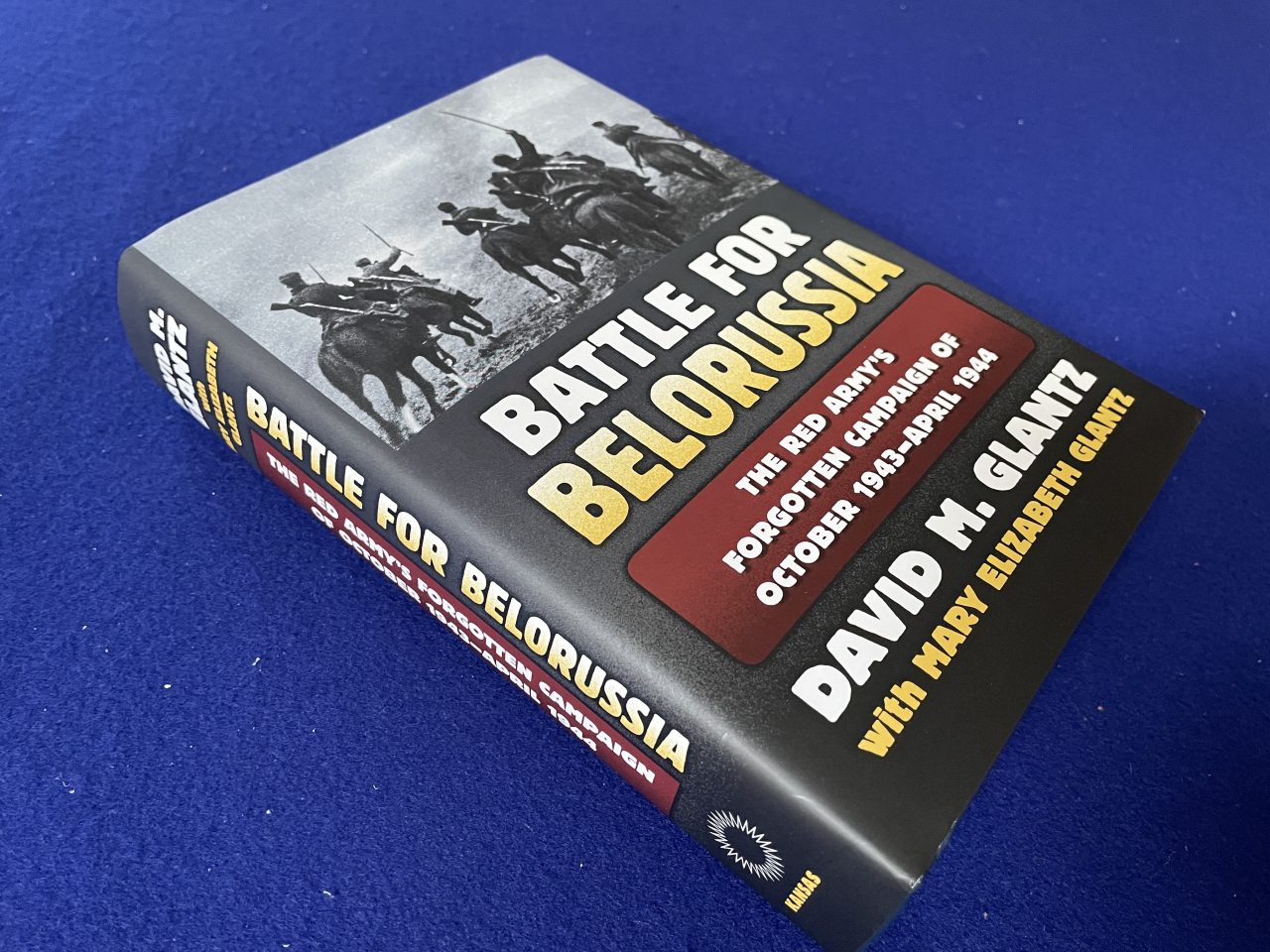
One of the presents this last Christmas that I found under the tree was the book Battle for Belorussia: The Red Army’s Forgotten Campaign of October 1943 – April 1944 by David M. Glantz with Mary Elizabeth Glantz from University of Kansas Press in 2016. Not only was the Battle for Belorussia forgotten but I too forgot that I placed it on my Amazon Wishlist.

Red Tome
Battle for Belorussia is a hefty book. Coming in at 758 pages the text is technically dense—as if one is reading transcripts from archives. All of which is another way of saying that I spent a good deal of evening reading time getting through the book. Yet, while one might think the book length made it a slog to read, the reality is that I found this history tale wove by Glantz very fascinating.
Red bloodletting
Here is the publisher’s blurb taken from goodreads.com:
The Red Army’s Operation Bagration that liberated Belorussia in June 1944 sits like a colossus in the annals of World War II history. What is little noted in the history books, however, is that the Bagration offensive was not the Soviets’ first attempt. Battle for Belorussia tells the story of how, eight months earlier, and acting under the direction of Stalin and his Stavka, three Red Army fronts conducted multiple simultaneous and successive operations along a nearly 400-mile front in an effort to liberate Belorussia and capture Minsk, its capital city. The campaign, with over 700,000 casualties, was a Red Army failure.
Glantz describes in detail the series of offensives, with their markedly different and ultimately disappointing results, that, contrary to later accounts, effectively shifted Stalin’s focus to the Ukraine as a more manageable theater of military operations. Restoring the first Belorussian offensive to its place in history, this work also reveals for the first time what the later, successful Bagration operation owed to its forgotten precursor.
I realize that some historians do not like Glantz. For myself, I appreciate the effort Glantz gave digging into the Soviet (and later Russian) archives to tell the story of the Eastern Front in World War II from other than the German perspective. Battle for Belorussia personally stands out to me for three reasons.
Commanders. While Battle for Belorussia is certainly a technical analysis of the fighting between October 1943 and April 1944 what first stands out to me is the role—and fate—of key Soviet commanders. As Glantz writes in the Preface:
[The first campaign to recapture Belorussia], which involved more than five months of bitter and costly fighting and cost the Red Army in excess of 700,000 casualties (including 150,000 dead), ended in late March 1944 with much of Belorussia still in German hands. Because this five-month campaign failed to achieve it objectives it also resulted in the relief of one of the three participating Red Army front commanders, Army General V.D. Sokolovsky, who nonetheless ultimately reached the august position of chief of the Soviet Army General Staff from 1952 to 1960, Soviet and Russian historians have since studiously erased much of the campaign’s conduct from the historical record. Interestingly enough, however, the expunging of this campaign from Soviet military history also rendered “forgotten” the exploits of another participating Red Army front commander, Army General K.K. Rokossovsky, whose efforts in the campaign were far more skillful and successful. This, perhaps, was done to avoid tarnishing the record of a truly great “Russian” general when compared to the achievement of another general many considered merely a “Pole.”
Glantz, p. xix
Distances. As much as I imagine the Eastern Front as large, sweeping steppe with hundreds of tanks rolling along, the reality is that distances were much smaller than I imagined. Take, for example, the Gomel’-Rechitsa Offensive (10-30 November 1943):
Rokossovsky’s forces struck from the Loev bridgehead early on 10 November across a broad front of 38 kilometers extending from the village of Domamerki northward to the Dnepr River at Chaplin… . Within three days, the attacking forces had torn a 15-kilometer-wide and 8-12 kilometer-deep gap in the German defenses from west of Uborok northward the Dnepr River north of Velin and almost halfway to Rechista.
Glantz, p. 182
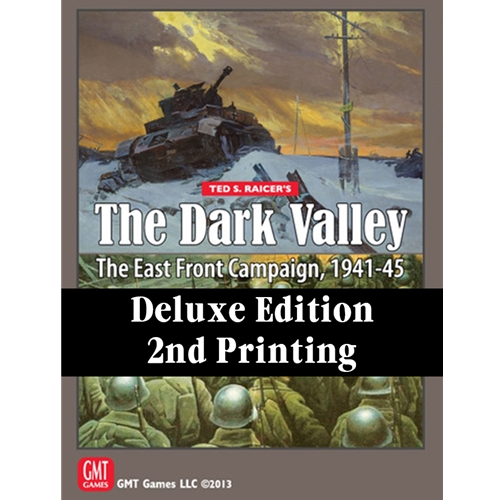
Comparing that to the wargame I was looking at to play along with this read, The Dark Valley 2nd Edition (Ted Raicer, GMT Games, 2019), the entire “front” of the Gomel’-Rechitsa offensive is covered in roughly one (!) hex that is 20 miles (32 km) across. So much for large sweeping battles.
Tank-less. In November 1943 the Soviet forces along the Belorussian Front that would undertake the above-mentioned Gomel’-Rechitsa Offensive possesses 493 tanks and 123 armored cars. This compares against the opposing German Army Group Center that in October 1943 reported 594 tanks with only 216 operational (Glantz, p. 176). The number of tanks in a Panzer Division, for example, was far less than I expected. Take for example the 5th Panzer (Division) fighting in mid-November 1943:
The 5th Panzer, also just transferred northward from the Chernobyl’ region, went into action at Malodusha on 18th November with its 13th and 14th Panzer Grenadier Regiments, equipped with roughly 15-20 tanks, 12 assault guns, and about 160 APCs [Armored Personnel Carriers].
Glantz, p. 188
Red wargame
I mention the wargame The Dark Valley and was looking to layout that game and play the campaigns of this time. Alas, any scenarios for late 1943 into 1944 are as forgotten as Battle for Belorussia. As it typical in so many games, scenario 17.3 Operation Zitadelle starts in July 1943 and runs for six turns (months) ending in December 1943—only part of the time period covered in Battle for Belorussia. Likewise, scenario 17.4 Operation Bagration starts in June 1944 after the history in Battle for Belorussia ends.
Red-eye nights
While it took a good number of evenings to read Battle for Belorussia I persevered as the slog reading was emblematic of the battle described. I also realized that my previous studies of the War in Russia during World War II has fallen into the classic Barbarossa – Stalingrad – Kursk – Bagration thinking trap. Battle for Belorussia reminded me that there were lots of other “battles” during the war. Indeed, given the Russian Army’s current stalemate in Ukraine, I wonder what lessons the Russians may be able to draw upon from this time period when the German defenses proved stiff enough to resist most of what was thrown against it. Then again, perhaps we do not want the Russians to learn those lessons from the Battle for Belorussia that eventually led to the successful Operation Bagration.
Feature image courtesy RMN
The opinions and views expressed in this blog are those of the author alone and are presented in a personal capacity. They do not necessarily represent the views of U.S. Navy or any other U.S. government Department, Service, Agency, Office, or employer.
RockyMountainNavy.com © 2007-2026 by Ian B is licensed under CC BY-SA 4.0
 Rocky Mountain Navy Gamer