
The Ghost in the Shell ARISE TTRPG Quickstart is a 48-page introduction to the tabletop roleplaying game (TTRPG) set in the universe of the anime movie Ghost in the Shell.
The Ghost in the Shell ARISE TTRPG Quickstart is produced by Mana Project Studio, the same producer of the Cowboy Bebop Roleplaying Game. I own and struggle with the Cowboy Bebop RPG which uses a similar game engine derived from Blades in the Dark (or, more correctly, the Forged in the Dark game engine).
Ghosts and shells
If you read my thoughts on the Cowboy Bebop RPG you will see I bounced hard off that game system. The primary reason I struggled to grok the Cowboy Bebop RPG is (in my opinion) the overly heavy use of narrative to describe the game system. No better example exists than the use of Approaches in the Cowboy Bebop RPG:
If you want to show your character…
…withstanding something overwhelming, that’s a Rock Approach.
…being the unstoppable force, that’s a Dance Approach.
…facing inner feelings, that’s a Blues Approach.
…influencing other people, that’s a Tango Approach.
…understanding the environment, blending in and being smart, that’s a Jazz Approach.
Cowboy Bebop: The Roleplaying Game; Choose the Approach, p. 16
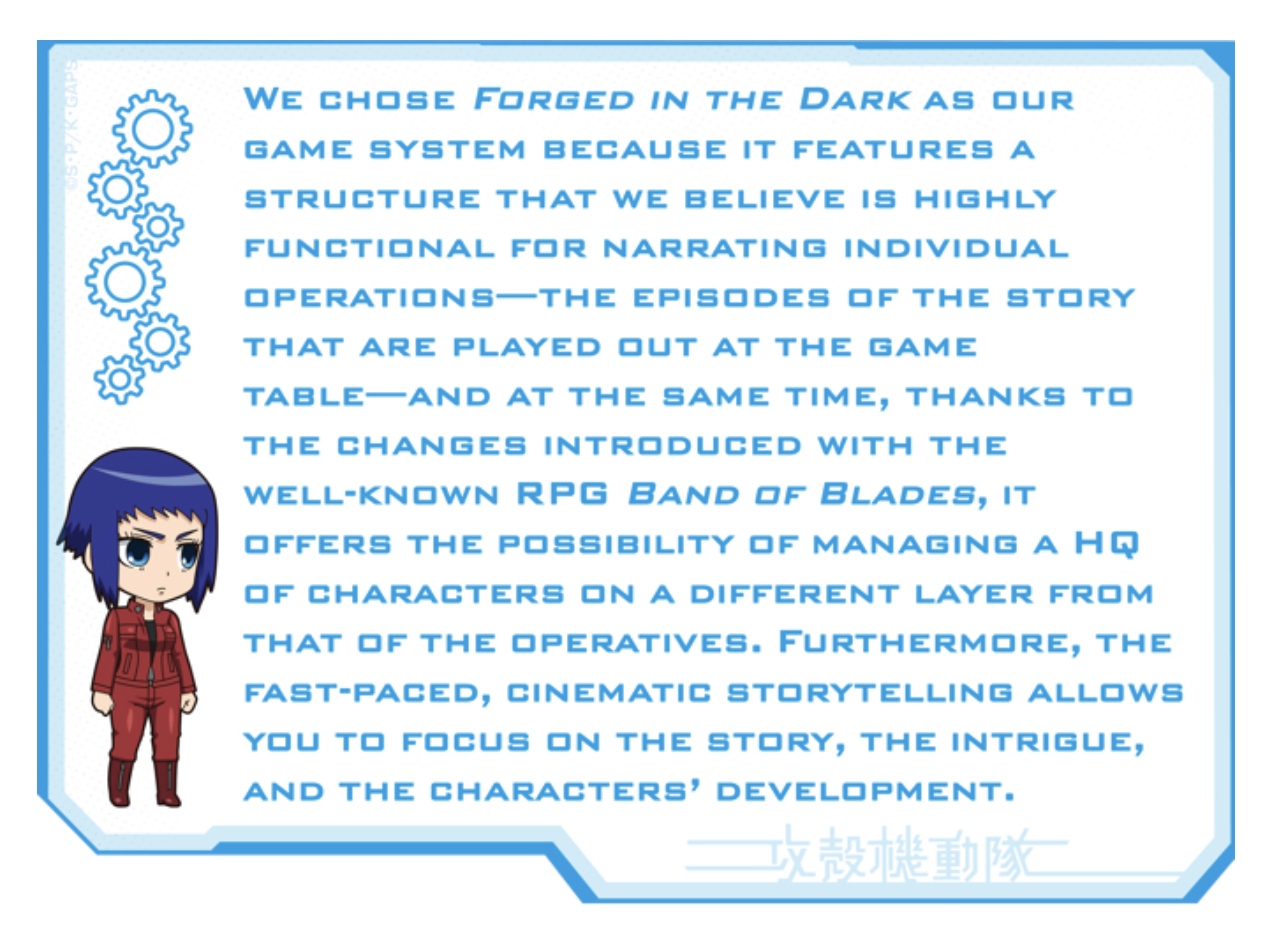
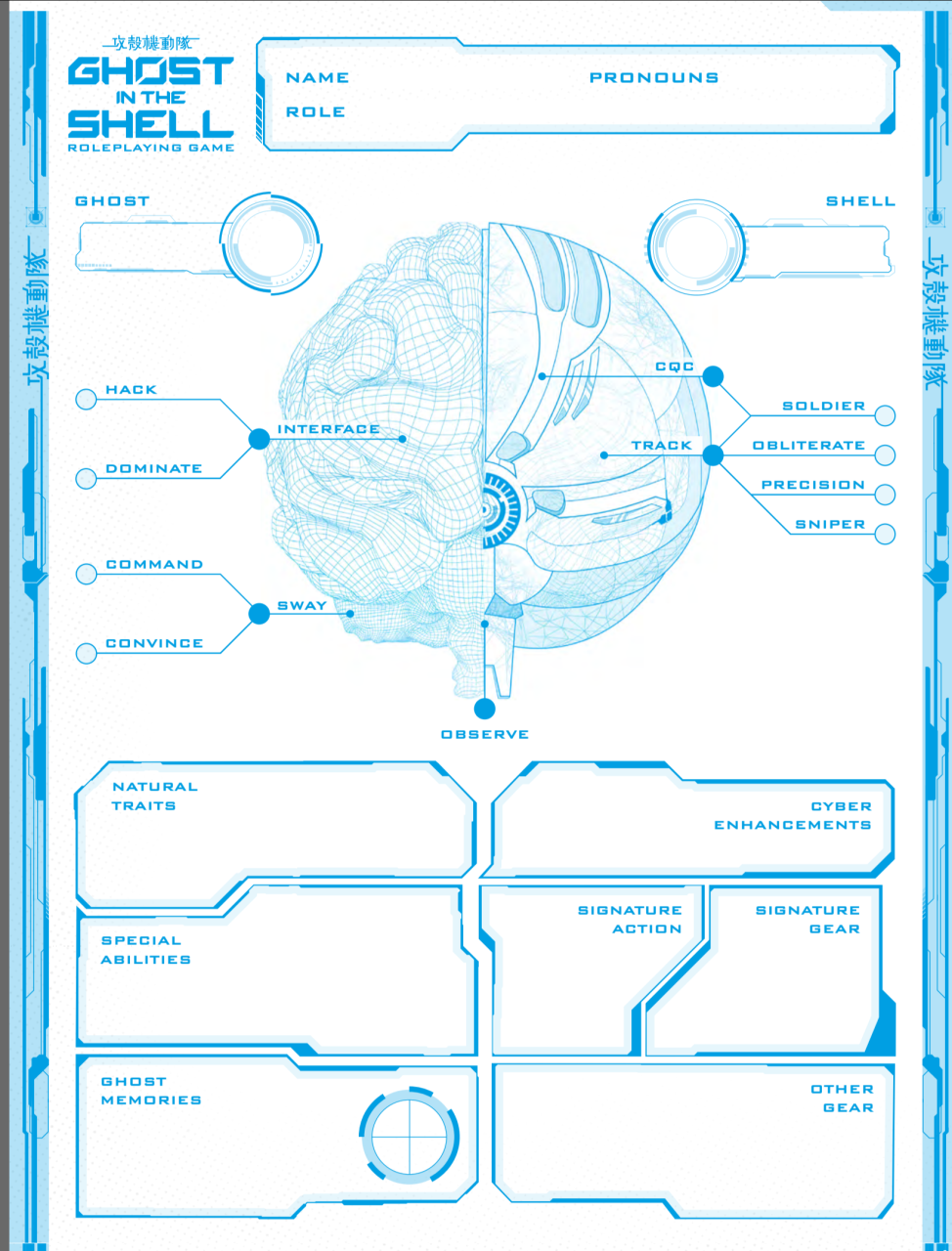
Fortunately, the Ghost in the Shell ARISE TTRPG does not go (quite) that far. Characters in the Ghost in the Shell ARISE TTRPG are built using a Playbook (i,.e. archetype) and described in terms of a Ghost (mental) and Shell (physical) Attributes, each of which has Actions are tied to them.
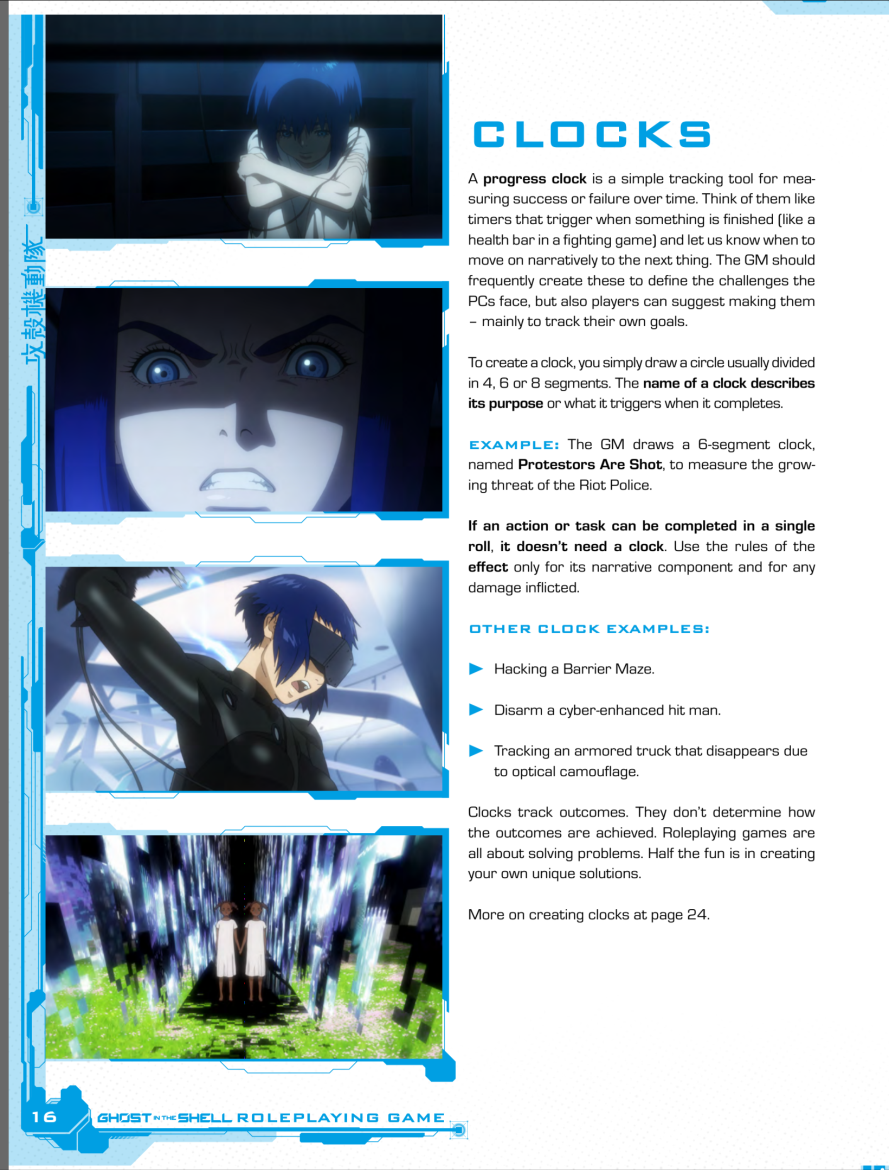
In play, Ghost in the Shell ARISE TTRPG uses Clocks to track progress or danger. Clocks can have between 4 and 8 segments.
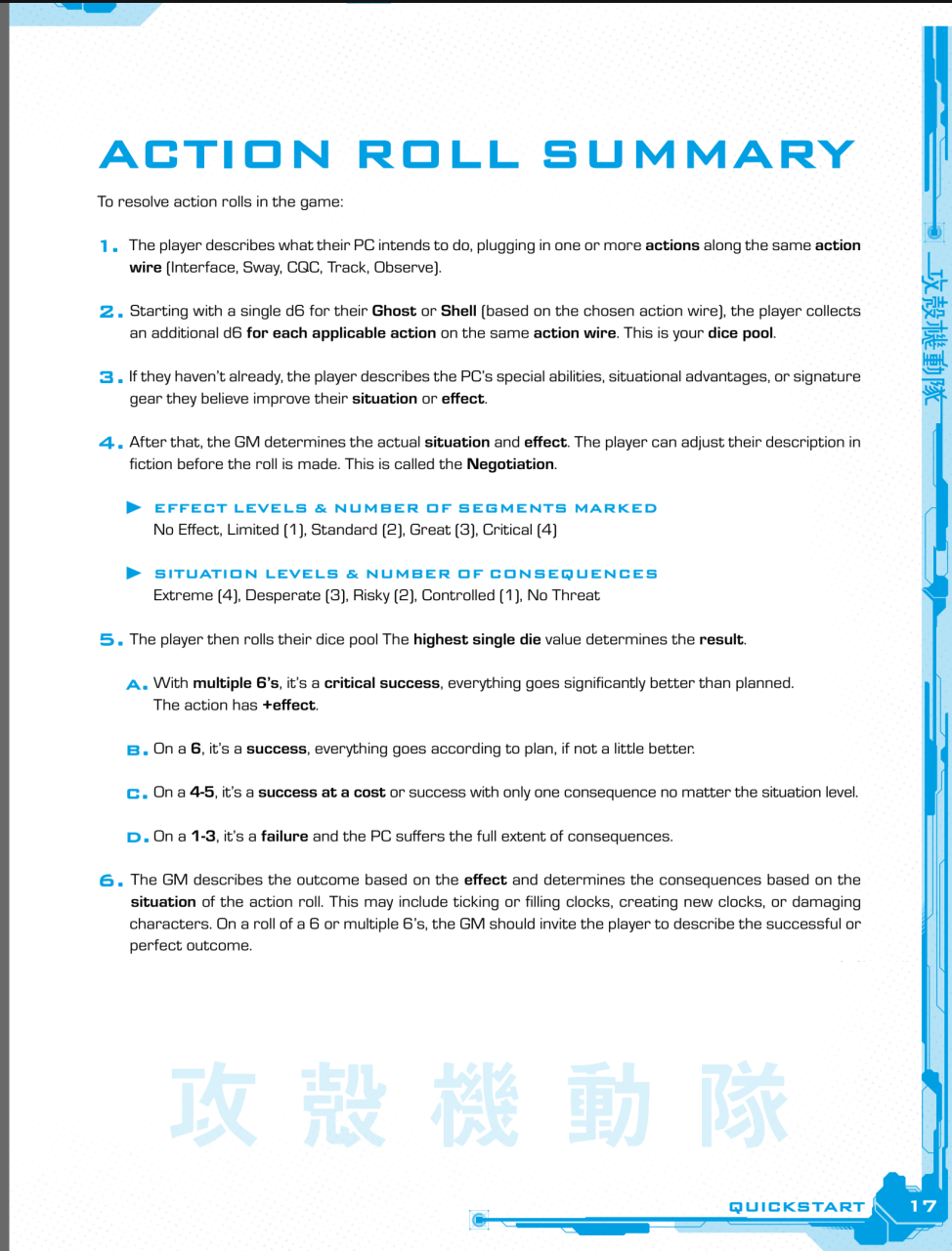
The core game mechanism in Ghost in the Shell ARISE TTRPG uses a pool of d6. Players first select which Attribute to use (1d6) and then which Action Wire to employ, gaining an additional d6 for each action along that wire. The pool is rolled with multiple 6’s being a critical success, a single 6 a success, and 4 or 5 being success at a cost, and 1-3 as a failure. The results are compared against the Situation and Effect and determines the number of Clock segments marked off.
Ghost of an idea
While I find the core game mechanism of used in the Ghost in the Shell ARISE TTRPG more intuitive to grok than the (very similar) one used in Cowboy Bebop RPG, it still is a bit baffling to me. For example, I struggle to explain this iconic fight scene in Action terms.
I also, frankly, stumble over a particular word in the Quickstart: “Play your own stories by impersonating operatives specializing in counterterrorism, in a future world where cybernetics poses new moral questions” (p. 2).
Impersonating?
I understand the definition of the word is, “to assume or act the character of” (Merriam-Webster). I, however, usually attach a negative connotation to the word “impersonate” more along the lines of, “Impersonate means to pretend to be someone else, often by mimicking their characteristics, behaviors, or speech. This can be done for various purposes, such as entertainment, deception, or in some cases, to commit fraud” (duck.ai).
Yes, language (and culture) is often difficult to translate but the use of this word makes me cautious going deeper into the game.
Kickstart or not
The Kickstarter campaign for the Ghost in the Shell ARISE TTPRG successfully funded in November 2025 with delivery scheduled for October 2026. While I could still jump in through BackerKit I will refrain from doing so. While the game looks visually impressive, I am still less-than-sold on the core game engine. I fully realize that there are some (many?) tabletop roleplaying game players out there that swear by Blade in the Dark and will almost certainly love playing this game.
I am just not one of them.
Feature image courtesy Kickstarter
The opinions and views expressed in this blog are those of the author alone and are presented in a personal capacity. They do not necessarily represent the views of U.S. Navy or any other U.S. government Department, Service, Agency, Office, or employer.
RockyMountainNavy.com © 2007-2026 by Ian B is licensed under CC BY-SA 4.0
 Rocky Mountain Navy Gamer