
“The PRC [People’s Republic of China] has decided that it’s time to end the rhetoric and posturing and bring the economically powerful and strategically important island [of Taiwan] back into the loving embrace of the motherland.”
Next War: Taiwan 2nd Edition
So reads the back-of-the-box blurb for Next War: Taiwan 2nd Edition by game designer Mitchell Land for GMT Games (2025). This new edition updates a long out-of-print first edition dating from 2014. I am of two minds when it comes to Next War: Taiwan 2nd Edition. On one hand the b\grognard hobby wargaming in me views the game design—though complex—as very enjoyable to play; that is, once you take the time to carefully learn the rules and ALWAYS FOLLOW THE SEQUENCE OF PLAY! On the other hand, the wargame practitioner in me notes how some call-out Next War: Taiwan 2nd Edition as a useful tool for looking at modern warfare…but I have my doubts. It is that later issue, the usefulness of Next War: Taiwan 2nd Edition in gaining insights into modern warfare, that form the bulk of my discussion below.

Not-so-spicy wargaming
I assert that the character of modern warfare has changed in ways that Next War: Taiwan 2nd Edition struggles to keep up. Specifically, Next War: Taiwan 2nd Edition optimally depicts China’s Joint Island Landing Campaign (JILC) at the expense of other military options for reunification rendered in far less detail. Further, Next War: Taiwan 2nd Edition struggles to depict modern operational concepts as it lacks a robust game design showing the effects of space, cyberspace, and conflict in the electromagnetic spectrum. Next War: Taiwan 2nd Edition uses “shiny kit” in an attempt to show the modern battlefield but with uneven results. In the end, the modern “flavor of the war” the publisher promises to deliver with Next War: Taiwan 2nd Edition lacks the true spiciness of the modern battlefield.
Operation wargame
Next War: Taiwan 2nd Edition depicts an operational-level view of an invasion of Taiwan in the near-future. Scale-wise, ground units in the game represent Divisions down to Battalions. Naval combatants are shown as Aircraft Carrier Battle Groups, Surface Action Groups, or Amphibious Groups. In the Standard Game, air power is measured in Strength Points but in the Advanced Game air units are represented by approximately squadron-strength counters. The main Operational Map uses a scale of 7.5 miles per hex and each turn represents 3.5 days. The longest published scenario for Next War: Taiwan 2nd Edition is played out over a maximum of 16 turns (representing ~56 days).
[Of note, every Next War-series wargame has three sets of rules: the Standard Series Rules (SSR), Advance Series Rules (ASR), and Game Specific Rules (GSR). Next War: Taiwan 2nd Edition ships with the latest SSR and ASR rulebook.]
On the website for Next War: Taiwan 2nd Edition, GMT Games describe the game system this way:
… the Standard Game rules encompass a fairly straightforward ruleset that will, we think, be considered pretty “easy to learn” by experienced wargamers. So players who choose to play Standard Game scenarios can have a relatively quick game when that’s what suits them. The real flavor of a war in the theatre, though, comes through in the Advanced Game, where you get much more control over airpower and can more clearly see each side’s strengths and weaknesses. For players who want a “mini-monster game” experience, playing the Advanced Game Campaign Scenarios with some or all of the optional rules will definitely “deliver.”
GMT Games
The back of the box for Next War: Taiwan 2nd Edition goes into some more game design detail:
All the same features of the 1st Edition remain with a refined, yet still abstract and playable, naval sub-system that includes submarine threats, ASW, mine warfare and Anti-Access Area Denial missile threats. In addition, there are Order of Battle changes for both sides as well as new Supply rules (for the Advanced Game) specifically to highlight the challenge each side will face have in getting supply to the island.
Next War: Taiwan 2nd Edition, Back of the Box
With the framework of a game design in place, let us explore how Next War: Taiwan 2nd Edition depicts potential military campaigns in a Taiwan “contingency.”
The Threat
In late 2025, the U.S. Department of War released the Annual Report to Congress on Military and Security Developments Involving the People’s Republic of China 2025. Commonly referred to as the “China Military Power Report” (CMPR) this 100-page report is the official statement from the Department of War on China’s military force, the People’s Liberation Army (PLA).
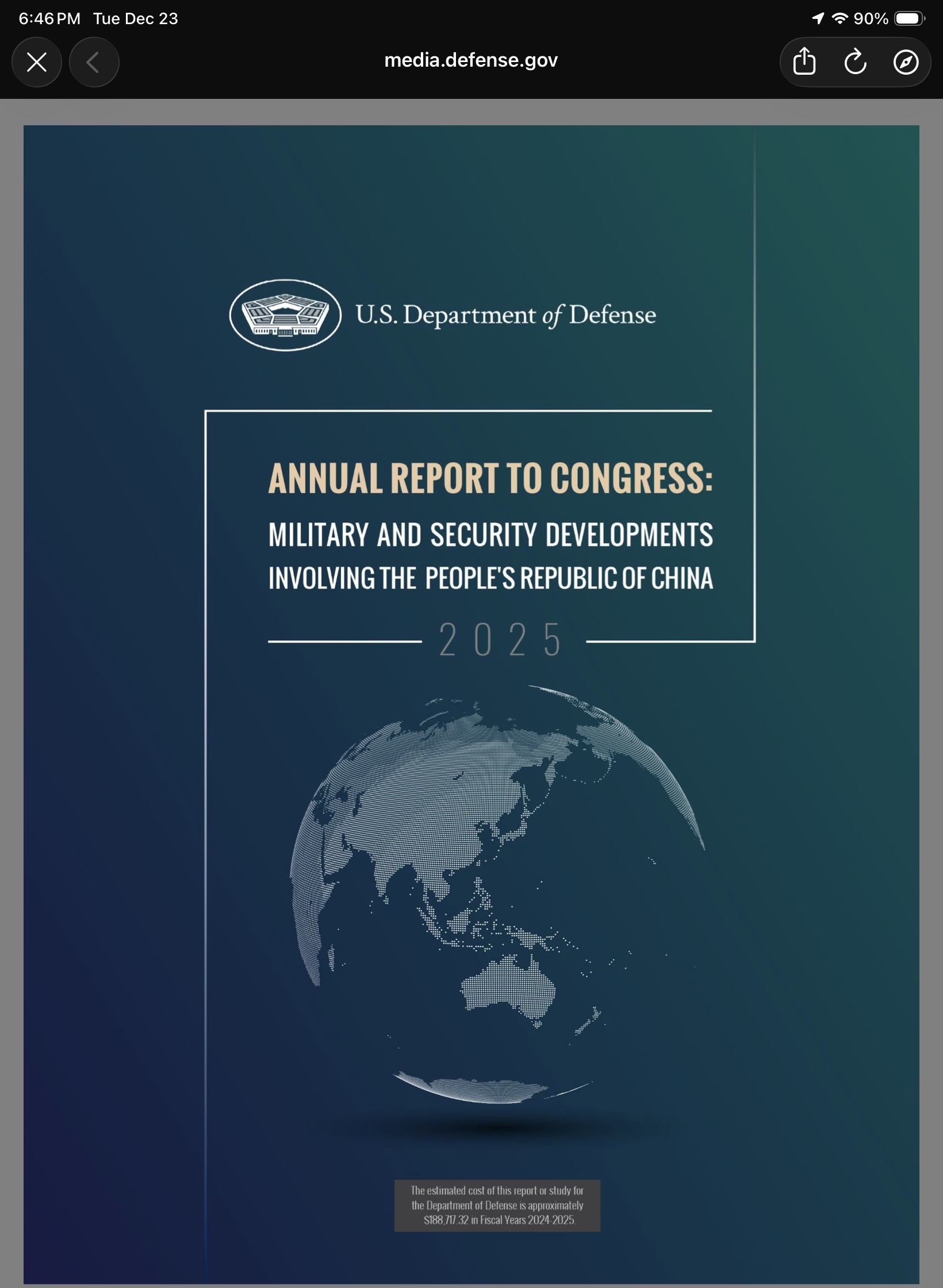
When it comes to the subject of Next War: Taiwan 2nd Edition, the CMPR lays out China’s four military options to force unification with Taiwan:
Beijing is continuing to refine plans for several military options to unify Taiwan by force. During the past year, the PLA conducted operations that exercised essential components of these options, including exercises that focused on blockading key ports, striking sea and land targets, and countering potential U.S. military involvement in a conflict. Outlined below are four military options that Beijing is likely considering, should China’s senior leaders determine that military action is necessary.
CMPR, p. 44
Next War: Taiwan 2nd Edition—by design—optimally depicts but one of the four military options available to China. The game can be used to explore facets of each but, as seen below, the game is optimized around the amphibious option.
Coercion Short of War. The design of Next War: Taiwan 2nd Edition is poorly suited for exploring this military option. When executing this option, Next War: Taiwan 2nd Edition has almost no game design elements to portray, “cyberattacks, electronic attacks, or conventional strikes against Taiwan’s political, military, and communications infrastructure… “ (CMPR, p. 44). As a wargame focused on kinetic, force-on-force military conflict Next War: Taiwan 2nd Edition has no real game mechanism to measure, “Taiwan’s resilience and will to resist China’s coercion… ” (CMPR, p. 44). Of particular note, the SSR, ASR, and GSR barely address Cyber Warfare; for that you need Next War: Supplement #1 and Supplement #3.

Joint Firepower Strike Campaign. In a Joint Firepower Strike Campaign the PLA uses, “precision missile and air strikes against key government and military targets, including air bases, radar sites, missiles, space assets, and communications facilities to degrade Taiwan’s defenses, decapitate its military and political leadership, or undermine the public’s resolve to resist” (CMPR, p. 44). Next War: Taiwan 2nd Edition can portray a Joint Firepower Strike Campaign at medium-low fidelity. Doing so relies heavily on the rules for the Advanced Game and especially Game Specific Rules (GSR) for Detection (GSR 12.0), Airpower (GSR 13.0), Hardened Targets (GSR 14.0), and most importantly Theater Weapons (ASR 26.0) and Theater Warfare Assets (GSR 15.0).
Joint Blockade Campaign. A Joint Blockade Campaign is, effectively, the Joint Firepower Strike with an additional naval element. Similar to the Joint Firepower Strike Campaign, Next War: Taiwan 2nd Edition can—at best—portray this option at medium-low fidelity. “[T]he PLA probably would posture air and naval forces to conduct weeks or months of blockade operations while conducting missile strikes and possible seizures of Taiwan’s offshore islands in an attempt to compel Taiwan to negotiate or surrender. China probably would conduct concurrent electronic warfare, network attacks, and information operations to further isolate and degrade the island and to control the international narrative of the conflict” (CMPR, p. 45). In this campaign, Sea Control and Naval Rules (SSR 7.0) and Advanced Naval Rules (ASR 17.0) are essential as well as the Game Specific Rules for Naval Affairs (GSR 5.0), Supply (GSR 10.0), and Isolation (GSR 11.0).
—————
[Interlude JUSTICE MISSION 2025]
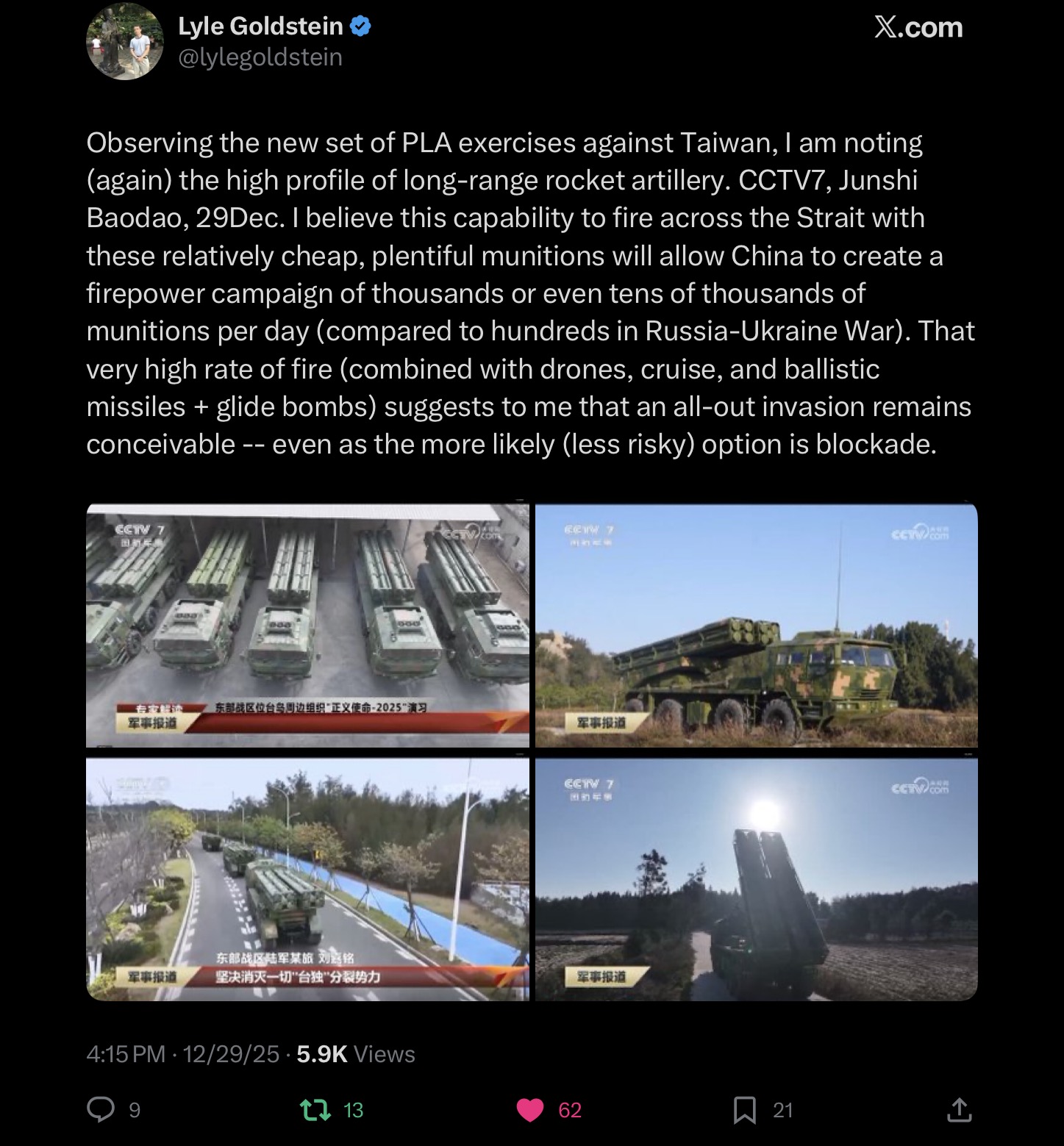
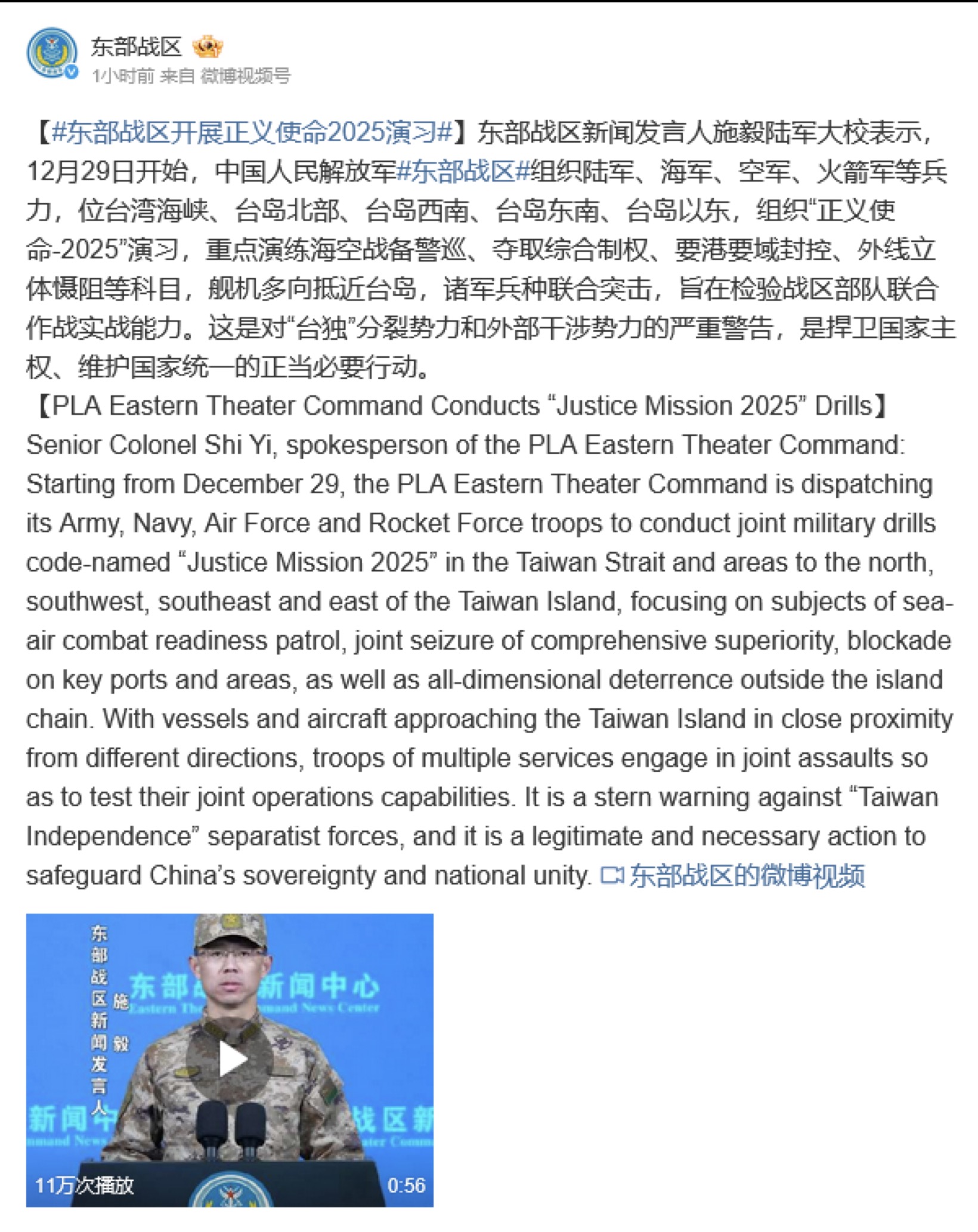
As I wrote this post, China announced and executed ta snap pressure campaign against Taiwan named JUSTICE MISSION 2025. Although the exercise was conducted over the course of two days (~1 turn of Next War: Taiwan 2nd Edition) the game is not very useful for simulating the event. JUSTICE MISSION 2025 took place off the shores of Taiwan in at least eight different closure areas and around Taiwanese islands in the area. The Operational Map for Next War: Taiwan 2nd Edition is too large scale (small area) to show the off-shore areas used for the exercise blockade, and the Strategic Display is too small scale (large area) to depict the exercise zones. The “blockade” rules in Next War: Taiwan 2nd Edition are focused on the effects of a “blockade” on ground force resupply for units fighting ashore, not civilian merchant traffic or arms shipments into the country.

—————
Joint Island Landing Campaign (JILC). The design of Next War: Taiwan 2nd Edition is optimized to portray a JILC. To do so, however, essentially requires the entirely of all three series rules…and the additional purchase of several Supplements. As the CMPR states, “An amphibious invasion of Taiwan would involve a highly complex three-dimensional assault on Taiwan, involving multiple carefully coordinated operations. The objectives would be to break through Taiwan’s shore defenses and establish a beachhead that allowed the PLA to build up enough combat power to seize key targets or territory to force unification. A large-scale amphibious invasion would be one of the most complicated and difficult military operations for the PLA, requiring it to achieve and maintain air and maritime superiority and rapidly buildup and sustain its forces” (CMPR, p. 45). Above all else, Next War: Taiwan 2nd Edition is focused on the JILC option as defined by the rules and scenarios.
While Next War: Taiwan 2nd Edition can be used to play out—to some degree more or less—each of China’s four military options to unify Taiwan by force the core game design is near-exclusively focused on the “big show” of the Joint Island Landing Campaign (JILC)
Which Way of War
While Next War: Taiwan 2nd Edition certainly can portray different Chinese campaign options against Taiwan, at its core the concept of war it portrays is not much different than the U.S. has used for several decades. This is the point Franz-Stefan Gady makes in his book How the United States Would Fight China: The Risks of Pursuing a Rapid Victory (Oxford, 2025) when discussing Joint Operations and Systems Warfare:
In general, however, the US armed forces have always relied more on advanced technological capabilities than on sheer numbers. Technological superiority is also the main building block of an emerging new ‘American way of war’ based on the idea that militaries are ‘systems’ (consisting of various subsystems) that maim to disrupt, disable, or destroy the adversary’s own systems. Future wars between industrial nation will, in the word of former Deputy Defense Secretary Robert Work, ‘be characterized, dominated, and decided by the collision of opposing systems of systems’. This approach is not entirely new. Effects-Based Operations (EBO), a concept introduced into the US armed forces in the late 1980s and early 1990s, aimed to achieve strategic objectives through precise, targeted actions across an adversary’s systems. This approach had mixed results, however, and cast skepticism in purely systematic approaches in the US military establishment. EBO was abolished in 2008 by General J.N. Mattis, at that time commander of the now defunct US Joint Forces Command, who stated that EBO had been ‘misapplied and over-extended to the point that it actually hinders rather than helps joint operations’. However, elements of a system warfare approach continued to permeate US operational concepts only to more fully reemerge over the past decade with the perceived growing military threat from China.
Gady, pp. 34-35
The core game design of Next War: Taiwan 2nd Edition is broadly synonymous with the state of U.S.operational concepts. The first edition of Next War: Taiwan was the second Next War-series title following Next War: Korea (1st Edition) in 2012. Next War: Korea was itself a development of an even earlier GMT Games title, Crisis: Korea 1995 that released in 1992. The core design philosophy of the Next War-series is laid out in Standard Game Rules 1.0 Introduction which remains essentially unchanged since 2012:
The Next War series is an updated, expanded look at potential conflicts and modern warfare based on the system released by GMT Games as Crisis: Korea 1995. These rules supersede any previous rules and should be used with all Next War series games.
The games in this series focus on a near future war in any of several potential hotspots. Players control land, air, and naval forces of the various sides engaged in the conflict. The scenarios provided allow players to examine multiple aspects of how a contemporary conflict might unfold. Modern war will, through the wholesale use of the destructive power of modern armaments deplete supplies of such armaments and outstrip any of the belligerents’ abilities to replace them. Thus, we believe that any such war would, of necessity, be a short, vicious engagement until settling in to prolonged battles of attrition unless a decisive victory is achieved. Both sides are challenged to win quickly and decisively, as both forces and munitions dwindle rapidly in the face of extended modern combat operations.
SSR 1.0
A “short, vicious engagement” is an apt descriptor of the desired American Way of War, be it the blitzkrieg of DESERT STORM, or the “Shock and Awe” of OPERATION IRAQI FREEDOM. Gady, however, goes as far as to argue that the American Way of War is “fundamentally flawed”:
Despite shifts in US warfare approaches towards China, both the current US military and its projected force structure over the next decade remain largely built around concepts of rapid, decisive warfare extensively supported by long-range precision strikes. … . This is reflected in existing US operational concepts, doctrine, force structure, and capabilities relevant to a high-intensity conventional war with China over Taiwan that are still for the most part designed on the assumption that the US needs to quickly achieve the ability to out-think and out-act the enemy through a real-time common operational picture of the entire battle space (air, sea, and, space, and cyberspace), while denying the same awareness to enemy forces to compensate of the lack of US mass and conventional firepower. In the jargon of the Pentagon, this is variously called ‘information advantage’, ‘information superiority,’ ‘decision superiority’, or ‘cognitive dominance’, and constitutes a foundational element of a systems warfare approach. To achieve this for air, maritime, land, and combined joint all-domain operations, it is necessary to (but not sufficient) first to quickly defeat a peer or near-peer adversary in space, cyberspace, and the electromagnetic spectrum, which are key enablers for such operations.
Gady, p. 9
To oppose the U.S. the CMPR points to the PLA’s core operational concept—Multi-Domain Precision Warfare—which is described as:
Multi-Domain Precision Warfare (MDPW) is the PLA’s core operational concept, representing an evolution of the PLA’s operational thinking for a potential future conflict with the United States. As envisioned, MDPW would leverage an integrated network of PLA command, control, communications, computers, intelligence, surveillance, and reconnaissance (C4ISR) systems to organize joint forces under a centralized command, instantly aggregate military power across all domains, and use that multi-domain power to identify and exploit weak points in the U.S. operational system. A primary aspect of MDPW is to harness the power of big data and artificial intelligence to rapidly process and analyze vast amounts of information, facilitating swift and informed operational decision-making.
CMPR, p. 19
It seems obvious that a future conflict between the U.S. and China will be a war over C4ISR, or what the PLA calls, “systems confrontation” or “systems destruction warfare” (Gady, p. 50).
—————
Interlude – White Sun War
Then, all the battle management systems, all of the different monitors in the command post, went blank. It was if some giant hand had quickly pulled the power plug from a socket, depriving the screens and their hardened computers and communications network of the essential life force that underpinned how modern armies stayed connected.
For a moment, the cacophony of hectic activity in Chen’s command post ceased. They all understood what this meant.
The People’s Liberation Army had worked for decades to hone its operational concepts to break down the cohesion of enemy forces. It was something that Chen and all the personnel in the headquarters understood. One of first things the PLA would do, if it actually came to a real, shooting war, would be to destroy the Taiwanese command and control systems.
The PLA called it “systems destruction warfare.” For years they had been publishing articles in their professional military journals about 21st-century warfare being about the confrontation between systems. It was a method of splitting large joint military forces down into smaller and smaller parcels that could be more easily attacked and destroyed. These foundational concepts had guided the development of new PLA organizations, tactics, as well as evolved kinetic and non-kinetic weapons.
Information warfare. Cyber and space operations. Deception and misinformation. Hard kill missile systems. These were orchestrated by the PLA in their operational system of systems. For Chen and his fellow soldiers, they had been schooled in these ideas as part of understanding their adversary. If systems destruction warfare was the PLA’s theory of victory, the military forces of the Taiwanese needed to be able to counter it. The needed to survive, to remain a cohesive joint force, and repel the onslaught of electronic warfare operations, and information operations.
White Sun War: The Campaign for Taiwan, pp. 115-116, by Mick Ryan, Casemate Publishers, 2023
—————
Space, Cyber, and Electromagnetic
Next War: Taiwan 2nd Edition actually has little to say about C4ISR. Like many wargames, Next War: Taiwan 2nd Edition gives players a near-perfect ability to Command, Control, and Communicate (C3) with their entire force. Computers (the ‘4th C’) are not addressed in the core game—to play Cyber Warfare requires Next War: Supplement #1 and Supplement #3 (more on that below). Likewise, the players Intelligence and Surveillance of the enemy is near-perfect as there are no hidden unit rules (see SSR 8.1.2 Examining Enemy Stacks which reads, “Players may freely examine enemy stacks at any time during play”). Next War: Taiwan 2nd Edition includes some rules for Reconnaissance in rule 17.1.2 Detection from the Advanced Naval Rules (ASR 17.0) and for ground units using ASR rule 21.0 Detection.
Recall Gady’s assertion that, “it is necessary to (but not sufficient) first to quickly defeat a peer or near-peer adversary in space, cyberspace, and the electromagnetic spectrum…” (Gady, p. 9). For all the importance Gady places on those three domains Next War: Taiwan 2nd Edition either ignores or treats them in a highly abstract manner that almost certainly downplays their impact on the battlefield.
Gady explains the importance of space operations this way: “Space, along with cyber, is one of the key domains for enabling the continuous flow of information necessary for the US to conduct combined joint all-domain operations, and to deny such capability to the enemy” (Gady, p. 83).
Space
In early 2025, the U.S. Space Force (USSF) released two capstone documents, Space Force Doctrine Document 1 (SFDD 1) and Space Warfighting: A Framework for Planners that discuss U.S. military space doctrine. In the later document, the importance of Space Superiority is laid out:
Space superiority is a joint force priority. This is especially important whenever the enemy is capable of threatening friendly forces in the space domain or inhibiting a Joint Force Commander’s (JFC’s) ability to conduct operations. Whether directly in the space domain, or through advances in space superiority capabilities, peer and near-peer competitors are capable of challenging or denying control of the space domain. These capabilities, supported by cyberspace and space advancements, present growing challenges to the Joint Force’s ability to exercise space superiority. Not only are space operations global, they are also multi-domain. A successful attack against the terrestrial, link, or orbital segment can neutralize a space capability; therefore, space domain access, maneuver, and utilization require deliberate and synchronized offensive and defensive operations across all segments.
Space Warfighting, p. 4
The CMPR describes the Chinese capability to threaten forces in the space domain this way:
China perceives that the U.S. military heavily relies on space for intelligence collection and communications, and China is developing counterspace capabilities designed to restrict U.S. use of space and space-enabling technologies in a conflict. The PLA almost certainly plans to conduct terrestrial and space-based kinetic and non-kinetic antisatellite (ASAT) operations during a conflict with the United States, and will adapt employment strategies as new capabilities are fielded. The PLA’s large and dispersed inventory of reversible counterspace systems, including disruptive lasers and jammers, almost certainly provides China sufficient capacity to execute such operations with little warning.
CMPR, p. 27
Neither the USSF nor China’s space or counterspace capabilities appear in Next War: Taiwan 2nd Edition. The space domain in the game is, literally, empty space.

—————
[Interlude – Space Corbett]
Few modern wargames cover the relation of space and warfare in their design. When they do approach the topic the space platform—often an ISR [Intelligence, Surveillance, Reconnaissance] system—usually has some limited effect on detection if any. There are no wargames that look deeply at space warfare. This is, perhaps, because arguments on theories of space warfare are not settled..though they could be. In 2006, John Klein laid out a framework in his book Space Warfare: Strategy, Principles and Policy. As Dr. Brent Ziarnick describes in his chapter, “Charting the Course of the Final Frontier: The Competing Spacepower Theories” found in The Future of Air and Space Power: The Intersection of Theory and Technology edited by Dr. Heather Venable from Air University Press (2025):
Believing that too much space writing focused on analogies derived from naval theorist Alfred Thayer Mahan’s writings, Klein found himself attracted to maritime theorist Julian Corbett. Taking much of Corbett’s strategic writing and directly applying it to the space domain, Klein concluded that the “inherent value of space is the utility and access it provides, and this utility and access are enabled through celestial lines of communication [CLOC] . . . those lines of communications in and through space used for the movement of trade, matériel, supplies, personnel, spacecraft, electromagnetic transmissions, and some military effects.”
Klein updated Corbett’s sea lines of communication concept to explain activities occurring in space, such as the advent of modern communications through the electromagnetic spectrum. He explained that there were both “physical” and “nonphysical-physical” CLOCs. Physical CLOCs were spacecraft and orbital trajectories that had direct analogies to the maritime domain. They were also tactile and easily understood. However, nonphysical CLOCs were something fundamentally different than anything seen in classic sea power. Nonphysical CLOCs consisted of nonphysical communications that “comprise the transmission of data, information, and some military effects along celestial lines of communication.” Today, nonphysical CLOCs are far more prevalent than physical CLOCs since much of spacepower’s utility results from the collection and distribution of data and communications via invisible electromagnetic signals.
Klein next described space warfare using CLOCs as the central object. Again, borrowing from Corbett, Klein argued that space warfare primarily seeks to “protect and defend one’s own lines of communications, while limiting the enemy’s ability to use his.” The CLOC was the central currency of spacepower and that which space warfare is fought to control. Space control, then, was control of the physical and nonphysical CLOCs important to belligerents. Klein’s definition of space warfare is valuable because it accounts for both of today’s space control activities. Nonphysical CLOCs were the targets of space electronic warfare, such as satellite downlink jamming, while physical CLOCs could be attacked by kinetic weapons such as direct ascent antisatellite-satellite missiles. Klein expanded his theory to discuss cruiser warfare, blocking activities, and other advanced military space options based off control of CLOCs. Klein’s emphasis on the CLOC has been his most profound contribution to spacepower theory, and his conception has remained unchallenged for almost two decades.
Venable, pp. 49-50
When will we finally see a space wargame using Klein’s theory of Space Warfare?
—————
Cyberspace
China almost certainly will employ Cyber Warfare in any conflict over Taiwan, starting much like Ryan describes in White Sun War above. As the CMPR warns:
During the initial stages and throughout a conflict, China probably would seek to create disruptive and destructive effects—from denial-of-service attacks to physical disruptions of critical infrastructure—to shape decision making and disrupt military operations. Initial target selection probably would include U.S. military C4ISR and logistics nodes, as well as civilian targets with political and economic significance. China can launch cyberspace attacks that, at a minimum, would cause localized, temporary disruptions to critical infrastructure —such as disruption of a continental United States natural gas pipeline—for days to weeks, and China probably believes these capabilities are even more effective against militarily superior adversaries that depend on information technologies. The objective of these cyberattacks probably would be to deter U.S. involvement by demonstrating China’s capability and resolve to threaten U.S. strategic interests and weaken U.S. public support for involvement.
CMPR, p. 24
Gady describes the U.S. cyber doctrine in a similar manner:
U.S. doctrine calls for blinding and paralyzing the other side by targeting its communications, as well as networked weapons and logistic systems, while at the same time doing everything to protect US networks from attack, with the ultimate goal of achieving information superiority or dominance.
Gady, p. 58
You cannot play Cyber Warfare in Next War: Taiwan 2nd Edition out of the box. To play Cyber Warfare you need Next War: Series Supplement #1 (GMT Games, 2017) and Next War: Series Supplement #3 (GMT Games, 2022). The game mechanisms used for Cyber Warfare in Next War are conceptually described this way:
8.1 Overall Concept
Each nation involved in the conflict depicted by the game receives several Cyber Warfare Capability markers each game turn. During the Electronic Warfare Phase, players will be able to use the markers to attempt “hacks” to affect things like Air Defense detection, combat, or the enemy’s Cyber Warfare ability itself. These rules are intended to be used with the Advanced Game only.
Design Note: EW/Jamming isn’t really “cyber” per se, but the effects tend to be the same, and, in the abstract, it’s easier to do the shaping of the electronic warfare battlefield all at the same time. (Next War: Series Supplement #3)
[As an aside, the Supplement #3 version of Cyber Warfare is played out on (yet another) side board tableau for each player. These added Cyber tableaus, though only page-sized each, must now find space on a table with an extended 22”x41” Operational Map alongside a 22”x34” Strategic Display. That is already a game space taking up roughly 22”x83” which does not account for any elbow room or space for charts and die rolling much less snacks or drinks (carefully placed to avoid “accidents”). A 3’x6’ folding table (36”x72”) is too short. Ah, the challenges of wargaming… .]
Electromagnetic Spectrum
Electronic Warfare (EW) is the battle over the electromagnetic spectrum. Gady describes the importance of EW at length:
Emerging technologies will likely further limit the ability of US ground forces to maneuver undetected on the battlefield, contributing to an operational environment even more advantageous to the defense. In other words, it would be disproportionately more difficult to attack Chinese forces than to defend against them, posing significant challenges for a land-based counter-A2/AD [Anti-Access/Area Denial] campaign. Advances in and proliferation of intelligence, surveillance, and reconnaissance capabilities, for example, puts any attacker on the ground at a disadvantage by limiting the ability to maneuver. Any action such as moving, shooting, communicating, or employing active sensors (for example, active radar) risks detection directly or indirectly by enemy radar or electronic, electro-optical, or other advanced sensors, and thus puts the platform or force at risk of being located, identified, and targeted.
Gady, p. 168
China’s capability to conduct EW is described in the CMPR this way:
Electronic Warfare (EW): China fields a range of ground-based jammers and likely intends to field space-based jammers, including global navigation satellite system “spoofers” and SATCOM {Satellite Communications] “jammers.” In early 2024, Chinese scientists claimed to have achieved seamless, wide bandwidth, real-time monitoring and analysis of the full electromagnetic spectrum to support future PLA EW operations. China probably is developing jammers dedicated to targeting SAR [Synthetic Aperture Radar], including aboard military reconnaissance platforms. Interfering with SAR satellites very likely protects terrestrial assets by denying imagery and targeting in any potential conflict involving the United States or its allies. China is also probably developing jammers to target SATCOM over a range of frequency bands, including extremely high frequency communications used by the U.S. military.
CMPR, p. 28
What Gady is concerned about—and the Chinese deploying capabilities for—is what John Antal calls the “Transparent Battlespace.” In his book Next War: Reimagining How We Fight (Casemate Publishers, 2023) Antal identifies nine disruptors of the modern battlefield, the first of which is that Transparent Battlespace:
The battlespace is now “naked,” day and night, and everything in it can be seen by sensors and targeted. A layer of sensors can stream real-time and reveal the battle space, confirm battle damage, and, in consonance with information from other sources, render the battlefield transparent.
Antal, p. 18
Maj. Gen. Thomas M. Feltey and Maj. Heath Rosendale, both U.S. Army, writing for Military Review Online – November 2025 in “Restoring Fires and Maneuver: An All-Arms Wave-Based Approach at the Tactical Edge” describe the impact of the transparent battlefield this way:
On the modern battlefield, every movement is exposed and punished by precision fires. Unmanned eyes haunt every contour of the terrain. Fires and maneuver—a cornerstone of warfare—has withered under the weight of constant surveillance and instantaneous lethal actions. The result is attritional, positional warfare: stagnant lines, fortified positions, and a costly grind for every inch of ground. Maneuver is no longer denied by terrain or weather alone but by the sheer destructive capacity of the modern kill chain carried out on a transparent battlefield.Feltey & Rosendale, p. 1
Electronic warfare—a key enabler of the modern kill chain—is abstractly covered in Next War: Taiwan 2nd Edition with the rules for Headquarters (HQs) (see ASR 18.0). As stated in rule 18.2, “Each HQ is assumed to include combat support elements such as Engineers, Reconnaissance assets, electronic warfare units, organic artillery, and, for some countries, Unmanned Aerial Vehicles (UAVs) for both reconnaissance and strike” (ASR 18.2). Rule 21.0 Detection in the Advanced Series Rules must also be considered. Detection is a prerequisite for certain Strike attacks: “In the Advanced Game, ground targets must be Detected before they can be attacked by Strike Missions (Theater Weapon Strikes, HQ Strikes, Helicopter Strikes, or Air Strikes)” (ASR 21.0).
Electronic Detection of HQ or Artillery units (eligible Strike targets) is one of four means to detect a target. Electronic Detection is conducted in the Electronic Detection Phase (once per turn) and the number of attempts a player can make is limited: “The Electronic Detection Table and the GSR will indicate the number of allowable rolls per nation” (ASR 21.3 Electronic Detection). In Next War: Taiwan 2nd Edition the Electronic Detection Table on the Advanced Game Tables player aid shows, “Clear/Overcast Weather: 3 attempts; +1 per nation which intervenes on that side. Storm Weather: -2 attempts per side.” This limited number of detections seems a far cry from Antal’s disruptive “naked” battlespace that Gady sees as so important to tomorrow’s fight.
Shiny!
While I assert the game design of Next War: Taiwan 2nd Edition fails to keep up with current operational concepts, there are some attempts to keep the game “modern” though the use introduction of new equipment, or kit. In Next War: Taiwan 2nd Edition this new kit is usually found in the rules for Theater Warfare Assets (GSR 15.0) and Optional Rules (GSR 17.0). In the Designer’s Notes in the Game Specific Rules, the comment is made that, “Finally, there are lots of optional rules, some of which will be familiar and others that are uniquely suited to this situation that allow players to explore some nuances of current or near future warfare” (GSR 20.0). Some of the rules are better than others but, on balance, I believe most underplay the capability or impact of the kit they are describing.
15.1.3 DF 21/26 and non-Allied A2/AD (Anti-Access/Area Denial)
In Next War: Taiwan 2nd Edition the Chinese player is allocated four (4) DF-21/26 markers to represent these Medium- and Intermediate-Range Ballistic Missiles (MRBM/IRBM) anti-ship ballistic missiles (ASBM) strike Naval Units. Per the rule, “Each DF-21/26 marker can use its capabilities…twice per turn, but only once per phase.” This effectively is eight salvos per turn (3.5 days).
The CMPR reveals the DF-21 and DF-26 missiles are far more capable than Next War: Taiwan 2nd Edition credits them. According to the CMPR, both the DF-21 and DF-26 are dual-role missile with both Land Attack and Anti-Ship capabilities (CMPR, p. 85) but in the game they can strike only Naval Units. The CMPR, unfortunately, has only gross numbers of MRBM (300 launchers with 1,300 missiles) and IRBM (300 launchers with 550 missile) without breaking out the DF-21 and DF-26 specifically (CMPR, p. 77). A slightly more detailed ballistic missile order of battle appears in China’s Quest for Military Supremacy by Joel Wuthnow and Phillip C. Saunders (Polity Press, 2025). In Table 5.2 Rocket Force Bases and Brigades, Wuthnow and Saunders identify as many as ten (10) DF-21/DF-26 Missile Brigades each with at least 12 Transporter-Erector-Launchers (TEL) (Wuthnow & Saunders, p. 123). This is not to say that there should be 10 DF-21/DF-26 markers in the game; Wuthnow and Saunders repeatedly point out that, “The DF-26 is a dual-capable missile that can rapidly swap between conventional and nuclear warheads; it is unclear how many DF-26 brigades are assigned to nuclear roles” (Wuthnow & Saunders, p. 124). Even if one stripped away half the DF-26 missile brigades, the remaining six missile brigades with 60 launchers likely seem capable of mounting more than four salvo attacks every three days or so in addition to the DF-21 brigades.
15.5 Ballistic Missiles
When playing the Advanced Game, players are assigned a number of Ballistic Missile points. The rule limits a player to using no more than 5 ballistic missile points in a given Strike Phase. In the Extended Buildup Scenario (GSR 18.3.6) the Chinese player starts with 45 Ballistic Missile Points.
Again the CMPR has only coarse numbers for an order of battle but looking at the graphic for Fielded Conventional Strike on page 85 shows a daunting array of weapons. Some, like the DF-27 intercontinental range ballistic missile (ICBM) with both a Land Attack and Anti-Ship capability is not present in Next War: Taiwan 2nd Edition. [Admittedly, the first public acknowledgment by the U.S. government regarding the DF-27 is in the 2025 CMPR. Not including it in Next War: Taiwan 2nd Edition that went to print months ago is not be a criticism but a warning as to the rapid pace of change in adversary capabilities depicted in the game.]
17.3 US Readiness
This optional rule reduces the Efficiency Rating (ER) of U.S. combat units by one (-1) for the duration of the scenario. As the Design Note explains:
This represents US forces having concentrated on COIN (Counterinsurgency) operations to the detriment of force readiness training, or, alternatively, it represents the massive recruitment shortfall resulting in reforms and/or hollow formations lacking the required base of knowledge to perform warfighting functions efficiently.
GSR 17.3
As defined in SSR 2.3.3 a unit’s Efficiency Rating (ER) is, “The unit’s morale, training, doctrine, cohesion, and ancillary weapons systems” (SSR 2.3.3). Reducing the ER to reflect a lack of doctrine seems like a bit of a stretch. Further, given the emphasis on readiness the current Secretary of War is pushing, an argument can be made that this is not an applicable option any more.
17.4 PRC Air and Naval Power
This optional rule has many interesting (challenging? threatening?) pieces of kit such as PRC Carrier Stealth Air Units (17.4.1) or PRC Stealth Fighters (17.4.2). These new air units use the standard rules for aircraft movement and attack.
One very interesting conventional strike threat revealed in the CMPR is the PL-17 air-to-air missile (AAM) to target HVAA [High Value Air Assets, i.e. tankers or AWACs aircraft). Per the graphic on page 82, the “J-16 with PL-17” has a threat range of 1,400 km (~756 nm or roughly 100 hexes) which extends far beyond the Operational Map. To depict conflict beyond the island of Taiwan, Next War: Taiwan 2nd Edition uses a Strategic Display that is divided into zones (see GSR 5.1 Strategic Display). The number of zones an air unit can travel is defined in the Air Unit Ranges Table on the Strategic Display. A Chinese J-16 fighter has a range of “M” (Medium) and possesses an Air-to-Air Combat Rating of “3*”. The M-range means it can strike out to one (1) area away on the Strategic Display. The “*” after the number means the unit can participate in Stand-Off Combat which represents, “firing radar-guided missiles at ranges of 10-30 miles” (ASR 22.6.3). Even if one was to use the rules as written to modify the J-16 Air-to-Air Rating to “3**”—those double asterisks show a Long-range Combat capability—it still only represents engagements, “at 30-100 miles” (ASR 22.6.5) or within the same area on the Strategic Display. The extended engagement range of the J-16 with PL-17 which spans two—if not three—areas on the Strategic Display make the platform and weapon a Theater Warfare Asset (GSR 15.0) but not one covered in the rules.
Hell Swarms
Some of the most important lessons learned coming out of the War in Ukraine is the use of unmanned systems in the battlespace. As Gady explains:
…the modern era of warfare is blurring the lines between mass and precision, giving rise to what can be termed ‘precise mass’. In this new operational environment, military actors such as the PLA and US armed forces are increasingly able to deploy unscrewed systems and missile while gaining access to more affordable satellites and state-of-the-art commercially available C4ISR technology. Advances in narrow AI [Artificial Intelligence] and autonomous systems, coupled with a new wave of commercially accessible technologies and lower manufacturing costs, are enabling both militaries and militant groups to reintroduce ‘mass’ into the battlefield.
Gady, p. 193
Feltey and Rosendale likewise expound on the threat of Unmanned Aerial Systems (UAS):
The UAS—stealthy, precise, inexpensive, and ubiquitous—is akin to the devastating use of improvised explosive devices during counterinsurgency operations in Iraq and Afghanistan. Units are unable, and often unwilling, to move or maneuver because the close fight is proliferated with first-person UAS capable of calling for fire, striking in a kamikaze manner, or dropping munitions. To protect soldiers on the ground, units must first suppress threats on the battlefield.
However, tactical units lack adequate suppression assets and rely heavily on indirect fire assets, which are time-consuming, limited by priority of fire, and restricted by controlled supply rates. Additionally, brigades and divisions are often overmatched in quantity and range by near-peer and peer adversaries. As a result, tactical tempo stalls, maneuver is halted, and elements become exposed. Furthermore, suppression arrives late or not at all, units lose the initiative, and vulnerability to enemy fire increases. These challenges force units into positional warfare.
Feltey & Rosendale, p. 4
Unmanned combat systems, be it drones or unmanned aerial vehicles (UAV) or unmanned surface vehicle (USV), appear in Next War: Taiwan 2nd Edition but often in an abstract manner. Specific examples include:
- HQ Capabilities. “Each HQ is assumed to include combat support elements such as Engineers, Reconnaissance assets, electronic warfare units, organic artillery, and, for some countries, Unmanned Aerial Vehicles (UAVs) for both reconnaissance and strike” (ASR 18.2).
- J-7 Attack Drones. This option give the Chinese player converted J-7 aircraft to use like a Theater Warfare Asset, essentially giving the Chinese player another Cruise Missile-like capability to employ (GSR 17.14).
- Fifth Generation Operations. This option gives the Chinese player four Naval Bombardments once per game. “This posits advanced, swarming, aggregating, autonomous (and semi-autonomous) vehicle attacks, specifically designed to attack the beach defenses” (GSR 17.17).
- Unmanned Surface Vessels. This option gives both players the option of conducting a Naval 2 Surface Combat against any Point Detected Naval Unit in a All-Sea hex on the Operational Map (GSR 17.20.1).
- Replicator Swarms. In this option, both players can conduct one drone swarm Strike (Naval 2 SSM Strike) against a Point Detected Naval Unit in an All-Sea Hex on the Operational Map or in the Taiwan Straits on the Strategic Display (GSR 17.20.2).
Yes, drones or UAV/UAS appear in Next War: Taiwan 2nd Edition but, yet again, the rules do not seemingly reflect the ubiquity of of the technology and instead still treat each as a “boutique” capability with limited employment options and limited operational effect.
Initiative versus Decision Dominance
Next War: Taiwan 2nd Edition uses a very classic wargame rule, Initiative, to determine movement and combat order in a turn. Initiative in Next War: Taiwan 2nd Edition comes in two types—Initiative Turns or Contested Turns.
- In an Initiative Turn, “The player with the Initiative will move first inch Movement and Combat Phase and will be allowed Exploitation Movement and Combat. The non-Initiative player will be allowed Elite Reaction Movement as well as Reaction Movement and Combat” (SSR 5.0).
- In a Contested Turn, “the player who had the last Initiative will move and fight first and is known as the First Player (SSR 5.0).
The Design Note in SSR rule 5.0 explains the rationale behind the Initiative rule:
This mechanism portrays the ebb and flow of combat operations, as the side with Initiative pushes, exploits, and presses the advantage of momentum until running out of steam. If constant momentum cannot be maintained, a short lull occurs as both sides rush to resupply, reinforce, and strike to gain the Initiative. Alternatively (and less often), the non-Initiative side might wrest the Initiative away by spectacular gains that radically reverse the momentum of battle.
SSR 5.0 Design Note
John Antal in Next War: Reimagining How We Fight argues that it is Decision Dominance, not solely Initiative, that decides who moves faster on the battlefield. “The essence of decision dominance is the ability to perceive and comprehend critical information faster and more clearly than your adversary, and to be able to act on it before the adversary even realizes what is occurring” (Antal, p. 116). Antal goes on to explain:
Decision dominance is as much a commander’s ability to gain and maintain the operational initiative by achieving:
…a desired state in which a force generates decisions, counters threat information warfare capabilities, strengthens friendly morale and will, and affects threat decision making more effectively than the opponent. Decision dominance requires developing a variety of information advantages relative to that of the threat and then exploiting those advantages to achieve objectives.
… The goal is to understand, decide, and act faster and more effectively than the threat. It is not absolute speed that matters, but speed relative to the threat.
Decision dominance is the capability to make better decisions, faster, enhanced by technology and convergence… .
Antal, p. 116
“War,” Antal writes, “is matter of speed—speed in thinking, deciding, acting, and directing—and speed wins war” (Antal, p. 117). While the Initiative rule in Next War: Taiwan 2nd Edition captures the grater options available to the player (combatant) with Initiative, the simple “who goes first” element does not seem—to me—to capture the speedy essence of Decision Dominance.
I admit that portraying Decision Dominance in Next War: Taiwan 2nd Edition may not be possible if one keeps to the designer’s stated intent to limit changes to the core rules and not introduce new sub-routines. I cannot help but look, however, at how at least one Chinese wargame designer addressed the problem and wonder if their solution is applicable—or can even be applied—to Next War: Taiwan 2nd Edition.
The game I am looking at is Joint All Domain Operation 01 Land East China Sea Block 01B (hereafter JADO 01B) from Chinese wargame publisher War Drum Games (2024). JADO 01B depicts the invasion of Taiwan using a super-tactical scale game system with 4 hour turns and 15 km hexes—a major step down in scale from Next War: Taiwan 2nd Edition. The differences in scale makes direct translation (no pun intended) between JADO 01B and Next War: Taiwan 2nd Edition difficult, if not outright impossible at times. Yet, it is the treatment of Informatized Warfare in JADO 01B and its relation to Decision Dominance and the speed of battle that nonetheless draws my attention.
JADO 01B expresses informatization warfare—in effect the Chinese quest for Decision Dominance—through the use of the Informatization Value of each unit. In JADO 01B the Informatization Value of a unit is very important and used in multiple ways during a turn. Most importantly, actions within a phase are often acted upon in a countdown manner using the Informatization Value. For instance, in the Ground Combat First Phase, the Information Preparation Action Step is conducted 10 times—once for each Informatization Value—with only units having that value being allowed to act in that particular step. Disappointingly, the best listing of when the Informatization Value is used is buried in rule 9.13 Battlefield Situational Awareness (which is in turn buried in optional rule 9.0 Electromagnetic Space Warfare):
9.13 Battlefield Situation Awareness: The difference in informatization values reflects the various technical reconnaissance equipment that Ground units possess, providing comprehensive battlefield situation awareness capabilities. Units with higher informatization values have the following advantages:
- The higher the informatization value, the earlier the unit acts.
- The higher the informatization value, the earlier it attacks.
- During reactive movement, an informatization value judgment is required.
- After moving, if continuous action is executed, an informatization value judgment is required.
- When participating in retaliatory combat or joint firepower support, an informatization value judgment is required.
- During anti-aircraft fire, an informatization value judgment is required.
- When executing electronic interference, an informatization value judgment is required.
- When removing electronic interference, an informatization value judgment is required.
- When a unit attacks, it gets a die roll modifier equal to the difference between the highest informatization values of both sides.
When judging the informatizition value, the higher the informatization value, the higher the success rate of the judgment, and the higher the efficiency and lethality of the unit’s actions.
As noted in rule 9.13 Battlefield Situational Awareness, there are many occasions in a game turn that units act in descending order based on their Informatization Value which in turn limits which units can—or cannot—execute actions unless they pass an informatization die roll challenge. If one was to add an Information Value (C4ISR Value?) to each unit, it very likely will disrupt the game design. It is easy to see in any given combat that a dice-off between Information Values determines who acts first; it is possible that the attacker becomes the attacked if they lack information advantage. Perhaps that is too disruptive an impact to the game flow in Next War: Taiwan 2nd Edition. Then again, Antal did not identify Decision Dominance as one of nine key battlefield disruptors for capricious reasons.
Past Performance ≠ Future Promise
Long-time followers of the Next War-series of wargames from GMT Games might recall that wargame practitioners have used several Next War titles, includingNext War: Taiwan 1st Edition, to explore the future of warfare. Two such examples are prominently featured on the GMT Games page for Next War: Taiwan 2nd Edition.
In “How Does the Next Great Power Conflict Play Out? Lessons from a Wargame, an article by War on the Rocks” from April 2019, James Lacey relates play of (what I call) a Super-Next War game using Next War: Taiwan, Next War: Korea, and Next War: Poland played simultaneously. While I respect James and his work as a wargame practitioner, my view of the applicability of the Next War-series of games for exploring modern and near-future warfare is less sanguine:
For those interested, the games used are all part of GMT’s Next War Series, designed by Mitchell Land and Greg Billingsley. I have found these commercial games are far more sophisticated and truer to what we expect future combat to look like than anything being used by most of the Department of Defense’s wargaming community which is often decades behind commercial game publishers when it comes to designing realistic games. In fact, if I was to fault the Next War series for anything, it is that it may be overly realistic and therefore very complex and difficult to master, and time consuming to play. Thankfully, the designer has agreed to produce a simplified rule-set that will allow for more student iterations without sacrificing realism.
Lacey, 22 April 2019
The second article highlighted on the GMT Games site is, ““No Option is Excluded” — Using Wargaming to Envision a Chinese Assault on Taiwan, an article by Ian Sullivan on the Mad Scientist blog.”
In November 2020, I wrote a previous post arguing that wargaming can help us visualize what the threat can be. It can help us imagine it and provide context to our thinking about it. It can help us check our assumptions, and perhaps even offer thoughts and ideas that we would never have considered. It will not tell us the future, or lay out with certainty what will happen. But it can offer us an opportunity to prevent a failure of imagination of the kind warned against in the 9/11 Commission Report. By imagining the threat, we may be in a position to make better decisions during moments of crisis. This time, I’m using a copy of GMT Games “Next War: Taiwan” to help visualize what such a fight could entail.
Sullivan, 21 July 2021
After playing Next War: Taiwan the main lesson Sullivan takes away is that wargaming is a thought exercise first:
The events portrayed in this article are clearly fictitious. War games are not intended to predict the future, and any simulation, from the most advanced algorithm-driven game to the commercially available board game I used are flawed instruments. Indeed, although “Next War Taiwan” is judged to be a complex wargame, it by no means comes close to accurately portraying what would happen in a fight between the United States and China over Taiwan. However, as a thought exercise, wargaming can be incredibly valuable.
Sullivan, 21 July 2021
That is not to say Next War: Taiwan provided no insights. Sullivan notes:
This game shows that the Joint Force must focus on approaches to warfare that overcome key advantages (time and space) held by our potential adversaries. We must get the operational and strategic level fights right. In such a conflict, the operational art could be the difference between victory and defeat. And at the strategic level, whole-of-nation resilience will take on increasing importance.
Emphasis in original; Sullivan, 21 July 2021
While I am certainly joyful that Lacey and Sullivan—and many other wargame practitioners—find value in using Next War: Taiwan for insights, I cannot help but to be concerned that the insights are relevant. Lacey’s comment that the Next War-series of wargames are, “are far more sophisticated and truer to what we expect future combat to look like than anything being used by most of the Department of Defense’s wargaming community” is troubling, especially in light of my concerns that Next War: Taiwan 2nd Edition lacks a game design covering space, cyberspace, the battle over the electromagnetic spectrum, and barely addresses future unmanned warfare and Decision Dominance. On the other hand, I am in great agreement with Sullivan that wargames are thought experiments and the acknowledgment that, “the operational art could be the difference between victory or defeat” is—to me—a clarion call to ensure those operational factors of space, cyberspace, the electromagnetic spectrum, future unmanned warfare, and Decision Dominance included in some manner in the design.
Playable mini-monster
As I wind down this post I wish to make it clear that—though I may criticize the design—I like Next War: Taiwan 2nd Edition. I also fully recognize that what I am looking for in a wargame on the conflict over Taiwan does not exist in any wargame I have yet encountered.
[Yes, this includes Joint All Domain Operation that I compare Next War: Taiwan 2nd Edition against. The super-tactical scale JADO tried very hard to be a simulation but with 4 hours turns and scenarios lasting 12 turns (representing about 48 hours) I am not sure what it really expresses. In several ways the core game model in JADO is perhaps better used in a super-tactical scale computer-driven simulation vice a manual tabletop game.]
While my concerns above center on the applicability of using Next War: Taiwan 2nd Edition to explore future warfare, I do not forget this is a commercial hobby wargame title. As much as I would like to see Next War: Taiwan 2nd Edition do more I am also very cognizant of the GSR Designer’s Notes which states, “I have tried to capture an portray those challenges [i.e. modeling the threat] within the existing subsystems so that players don’t have to learn whole new sub-routines” (GSR 20.0).
There certainly are wargamers—grognards if you please—that first and foremost just relish in the challenge of playing a wargame. GMT Games acknowledges these players in the site description for the game that was referenced in part above:
Note: the Next War series is not an Introductory wargame. Rather, we have intended herein to create a system (and a series) that will allow detailed study of modern warfare in various venues as well as engaging gameplay.That said, the Standard Game rules encompass a fairly straightforward ruleset that will, we think, be considered pretty “easy to learn” by experienced wargamers. So players who choose to play Standard Game scenarios can have a relatively quick game when that’s what suits them.The real flavor of a war in the theatre, though, comes through in the Advanced Game, where you get much more control over airpower and can more clearly see each side’s strengths and weaknesses. For players who want a “mini-monster game” experience, playing the Advanced Game Campaign Scenarios with some or all of the optional rules will definitely “deliver.”
GMT Games
Candidly speaking, I am a wargamer dabbling in two worlds of wargaming. I am a wargamer (and wargame practitioner with imposter syndrome) that loves wargames to learn about history or to gain insights into the future. I also am a hobby wargamer that loves to play a good, well-designed wargame that is engaging yet playable. Next War: Taiwan 2nd Edition satisfies both of my wargaming personas. Whatever reason you have for playing it is likely that Next War: Taiwan 2nd Edition can satisfy your wargaming desires; that is, long as you are not seeking an Introductory wargame (you have been warned).
Feature image courtesy
The opinions and views expressed in this blog are those of the author alone and are presented in a personal capacity. They do not necessarily represent the views of U.S. Navy or any other U.S. government Department, Service, Agency, Office, or employer.
RockyMountainNavy.com © 2007-2025 by Ian B is licensed under CC BY-SA 4.0
 Rocky Mountain Navy Gamer
A nice write up on the issues of NWT2 – something I was concerned about once the delays got too big.
For myself, working freelance for the likes of Janes and other “companies”, it’s hard enough keeping up with developments for them with reference to PLAN, PLARF etc. let alone trying to put it into a game.
Personally, I think GMT should have abandoned NWT2 and cancelled everyones P500 pledge. The moment the delays came in, it was always going to be out of date.
I think it’s ok playing an older game – well, because it’s almost historic in nature, even the NW series (the older versions) – but NWT2 (all of the NW’s really) is really trying to capture something that is changing daily – and that is just impossible in a board game to do unless you have a constant errata update system.
And even an errata/update system takes time – Supp 4 has been on the cards since February 2023 and that is supposed to give us the latest data!! It will be at least 3 and a half years out of date effectively when it arrives with people.
Whilst I’m looking forward to playing it, I think I’ll be using other simulations (Command: Modern Warfare for example) to try and represent things better – but even then…..
showing the effects of space, cyberspace, and conflict in the electromagnetic What are you talking about? See supplements for cyber etc. Its a full suite. As far as im concerned it just bogs down an already detailed game.
Yes, there are rules for Cyber in Supplement #1 and #3. In my opinion, they are but a narrow sliver of the spectrum of cyber effects; the very tactical ones that I am not even sure are reflective of what a commander at the operational level may face.
…and yes, they add yet another sub-system on a game of multiple sub-systems. So maybe you are right; the mere presence of cyber rules has similar effects even if not reflective of cyber tactics, techniques, and procedures.