
“Boney” battling
In the world of wargaming, the La Bataille series is one of the true Grognards1 of the hobby. As the series description on BoardGameGeek explains:
The La Bataille game series are games simulating grand tactical Napoleonic combat. The games are based on historical battles, have detailed Orders of Battles, and can range from small (the space of a coffee table) to “monster game” size (4 or more full maps.) They use the battalion as the primary unit size and 125 yards per hexagon. Units are measured in steps, each step being 100 infantry, 50 cavalry or 1 gun.
Famed game designer Richard H. Berg credits Laurence A. Groves‘ La Bataille de la Moscowa as being the first “monster game.” This large 4 map game made its debut at the 1975 Origins game convention.
From the Clash of Arms Games‘ website:
“In 1975 Larry Groves and what was then known as Martial Enterprises won the Charles Roberts award, Best Amateur Game, for their release of La Bataille de la Moscowa. Next, in 1977, a rechristened Marshal Enterprises released La Bataille D’ Auerstoedt refining the rules. Then in 1984 Clash of Arms Games acquired the series; polishing the rules yet again with a third edition in 1990.”
La Bataille series is based on a system designed by Larry Groves, Dennis Spors, Monte Mattson and James Soto. It is one of the longest running series in wargame history. They (The Household) continue to publish as Marshal Enterprises releasing at least a game a year since 2011.
BoardGameGeek lists 45 titles under the La Bataille series of games. I owned none of those 45 before acquiring La Bataille de Kulm, 1813 through a Kickstarter campaign for Against the Odds Annual 2023 from LPS, Inc. that published in 2025.

Although I never played a La Bataille wargame before, I came close when I owned two Clash of Arms wargames, Kolin: Frederick’s First Defeat – June 18, 1757 (1994) and Zorndorf (1996) both of which are part of the Battles from the Age of Reason series but with rules based on the La Bataille system. I eventually traded both those games away in great part because I bounced very hard off the game system—at that time I just could not grok the rules.
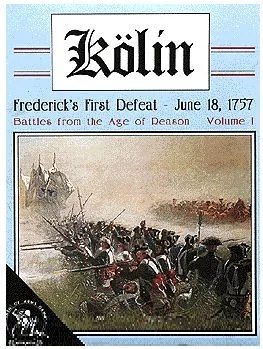

That said, I have long admired the presentation of La Bataille wargames. There is something about the way the counters and map look on a gaming table that greatly appeals to me. When LPS, Inc. opened a Kickstarter campaign for La Bataille de Kulm I was interested mostly because they marketed this new game as a smaller introduction to the La Bataille series:
Against the Odds published a great intro game with La Bataille de Vauchamps, which used slightly streamlined Premier rules and was very popular, both for being an easy entry for new folks and also for having a smaller footprint. It worked successfully and the game is entirely Out of Print.
ATO is now offering the same approach, with the 1813 Battle of Kulm. Why pick Kulm? It hasn’t been done in La Bataille. It offers another “small footprint” that will be good for an intro (or a fun afternoon for any gamer). And it’s a really important battle hardly anyone has heard of!

Premier league
Looking back, I think I knew—on some subconscious level—that there are several versions of the La Bataille rules. I admit I read the words “Premier rules” in the Kickstarter campaign but their impact did not fully land on me until I had the game in hand and read the Introduction to the La Bataille de Kulm Rules of Play:
Designer’s Note: This game has been designed and developed to be a second game to introduce gamers to the La Bataille Premier ME rules system produced by Marshal Enterprises…. Please note that these rules are not teaching you the rules for Clash of Arms’ Fifth Edition, Marie Louise, or Regulations XXX systems, which are closely related but not the same.
1.0 INTRODUCTION, Rules of Play, p. 2
As I know nothing of those other systems, I am comfortable forging ahead with learning the Premier ME rules. It also is apparent that I am on the edge of controversy regarding not just what rules are used, but how they are presented:
The rules are presented in a more legal (instead of conversational) method so that newcomers to the game system can reference them faster. These rules have been tailored and reorganized to facilitate learning of the Premier ME rules as they pertain to this battle. The battle-specific rules are located at the end of these rules and not in a separate booklet as is usually done in a regular La Bataille game.
1.0 INTRODUCTION, Rules of Play, p. 2
The READ THIS FIRST entry in the Rules of Play further explains the format of the rulebook, “We’ve organized the overall structure of the rules of this LPS simulation game to follow this game’s sequence of play in introducing concepts. The rules themselves are written in a format known as the Case System” (READ THIS FIRST, Rules of Play, p. 2). As a grognard who is comfortable with the “SPI Case” system of rules numbering I am not put off by its use—though I recognize that is not necessarily a popular opinion in this new-age of war gaming.
In the Rules of Play, the designer/developer assure me that they want to assist my learning of La Bataille de Kulm. They provide encouragement such as, “If you are a newcomer to the game, there is quite a bit to learn, but the system will provide you with a game that represents combat in the time of Napoleon. We hope that the presentation helps you get into this really great Napoleonic game system that was first introduced back in the 1970s” (1.0 INTRODUCTION, Designer’s Notes, Rules of Play, p. 2).
One “learning lesson learned” I took away from playing By Swords & Bayonets (GMT Games, 2025) recently was to read and heed any advice given by the designer or developer on how to learn the game. In La Bataille de Kulm that advice is found in a section titled, “LEARNING TO PLAY THE GAME”:
Begin by familiarizing yourself with all the components listed for this game. Then skim through the charts and rules, reading all the titles of the Modules and Sections. Set up a game scenario or portion of a scenario (after reading the applicable Module) and play a trial game against yourself. During this trial game, try referring to the rules only when you have a question and remember the numbering system we employ makes it easy to look up rules when you do. While a trial game may take you an hour or two, it is the quickest and most pleasant way to learn (short of having an experienced friend teach you). We also don’t recommend learning the rules word-for-word. Memorizing all the details is an effort that few can do. We’ve written the rules to be as comprehensive as possible, but they are not designed to be memorized. Taking in the rules in this way (as you play along) is the best approach to mastering this game.
LEARNING TO PLAY THE GAME, Rules of Play, p. 2
Learn to play
STEP 1 – Familiarize with components
Map. The ground scale in La Bataille de Kulm is 100 meters per hex. The map for La Bataille de Kulm is a standard 22″ x 34″ paper sheet printed in landscape orientation. The hexes are 15mm (~5/8″) and run east-west (left-right) on the map. The colors to my eye are a bit muted with heavy use of yellow and green. I cannot decide if the terrain features, such as towns, are done is something akin to a period-style or are…whimsical. If you look at the map below and say, “Hey, that looks vaguely GMT Games-ish to me” then you should not be surprised that the map art is by Charles Kibler who also does lots of work for…GMT Games.

Counters. Nobody can accuse LPS, Inc. of not making colorful counters. La Bataille de Kulm has three countersheets: a main sheet with 280 counters that are mostly units and two copies of a second half-sheet of 140 markers. All the counters/markers are 1/2″ size. In La Bataille de Kulm, each Increment Point (also called a Strength Point) on a counter equals about 100 infantry, 50 cavalry, or four artillery cannons. As colorful as the unit markers are I am concerned at how readable they will be in play; the colorful front side (called the General Side, see 2.2.2.a) provides some information but the back side (called the Specific Side, see 2.2.2.b) starkly shows combat values. As rule 2.2.3 notes, “As a basic concept of the game, opponents do not view the Specific Side of their opponent’s units.” We will see how that works in play. [Spoiler Alert: It’s a bit fiddly.]
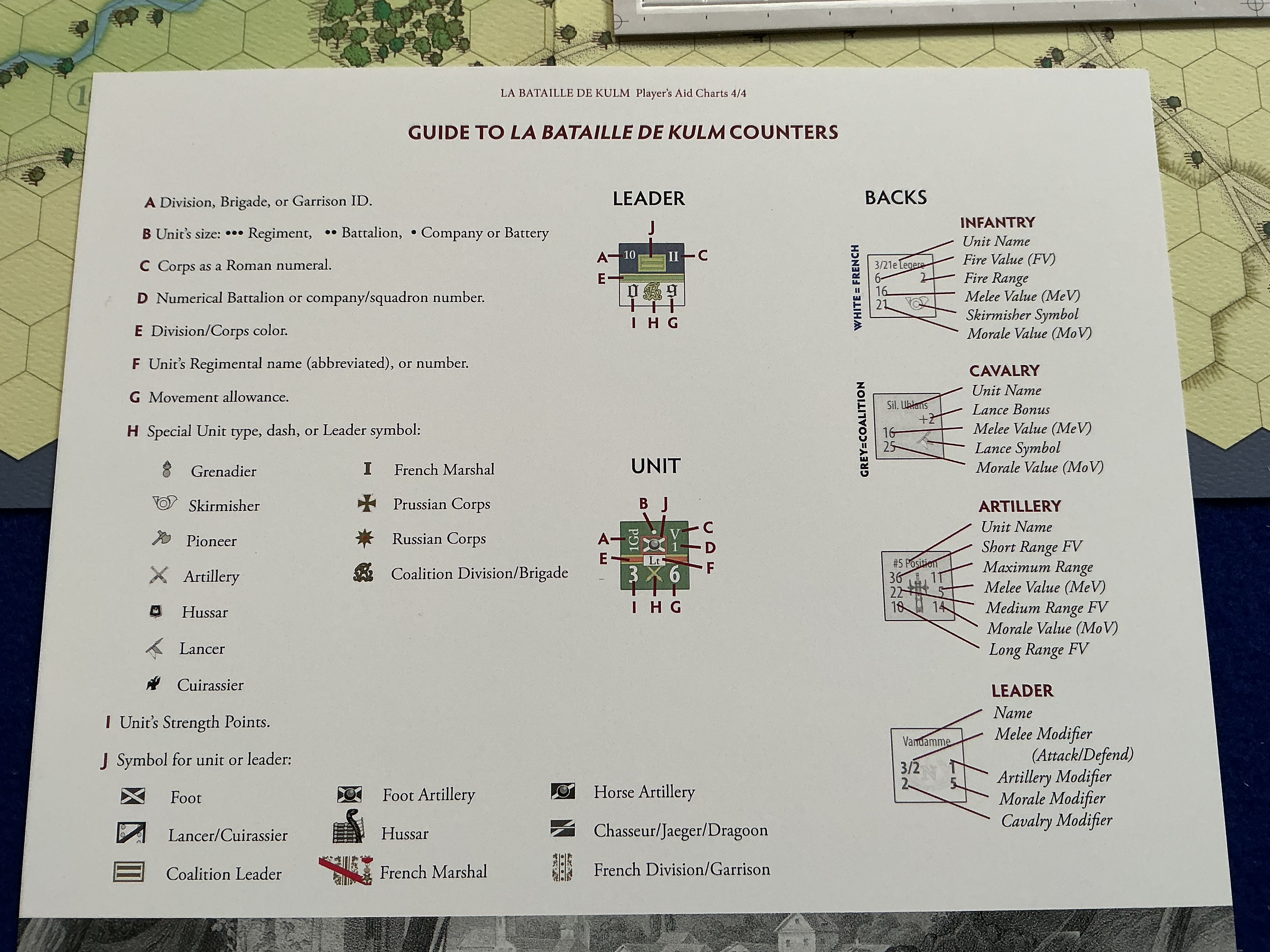
Rules. The Rules of Play for La Bataille de Kulm are in a 24-page pull-out from the center of the Against the Odds Annual 23. A bit annoyingly, within the Rules of Play is a 4-page pull-out for the La Vendée – 1815 Variant Game. I wish the rulebook had been stapled separate from the Annual; the pages are free once you open the staples of the Annual to remove the rulebook inserts. The 24-pages of the Rules of Play for La Bataille de Kulm are in triple column in a bit of a small font. As dense as the rules are, the use of Case System formatting with color, along with some graphics, keeps the rules fairly readable. The core rules for La Bataille de Kulm are covered in about 18 pages with one-plus page (four columns) for the game-specific special rules. Four scenarios are provided on three more pages. The final page of the Rules of Play is an extended Melee example with a large graphic.

Charts. La Bataille de Kulm relies on several page-sized Player Aid Cards (called PACs in the Rules of Play) printed on cardstock to deliver all the charts and tables necessary for play. The various charts include:
- Order of Battle (French, Austrian+Prussian, Russian, all single-sided) – These are not only set-up charts but also used to hold the breakdown battalions for the various regiments; this will demand a reconsideration of the table space needed for play.
- Sequence of Play (1x copy, single-sided) – Each turn of La Bataille de Kulm represents about 20 minutes of real time. Though the title includes a rules cross-reference with, “SEQUENCE OF PLAY (8.0)” the rest of the entries do not include rules cross-references. The lack of cross-references is all the more noticeable given the lower half of the card which has a Time Record Chart with some, but not all, cross-referenced rules noted.
- Player Aid Cards (PACs) (2x copies, two sets of two double-sided cards) – The four cards are roughly divided by Movement (Chart 1), Combat (Chart 2), Morale (Chart 3), and Counters & Victory Conditions (Chart 4).
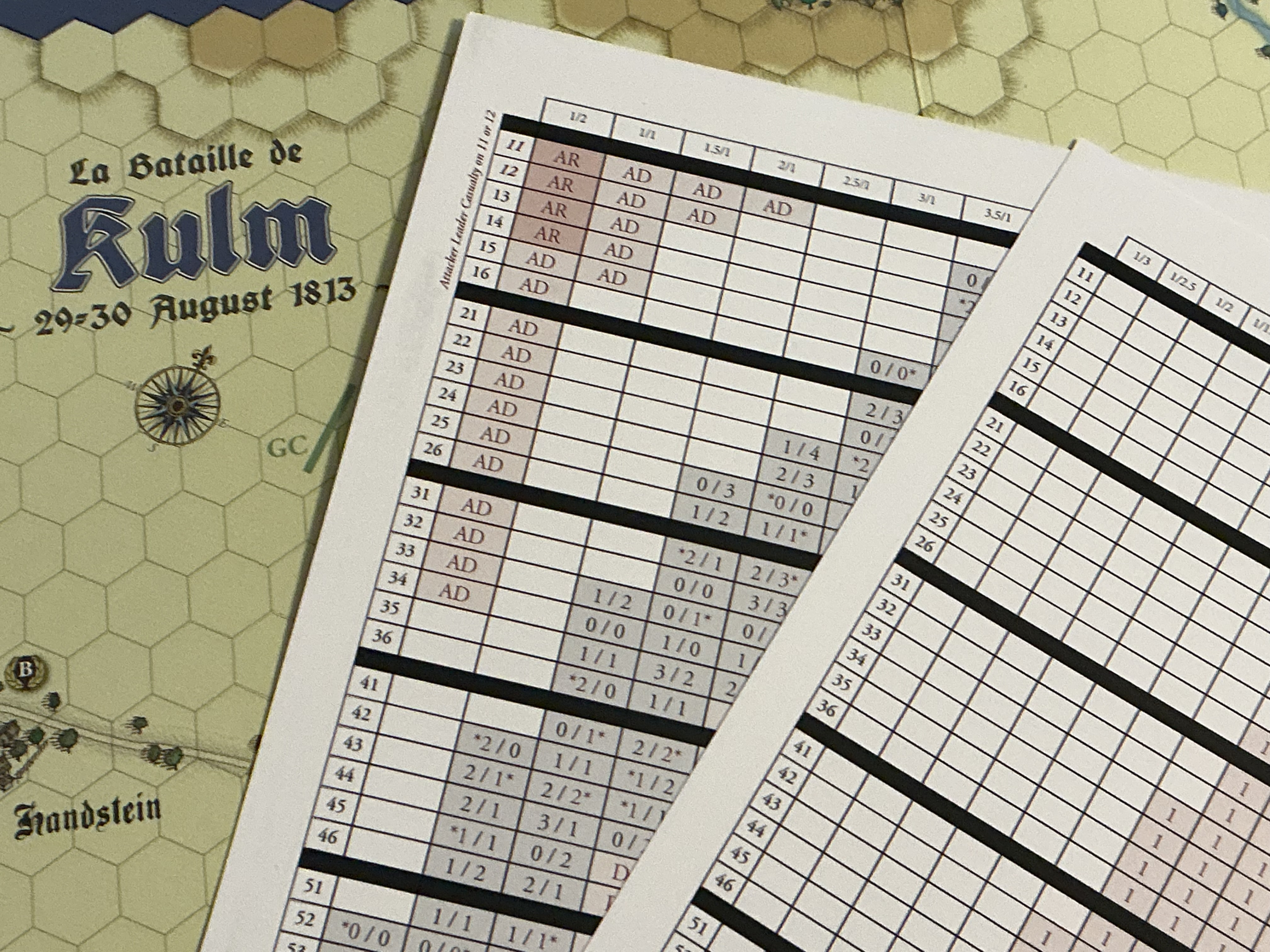
- Combat Results Tables (2x copies) – A double-sided card with the Melee Combat Results Table on one side and the Fire Combat Results Table on the other.
STEP 2 – Skim rules
Reading through the Rules of Play for the first time, several game mechanisms jump out to me as very different.
Die Rolls. Rule 2.5 Die Rolls explains how, “…the La Bataille Premier ME system…uses a base six numerical concept…so when two different colored dice are rolled, they provide for 36 results” (Rules of Play, p. 3). The rule goes on to recommend that players not familiar with this system use the Fire Combat Results Table (FCRT) or Melee Combat Results Table (MCRT) to count up or down rows.
Proportions. Rule 3.3 Proportion of Increments is used to determine Melee Value (MeV) after losses. Though I eventually grokked this rule, the math required is less-than-straight forward on first reading:
To determine the MeV of a unit that has suffered losses, subtract the number of lost Increments from the unit’s full strength Increment value. Multiply this sum by the unit’s MeV and then divide this by the unit’s full strength Increment value. Drop any fractions. This new value is the current MeV of the unit.
3.3.1 Melee Value
[As it turns out, determining Proportions is easier in practice than the rule makes it sound as most units have a Melee Value that is a multiple of the Increments. For example, a 5-Increment unit had a MeV of 15 which means every Increment is worth 3 MeV. Got three Increments left? That is an MeV of 9. Easy.]
Specific Side up. Remember how above I questioned the use of the Specific Side of a counter? It appears there are instances where the unit uses Specific Side up; to wit, when an infantry unit is in Skirmish Order (6.7.3) and when an artillery unit is unlimbered (6.9.2). I also see that a unit in column faces a hexside (6.3.1) while a unit in General Order also faces a hexside (6.6.2) but lacks a status marker like an infantry unit in Square that also faces a hexside but has a marker placed (6.5.4).
Chess clock not included. Rule 9.1 Errors in Judgment is a very interesting rule and almost certainly universally hated by those who suffer from Analysis Paralysis. To replicate part of the drama of battle, rule 9.1.1 sets a time limit for each side’s Movement Phase: the French get 5 or 8 minutes depending on the time of day and the Coalition gets 8 minutes on Day 1 and 10 minutes thereafter.
Charge! The rules for Cavalry Charge (module 10.0) are three pages long; that is far longer than Fire Combat (2 pages) or even Melee (just over one page).
STEP 3 – Trial game
Of the four scenarios in La Bataille de Kulm, I knew for sure that I was not going to start with the full two-day campaign (17.3 CAMPAIGN GAME) nor was I going to play scenario 17.4 THREE-PLAYER GAME solo. My choice was between 17.1 BATTLE OF KULM DAY 1 and 17.2 BATTLE OF KULM DAY 2. Before deciding I took the time to read Andy Nunez’s article, “Kulm: Vandamme’s Ordeal” in the pages of Annual 2023. This 25 page (!) article discusses the background, action, and aftermath of the battle at Kulm—highly recommended reading. I decided to go with the Day 1 scenario.
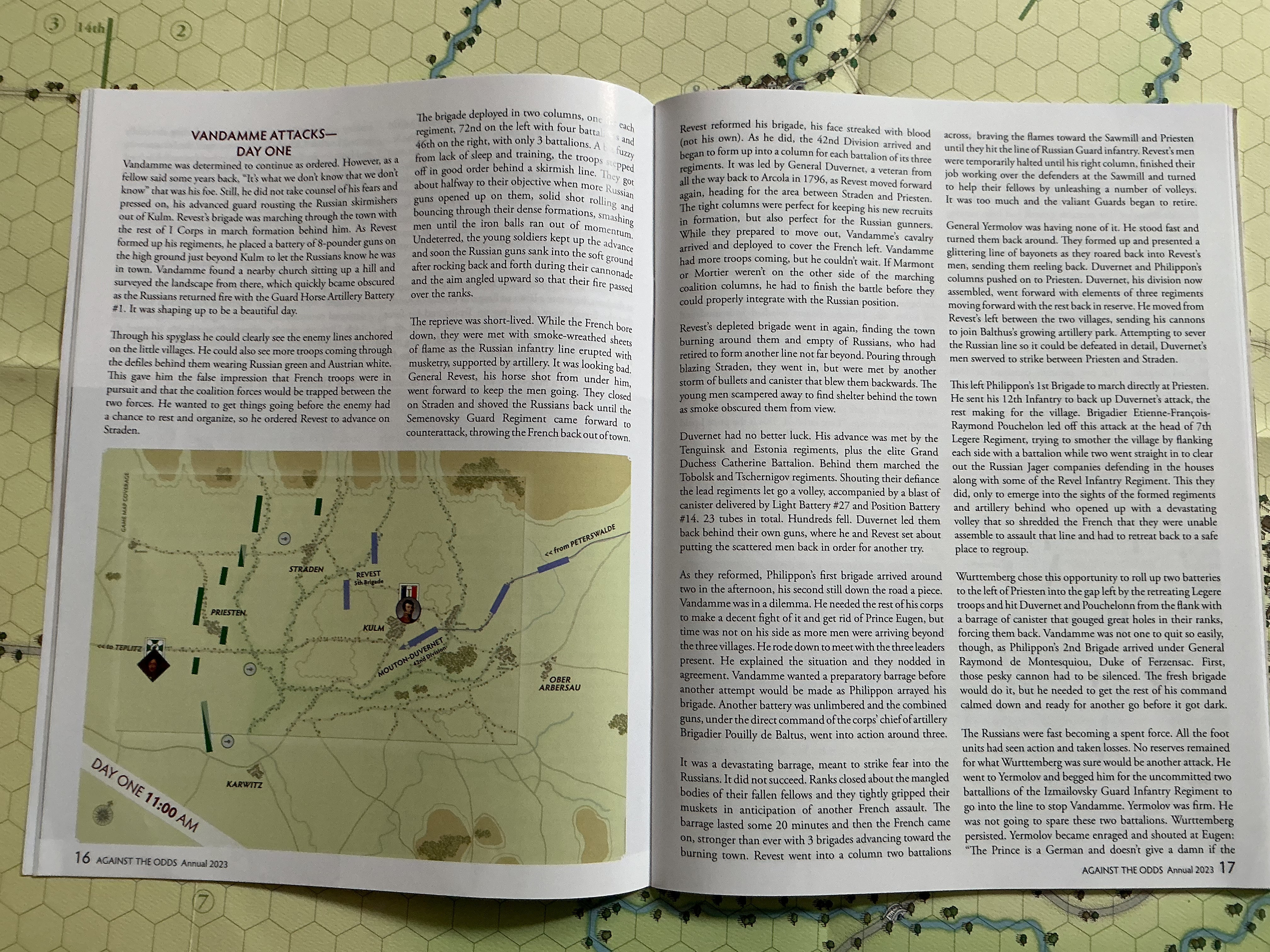
When setting up the scenario, the reason behind various markings on the map becomes apparent. For instance, in scenario 17.1 the French Advance Guard 5e Division (AG/5e) deploys at ‘5e” on the map. It was at this exact moment I realized that the map for La Bataille de Kulm has no hex numbers! During set up it also became obvious that any corner tuft on the small 1/2″ counters sitting in 15mm hexes was not going to work. Hence, I summoned my 2mm Corner Rounder for action….
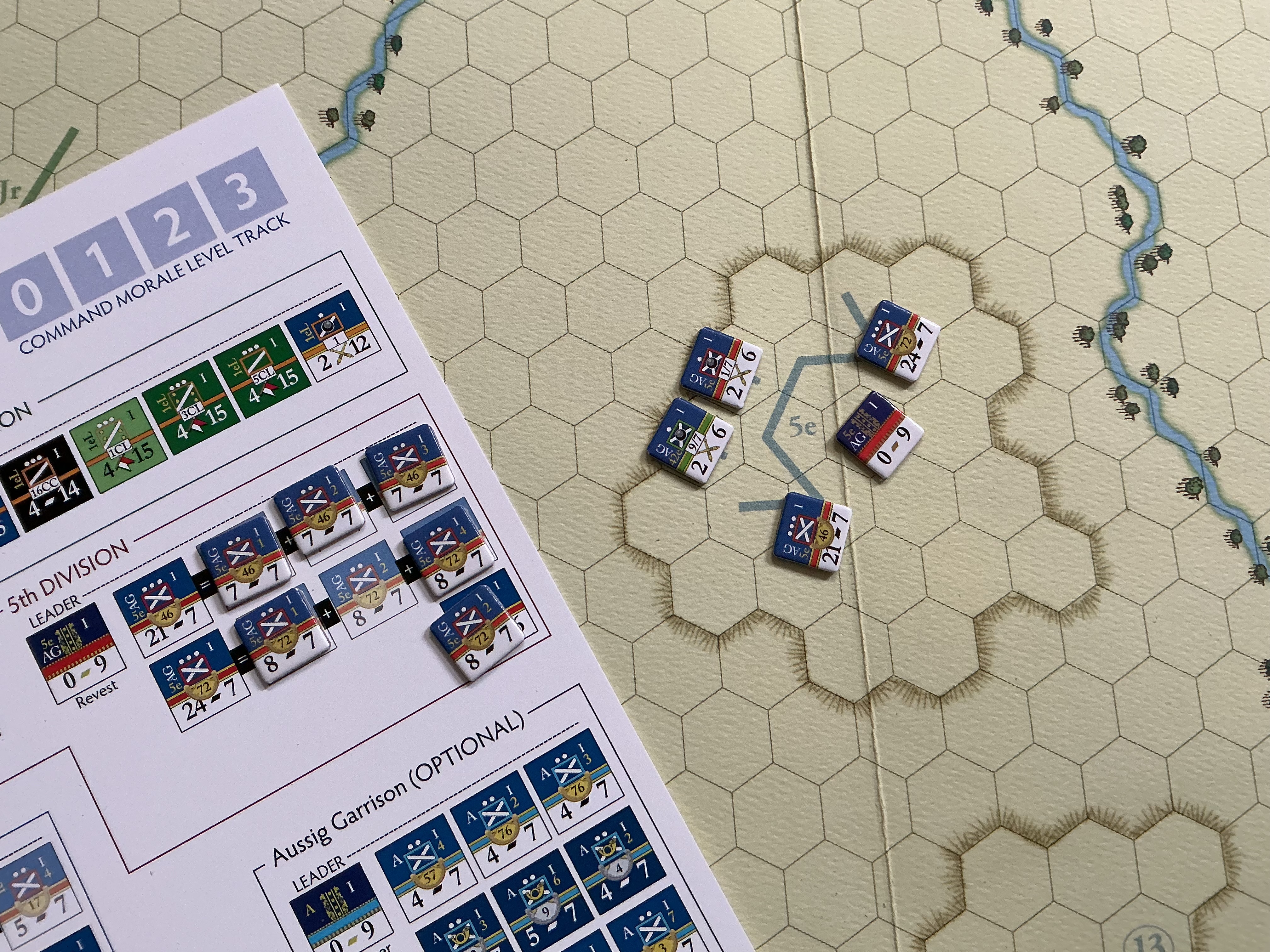
Setting up the game certainly familiarized me with rules modules 2.0 GAME COMPONENTS and 3.0 INCREMENTS of the Rules of Play. My walkthrough crawl-through of a first turn helped familiarize me with rules modules 6.0 TACTICAL FORMATIONS, 7.0 LINE OF SIGHT, 9.0 COMMAND PHASE, and 11.0 MOVEMENT. What it did not help me learn was rules modules 5.0 CAVALRY READINESS, 10.0 CAVALRY CHARGE, 12.0 FIRE COMBAT, 13.0 MELEE ASSAULT COMBAT, 14.0 LEADER CASUALTIES, and 15.0 RECOVERY PHASE. Instead of continuing play and addressing those rules only in the event they were called upon, I reset the game and pulled various pieces aside to make my own “learn to play” situations using the combat rules. I did my own cavalry charge, fire combat to include artillery, and melee assault. Only after I stepped through my learning situations did I do a total reset to the scenario and start afresh.
[As the afternoon was turning to evening and I had been standing over my gaming table most of the day, I relaxed after dinner by thumbing through my copy of With Musket, Cannon and Sword: Battle Tactics of Napoleon and His Enemies by Brent Nosworthy.2 Twenty years ago Nosworthy’s book was recommended to me as a good study on Napoleonic tactics. While I am not sure it is as highly praised today as it was nearly 30 years ago, I nonetheless learned much in my reading opportunity. In particular, I closely read “Part Two: Grand Tactics in the Napoleonic Era.” I eventually must read “Part Three: Infantry Tactics” and “Part Four: Cavalry and Artillery Tactics” but those are around 75 and 140 pages, respectively.]

Kulm-ulation
General Duvernet sat atop his horse as the Advance Guard of the 42e rode through the town of Kulm. Few townspeople were out; they likely knew that the battle was near. Lat night’s rain was going to make any work today sloppy [16.1.3 Day 1 Ground Effects: Cavalry +5 MP when charging; assaulting upslope or across stream -2 DRM when melee.] Looking to the sky, Duvernet judged it about noon [17.1 Start time 11:00 AM turn].

Playing La Bataille de Kulm for the first time led me to several observations regarding the game:
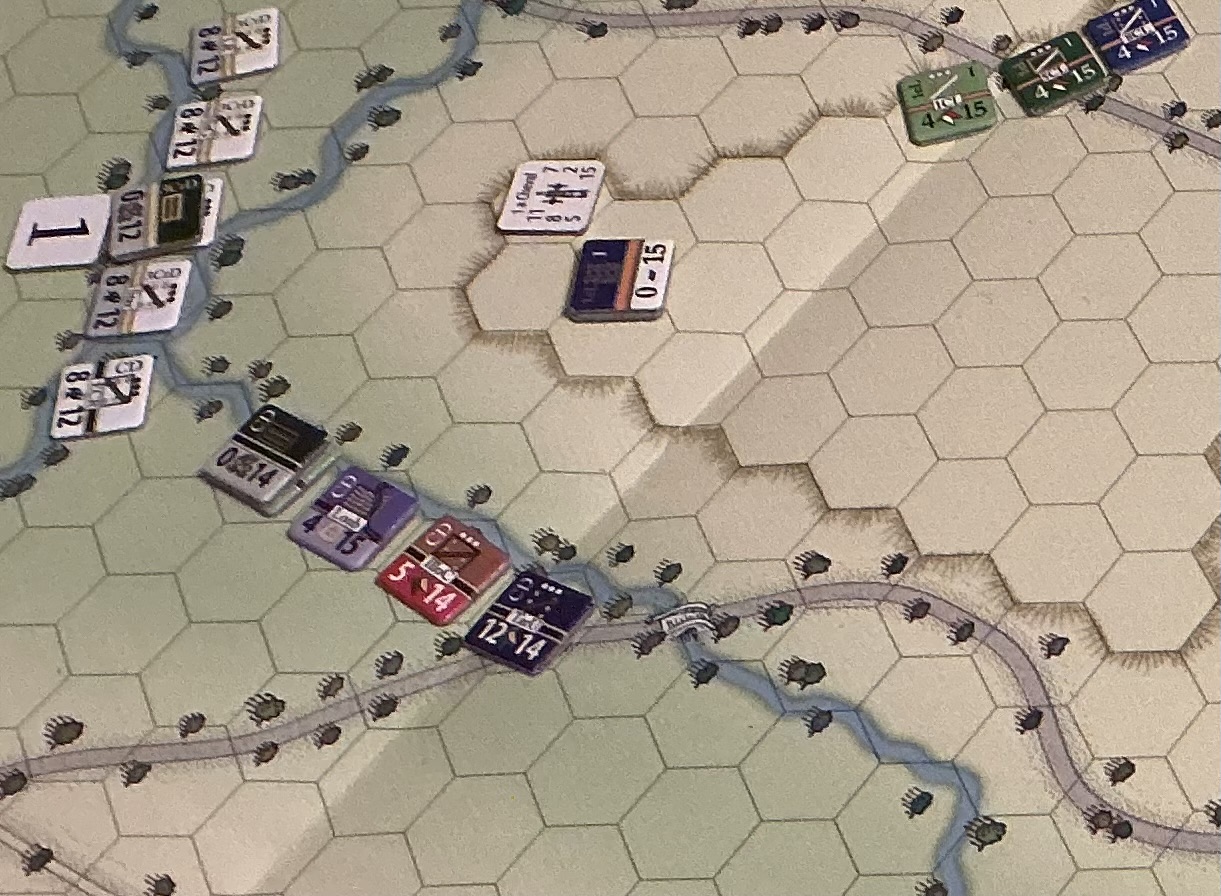
Time of Play. The Day 1 scenario is 24 turns (!); if each turn takes as little as 20 minutes to play that is still an eight hour game. Now the timing rule of 9.1.1 makes sense—and is very welcomed. La Bataille de Kulm is certainly a “weekend” or “game of the week” wargame title. [As I was in a learning game my early turns took closer to 30 minutes but, as I became more comfortable with the game system, later turns took about 20 minutes—meaning each simulated turn on the game table took about as long the time it represents in real life.]
Morale. Morale, not destruction of strength points, is the key to victory. Too many wargames focus on destroying strength points but in La Bataille de Kulm eliminating Increments is comparatively less important than causing a Morale Check and Disordering or Routing a unit.
Procedural. When conducting a Cavalry Charge or Fire Combat or Melee Combat the Player Aid Cards (PACs) are your best friend; each process is very procedural and Rules of Play is well organized making look up fairly easy (though an index would be helpful). If there is one other player aid needed I recommend a Player Aid Card with the Cavalry Charge, Fire Combat, and Melee Combat processes flowcharted to make working through each that much easier.
Increments, Stacking, Tactical Formations and Combat. I did not figure out the subtle—yet very important—relationship of rules 3.0 INCREMENTS, 3.1 Stacking, and 6.0 TACTICAL FORMATIONS to combat strength until four turns into my play through. Increments are the, “numerical value of the basic number of effective men and their equipment (including horses) of a unit” (3.0 INCREMENTS). The stacking chart on Player Aid Card (PAC) 1 lists the stacking limits based on unit type and formation in a given terrain. While the stacking limits make sense, what I missed is how many Increments in a hex is determined by the formation and its resultant impact on combat. The rules are written right there (and most modifiers appear on the Player Aid Cards) but taking the words from the page/chart to implementing them on my gaming table was just not automatic. In this case, the “Case System” of rules was most helpful; I cringe at the thought of reading a conversationally-written paragraph and trying to pick out all the specific instances.
[For example, a unit with 5 Increments or more can form an extended Line covering two hexes where the number of Increments in a hex is evenly split (see 6.4.6 second para). Rule 6.4.10 Fire from Line and 6.4.13.a Melee While in Line, Assault specify that a maximum of 4 Increments per hex can fire/assault. Since an extended Line has three frontal hexes, you can fire/melee a maximum of 4 Increments in the outer hexes and 8 Increments in the center (i.e. 4 from each hex). Further rules specify that in Fire Defense to use Line if 6 Increments or less are in the hex but if 7 Increments or more they defend using the Column table (see 6.4.11 Fire Defense in Line). When defending in Melee, all the Increments in a hex are used for the pre-melee strength morale check modifier (6.4.14.b) but each hex of a 2-hex line formation has 1/2 the Melee Value (MeV) of the unit’s current MeV (6.4.13.d). Whew!]
Premier Kulm
My learning and play-through of La Bataille de Kulm was an interesting journey. As mentioned before, this is my first real La Bataille series wargame, even if it is the Premier ME version which I understand from reading elsewhere is a somewhat simplified rules set. As one should expect from a rules set that has been around for fifty years the system is well refined. The La Bataille series certainly is an “old-school” wargame in that it uses a simple map (almost a miniatures playmat overlaid with hexes) and counters that very well could be flags. Rules are rules, but the many Player Aid Cards (PACs) is very reminiscent of golden age wargames. Implementing the game model also requires a bit of a “rules lawyer” approach as there are many specific details that are easily overlooked. It is also a very long game; if La Bataille de Kulm is a “smaller” battle that still takes 8-12 hours of game time to play a single day then I shudder at the thought of how long a “major” battle will take to play, especially using a more robust rules set.
Yet, despite the age of the La Bataille system and the use of more “classic” game components and mechanisms, playing La Bataille de Kulm is immensely satisfying. My enjoyment increased significantly after I read the tactics sections in Nosworthy’s book With Musket, Cannon and Sword because in playing La Bataille de Kulm empowered me to put into action the tactics that Nosworthy discussed and see results on my gaming table that are broadly compatible with the historical reality. In other words, La Bataille de Kulm truly brought Napoleonic Grand Tactics to life.

Issy-fit
I do not have many Napoleonic wargames to compare with La Bataille de Kulm with the exception of Battle of Issy 1815 by designer Fréderic Bey that appeared C3i Magazine Nr. 32 in 2018. Like La Bataille de Kulm is part of the La Bataille series, Issy 1815 is part of the Jours de Gloire series and was my first foray into those games.
While both look to be relatively similar in that the core combat unit is the Battalion, the scale of Issy 1815 (350 meters per hex, 90 minute turns) and the use of a chit-pull activation mechanism make both games play and feel very different.


I am not inclined to recommend one over the other but if you want a relatively quick-playing Napoleonic battle wargame then look to Issy 1815 and other Jours de Gloire games. If you have the time and want a deeper, more immersive excursion into the realm of Napoleonic grand tactics than a La Bataille series wargame like La Bataille de Kulm should be considered. You really cannot go wrong with either.
- (From Duck.ai) The term “Grognard” originally referred to an old soldier, particularly one from Napoleon’s army. It has evolved to describe a veteran or someone with a deep knowledge of something, often in the context of board games or wargaming.
Origins
– Napoleonic Era: The word comes from the French term meaning “grumbler,” used for the experienced soldiers who fought in Napoleon’s campaigns.
– Wargaming: In modern usage, it refers to a dedicated, often long-time player of tabletop wargames, especially those focused on historical battles.
Grognards are usually characterized by their passion for strategy, historical accuracy, and lengthy discussions about gaming tactics and histories. ↩︎ - Nosworthy, Brent (1996) With Musket, Cannon and Sword. New York: Sarpedon. ↩︎
Feature image courtesy RMN
The opinions and views expressed in this blog are those of the author alone and are presented in a personal capacity. They do not necessarily represent the views of U.S. Navy or any other U.S. government Department, Service, Agency, Office, or employer.
RockyMountainNavy.com © 2007-2025 by Ian B is licensed under CC BY-SA 4.0
 Rocky Mountain Navy Gamer
Excellent review/intro to the system!