
K-(War)-Pop
A simple search of BoardGameGeek using the term “Korea” returns 30-plus wargames on the ground campaign of the Korean War; that is, once you exclude air combat wargames and titles concerned about the next Korean War. That just about makes Trevor Bender’s new entry in the C3i Combined Arms series, Korea: The Fight Across the 38th from RBM Studios and published in C3i Magazine Nr. 38 (2025), the 38th wargame on the Korean War. Korea: The Fight Across the 38th (aka Korea 38th) is an easy-to-learn, easy-to-play, low-complexity wargame that recreates the narrative beats of the first year or so of the Korean War in an engaging manner.
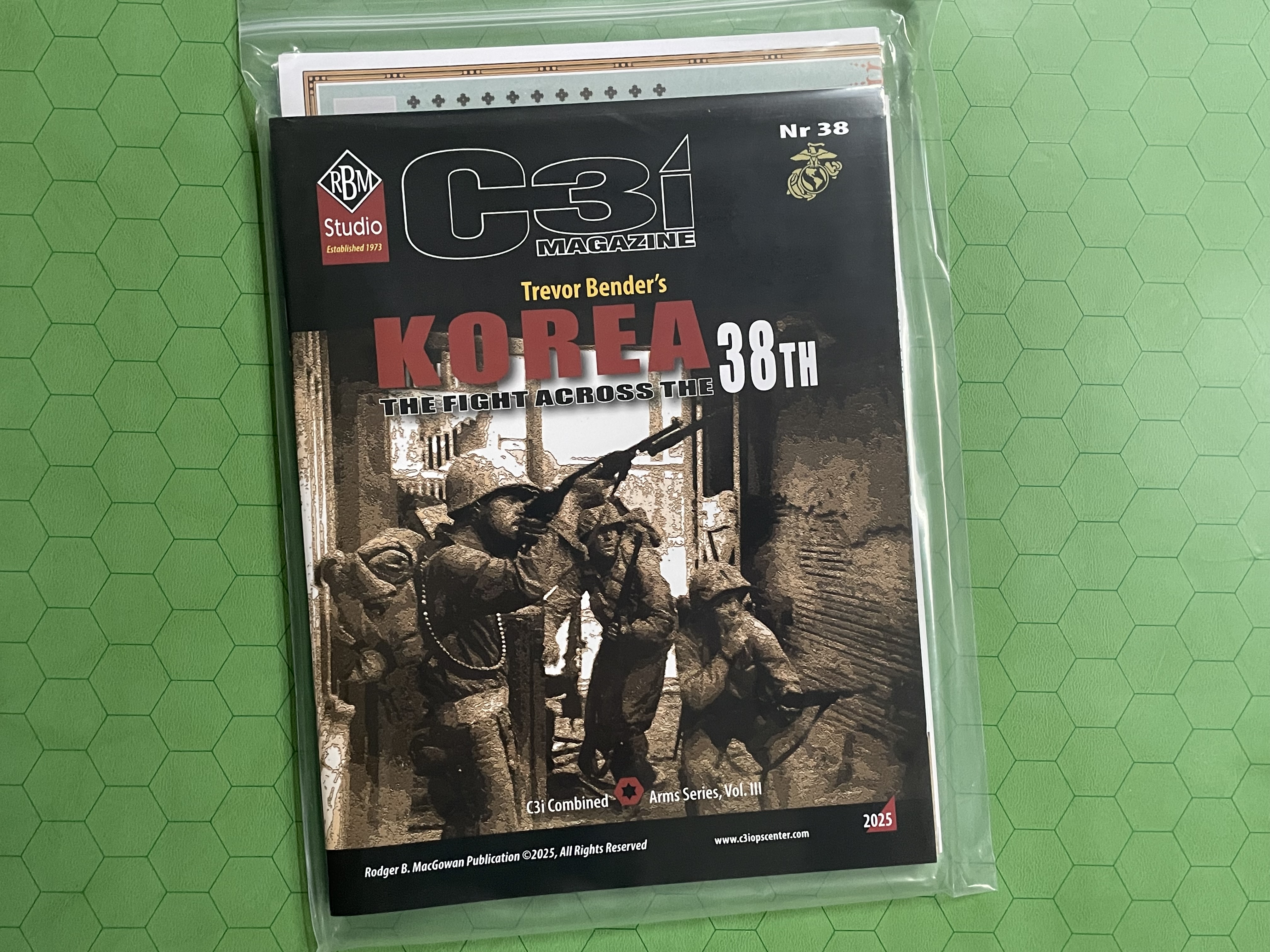
Battle for Korea
In the Designer’s Notes for Korea: The Fight Across the 38th, Trevor Bender discusses how his new game design follows the sequence of play that first appeared in Battle For Moscow by Frank Chadwick from Game Designers’ Workshop (GDW) in 1986. Chadwick and GDW intended Battle for Moscow to be an introductory wargame. As such, the components were simple: a map, counters, rules, and charts. Korea 38th continues that simple approach to wargaming with the same four common components.

Map. The map in Korea 38th is 22″ x 34″ sheet arranged portrait style with the Allied Player sitting to the east of the Peninsula and the Communist Player sitting to the west. Each side has their tables and charts facing them, though the main map is labeled in a North-South fashion with a Turn Track across the top (northern edge). The hexes are a generous 23mm (just under 1″) with a color palette that makes distinguishing terrain easy.
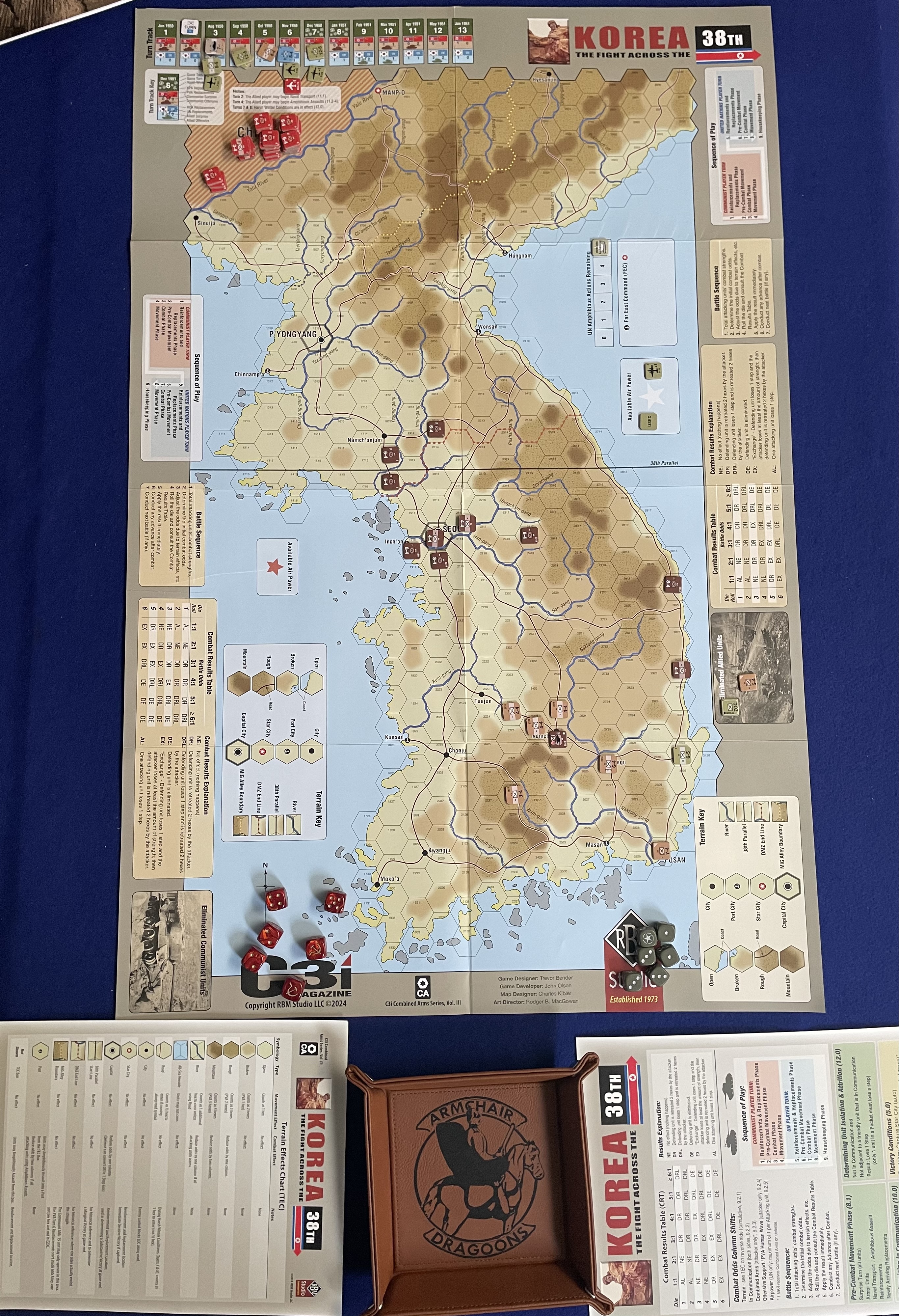
Counters. The counters in Korea 38th are 14mm (just under 1/2″) of a nice thickness. The units on counters are designated using a mix of standard NATO symbology and equipment profiles. The most used information is prominent on the counters with lesser, often “flavor” text relegated to a smaller font. The counters separate easily with just a hint of corner tuft; I recommend using a 2.5mm corner rounder as it nicely rounds the corners without fear of disrupting needed information.

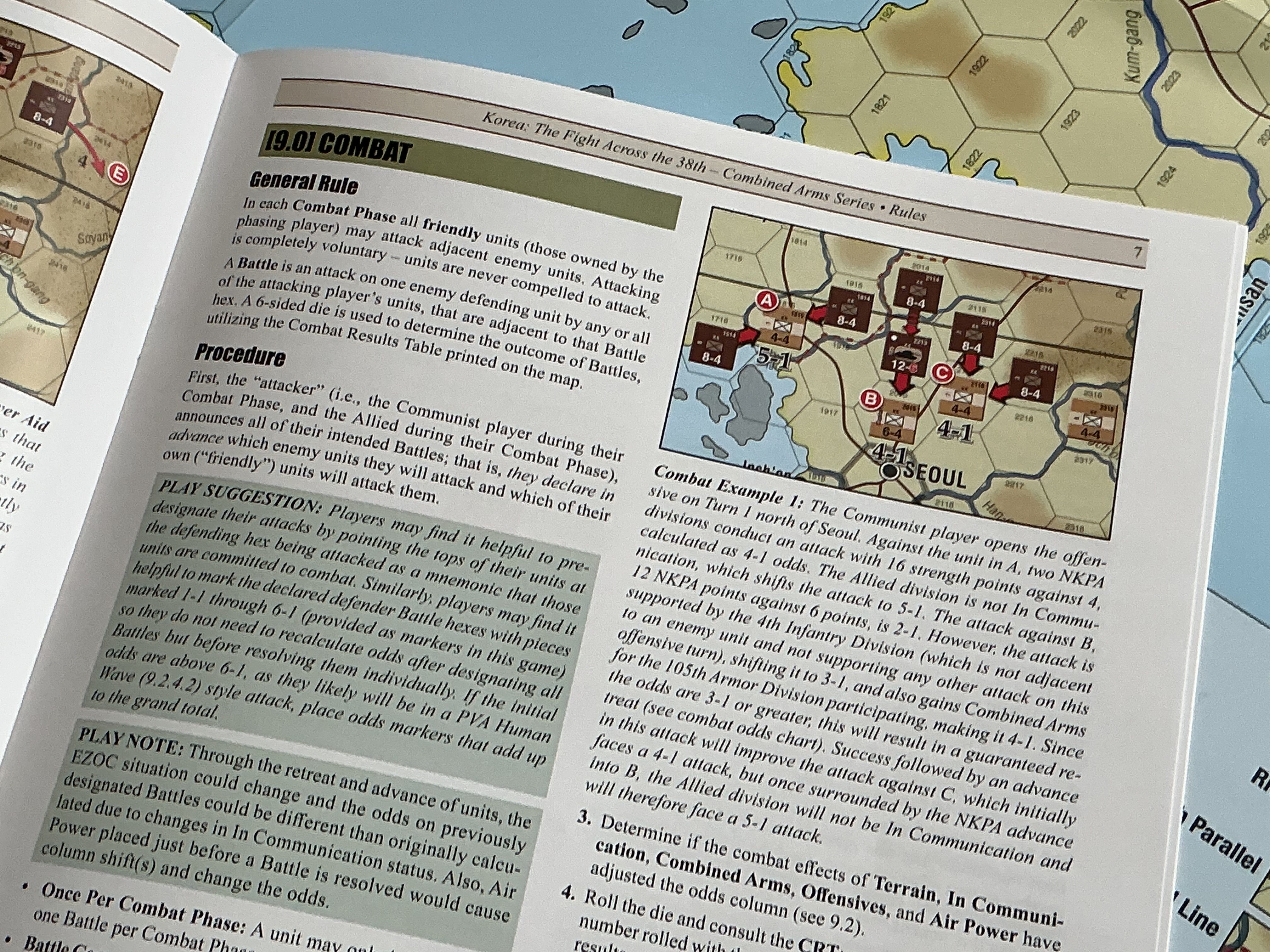
Rules. The 16-page rulebook for Korea 38th is four-times the length of the rules for Battle for Moscow. Much of the additional text, however, is background and other material and not a extensive collection of new rules. Bender is quick to point out that, “Familiarity with Battle for Moscow is not required to play…though it is a simpler presentation with far fewer counters…” (Rules, p. 16). The actual rules of play for Korea 38th take up about 10 of the 16 pages in the rulebook. For those familiar with the previous two games in Bender’s C3i Combined Arms series, Battle for Kursk: The Tigers Are Burning ,1943 (C3i Magazine Nr. 34, 2021), and Desert Victory: North Africa, 1942-1943 (C3i Magazine Nr. 36, 2022) the rules should be mostly familiar. The major difference in Korea 38th is the absence of the Posture mechanism used in the previous two games in the series. None of the rules in Korea 38th, however, are complicated to learn or use in play; the game very much draws on its roots from Battle for Moscow making it an easy-to-learn game.
Charts. In keeping with its component simplicity, the few charts used in Korea 38th are readily available either on the map or on the Player Aid cards. The four that are most commonly used appear on the game map; this is, the Sequence of Play, the Battle Sequence, the Combat Results Table (CRT), and the Terrain Key. The double-sided Player Aid cards have the Terrain Effects Chart on one side and a repeated CRT and both Sequence charts along with four other commonly used rules sequences—Pre-Combat Movement, Determining in Communication, Determining Unit Isolation & Attrition, and Victory Conditions.

Korea 3 by 8
Korea: The Fight Across the 38th is potentially a 13-turn game where each turn represents a month of combat. The game starts in June 1950 with the invasion of South Korea by North Korea. The game automatically ends after Turn 13, but players can use rule [15.41] Armistice Discussions to ends the game earlier if they agree.
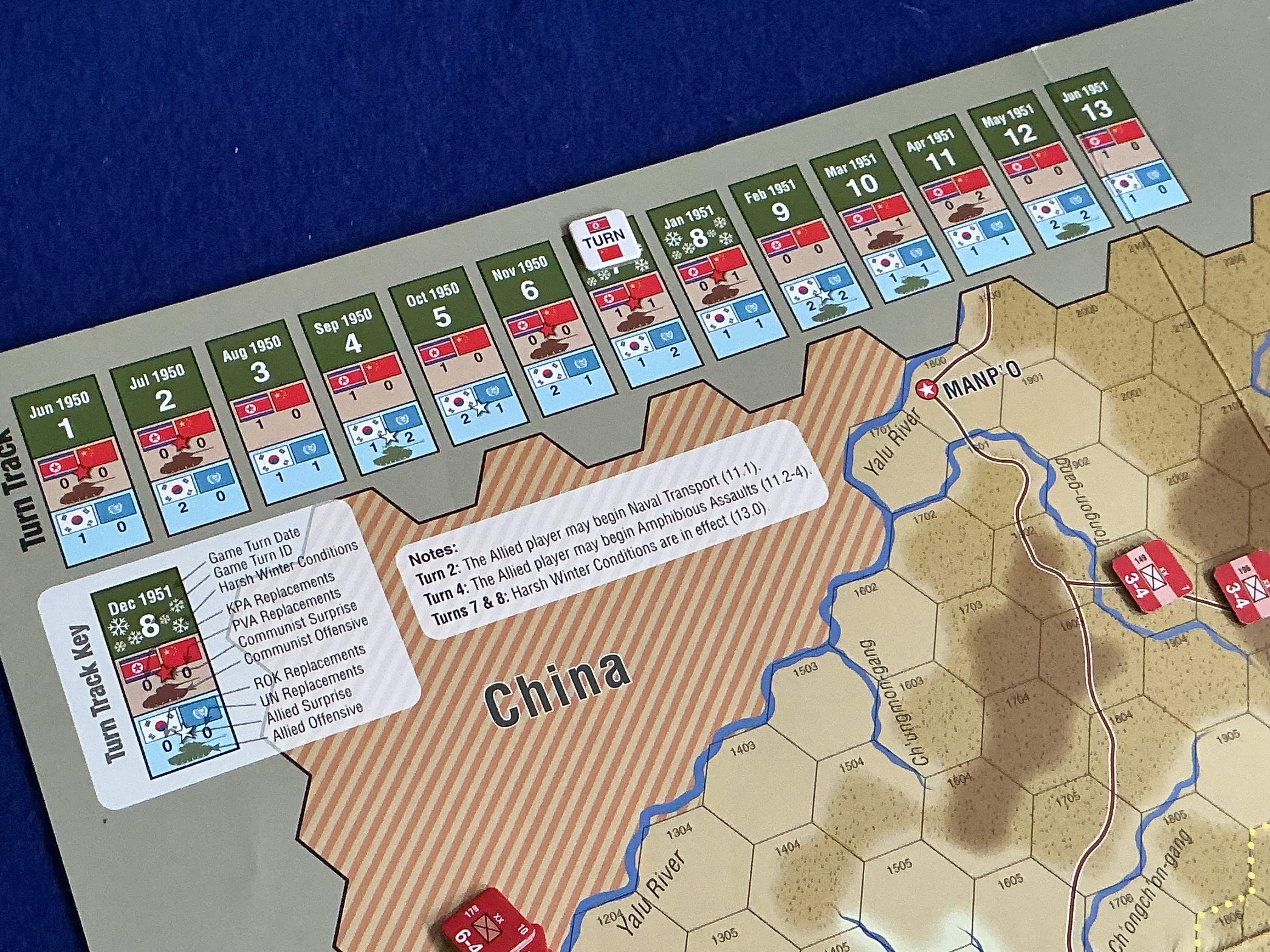
[The Armistice Discussions rules is quite literally a friendly way of ending a game when one side has assured themselves a Marginal or Substantive Victory. From a thematic viewpoint I can understand why the rule is included but at the same time believe that if you are playing with a player that cannot reach the same friendly agreement in a game without such a rule, well, you need to find a different opponent.]
Korea 38th in thirds
Much like the historical Korean War, a play of Korea 38th almost certainly will be divided into three parts:
- The initial North Korean attack and defense of Pusan.
- The Allied counterattack and Chinese entry into the war.
- The inevitable see-saw battles across the middle of the Peninsula.
That is not to say that players are railroaded in Korea 38th into particular historical actions; the game actually offers much decision space for players to make their own history; that is, with the cooperation (or not) from the dice of Lady Luck.
[Unlike my last several play throughs of By Swords & Bayonets (GMT Games, 2025), Inflection Point (MultiMan Publishing, 2025), and Battle for Moscow (C3i/RBM Studios 2025), Lady Luck seemed a bit more comfortable allowing the dice to roll in a more “average” manner when I played Korea 38th. I hope my days of consistently rolling low dice in a wargame are past.]
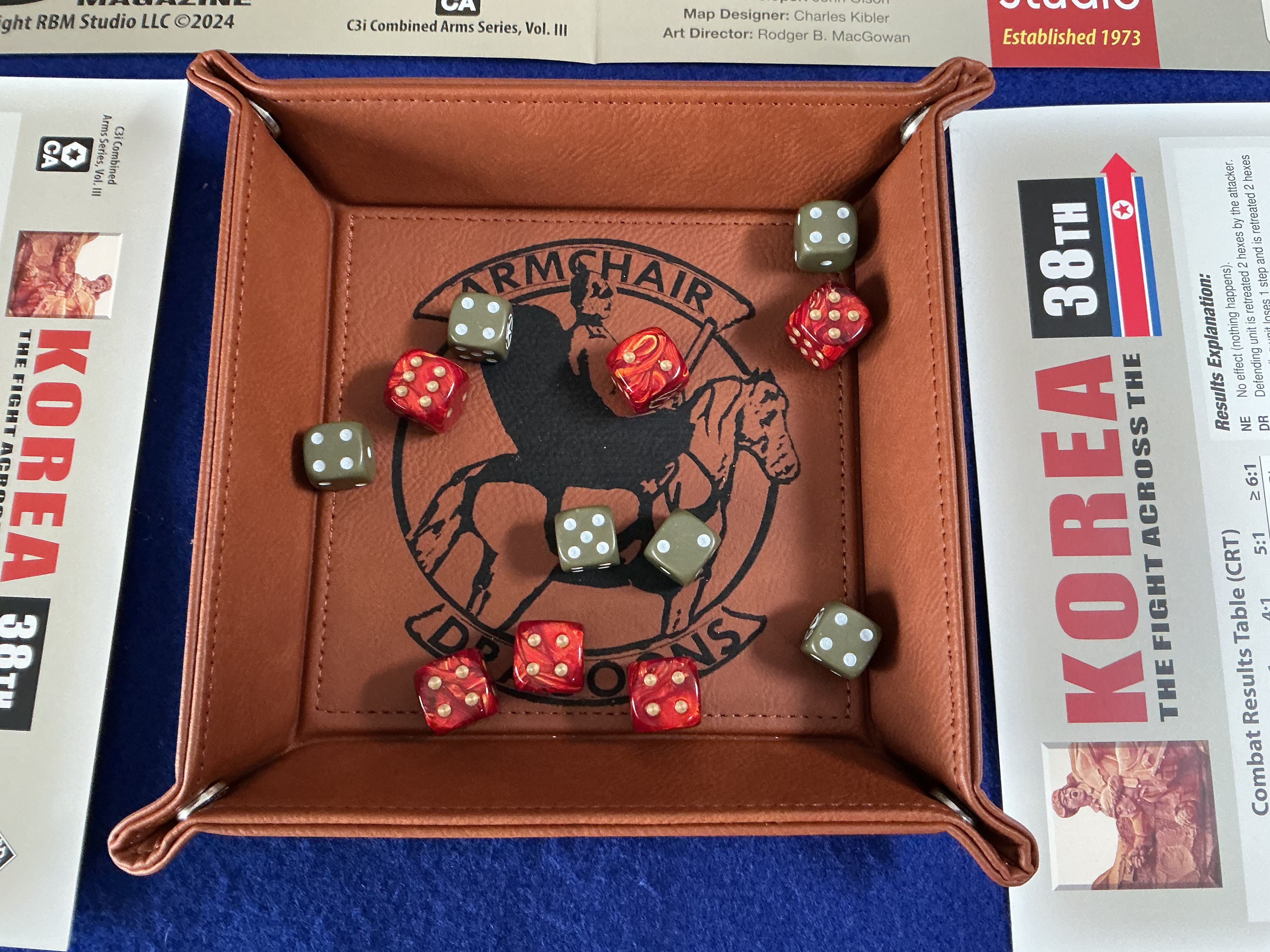
Korea 38th by eighths
There are eight great examples of how the rules in Korea 38th add to the narrative flavor of the game. These include:
- Task Force Smith. The first American reinforcements sent to the Korean Peninsula in June 1950 were woefully unprepared for what they faced. Historically, on 5 July 1950 the 540 soldiers of Task Force Smith faced off against 33 North Korean T-34 tanks supported by a regiment of infantry. While Task Force Smith fought nobly, the fact is they were ill-prepared to fight coming straight from occupation duty in Japan.1 In Korea 38th, Task Force Smith is represented by a single counter and used that arrives in the Allied Reinforcement Phase of Turn 1. Per rule [7.4] Task Force Smith, the counter uses Pre-Combat movement to travel by road avoiding enemy units or Enemy Zones of Control to any hex where it is placed. The Task Force Smith counter has no Zone of Control nor Combat Strength; it literally is a “road block” that occupies a hex stopping other units from entering that hex (see rule [8.2.1] Enemy Units which specifies a unit may never enter a hex containing an enemy unit). The Task Force Smith counter is removed if adjacent to an enemy unit or at the start of the Allied Reinforcement and Replacement Phase of Turn 2.
- Surprise. Generally speaking, only Armor units or units using Naval Transport or Amphibious Assault may use Pre-Combat Movement (see rule [8.1] Pre-Combat Movement). Certain turns, however, are designated as Surprise turns for one side or the other and in those turns all units for the surprise side are eligible for Pre-Combat Movement.
- Offensives. Offensives are not the same as a Surprise but instead allow an attacker to declare Offensive Support (rule [9.2.4.1] Offensive Support) where units not in an Enemy Zone of Control and adjacent to the attacking unit—and not necessarily adjacent to the defending unit—provides a favorable column shift in combat and can absorb losses.
- Human Wave Attacks. Rule [9.2.4.2] PVA Human Wave provides the Communist player the option, during Communist Offensive turns only, to designate units not adjacent to a defending hex but instead up to two-hexes distance to participate in the attack (i.e., add Combat Strength). The penalty paid is that one Step Loss is automatically taken (two Step Losses if the Allied player commits two or more Air Points in defense).
- MiG Alley. While the Allied Player has Air Points that may be used to support a battle (providing a favorable column shift, see [9.2.5] Air Power), the Communist player has a MiG-15 unit that can counter Allied Air Power in the MiG Alley section of the map. The MiG-15 literally “cancels” a single Allied Air Point in a battle provided the battle is taking place in a hex covered by MiG Alley.
- Seapower. Starting on Turn 2, the Allied player has access to Naval Transport ([11.1] Naval Transport) to move units by sea between friendly ports. Starting on Turn 4, the Allied player gains the ability to conduct Amphibious Assault ([11.2] Amphibious Assault) to attack enemy-controlled ports.
- Isolation, Attrition, and Pockets. In the Housekeeping Phase at the end of every turn, units that are Isolated (not In Communications) suffer Attrition by losing a single Step. A group of units that are pocketed—where several units are not In Communication but adjacent to each other—suffer a single Step loss as a group. See [12.0] UNIT ISOLATION & ATTRITION.
- Harsh Winter. Turns 7 and 8 (December 1950 and January 1951) are designated Harsh Winter Conditions. During these turns there is not Road Movement bonus north of the 38th Parallel and Allied Air Points are reduced by half. See [13.0] HARSH WINTER CONDITIONS.
한반도 왔다 갔다 (Korean Peninsula back and forth)
“The war in Korea was very much a back and forth affair. The North Korean invasion in June 1950 quickly saw Seoul fall to the Communist forces, and Pusan was threatened by a dash down the east coast by a flying column of infantry that swept aside all opposition. A heroic stand by Task Force Smith, support by the new U.S. Air Force, eventually halted the runaway east coast advance while South Korean Army defenses stiffened in front of Kumch’om. The newly arrived Commonwealth Division and 1st U.S. Cavalry Division took on the North Korean 105th Armor Division and destroyed it between Masan and Kwangju as it attempted to outflank the Allied defenses.”
“In September 1950, MacArthur landed the 1st Marine and 7th Infantry Divisions at Inche’on, retaking Seoul and cutting North Korean supply lines. North Korean units, now trapped in South Korea, desperately tried to retake Seoul and reopen their supply lines. The Chinese invasion in November 1950 took the West completely by surprise; there were no Allied formations north of the 38th parallel.
“As the last North Korean units withered away, the Allies tried to establish a new defensive line along the 38th parallel as the war settled down into a fruitless war of attrition. MacArthur debated on another Amphibious Assault against Hungnam to drive across the Taebaek Mountains to seize Man’po and end the war. It was a risk that MacArthur certainly was willing to take but Truman was not. Thus, the stalemate across the 38th parallel continued.”
“In June 1951 the advantage sat with the Communists who used the surprise entry of the Chinese into the war in December 1950 and operational momentum that carried through Janaury 1951 to seize and hold territory south of the 38th parallel on the east side of the Korean Peninsula. Pyongyang and Peking called it a victory; the Seoul and Washington called it a reset. How long the Land of the Morning Calm would remain that was was a question asked every day by both sides as they patrolled the fences and minefields of the Demilitarized Zone.”
Korea 38th key reads
Sequence. Of. Play. Designer Trevor Bender calls out the “Reverse Sequence of Play” as an unusual feature of Battle for Moscow and, by extension, Korea 38th. The “unusual” sequence of combat before movement is not a difficult rule to learn, but (at least for me) a seemingly difficult rule to remember. More than once I forced myself to stop caving to muscle memory and not reach for the dice to fight a round of combat after movement.

Combined Arms. Once the Chinese arrive the Allies are outnumbered roughly 2:1 in terms of numbers of formations. Much of the terrain along the 38th parallel or the final DMZ line is only marginally favorable for defense. The key to the Allies leveraging the Chinese out of a hex is to use combined arms, be it a combination of armor and infantry on the attack or supporting air power. On the Chinese side, the November 1950 through January 1951 turns are key as those are both Surprise and Offensive turns that unlock not only extra Pre-Combat Movement but also only Offensive Support and Human Wave Attacks.

Ebbs and flows of the 38th
In February 2024, I covered Ty Bomba’s then-new wargame Ebb & Flow: The Final Communist Offensive in Korea, 22 April-10 June 1951 printed in Paper Wars #105 (Compass Games, 2024). While Korea 38th and Ebb & Flow both cover the early days of the Korean War (Ebb & Flow taking place in Turns 11-13 of Korea 38th) the two games are of sufficiently different scale that they complement rather than compete with one another.
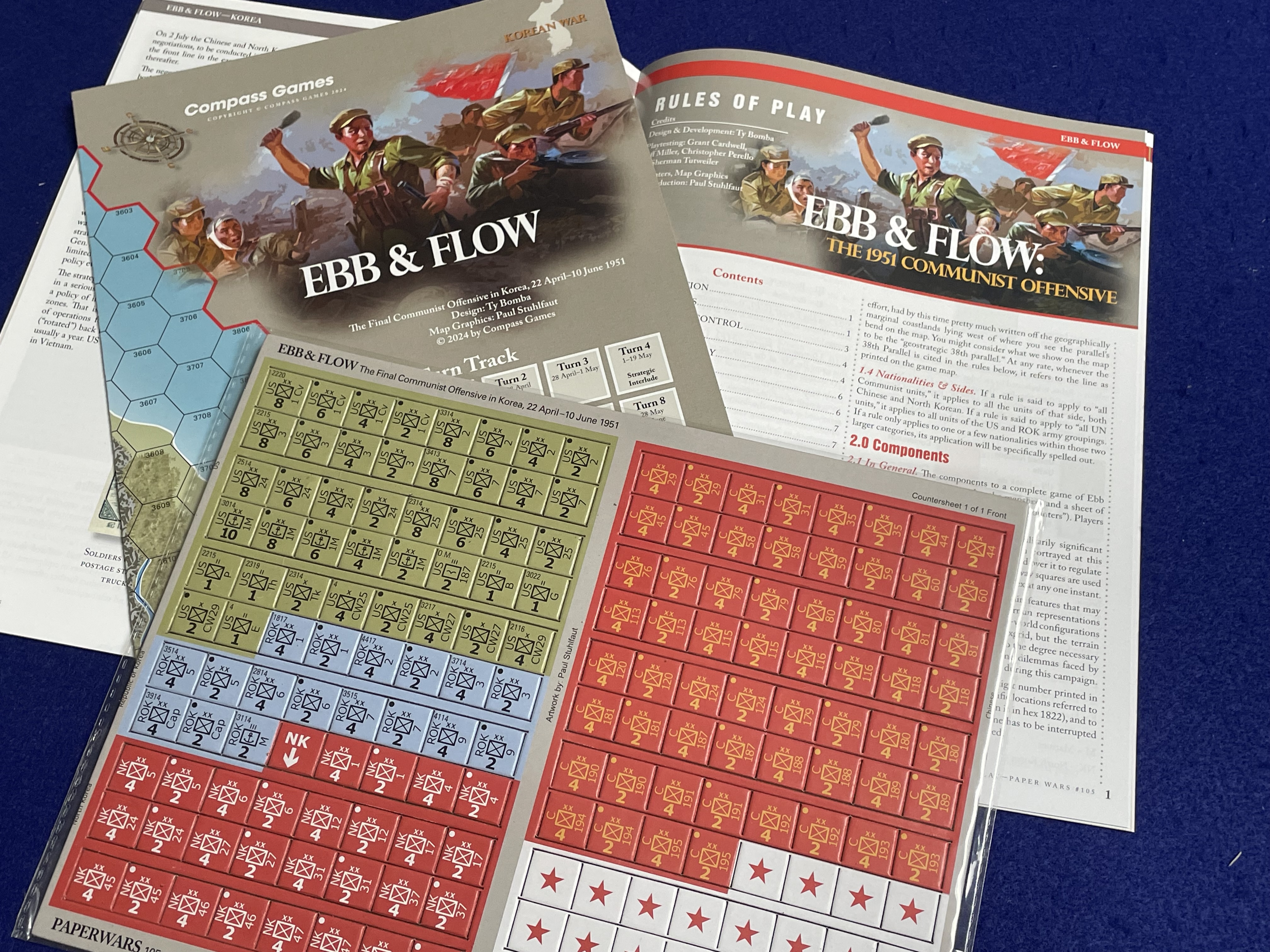
Indeed, it was very nice to see Korea 38th designer Trevor Bender call out the Paper Wars #105 article that accompanied Ebb & Flow as an excellent additional read (Rules, p. 15). All of which highlights the value of Korea: The Fight Across the 38th. This wargame is not only a good introductory wargame but also a useful teaching aid for exploring the early days of the Korean War. For myself, I need to start a list of wargames for next year’s Fall Assembly wargamers meet sponsored by The Armchair Dragoons and put Korea 38th high on the list of potential games to host.
Sources Referenced
- Blair, Clay (1987) The Forgotten War: America in Korea 1950-1953. New York: Anchor Books.
- Bomba, Ty (2024) Ebb & Flow: The Final Communist Offensive in Korea, 22 April-10 June 1951. In Paper Wars #105 from Compass Games.
- Finley, James P. (1983) The US Military Experience in Korea, 1871-1982. Command Historian’s Office, Secretary Joint Staff, Hqs, USFK/EUSA, APO San Francisco.
- In The US Military Experience in Korea, 1871-1982, US Forces Korea and Eighth US Army Command Historian James Finley wrote, “Though hopelessly outnumbered, they [Task Force Smith] acquitted themselves nobly and, before withdrawing to Taejon, inflicted heavy losses on the enemy” (Finley, p. 74). Clay Blair in his book The Forgotten War: America in Korea 1950-1953 was far less charitable: “In this historic, heroic, but utterly futile confrontation Task Force Smith had been wiped out in a few hours.” Blair notes that in the aftermath of the disintegration of Task Force Smith one soldier commented, “It planted a doubt in many minds about the effectivness of our tactics and weapons…[and] swollen by rumor…the doubt ate like a cancer into the combat morale of all troops moving to the front” (Blair, p. 103). ↩︎
Feature image courtesy
The opinions and views expressed in this blog are those of the author alone and are presented in a personal capacity. They do not necessarily represent the views of U.S. Navy or any other U.S. government Department, Agency, Office, or employer.
RockyMountainNavy.com © 2007-2025 by Ian B is licensed under CC BY-SA 4.0
 Rocky Mountain Navy Gamer
Excellent review of the unique details of this treatment of the Korean War.