
Hello, wargamer
The very first edition of Battle for Moscow, designed by Frank Chadwick, was printed by Game Designers’ Workshop (GDW) in 1986. From the beginning, Chadwick and GDW intended the game to be an introduction to wargaming. With a quarter-sheet game map (11″ x17″), 40 counters, and four pages of rules, Battle for Moscow introduced players to the essential elements of a wargame; that is, a map, counters, rules, and charts. Although the game is available for free on the internet, RBM Studios included a very nicely produced new edition in the issue 38 of C3i Magazine.

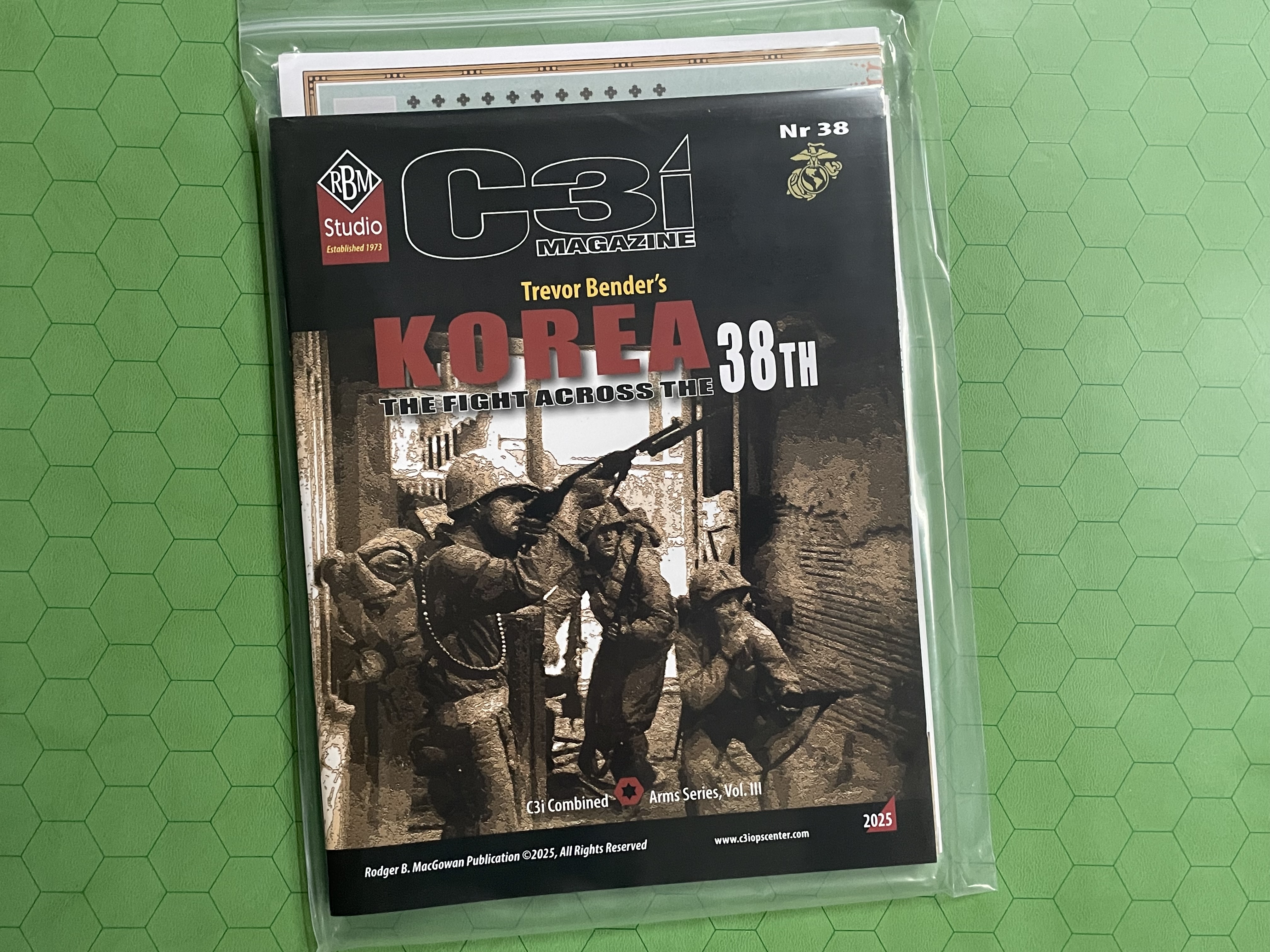
The feature wargame in C3i Magazine Nr. 38 is Korea: The Fight Across the 38th designed by Trevor Bender. Korea 38th is the third game in Bender’s C3i Combined Arms series of wargames, all of which trace their design lineage back to Battle for Moscow. While I was getting set to learn and play Korea 38th, I took the opportunity to play the core game engine of Korea 38th by going back to Battle for Moscow. It proved to be a very enjoyable experience and a reminder of why I love wargaming.

Gateway back(wards) to the past?
After wargaming for 46 years playing Battle for Moscow my perspective of the game cannot be that of a newcomer to the hobby. Through playing the game I actually discovered two perspectives. The first perspective—on a very personal level—is always read the rules and never assume you know a game model. The second is how appropriate Battle for Moscow is for introducing newcomers to the hobby of wargaming.
The first perspective—always read the rules—comes from playing my first turn of Battle for Moscow in decades. As every wargamer “knows,” Movement always comes before Combat in a turn [Make sure you read that sentence using a voice dripping with sarcasm.] That is not, however, the case in Battle for Moscow. In Battle for Moscow the sequence of play for each player is:
- Replacement Phase
- Armor Movement Phase (German) / Rail Movement Phase (Soviet)
- Combat Phase
- Movement Phase
In the Designer’s Notes for Korea 38th, Trevor Bender makes note of this…backwards phase order in a section titled, “Reverse Order Sequence of Play”:
The games in the [C3i Combined Arms] series follow the Battle for Moscow sequence of play where the general movement of all pieces occurs after combat. This is unusual for a wargame, where typically units advance to contact, then fight during the combat phase.
Designer’s Notes, Korea: The Fight Across the 38th, p. 13
For the German player, the Battle for Moscow reverse sequence of play emphasizes the role of armor in the German Blitzkrieg. German armor units get to move before combat and then (hopefully) exploit holes in the line with movement after combat. For the Soviet player, the Rail Movement Phase depicts the usefulness of interior lines of communications allowing rapid shifting of units across the battlefield. Both are simple game mechanisms showing important strategic impacts—lessons taught if you follow the sequence of play properly! The use of that unusual reverse sequence of play is all the more unexpected given Battle for Moscow is marketed as an introduction to wargaming. Which leads to my second perspective…
The second perspective I gained playing Battle for Moscow is how it can help introduce new wargamers to the hobby, even with a reverse sequence of play. When it comes to teaching new wargamers using Battle for Moscow, designer Frank Chadwick offered support and advice years ago. The Battle for Moscow page on BoardGameGeek has a link to, “The official Battle for Moscow website.” This (very) old webpage created way back in 1996 (yes, the internet existed way back then) resides on Grognard.com with six subordinate pages that cover topics such as:
- “An introduction to wargaming.”
- “Information about the wargaming hobby.”
- “How to learn to play wargames.”
- “A complete board wargame (Battle for Moscow).”
- “Details of Operation Typhoon (historical background for the Battle for Moscow game).”
- “What happens next: continuing play in Battle For Moscow.”
The most useful sections for teaching beginning wargamers are the first “introduction to wargaming” and the third “How to learn to play…”. The “How to learn to play…” page in particular was written by Frank Chadwick and offers several pieces of great advice that sometime even grognards like myself forget. The advice includes:
- “Objective. Always keep the objective in mind. In Battle for Moscow, the player who controls Moscow at the end of the game wins. Each player should develop his strategies with this objective in mind: the German player on how to take Moscow, and the Soviet player on how to defend Moscow or how to retake the city if he loses it. All other game strategies for both sides are means to the end and must not supplant the objective.
- “Your Ultimate Goal. Don’t forget your ultimate goal while you’re playing the game. Winning is nice, but, statistically, half of all players lose. The real goal is to have fun, so make the best of everything during the game, concentrate, and, above all, have fun.”
The teaching and learning advice behind Battle for Moscow works together with the simplicity of the game design to make it an excellent gateway game to enter the wargaming world.
[Now, I realize some gamers out there at this very moment are almost certainly recoiling in horror as they read “that” word. How can a hex & counter wargame with a Combat Results Table (CRT), such an ancient and dated set of game design mechanisms, ever be considered a gateway game given all the wonderful, progressive game designs that have advanced the hobby far from those dark early days of wargaming? We all just “know” that a hex & counter wargame with a CRT can never be as elegant as a “new-age” wargame with cubes and cards and a combat resolution system that limits dice randomness. [Again, make sure you read that with as much disdain you can muster dripping from your voice.]]
“This is the game of a 21st Century wargamer. Not as clumsy or random as an ancient wargame with hexes and counters and an odd-based CRT; an elegant wargame design for a more civilized age.”
Obi-wan “Cubist” Kenobi, EuroWar Knight and BGG Hotness Influencer
I admit that Battle for Moscow, even this new RBM Studios/C3i edition, does not have the same table presence as a wargame with blocks or cubes or little plastic figures spread across a mounted mapboard with specialty dice or decks of cards. It also doesn’t have the price tag that goes along with all that bling. Yet, as simple as the components are, I argue that the very simplicity of Battle for Moscow is exactly what makes it an excellent introductory wargame. The game is a taster and offers a glimpse of what the wargaming hobby offers.
Rodger was always at the beginning
Sadly, C3i Magazine, and RBM Studios, likely will not publish again due to the sad loss of wargaming giant Rodger B. MacGowan. Issue Nr. 38 is dedicated to Rodger’s memory with many testimonials commemorating his numerous contributions to the wargaming world. For myself, the inclusion of Battle for Moscow, an introductory wargame, in C3i Magazine Nr. 38 which honors Rodger is a coincidence that has deep meaning to me. My “introduction” to wargaming was, alas, not Battle for Moscow but Panzer: A Tactical Game of Armored Combat on the Eastern Front, 1941-1945 by Jim Day and published by Yaquinto Publishing (1979). The cover artist was Rodger B. MacGowan himself. For many years the art of Rodger and wargaming were synonymous to this (then) young grognard—and still is today.

Feature image courtesy RMN
The opinions and views expressed in this blog are those of the author alone and are presented in a personal capacity. They do not necessarily represent the views of U.S. Navy or any other U.S. government Department, Service, Agency, Office, or employer.
RockyMountainNavy.com © 2007-2025 by Ian B is licensed under CC BY-SA 4.0
 Rocky Mountain Navy Gamer