
What if?
One of the greatest “what if” questions from the Second World War concerns the U.S. invasion of the Japanese Home Islands. The first invasion, Operation Olympic against the island of Kyüshü, was set for November 1945. The dropping of the atomic bombs on Hiroshima and Nagasaki in August 1945, however, ended the war before that invasion was necessary. Of course, wargamers can play out alternate history events to include Operation Olympic. Thanks to the generosity of Yasushi Nakagoru of Bonsai Games, I acquired a copy of the 2025 folio edition of Assault on Ancient Japan, Kyüshü 1945 which I unbagged in May 2025. This game by designer Antonio Rodriguez was first published by Ludo Press in the July 2024 edition of Alea Magazine (Nr. 41) in Spanish under the same title. After too long a delay I finally got Kyüshü 1945 to my gaming table. Kyüshü 1945 is a relatively simple wargame that introduces several options in play that make it an easy-to-learn and quick-playing title that is interesting and very replayable.


Ancient design…with a repeatable twist
In terms of game design mechanisms, Kyüshü 1945 is in many ways a “classic” wargame. The game map uses hexes (7 km across) and Regiment/Brigade counters using Steps in addition to a Combat and Movement factor. Most combat is resolved on an odds-based Combat Results Table (CRT). There are those seemingly obligatory rules for Zones of Control (ZoC) and Supply.
Some wargamers are bound to ask that if Kyüshü 1945 is such an ordinary—even ancient—wargame design how could it possibly be interesting to play. My answer is to point out that Kyüshü 1945 has many variables in play that almost certainly ensure that no two games will ever play out the same. The replayability of Kyüshü 1945 comes most directly from the rules for “Turn 0”, rule 16.0 (Optional Rules, End of Game/Turn and Victory Conditions), and rule 9.2 (Events).
Turn 0
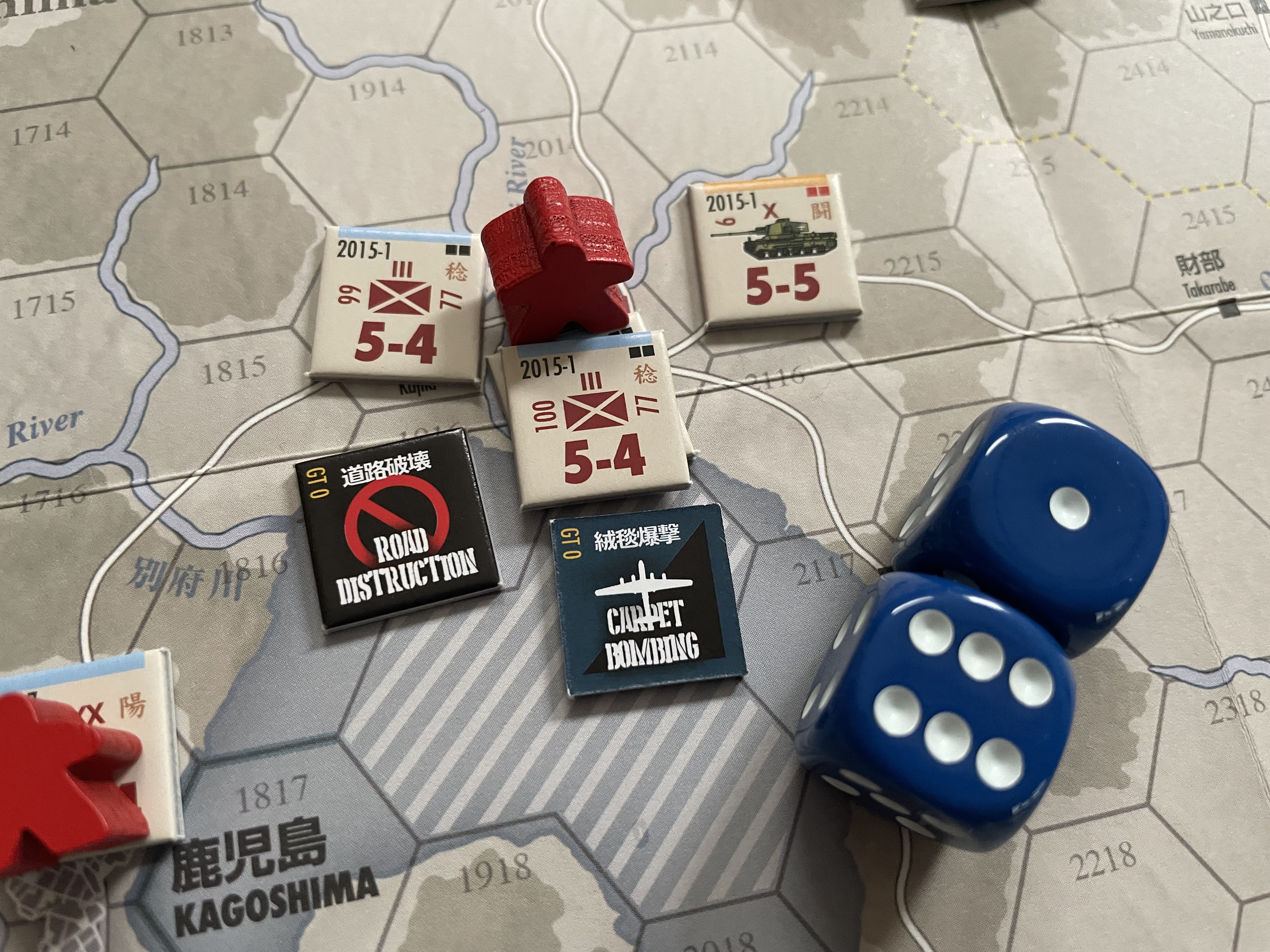
“Turn 0” represents the strategic phase of the invasion leading up to the landing of troops on beaches. In Turn 0, the American player has a chance to make Carpet Bombing attacks which can reduce Japanese units. The American player gets the chance of one Carpet Bombing attack on Turn 0 and a second later in the game on or after Turn 4 at the American player’s choice. On Turn 0 the American player also gets two road attacks that renders roads in the target and adjacent hexes unusable for the duration of the game (i.e. pay usual terrain cost without road movement benefit).
16.1.1 Atomic Bomb
In order to get to the invasion of the Japanese Home Islands, Kyüshü 1945 assumes and alternate timeline in which the U.S. did not employ atomic bombs in August 1945 as they did historically. Instead, rule 16.1.1 assumes that the first atomic weapons were not available until the invasion and are not “released” until the Americans suffer many casualties. Further, the atomic bomb (single one) is used for battlefield tactical effect vice strategic bombing. In game terms this means that once the U.S. side suffers 40 Casualty Points (step losses of units) the American player gets one (1) atomic bomb marker. When placed (“dropped”) the atomic bomb permanently destroys all enemy units in the target hex (cannot return as replacements) and renders roads in target hex impassable for the rest of the game.
16.1.2 Soviet Invasion of Hokkaido
This optional rule (which I highly encourage to use in play) for Kyüshü 1945 postulates the Soviets enter the war sometime after turn 5 (of 12 possible). The game effect is that the Japanese player loses Replacement Points and “Tokko” attacks—Kamikaze units that threaten American combat units, Offensive Markers (representing staging of supplies or support), and Naval Support markers.
16.1.3 Port of Kagoshima
The port of Kagoshima is a major objective of the American player in Kyüshü 1945. If Kagoshima port is seized by the American player, they earn an extra Offensive Marker each game turn. This represents the improved supply flow possible from that seized port.
16.1.4 Emperor’s Speech
The Japanese player in Kyüshü 1945 can try to bolster morale with an Emperor’s Speech. Although the chances of triggering the event are low (roll a [6] on a d6), if the Emperor speaks the Japanese player gets a combat and recruitment bonus on that turn. The Emperor’s Speech is a one-time effect with any earned bonuses only playable on the turn of the speech.
16.2 End of Game/Turn
Although the campaign scenario of Kyüshü 1945 is 12 turns, starting at the end of turn 10 there is a chance the game ends early. This creates a bit of an unknown factor for players who very likely will need those final turns to assure their victory.
16.3 Victory Conditions
In every campaign game of Kyüshü 1945 the U.S. player semi-randomly determines their victory conditions by rolling a single d6 against a table of five possible results:
- On a roll of [1] the American player must conquer and hold ALL five (5) cities south of the Final Line of Advance.
- On a roll of [2] the American player must conquer and hold at least nine (9) of the ten (10) Cities and Towns south of the Maximum Line of Advance and hold one or more of the four City and Towns north of the Maximum Line of Advance (making it not-so-maximal, eh?).
- On a roll of [3] the American player wins if there are no Japanese units more than two (2) hexes south of the MaximumLine of Advance.
- On a roll of [4] that American player wins if there are as many or more steps of American units north of the Maximum Line of Advance as there are Japanese steps south of that line.
- On a roll of [5] or [6] the American player chooses one of the other victory conditions.
The American victory condition is shown on a chit that is kept secret (face down) from the Japanese player and revealed at the end of the game. The American player wins a Major Victory if they reach their victory condition at least one turn before the end of the game. If the American player reaches their victory condition on the last turn it is a Minor Victory.
The Japanese player in Kyüshü 1945 wins a Major Victory—and an automatic win—if they can inflict 60 or more steps of casualties on the American player. If the Japanese player does not inflict at least 60 casualties but prevents the U.S. from reaching their victory condition it is a Minor Victory.
Events
Every turn in Kyüshü 1945 gives a chance of random events that can add/lose various points (Sabotage/Ammo shortage for both that reduces Headquarters support, Guerrillas for the Japanese, Air Points for the Americans, and Replacement Points for both).
Olympic (re)written
Setting up Kyüshü 1945 is a relatively quick process thanks in great part to awesome Set-Up Cards and hex locations on Japanese counters. It also is not a table-hog; a complete game can easily fit on a 3’x3′ card table.

Victory Condition Draw
In my first game of Kyüshü 1945 I drew the #2 Victory Condition (hold at least nine (9) of the ten (10) Cities and Towns south of the Maximum Line of Advance and hold one or more of the four City and Towns north of the Maximum Line of Advance) for the Americans. I decided that the Japanese strategy was to defend the beaches from fortifications and aggressively once the Americans were ashore.

Strategic Campaign (Turn 0)
Upon setup of Kyüshü 1945 the village of Kokubu (hex 2015) is occupied by two brigades of the Japanese 77th Infantry Division. It also is a crossroads on the only real east-west road connection across Kyüshü that lies south of the Final Line of Advance. The village and the units in it were hit both by Carpet Bombing (one brigade with no damage and the second with 2-step losses and eliminated) and a Road Interdiction (marker placed). The second American Road Interdiction was placed in the town of Kobayashi (hex 2512). [Choosing placement of the Road Interdiction markers was tougher than I thought as I realized that the American player likely will also need those roads. Once interdicted, however, the hex is interdicted for both sides for the entire game.]

Initial Landings (Turn 1)
The first turn of Kyüshü 1945 is almost exclusively dedicated to two waves of landings. When American divisions land they do so against opposition (enemy on the beach) or unopposed. Either way the division headquaters is always “spent” (i.e. unable to lend Support) and there is a chance the American units will lose steps. Here is how the first wave of landings developed:
- I Corps (Town Car Beach) – Divisions went ashore unopposed but 186th/41st (Brigade/Division) lost a step.
- IX Corps (Station Wagon Beach) – The Americal and 1st Cavalry divisions went ashore unopposed yet 186/Americal lost a step. The landing of the 43rd Infantry Division into Shibushi (hex 2520) was opposed by the 198/86th Infantry. The bloody combat on the beach saw Americans lose two steps and the Japanese one step and withdraw.
- V Corps (Roadster Beach) – All U.S. Marine units made it ashore in good order without losses.
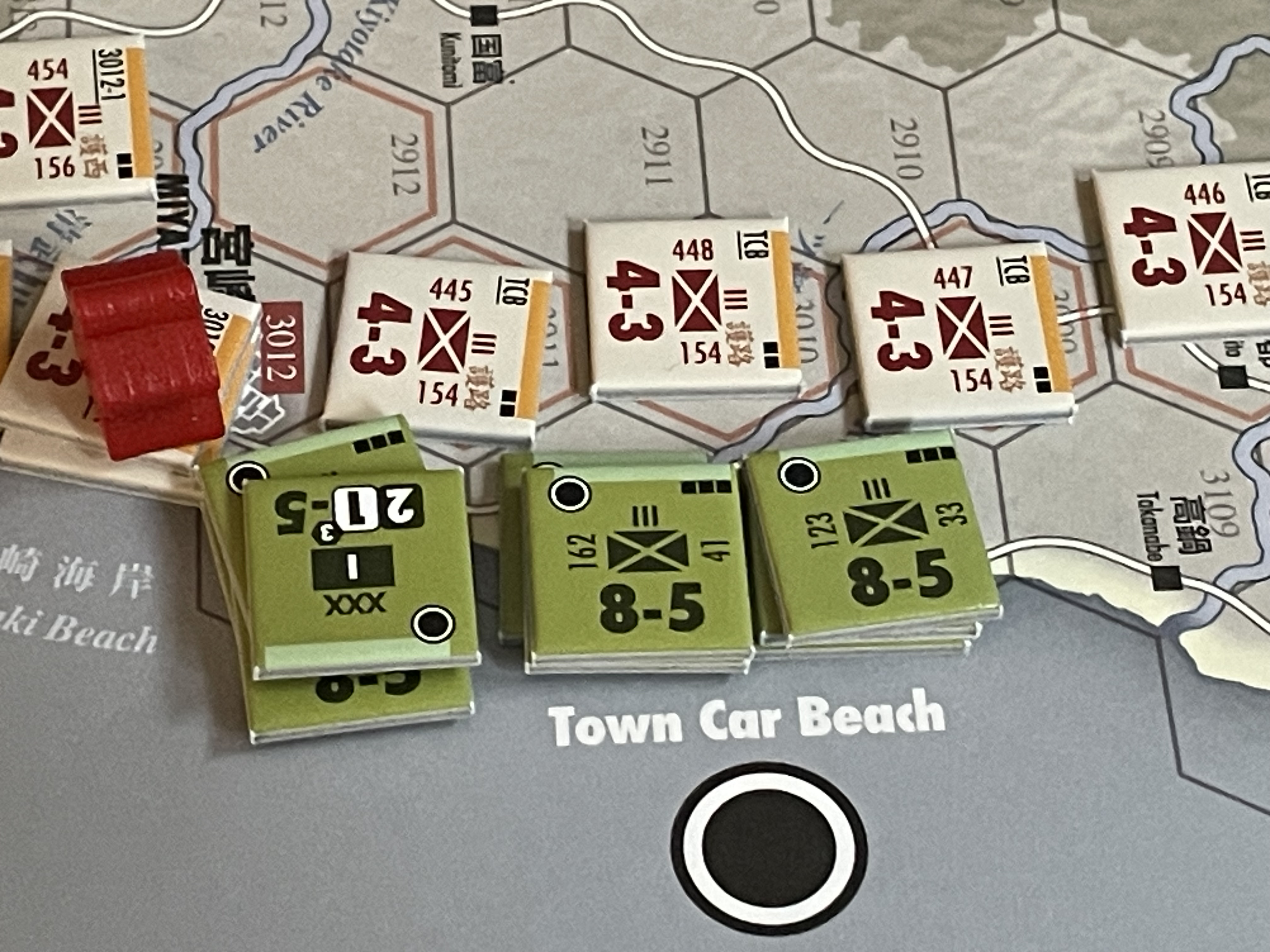
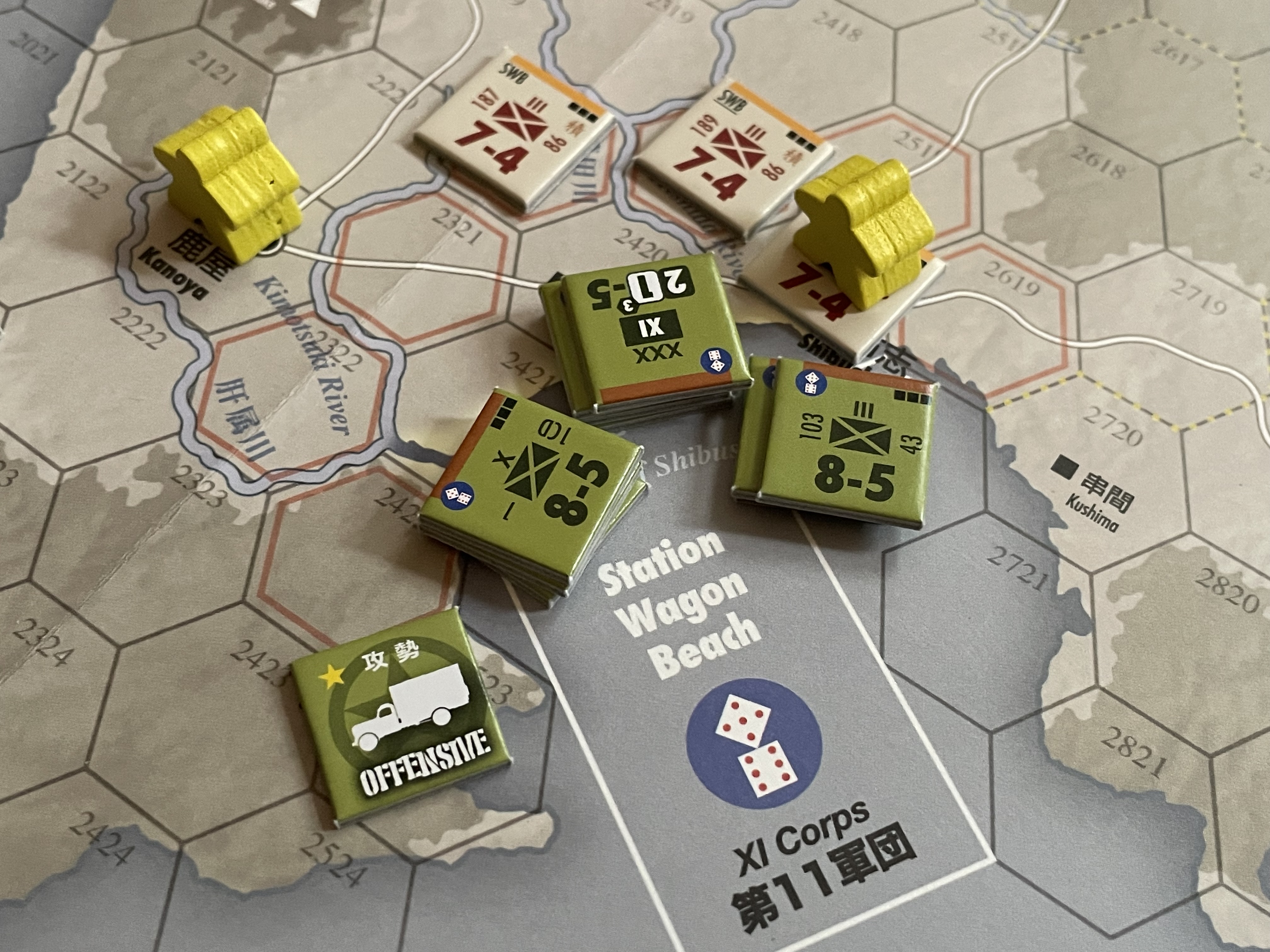
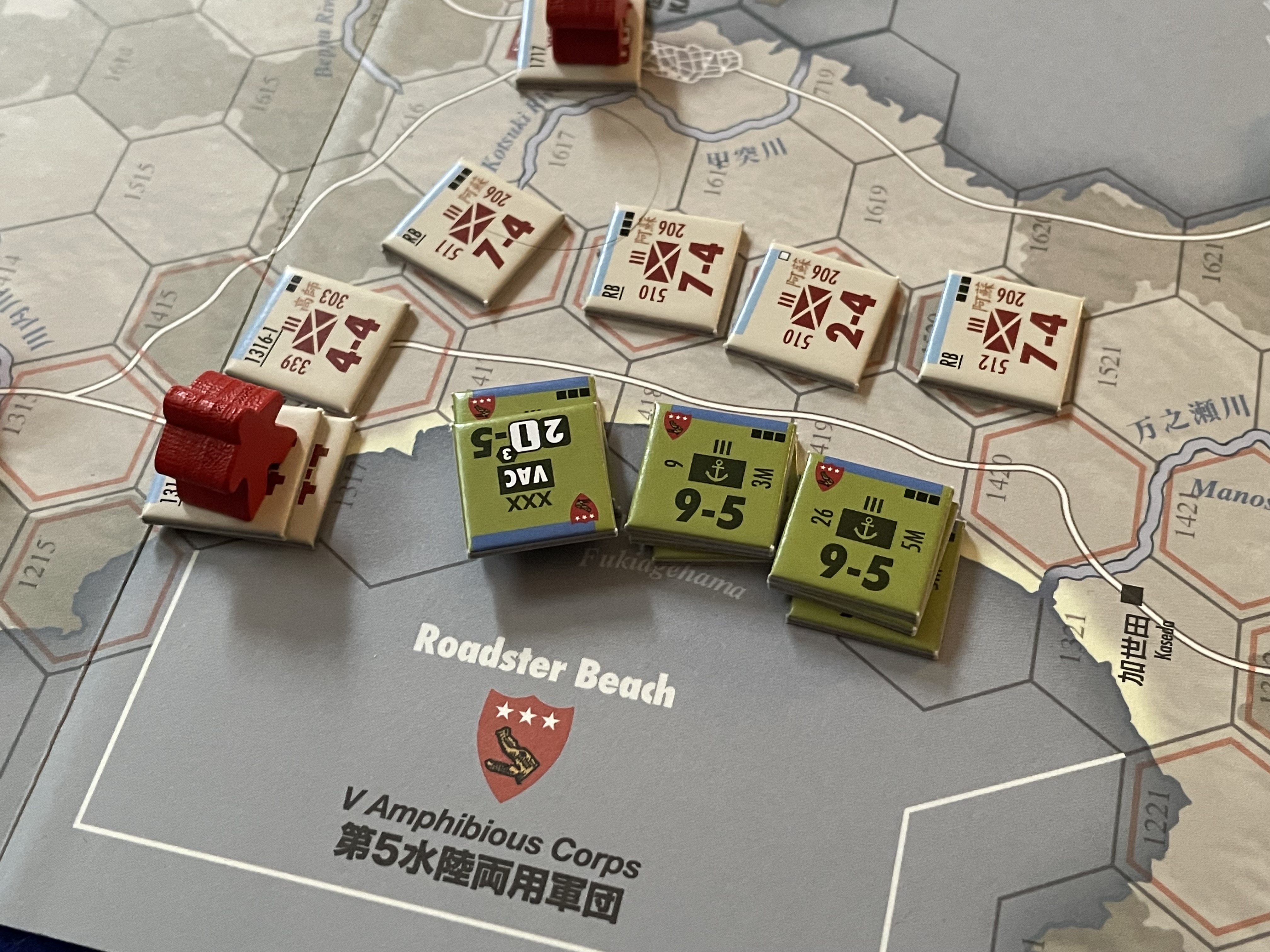
Following the first wave landing the Japanese player gets to move units not adjacent to U.S. forces and then initiate a round of combat. After facing unfavorable odds in attacking stacks of American divisions I realize that a better Japanese strategy is, perhaps, to sit in favorable defensive terrain and let the Americans attack. Many Japanese units already sit in fortified positions behinds the beaches; those fortified hexes by themselves give the Japanese defender a 3-Left column shift on the CRT. [Though combat is odds-based, it is important that either side use terrain or support points, be it from a HQ or air or naval, to create column shifts.]
The Japanese attack is followed by a second assault wave by XI Corps against Limousine Beach; this unopposed landing suffers no step losses. After the Japanese gain but two steps of reinforcements the American player takes to the offensive and pushes the Japanese off their fortifications facing Roadster Beach (V Corps) in the west and Station Wagon Beach (XI Corps) to the southeast. At Town Car Beach (I Corps) the Americans (barely) push off the beach in the face of strong Japanese resistance.
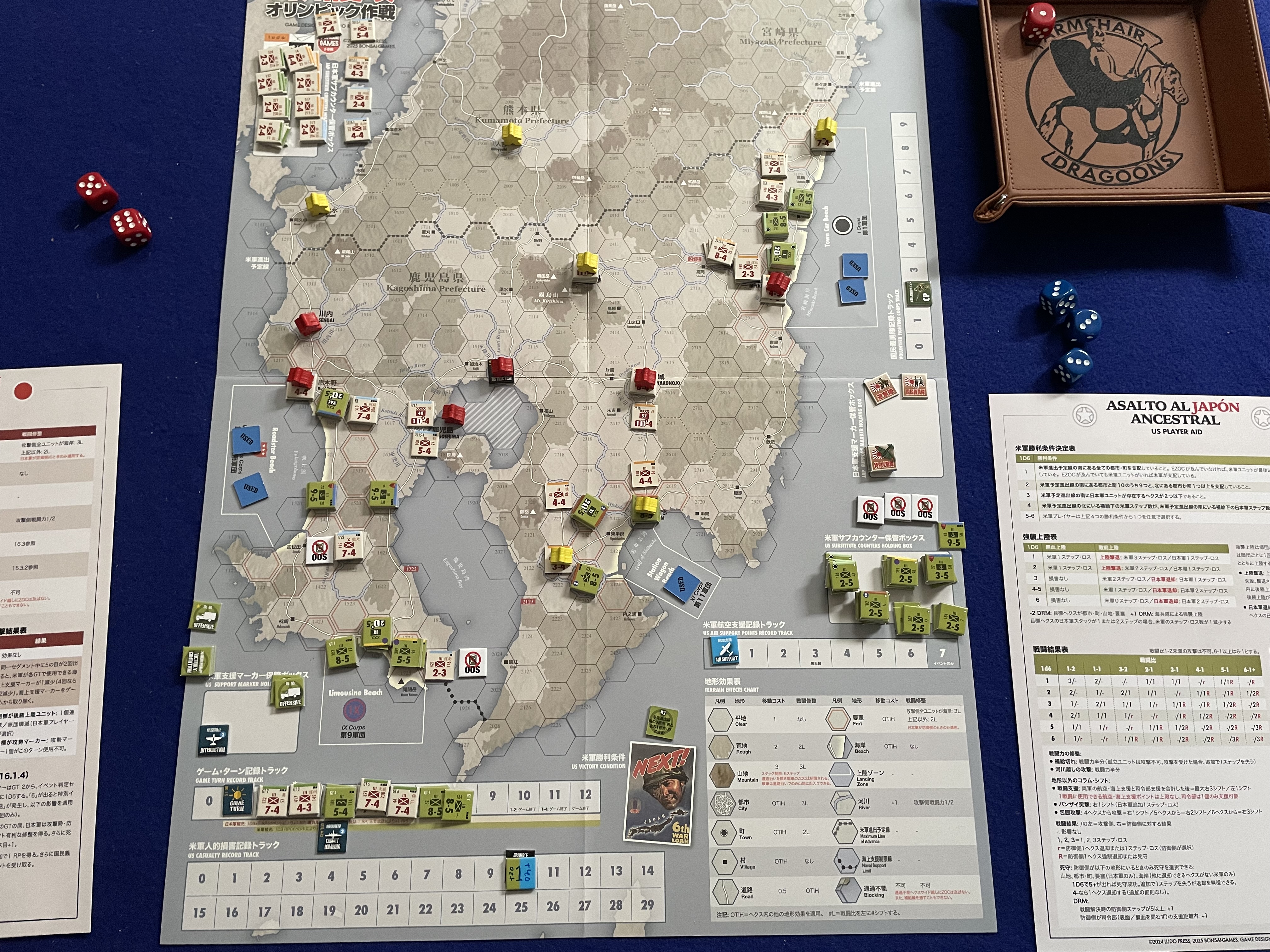
After the first week (i.e Turn 1) of Operation Olympic the Americans are firmly ashore as the Japanese scramble to create new defensive lines; the Japanese 146th Infantry Division with the 125th Infantry Brigade and 512/206 Infantry are cut off and Out of Supply.
[While the Americans are solidly ashore, the Casualty Track shows 10 step losses. Given the Japanese need 60 for an automatic victory, and this is but the end of turn one of 12 possible, the Americans can ill-afford to maintain this rate of losses. On the plus side—for the Americans—there is a possibility that as many as four of the 10 locations needed for victory may be secured over the next few days (game turn).]
Land Campaign (Turn 2 – ?)
Turn 2 of Kyüshü 1945 was clear weather. On the west coast, V and IX Corps were near linking up. To the southeast the Japanese were falling back on Miyakanojo (2516) in face of XI Corps. On the east coast the Americans took Miyazaki (3012) but still face strong Japanese opposition in the area. The U.S. held three Victory locations and now has 15 cumulative Casualty Points.

Turn 3 of Kyüshü 1945 was again clear weather—and a meat-grinder time for the Americans.
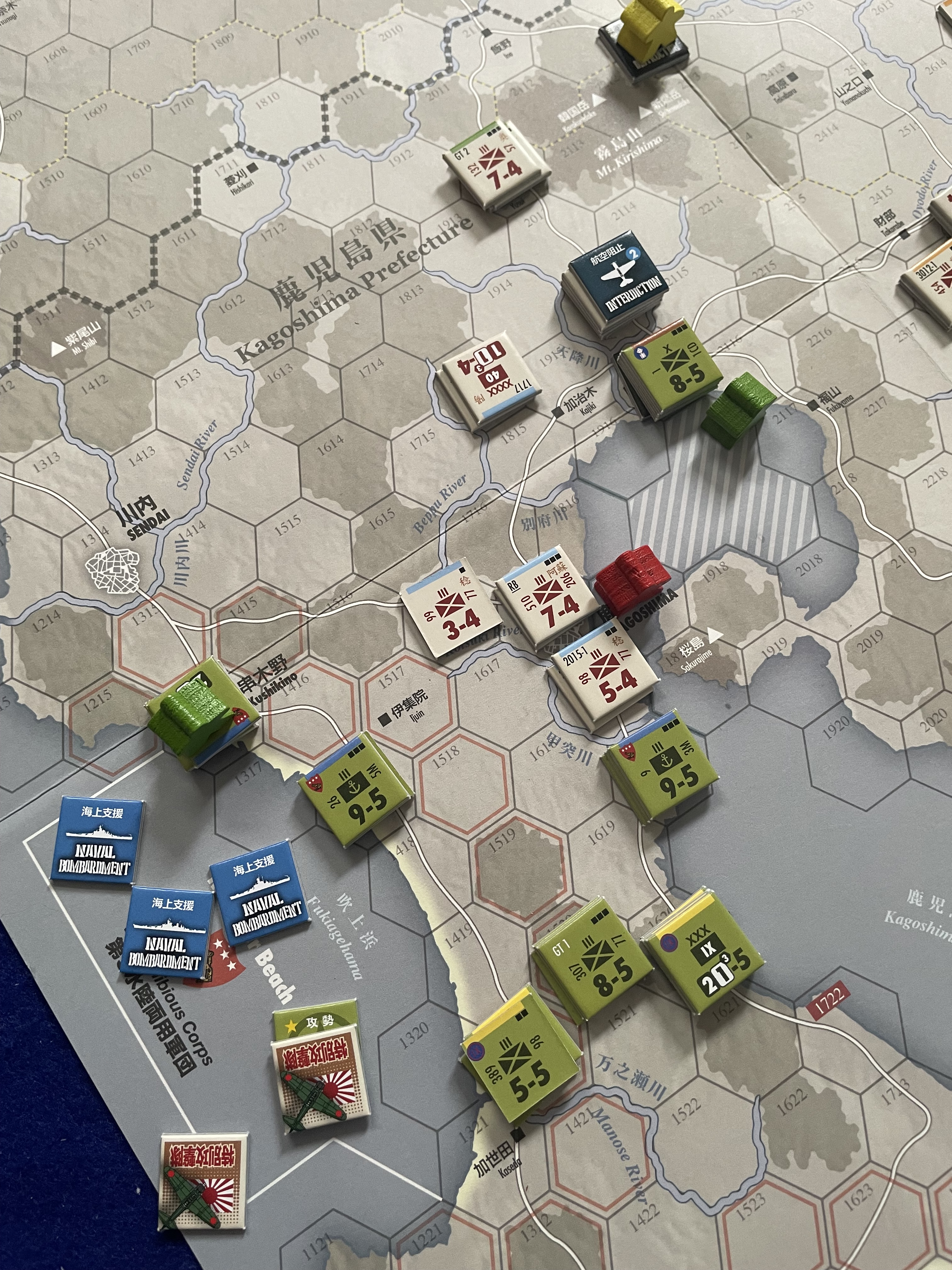


Turn 4 of Kyüshü 1945 was again clear weather. This turn saw a breakout from V Corps but the start of city sieges at Kagoshima by V and IX Corps and Miyakonojo by XI Corps; the Japanese are trying to take best advantage of defensible terrain such as Rough (2-Left CRT shift), Mountains (3-Left CRT shift), Rivers (Attacker at half-strength), and Cities (3-Left CRT shift). In the I Corps area, Japanese “Banzai Charges” pushed a severely reduced 41st Infantry Division back into the environs of Miyazaki. The Americans avoided major casualties (+1 Casualty Points) and now hold six (6) of ten (10) Victory locations south of the Maximum Line of Advance (they need to hold nine (9) and one (1) Victory location north of the Maximum Line of Advance (they need one for the Victory Condition).
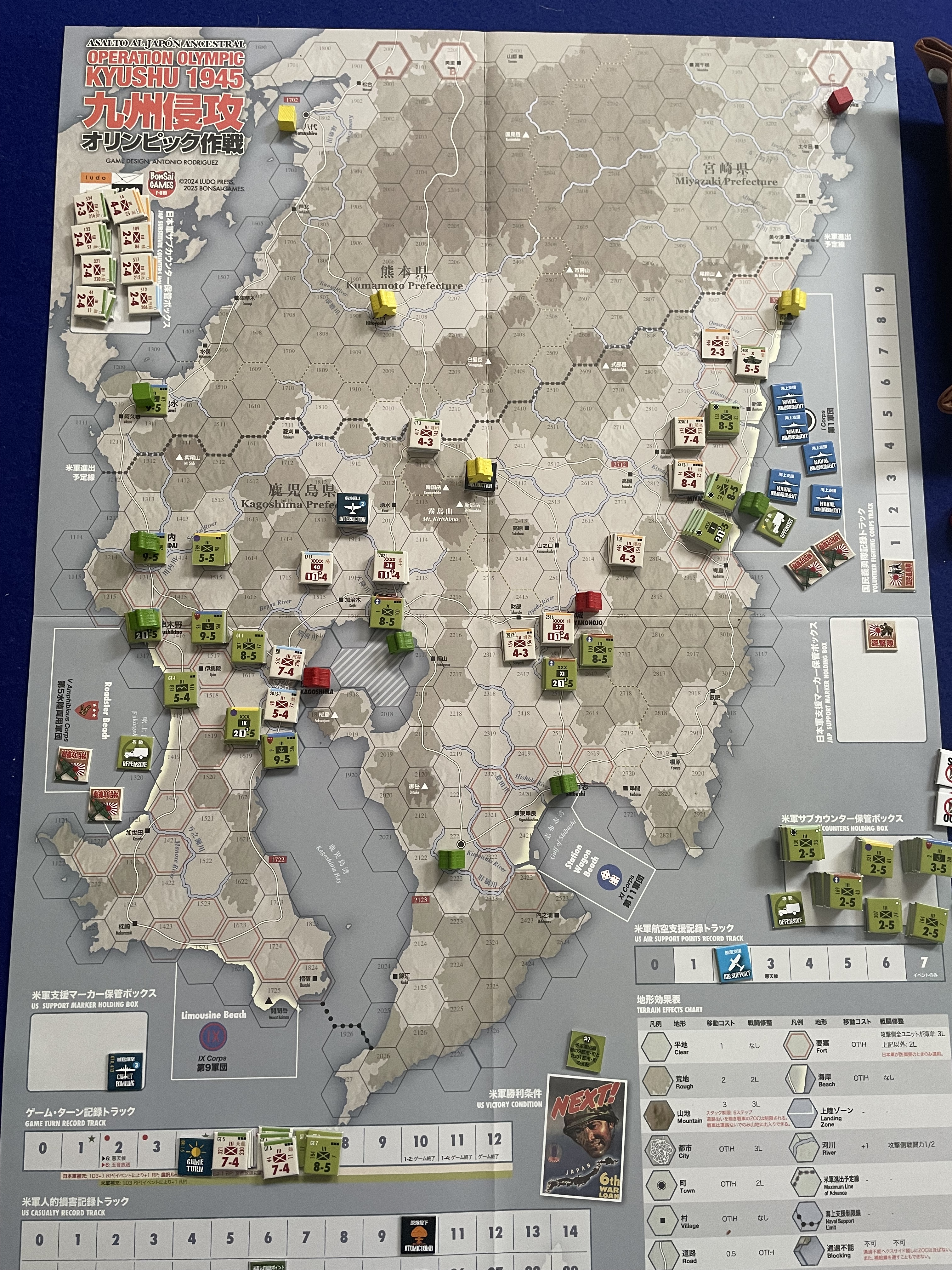
The weather in Turn 5 of Kyüshü 1945 was—for the first time—bad. This means the Americans only get half of their usual Air Support Points, there are no Offensive markers available (there are no Japanese “Tokko” attacks either), and no Air Interdiction or Carpet Bombing available. The poor weather led to limited activity this turn. V Corps built a front in preparation for an advance to the east while the Japanese reorganized to create their own front line to defend. Japanese reinforcements arrived around Miyakonojo and probed American defenses that held. In I Corps, the 25th Infantry Division assumed the defenses of Miyazaki and faced another Banzai attack. The Americans are now up to 24 Casualty Points and still hold the same Victory locations as before, though the hold on Miyazaki appears somewhat tenuous. The Americans are now up to 24 Casualty Points.

The skies cleared on Turn 6 of Kyüshü 1945 meaning American airpower could return. In the American segment of the turn the port of Kagoshima was (finally) secured; starting next turn the port can act as an American supply hex. The Japanese, perhaps recognizing that no more reinforcements are coming, start collapsing their defensive line to an area around Mount Kirishima near the Victory location and interdicted town of Kobayashi and across the Omaru River in front of Tsuno (3207 and another Victory town). There were few American casualties this turn which is now up to 26.
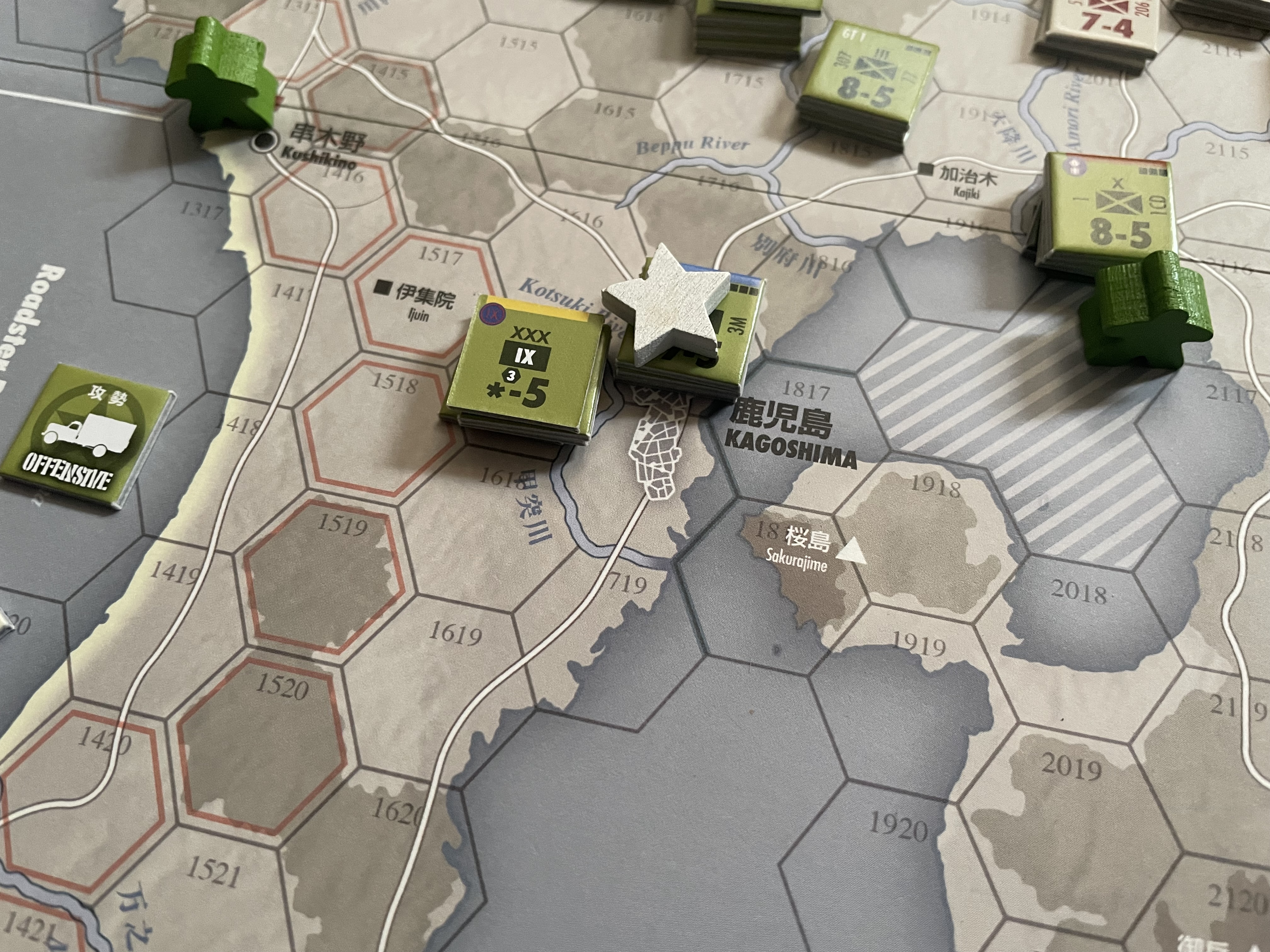


[As I progress through my first play of Kyüshü 1945 I already have learned much and it reflects in the change in Japanese strategy. While the Americans bring plenty of firepower, better Headquarters, the ability to undertake Offensives, and air/naval support the Japanese are not helpless. Indeed, the defensive nature of the terrain often can more than offset American advantages. The prospect of forcing the Americans to fight in Rough, or even Mountain terrain with a two- or three-column shift on the CRT in favor of the defender is powerful. Forcing the Americans to attack across a river with half combat strength is also dangerous—for the Americans.]
Turn 7 of Kyüshü 1945 was Bad Weather. Most importantly for the Americans this meant that the arrival of the 7th Infantry Division was delayed. The Japanese continued to consolidate their defense around Mount Kirishima. American Casualty Points = 26.
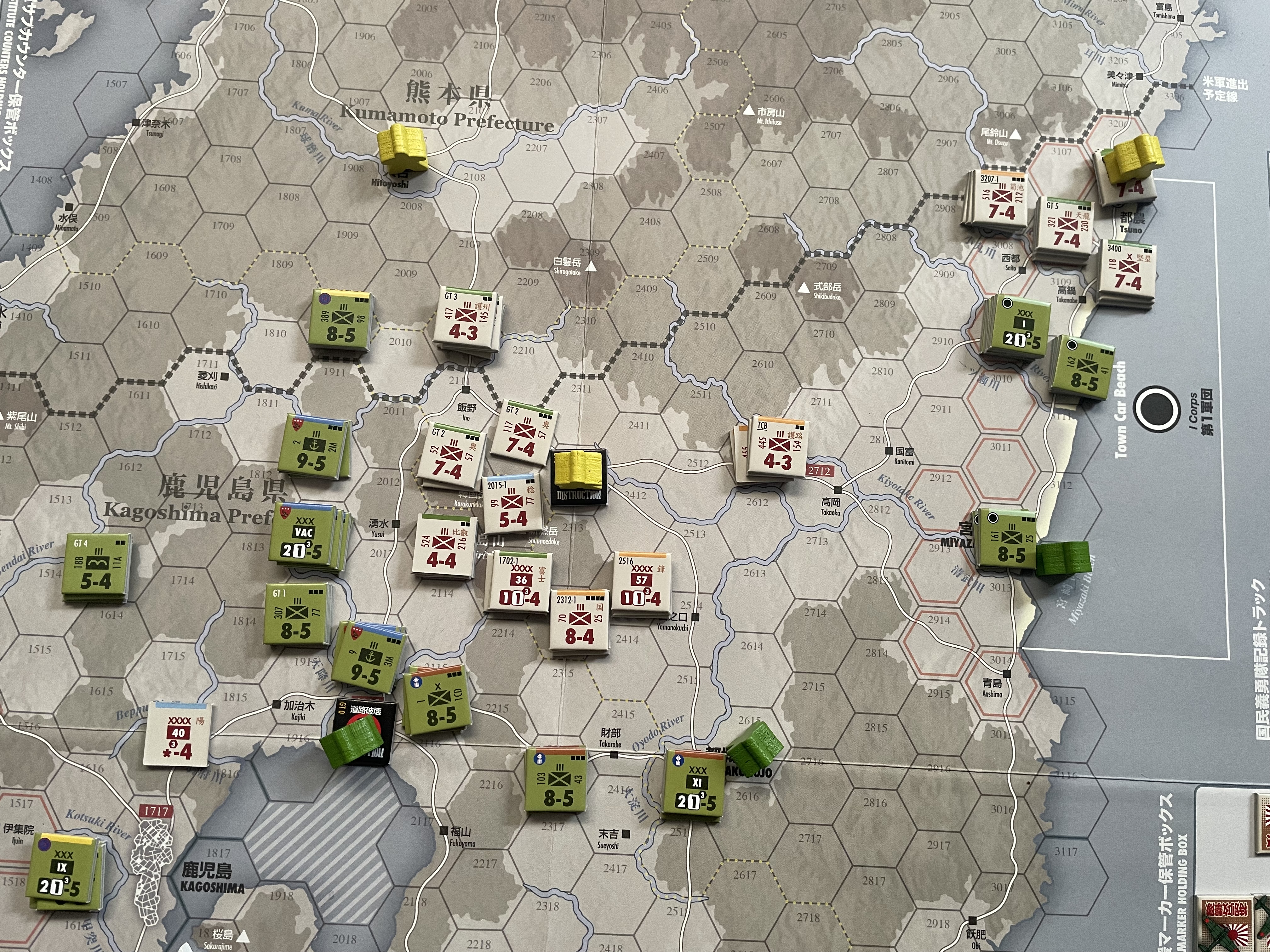
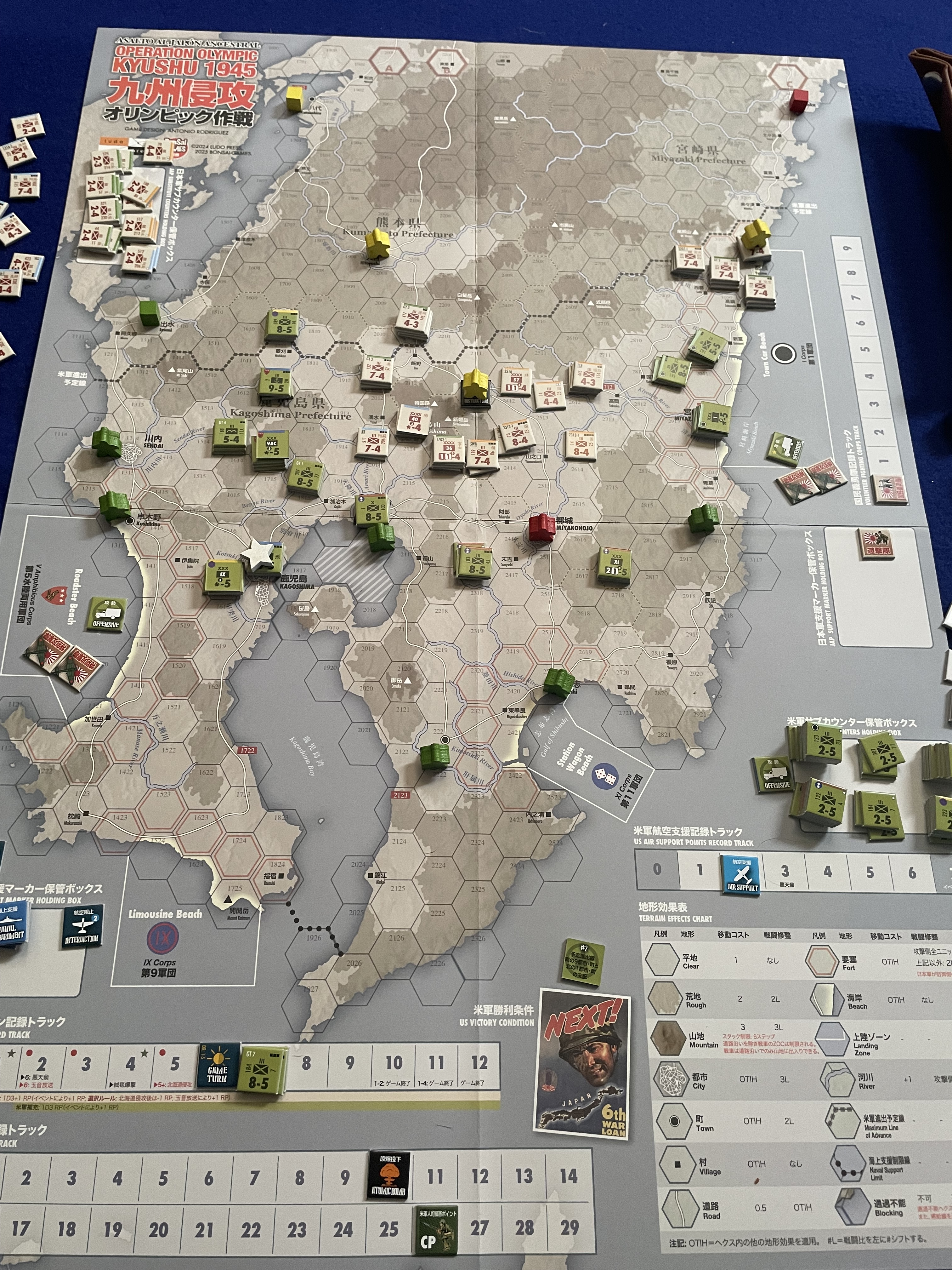
Kyüshü 1945 Turn 8 – Bad Weather limits operations. The arrival of the American 7th Infantry Division—urgently needed by I Corps—is again delayed.

Turn 9 of Kyüshü 1945 sees the return of good weather meaning the 7th Infantry Division will arrive in an administrative landing. Unfortunately, the Soviets enter the war (Optional Rule 16.1.2) which takes away half of the Japanese “Tokko” attacks. In the Events Phase, the Japanese get “Guerrillas” which they place on V Corps Headquarters and the Americans roll “Sabotage” which allows the Japanese to expend XI Corps Headquarters—any American offensive this turn will be limited. In a change of tactics, the Japanese “Tokko” attacks go after the arriving 7th Infantry and prevent an entire Regiment (3 Strength Points = 3 Casualty Points) from coming ashore. In the combat phases, the Americans cross the Omaru River but at cost, a Japanese Banzai attack pushes back the IX Corps Headquarters, and lower-odds attacks by the Americans wear away the Japanese who nonetheless hold a strong position around Mount Kirishima. American casualties trend significantly upward this turn with a new total of 41. The Joint Chiefs communicate that a new Atomic Bomb is ready and MacArthur’s staff starts looking for a suitable target…

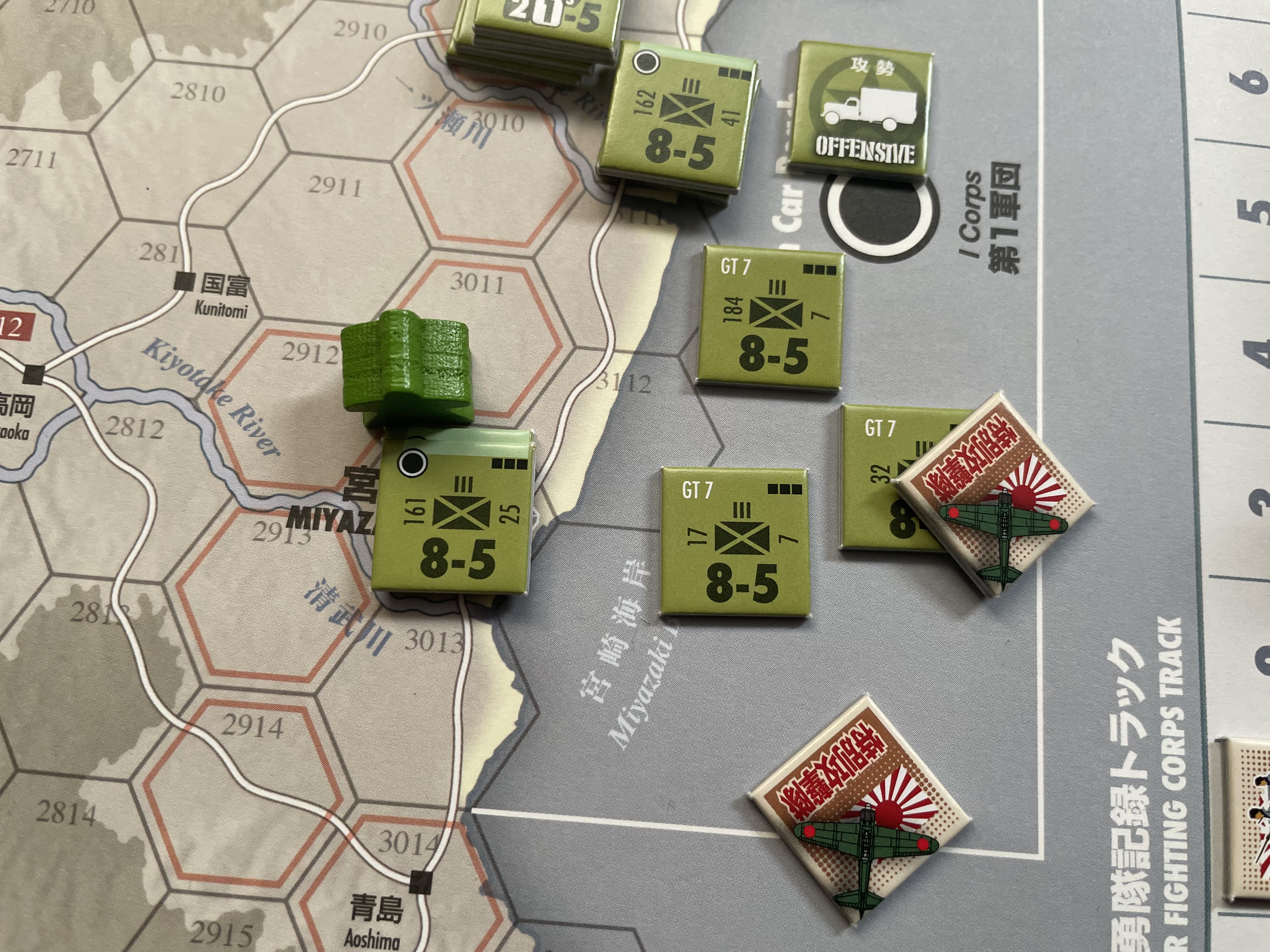
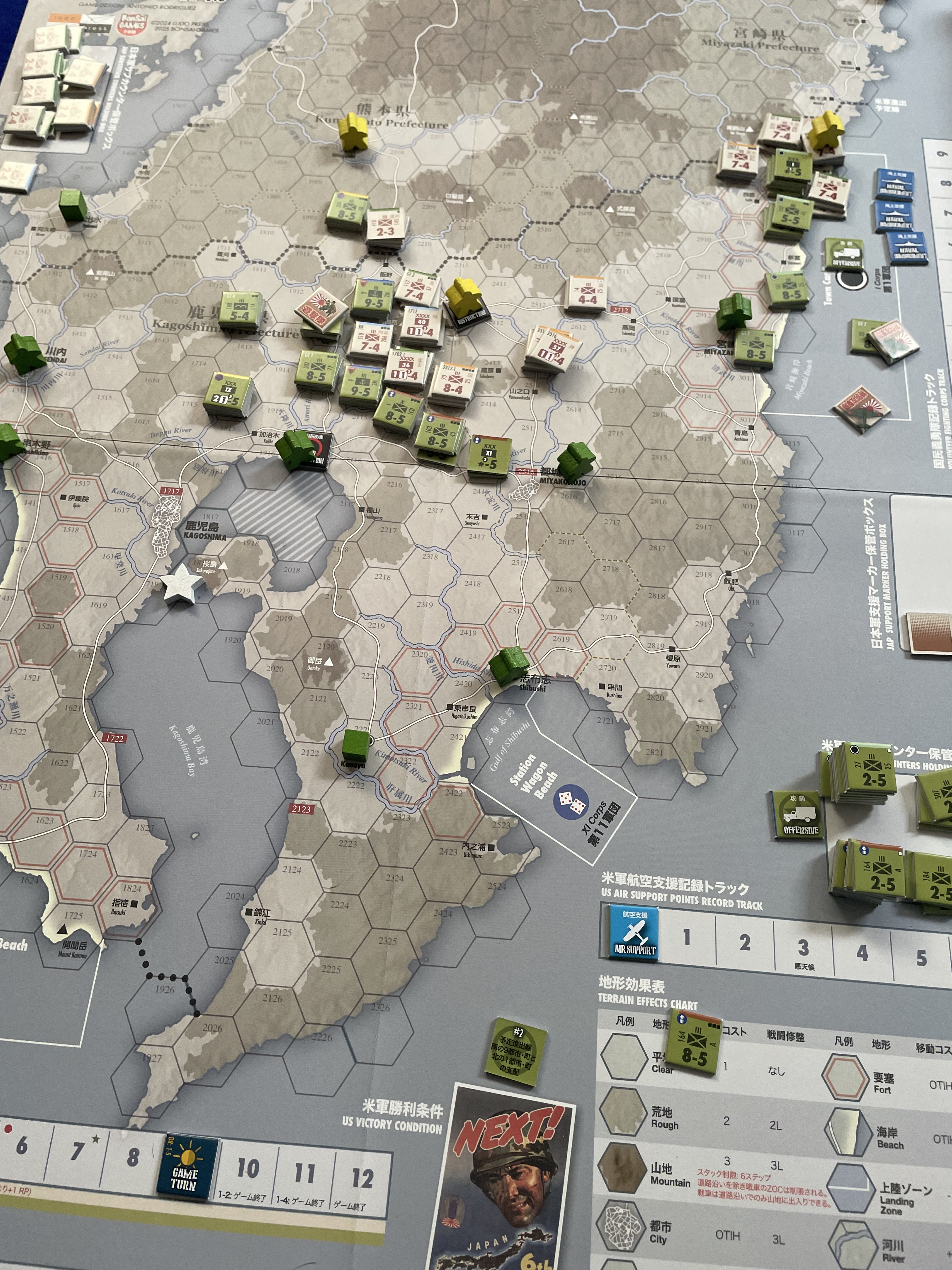
With time running out—and good weather—the Americans push hard in Turn 10 of Kyüshü 1945. Or at least they tried. With Kagoshima Port in hand the Americans earned a third Offensive chit. Unfortunately for the Americans, the Offensive designated to support the I Corps Headquarters was stopped by a Japanese “Tokko” attack. In the Mount Kirishima area the battling was slow as the Americans tried to push the Japanese off the mountain; even efforts to go around them are stymied by Zones of Control or other units sitting in defensible terrain. Along the Omaru River facing I Corps, two regiments of the American 25th Infantry Division with one regiment of the 41st Infantry Division attacked Japanese defenders in Tsuno. Taking Tsuno would be the final Victory location needed. The attack goes in with extensive off-shore Naval Support and…fails to dislodge the Japanese.

Endgame
With the end of Turn 10 of Kyüshü 1945, and in accordance with Optional Rule 16.2 for Soviet entry, a roll is made for end of the game. A roll of [2] sees the game end. The final result: The Americans hold eight (8) of nine (9) Victory locations south of the Maximum Line of Advance and one (1) location North—and thus does not satisfy their Victory Condition. With the Americans failing to achieve their Victory Condition but suffering 49 Casualty Points the final result is a Japanese Minor Victory.

Post-game analysis

The American invasion of Kyüshü—Operation Olympic—in November 1945 was unarguably both a strategic and tactical failure. On the strategic level, the slow advance of American troops—and the valiant defense by the Japanese at Mt. Kirishima and along the Omaru River and Tsuno—gave time for the Soviet Union to enter the war (the much delayed August Storm) which only served to strengthen Stalin’s hand at the Armistice negotiations. Tactically, a fear of high casualties like that at Okinawa or Iwo Jima made American commanders timid; attacks could only be made when success was assured. In the later stages of the campaign American commanders accepted greater casualties but, at that point, American public opinion weighed in and brought the campaign to an early end.
For the U.S. Army the aftermath of Operation Olympic was devastating. The U.S. I Corps commander Major General Innis P. Swift—already the oldest Corps commander in the Army—was quietly retired. Even his long friendship with the Supreme Allied Commander, General Douglas MacArthur, could not save him from the extensive criticism of I Corps’ failure to ever move more than 18 miles inland. The sleepy coastal hamlet of Tsuno was supposed to be taken no later than X+10 yet the Japanese held it at the end of the campaign over 50 days later.
At Mount Kirishima the nightmares of American planners was on full display. Much like they did at Iwo Jima, the Japanese defenders dug into a mountain and rooting them out was a costly affair in terms of both time and casualties.
Other critics of Operation Olympic accuse MacArthur of “criminal misuse” of the 11th Airborne Division. In the Philippines this unit destroyed multiple enemy divisions in the jungles of Leyte and later coordinated airborne and amphibious assaults to seize key terrain during the allied assault on Luzon. Most famously, the 11th Airborne Division liberated more than 2,000 civilians by raiding the internment camp at Los Banos, again synchronizing both airborne and amphibious operations. Critics of the Army—and MacArthur in particular—contend that the 11th Airborne should of dropped behind enemy lines as a type of blocking force. Supporters of MacArthur’s pedestrian use of 11th Airborne point to the lessons of Operation Market Garden at The Battle of Arnhem in September 1944—the infamous ‘Bridge too far’—and contend 11th Airborne was used in the only reasonable manner possible.
The Japanese defense of Kyüshü in November and December 1945, along with the Soviet entry into the Pacific War, was enough for the Allies to drop their ‘unconditional surrender’ demand from the Potsdam Conference. Although an Armistice was signed in early 1946, the division of the Japanese Islands ultimately led to the Honshu War of 1950-1953.
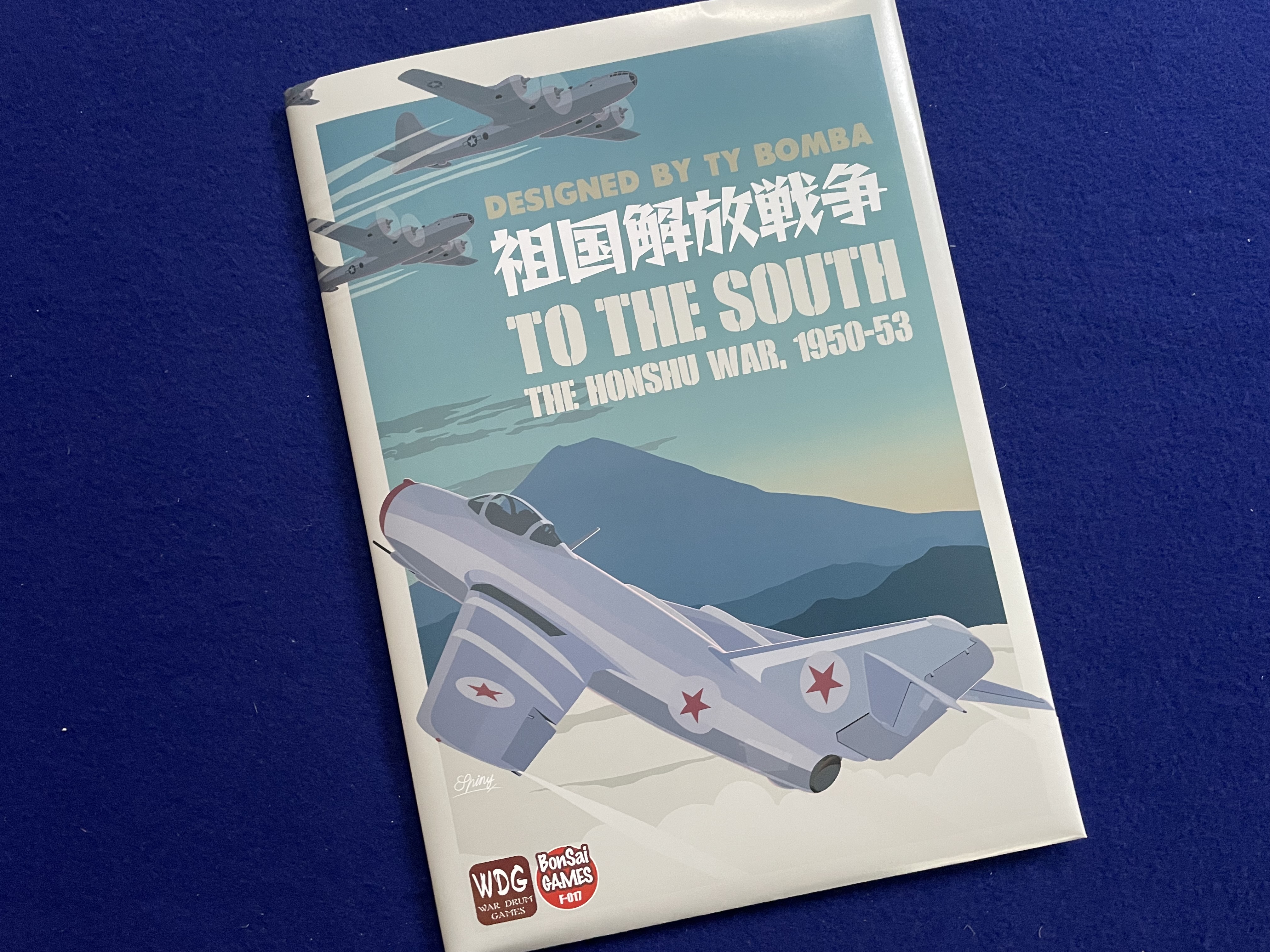
[ Honshu War of 1950-1953. As a result of World War II, Japan was divided into East and West—West Japan governed by the United States and East Japan by the Soviet Union. The “Republic of Japan” (ROJ) was established in West Japan, while the “Democratic People’s Republic of Japan” (DPRJ) was founded in North Japan. Both East and West Japan began their own distinct “postwar” paths. However, in 1950, North Japan (commonly referred to as “North Japan” rather than “East Japan” due to its capital being in Sakhalin) suddenly launched a military invasion of West Japan. Under the pretext of “protecting North Japan from imperialist aggression,” the “Soviet Volunteer Army” joined the conflict. In response, the United Nations forces, led primarily by the United States, intervened to defend the frontline of the “free world”.]
Most importantly, perhaps, was the American failure to use their Atomic Bomb. The failure to use the atomic bomb on the battlefield meant the Pentagon lacked empirical evidence of a bombs effect on the battlefield. Later calls to drop the Bomb strategically on cities were drowned out by those pushing for an Armistice. Regardless, the U.S. Army believes the next war will be fought on an atomic battlefield and is pushing ahead with the new Pentomic Army. It remains to be seen if that vision of the future will be a positive—or the darkest—legacy of the campaign in Kyüshü in late 1945.
‘An Olympic Failure,’ The Naval Association of the Rocky Mountains, November 1956



My play thru of Kyüshü 1945 was very much a learning game and was far from perfect. I am confident, however, that my errors in play did not significantly alter the outcome of the game. Most importantly, the story that developed in play felt organic—realistic if you will. In Kyüshü 1945 designer Antonio Rodriguez hits all the right wargame design and narrative beats in play.
If there is one part of Kyüshü 1945 that I am not totally enamored with it is the 11th Airborne Division. This three-unit division is composed of two parachute and one glider regiments. Though airborne units, they enter on a beach via an administrative landing on Turn 4. I understand that is the “historical” employment of the division but, in a wargame that is already alternate history, why not take advantage of the opportunity to “showcase” this unit? I understand that would require another rule for an airborne assault. That rule could be as simple as using two Air Support Points per Regiment dropped with landing results using the same (or slightly modified) table as the amphibious landings. To be clear, the absence of airborne landings in Kyüshü 1945 is not a game-breaker for me, I just see it as an opportunity missed.
Assault on Ancient Japan, Kyüshü 1945 is an excellent wargame. Though using classic wargame design inspirations, the mix of “old” game mechanisms with optional rules makes Kyüshü 1945 an easy-to-learn and quick-playing wargame—with plenty of replayability. Indeed, the “chrome” in the rules of Kyüshü 1945 help build narrative, not complexity. The real joy of Kyüshü 1945 is not the rules but the narrative that is built in play.
All for a wargamer’s enjoyment…even those that are ancient grognards like myself.
Feature image and all photos by RMN unless otherwise noted.
The opinions and views expressed in this blog are those of the author alone and are presented in a personal capacity. They do not necessarily represent the views of U.S. Navy or any other U.S. government Department, Service, Agency, Office, or employer.
RockyMountainNavy.com © 2007-2025 by Ian B is licensed under CC BY-SA 4.0
 Rocky Mountain Navy Gamer