
One often heard criticism of Seapower & The State actually has nothing to do with what the game represents but with how the game is played. Some critics of Seapower & The State complain that the game suffers from extreme bookkeeping requirements. Some go so far as to assert that the game is really not much more than an accounting exercise rather than a proper wargame.

The onerous accounting complaints regarding Seapower & The State are not without merit. Three game mechanisms in particular stand out for their bookkeeping requirements: assigning aircraft to missions, shipping route interdiction, and All-Out Nuclear War.
Air Missions
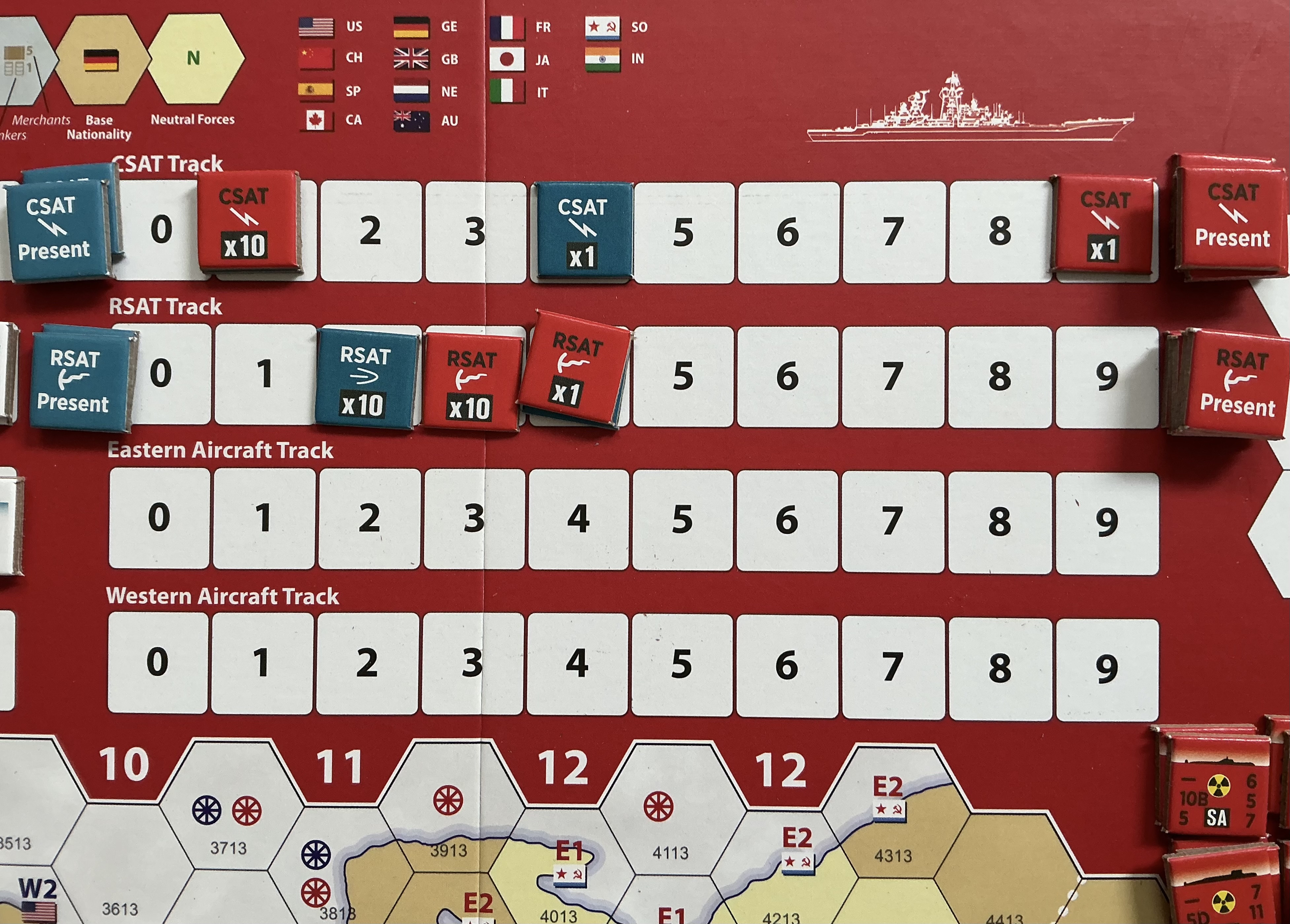
Both players in Seapower & The State use their individual Air Tracks player aid to keep track of the number of aircraft available to them. The Air Tracks player aid is an upgrade in the 2025 edition; in the 1982 edition each player had a single Air Track for each player on the map that was crowded with the many aircraft tally markers. [The 2025 edition retains those tracks on the map; I’ve heard of “faithful reproductions” but why?]
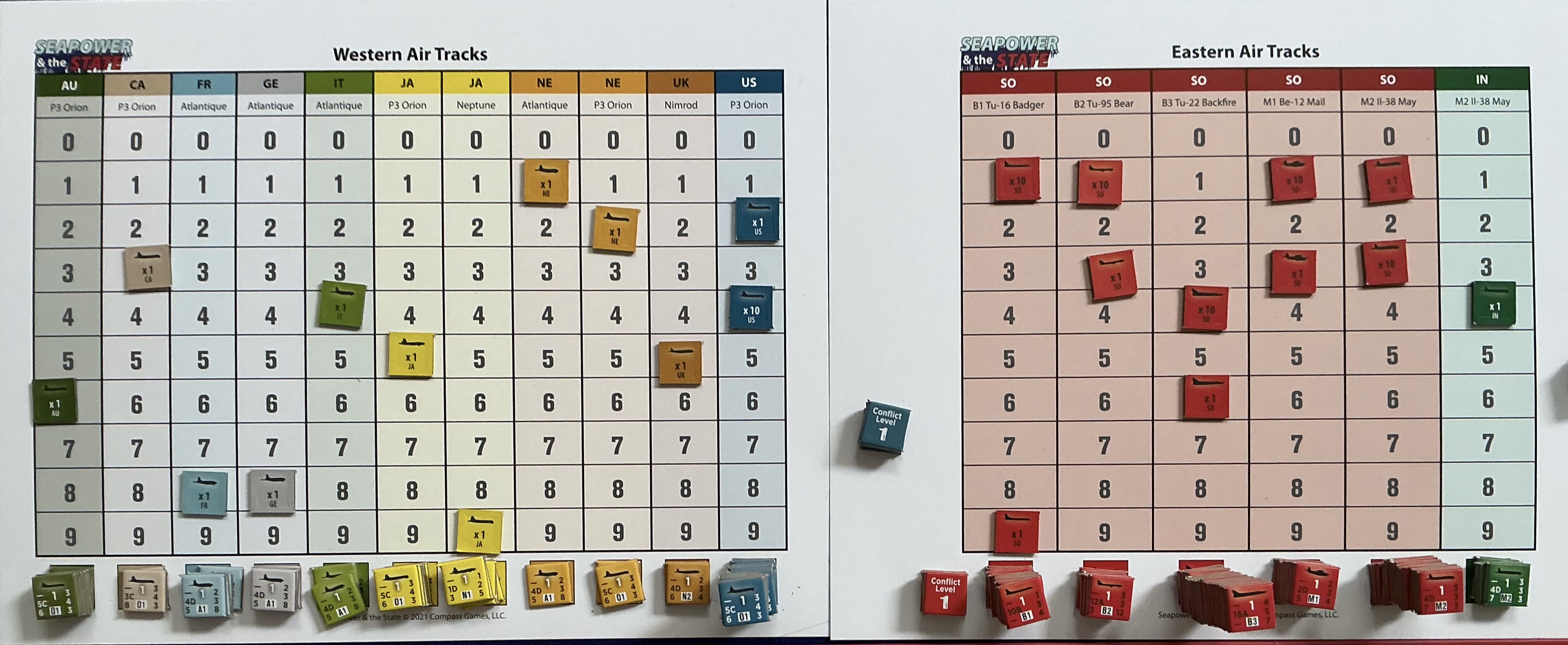
The real bookkeeping challenge, however, comes not from the number of aircraft units available but from assigning them missions. Using rule 6.4 Aircraft Procedure under 6.0 MOVEMENT SEGMENT, to assign aircraft the players, “simply makes a list of the numbers of each type of aircraft going from a particular base hex to a particular target hex.” This is far from a “simple” matter given the Eastern player has just under 50 base hexes and the Western player has just over 60 base hexes to choose from. When assigning aircraft the Class of the base hex must also be considered as, “Any number [of aircraft] may be assigned from a Class 1 base, up to 6 from a Class 2 base and up to 3 from a Class 3 base” (6.4 Aircraft Procedure). There is, however, no player aid or base listing provided to either player. The lack of a player aid demands the players to create their own.
Shipping Interdiction
The rules for scoring Victory Points on interdicted shipping lanes in Seapower & The State require some additional bookkeeping. The relevant rules are found in 16.11 Surface Ship & Submarine Interdiction, 16.12 Aircraft Interdiction, 16.13 Recording Shipping Losses, and 16.14 Routes Interdicted.
Scoring Losses
Per rule 17.2 Eastern Victory Points for Shipping, the Eastern player earns 1 Victory Point for each merchant or tanker lost during a turn of Seapower & The State. A shipping route is interdicted if ANY hex of the route is occupied by an Eastern ship or submarine; the presence of a Western unit along the route is not relevant. For each such route the Eastern player will, “Roll 1 die for each route containing Eastern units and multiply it times the number of Eastern occupied hexes on the route. The resulting number is the maximum number of merchants and/or tankers that have been lost on that route” (16.11 Surface Ship & Submarine Interdiction). For aircraft interdiction the Eastern player must consider how many B1, B2, or B3 type aircraft were not assigned strike missions in the Movement Segment (another bookkeeping requirement on top of the assigned missions—or maybe another column on a player aid to track this number) and then, “Total the number of unassigned aircraft of these types and divide the number by 2 (dropping fractions). The result is the total number of merchants and/or tankers lost to aircraft that turn” (16.12 Aircraft Interdiction). The Eastern player assigns these loses to any shipping route where less than half the hexes are interdicted by ships or submarines. The Eastern player must also take attrition losses to their interdicting aircraft—a flat 10% rate (see 16.13 Recording Shipping Losses).
Tracking Losses
Tracking losses is, “done by moving the quantity markers on the appropriate Merchant and/or Tanker track to indicate the new number of each type still available. It is not possible for a route to take more losses in either shipping category than is indicated as its maximum number in that category [found on the map]” (16.13 Recording Shipping Losses).
Routes Interdicted
“A route is considered interdicted if the total interdiction losses for the route that turn subtracted from the total merchant and tanker maximums for that route gives a result of less than 4. Interdicted routes should be noted” (16.14 Routes Interdicted).

The final note in 16.14 that “routes should be noted” sums up the bookkeeping issues for aircraft and shipping lanes in Seapower & The State. Stated bluntly, Compass Games missed an opportunity to facilitate bookkeeping with the addition of new player aids to assist in assigning air missions as well as scoring and tracking shipping losses and shipping routes interdicted. Yes, the Air Tracks player aid was added, but instead of replacing the now unused Eastern and Western Air Track spaces on the game board with Eastern or Western Victory Points the space goes unused. Three other player aid cards are needed, for each player a Base Hex listing with 10 columns for game turns and another column to denote status (damaged per rule 5.34 Level 4, captured or inoperative per rule 16.2 Bases Captured & Inoperative). The third player aid card would be for tracking shipping routes, perhaps a laminated card where players can annotate routes open or interdicted.
“It’s the end of the world as we know it…”
The last criticism of Seapower & The State is also the last game action for players should it occur. If the game escalates into all-out nuclear war, in the game called Conflict Level 5: Strategic Nuclear Weapons Combat, the game effectively ends with a scoring round. As rule 5.35 Level 5 specifies:
All operations for the turn are not allowed. Play moves immediately to the Level 5 Conflict portion of the Victory Points Segment in the End Turn Phase, skipping all other portions of the play sequence. The game ends at the conclusion of a Level 5 turn.
5.35 Level 5: Strategic Nuclear Weapons Combat
The first “accounting” that takes place in the Level 5 Conflict Resolution step is the subtraction of 150 Victory Points to the side that bid Level 5 Conflict (see 17.44 Escalation). Following the accounting of escalation victory points, Seapower & the State then admittedly becomes a real scoring drill—or an accounting exercise of you will. The key to scoring Victory Points is the number of ballistic missile submarines that are in position to deliver their cans of instant sunshine:
Both players must examine the positions of all their SB [Strategic Ballistic Missile] type units. The BM [Ballistic Missile] range is on the back of the SB unit counters and may not be examined by the opposing player prior to a level 5 turn. The range represents the number of hexes distant the SB unit may attack a land target. Each land target hex is coded E or W as to the the player that controls the hex for the purposes of having targets in the hex (that the opposing player may attack with ballistic missiles). This range is counted inclusive of the target hex. Each player receives 2 victory points for each of their SB units with a BM range of 5 or more that are within range of the opposing target hex.
A neutral nation that has not entered the conflict but has target hexes still has these hexes counted as targets. Target hexes containing Western bases that were captured during the game cease to be considered target hexes for either player. Target hexes containing Western bases that have become inoperative due to interdiction remain as targets for the Eastern player. After totaling points earned by each player for SB units in range, each player must subtract from their total 10 points for each opposing target hex that did not have at least one SB type units in range to attack that target (regardless of the BM range of the SB unit). In addition 1 point is subtracted for each SB unit that was in range to attack but not within 14 hexes of a friendly CSAT [Communications Satellite] present marker.
17.6 Level 5 Conflict
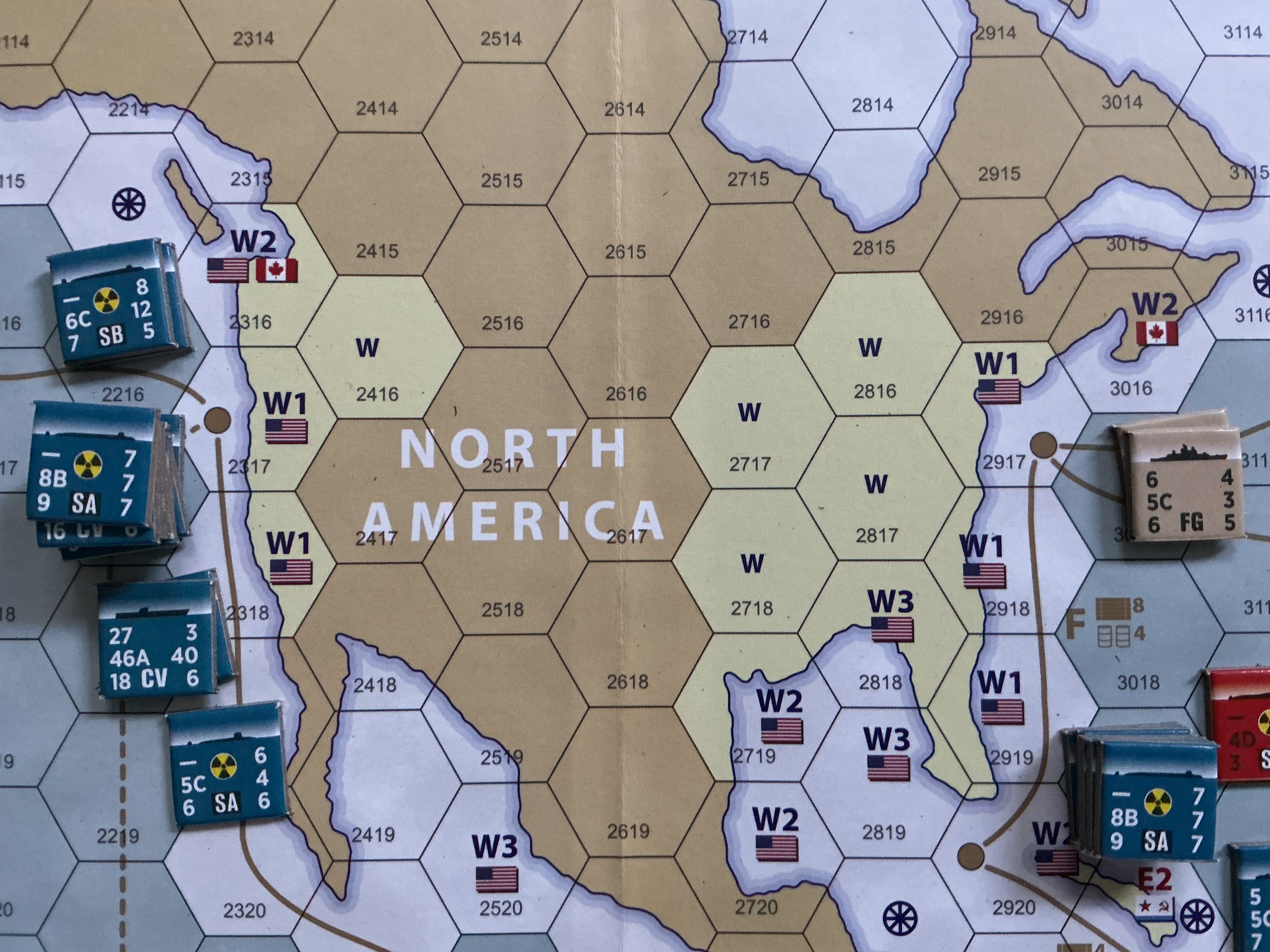
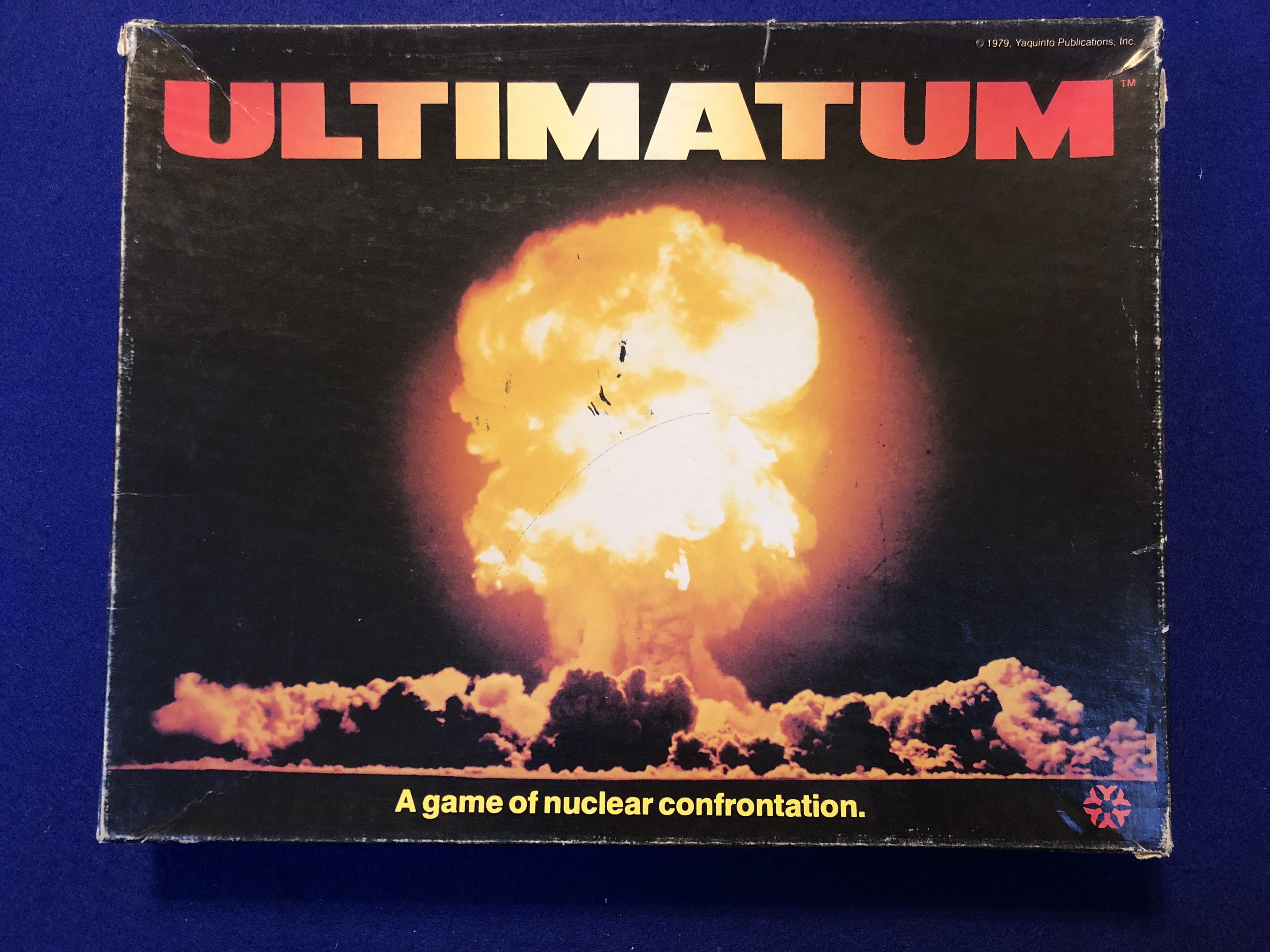
As with tracking aircraft and shipping losses in Seapower & The State, keeping track of target hexes cries out for a player aid. A more relevant question, however, is asking what is the point of Level 5 Conflict in the game. Does counting Victory Points really mean anything in a (game) world that has glowing landscaping and mushroom clouds across the horizon? I wonder if Newberg was channeling thoughts generated by another nuclear conflict wargame for I am reminded of the Designer’s Notes in Ultimatum: A Game of Nuclear Confrontation by J. Michael Hemphill from Yaquinto Publications in 1979:
There is one final note to be made on the design on this game. Several hours were spent attempting to give the players some reason (moral, love of fellow man, nationalism) for avoiding nuclear war. The destruction of a nation of tens of millions of people weighs heavily on the minds of the leaders of both the Soviet Union and the United States. But in a game the players have no such weight balancing their decisions. It becomes an abstraction and the players easily forget what the game is simulating. More than any other game on the market, this can create problems in the simulation of reality.
Ultimatum, Designer’s Notes
The reality of Seapower & The State is that, should the game escalate to all-out nuclear war, one must question what reality it is simulating.
Shot out…Splash…Short!
I strongly empathize with players who criticize Seapower & The State as being bookkeeping heavy. As noted above, I lament the need to make additional player aids. I note that seveal of these potential player aids are found in the Files section of the Seapower & The State entry at BoardGameGeek. Some, but not all.
Many wargamers talk about the need for more “bling” in wargames. Here is where the grognard in me comes out. You see, I view the original 1982 edition of Seapower & The State as a product very much of its time. In 1982, Simulations Canada published games that quality-wise I call “semi-professional” desktop publishing. This is not intended as a knock on designer and then-publisher Stephen Newberg; he was working with what was economically feasible in those days. The end result was a wargame with a map, counters that appears, well, dull by today’s standards.
Fast forward to 2025 and we have Seapower & The State reprinted by a major wargame publisher. I believe it is acceptable to criticize the Compass Games decision to do what basically amounts to a straight up reprint with not much more than prettified graphics. Yes, several player aids were added (Air Tracks, Battle Board, Task Forces, Sequence of Play and Counter Guides) as well as a European Expansion Map (unfortunately labeled “EUROPEAN EXPANTION MAP”). What Compass Games did not do remove or (better yet) repurpose the on-board Air Tracks or add player aids for tracking air missions or shipping losses. How much would five more player aids cost?
I strongly feel that, with the right player aids, the “onerous” bookkeeping requirements that many critics of Seapower & The State offer up is not actually that onerous. With a good air mission planning player aid the assignment of aircraft is expedited and play speeds up. With a good shipping losses and route interdiction player aid the scoring process is sped up, not slowed down. As it stands at the moment, for players to realize those gains requires making efforts outside of those provided by the game components. In 1982 such requirements were understood; maybe not fully accepted but generally understood. In today’s wargame publishing world they are now expectations.
Feature image courtesy RMN
The opinions and views expressed in this blog are those of the author alone and are presented in a personal capacity. They do not necessarily represent the views of U.S. Navy or any other U.S. government Department, Service, Agency, Office, or employer.
RockyMountainNavy.com © 2007-2025 by Ian B is licensed under CC BY-SA 4.0
 Rocky Mountain Navy Gamer
Red Strike has the same monumental issue, with 100’s of aircraft on each side.
But the VUCA games developers decided to double down and allow up to THREE missions a turn…..Talk about paperwork, tracking fiascos, and overhead. At least this game appears to be a manageable size.
Wow…first time I think I ever heard somebody call Air Missions in Seapower & The State as “manageable.”