
What’s old is new again
Since 1982, the only Cold War strategic-level wargame I owned was Seapower & The State: A Strategic Study Simulation of World War Three at Sea, 1984-1994 designed by Stephen Newberg and published by Simulations Canada in 1982. I now have a second Cold War strategic-level wargame with the arrival of Seapower & The State: World War Three at Sea by designer Stephen Newberg from Compass Games in 2025. Though Compass Games often gives designers a new ‘Signature Edition’ of their games the intent for the reprint of Seapower & The State was a bit more limited. As the Compass Games website noted, “Designed & developed by Stephen Newberg, this substantially upgraded 2nd edition includes all of the aspects of the original with more components and all-new artwork. Although the new edition of Seapower & The State is not much more than a “prettified” version of the original I personally am happy with the product—though it does have a few production warts.

Bling out your red
Production-wise, the 1982 edition of Seapower & The State is perhaps best described as “semi-professional desktop publishing.” In many ways the simplicity of the components is what helped Seapower & The State work; from the small counters with the most simple of profile art and many numbers and an occasional symbol to the saddle-stapled, digest-sized rulebook with a cover of slightly heavier colored cardstock paper, and a game map using a small color palette.

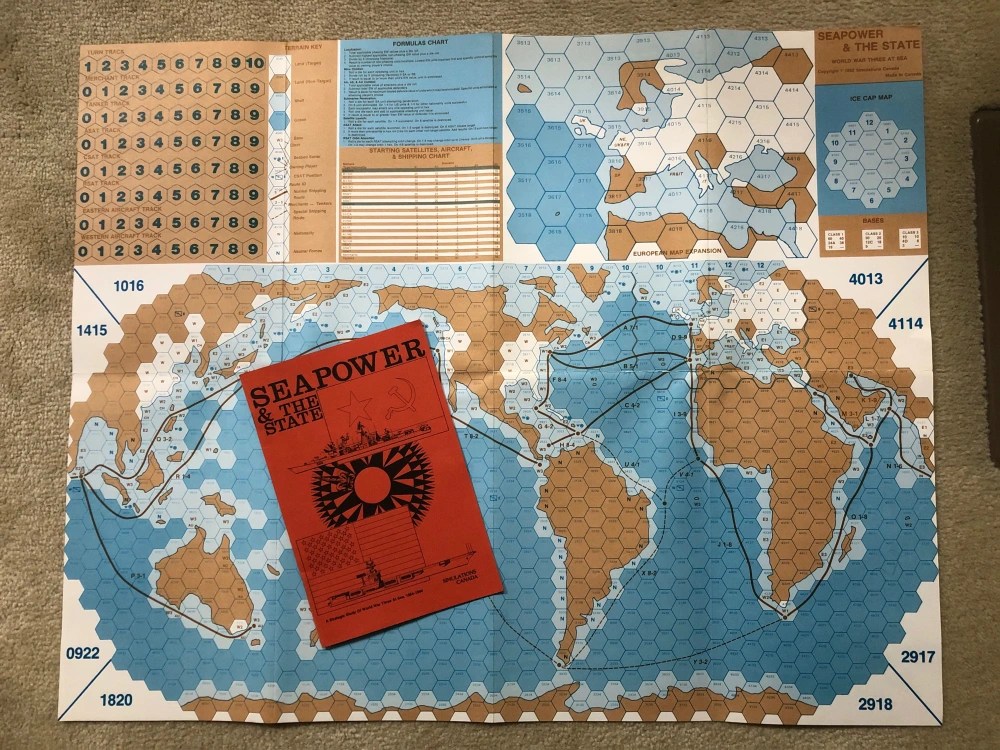
The 2025 Compass Games edition of Seapower & The State certainly has different components. The map is bigger and mounted with the European expansion map moved to a seperate board. New player aid cards for Task Forces and AirTracks are provided for both the Eastern and Western players. Two double-sided player aid cards give each player the Sequence of Play and a cheat sheet for reading counters. A Range Diagram Battle Board is also included along. Whereas I could easily fit the original edition on my home office 3’x4′ game table, the new edition basically takes up all the real estate forcing me to use the lesser-travelled and fought over South America portion of the map for “game admin” activities.

[The biggest visual “oppsie” I found is the title of the European Map Expansion which is labeled, “EUROPEAN MAP EXPANTION.”]
The counters in the new edition of Seapower & The State retain the same small, data-dense, 1/2″ format but with a bit more color. Unfortunately, final checks and counter layout apparently encountered some difficulty as Compass Games provided a Countersheet 3 with replacement counters.
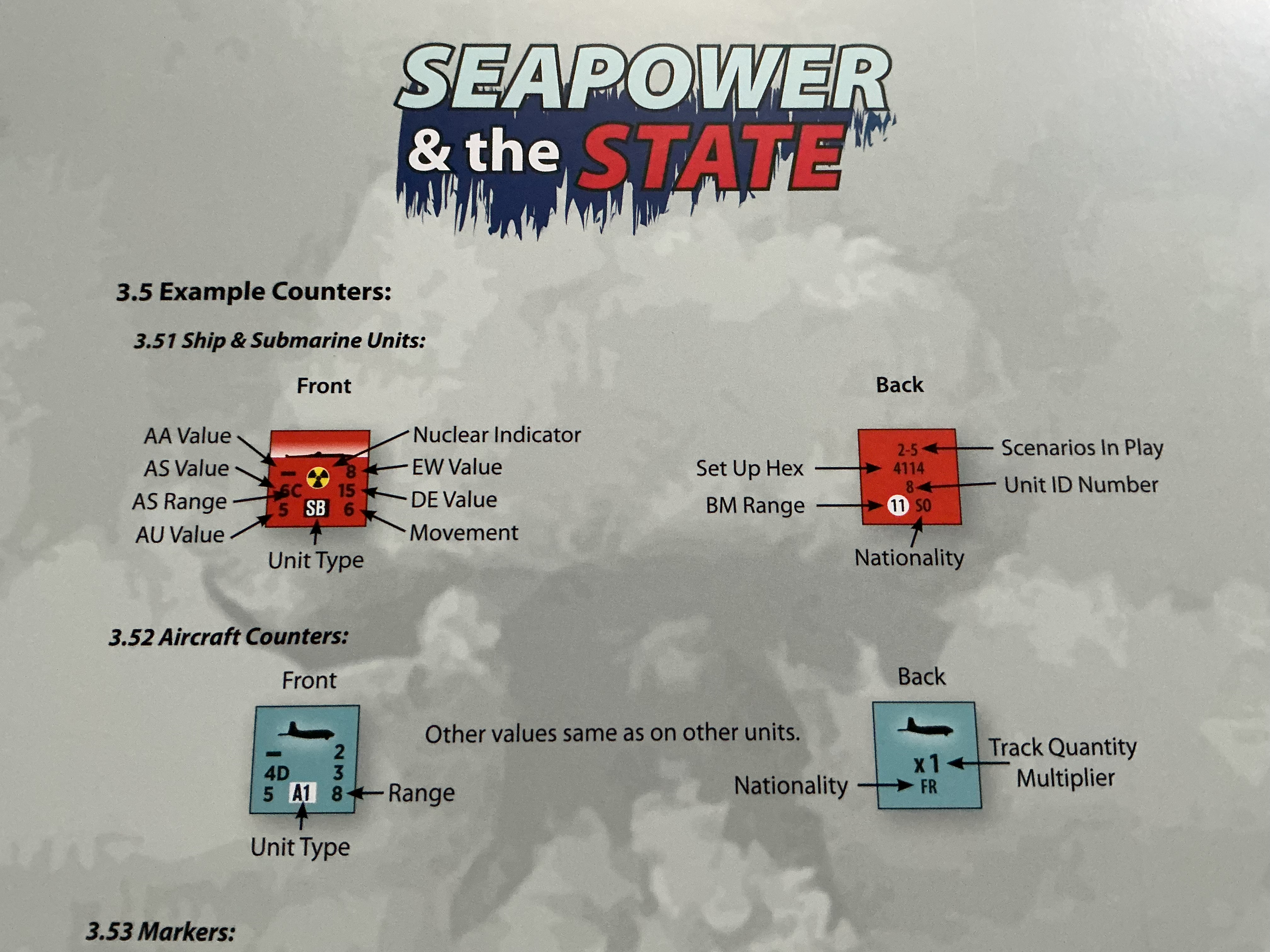

The 2025 rulebook for Seapower & The State is a major improvement in layout over the first edition. The new rulebook is now standard sized, two-column, full-color on glossy paper.
Commies, sir. Stacks of ’em!
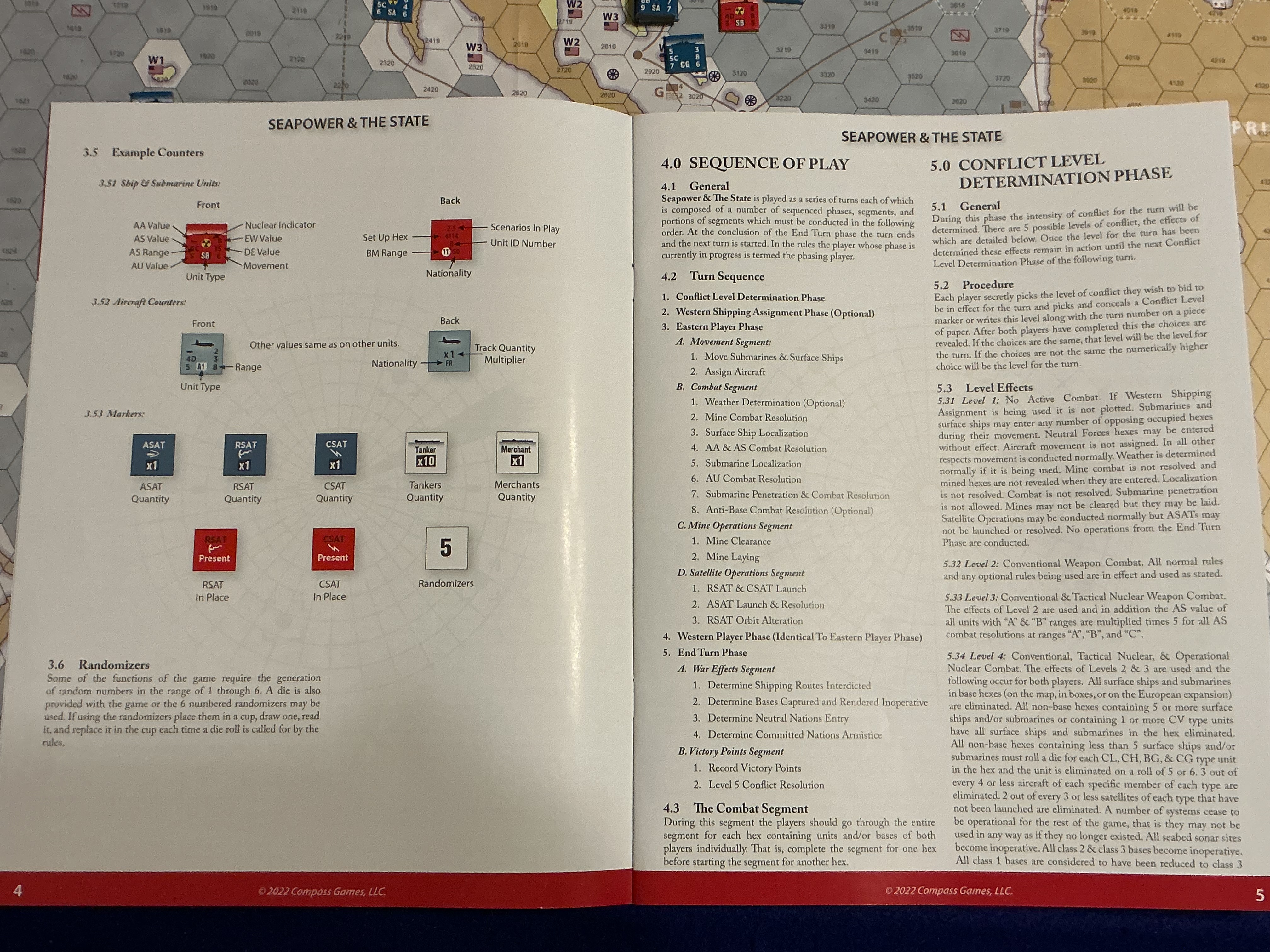
One part of gameplay in Seapower & The State that did not change, even with new components, is the large stacks of units that inevitably appear on the board. Between the Task Force player aids and some holding boxes on the board for eight major bases (4x Eastern, 4x Western) the overall impact of the stacks is less than the original edition but this is a game where tweezers likely will be required. Honestly, the big-stack problem really only lasts for one or two turns; that is, long enough for the huge initial battles to take place and dispersement into smaller stacks to avoid nuclear war effects or—more often than not—the removal of many units thanks to the use of tactical nuclear weapons.


Check the manual
The last time I played Seapower & The State was a bit over five years ago. The new larger-format rulebook helped this grognard learn to play again. Over the years I forgot some of the rules; replaying now not only again familiarized me with the rules but also gave me another perspective on some of the game mechanisms.
Nukes. In Level 3: Conventional & Tactical Nuclear Weapon Combat, “the AS [Anti-Surface] value of all units with ‘A’ & ‘B’ ranges are multiplied by 5 for all AS combat resolutions at ranges ‘A’, ‘B’, and ‘C'” (see 5.33 Level 3). The auto-removal of stacks or bases does not kick off until Level 4: Conventional, Tactical Nuclear, & Operational Nuclear Combat (see 5.34 Level 4). The Victory Point penalty for Escalation only applies if Level 4 or Level 5 Conflict is chosen (see 17.44 Escalation). Interesting reflection of the day; nukes are powerful and the smaller tactical weapons are useful for fighting without political penalty.
Sneaky Subs. At Level 2 Conflict or higher ships must stop when entering a hex occupied by enemy units or bases but submarines must stop when entering the second hex containing opposing units or bases (see 6.2 Submarine & Surface Ship Procedure).
Logistics. Using rule 6.31 Logistics in play is a bit hard as it requires consideration both during and at the end of movement. First, ships that start out of port must end their turn in-port; this effectively gives ships only “two turns of action”. Ports themselves have limits on how many units can be supported; Class 1 Bases are unlimited but the many smaller Class 3 Bases spread around the globe only support 3 units! Aircraft carrier (CV) units also can act as a supply source depending on their DE [Defense] rating; DE 30+ supplies 6 units while DE >30 supplies only 3. The penalty for overstacking and exceeding supply limits is brutal—elimination!
In & Out. Rule 8.4 Breakaway allows for attacking units making AS [Anti-Surface] attacks to “turn away” if desired. It is possible to have some units continue in while others turn away. This is a layer of complexity the rules barely address as the Combat Resolution Sequence (see rule 8.2 AA & AS Combat Resolution Sequence Outline) counts down ranges for resolving combat. If you have units breakoff and move away, in what order are those actions resolved?
Air DEFENSE. Anti-Aircraft (AA) “attacks” are made by defending (i.e. non-phasing) bases and ships. This means AA is limited to defending against aircraft only (see 9.0 ANTI-AIRCRAFT COMBAT, specifically 9.1 General). Missile defense is part of Anti-Surface (AS) combat and missile defenses are accounted for as part of a unit’s EW (Electronic Warfare) and DE (Defense) ratings (see 10.0 ANTI-SURFACE COMBAT specifically 10.1 General).
Dependable allies…NOT! Rule 16.51 Early Wavering has France, Netherlands, Italy, and the United Kingdom making die rolls to see if they remain in the fight. The rule makes for interesting commentary on the state of relations in those days.
Not your Pappy’s chit pusher
While the reputation of the 1982 edition of Seapower & The State was certainly strong enough to incentivize Compass Games to make a reprint, the game is not without it’s critics.

As I got Seapower & The State to the table I took the opportunity to deep dive into the theme and design. That turned into a major look at the naval competing naval doctrines of the early 1980’s and how Seapower & The State reflects—or not—that reality. When I say “major” I am talking on the order of 10,000+ words. Look for that over at The Armchair Dragoons in the near future!
Feature image courtesy RMN
The opinions and views expressed in this blog are those of the author alone and are presented in a personal capacity. They do not necessarily represent the views of U.S. Navy or any other U.S. government Department, Service, Agency, Office, or employer.
RockyMountainNavy.com © 2007-2025 by Ian B is licensed under CC BY-SA 4.0
 Rocky Mountain Navy Gamer
Rocky, thanks for the review. I am on the fence with this one (I am not a fan of small, dense unit counters). I can understand if the game doesn’t reflect doctrine at the time; it was not publicly known at the time, and in some cases needed to be declassified (https://digital-commons.usnwc.edu/newport-papers/21/). That certainly would have been worth an updated version of this game vice a straight reprint. However, since no warfare occurred, its hard to criticize its simulation of naval combat.
While I certainly wish the reprint was a bit more, at the end of the day SEAPOWER & THE STATE is a lens into the past. If you play the game to the Victory Conditions it is not that bad. I think many people do not accept the game for what is it and instead want it to be something else. My long-form commentary should be up on Armchair Dragoons in a few days.
I was pointed to the longer review and just finished reading it. Very well done. Thank you for the effort.
You would not believe the work involved in making sure that everything in S&ST reflected the current thinking and valuations at the time that were in the public domain, and only what was in the public domain. Not being willing to go through any of that again is the main reason I eventually gave up on the idea of doing ‘modern’ designs for entertainment publication.
Again, thanks. 🙂
Stephen
SimCan, North Oyster, BC, Canada
Thank you, kind sir, for dropping by. Always been a SimCan fan. I can assure you that “prepublication review” has not gotten any easier over the years; perhaps, in the aftermath of WikiLeaks and Discord leaks for Call of Duty or the like, it has turned worse.
Some day I hope somebody does an in-depth interview with you on the early days of SimCan and your perspectives on being a wargame designer and a wargame practitioner.