
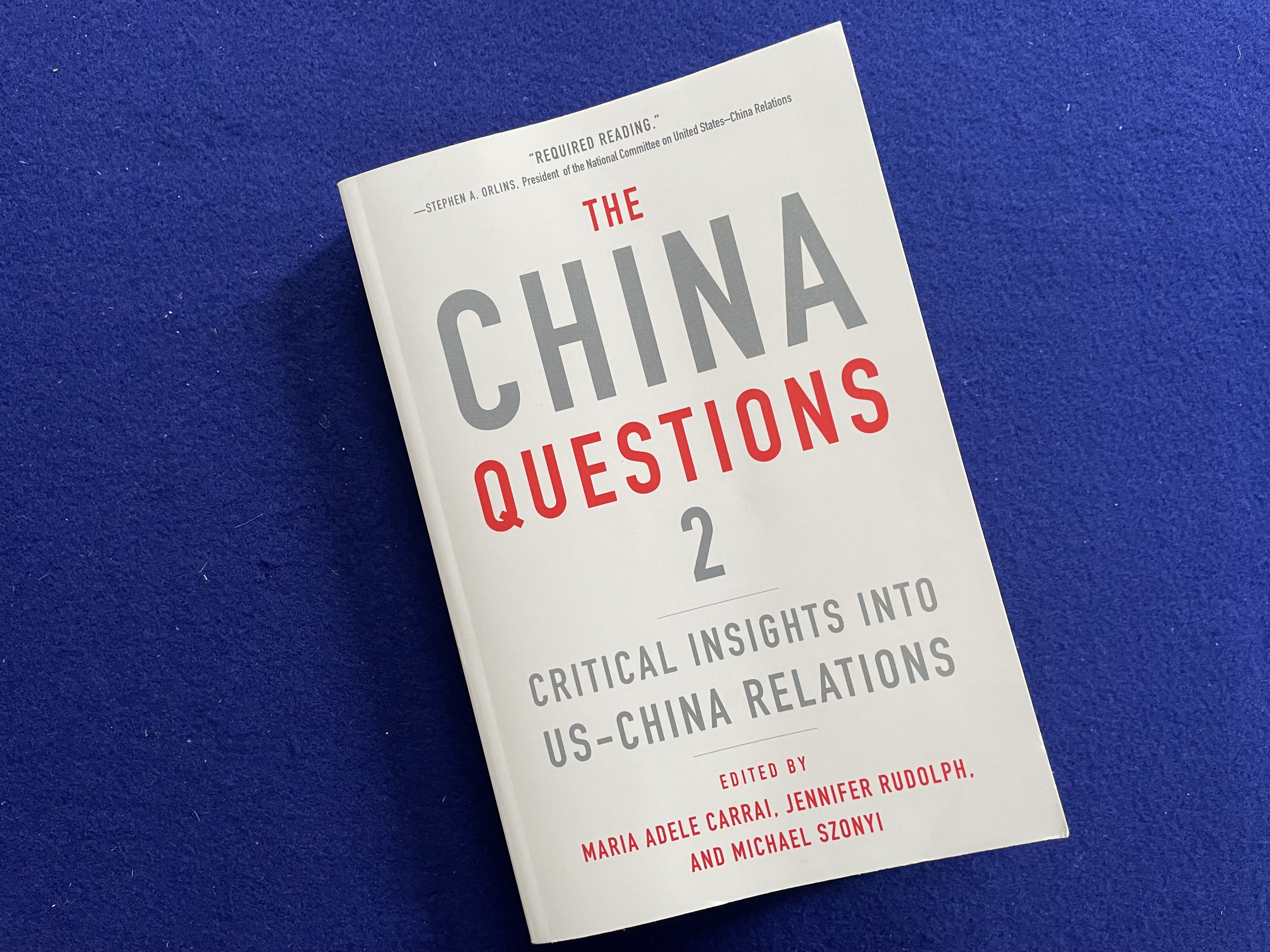
For decades Americans have described China as a rising power. But China has already risen. What does this mean for the United States, for the global economy and for international security? Tackling key issues, providing historical perspective, and demystify stereotypes, Maria Adele Carrai, Jennifer Rudolph, Michael Szonyi and an all-star group of China experts offer essential insights into the many dimensions of the world’s most important bilateral relationship.
Ranging across questions of security, economics, military development, climate change, public health, science and technology, education, and the worrying flashpoints of Hong Kong, Taiwan, and Xinjiang, the concise essays that compose this book are an ideal vantage point on where the US-China relationship may go in the future. What is certain is that the relationship has changed, and the terms of engagement need to change, too. However, much that is good for one society is good for both. We are faced with not another Cold War but with a complex picture of conflict, competition, and cooperation that must be understood on its own terms.
Back of the book
Précis
This book is a follow-on to The China Questions (2018) which provides insights from China experts explaining key issues that shape the US-China relationship. The China Questions 2 is a collection of 36 short essays by scholars at Harvard’s Fairbank Center for Chinese Studies. Overall it is a very accessible study well-suited to a lay reader. The topics addressed range from political to social, environmental, literary and even religious. For wargamers focusing on military conflict with China, seven essays in particular are relevant:
- 17. “How Will China’s National Power Evolve vis-à-vis the United States?” by Andrew S. Erickson (10 pages).
- 18. “How Does China Think About National Security?” by Sheena Chestnut Greitens (6 pages).
- 19. “Is China a Challenge to US National Security?” by Oriana Skylar Mastro (8 pages).
- 20. “How Will Emerging Technologies and Capabilities Impact Future US-China Military Competition?” by Elsa B. Kania (8 pages).
- 21. “Where Do Divergent US and Chinese Approaches to Dealing with North Korea Lead?” by John Park (9 pages).
- 22. “How Does Taiwan Affect US-PRC Relations?” by Shelley Rigger (7 pages).
- 25. “Why Did China Build and Militarize Islands in the South China Sea, and Should the United States Care?” by Bonnie S. Glaser (8 pages).
Ponderings
Though this book is a Harvard University Press paperback first edition dated 2025, the original text for The China Questions 2 was first printed in 2022. That means that most, if not all of these essays, likely were written in 2021 or earlier. The view of the US-China relationship certainly has changed since then, if for no other reason than a new US administration was elected in late 2024.
The negative import of the older text in The China Questions 2 is most clearly seen in essays like Elsa B. Kania’s “How Will Emerging Technologies and Capabilities Impact Future US-China Military Competition?” The PLA [People’s Liberation Army] threat Kania discusses is that of circa 2019 and the time before the Russian invasion of Ukraine in February 2022. That is not to say that Kania’s threat characterization of the PLA is invalid; rather, it needs to be taken in the context of when it was written and comes with a recognition that much has changed since the text was first printed.
Gaming Connection
Given the focus on many topics that are not directly tied to kinetic military conflict—or even gray zone confrontations—wargamers likely will find The China Questions 2 useful mostly for background on the broader geo-political issues that influence the US-China relationship. Granted, some of those friction points could lead to crisis or conflict, but The China Questions 2 perhaps better informs a policy game than a conflict-focused wargame.
Feature image courtesy msn.com
The opinions and views expressed in this blog are those of the author alone and are presented in a personal capacity. They do not necessarily represent the views of U.S. Navy or any other U.S. government Department, Service, Agency, Office, or employer.
RockyMountainNavy.com © 2007-2025 by Ian B is licensed under CC BY-SA 4.0
 Rocky Mountain Navy Gamer