
Lead with a plan
As I stated previously, Corsair Leader: The WWII Pacific Theater Solitaire Game is my first foray into the Dan Verssen Games Leader-series. My expectations of a solitaire game are, often, quite low. In my experience, many solitaire games tend to be long on procedure and short on, well, fun. In too many solitaire games a player simply repeats (endlessly at times) a series of procedures that supposedly advance a storyline or mission…one step at a time.

I am happy to say that Corsair Leader does fall into the traps too many of those poor solitaire games languish in. The main reason, in my opinion, is that Corsair Leader avoids the solitaire pitfalls in the planning. While missions are resolved—procedurally—on the Tactical Board, the planning before and after a mission are what makes the procedural portion create an interesting narrative.
Campaign planning
Planning in Corsair Leader starts long before the first mission in Campaign Set-Up. The crucial currency of planning are Special Option (SO) points. As the rulebook explains,”You can purchase Special Weapons, Aircraft, or Priority Options with your Special Option points” (p. 12). Each Campaign Sheet tells the player how many Days the Campaign lasts and their SO allotment. For example, the Introductory Campaign “Luzon 1945” has is 3 Days with 20 SO points.
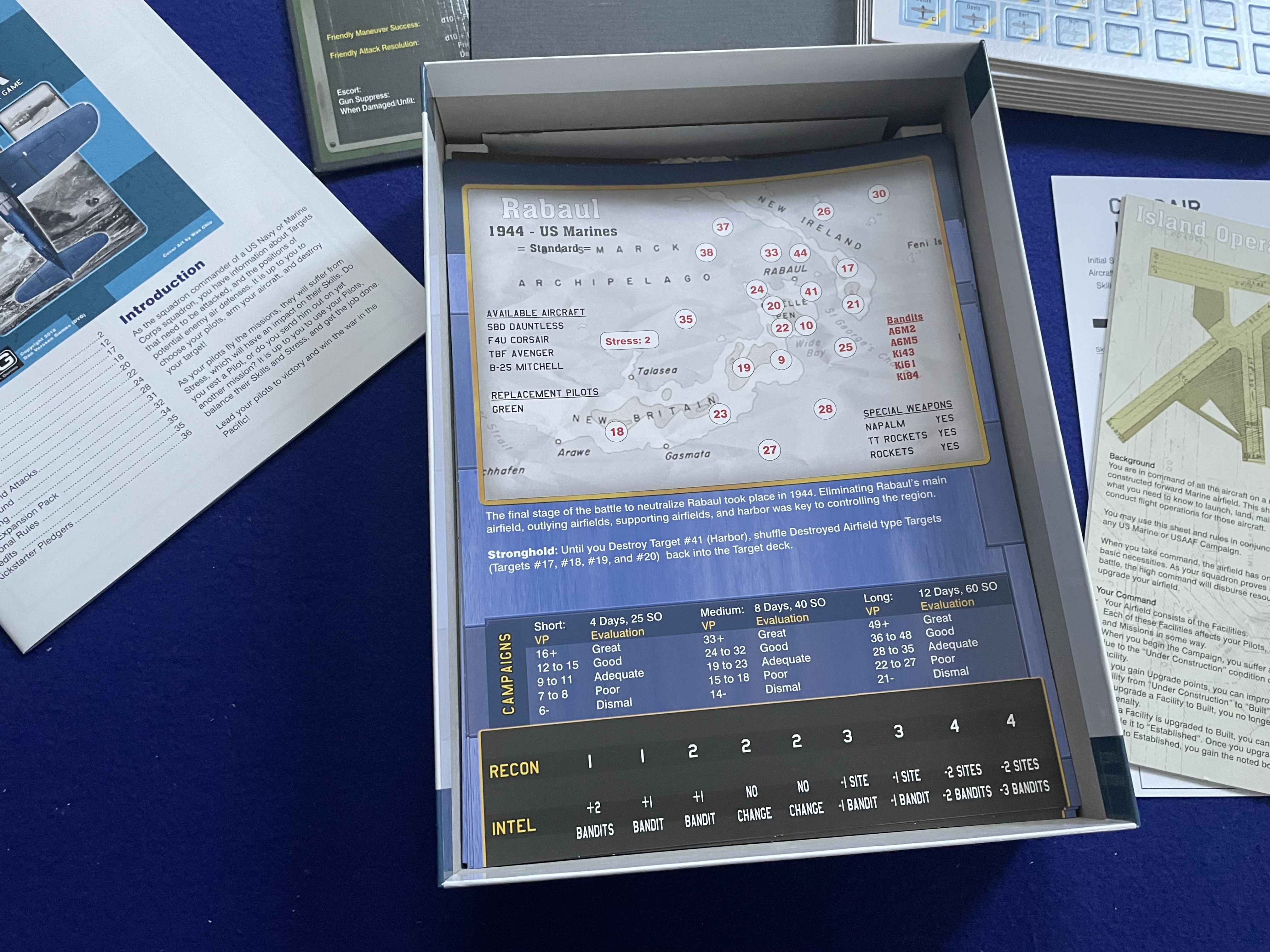
Even before one starts spending SO points in a Corsair Leader Campaign you must plan your team by selecting pilots. The Campaign Sheet tells you what aircraft are available—and how many—and the Campaign Duration specifies your starting skill levels.
This leads the player to their first major decision in Corsair Leader: Which aircraft to use. A mental hurdle I had to break through at this stage of the game was that my “squadron” was not necessarily a homogenous grouping of aircraft. Given each aircraft is individually named I initially thought my squadron was going to be all of one type. That is not a good plan because the aircraft in your squadron are better thought of as representing one member of many in a squadron of that type. This is because in Corsair Leader you are not a Schedules Officer in a squadron posting the flying roster of the day but more akin to an Airwing operations officer that is planning how several squadrons are mutually supporting one another on a mission. This in turns calls for another planning step; studying the Campaign Sheet to see what variety of targets are possible. Do you want to have more air-to-air fighters or do you need some extra ground-pounding assets? Taking a look at my “Luzon 1945” Introductory Campaign I saw many ground attack missions, a few naval strike missions, and just a few pure air supremacy missions. Given that mission selection, I chose 5x F4U Corsair, 1x SDB Dauntless, 1x TBF Avenger, and 1x B-25 Mitchell.
The next decision Corsair Leader puts to planners is who will fly those aircraft. In a Short Campaign the player starts with a Squadron of 1 Newbie, 2 Green, 4 Average, and 1 Skilled pilot. Picking a pilot is not just a matter of drawing a card as each pilot is different. Some have a better Situational Awareness or Cool rating; others are Fast or Slow (makes a difference in combat) and each has their own Air-to-Air (AtA) or Air-to-Ground (AtG) rating. Stress effects each pilot differently. The point is while one certainly could randomly pick a crop of pilots (which, admittedly, likely is closer to reality) in Corsair Leader the player gets some choice. Use it!
[For my “Luzon 1945” game I started out with: F4U Gallant Newbie, F4U Rodriquez Green, F4U Gutenkunst Green, F4U Rider Average, F4U Schettler Average, SBD Dauntless Luis (Lewis?) Average, TDF Avenger “Jericho” Average, and B-24 “Foster” Skilled.1]
Nugget or Ace?
The next step in setting up a campaign of Corsair Leader is where those SO points start slipping away. The player can purchase one or two Skills for each pilot—by spending SO points. In a Short Duration campaign like “Luzon 1945” it costs one (1) SO point to buy a skill. As the rulebook notes, this is the only time in a campaign a player can buy skills and skills are non-transferrable. So…choose wisely.
The type of aircraft you chose in Corsair Leader can also change your SO point pool. Certain aircraft are of inferior quality and taking them provides a SO point bonus. Other aircraft, like the B-25 Mitchell I took, force me to spend SO points.
Next, the Campaign Set-Up of Corsair Leader offers you the opportunity to promote pilots—by again spending SO points.
[In the Campaign Set-Up of my first play of Corsair Leader I spent 8x SO points; 1x for skill “Fighter Pilot” for Schettler, 5x for the B-25, and 2x to promote Gallant to Green. This leaves me 12 SO points for three days. Plenty, right?]
Pre-Flight
Planning is a key element of preparing for a mission of Corsair Leader. The first step of Pre-Flight is to draw Target Cards and decide on a target. There is more to this decision than just drawing the top cards of the Target Deck; rather, the player will usually get a selection of targets to consider. And consider they must. Targets are worth different Victory Points (VP) and are located at different locations across the campaign area. The defenses of each target are different. The more lucrative targets (in terms of VP) are also more likely to be well-defended or deeper in the battlespace which means striking them is not only a greater risk but will also incur more Stress…not to mention a higher probability that some pilots might not make it back.
Finally, after so much planning, the first procedural step of Corsair Leader arrives. Using information on the Target Card, chits are drawn for the Sites in each Approach and Center Area. Play immediately returns planning, however, as the player now gets to assign Pilots to the mission in light of the Target and static defenses. The Target Card tells the player what the limit is for assigning aircraft—you might not be able to take everybody. Next, the player can spend SO points on Special Weapons—in other words the player must weaponeer the target.
[Even weaponeering in Corsair Leader poses challenges to the players. For instance, in my campaign the first day the target was a Headquarters which is a Hard target taking 5 hits to destroy. The Hard rating means each AtG attack SUBTRACTS a single hit. Whereas the 1000 lb bomb (2 SO points) can score between 1-3 hits, against a Hard target the best you can hope for is 0-2 hits. My second day mission was against a Large AAA cluster which is 6 Lt Machine Guns. Here simple guns are effective so I did not spend SO points for Special Weapons. For day three the mission was Landing Support which required 6 hits but the target is Soft and Dispersed. Certain weapons (like 250 lb and 500 lb bombs) get an attack bonus against Soft targets, but the Dispersed rating means each AtG attack can only score one hit maximum. So many weaponeering choises, so few SO points…]
Target-Bound
The next step in a turn of Corsair Leader is the Target-Bound step. This step starts out with an Event card. After the card is resolved players have a choice to conintue or Abort a mission. If the mission continues, Bandits (enemy aircraft) are placed. Remember, the player placed their aircraft on the Tactical Board in the previous step so this is not a matter of planning your approach now as much as it is adjusting your plan based on imminent contact with the enemy. At this point another Event card is draw which may again alter the situation, i.e. call again for an adjustment in plans.
Tally Ho!
Play of Corsair Leader now enters the more procedural portion of play. That is not to say, however, that is is bereft of decisions. Decisions on where to move, to enter a dogfight, to maneuver in a dogfight, to suppress enemy ground fire, to attack a target with which weapon, or when to drop out of a fight.
This is the step in Corsair Leader where you really see if your plan survives enemy contact. Is my mix of aircraft right? How are my pilots performing? Are my Special Weapons purchases paying off?
Home-Bound Flight
While this step in a turn of Corsair Leader starts with another Event card draw, taken as a whole it seemingly has few decisions to make. In reality, there is actually a very important decision—technically carried over from the previous step—that is subtle and easy to miss. Pilots that were shot down make a Search and Rescue (SAR) roll for their fate. The SAR roll can be modified by expending any Special Weapons that were not used over the target. When you think about it that is an agonizing decision to make; do you NOT expend a Special Weapon on a target so you have some insurance just in case you need to make a SAR roll?
Debriefing
Even the post-mission step in Corsair Leader challenges your planning skills. As pilots fly more missions they accumulate Stress. Too much Stress and they become Shaken or even Unfit to fly. The only ways to reduce Stress is to have a pilot with a Cool rating that gets rid of some, not fly them, or spend SO points for some priority R&R.
Sometimes, though, it is not just pilots that need relaxation but aircraft to be replaced. Every lost pilot requires a new plane to join the squadron. That new plane comes with a new pilot that may, or may not be, up to the standard of the pilot just lost. Hopefully, some pilots gain skill and experience and are promoted. Note, however, that while pilots may “make rank” and advance, they do not lose Stress.
SO what of Corsair Leader
With the end of a day’s mission the planning for the next day of Corsair Leader begins. The player is back to drawing new Target cards, selecting a Target, placing static defenses, and Assigning Pilots and purchasing Special Weapons. Except now the pilots are Stressed, or new, or logistics is not right and you cannot get the weapons you really want (where did all those SO points go?). To get through another day you need a plan. Play of Corsair Leader does not reward mavericks; success comes from those with ice in their veins from the cold depths of a planning cell.
- This will cost me 5x SO points as will be explained later. ↩︎
Feature image courtesy RMN
The opinions and views expressed in this blog are those of the author alone and are presented in a personal capacity. They do not necessarily represent the views of U.S. Navy or any other U.S. government Department, Agency, Office, or employer.
RockyMountainNavy.com © 2007-2025 by Ian B is licensed under CC BY-SA 4.0
 Rocky Mountain Navy Gamer