
Furry-ish RPG
Let me be perfectly clear: I am not, nor will I ever be, a Furry cosplayer. I make that declaration because if one sees my interest in this product and then looks at the promotional video on Kickstarter for the tabletop roleplaying game (RPG) Scavenger: Caches and Prizes (Joel Kreissman, 2025)—which starts off with a very furry narrator—you might come to a different conclusion.
Scavenger: Caches and Prizes is not a furry cosplay RPG but a new sci-fi tabletop RPG setting and core rulebook built around Cepheus Engine. The Kickstarter page for the game describes it as, “An anthropomorphic sci-fi RPG set after the fall of a galactic empire, based on the Cepheus Engine.”

Fur meets Cepheus
The setting for Scavenger: Caches and Prizes is actually quite simple, if not a bit interesting:
Thousands of years in the future, the Federation connected dozens of stars with its wormhole network. Colonizing hundreds of planets with transgenic “parahumans” using technology that seemed like magic.
And then the wormholes collapsed, taking the Federation with them.
Now colonies struggle to survive, free of their imperialist overlords but bereft of the technology they provided. Fabricators and medical nanotech alike failed with the Federation’s network. Former admirals turned pirate warlords prey upon defenseless worlds. Unrestrained corporations suck planets dry of resources. And mysterious probes wander the depths of space.
But hope is not lost, the wrecks of Federal starships and abandoned stations hold the promise of advanced technologies that could alleviate hunger or unlock the stars again, in the right hands. If you’re brave enough to chance the dangers of radiation leaks, malfunctioning robots, or the dreaded Kessler cascade you may bring back great riches. You may find anything from a laser rifle to a technomage’s staff that might as well be magic to you. If you’re lucky you might even find a ship that you can patch up with scrap.

In Scavenger: Caches and Prizes, author Joel Kreissman takes his “Parahuman Space” setting and gives it the Cepheus Engine treatment. Kreissman takes full advantage of the Open Game License and Cepheus Engine Source Reference Document (SRD) to deliver not only the background of the Parahuman setting but a set of easy-to-play tabletop RPG rules to adventure around that universe.
Cepheus Engine…but furry digits for now
Scavenger: Caches and Prizes is currently available in digital format via DriveThruRPG for $5 retail. A hardcover version is yet to deliver. Upon purchase from DriveThruRPG you get a 195-page pdf file that contains not only Parahuman Space setting but also a complete core rulebook built on Cepheus Engine.
Longtime players of the Traveller RPG (the progenitor of Cepheus Engine) know that many different adventure styles are possible using those rules—a vast sandbox if you like. Alternatively, Scavenger: Caches and Prizes starts with a narrow player focus that tries to generate interest in the setting and ruleset by appealing to dungeon divers first:
Story? What kind of Story?:
The earliest RPGs focused heavily on “dungeon crawls” through the ruins of fallen civilizations, fighting monsters and disarming traps in order to claim the treasure in the middle of the maze. But what do you do in a space setting? A wide-open sandbox is nice, but some players need a direction to be pointed in. Fortunately, space does have an analogue to fantasy dungeons. Wrecked starships, with their leaking coolants, security robots, space monsters, and hard vacuum between the foolhardy adventurers and fame and fortune.
Scavenger: Caches and Prizes, p. 7
That is not to say that Scavenger: Caches and Prizes paints itself into a proverbial RPG corner and exclusively embraces dungeon crawls. As the rules explain:
Other types of campaigns are possible besides salvage, of course. If your players want, they might be explorers seeking to recontact lost colonies or find whole new worlds, relativistic data traders plying the space lanes for profit, soldiers of fortune, or even pirate warlords trying to carve out thier own pocket empires. And, unlike spaceships, there’s no reason a campaign can’t change direction mid-journey. If your salvagers find a prototype starship drive or abandoned warship they might decide to keep it for themselves instead of selling it.
Scavenger: Caches and Prizes, p. 8
While the rules for Scavenger: Caches and Prizes is based on Cepheus Engine, the rulebook is not a direct copy of the SRD with a setting chapter added. This is apparent in several areas of the rules and all the more noticeable for those who are familiar with the Traveller RPG or previous Cepheus Engine rulesets like Clement Sector (Independence Games) or HOSTILE (Zozer Games)—both of which I highly recommend. The rules for Scavenger: Caches and Prizes are particularly “customized” for Character Generation, specifically for “Genetic Traits” which covers the genetic modifications to create a parahuman. Interestingly, while Character Generation example refers to a specific animal type (“A player decides they want a racoon pilot…”) the rules for Character Generation do not specify an animal template but a Phenotype instead (Did you know a raccoon is of the genus Procyon? I had to look it up…).
The rules in Scavenger: Caches and Prizes for Skills and Combat are fairly generic Cepheus Engine with little setting adjustments. Equipment, which involves Tech Level (TL), is not necessarily modified by the setting but instead translated into setting terms. For example, most planets in Parahuman Space range from TL 6 to 9 (p. 46). This, in many ways, makes Scavenger: Caches and Prizes a somewhat “low tech” setting as compared to others.
In keeping with the setting of Scavenger: Caches and Prizes, the rules for biological modifications (Biomods) and Cybernetics are fully taken advantage of. Weapons, on the other hand (paw?) is again almost straight stock Cepheus Engine.
Scavenger: Caches and Prizes does not have a magic system, per se. Leaning fully into Arthur C. Clarke’s Third Law, what characters in the setting refer to as “magic” is actually advanced technology. For those familiar with Cepheus Engine and the rules for Psionics this is the section for those abilities.
“Any sufficiently advanced technology is indistinguishable from magic.”
Arthur C. Clarke’s Third Law
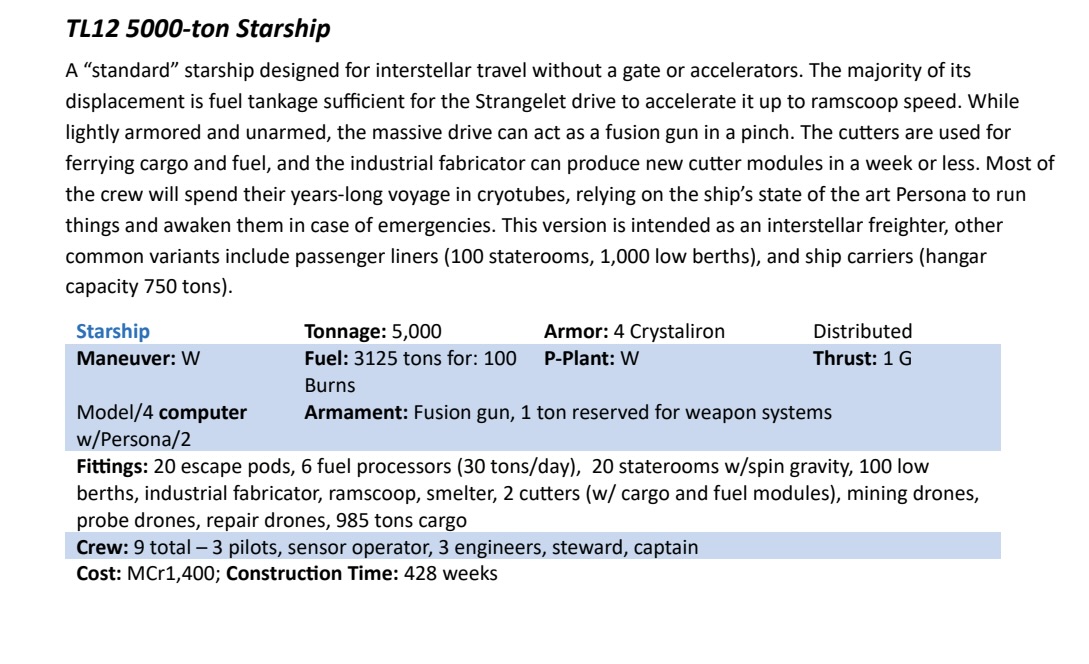
In keeping with the relatively low-tech setting of in Scavenger: Caches and Prizes the rules for Spaceship Operations draw on the similar low-tech rules from Cepheus Engine. The low-tech approach also carries over into Starship Construction; this is certainly a small-ship, or as some grognards would say, “Adventure-class,” setting with tonnage capped at 5,000 tons (p.94). In Parahuman Space you also do not have magic Maneuver Drives with their anti-gravity blue glow but instead one must track Burns. That differing rules approach to starship design carries over Interstellar travel in Scavenger: Caches and Prizes. Pre-collapse travel between stars was accomplished via wormholes that exist in different star systems but beyond the Oort Cloud or the like (p. 74). Post-collapse, interstellar travel is accomplished by using ramscoop at speeds approaching c or the speed of light.
[If there is a weak point in the Scavenger: Caches and Prizes setting the confusing rules for interstellar travel are perhaps the most noticeable. Chapter 8: Spaceship Operations states, “..interplanetary voyages still take weeks or even months” but this is a reference to in-system travel (p. 84). This is reinforced by the Orbit to Orbit (p. 85) and Travel Times (pp. 85-86) rules. The “Reaction Drive Cruising Speeds” table under Fuel Use (p. 88) also covers interplanetary but not interstellar travel. In a section called, “Interstellar Travel,” ramscoop technology that moves at a fraction of the speed of light is introduced as well as rules for Relativistic Time Dilation (pp. 90-91). Annoyingly, a “Conversion Drive” or “Strange Matter Conversion Drive” (p.91) is mentioned but only with a very close reading does one discover that the “Stranglet” alternative reactor (aka “drive”) on page 98 in Chapter 10: Spaceship Construction has the same 0.8c rating so that must be the same technology. The example Stranglet-powered ship is unhelpfully labeled “Generation Ship” in Chapter 11: Common Spacecraft making association of the rule and ship difficult. Other interstellar drives are relegated to Chapter 15: High Technology where Warp Drives (p. 158) or Wormholes (pp. 159-160) appear. All of which is to say that the majority of adventuring in Scavenger: Caches and Prizes will almost certainly be limited to a single solar system unless, 1) Players are willing to take a “time-out” of years moving between star systems or, 2) Some sort of higher tech is somehow “acquired.”]

Given the centrality of salvage to Scavenger: Caches and Prizes it should be no surprise that those rules are found right next to rules for Trade. The brevity of the rules, however, is a bit surprising to me; if salvage is really that core to the setting (it is a Chapter title after all) why is it given a mere two pages (one of which is mostly an image) of attention?
“Chapter 17: NPC Encounters” in Scavenger: Caches and Prizes is a very underrated set of rules. If Kleissman was really focused on that “starship crawl” I would expect to find those rules here. Instead, we are given the rules for cross-country travel, again seemingly stock Cepheus Engine with little thought as to how it links to other elements of the setting.
When it comes to artwork, Scavenger: Caches and Prizes is a bit lighter than I expected. Including the cover I count 27 pieces of art, seven of which are either maps, ships, animals (not player characters) or some other graphic that does not depict a parahuman. The art styles are varied as is the use of color. All of which means that players who are searching for story inspiration from the art are likely to be disappointed. That said, the original Classic Traveller was also very light on art, even more so than Scavenger: Caches and Prizes. The relative lack of art, as compared to the heavyweights in the market such as Wizards of the Coast or Free League Publishing, leads to the question, “How much art is really needed?” In the case of Scavenger: Caches and Prizes my answer is, a bit to my surprise given how I opened this paragraph, “Not much.” Here I fully admit that I always play RPGs in the “theater of the mind” over figures or minis or artwork on the table.
“Tabletop RPGs are the theater of the mind; video games are the theater of the mindless.”
RMN, adopted from Steve Allen, “Radio is the theater of the mind; television is the theater of the mindless.”
Sure, when necessary I use a map and tokens (Fantasy Flight Games’ Star Wars Roleplaying Game—since moved to Edge Studios—does this quite well in their starter sets) but I rarely, if ever, have a character sketch. Even in this world with Ai generated images. If I have an image it is likely abstract. Thus, the artwork in Scavenger: Caches and Prizes is, for me, sufficient to start my creative thought processes.

Fur-less?
If I was put on the spot and asked how much of Scavenger: Caches and Prizes feels “unique” as compared to Cepheus Engine my response is maybe 10%. Aside from differences in Character Generation and some setting touch in starships (i.e. no Jump Drive)—not to mention the artwork—the rules for Scavenger: Caches and Prizes feel very stock-Cepheus Engine. That is not necessarily A Bad ThingTM; players familiar with Cepheus Engine will be able to quickly start play. If anything, Scavenger: Caches and Prizes is an opportunity that only partially delivers.
The Parahuman Space setting offers interesting adventure opportunities, but the adaptation of Cepheus Engine does not fully create linkages from setting to rules to take advantage of those opportunities. While some are there, I feel that a bit more focus on the core setting theme, starship crawls, should be emphasized. This is not a call for a sub-game like Snapshot for Classic Traveller but instead a rules focus. For example, taking the Traps section of Chapter 16: Environmental Hazards and showing how it can work on a starship could be a good example of play and highly inspirational for players and Referees alike.
Going back to a line in the original Kickstarter promotion and breaking it down is a good example of how Scavenger: Caches and Prizes both does, and does not, deliver: “If you’re brave enough to chance the dangers of radiation leaks, malfunctioning robots, or the dreaded Kessler cascade you may bring back great riches.”
- “radiation leaks” – See rules for Radiation in Chapter 16: Environmental Hazards (pp. 162-163).
- “malfunctioning robots” – Rules for Robots and Drones are found in Chapter 5: Equipment (pp. 57-58) but are characteristics only; no rules for malfunctions.
- “dreaded Kessler cascade” – The word “Kessler” does not appear in the core rulebook; the “Kessler cascade” is a likely reference to the Kessler Syndrome where debris in low orbit collides with other debris in low orbit and creates even more debris with escalating danger…not that the rules tell us.
While Scavenger: Caches and Prizes could do a better job at combining it’s Parahuman Space setting and the Cepheus Engine rules, it is not a bad game. The reality is that every RPG is only as good as the Referee and players make it. From that perspective Scavenger: Caches and Prizes is a good ruleset for starting adventures in a setting sufficiently different from Classic Traveller or other Cepheus Engine offerings. It is, so to speak, just furry enough for inspiration.
Feature image courtesy Joel Kleissman, Scavenger: Caches and Prized, p. 110
The opinions and views expressed in this blog are those of the author alone and are presented in a personal capacity. They do not necessarily represent the views of U.S. Navy or any other U.S. government Department, Service, Agency, Office, or employer.
RockyMountainNavy.com © 2007-2025 by Ian B is licensed under CC BY-SA 4.0
 Rocky Mountain Navy Gamer
aside from the Cepheus-specific stuff, this looks a lot like the mid-90s “Justifiers” game