
In 2025, boardgame publisher Days of Wonder delivered Star Wars: Battle of Hoth to gaming tables. Star Wars: Battle of Hoth is a lite, two-player wargame to play out skirmishes, engagements, and even the entire campaign of the Battle of Hoth from the movie Star Wars: The Empire Strikes Back. While I often call wargames with less complex rules—or ones aimed at an introductory or family audience—”lite” wargames that term is seemingly insufficient to characterize Battle of Hoth. Instead, I see Battle of Hoth as a highly thematic yet “simple-easy” wargame. Indeed, it appears that the designers and developers chose to use a “simple-easy” philosophy in all aspects of the game.
“The Imperial assault on the rebel base on Hoth has long been considered one of the darkest days for the Rebel Alliance, and with good cause.”1
When someone mentions battles in the Star Wars movie universe, I admit that the first thing that comes to my mind is space battles. In the Original Trilogy of real Star Wars movies this was quite true with the Battle of Yavin in Star Wars, the blockade running battles in The Empire Strikes Back, and the final climatic battle over Endor in Return of the Jedi. That said, there were also several important ground, or surface, battles shown in those movies. The most important surface battle in the Original Trilogy of movies almost certainly is the Battle of Hoth as seen in The Empire Strike Back.
From the perspective of theme, given the fame of the Battle of Hoth among both viewers and fandom of Star Wars, it very likely was a “simple-easy” choice to design a wargame around the battle. The Battle of Hoth is ideally suited for a small wargame treatment; the battle was fought at an icy location (simple map) with few units (simple variety) and barely in two dimensions (simple rules interactions).
Given the relative simplicity of the Battle of Hoth compared to other battles that appear in the films (and elsewhere in lore, which is not as simple), it appears Days of Wonder made the simple choice to start a new Galactic Battles series of wargames with a simple introductory game. Battle of Hoth is very much an introductory game with simplified rules, a few simple units, simple scenarios, and a simple campaign. That simplification, however, provides a solid foundation for future game expansions or developments that can address a greater, more complex variety of situations, battles or campaigns.
“General, prepare your troops for a surface attack.”2
When I was first handed the box for Star Wars: Battle of Hoth my first reaction was, “this looks to be much simpler than I expected.” At release, Star Wars: Battle of Hoth retails for around $60 in the United States. For that money one gets…
…a decent but not oversized box.
- Measuring 14.5″ x 10.5″ x ~2.5″ it will not take up excessive shelf space.
- The plastic insert helps organize components making set up/tear down quick.
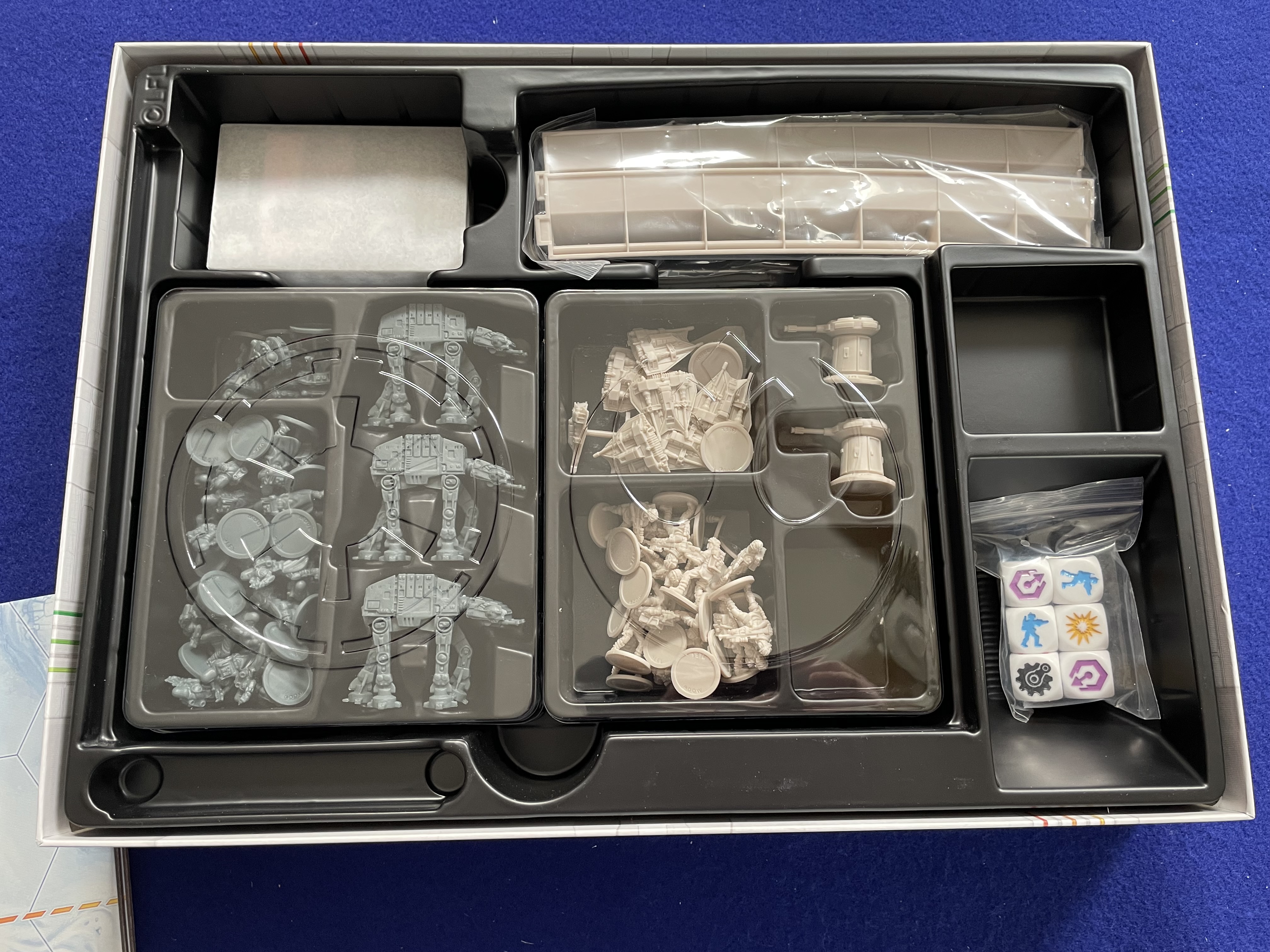
…74 miniatures.
- Made using soft plastic they come in simple two colors: Gray for the
ImperialsGalactic Empire and an off-white, or light-beige, for the Rebels. - The ‘toy factor” is very high; table presence—even without painting—is thematically appropriate and highly evocative.
…a double-sided, mounted game board.
- The main game board folds out to 21.5″ x 16″ with a playing area of 10 hexes across by 7 hexes deep.
- The game map feels smaller (simpler?) than Memoir’ 44 or other Commands & Colors games; indeed, my Memoir ‘ 44 map is 28″ x ~19.5″ with a playing area 13 hexes wide by 9 hexes deep.
- The game map is divided into three game sections (Left – Center – Right from the players perspective).
- In play the
smallersimple game board and playing area does not matter; with only two players [yes, I know it can play with 3 or 4 but those player counts are extremely suboptimal] unit density is actually quite small and the smaller board thematically fits smaller engagements—even the “largest” battles are simple to manage.
- The back of the board is half of an Epic-size map that, when combined with another copy of the game, creates a playing board 32″ x 21.5″ and 15 hexes wide by 9 hexes deep.

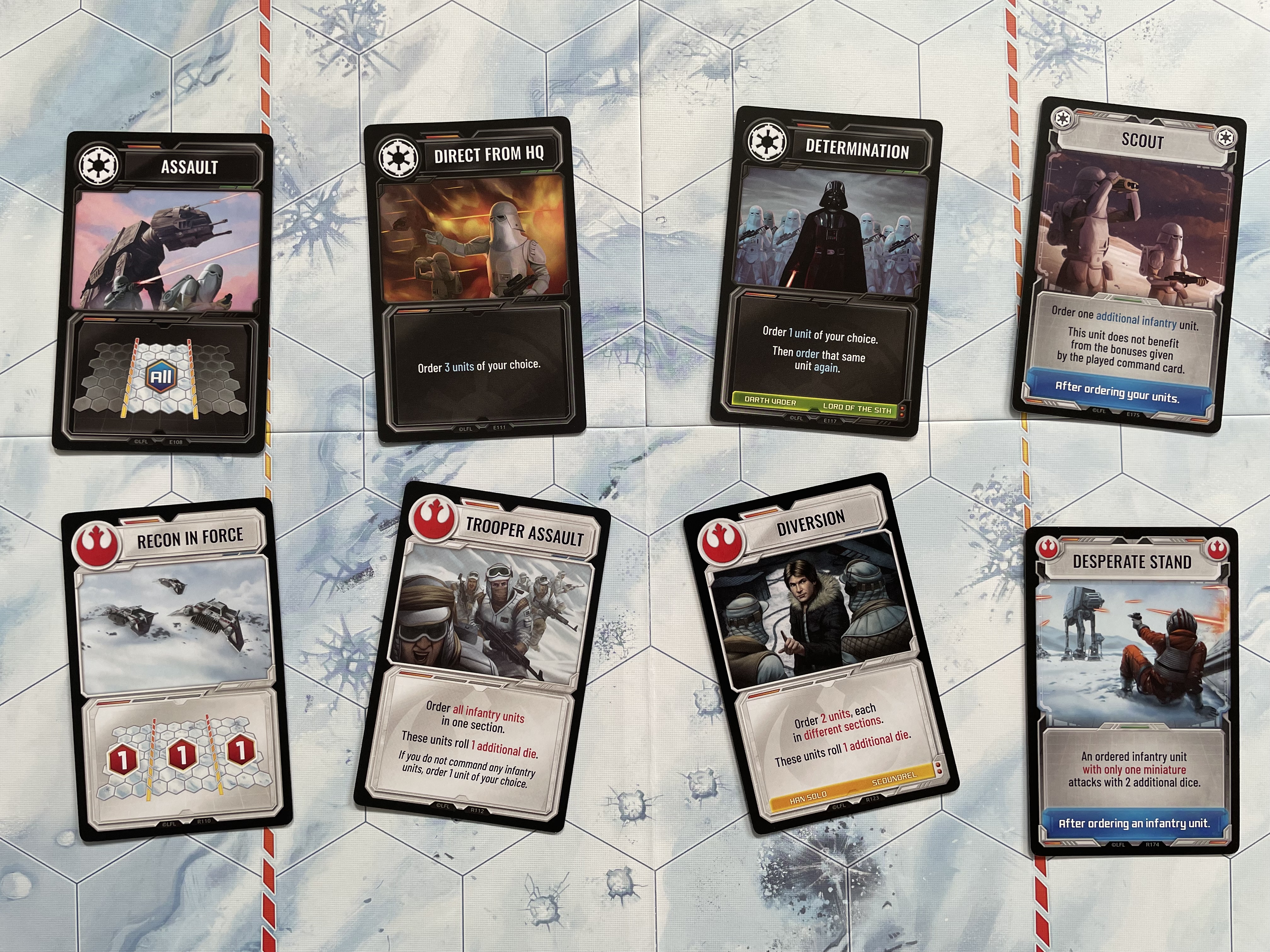
…60 game cards.
- Thirty-two (32) of the cards are Command Cards for each side (16 each).
- The commands for each side are not necessarily mirrored but thematically appropriate—a simple way to differentiate the two sides way of fighting.
- Each side also has nine Leader Cards (3 sets of 3) which can be added into the Command Deck as directed/desired.
- Much to the apparent chagrin of some fans, the different leaders do not appear as a miniature on the table but rather as a command effect; a simple way to add leaders without introducing rules overhead to account for another figure on the table and all the rules interactions that introduces.
- Each side also has five (5) Support Cards which are used as directed in the rules.
- For those familiar with “Battle Cards” in some Commands and Colors games the Support Cards in Battle of Hoth serve in a similar manner (more discussion below).
- The limited selection of Support cards and use in the campaign (not the basic rules) keeps the core game engine simple and allows for later expansions to add special rules (that fans/players will very likely be simply pleased to pay for).
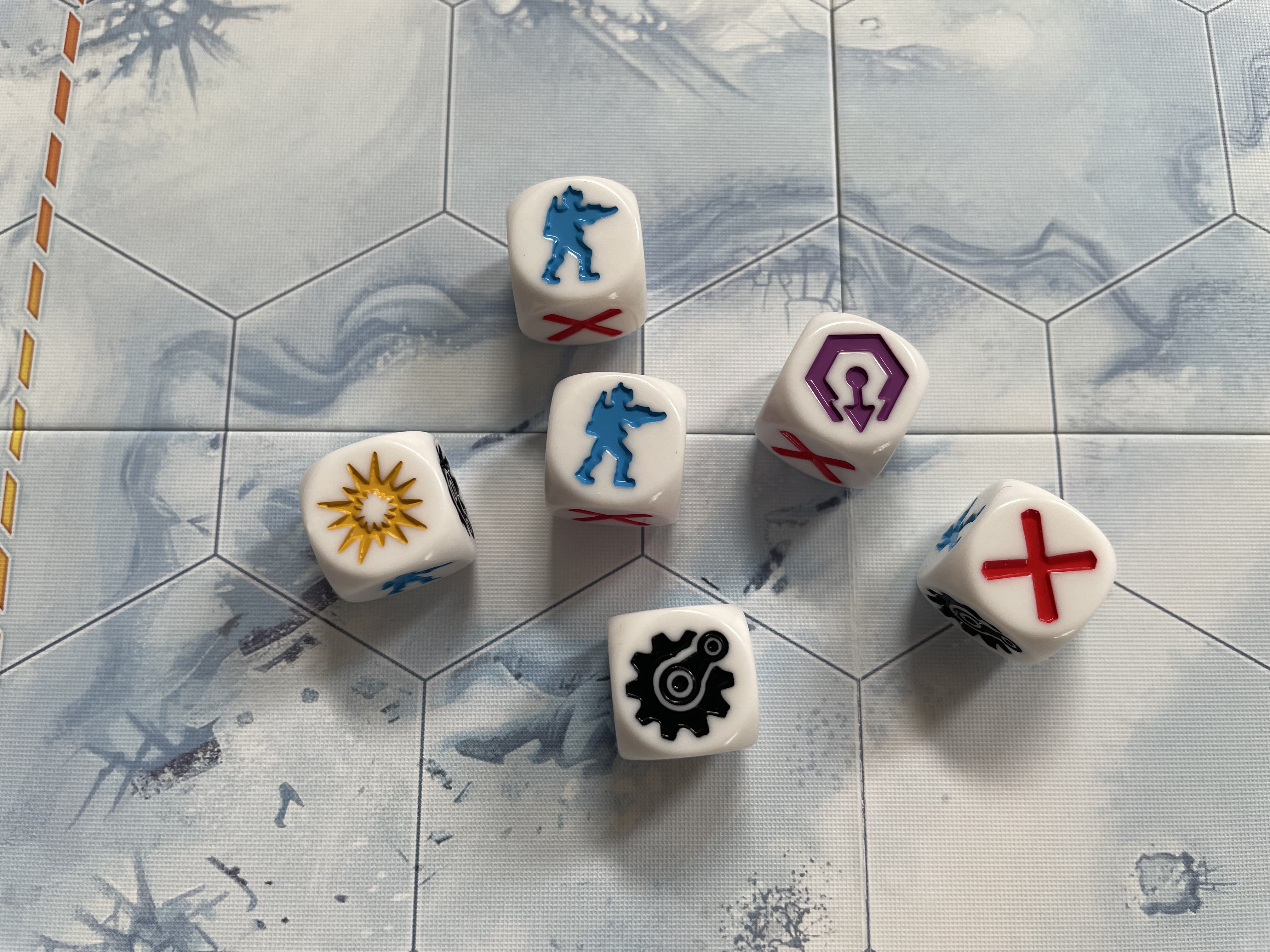
…6 attack dice.
- Plastic (thankfully) and not stickered or wood.
- Yes, stickering older dice was not as simple as it sounds, especially for those with a touch of OCD that had to get every sticker lined un exactly right.
- Different faces generate different results.
- A simple way of hiding probability; the six faces of the die have 2x Trooper icons, 1x Vehicle, Blast, or Cross (Miss) icon, and 1x Retreat icon. We will discuss the impact the different faces of attack dice have later when we talk about combat.
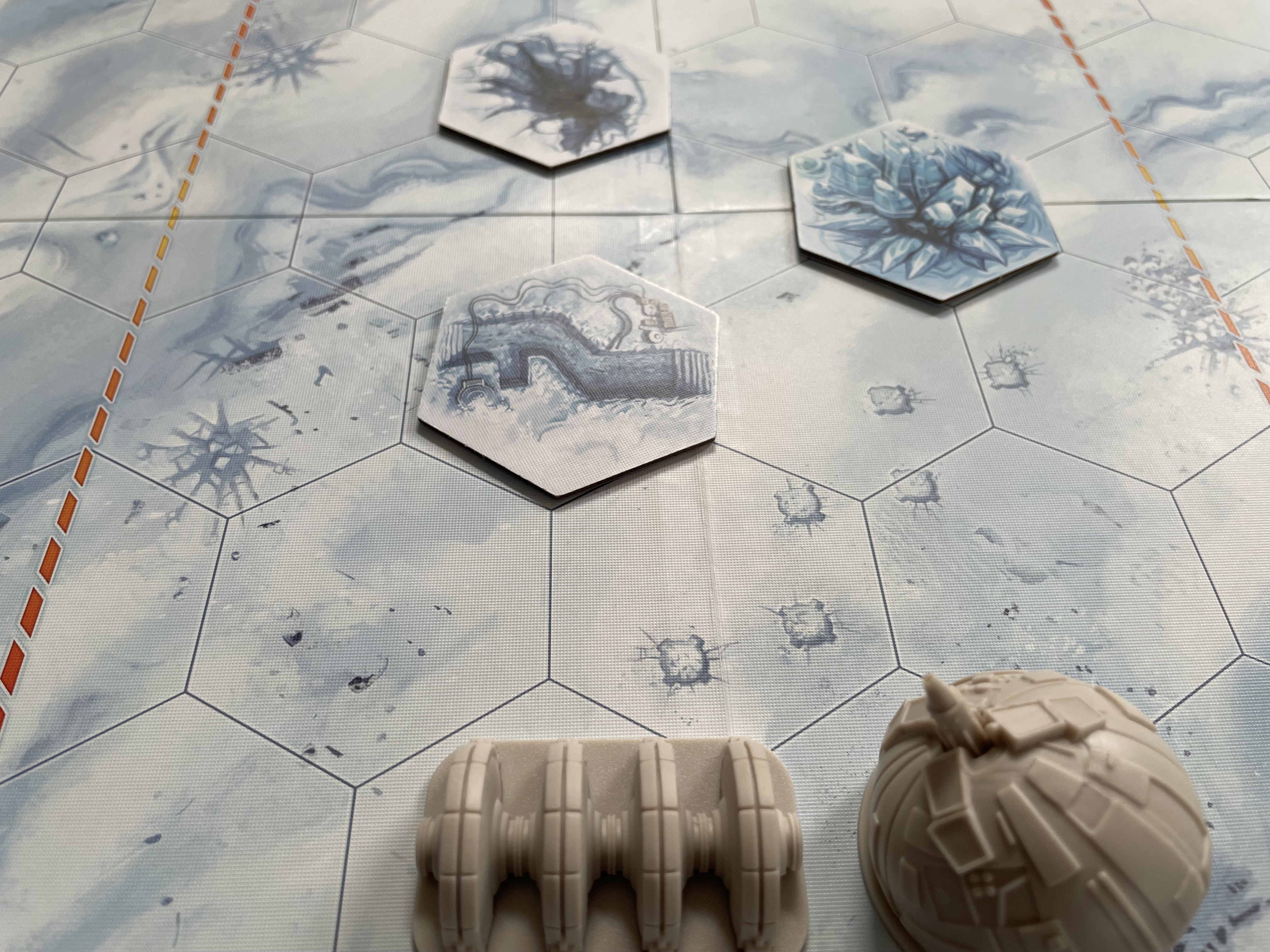
…structure tiles (3) and tokens (16).
- Hexagonal tiles are used to show terrain on the map; a simple, low cost way of marking locations making for grand variety of maps using an simple production model.
- Tokens are used to show medals or other special attributes of units.
- My purchase included a special promo pack with three pieces; 3D structures replacing the Ion Cannon and two Shield Generator tiles.
- Given other units cannot enter hexes with these structures, the three-dimensional models do not interfere with movement or combat (they block Line of Sight); a simple (and fun) way of showing these “key terrain” features.
…cardholder sections.
- Plastic.
- Simple and useful but not necessary.
…printed material including a Rulebook, Scenario Book, campaign booklets, and Player Aids.
- The Rulebook is 12-pages of double-column rules on glossy paper that is laid out and written in a simple to folow manner with full use of color and numerous graphics and illustrations.
- Layout and rules density is so simple one does not even need an index.
- The Scenario Book contains 17 standard scenarios and one Epic scenario that requires a second copy of the game.
- The 17 scenarios follow the Battle of Hoth from a first encounter with Probe Droids through the main engagement and the evacuations after.
- Each scenario is laid out in a very graphics-forward fashion that make it simple to use; indeed, scenario setup is almost language independent.
- There is also a Scenario Editor available online to make your own battles.
- Four campaign booklets (two Rebel, two Galactic Empire) that lay out a campaign series where the result of every game influences the set up of the next.
- Three Player Aids are provided:
- Each player gets a Summary Sheet with simple graphics showing the capabilities of their units.
- A shared Terrain Card shows the rules for the various different terrain features that might be in play.

The overall look and feel of the components of Star Wars: Battle of Hoth is both simple and thematically tied; the product clearly shows a quality in production and extensive use of the IP license. Even before playing a card, moving a unit, or rolling dice, Battle of Hoth simply looks and feels like a Star Wars game “should.”
“Echo station 3-T-8, we have spotted Imperial walkers.”3
Setting up a game of Star Wars: Battle of Hoth as simple as looking at a picture. Each scenario in the Scenario Book has the same five elements of information:
- Scenario Name
- Map showing terrain tiles needed and setup along with deployment of units
- Flavor background text for that battle
- Player rules with number of Command Cards in starting hand, who moves first, and Victory conditions (usually number of medals needed); special rules for each player or the scenario in general also appear here.

In keeping with the simple, introductory nature of Star Wars: Battle of Hoth the variety of units in the game is quite limited. It must be convenient for Days of Wonder that the Battle of Hoth in the movie did not feature an extensive variety of equipment. As a result each side has only three simple unit types:
- Rebel Alliance
- Echo Base Trooper
- Snowspeeder
- Rebel Artillery
- Galactic Alliance
- Snowtrooper (though gray not white)
- AT-AT
- Imperial Probe Droid [Heh heh, the editors missed an “Imperial” I see]

When deploying units in Battle of Hoth, it is important to pay attention to how many figures are in each unit. For example, while both Echo Base Troopers and Snowtroopers are classed as Infantry, a Rebel Trooper unit has only three figures whereas a Snowtrooper unit has four. Some units, like the Rebel Artillery or AT-AT, are single figures. As we will see later, the number of figures is important in the attack segment of a player turn.
While not a separate unit with its own figures, units may also be designated as “Special Forces Unit” by simply adding a badge (game token) to signify a special ability. Of the five different badges in the game, four are simple (usually only one rule) modifications for infantry and one is for Snowspeeders.
Once a scenario is chosen, and setup complete, play in Star Wars: Battle of Hoth proceeds in simple alternating players turns.The flow of each player turn in Battle of Hoth is simple: PLAY a Command Card, MOVE and/or ATTACK with activated units, then DRAW a new Command Card. Players earn medals by eliminating the last figure of an enemy unit or accomplishing some other objective. Victory is usually determined simply by the number of medals collected.

“Attack pattern Delta.”4
A player’s turn in Star Wars: Battle of Hoth starts with the simple play of a Command Card. The scenario rules specify how many Command Cards each side begins with. Command Cards are of two simple types: Section cards and Tactics cards.
Section cards in Battle of Hoth are used to activate one, two, three, or all units occupying a specified section of the map. The game map is divided into Left, Center, and Right areas fro each player’s perspective. Tactic cards, alternatively, allow for special moves or other special actions and are not necessarily tied to section of the map. A Command Card can always be played to activate a single unit in any area if needed.
Command Cards in Battle of Hoth represent, in a very simple and somewhat abstract manner, the command and control efficiency of each side. The more Command Cards in hand the more flexible, responsive, or adaptive that player can be in play.
[In our first play of the introductory scenario, “Imperial Scout Mission,” my Rebel units were driven out of my Right section of the map. Any Command Card in my hand for that section now became, in effect, a low-impact, near-useless, one-unit activation card. Likewise, RMN T commanding the Galactic Empire [the politically correct term I guess] moved the bulk of his force into the Center area but, mid-game, had a dearth of Center-section Command Cards in his hand which slowed down his attack. Most importantly for me, his lack of Center Section cards also prevented him from moving a Probe Droid unit out of danger which allowed my Rebel Troopers to get in range to attack and eliminate for double-medals (a special scenario rule).]
Star Wars: Battle of Hoth also has Leader Cards which are sets of three Command Cards thematically linked to a named leader. The Leader Cards can be added to the Command Card deck for additional command choices. Some early comments on gaming forums complain that the Leader Cards are not very powerful. Looking at the Leader Cards from a broad perspective it is easy for me to see that Days of Wonder wanted to add another appealing thematic element to the game but still keep the game simple. Battle of Hoth is clearly intended to be an introductory wargame and any Leaders, new units, or other rules introduced are likely done to add a thematic elements with minimal gameplay complexity added.
“Coming around, Rogue Leader.”5
Activating a unit in Star Wars: Battle of Hoth means that unit can now MOVE and/or ATTACK. In keeping with the simple nature of the game, movement rules equally simple:
- Rebel Units
- Echo Base Trooper – Move 0-1 hex and attack OR move 2 hexes and no attack.
- Special Rule – Elite Troops can move 0-2 hexes and still attack.
- Snowspeeder – Move 0-3 hexes remaining eligible to attack; can move in/over crevasse hexes.
- Rebel Artillery – Cannot move (fixed in place); attack only.
- Echo Base Trooper – Move 0-1 hex and attack OR move 2 hexes and no attack.
- Galactic Empire
- Snowtrooper – Move 0-1 hex and attack OR move 2 hexes and no attack.
- Special Rule – Elite Troops can move 0-2 hexes and still attack.
- AT-AT – Move 0-1 hexes and attack; cannot move onto ridge hexes.
- Imperial Probe Droid – Move 0-2 hexes remaining eligible to attack.
- Snowtrooper – Move 0-1 hex and attack OR move 2 hexes and no attack.
In addition to clear terrain, there are six other terrain types in Battle of Hoth as well as several structures. Each terrain type/structure is described in terms of effects on Movement, Attack, Protection, and Line of Sight. For example, Trenches effects are:
- Movement – No restrictions.
- Attack: No restrictions.
- Protection – Infantry in trenches reduce all attack rolls by 1 die and may ignore 1 retreat.
As a long time player of Memoir ’44 and other Commands and Colors wargames—all which use the same core game engine movement rules—Battle of Hoth show ruthless simplification of the movement rules. For example, Star Wars: Battle of Hoth has no basic movement rule to advance after combat. Even Memoir ’44 has such a rule, called a “Taking Ground,” that allows an infantry unit in close combat (combat in adjacent hexes) to advance into a hex an enemy unit vacated due to destruction or retreat.

Armor units in Memoir ’44 also have an “Armor Overrun Combat” ability which not only allow an armored unit to advance into a vacated hex but attack again. In Battle of Hoth a similar rule appears not as basic rule but a special rule for Special Forces Units. In Battle of Hoth, A Special Forces Assault (Infantry) unit, when in close combat, may conduct a Breakthrough and advance into a vacated hex…and attack again. This subtle rules change from what was formally a basic rule to a special rule illustrates the simplification of the entire rules set in Battle of Hoth. Mind you, this does not make Battle of Hoth a lesser game, just a simpler one to play.
“I’ve been hit!” 6
To ATTACK a unit in Star Wars: Battle of Hoth is a simple 4-Step process:
- Declare which unit is attacking what target, checking range and Line of Sight.
- Count down number of attack dice to roll.
- Determine terrain modifiers.
- Resolve attack.
When attacking in Battle of Hoth, one unit fires on one target; there is no splitting fire or the like. The unit must be in range of the attacking unit (easy to judge using the simple Player Aid card) and must have a Line of Sight (cannot fire through other units or through certain terrain). The Player Aid card shows the number of dice rolled for a given range and some terrain may subtract attack dice—modifiers found on the simple Player Aid card and Terrain card. Finally, units roll the special d6 and must match certain icons to score hits.
Counting down the number of attack dice rolled in Battle of Hoth is a simple way to show the capabilities of different weapons. Using simply four attack dice and four hexes of range there are a multitude of different weapons effects possible. Battle of Hoth uses three simple weapons effects models:
- ‘Three Count’ – Start with three attack dice and count down using one less for each additional hex of range (used by Infantry).
- ‘Two-Count’ – Start with two or four attack dice and cut in half at two-hex range (Snowspeeders, Probe Droids).
- ‘Four Count’ – Star with four attack dice and count down using one less for each additional hex of range (Rebel Artillery).
- ‘AT-AT Blasters’ – AT-AT attack with three attack dice out to three hexes of range (no step reduction).
As mentioned above, those icons on the attack dice in Battle of Hoth simplify probability. Indeed, it looks like Days of Wonder took Han Solo’s admonishment to, “Never tell me the odds!” to heart.

To review, the six faces of the die have 2x Trooper icons, 1x Vehicle, Blast, or Cross (Miss) icon, and 1x Retreat icon. When attacking, players are looking to roll an icon that matches the target with a Blast icon being an automatic hit. For example, when attacking an infantry unit, a hit is scored with a Blast or Infantry icon which appear on three of six faces—a 50% chance of a hit. An Imperial Probe Droid, however, needs a Blast icon to register a hit which has only a 1-in-6 chance (~18%) of rolling.
Every hit in Battle of Hoth removes a figure from the targeted unit. An important simple rule in the game is that, regardless of the number of figures in a unit, it always attacks with its standard attack dice. There is no “half-strength” or “reduced strength” rules; units simply attack using the standard, normal procedure.
The number of figures in a unit of Battle of Hoth is a simple way of showing the resilience of a unit. While both an Echo Base Trooper and Snowtrooper attack with a base of three attack dice, the Snowtrooper has four figures meaning it takes an extra hit to eliminate the unit. Varying the number of figures in a unit is a great way to show a different unit; for example, Rebel Snowspeeders may be designated as an Elite Squadron (a Special Forces Unit badge) that adds a fourth figure without changing any of the core MOVE or ATTACK rules—a simple way to show a different unit without complex new rules.
I must admit, however, that it is in combat that perhaps the most complex rule in the Battle of Hoth appears. It starts with the AT-AT unit which is a single figure. An AT-AT is hit on a Vehicle or Blast icon (33.3% chance) and, using the standard simple rules, would be removed with a single hit. Thematically that does not work; the AT-AT is supposed to be a heavily armored behemoth of the battlefield that even the heavy blasters of Snowspeeders or Rebel Artillery had a hard time handling. To reflect the difficulty of scoring hit on an AT-AT vehicle, every hit must be “confirmed” by rolling an additional die with a Blast icon result confirming the hit. Mathematically, that means when rolling a single die (~33.3% chance of hit) which must be confirmed (1-in-6 chance or ~18%) the overall chances of eliminating an AT-AT starting with a single attack die is ~6%—a very thematically believable set of odds. [It is hard to convey sarcasm in the written word so I hope you caught on that my assertion the hit confirmation process is the “most complex” rule in Battle of Hoth really means that even the “most complex” is still extremely simple.]

Before leaving this combat discussion one also needs to understand the retreat rules in Star Wars: Battle of Hoth. The retreat rules in Battle of Hoth are yet another example of the ruthless simplification of the core game engine. In combat, for every Retreat icon rolled the attacked unit must retreat (move towards their baseline) one hex. If the retreat path of a unit is blocked or it would exit the map a figure must be removed for each Retreat icon not otherwise satisfied.
The simple retreat procedures in Star Wars: Battle of Hoth also highlight for this grognard where the rules not only for Battle of Hoth but other games using the Memoir ’44 or Commands and Colors game engine have simplified over the years. The simple retreat rules in Battle of Hoth and the absence of a “Battle Back” combat rule in particular stands out to me. I recall the “Battle Back” rule appearing in the first edition of Battlelore in 2006 and in Commands and Colors: Ancients also dating back to at least 2009. Here is the rule from Ancients:
Battle Back: In Close Combat, the defending enemy unit may Battle Back against the attacking unit if one or more of the defending unit’s blocks survived the Close Combat attack and the defending unit did not retreat from its hex.
If the defending unit is forced to retreat out of its original hex, it may not Battle Back, even if the retreat move leaves the unit in a hex that is still adjacent to the attacking unit.
If the defending unit was unable to fulfill a required retreat, it may Battle Back as long as it still has one or more blocks remaining on the battlefield after taking losses (see Retreat).
During a Battle Back, the unit determines any terrain battle dice reduction, and resolves Battle Back (roll battle dice and apply hits and retreats) in the same manner as the attacker.
In the first edition of Battlelore the rule reads this way:
BATTLE BACK
In Melee combat, any defending unit that may ignore a flag (i.e. any unit whose morale is Bold ) at the time of its attack is entitled to Battle back. It may fight back as soon as the attacker’s dice roll is completed and fully resolved, assuming it survived the initial assault and did not vacate the hex it was standing on.
The Star Wars: Battle of Hoth rules showcase how the core game engine of Memoir ’44 or Commands and Colors can be simplified. While looking at specific rules like “Battle Back” that disappeared over the years is one way of judging simplification, perhaps the most simple approach is to look at the page count of a rulebook. The first edition of Battlelore from 2006 is an 80-page tome. The third edition Commands and Colors: Ancients rulebook from 2009 is 24 pages. The current rulebook for Memoir ’44 is 17-pages. By comparison, the 12-page rulebook for Battle of Hoth really is a simple version of the core game.
It is also though combat that Victory is determined in Star Wars: Battle of Hoth. Score enough medals to win and the game ends…immediately. Medals are a simple, direct way of showing victory.
[In every game of Battle of Hoth or Memoir ’44 or Commands and Colors I ever played the visible medal scoring track serves as a simple and obvious sign of progress towards victory. The simplicity of the track also conveys great psychological pressure. For example, in our first Battle of Hoth game, RMN T and I were tied at 3 medals apiece; a fourth meant automatic victory. I could see that each of us had three medals but I could also see that my Rebel troops were being picked off at a very unfavorable exchange rate. Desperate times called for desperate measures.]
“Send all troops in Sector 1 2 to the south slope to protect the fighters.”7
A player turn in Star Wars: Battle of Hoth ends with the the player drawing up their hand of Command Cards back to their limit. This simple administrative activity inevitably leads to a new planning cycle for each player. With a full hand of cards the question becomes, “What do I do next?” The Command Cards clearly impose limits on what is in the realm of the possible. In this case the simplicity of the Command Cards leads to greater strategic complexity—what I like to call “simple-complexity”—because the Command Cards limit the options available to players. The player must, indeed, take the “hand they are dealt” and try to accomplish their mission.

“Hoth was the worst day the Rebel Alliance suffered in the entire war. It was the day when their base and significant members of their leadership were destroyed, captured, or killed. But that isn’t entirely what happened.”8
With simply seventeen scenarios, variable terrain, multiple unit variations, and Leader or Support card options, the replayability of Star Wars: Battle of Hoth is already quite high. Many Star Wars fans, however, are not simply satisfied with taking part in a moment of lore, but really enjoy making decisions that can change lore (though they usually revert to canon, no matter how sullied it has become). To placate both rabid fans and wargamers who look for more than just set-piece battles, two campaigns for Battle of Hoth are provided. Each campaign is, in effect, a “win your way to a story” adventure. Each campaign starts with a standard Chapter A battle but the result—Alliance or Galactic Empire victory—leads to a different story branch. The end result is a three-or four-battle campaign series. Simple.
But wait, there’s more!
While each battle in a campaign for Battle of Hoth is unique, the rules also add Leader or Support cards at different stages of the campaign. Again, a simple variation is setup provides potentially radically different games from an otherwise a common setup.
It is also in a campaign for Battle of Hoth where a Support cards are introduced. Support cards are in a separate deck from Command Cards and can be used in specified situations. For those familiar with Battle cards in some Commands and Colors games the Support cards will be familiar. A Support card usually bends some rule in some specific way, usually in a very thematically appropriate manner. For example, the Galactic Empire Support card “Scout” activates one additional infantry unit and is played after units are ordered with a standard Command Card but before MOVE and ATTACK actions occur. Simple rules for simple thematic impact.
“Hoth had been a costly loss, but without Rieekan’s careful preparations and quick action, things would have been much worse”9
From a player perspective, Star Wars: Battle of Hoth is not very costly; for $60 there is actually plenty of game inside the box. Preparing to play is simple as the rulebook and scenario books were carefully prepared to make learning easy. The simplified game mechanisms also ensure that every game of Battle of Hoth is quick to play yet delivers a highly thematic experience.
From a game design perspective, Days of Wonder carefully simplified the versatile Memoir ’44 or Commands and Colors game engine originally designed by Richard Borg into a lite or “simple-easy” wargame. I appreciate the fact that Battle of Hoth is NOT simply a reskinned Memoir ’44. Broadly, Battle of Hoth shares the same game design DNA as Memoir ’44 making it a very easy-to-learn, easy (and fun)-to-play, lite wargame. Compared to Memoir ’44, however, Battle of Hoth is a simplified version of that core game engine.
The streamlined rules in Star Wars: Battle of Hoth has two immediate—and simple—consequences; on one hand the game sets up and plays very fast—the projected 30 minute game time is a very realistic number. On the other hand, the depth of game play is less than a comparable Memoir’ 44 game experience. That is not to say that Battle of Hoth is a lesser wargame; in fact, the simplification allows for a focus theme that carries the game forward into highly enjoyable areas. From the perspective of table presence, the simple figures make it very clear that this is a Star Wars game. The game engine, though simple, delivers highly thematic action.

“Hoth should of been a decisive moment for the Empire in the Galactic Civil War. Instead the repercussions reverberated throughout the Imperial military at all levels.”10
Shown above is the final card played in our first game of Battle of Hoth. Out of a Rebel force that started with seven full-strength, three-figure units, a mere four units (two with a single figure) is all that I had left. Compare that with the bulk of the Galactic Empire’s force where four units (three at full strength) are relentlessly advancing after being slowed by poor command coordination mid-game (a dearth of Center-area Section cards you recall). Going into this turn both sides had three medals—the next medal determined the winner. As the Snowtroopers advanced the Command Card “Defensive Position” entered my hand. This Tactics card orders any three units which cannot move but attack with one extra die. Desperately, I played the card to activate my three reduced units to attack a full-strength (four-figure) Snowtrooper unit that was between the two-figure Snowtrooper and Rebel units. The first attack roll at range one rolled four attack dice and two others at range two rolled two attack dice each. As luck would have it, of the six dice rolled there were four hits (Infantry or Blast icons) and no Retreat icons which eliminated the Snowtrooper unit for the win. RMN T’s response to my final, desperate stand and die rolling was a simple, “Well, the force was with you.” You simply can’t get much more thematic—nor more dramatic—than that.
- Kempshall, Dr. Chris (2024) Star Wars: The Rise and Fall of the Galactic Empire. DK Books, p. 259. ↩︎
- The Empire Strikes Back. ↩︎
- The Empire Strikes Back. ↩︎
- The Empire Strikes Back. ↩︎
- The Empire Strikes Back. ↩︎
- The Empire Strikes Back. ↩︎
- The Empire Strikes Back. ↩︎
- Kempshall, p. 259. ↩︎
- Fry, Jason (2012) Star Wars: The Essential Guide to Warfare. Ballantine Books, p. 174. ↩︎
- Kempshall, p. 266. ↩︎
Feature image courtesy RMN
The opinions and views expressed in this blog are those of the author alone and are presented in a personal capacity. They do not necessarily represent the views of U.S. Navy or any other U.S. government Department, Service, Agency, Office, or employer.
RockyMountainNavy.com © 2007-2025 by Ian B is licensed under CC BY-SA 4.0
 Rocky Mountain Navy Gamer