
There are more than a few popular topics in wargames. Here in the United States there are many historical wargames on the topic of the Battle of Gettysburg or the Battle of Midway or the Battle of the Bulge. When it comes to modern wargames—or “future-history” as SPI called them—the coming Battle for Taiwan is a hot topic with wargames such as Next War: Taiwan (Mitchell Land, GMT Games, 2012) or Littoral Commander: Indo-Pacific (Sebastian Bae, The Dietz Foundation, 2023) or Joint All Domain Operation (War Drum Games, 2024) amongst the many titles. Bonsai Games jumped onto the Battle of Taiwan wargaming bandwagon in 2025 with a new title on the Battles for Taiwan, but from a historical angle that nonetheless can inform wargamers interested in modern or near-future warfare.
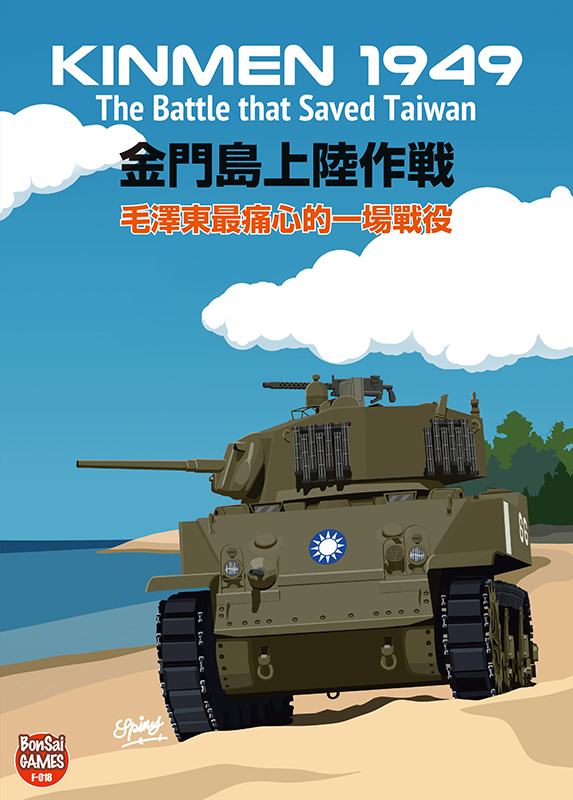
Kinmen 1949: The Battle that Saved Taiwan is a 2025 reprint of a 2019 magazine game (Banzai Magazine Nr. 3) designed by Yasushi Nakaguro. The titular battle is also known as the Battle of Guningtou and was fought in late October 1949.
Invasion in ’49
In the autumn of 1949, the Republic of China Armed Forces (ROCAF)—which would soon become better known as the military of Taiwan—suffered a series of military defeats on mainland China. After the fall of Beijing, communist forces established the People’s Republic of China (PRC) on 1 October 1949. In response, the ROCAF withdrew from the mainland and retreated to Taiwan or islands off the coast of southern China. Amongst those islands was Kinmen. The communist forces wanted to subjugate Kinmen in no small part because it controlled access to the strategic harbor at Xiamen.

The People’s Liberation Army (PLA) 10th Army Group’s 28th Corps (roughly 35,000 troops) was tasked with taking Kinmen. The PLA estimated Kinmen was defended by approximately 20,000 troops with a few tanks but were demoralized and otherwise low on supplies. The PLA estimated they needed about 800 fishing boats to transport the invasion force but after many fishing boats fled and others were attacked by ROCAF air assets the invasion went ahead with only about 300 boats.
The PLA was not ready for the real defenses of Kinmen. As Vermilion China writes in “PLA Amphibious Ops Series: EP1 – Battle of Kinmen”:
Little did PLA planners realize that the true ROCAF troop count on Kinmen numbered approximately 40,000 soldiers reinforced by a light tank regiment (1st Battalion, 3rd Tank Regiment) consisting of 21 US produced M5A1 Stuart light tanks. These tankers were seasoned veterans of the WWII Burma campaign. Hard combat experience fighting against the Japanese was to serve as an excellent guide to 1/3 tanks leadership. Additionally, the Kinmen garrison spent significant time constructing over 200 bunkers and lined the shores with nearly 7,500 landmines. ROC troops were prepared for the coming storm.
The invasion of Kinmen began on the night of 24 October 1949 with the first of a planned two-wave amphibious assault. On this night luck was certainly on the side of the Taiwanese defenders. As Vermilion China explains:
During the previous day on October 24th, several M5A1 light tanks were conducting anti-invasion exercises along the beach directly north of Qionglin. During these exercises, one of these tanks (Tank 66) got stuck in the sand and was unable to move all night until it was pulled out at 0300 on the 25th. This meant that it was coincidentally directly in the path of the PLA 244th Regiment during their landing. When the PLA landed at Qionglin, the tankers heard their movement and then saw the enemy boats when the signal flares were fired. The commander of Tank 66 began to open fire on the enemy, ripping through PLA ranks with the 37mm main gun and .30 caliber machine guns.
By sheer luck, a shell from 66’s main gun hit the mast of one of the transports and ignited the sail. The fast Kinmen winds spread the fire across multiple boats, providing illumination for the defenders. PLA troops assaulting up the beach were perfectly backlit by their own burning boats while attempting to identify ROC positions covered in darkness. Shortly after Tank 66 opened fire, it was joined by two additional tanks from its platoon. The tank fire completely halted the 244th Regiment’s advance at Qionglin and forced the regiment to begin moving north towards Longkou.

The Battle of Kinmen was more than just a combined arms battle ashore. The young ROCAF Navy got in on the action too. Again Vermilion China explains:
ROC navy warships also played a critical part in the battle, but it was only a twist of fate that led the vessels to be present on that day. Two days before the assault, the officers and sailors of the Zhongrong, a tank landing ship (LST), purchased brown sugar in Taiwan to sell in Zhejiang. However, at the last minute the ship’s destination was changed by ROC HQ and the Zhongrong received orders to transport elements of the ROC 19th Army to Kinmen in order to bolster defenses.
The Zhongrong arrived at Kinmen on October 24th. The crew, realizing they were unable to continue on to Zhejiang, opted to trade their brown sugar to Kinmen locals in exchange for peanut oil. Unfortunately for the ROC sailors, Kinmen had an insufficient amount of peanut oil on hand and the Zhongrong would have to stay an additional day to load the remaining balance. This ironically put them in prime position to assist the defenders in the early hours of October 25th.
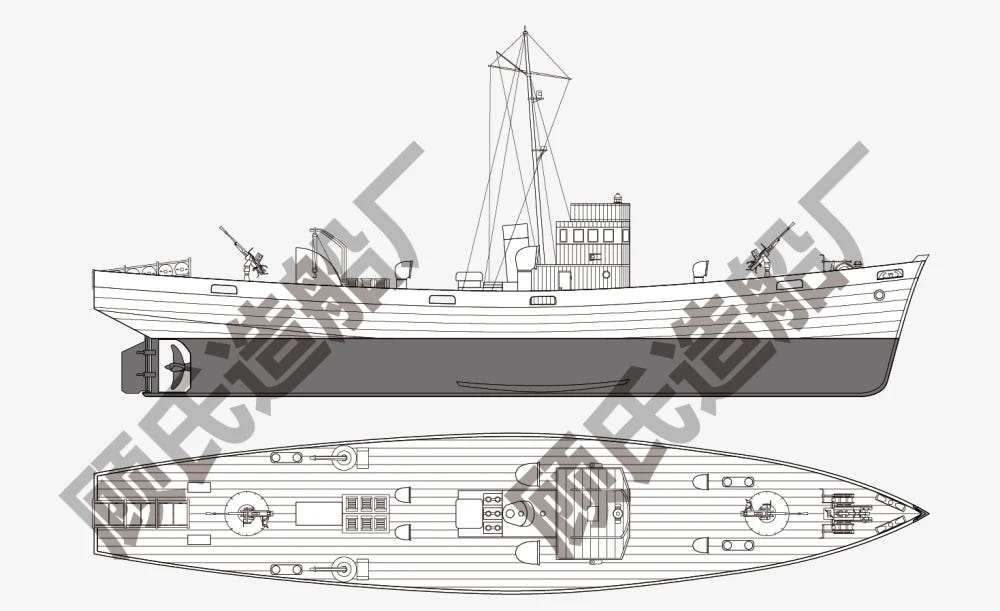
At approximately 0230 the Zhongrong and the Nan’an (a 150 ton light gunship) swung around the northwest coast of Kinmen to join battle. The vessels employed their Bofors 40mm anti-aircraft guns, 20mm cannons, and machine guns to annihilate the remnants of the 251st and 253rd Regiments strung along the beach. Crucially, PLA planners did not heed the pleas of the fisherman and landed during high tide, stranding many of the troop transports along the Kinmen mud flats. The Zhongrong and Nan’an, now joined by the Hui’an, another light gunship, proceeded to destroy stranded vessels along the coast one by one. The forsaken first wave was forced to bide its time.
Even the ROCAF Air Force got in on the action:
As the ground battle continued, the ROC utilized an additional advantage, complete domination of the skies over the Kinmen and the surrounding operating environment. A local infantry commander was a prior air force officer who functioned as a forward observer. He used this experience to successfully direct air strikes against PLA troops throughout Kinmen. The Air Force also destroyed additional transport ships and raided PLA outposts along the shores of Xiamen, further diminishing any hopes of a second wave from the PLA 28th Corps.
By the 26th of October the beleaguered PLA attackers were backed into the towns of Guningtou and Lincuo. It was this day of battle where the legend of the “Bear of Kinmen” was born:
The aerial bombardment of the town continued throughout the day and fighting between the PLA and the ROC continued with heavy urban combat and hand to hand fighting as both sides ran low on ammunition. According to the legend of the “Bear of Kinmen” (金门之熊), the M5A1 Stuarts ran out of ammunition and proceeded to drive through the town, running over PLA soldiers and creating gaps in their lines for the ROC to advance through. The PLA forces lacked anti-tank equipment and failed to stop the ROC tanks with small arms and grenades. By 2200 on the 27th, the remaining PLA troops evacuated the town and made their last stand on the beaches to the north of Guningtou. Here they exhausted the remainder of their ammunition and were surrounded by ROC forces. After taking approximately 400 casualties on the beach alone, the remaining soldiers surrendered and ROC troops began to mop up the rest of the island.
Of the 9,086 PLA soldiers who fought on Kinmen, 5,175 were captured and the remainder were killed in action. None returned from the battle. The ROC, while victorious, suffered 1,267 killed in action with an additional 1,982 wounded.
Kinmen as a paper time machine
Designer Yasushi Nakaguro admits that the historical Battle of Kinmen is almost a guaranteed win for the ROCAF player. Instead of strictly recreating the scenario, in Kinmen 1949: The Battle that Saved Taiwan Nakaguro looks at some “what if” situations:
Looking back at history, the landing operation was bound to fail. However, it’s not entirely devoid of “what-if” elements. What if the Chinese military had prepared more landing craft? What if command and control had been more effective? What if they had chosen a different beach for the secondary landing? By incorporating these “what-if” scenarios into the game, this work gives the Chinese military a chance to achieve victory.
1.0 Introduction

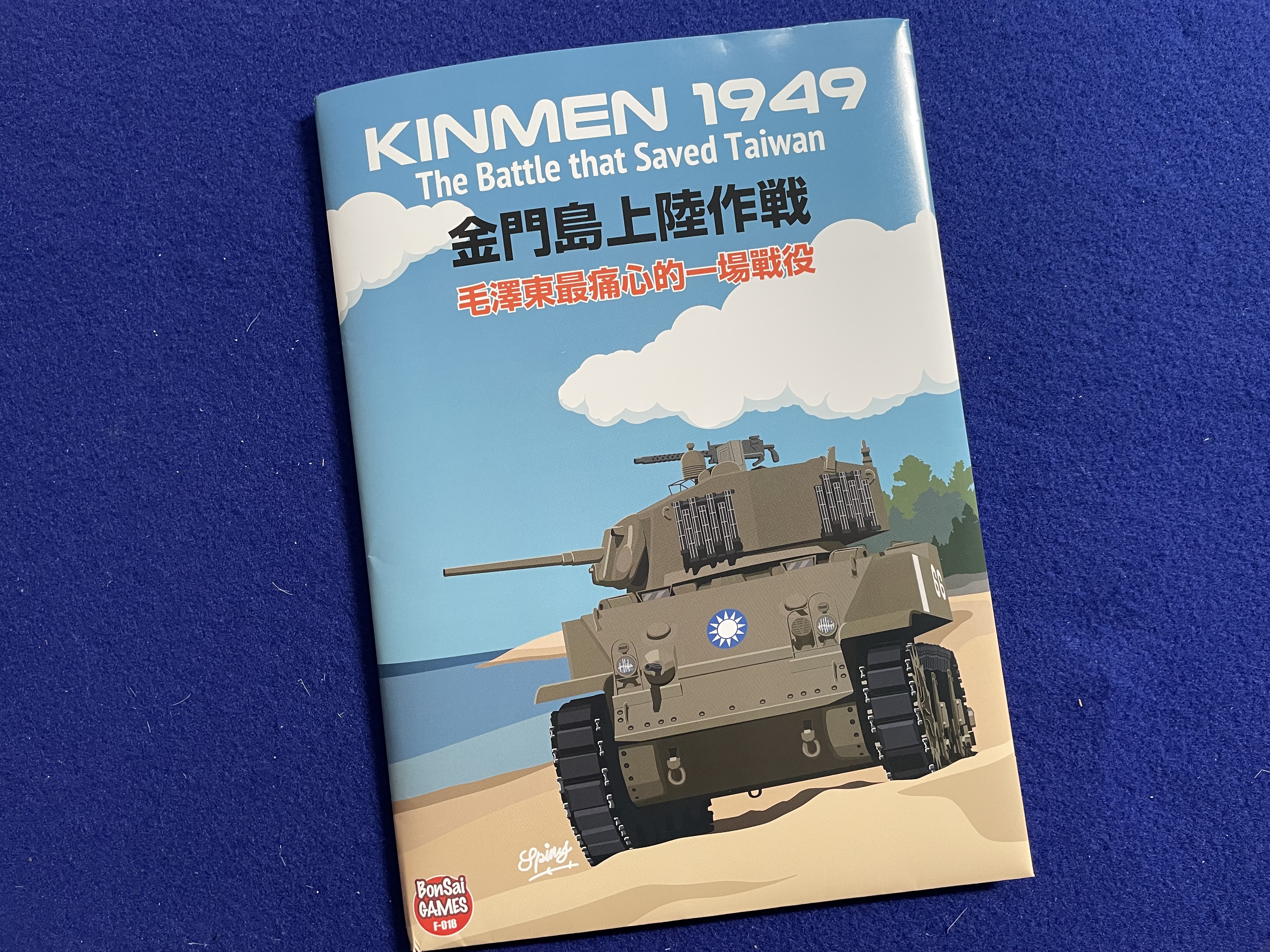

As befits a folio game, Kinmen 1949 is light on components. The paper cardstock map is landscape orientation at 16.5″ x 11.75″ and shows the western portion of Kinmen. Like many Bonsai maps the various charts and tables are arranged around the edge of the hex map to facilitate players sitting opposite each other. There are 99 counters for units and markers and two single-page player aids. The glossy-print rulebook is 20 double-column pages printed in full color with excellent graphics. The actual rules for Kinmen 1949 are covered in nine pages with an Example of Play on two more and the balance given to historical commentary.


Kimmen 1949 is played on a game map using hexes covering 750 meters. Each unit is a battalion or company of tanks. Air power for the Taiwanese player and artillery support for the Chinese player are represented by abstract markers with a game effect. Each turn covers one day of the battle.

The Sequence of Play for Kinmen 1949 is very simple:
- Chinese Military Landing Phase
- Weather Decision Phase
- Strategy Phase
- Chinese Military Operation Phase
- Taiwanese Military Operation Phase
- (Repeat Operations Phases until both armies Pass)
- Night Phase
Taken as a whole, the core game mechanisms in Kinmen 1949 are very wargame-classic standard. Units in Kinmen 1949 move using movement points and a very standard Terrain Effects Chart. Combat is odds-based with few modifiers. The standard game scenario is three turns (three days) long though there is a option that can take the game into a fourth turn or day. Victory is determined by Victory Points (VP). The Chinese player earns VP by occupying towns and eliminating more ROCAF units then the PLA loses. The Taiwanese player earns VP by not allowing the PLA to occupy towns and destroying more PLA units then the ROCAF loses. The Chinese player can also give up VP to the Taiwanese player if using a Strategic Option (see below).
The most interesting aspect—and game design twist—in the design for Kinmen 1949 is the use of Chinese Strategic Options. At game setup, the Chinese player draws three of six possible option chits; the three drawn are options are available for use in the scenario. If the Chinese player draws an eligible Strategic Option and wants to use it there is a VP penalty that must be paid.

Lessons
Vermilion China lays out ten lessons from the Battle of Kinmen (see below). From Vermilion China:
- The assaulting force must command the skies and the sea around landing zones and objectives.
In 1949, the PLA “navy” largely consisted of fishing boats and junks. This “People’s Flotilla” (their term for requisitioning civilian vessels) would have to suffice for a few years before the PRC could produce or procure warships. As a result, the PRC had little ability to control the seas around the landing zone. While the PLA did have a fledgling air force, the majority of the PLA’s planes were in Beijing for military parades that took place earlier in October.
The combination of these two factors meant that the invasion force was completely exposed to ROC combined arms with little ability to react.
- Amphibious operations require an extensive study of local hydrography, weather patterns, and terrain.
It is obvious, but planning and executing an amphibious operation is not similar to standard ground warfare of the type conducted by the PLA during the Chinese Civil War. It is quite literally planning a ground action upon the changing, chaotic sea. The PLA did not account for shifting tides, extended mud flats, or high winds cutting across the landing areas. These natural features blunted the assault’s initiative and caused confusion and casualties during the landing phase. To compound the PLA planners’ mistakes, even normal ground planning factors were not considered, such as night illumination, obstacle reduction, and fire support.
- Land the heaviest weapons as early as practical.
The key component of amphibious assault is the ability to rapidly build up combat power at the landing zone in order to achieve breakout. To accomplish this, the landing force must be tailored to meet potential challenges immediately at the landing zone and have the equipment necessary to overcome superior enemy positions and firepower. The landing force, regardless of whether the operation will be an amphibious landing or amphibious assault, must be packed and then unloaded at the beach as if the operation were an assault. At Kinmen, the PLA knew that tanks were a possibly yet opted to send their anti-tank weapons in the second wave. As a result, the assaulting force had no ability to counter the M5A1 Stuarts of 1/3 tanks.
- Have a marshaling plan.
Amphibious operations often utilize hundreds of ships. Each vessel needs to have clear guidance on where they are going and what they need to do once they get there.
In the case of Kinmen, there was no plan once the troop transports reached a designated rally point and units were mixed together, with many troops landing on the wrong beaches. Additionally, there was no plan to recover the transports once they unloaded. PLA staff were relying on civilian coxswains to bring the boats back for the second echelon.
- Plan for the catastrophic loss of the first wave.
Amphibious operations are inherently volatile. It is entirely possible to lose most of the first wave but still end up victorious. During Operation Overlord, the amphibious invasion of Normandy by the Allies during WWII, Omaha beach landing companies of the 29th Infantry Division suffered 90%+ casualties. The men and material landing first must be completely written off during planning. The PLA violated this dictum and counted on first wave boats returning to ferry second wave troops.
- Have a unified command.
An assault force must have a unified command structure so adjacent units are able to deconflict and/or work together to seize objectives. At Kinmen, the three PLA regiments had three separate commands, meaning that there was no coordination and each unit was fighting a battle independent of the other assault forces.
- The objective must be isolated.
Recon, isolate, seize a foothold, secure the objective. These are inherent components of an offensive scheme of maneuver and hold true in an amphibious assault as well. The PLA did not isolate their objective and the ROC had freedom of movement on, around, and to the island. This allowed defenders to flow freely throughout the island and maneuver around the assaulting force. This led to the PLA’s own isolation and ultimate crushing defeat.
- Communications must be established between beachhead forces and the rearward headquarters until C2 can be established ashore.
Once the assault force is ashore, the command element must establish immediate communications with headquarters and update them on the status of the assault. This will allow them to coordinate/reposition fires and supporting elements to better assist the assault. The PLA had no coordinated communications and they were not able to provide accurate battlefield estimates to headquarters.
- The assault force must have overwhelming quantitative superiority and outnumber the defender 3:1 at the absolute minimum.
There is an axiom of attack that gives an advantage to defenders by a margin of 3:1. This means that in order to overwhelm defenders and ensure victory, attackers must bring at least 3x the number of combat troops. At Kinmen, the first wave put the ROCAF quantitative advantage at 4:1 over the PLA. The total advantage of the ROCAF over the PLA was by a margin of 4:3. By numbers alone the PLA had little chance of success.
- Complex military operational objectives cannot be subordinated to political strategic timelines.
Operational timelines cannot be tied to arbitrary political timelines. This causes mistakes that will ultimately render a military unable to achieve its objectives.
Mao’s sense of urgency, partially tied to a notion that the US would get involved in the war, caused PLA commanders to speed up their operational timelines. This meant that they did not have adequate resources to achieve their operational goals and this set back the entire communist strategic timeline.
From paper time machine to entertaining analytic tool
Each of the ten lessons presented by Vermilion China can be experienced to some more or lesser degree in Kinmen 1949: The Battle that Saved Taiwan. More sanguinely, each of these ten lessons should be considered as part of any study on the possibility of a future invasion of Taiwan. The Strategic Options in Kinmen 1949 allow players to experiment with a range of “what if” scenario alterations to see if they can keep (for the Taiwanese player) or change (for the Chinese player) the historical outcome.
Kinmen 1949 is not a complex or complicated wargame. Indeed, it is the simplicity of play that makes the game very approachable. The use of Strategic Options is the real appealing factor of the game design. The Strategic Options, though few, are more enough to make every game sufficiently different to keep the game interesting play after play.

At the time of this posting, Kinmen 1949: The Battle that Saved Taiwan is available through Bonsai Games and retails for 3,520 Yen. If you are print-n-play type, one can also purchase an electronic (pdf) version of Banzai Magazine Nr. 3 to see the original game.
Chinese Version?
Interestingly, designer Yasushi Nakaguro mentions that a Chinese version of Kinmen 1949 was printed and released following the initial 2019 magazine edition. I have no insight into how much the game was altered, if at all, to be “acceptable” in the Chinese market. Perhaps the game was viewed as acceptable because the “what if” changes give the PLA a chance of victory unlike the historical outcome. Given recent issues raised by US wargame publishers over not using Chinese printers for Taiwan-related or other China-themed games makes one wonder how much the core issue preventing printing in China is over theme or an inability/unwillingness to make alterations—or perhaps something more akin to anti-Americanism.
Feature image courtesy Vermilion China
The opinions and views expressed in this blog are those of the author alone and are presented in a personal capacity. They do not necessarily represent the views of U.S. Navy or any other U.S. government Department, Service, Agency, Office, or employer.
RockyMountainNavy.com © 2007-2025 by Ian B is licensed under CC BY-SA 4.0
 Rocky Mountain Navy Gamer
1 thought on “Wargame SITREP 25-21 ~ Wargaming the battle to save Taiwan – Kinmen 1949 (Yasushi Nakaguro, Bonsai Games, 2025)”