
History of Wargaming Project
Wargame practitioners cannot give enough praise and thanks to Dr. John Curry and the History of Wargaming Project:
The Project aims to research and publish key works in the development of professional, hobby and educational use of wargaming. It currently includes work from Donald Featherstone, Fletcher Pratt, Peter Perla, Phil Barker,Fred Jane, Charles Grant, Stuart Asquith and Terry Wise…
http://www.wargaming.co front page
The most recent title in this continually-growing series of books I acquired is Cold War Nuclear Wargaming 1947-1991: Professional Wargaming of Dark Themes. Curry’s blurb for the book is fascinating:
During the Cold War, more accurately known as the First Cold War from 1945 to 1991, wargames were a staple in the military, political, and industrial sectors. This book delves into a seldom-explored area of literature: nuclear wargaming. It features a variety of professional wargames from that period, including Tom Schelling’s classic crisis game set in Cold War Berlin, which often incorporated nuclear war scenarios, Dr. Paddy Griffith’s strategic nuclear wargame, and decision-making games for political leaders facing the ultimate choice of whether to resort to nuclear options in response to a Warsaw Pact invasion of Europe. Additionally, it includes extracts from tactical nuclear wargaming rules used by the British and American military in their land wargames, as well as a civil defence exercise addressing the challenges of local government managing the transition to war and the immediate post-strike period.

Cold War(gamer)
As with most all History of Wargaming Project studies, the first part of the book introduces the reader to the context within which the subject games are set. In the case of Cold War Nuclear Wargaming Curry uses the forward to discuss three common use-cases for nuclear wargames in the Cold War:
While the military used these games to simulate the use of force, the military-industrial complex engaged in wargames to aid in decision-making for weapons projects and to market the final products. Less commonly known, however, were the wargames conducted for politicians and foreign policy officials. Some of these focused on nuclear weapons, which is the central theme of this book.
Curry, p. 7
Wargamers—hobbyist or practitioner—reading Cold War Nuclear Wargaming interested in nuclear aspects of the Cold War will find a plethora of books and wargames referenced within the Forward and Chapter 1, “The Nuclear Option in Hobby Games.” For books, Curry makes sure to go back to General Sir John Hackett’s The Third World War: A Future History from 1978. Other titles are mentioned, though wargamers might be surprised to not see the likes Tom Clancy’s Red Storm Rising or Harold Coyle’s Team Yankee mentioned almost certainly because those stories do not include the use of nuclear weapons. Instead, wargamers might be surprised to see James F. Dunnigan’s How to Make War: A Comprehensive Guide to Modern Warfare from 1982 appear instead.
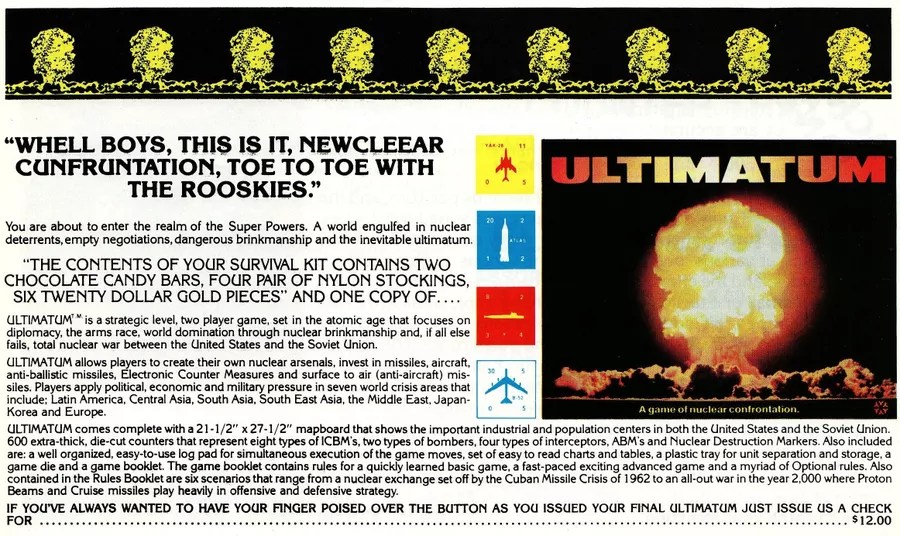
Likewise, more than a few hobby (i.e. commercial) wargames are mentioned amongst which one can find titles ranging from the 1974 wargame The East is Red: The Sino Soviet War to the 1979 Ultimatum: A Game of Nuclear Confrontation to the 1983 NATO: The Next War in Europe to Twilight Struggle from 2009 up to Fail Safe: Strategic Nuclear Warfare in the Cold War published in 2013.
Nuclear war according to the professionals
The core content of Cold War Nuclear Wargaming 1947-1991 is seven “professional”—or what I prefer to call “practitioner”—wargames. These include:
- “Gaming Strategic Confrontations: Tom Schelling 1961” is a Thomas Schelling game from 1961 with Berlin Crisis scenarios.
- “Strategic Nuclear Wargame (1980)” is an technically undated (likely 1980) design by Dr. Paddy Griffith .
- “British Tactical Nuclear Wargaming Rules (1956).”
- Excerpts from US Army Field Manual (FM) 105-6-3 Nuclear Play Calculator from April 1964.
- “The Button: Nuclear Decision Making” is another Paddy Griffith design from 1980 that was previously classified.
- “The Envelope: Executive Decision” is an undated short staff college problem where the players simulate the new political leadership of the UK and have to write their Letters of Last Resort to the submarine launched ballistic missile force.
- “Exercise Hard Rock: Civil Defense” is a first-time published wargame focusing on the civilian experience in a nuclear exchange.
Each wargame has rules that ranges from detailed to bare bones and are likewise from simple to complex in technical depth. Some are “committee games” while others are “manual simulators.” All are excellent exemplars—though admittedly Europe or NATO-centric—of the perils and challenges of managing or conducting nuclear conflict. Some, like FM-105-6-3 could assist in designing game mechanisms. Others, like “The Button,” are far more political; perhaps serving as a core element of a random event in a larger wargame.
Cold War redux
Dr. Curry makes the point—several times—that the focus of Cold War Nuclear Wargaming 1947-1991 is the “first Cold War (1947-1991).” Curry also goes as far as to share how they see nuclear wargaming, be it in a committee room or a simulator, relating to nuclear war fighting:
It should also be said that the topic of nuclear war fighting is contested, even experts disagree about the effectiveness of various strategies. My understanding, such as it is, has been informed by extensive reading, but developed by the tools of wargaming. Personally, I find that modeling the complex situation through designing and running wargames involving nuclear as a superior tool to just talking about the topic.
Curry, p. 13
On that final point I wholeheartedly agree with Dr. Curry. Cold War Nuclear Wargaming 1947-1991 is not just peek at historical wargames from practitioners that for too long were squirreled away in archives, but valuable insight into the different wargames that helped shape military and political leaders during the Cold War. That historical survey and insight is espcially valuable today government and business leaders once again turn to wargame practitioners for assistance in navigating our own uncertain future where it involves nuclear weapons.
Bibliography
Books
- Clancy, Tom (1986) Red Storm Rising. New York: G.P. Putnam’s Sons.
- Coyle, Harold (1987) Team Yankee: A Novel of World War III. Havertown, PA: Casemate Publishing.
- Curry, John (2025) Cold War Nuclear Wargaming 1947-1991: Professional Wargaming of Dark Themes. History of Wargaming Project.
- Dunnigan, James F. (1982) How to Make War: A Comprehensive Guide to Modern Warfare in the 21st Century. New York. Harper.
- Hackett, General Sir John (1979) The Third World War: August 1985. New York: Macmillan Publishing Co.
Wargames
- The East is Red: The Sino Soviet War (1974) Designer: Jim Dunnigan. Artist: Redmond A. Simonson. Publisher: SPI, Inc.
- Fail Safe: Strategic Nuclear Warfare in the Cold War (2013) Designer: Joseph Miranda. Artist: Brandon Pennington. Publisher: Decision Games.
- NATO: The Next War in Europe (1983) Designer: Bruce S. Maxwell. Artist: Ted Koller. Publisher: Victory Games.
- Ultimatum: A Game of Nuclear Confrontation (1979) Designer: J. Michael Hemphill. Artist: J. Stephen Peek. Publisher: Yaquinto.
Feature image courtesy RMN
The opinions and views expressed in this blog are those of the author alone and are presented in a personal capacity. They do not necessarily represent the views of U.S. Navy or any other U.S. government Department, Agency, Office, or employer.
RockyMountainNavy.com © 2007-2025 by Ian B is licensed under CC BY-SA 4.0
 Rocky Mountain Navy Gamer
1 thought on “Book Shelf 25-11 / Wargame SITREP 25-20 ~ Brightest moment in a wargame is the darkest – Cold War Nuclear Wargaming 1947-1991 (Curry, History of Wargame Project)”