
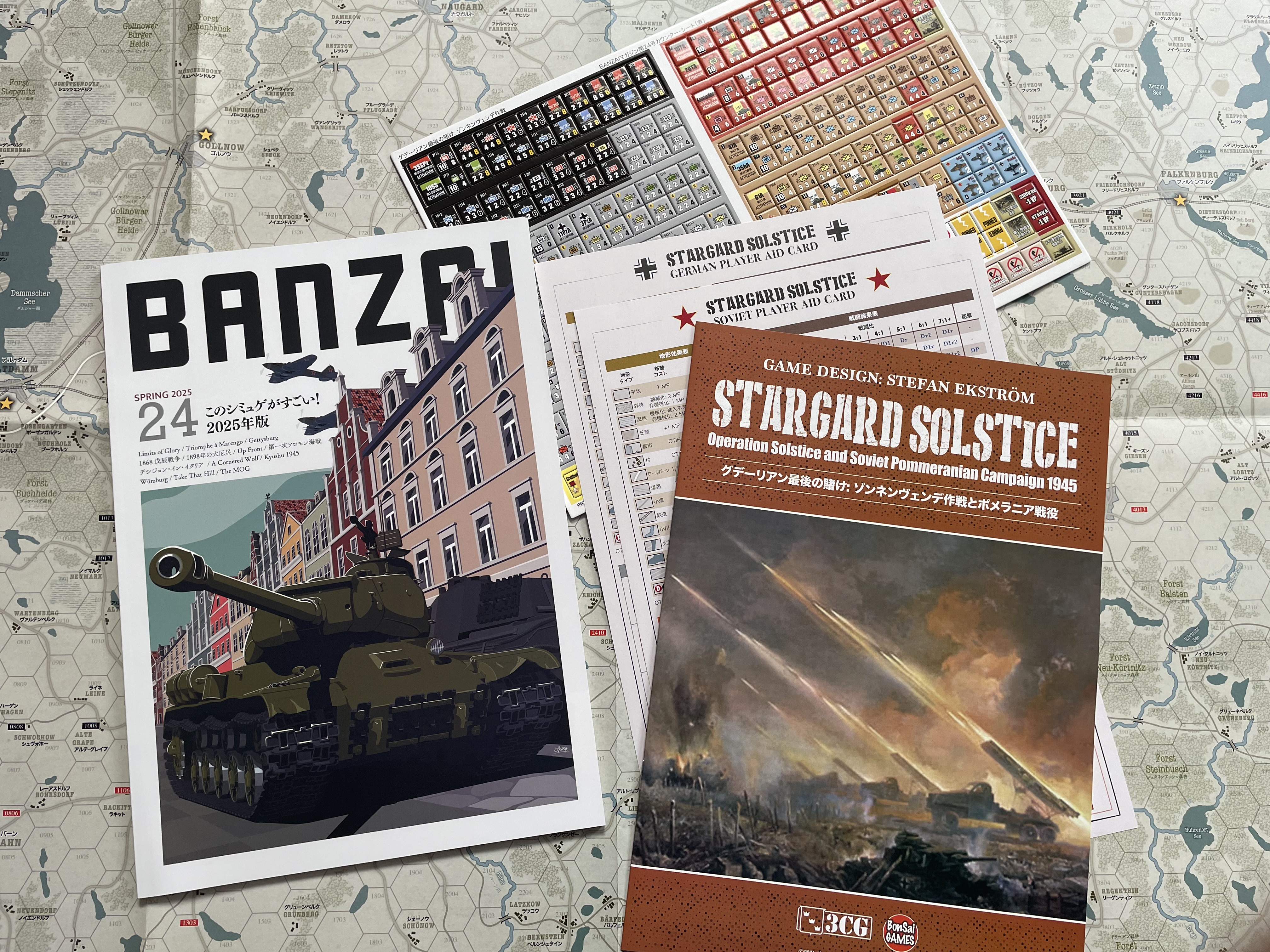
The feature wargame in Banzai Magazine Nr.24 (Spring 2025) is Stargard Solstice: Operations Solstice and Soviet Pommeranian Campaign 1945 (Japanese title Guderian’s Last Gamble: Operation Sonnenwende and the Pomeranian Campaign). The game, designed by Stefan Ekström, was originally published by Three Crown Games in 2021. Bonsai Games in Japan brought the game back for their Spring 2025 edition of Banzai Magazine. Stargard Solstice is a wargame that not only covers a lesser-gamed subject but does so using interesting game mechanisms that incidentally also make the game very solo-play friendly.
Grok’ing Japanese
The entire wargame of Stargard Solstice is printed in Japanese so some prep work is required before play given I do not speak or read Japanese. Bonsai puts a pdf version of the rules online (as well as a Q&A file and a VASSAL module) so I am able to use AI tools to translate. I have found that Grok AI seems to do the best “first pass” translation amongst various free AI tools; indeed, I find I am often able to play directly from that first-pass translation.

Star wha?
As the introduction to the rules for Stargard Solstice tell us:
The game begins with Operation Solstice (Sonnenwende), one of the last German offensives of 1945. Initially, Heinz Guderian planned an operation to crush the Soviet salient and rescue encircled German units, but Hitler, dreaming of recapturing Budapest, forced a reduction in the operation’s scale. As a result, the objectives shifted to relieving the Arnswalde fortress and cutting the Soviet supply lines toward Küstrin. Meanwhile, the Soviet army aimed to expel the Germans from Pomerania to secure their right flank, prepare to capture Küstrin, and launch their final advance toward Berlin.
Guderian’s Last Gamble (original title: Stargard Solstice) recreates this battle in Pomerania from February 15 to March 6, 1945.
In my attempt to research a bit more on Operation Solstice I went to The World Almanac Book of World War II: The Complete and Comprehensive Documentary of World War II. Granted, this book was published in 1981 and scholarship on World War II has come far since then (especially in the aftermath of the fall of the Berlin Wall) but Operation Solstice was not mentioned; in fact, the Pommeranian Campaign was barely mentioned and when it did appear it was almost always as a passing-like reference.
If one is to believe some sources, wargaming Operation Solstice is not very worthy. Here is how Stephen G. Fritz wrote of Operation Solstice in their 2011 book Ostkrieg:
Two days after Konev’s attack, units of Rokossovsky’s Second Belorussian Front struck northeastward into Pomerania to eliminate the Baltic balcony overhanging Soviet forces in Poland. Five days later, the Germans gave proof of the overstated fears for their flanks, launching one of the sorriest attacks [my emphasis] in their military history. Conceived by Guderian as a typical two-pronged thrust into the flanks of an advancing enemy, Operation Sonnenwende (Solstice) was a fiasco from the beginning. … Although Guderian managed the amazing feat at this stage of the war of cobbling together ten divisions for the counterattack, seven of them panzer, the troops involved were poorly equipped, inexperienced, and woefully led.
Fritz, p. 448
In the Design Notes to Stargard Solstice, designer Stefan Ekström tells us a bit about their research and a few related design decisions:
Design Motivation
The concept for this work began when I read a book about the 11th SS Volunteer Panzergrenadier Division “Nordland” from 1944 to 1945. There, I coincidentally learned about “Operation Sonnenwende (Solstice)” and decided to create a small game based on it. However, as usual, the scope quickly expanded, and I ended up including the Soviet East Pomeranian Offensive as well. I must admit I even considered incorporating the Battle of Seelow Heights—luckily, I abandoned that idea just in time.
First, let me reiterate what I wrote for Across the Narwa (Translator’s note: published in Japanese by Command Magazine in 2013): “To avoid major debates later, there are a few things I think should be mentioned upfront. The setup is not 100% historically accurate.”
I tried to recreate the starting positions as accurately as possible. The Soviet Order of Battle (OOB) was relatively easy to identify, and I found the German OOB in copies of war diaries. However, with numerous task forces/combat groups, security units, blocking detachments, and Volkssturm units, evaluating unit combat strength for this game was extremely challenging. The Soviets had a 3:1 advantage in personnel and a 5:1 advantage in tanks, but the German units’ combat strength reflects their high morale. Since most German units arrived on the battlefield between February 14 and 15, their deployment is restricted in this game.
18.0 Design Note
For myself, I am fine that Stargard Solstice is not “100% historically accurate.” Ekström maybe even took some “liberties” in their interpretation of the German readiness (see Fritz’s “poorly equipped, inexperienced, and poorly led” versus Ekström’s “high morale”). I personally know less about late-war battles on the Eastern Front being, like many wargamers almost certainly are, more familiar with the beginning of the war (Operation Barbarossa) and mid-war (Stalingrad, etc.). Thus, wargames like Stargard Solstice are good “tastes” of the situation to learn a bit from even if not strictly “accurate”.
Chit-show
Stargard Solstice is one of designer Stefan Ekström’s chit-activated wargames. Every turn, each side has a limited number of formation that are activated when their formation chit is pulled from the cup. For instance, in Stargard Solstice on turn one the Germans get five (5) activations to the Soviet’s one (1). By turn 10—the last possible turn—the Germans get four (4) activations against the Soviet’s eight (8). The chit pull mechanism not only recreates the command and control capabilities—and challenges—facing both sides but it also makes the game very solo-play friendly.
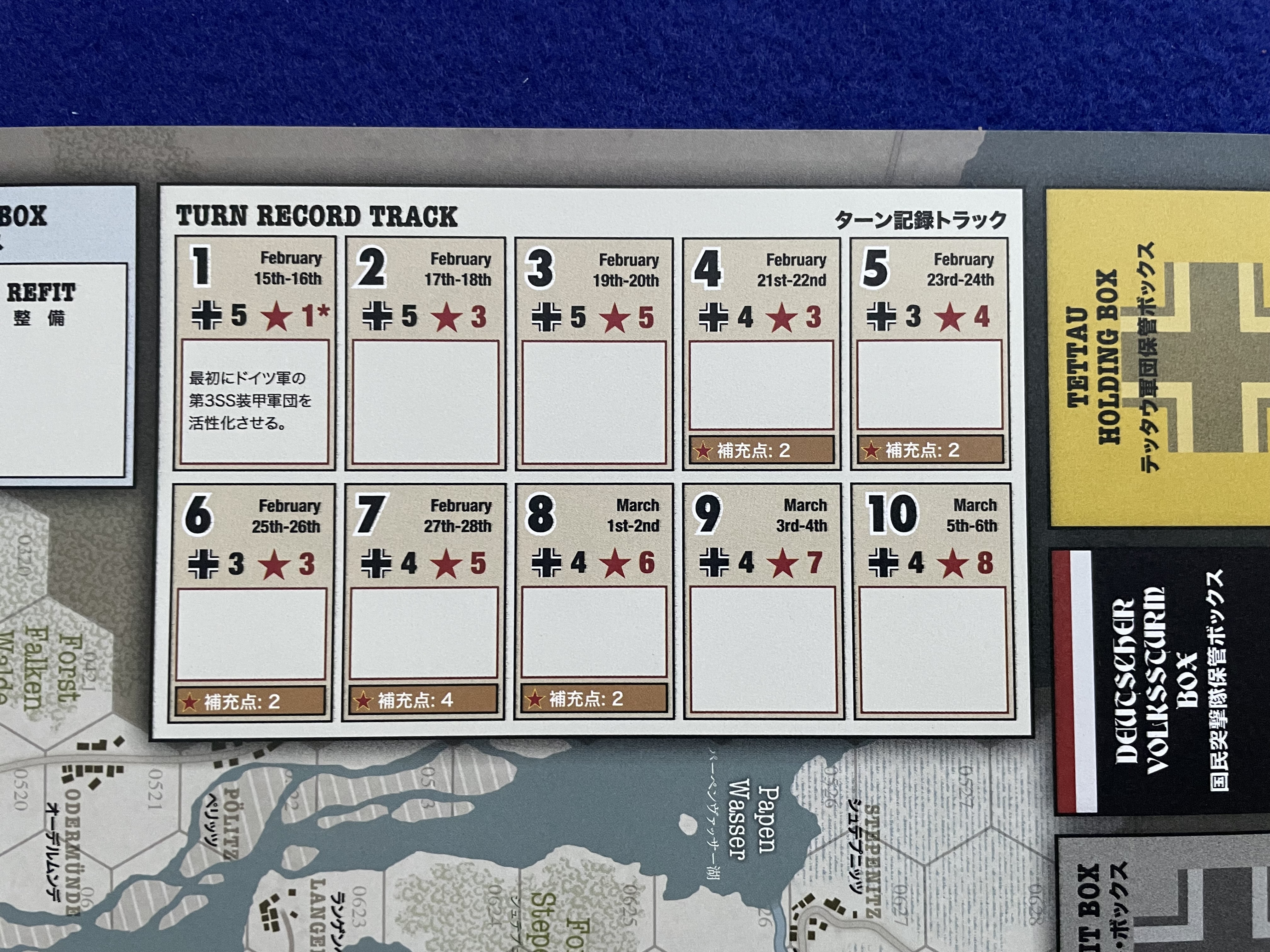
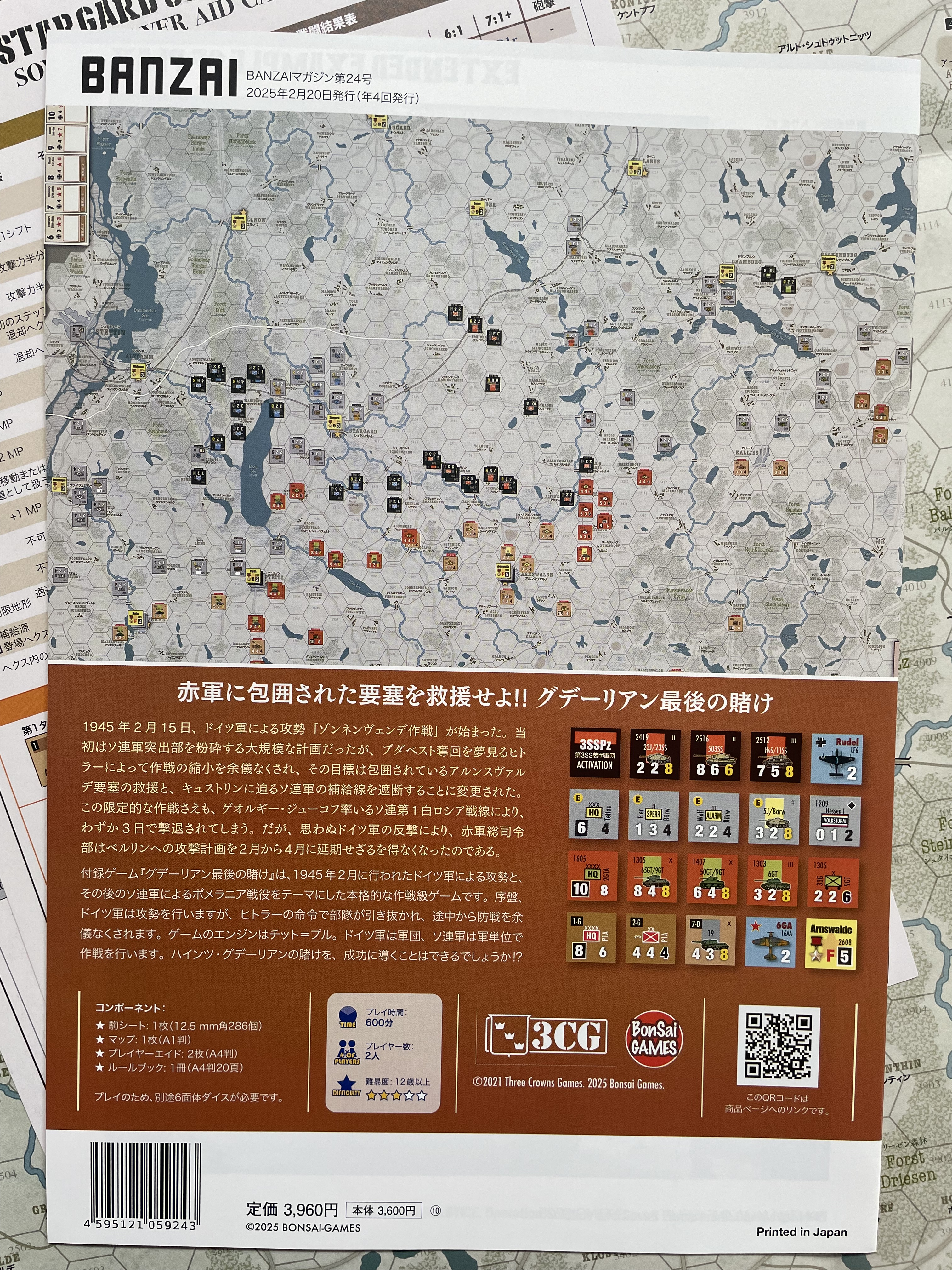
The rules for Stargard Solstice take up 12 pages in Japanese. Another five pages are used for an extended (and well illustrated) Example of Play. The game itself is played on a ~33″ x ~23.5″ map (roughly 48 x 30 hexes) with a total of 286 counters for units and markers. Two play aids are included with Set Up and the other useful tables for play.
Looking beyond the chit-activation game mechanism the rules for Stargard Solstice are actually very simple. Each turn represents about two days, each hex is 3-4 km, and units are Battalions to Divisions. The Sequence of Play is nothing complicated: Air Unit Phase, Random Event Phase, Command Phase (chit activations), Supply Phase, Reinforcement Phase, and Turn End Phase. Movement is in accordance with a Terrain Effects Chart (TEC) and combat uses an odds-based Combat Results Table (CRT). Both Three Crown Games and Bonsai Games say the game is Medium complexity. Three Crown Games says time to play is 480 minutes (4 hours) whereas Bonsai says 600 minutes (10 hours). Personally, given I was somewhat familiar with the chit-pull mechanism and playing solo, my play time was towards the lower end of the spread.
Thanks Yas!
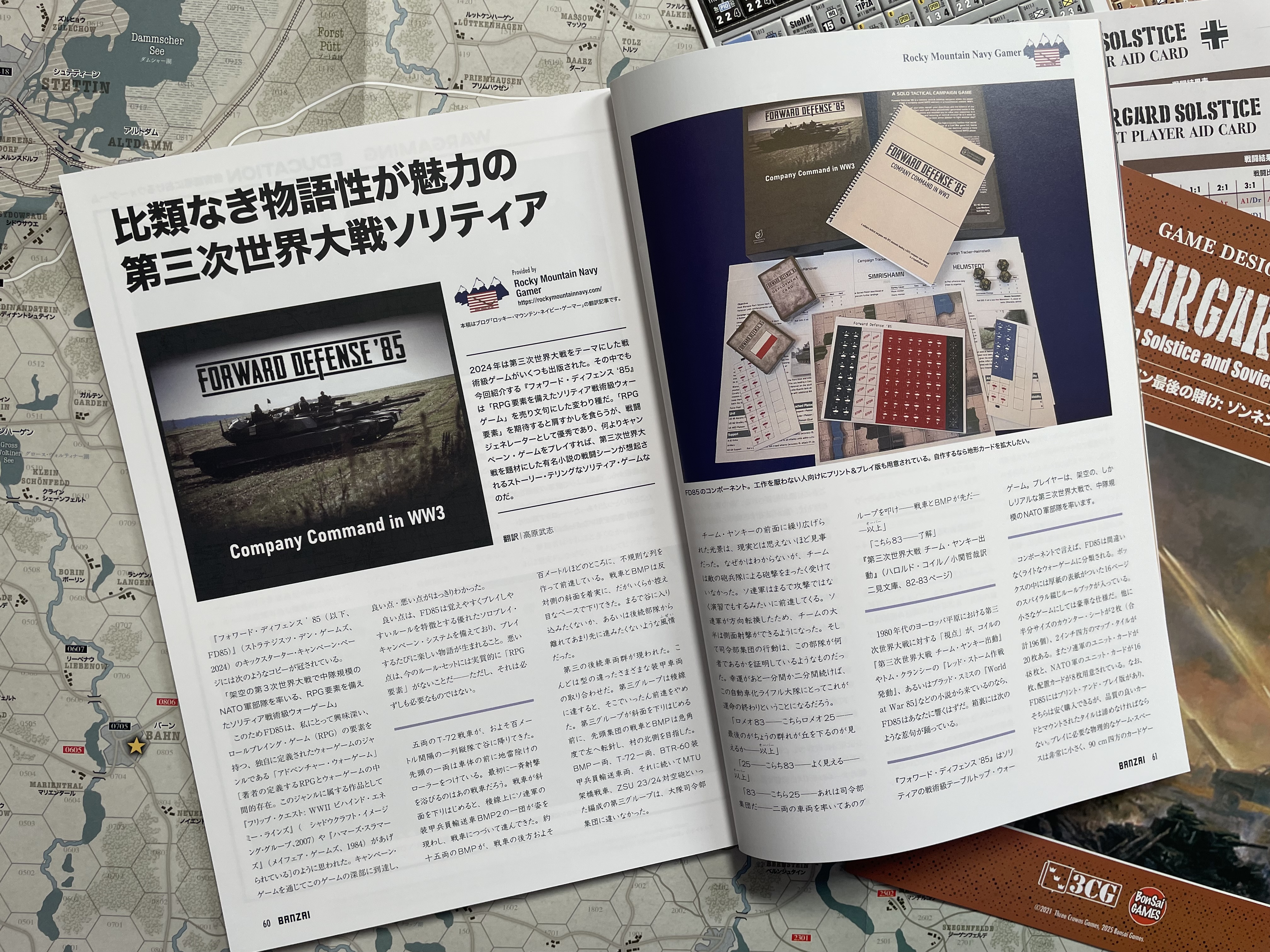
One final point: I must say thanks to Banzai Magazine publisher Yasushi Nakaguro who was kind enough to gift me a copy of the magazine because I was happy to contribute an article on Forward Defense ’85 (Ethan Redrup, Strategist’s Den Games, 2024) to the issue. Truth be told I am the real winner in the exchange as Yas gets one of my articles but I get a whole wargame. Thank you, Yas, for your kindness.
Bibliography
- Fritz, Stephan G. (2011) Ostkrieg: Hitler’s War of Extermination in the East. Lexington: University Press of Kentucky.
- Young, Brigadier Peter, ed. (1981) The World Almanac Book of World War II: The Complete and Comprehensive Documentary of World War II. New York: World Almanac Publications.
Feature image courtesy http://sonnenwende-1945.blogspot.com/p/23-ochotnicza-dywizja-grenadierow.html
The opinions and views expressed in this blog are those of the author alone and are presented in a personal capacity. They do not necessarily represent the views of U.S. Navy or any other U.S. government Department, Agency, Office, or employer.
RockyMountainNavy.com © 2007-2025 by Ian B is licensed under CC BY-SA 4.0
 Rocky Mountain Navy Gamer